The Menstrual Cycle www.freelivedoctor.com
www.freelivedoctor.com
The Menstrual Cycle: Two Phases Ideally 14 days each Follicular and Luteal Describe changes in the ovary  Proliferative and Secretory Describe changes in the endometrium www.freelivedoctor.com
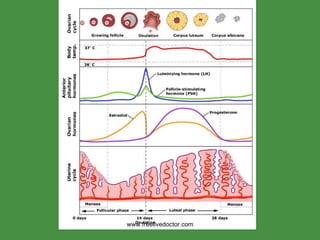
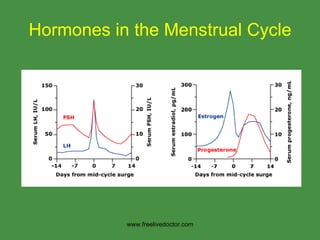
Hormones in the Menstrual Cycle www.freelivedoctor.com
Follicular phase Begins with the onset of menses and ends on the day of the luteinizing hormone (LH) surge During late luteal phase/ early follicular phase:  withdrawal of estrogen and progesterone in late luteal phase In early follicular phase,  ovary is least hormonally active    low serum estradiol and progesterone release from negative feedback effects of estrogen + progesterone    increase in GnRH pulse frequency in early follicular phase  Increased GnRH pulse    30% increase in serum FSH concentrations FSH release from the pituitary stimulates growth of 5-15 primordial follicles By late follicular phase, a single dominant follicle has been selected.  www.freelivedoctor.com
Follicular Phase The developing dominant follicle produces estrogen in a 2-cell process Theca interna cells produce androstenedione in response to LH stimulation Granulosa cells convert androstenedione    estradiol when stimulated by FSH Estrogen causes the uterine lining to thicken / proliferate GnRH pulse frequency increase   rise in LH Rise in LH also stimulates androgen synthesis    androgens are converted to estrogens www.freelivedoctor.com
Follicular Phase Serum estradiol concentrations peak approximately 1 day before ovulation Midcycle (~day 14) there is an LH spike in response to this estrogen surge Ovulation occurs as increase in LH level causes the follicle to rupture and release mature ovum www.freelivedoctor.com
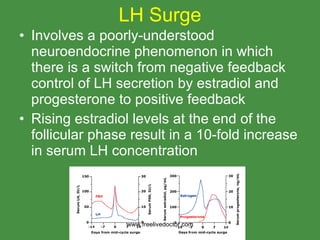
LH Surge Involves a poorly-understood neuroendocrine phenomenon in which there is a switch from negative feedback control of LH secretion by estradiol and progesterone to positive feedback Rising estradiol levels at the end of the follicular phase result in a 10-fold increase in serum LH concentration www.freelivedoctor.com
LH Surge: Effect on the Ovary In response to LH: Oocyte in the dominant follicle completes 1 st  meiotic division Increase in local secretion of plasminogen activator and cytokines required for ovulation Oocyte released from follicle at ovarian surface ~ 36 hrs after LH surge. Even before oocyte is released, granulosa cells around it begin to “luteinize” and produce progesterone. Progesterone slows LH pulses/ decreases LH pulse frequency  www.freelivedoctor.com
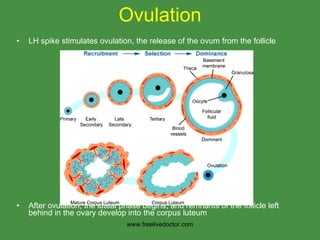
Ovulation LH spike stimulates ovulation, the release of the ovum from the follicle After ovulation, the luteal phase begins, and remnants of the follicle left behind in the ovary develop into the corpus luteum www.freelivedoctor.com
Ovulation Ovum usually passes into adjoining fallopian tube and is swept down to the uterus by the cilia lining the tube Takes 3-4 days for ovum to travel down tube to the uterus Fertilization must occur within 24 hrs of ovulation or ovum degenerates www.freelivedoctor.com
Luteal Phase After ovulation, granulosa and theca interna cells lining the wall of the follicle form the corpus luteum cyst (stimulated by LH) The corpus luteum synthesizes estrogen and large amounts of progesterone    Progesterone stimulates the endometrium to become more glandular/secretory in preparation for implantation of fertilized ovum www.freelivedoctor.com
Luteal Phase If fertilization occurs: developing trophoblast synthesizes human chorionic gonadotropin (hcg)  hcg maintains the corpus luteum so it may continue producing estrogen and progesterone to support the endometrium By ~ 8-10 weeks gestation, the placenta is developed, and takes over production of estrogen and progesterone www.freelivedoctor.com
Luteal Phase If fertilization does not occur: corpus luteum is not  maintained by hcg Corpus luteum degenerates after ~ 14 days Estrogen and progesterone levels fall Withdrawal of progesterone causes secretory endometrium to slough FSH levels slowly rise again in absence of negative feedback ↓     MENSTRUATION www.freelivedoctor.com

Menstrual cycle

  • 1.
    The Menstrual Cyclewww.freelivedoctor.com
  • 2.
  • 3.
    The Menstrual Cycle:Two Phases Ideally 14 days each Follicular and Luteal Describe changes in the ovary Proliferative and Secretory Describe changes in the endometrium www.freelivedoctor.com
  • 4.
    Hormones in theMenstrual Cycle www.freelivedoctor.com
  • 5.
    Follicular phase Beginswith the onset of menses and ends on the day of the luteinizing hormone (LH) surge During late luteal phase/ early follicular phase: withdrawal of estrogen and progesterone in late luteal phase In early follicular phase, ovary is least hormonally active  low serum estradiol and progesterone release from negative feedback effects of estrogen + progesterone  increase in GnRH pulse frequency in early follicular phase Increased GnRH pulse  30% increase in serum FSH concentrations FSH release from the pituitary stimulates growth of 5-15 primordial follicles By late follicular phase, a single dominant follicle has been selected. www.freelivedoctor.com
  • 6.
    Follicular Phase Thedeveloping dominant follicle produces estrogen in a 2-cell process Theca interna cells produce androstenedione in response to LH stimulation Granulosa cells convert androstenedione  estradiol when stimulated by FSH Estrogen causes the uterine lining to thicken / proliferate GnRH pulse frequency increase  rise in LH Rise in LH also stimulates androgen synthesis  androgens are converted to estrogens www.freelivedoctor.com
  • 7.
    Follicular Phase Serumestradiol concentrations peak approximately 1 day before ovulation Midcycle (~day 14) there is an LH spike in response to this estrogen surge Ovulation occurs as increase in LH level causes the follicle to rupture and release mature ovum www.freelivedoctor.com
  • 8.
    LH Surge Involvesa poorly-understood neuroendocrine phenomenon in which there is a switch from negative feedback control of LH secretion by estradiol and progesterone to positive feedback Rising estradiol levels at the end of the follicular phase result in a 10-fold increase in serum LH concentration www.freelivedoctor.com
  • 9.
    LH Surge: Effecton the Ovary In response to LH: Oocyte in the dominant follicle completes 1 st meiotic division Increase in local secretion of plasminogen activator and cytokines required for ovulation Oocyte released from follicle at ovarian surface ~ 36 hrs after LH surge. Even before oocyte is released, granulosa cells around it begin to “luteinize” and produce progesterone. Progesterone slows LH pulses/ decreases LH pulse frequency www.freelivedoctor.com
  • 10.
    Ovulation LH spikestimulates ovulation, the release of the ovum from the follicle After ovulation, the luteal phase begins, and remnants of the follicle left behind in the ovary develop into the corpus luteum www.freelivedoctor.com
  • 11.
    Ovulation Ovum usuallypasses into adjoining fallopian tube and is swept down to the uterus by the cilia lining the tube Takes 3-4 days for ovum to travel down tube to the uterus Fertilization must occur within 24 hrs of ovulation or ovum degenerates www.freelivedoctor.com
  • 12.
    Luteal Phase Afterovulation, granulosa and theca interna cells lining the wall of the follicle form the corpus luteum cyst (stimulated by LH) The corpus luteum synthesizes estrogen and large amounts of progesterone  Progesterone stimulates the endometrium to become more glandular/secretory in preparation for implantation of fertilized ovum www.freelivedoctor.com
  • 13.
    Luteal Phase Iffertilization occurs: developing trophoblast synthesizes human chorionic gonadotropin (hcg) hcg maintains the corpus luteum so it may continue producing estrogen and progesterone to support the endometrium By ~ 8-10 weeks gestation, the placenta is developed, and takes over production of estrogen and progesterone www.freelivedoctor.com
  • 14.
    Luteal Phase Iffertilization does not occur: corpus luteum is not maintained by hcg Corpus luteum degenerates after ~ 14 days Estrogen and progesterone levels fall Withdrawal of progesterone causes secretory endometrium to slough FSH levels slowly rise again in absence of negative feedback ↓ MENSTRUATION www.freelivedoctor.com