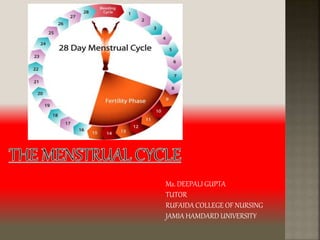
Ms. DEEPALI GUPTA
TUTOR
RUFAIDA COLLEGE OF NURSING
JAMIA HAMDARD UNIVERSITY
Under the control of the endocrine
system
Rhythmical series of physiological
changes that occur in fertile women
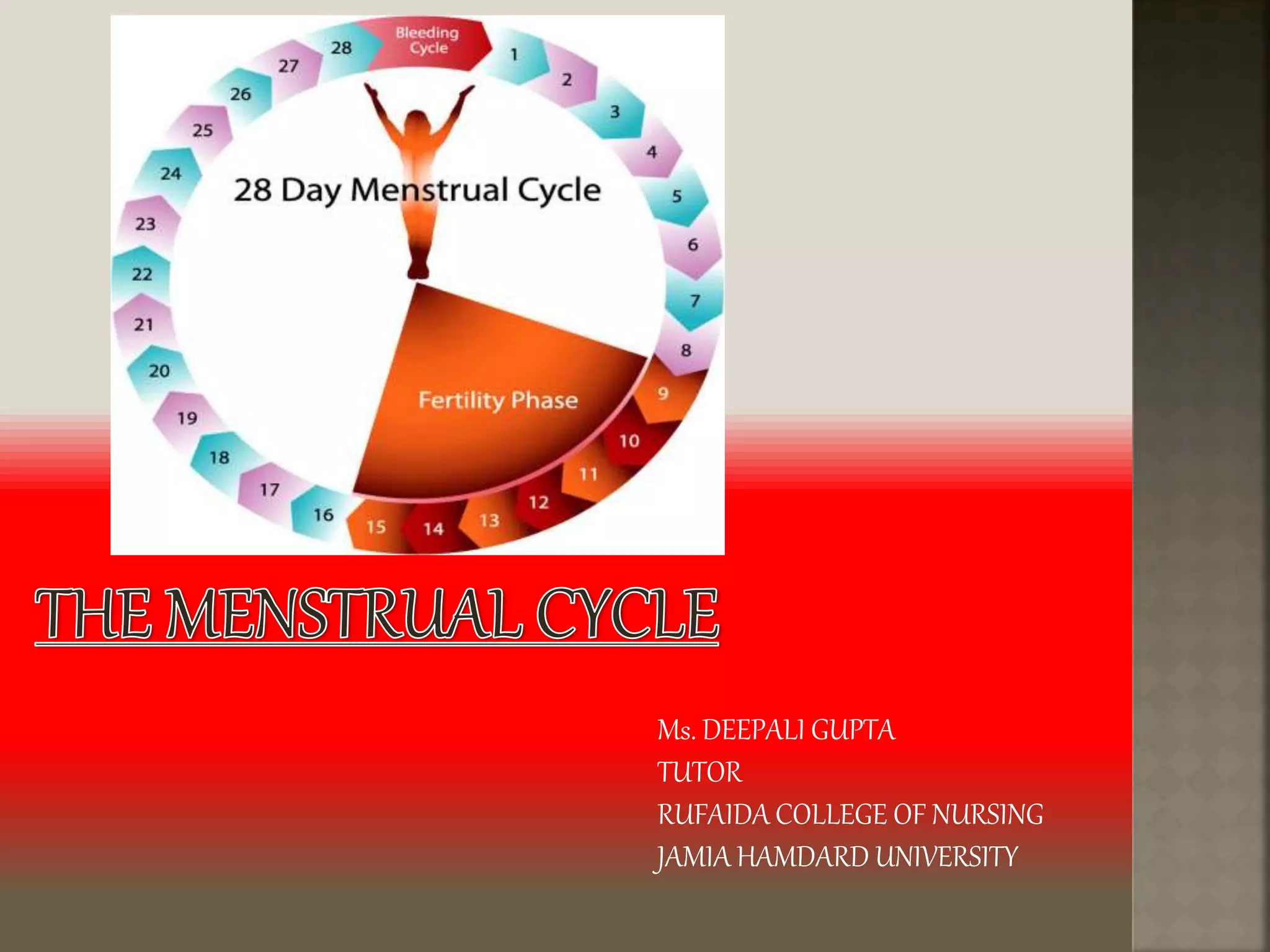
Average length: 28 days, but typically
varies, with shorter and longer cycles
MENSTRUAL CYCLE
This is a series of events, occurring regularly in
females every 26 to 30 days throughout the
childbearing period of about 36 years.
Menarche: woman's first menstruation typically
occurs around age 12 – occurrence depends on
overall health and diet
DEFINITION
REPRODUCTIVE CYCLE
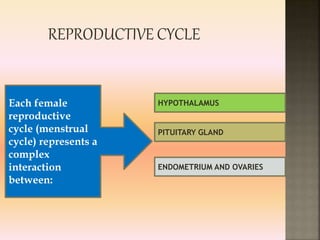
Each female
reproductive
cycle (menstrual
cycle) represents a
complex
interaction
between:
HYPOTHALAMUS
PITUITARY GLAND
ENDOMETRIUM AND OVARIES
REPRODUCTIVE
CYCLE
The hypothalamus secretes luteinising hormone releasing
hormone (LHRH) which stimulates the anterior pituitary to
secrete follicle stimulating hormone (FSH), which
promotes the maturation of ovarian follicles and the
secretion of oestrogen, leading to ovulation
luteinising hormone (LH), which triggers ovulation,
stimulates the development of the corpus luteum and the
secretion of progesterone.
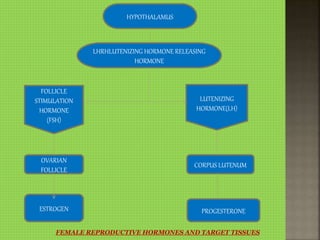
HYPOTHALAMUS
LHRHLUTENIZING HORMONE RELEASING
HORMONE
FOLLICLE
STIMULATION
HORMONE
(FSH)
LUTENIZING
HORMONE(LH)
OVARIAN
FOLLICLE
ESTROGEN
CORPUS LUTENUM
PROGESTERONE
FEMALE REPRODUCTIVE HORMONES AND TARGET TISSUES
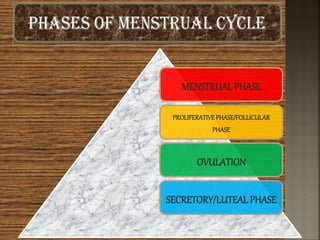
MENSTRUAL PHASE
PROLIFERATIVEPHASE/FOLLICULAR
PHASE
OVULATION
SECRETORY/LUTEAL PHASE
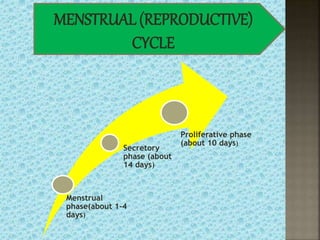
MENSTRUAL (REPRODUCTIVE)
CYCLE
Menstrual
phase(about 1-4
days)
Secretory
phase (about
14 days)
Proliferative phase
(about 10 days)
Menstrual phase
When the ovum is
not fertilised, the
corpus luteum starts
to degenerate.(In the
event of pregnancy,
the corpus luteum is
supported by human
chorionic
gonadotrophin (hCG)
secreted by the
developing embryo.)
Progesterone and
oestrogen levels
therefore fall, and
the functional layer
of the endometrium,
which is dependent
on high levels of
these ovarian
hormones, is shed in
menstruation.
The menstrual flow
consists of the
secretions from
endometrial glands,
endometrial cells,
blood from the
broken down
capillaries and the
unfertilised ovum.
MENSTRUAL PHASE
High circulating levels of ovarian progesterone and
oestrogen inhibit the anterior pituitary, blocking the
release of FSH and LH, and should pregnancy occur then
rising oestrogen and progesterone levels therefore prevent
the maturation and release of another ovum.
After degeneration of the corpus luteum, however, falling
levels of oestrogen and progesterone lead to resumed
anterior pituitary activity, rising FSH levels and the
initiation of the next cycle.
PROLIFERATIVE PHASE
At this stage an ovarian follicle, stimulated by FSH, is growing
towards maturity and is producing oestrogen. Oestrogen
stimulates the proliferation of the functional layer of the
endometrium in preparation for the reception of a fertilised
ovum.
The endometrium becomes thicker by rapid cell
multiplication accompanied by an increase in the numbers of
mucus-secreting glands and blood capillaries. This phase ends
when ovulation occurs and oestrogen production declines
.
SECRETORY PHASE
Immediately
after ovulation,
the lining cells of
the ovarian
follicle are
stimulated by LH
to develop the
corpus luteum,
which produces
progesterone and
some oestrogen
Under the
influence of
progesterone the
endometrium
becomes
oedematous and
the secretory
glands produce
increased
amounts of
watery mucus.
There is a similar
increase in the
secretion of
watery mucus by
the glands of the
uterine tubes and
by cervical glands
which lubricate
the vagina.
The ovum may survive in a fertilisable form for a very short time after
ovulation, probably as little as 8 hours. The spermatozoa, deposited in
the vagina during coitus, may be capable of fertilising the ovum for only
about 24 hours although they may survive for several days. This means
that the period in each cycle during which fertilisation can occur is
relatively short.
The time of ovulation can be determined by observing certain changes in
the woman's body around this period. Changes in cervical mucus, from
thick and dry in consistency to thin, elastic and watery, are detected and,
in addition, body temperature rises by a small but measurable amount
immediately following ovulation. Some women experience some degree of
abdominal discomfort in the middle of the cycle, thought to correspond to
rupture of the follicle and release of its contents into the abdominal
cavity.
SECRETORY PHASE
If the ovum is not fertilised menstruation occurs and a new cycle begins. If the
ovum is fertilised there is no breakdown of the endometrium and no menstrual
flow. The fertilised ovum (zygote) travels through the uterine tube to the uterus
where it becomes embedded in the wall and produces human chorionic
gonadotrophin (hCG), which is similar to anterior pituitary luteinising hormone.
This hormone keeps the corpus luteum intact, enabling it to continue secreting
progesterone and oestrogen for the first 3 to 4 months of the pregnancy,
inhibiting the maturation of further ovarian follicles During that time the
placenta develops and produces oestrogen, progesterone and gonadotrophins.
The menopause usually occurs between the ages of 45 and 55
years, marking the end of the childbearing period. It may
occur suddenly or over a period of years, sometimes as long
as 10 years, and is caused by changes in sex hormone levels.
The ovaries gradually become less responsive to FSH and LH,
and ovulation and the menstrual cycle become irregular,
eventually ceasing.
Menopause (climacteric)
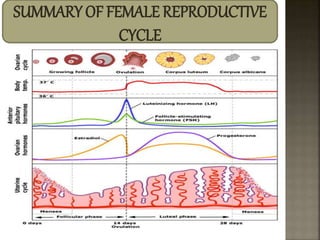
SUMMARY OF FEMALE REPRODUCTIVE
CYCLE

The menstrual cycle

  • 1.
    Ms. DEEPALI GUPTA TUTOR RUFAIDACOLLEGE OF NURSING JAMIA HAMDARD UNIVERSITY
  • 2.
    Under the controlof the endocrine system Rhythmical series of physiological changes that occur in fertile women Average length: 28 days, but typically varies, with shorter and longer cycles MENSTRUAL CYCLE
  • 3.
    This is aseries of events, occurring regularly in females every 26 to 30 days throughout the childbearing period of about 36 years. Menarche: woman's first menstruation typically occurs around age 12 – occurrence depends on overall health and diet DEFINITION
  • 4.
    REPRODUCTIVE CYCLE Each female reproductive cycle(menstrual cycle) represents a complex interaction between: HYPOTHALAMUS PITUITARY GLAND ENDOMETRIUM AND OVARIES
  • 5.
    REPRODUCTIVE CYCLE The hypothalamus secretesluteinising hormone releasing hormone (LHRH) which stimulates the anterior pituitary to secrete follicle stimulating hormone (FSH), which promotes the maturation of ovarian follicles and the secretion of oestrogen, leading to ovulation luteinising hormone (LH), which triggers ovulation, stimulates the development of the corpus luteum and the secretion of progesterone.
  • 6.
  • 7.
  • 8.
    MENSTRUAL (REPRODUCTIVE) CYCLE Menstrual phase(about 1-4 days) Secretory phase(about 14 days) Proliferative phase (about 10 days)
  • 9.
    Menstrual phase When theovum is not fertilised, the corpus luteum starts to degenerate.(In the event of pregnancy, the corpus luteum is supported by human chorionic gonadotrophin (hCG) secreted by the developing embryo.) Progesterone and oestrogen levels therefore fall, and the functional layer of the endometrium, which is dependent on high levels of these ovarian hormones, is shed in menstruation. The menstrual flow consists of the secretions from endometrial glands, endometrial cells, blood from the broken down capillaries and the unfertilised ovum.
  • 10.
    MENSTRUAL PHASE High circulatinglevels of ovarian progesterone and oestrogen inhibit the anterior pituitary, blocking the release of FSH and LH, and should pregnancy occur then rising oestrogen and progesterone levels therefore prevent the maturation and release of another ovum. After degeneration of the corpus luteum, however, falling levels of oestrogen and progesterone lead to resumed anterior pituitary activity, rising FSH levels and the initiation of the next cycle.
  • 11.
    PROLIFERATIVE PHASE At thisstage an ovarian follicle, stimulated by FSH, is growing towards maturity and is producing oestrogen. Oestrogen stimulates the proliferation of the functional layer of the endometrium in preparation for the reception of a fertilised ovum. The endometrium becomes thicker by rapid cell multiplication accompanied by an increase in the numbers of mucus-secreting glands and blood capillaries. This phase ends when ovulation occurs and oestrogen production declines
  • 12.
    . SECRETORY PHASE Immediately after ovulation, thelining cells of the ovarian follicle are stimulated by LH to develop the corpus luteum, which produces progesterone and some oestrogen Under the influence of progesterone the endometrium becomes oedematous and the secretory glands produce increased amounts of watery mucus. There is a similar increase in the secretion of watery mucus by the glands of the uterine tubes and by cervical glands which lubricate the vagina.
  • 13.
    The ovum maysurvive in a fertilisable form for a very short time after ovulation, probably as little as 8 hours. The spermatozoa, deposited in the vagina during coitus, may be capable of fertilising the ovum for only about 24 hours although they may survive for several days. This means that the period in each cycle during which fertilisation can occur is relatively short. The time of ovulation can be determined by observing certain changes in the woman's body around this period. Changes in cervical mucus, from thick and dry in consistency to thin, elastic and watery, are detected and, in addition, body temperature rises by a small but measurable amount immediately following ovulation. Some women experience some degree of abdominal discomfort in the middle of the cycle, thought to correspond to rupture of the follicle and release of its contents into the abdominal cavity. SECRETORY PHASE
  • 14.
    If the ovumis not fertilised menstruation occurs and a new cycle begins. If the ovum is fertilised there is no breakdown of the endometrium and no menstrual flow. The fertilised ovum (zygote) travels through the uterine tube to the uterus where it becomes embedded in the wall and produces human chorionic gonadotrophin (hCG), which is similar to anterior pituitary luteinising hormone. This hormone keeps the corpus luteum intact, enabling it to continue secreting progesterone and oestrogen for the first 3 to 4 months of the pregnancy, inhibiting the maturation of further ovarian follicles During that time the placenta develops and produces oestrogen, progesterone and gonadotrophins.
  • 15.
    The menopause usuallyoccurs between the ages of 45 and 55 years, marking the end of the childbearing period. It may occur suddenly or over a period of years, sometimes as long as 10 years, and is caused by changes in sex hormone levels. The ovaries gradually become less responsive to FSH and LH, and ovulation and the menstrual cycle become irregular, eventually ceasing. Menopause (climacteric)
  • 16.
    SUMMARY OF FEMALEREPRODUCTIVE CYCLE