MENSTRUAL CYCLE
Presented by:-
KHUSHBOO SINGH
INTRODUCTION
DEFINITION
• Menstruation is the periodic discharge of blood
and sloughed endometrium (collectively called
menses or menstrual flow) through the vagina.
• The menstrual cycle is the regular natural change
that occur in the female reproductive system
(specially the ovaries and uterus) that makes
pregnancy possible. This cycle is controlled by
hormones, The menstrual cycle occurs because of a
complex relationship between hormones from the
brain and ovaries. This leads to the development
and release of an egg from the ovary (ovulation) and
growth of the internal lining (endometrium) of the
uterus, to prepare it for pregnancy
GENERAL POINTS
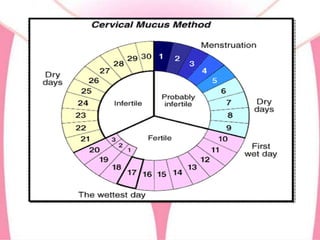
• The average Menstrual Cycle length is 28 days
(usual range, about 25 to 36 days).
• Average duration of menses is 5 (± 2) days.
• Blood loss per cycle averages 30 mL (normal
range, 13 to 80 mL) and is usually greatest on
the 2nd day.
PHASES OF MENSTRUAL
CYCLE
•
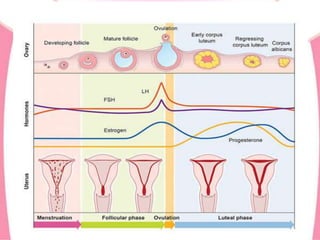
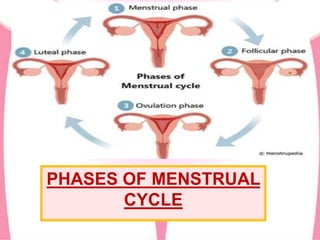
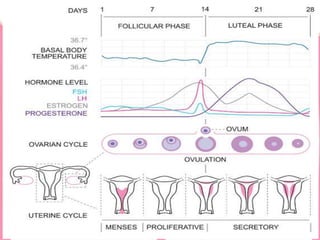
• There are four phases of menstrual cycle
1. Menstrual phase- First 5 days of the month
2. Post-menstrual /pre ovulation/proliferative
/Follicular phase-6th -13th day
3. Ovulation phase-On 14th day
4. Luteal phase15-28 days
MENSTRUAL PHASE
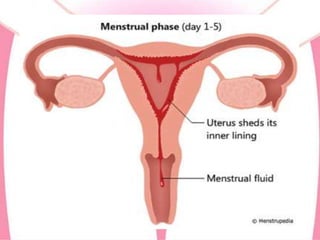
• When: From the time bleeding starts to the
time it ends.
• What: Old blood and tissue from inside the
uterus is shed through the vagina.
Menstrual phase
• It lasts for about 3 – 5 days.
• If the ovum is not fertilized, corpus luteum regresses
from 24th day of the cycle.
• This causes a decrease in estrogen and progesterone
levels.
• It results in shrinkage of endometrium, coiling and
spasm of arteries leading to focal necrosis of the
endometrium.
• The necrosed endometrium is shed along with blood
and other secretions ie.Tissue, blood, unfertilized egg
all discharged
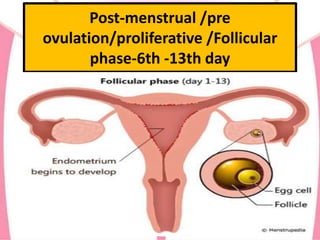
Post-menstrual /pre
ovulation/proliferative /Follicular
phase-6th -13th day
Post-menstrual /pre
ovulation/proliferative /Follicular
phase-6th -13th day
• Proliferative phase starts at the end of menstrual phase.
Its duration is about 10 days.
• At the beginning of this phase most of the endometrium
has been desquamated.
• Later endometrium starts healing and then proliferates
rapidly from 5th –14th day of menstrual cycle.
• This proliferation occurs under the influence of estrogen.
There is growth of simple tubular glands and blood
vessels. Endometrium increases in thickness to about 3 –
5mm. The endometrial glands produce a thick mucus.At
the end of proliferative phase ovulation occurs.
• Along with that in this phase
• Anterior pituitary secrete FSH (follicles
stimulating hormone) which help in growth
development and maturity of follicles
• The follicles that reaches maturity called
graffian follicles
• Follicles secreate estrogen which thickens the
new endometrium
• At the end of this phase ovulation occurs
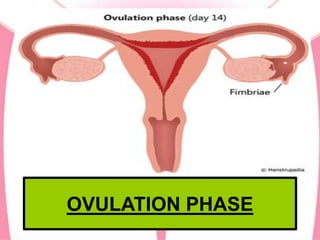
OVULATION PHASE
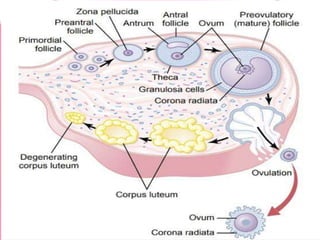
Ovulation Phase
• During the follicular phase, estrogen suppresses
production of luteinizing hormone (LH) from the
pituitary gland • When the ovum has nearly
matured, levels of estrogen reach a threshold above
which they stimulate production of LH (positive
feedback loop) •
• The release of LH matures the ovum and weakens
the wall of the follicle in the ovary, causing the fully
developed follicle to release its secondary oocyte •
• After being released from the ovary, the ovum is
swept into the fallopian tube
• Ovulation is when ovary releases a mature egg.
• The egg travels down the fallopian tube toward the
uterus to be fertilized by sperm.
• The ovulation phase is the only time during
menstrual cycle when a women can get pregnant.
• The symptoms are:
• A slight rise in basal body temperature
• Thicker discharge that has the texture of egg
whites
• Ovulation happens at around day 8-19 in a 28-30
days cycle , right in the middle of menstrual cycle.
• It lasts about 24 hours. After a day, the egg will die
or dissolve if it isn’t fertilized
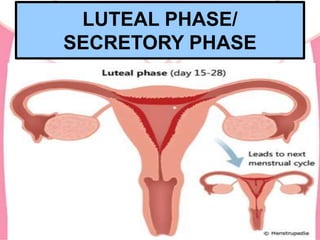
LUTEAL PHASE/
SECRETORY PHASE
LUTEAL PHASE/
SECRETORY PHASE
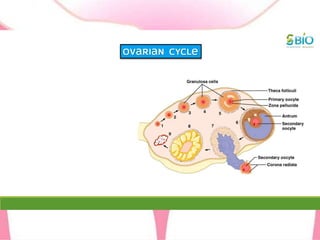
• During ovulation, the egg bursts from its follicle, but
the ruptured follicle stays on the surface of the ovary.
• For the next two weeks or so, the follicle transforms
into a structure known as the corpus luteum.
• This structure starts releasing progesterone, along with
small amounts of oestrogen.
• The cells of the corpus luteum produce estrogen and
large amounts of progesterone. Progesterone
stimulates your uterine lining to prepare for a fertilized
egg.
• Here’s where two things can happen.
• 1. If egg fertilized the egg moves into your
uterus and attaches to the lining.
• 2. If not , the lining of the uterus is shed
through the vaginal opening. Your period
starts and a new menstrual cycle begins.
• If a sperm cell does not impregnate the egg
cell within that time, the egg cell disintegrate
Amenorrhea
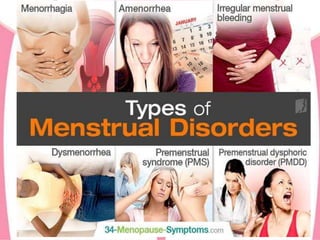
• Amenorrhea is the absence of a menstrual period
in a woman of reproductive age.
• Primary Amenorrhea Primary Amenorrhea is the
absence of menstruation in a woman bythe age of
16.
• Secondary Amenorrhea Secondary Amenorrhea is
where an established menstruation has ceased—
for 3 months in a woman with a history of regular
cyclic bleeding, or 9 months in a woman with a
history of irregular periods
Dysmenorrhea
• Dysmenorrhea is a gynecological medical
condition characterized by severe uterine pain
during menstruation.
Metrorrhagia
• Metrorrhagia is uterine bleeding at frequent,
irregular intervals, particularly between the
expected menstrual periods.
Menorrhagia/Hypermenorrhea
• Menorrhagia is an unusually heavy and
prolonged menstrual period at regular
intervals. A blood loss of greater than 80 ml or
lasting longer than 7 days constitutes
menorrhagia
Hypomenorrhea
• Hypomenorrhea is extremely light menstrual
blood flow (scanty periods).
Menometrorrhagia
• Menometrorrhagia is a condition in which
prolonged or excessive uterine bleeding
occurs irregularly and more frequently than
normal.
Polymenorrhea
• Polymenorrhea is the medical term for cycles
with intervals of 21 days or fewer.
Oligomenorrhea
• Oligomenorrhea is infrequent (or very light)
menstruation. More strictly, it is menstrual
periods occurring at intervals of greater than
35 days.
Menstrual cycle
Menstrual cycle

Menstrual cycle

  • 1.
  • 2.
  • 3.
    DEFINITION • Menstruation isthe periodic discharge of blood and sloughed endometrium (collectively called menses or menstrual flow) through the vagina. • The menstrual cycle is the regular natural change that occur in the female reproductive system (specially the ovaries and uterus) that makes pregnancy possible. This cycle is controlled by hormones, The menstrual cycle occurs because of a complex relationship between hormones from the brain and ovaries. This leads to the development and release of an egg from the ovary (ovulation) and growth of the internal lining (endometrium) of the uterus, to prepare it for pregnancy
  • 5.
    GENERAL POINTS • Theaverage Menstrual Cycle length is 28 days (usual range, about 25 to 36 days). • Average duration of menses is 5 (± 2) days. • Blood loss per cycle averages 30 mL (normal range, 13 to 80 mL) and is usually greatest on the 2nd day.
  • 8.
  • 9.
    • • There arefour phases of menstrual cycle 1. Menstrual phase- First 5 days of the month 2. Post-menstrual /pre ovulation/proliferative /Follicular phase-6th -13th day 3. Ovulation phase-On 14th day 4. Luteal phase15-28 days
  • 10.
  • 12.
    • When: Fromthe time bleeding starts to the time it ends. • What: Old blood and tissue from inside the uterus is shed through the vagina.
  • 13.
    Menstrual phase • Itlasts for about 3 – 5 days. • If the ovum is not fertilized, corpus luteum regresses from 24th day of the cycle. • This causes a decrease in estrogen and progesterone levels. • It results in shrinkage of endometrium, coiling and spasm of arteries leading to focal necrosis of the endometrium. • The necrosed endometrium is shed along with blood and other secretions ie.Tissue, blood, unfertilized egg all discharged
  • 14.
  • 15.
    Post-menstrual /pre ovulation/proliferative /Follicular phase-6th-13th day • Proliferative phase starts at the end of menstrual phase. Its duration is about 10 days. • At the beginning of this phase most of the endometrium has been desquamated. • Later endometrium starts healing and then proliferates rapidly from 5th –14th day of menstrual cycle. • This proliferation occurs under the influence of estrogen. There is growth of simple tubular glands and blood vessels. Endometrium increases in thickness to about 3 – 5mm. The endometrial glands produce a thick mucus.At the end of proliferative phase ovulation occurs.
  • 16.
    • Along withthat in this phase • Anterior pituitary secrete FSH (follicles stimulating hormone) which help in growth development and maturity of follicles • The follicles that reaches maturity called graffian follicles • Follicles secreate estrogen which thickens the new endometrium • At the end of this phase ovulation occurs
  • 19.
  • 20.
    Ovulation Phase • Duringthe follicular phase, estrogen suppresses production of luteinizing hormone (LH) from the pituitary gland • When the ovum has nearly matured, levels of estrogen reach a threshold above which they stimulate production of LH (positive feedback loop) • • The release of LH matures the ovum and weakens the wall of the follicle in the ovary, causing the fully developed follicle to release its secondary oocyte • • After being released from the ovary, the ovum is swept into the fallopian tube
  • 21.
    • Ovulation iswhen ovary releases a mature egg. • The egg travels down the fallopian tube toward the uterus to be fertilized by sperm. • The ovulation phase is the only time during menstrual cycle when a women can get pregnant. • The symptoms are: • A slight rise in basal body temperature • Thicker discharge that has the texture of egg whites • Ovulation happens at around day 8-19 in a 28-30 days cycle , right in the middle of menstrual cycle. • It lasts about 24 hours. After a day, the egg will die or dissolve if it isn’t fertilized
  • 22.
  • 23.
    LUTEAL PHASE/ SECRETORY PHASE •During ovulation, the egg bursts from its follicle, but the ruptured follicle stays on the surface of the ovary. • For the next two weeks or so, the follicle transforms into a structure known as the corpus luteum. • This structure starts releasing progesterone, along with small amounts of oestrogen. • The cells of the corpus luteum produce estrogen and large amounts of progesterone. Progesterone stimulates your uterine lining to prepare for a fertilized egg.
  • 24.
    • Here’s wheretwo things can happen. • 1. If egg fertilized the egg moves into your uterus and attaches to the lining. • 2. If not , the lining of the uterus is shed through the vaginal opening. Your period starts and a new menstrual cycle begins. • If a sperm cell does not impregnate the egg cell within that time, the egg cell disintegrate
  • 28.
    Amenorrhea • Amenorrhea isthe absence of a menstrual period in a woman of reproductive age. • Primary Amenorrhea Primary Amenorrhea is the absence of menstruation in a woman bythe age of 16. • Secondary Amenorrhea Secondary Amenorrhea is where an established menstruation has ceased— for 3 months in a woman with a history of regular cyclic bleeding, or 9 months in a woman with a history of irregular periods
  • 29.
    Dysmenorrhea • Dysmenorrhea isa gynecological medical condition characterized by severe uterine pain during menstruation.
  • 30.
    Metrorrhagia • Metrorrhagia isuterine bleeding at frequent, irregular intervals, particularly between the expected menstrual periods.
  • 31.
    Menorrhagia/Hypermenorrhea • Menorrhagia isan unusually heavy and prolonged menstrual period at regular intervals. A blood loss of greater than 80 ml or lasting longer than 7 days constitutes menorrhagia
  • 32.
    Hypomenorrhea • Hypomenorrhea isextremely light menstrual blood flow (scanty periods).
  • 33.
    Menometrorrhagia • Menometrorrhagia isa condition in which prolonged or excessive uterine bleeding occurs irregularly and more frequently than normal.
  • 34.
    Polymenorrhea • Polymenorrhea isthe medical term for cycles with intervals of 21 days or fewer.
  • 35.
    Oligomenorrhea • Oligomenorrhea isinfrequent (or very light) menstruation. More strictly, it is menstrual periods occurring at intervals of greater than 35 days.