INTRODUCTION
 Typically a women of child bearing age or
reproductive age (15 -45 years) should
menstruate every 28 days or so unless she is
pregnant or moving into menopause .
 A menstrual cycle consist of natural changes
that occur in a women body every month in
prepration for pregnancy .
 Menstruation starts at puberty and ends at
menopause
 Eumenorrhea is the term for normal
menstruation .
DEFINITION
 Menstruation means cyclic uterine bleeding caused
by shedding of progestational endometrium . It
occurs between menarche and menopause .
 Menstruation is also called menstrual bleeding ,
Menses or Periods.
OR
 The cyclic events that takes place in a rhythmic
manner during the reproductive period of a woman
life is called menstrual cycle .
1. Menarche :- First occurance of menstruation .
Starts at 12 to 16 years . Average 14 years .
2. Menopause :- Permanent cessation of menstrual
cycle . Ends at 45- 50 years.
3. Duration :-2 to 7 days . ( < 2 days in hypomenorrhea
and >7 days in menorrhagia.
4. Amount :- 30 to 80 ml. .>80 ml is menorrhagia & <30
ml is hypomenorrhea.
CHARACTERISTICS OF
MENSTRUATION
CHARACTERISTICS OF NORMAL
MENSTRUATION
5 . Coagulation :-
 Some authors state that the mixture of mucus with
menstrual blood prevents the clotting of the
menstrual blood .
 Others state that the acidity of vaginal secretion is
responsible for non coagulibility .
 Some states that it does not clot due to
present in endometrial debris .
Hypothalmic - Pituitary Ovarian Axis
Hypothalmus Gland
Secrete Gonadotrophin Releasing Harmones
FSH LH
Components of Menstrual Cycle
 There are 2 main components of the menstrual cycle :-
1. Ovarian Cycle
2. Uterine Cycle
 Ovarian Cycle :- Changes happen in ovaries in
response to pituitary harmones .
Uterine Cycle :- Changes that takes place in the
uterus .
 But it is important to remember that both cycles work
simultaneously to produce menstrual cycle .
 Changes in the cervical mucus also takes place during
menstrual cycle .
OVARIAN CYCLE
 The ovarian cycle refers to periodic changes that
occur in the ovary every month during the female
reproductive life .
 Cyclical changes in the ovaries occur in response to 2
anterior pituitary harmones .
1. Follicle stimulating harmone (FSH)
2. Luteinizing harmone ( )
UTERINE CYCLE
 The uterine cycle refers to changes that are found in
the lining of the uterus
 The changes come about in response to the ovarian
harmones :-
1. Estrogen
2.
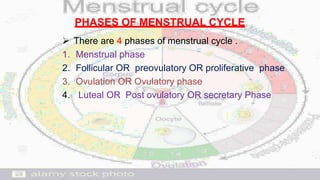
PHASES OF MENSTRUAL CYCLE
 There are 4 phases of menstrual cycle .
1. Menstrual phase
2. Follicular OR preovulatory OR proliferative phase
3. Ovulation OR Ovulatory phase
4. Luteal OR Post ovulatory OR secretary Phase
Menstrual Phase
 It is called Bleeding phase .
 Average duration of this phase is 3-5 days .
 Day 1 of the menstrual cycle is marked by onset of
menstruation.
 During the menstrual phase the uterine lining is shed
because of .
 The menstrual flow consist of the secretions from the
endometrial gland , endometrial cells , blood from the
degenerating capillaries and unfertilized ovum.
 The menstrual phase ends when menstrual period stops
on day 5.
Follicular &Pre ovulatory and Proliferative
phase
 This phase of the cycle extends from the day 5th
of the menstrual phase till the time of ovulation .
 This phase generally lasts for 8-9 days .
 During this phase some 10 - 15 primordial follicles
start maturing .
 But only one follicle of one of the ovaries reaches
maturity .
 The mature follicle is called which
secretes estrogen .
 Estrogen has a negative feedback on the FSH .
 This is to stop the other follicles from maturing .
Follicular &Pre ovulatory and Proliferative
phase
 Estrogen has another function also.
 Estrogen causes the level to rise further .
OVULATORY PHASE
 Estrogen peak stimulates the secretion of LH.
 LH peak leads to :-
 The follicle to burst open releasing the mature ovum .
This is called as ovulation .
 Ovulation occurs on 14 th day of each 28 day cycle .
LUTEAL or POSTOVULATORY or SECRETARY PHASE
 This phase starts from day 15 and last till the end
of cycle that is from day 15 to 28.
 After ovulation LH levels remains elevated and
cause the remnants of the follicle to develop into a
yellow body called corpus luteum .
mainly :-
 Corpus luteum
1. Estrogen
2. Progesterone
These 2 harmones function to maintain the lining
of the uterus that is endometrium and prepare it
for pregnancy
LUTEAL PHASE
 When there is no fertilization for about 7-8 days
then degeneration of corpus luteum starts .
 Due to corpus luteum degeneration level of
estrogen and progesterone also falls down .
 Corpus luteum then changes to corpus albicans
and then it is reabsorbed .
 Cells or lining of endometrium develops a
condition of ischemia . So they starts to fall
down or there shedding starts .
 And women is once again at the day 1 of
menstrual cycle .
CERVICAL MUCUS CHANGES
 Changes in cervical mucus takes place
over the course of the menstrual cycle.
 During the menstrual phase the mucosa
of cervix does not undergo shedding off
like endometrium.
 As proliferative phase begins the cervix
begins to produce a thin watery alkaline
secretions .
 At the time of ovulation the cervical
mucus is thinnest and its elasticity is
maximum. .
Cervical mucus changes
 It can be stretched like a long thin elastic
thread upto 8 to 12 cm . This is called
Spinnbarkeit Effect . This nature of
cervical mucus favours the tansport of
sperms in the female genital tract and
makes the condition favourable for
fertilization .
 After ovulation cervical secretions
decrease in quantity and becomes thick .
These changes make a plug and prevent
entry of sperm through cervical canal .
CYCLE ABNORMALITIES
 Menorrhagia
 Hypomenorrhea
 Amenorrhea
 Dysmenorrhea
 Pre mentrual syndrome
Comfort measures during menstruation
 Sanitary pads and tampoons
 Vaginal spray and douching
 SANITARY PADS AND TAMPOONS :-
 Wash hands before and after giving self perineal
care .
 Washing or wiping the perinum should be always
from front to back.
 Use tampoons only for heavy menstrual flow.
Comfort measures during menstruation
 Vaginal spray & douching :-
 Spray should be used externally only ;
not with pads .
 Should not be applied with broken ,
irritated or itched skin.
 Douching washes away natural mucus ,
thus liable to infecton.
HEALTH EDUCATION
 Advise that heating pads may be very
effective for cramps.
 Advise all womens to keep self and her
genitals clean.
 Use cotton pads for better absorption of the
blood and to maintain hygiene .
 ased on the need and
amount of bleeding.
 Do not dispose the soiled pads into the toilet
and drains; it may get blocked .
 Clean your bathroom , wash your clothing
and dry under the sun .
BIBLIOGRAPHY
1. Jacob Annamma. Midwifery and Gynaecological
nursing. 5th edition. New Delhi: Jaypee
publishers; 2019. p.46-49
2. Magon Shally .Midwifery and Obstetrics. 3rd ed.
New Delhi: Lotus publishers; 2013.p.900
3. https://www.slideshare.net>mobile
4. https://www.better health.vic.gov.in
5. https://www.stay.free .in
menstrual cycle.pptx

menstrual cycle.pptx

  • 2.
    INTRODUCTION  Typically awomen of child bearing age or reproductive age (15 -45 years) should menstruate every 28 days or so unless she is pregnant or moving into menopause .  A menstrual cycle consist of natural changes that occur in a women body every month in prepration for pregnancy .  Menstruation starts at puberty and ends at menopause  Eumenorrhea is the term for normal menstruation .
  • 3.
    DEFINITION  Menstruation meanscyclic uterine bleeding caused by shedding of progestational endometrium . It occurs between menarche and menopause .  Menstruation is also called menstrual bleeding , Menses or Periods. OR  The cyclic events that takes place in a rhythmic manner during the reproductive period of a woman life is called menstrual cycle .
  • 4.
    1. Menarche :-First occurance of menstruation . Starts at 12 to 16 years . Average 14 years . 2. Menopause :- Permanent cessation of menstrual cycle . Ends at 45- 50 years. 3. Duration :-2 to 7 days . ( < 2 days in hypomenorrhea and >7 days in menorrhagia. 4. Amount :- 30 to 80 ml. .>80 ml is menorrhagia & <30 ml is hypomenorrhea. CHARACTERISTICS OF MENSTRUATION
  • 5.
    CHARACTERISTICS OF NORMAL MENSTRUATION 5. Coagulation :-  Some authors state that the mixture of mucus with menstrual blood prevents the clotting of the menstrual blood .  Others state that the acidity of vaginal secretion is responsible for non coagulibility .  Some states that it does not clot due to present in endometrial debris .
  • 6.
    Hypothalmic - PituitaryOvarian Axis Hypothalmus Gland Secrete Gonadotrophin Releasing Harmones FSH LH
  • 7.
    Components of MenstrualCycle  There are 2 main components of the menstrual cycle :- 1. Ovarian Cycle 2. Uterine Cycle  Ovarian Cycle :- Changes happen in ovaries in response to pituitary harmones . Uterine Cycle :- Changes that takes place in the uterus .  But it is important to remember that both cycles work simultaneously to produce menstrual cycle .  Changes in the cervical mucus also takes place during menstrual cycle .
  • 8.
    OVARIAN CYCLE  Theovarian cycle refers to periodic changes that occur in the ovary every month during the female reproductive life .  Cyclical changes in the ovaries occur in response to 2 anterior pituitary harmones . 1. Follicle stimulating harmone (FSH) 2. Luteinizing harmone ( )
  • 9.
    UTERINE CYCLE  Theuterine cycle refers to changes that are found in the lining of the uterus  The changes come about in response to the ovarian harmones :- 1. Estrogen 2.
  • 11.
    PHASES OF MENSTRUALCYCLE  There are 4 phases of menstrual cycle . 1. Menstrual phase 2. Follicular OR preovulatory OR proliferative phase 3. Ovulation OR Ovulatory phase 4. Luteal OR Post ovulatory OR secretary Phase
  • 13.
    Menstrual Phase  Itis called Bleeding phase .  Average duration of this phase is 3-5 days .  Day 1 of the menstrual cycle is marked by onset of menstruation.  During the menstrual phase the uterine lining is shed because of .  The menstrual flow consist of the secretions from the endometrial gland , endometrial cells , blood from the degenerating capillaries and unfertilized ovum.  The menstrual phase ends when menstrual period stops on day 5.
  • 14.
    Follicular &Pre ovulatoryand Proliferative phase  This phase of the cycle extends from the day 5th of the menstrual phase till the time of ovulation .  This phase generally lasts for 8-9 days .  During this phase some 10 - 15 primordial follicles start maturing .  But only one follicle of one of the ovaries reaches maturity .  The mature follicle is called which secretes estrogen .  Estrogen has a negative feedback on the FSH .  This is to stop the other follicles from maturing .
  • 15.
    Follicular &Pre ovulatoryand Proliferative phase  Estrogen has another function also.  Estrogen causes the level to rise further .
  • 16.
    OVULATORY PHASE  Estrogenpeak stimulates the secretion of LH.  LH peak leads to :-  The follicle to burst open releasing the mature ovum . This is called as ovulation .  Ovulation occurs on 14 th day of each 28 day cycle .
  • 17.
    LUTEAL or POSTOVULATORYor SECRETARY PHASE  This phase starts from day 15 and last till the end of cycle that is from day 15 to 28.  After ovulation LH levels remains elevated and cause the remnants of the follicle to develop into a yellow body called corpus luteum . mainly :-  Corpus luteum 1. Estrogen 2. Progesterone These 2 harmones function to maintain the lining of the uterus that is endometrium and prepare it for pregnancy
  • 18.
    LUTEAL PHASE  Whenthere is no fertilization for about 7-8 days then degeneration of corpus luteum starts .  Due to corpus luteum degeneration level of estrogen and progesterone also falls down .  Corpus luteum then changes to corpus albicans and then it is reabsorbed .  Cells or lining of endometrium develops a condition of ischemia . So they starts to fall down or there shedding starts .  And women is once again at the day 1 of menstrual cycle .
  • 20.
    CERVICAL MUCUS CHANGES Changes in cervical mucus takes place over the course of the menstrual cycle.  During the menstrual phase the mucosa of cervix does not undergo shedding off like endometrium.  As proliferative phase begins the cervix begins to produce a thin watery alkaline secretions .  At the time of ovulation the cervical mucus is thinnest and its elasticity is maximum. .
  • 21.
    Cervical mucus changes It can be stretched like a long thin elastic thread upto 8 to 12 cm . This is called Spinnbarkeit Effect . This nature of cervical mucus favours the tansport of sperms in the female genital tract and makes the condition favourable for fertilization .  After ovulation cervical secretions decrease in quantity and becomes thick . These changes make a plug and prevent entry of sperm through cervical canal .
  • 23.
    CYCLE ABNORMALITIES  Menorrhagia Hypomenorrhea  Amenorrhea  Dysmenorrhea  Pre mentrual syndrome
  • 24.
    Comfort measures duringmenstruation  Sanitary pads and tampoons  Vaginal spray and douching  SANITARY PADS AND TAMPOONS :-  Wash hands before and after giving self perineal care .  Washing or wiping the perinum should be always from front to back.  Use tampoons only for heavy menstrual flow.
  • 25.
    Comfort measures duringmenstruation  Vaginal spray & douching :-  Spray should be used externally only ; not with pads .  Should not be applied with broken , irritated or itched skin.  Douching washes away natural mucus , thus liable to infecton.
  • 26.
    HEALTH EDUCATION  Advisethat heating pads may be very effective for cramps.  Advise all womens to keep self and her genitals clean.  Use cotton pads for better absorption of the blood and to maintain hygiene .  ased on the need and amount of bleeding.  Do not dispose the soiled pads into the toilet and drains; it may get blocked .  Clean your bathroom , wash your clothing and dry under the sun .
  • 27.
    BIBLIOGRAPHY 1. Jacob Annamma.Midwifery and Gynaecological nursing. 5th edition. New Delhi: Jaypee publishers; 2019. p.46-49 2. Magon Shally .Midwifery and Obstetrics. 3rd ed. New Delhi: Lotus publishers; 2013.p.900 3. https://www.slideshare.net>mobile 4. https://www.better health.vic.gov.in 5. https://www.stay.free .in