MENSTRUAL CYCLE REGULATION
Misbah Akram
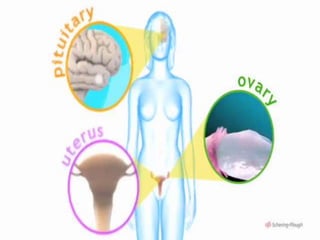
Menstruation???
 Natural changes that occur in the uterus and ovary as
an essential part of making sexual reproduction
possible.
 Essential for the production of eggs, and for the
preparation of the uterus for pregnancy.
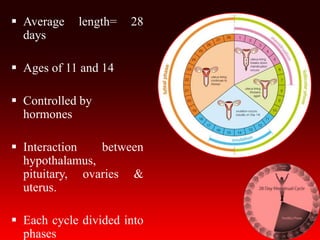
 Average length= 28
days
 Ages of 11 and 14
 Controlled by
hormones
 Interaction between
hypothalamus,
pituitary, ovaries &
uterus.
 Each cycle divided into
phases
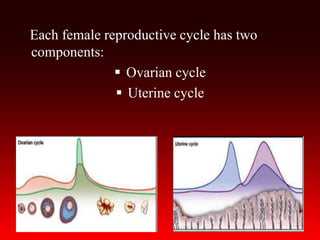
Each female reproductive cycle has two
components:
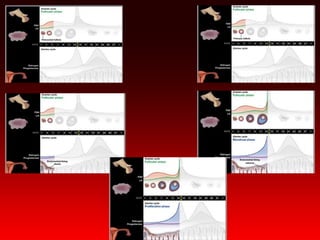
 Ovarian cycle
 Uterine cycle
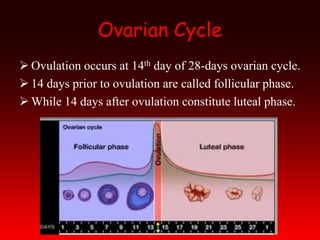
Ovarian Cycle
 Ovulation occurs at 14th day of 28-days ovarian cycle.
 14 days prior to ovulation are called follicular phase.
 While 14 days after ovulation constitute luteal phase.
Uterine Cycle
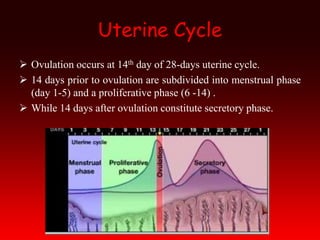
 Ovulation occurs at 14th day of 28-days uterine cycle.
 14 days prior to ovulation are subdivided into menstrual phase
(day 1-5) and a proliferative phase (6 -14) .
 While 14 days after ovulation constitute secretory phase.
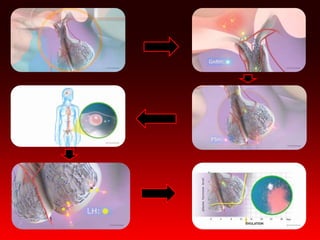
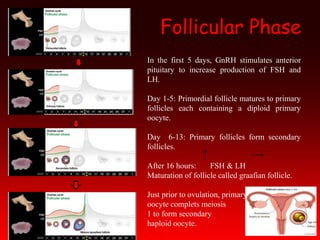
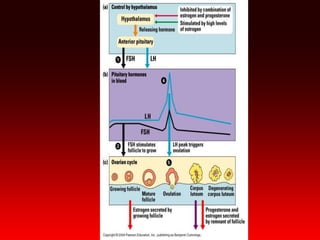
In the first 5 days, GnRH stimulates anterior
pituitary to increase production of FSH and
LH.
Day 1-5: Primordial follicle matures to primary
follicles each containing a diploid primary
oocyte.
Day 6-13: Primary follicles form secondary
follicles.
After 16 hours: FSH & LH
Maturation of follicle called graafian follicle.
Just prior to ovulation, primary
oocyte complets meiosis
1 to form secondary
haploid oocyte.
Follicular Phase
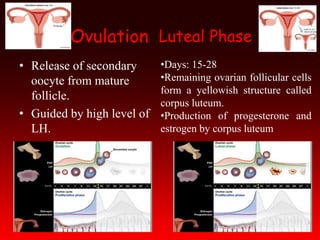
Ovulation
• Release of secondary
oocyte from mature
follicle.
• Guided by high level of
LH.
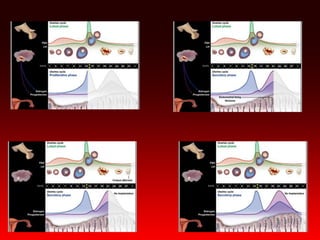
Luteal Phase
•Days: 15-28
•Remaining ovarian follicular cells
form a yellowish structure called
corpus luteum.
•Production of progesterone and
estrogen by corpus luteum
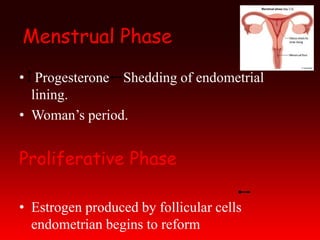
Menstrual Phase
• Progesterone Shedding of endometrial
lining.
• Woman’s period.
Proliferative Phase
• Estrogen produced by follicular cells
endometrian begins to reform
Secretory Phase
• Days: 15-28
• Progesterone and estrogen from corpus luteum
stimulates further thickening of the
endometrium.
In case of no fertilization:
• Corpus luteum becomes corpus albicans.
• Decreased level of progesterone and estrogen
• Leads to menstruation.
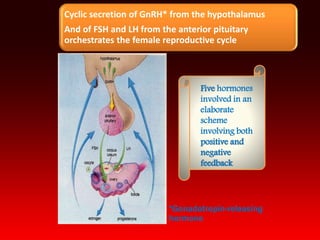
Gonadotr
ophin
releasing
hormones
Follicle
stimulatin
g
hormones
Leuteinizi
ng
hormones
estrogen
progester
on
*Gonadotropin-releasing
hormone
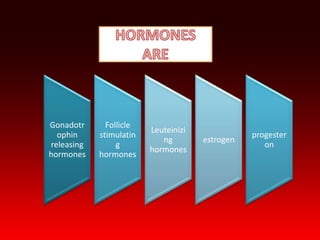
Five hormones
involved in an
elaborate
scheme
involving both
positive and
negative
feedback
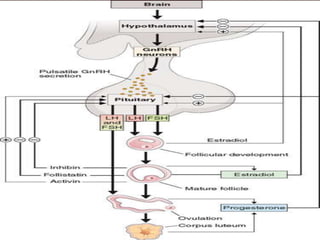
Cyclic secretion of GnRH* from the hypothalamus
And of FSH and LH from the anterior pituitary
orchestrates the female reproductive cycle
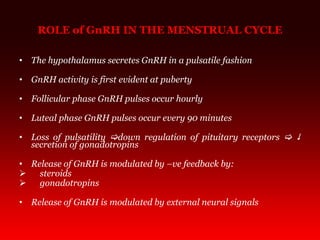
ROLE of GnRH IN THE MENSTRUAL CYCLE
• The hypothalamus secretes GnRH in a pulsatile fashion
• GnRH activity is first evident at puberty
• Follicular phase GnRH pulses occur hourly
• Luteal phase GnRH pulses occur every 90 minutes
• Loss of pulsatility down regulation of pituitary receptors  
secretion of gonadotropins
• Release of GnRH is modulated by –ve feedback by:
 steroids
 gonadotropins
• Release of GnRH is modulated by external neural signals
1. High levels of estrogens suppress the release of GnRH (bar) providing a negative-
feedback control of hormone levels.
2. Secretion of GnRH depends on certain neurons in the hypothalamus which
express a gene (KISS-1) encoding a protein of 145 amino acids. From this are cut
several short peptides collectively called kisspeptin. These are secreted and bind
to G-protein-coupled receptors on the surface of the GnRH neurons stimulating
them to release GnRH. However, high levels of estrogen inhibit the secretion of
kisspeptin and suppress further production of those hormones.
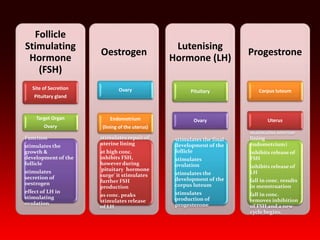
Follicle
Stimulating
Hormone
(FSH)
Site of Secretion
Pituitary gland
Target Organ
Ovary
Function
stimulates the
growth &
development of the
follicle
stimulates
secretion of
oestrogen
effect of LH in
stimulating
ovulation
Oestrogen
Ovary
Endometrium
(lining of the uterus)
stimulates repair of
uterine lining
at high conc.
inhibits FSH,
however during
'pituitary hormone
surge' it stimulates
further FSH
production
as conc. peaks
stimulates release
of LH
Lutenising
Hormone (LH)
Pituitary
Ovary
stimulates the final
development of the
follicle
stimulates
ovulation
stimulates the
development of the
corpus luteum
stimulates
production of
progesterone
Progestrone
Corpus luteum
Uterus
maintains uterine
lining
endometrium)
inhibits release of
FSH
inhibits release of
LH
fall in conc. results
in menstruation
fall in conc.
removes inhibition
of FSH and a new
cycle begins.
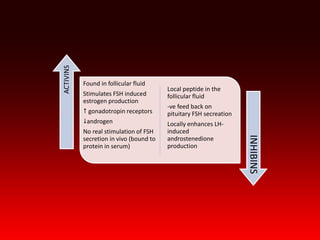
Found in follicular fluid
Stimulates FSH induced
estrogen production
 gonadotropin receptors
androgen
No real stimulation of FSH
secretion in vivo (bound to
protein in serum)
Local peptide in the
follicular fluid
-ve feed back on
pituitary FSH secreation
Locally enhances LH-
induced
androstenedione
production
ACTIVINS
INHIBINS
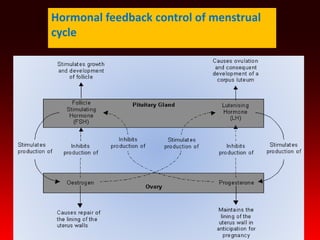
Hormonal feedback control of menstrual
cycle
Hormones of Placenta
 The placenta forms large quantities of human chorionic gonadotropin,
estrogen, progesterone and human chorionic somatomammotropin,
which are all essential to a normal pregnancy
 HUMAN CHORIONIC GONADOTROPIN (HCG)
 HCG is a glycoprotein with a molecular weight of 39,000.
 It is secreted by the syncytial trophoblast cells and can be measured in
the blood 8 to 9 days after ovulation.
 The rate of secretion rises rapidly to reach maximum bout 10 to 12
weeks after ovulation and decreases to much lower value by 16 to 20
weeks after ovulation.
 It continues at this level for the remainder of pregnancy.
• This hormone is identical to LH in its effect and
therefore is able to maintain the corpus luteum
past the time when it would otherwise regress.
• The secretion of estradiol and progesterone is
thus maintained and menstruation is normally
prevented.
• Diagnosis of the early pregnancy
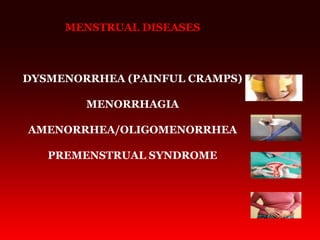
MENSTRUAL DISEASES
DYSMENORRHEA (PAINFUL CRAMPS)
MENORRHAGIA
AMENORRHEA/OLIGOMENORRHEA
PREMENSTRUAL SYNDROME
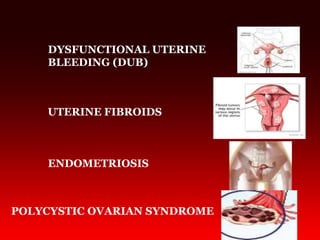
UTERINE FIBROIDS
ENDOMETRIOSIS
POLYCYSTIC OVARIAN SYNDROME
DYSFUNCTIONAL UTERINE
BLEEDING (DUB)
OTHER RISK FACTORS
INCLUDE:
 Weight.
 Smoking and Alcohol Use.
 Stress.
 Menstrual Cycles and Flow.
 Chronic Pelvic Pain
 Diet
 Too much exercise
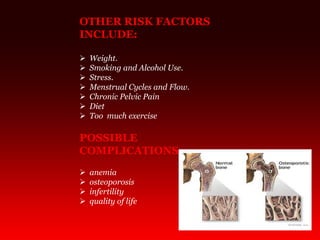
POSSIBLE
COMPLICATIONS
 anemia
 osteoporosis
 infertility
 quality of life
DIAGNOSIS
 first the patient history
 blood and hormonal tests
 ultrasound
OTHER DIAGNOSTIC PROCEDURES
 Hysteroscopy
 Laparoscopy
 Endometrial Biopsy
 Dilation and Curettage (D&C)
MEDICATIONS
 Nonsteroidal Anti-inflammatory Drugs (NSAIDs)
 levonorgestrol, drospirenone, norgestrol, norethindrone, and
desogestrel.
 PROGESTINS
 Gonadotropin releasing hormone (GnRH) agonists
Menstrual cycle regulation

Menstrual cycle regulation

  • 1.
  • 2.
    Menstruation???  Natural changesthat occur in the uterus and ovary as an essential part of making sexual reproduction possible.  Essential for the production of eggs, and for the preparation of the uterus for pregnancy.
  • 3.
     Average length=28 days  Ages of 11 and 14  Controlled by hormones  Interaction between hypothalamus, pituitary, ovaries & uterus.  Each cycle divided into phases
  • 5.
    Each female reproductivecycle has two components:  Ovarian cycle  Uterine cycle
  • 7.
    Ovarian Cycle  Ovulationoccurs at 14th day of 28-days ovarian cycle.  14 days prior to ovulation are called follicular phase.  While 14 days after ovulation constitute luteal phase.
  • 8.
    Uterine Cycle  Ovulationoccurs at 14th day of 28-days uterine cycle.  14 days prior to ovulation are subdivided into menstrual phase (day 1-5) and a proliferative phase (6 -14) .  While 14 days after ovulation constitute secretory phase.
  • 9.
    In the first5 days, GnRH stimulates anterior pituitary to increase production of FSH and LH. Day 1-5: Primordial follicle matures to primary follicles each containing a diploid primary oocyte. Day 6-13: Primary follicles form secondary follicles. After 16 hours: FSH & LH Maturation of follicle called graafian follicle. Just prior to ovulation, primary oocyte complets meiosis 1 to form secondary haploid oocyte. Follicular Phase
  • 10.
    Ovulation • Release ofsecondary oocyte from mature follicle. • Guided by high level of LH. Luteal Phase •Days: 15-28 •Remaining ovarian follicular cells form a yellowish structure called corpus luteum. •Production of progesterone and estrogen by corpus luteum
  • 11.
    Menstrual Phase • ProgesteroneShedding of endometrial lining. • Woman’s period. Proliferative Phase • Estrogen produced by follicular cells endometrian begins to reform
  • 13.
    Secretory Phase • Days:15-28 • Progesterone and estrogen from corpus luteum stimulates further thickening of the endometrium. In case of no fertilization: • Corpus luteum becomes corpus albicans. • Decreased level of progesterone and estrogen • Leads to menstruation.
  • 15.
  • 16.
    *Gonadotropin-releasing hormone Five hormones involved inan elaborate scheme involving both positive and negative feedback Cyclic secretion of GnRH* from the hypothalamus And of FSH and LH from the anterior pituitary orchestrates the female reproductive cycle
  • 17.
    ROLE of GnRHIN THE MENSTRUAL CYCLE • The hypothalamus secretes GnRH in a pulsatile fashion • GnRH activity is first evident at puberty • Follicular phase GnRH pulses occur hourly • Luteal phase GnRH pulses occur every 90 minutes • Loss of pulsatility down regulation of pituitary receptors   secretion of gonadotropins • Release of GnRH is modulated by –ve feedback by:  steroids  gonadotropins • Release of GnRH is modulated by external neural signals
  • 18.
    1. High levelsof estrogens suppress the release of GnRH (bar) providing a negative- feedback control of hormone levels. 2. Secretion of GnRH depends on certain neurons in the hypothalamus which express a gene (KISS-1) encoding a protein of 145 amino acids. From this are cut several short peptides collectively called kisspeptin. These are secreted and bind to G-protein-coupled receptors on the surface of the GnRH neurons stimulating them to release GnRH. However, high levels of estrogen inhibit the secretion of kisspeptin and suppress further production of those hormones.
  • 19.
    Follicle Stimulating Hormone (FSH) Site of Secretion Pituitarygland Target Organ Ovary Function stimulates the growth & development of the follicle stimulates secretion of oestrogen effect of LH in stimulating ovulation Oestrogen Ovary Endometrium (lining of the uterus) stimulates repair of uterine lining at high conc. inhibits FSH, however during 'pituitary hormone surge' it stimulates further FSH production as conc. peaks stimulates release of LH Lutenising Hormone (LH) Pituitary Ovary stimulates the final development of the follicle stimulates ovulation stimulates the development of the corpus luteum stimulates production of progesterone Progestrone Corpus luteum Uterus maintains uterine lining endometrium) inhibits release of FSH inhibits release of LH fall in conc. results in menstruation fall in conc. removes inhibition of FSH and a new cycle begins.
  • 20.
    Found in follicularfluid Stimulates FSH induced estrogen production  gonadotropin receptors androgen No real stimulation of FSH secretion in vivo (bound to protein in serum) Local peptide in the follicular fluid -ve feed back on pituitary FSH secreation Locally enhances LH- induced androstenedione production ACTIVINS INHIBINS
  • 22.
    Hormonal feedback controlof menstrual cycle
  • 24.
    Hormones of Placenta The placenta forms large quantities of human chorionic gonadotropin, estrogen, progesterone and human chorionic somatomammotropin, which are all essential to a normal pregnancy  HUMAN CHORIONIC GONADOTROPIN (HCG)  HCG is a glycoprotein with a molecular weight of 39,000.  It is secreted by the syncytial trophoblast cells and can be measured in the blood 8 to 9 days after ovulation.  The rate of secretion rises rapidly to reach maximum bout 10 to 12 weeks after ovulation and decreases to much lower value by 16 to 20 weeks after ovulation.  It continues at this level for the remainder of pregnancy.
  • 25.
    • This hormoneis identical to LH in its effect and therefore is able to maintain the corpus luteum past the time when it would otherwise regress. • The secretion of estradiol and progesterone is thus maintained and menstruation is normally prevented. • Diagnosis of the early pregnancy
  • 26.
    MENSTRUAL DISEASES DYSMENORRHEA (PAINFULCRAMPS) MENORRHAGIA AMENORRHEA/OLIGOMENORRHEA PREMENSTRUAL SYNDROME
  • 27.
    UTERINE FIBROIDS ENDOMETRIOSIS POLYCYSTIC OVARIANSYNDROME DYSFUNCTIONAL UTERINE BLEEDING (DUB)
  • 28.
    OTHER RISK FACTORS INCLUDE: Weight.  Smoking and Alcohol Use.  Stress.  Menstrual Cycles and Flow.  Chronic Pelvic Pain  Diet  Too much exercise POSSIBLE COMPLICATIONS  anemia  osteoporosis  infertility  quality of life
  • 29.
    DIAGNOSIS  first thepatient history  blood and hormonal tests  ultrasound OTHER DIAGNOSTIC PROCEDURES  Hysteroscopy  Laparoscopy  Endometrial Biopsy  Dilation and Curettage (D&C) MEDICATIONS  Nonsteroidal Anti-inflammatory Drugs (NSAIDs)  levonorgestrol, drospirenone, norgestrol, norethindrone, and desogestrel.  PROGESTINS  Gonadotropin releasing hormone (GnRH) agonists