THE MENSTRUAL CYCLE
Sevag Ouzounian
Overview
• Menstrual cycle has evolved to follow lunar cycle – 28
days. This however varies month to month and can be
different in different women
• There is the uterine cycle and the ovarian cycle
• Cycle composed of
• Follicular phase
• Ovulation
• A postovulatory or luteal phase
Overview
• Necessities for normal menstrual cycle
• Intact hypothalamo-pituitary-ovarian axis
• Responsive follicles in ovaries
• Functional uterus
• If cycle is prolonged
• Follicular phase will lengthen
• Luteal phase will remain constant at 14 days
Hormone Control of Cycle
• Hypothalamo-pituitary-ovarian axis
• Cycle controlled by hypothalamus,
however this can be influenced by
higher centres within the brain
• i.e. due to stress or anxiety
• Hypothalamus releases
gonadotrophin-releasing hormone
in pulsatile manner  anterior
pituitary  release of LH and FSH
Hormone Control
• Follicular stimulating hormone (FSH) – glycoprotein
• Stimulates follicular maturation during follicular phase
• Stimulates steroid hormone secretion – oestrogen (by the granulosa
cells of mature ovarian follicle)
• Lutenizing Hormone (LH) – glycoprotein
• Stimulates steroid hormone secretion – oestrogen
• Ovulation – mid-cycle surge of LH
• Progesterone production by corpus luteum
• Negative feedback mechanism controls cycle
Ovarian Cycle – Follicular Phase
• Days 1-8 – FSH and LH relatively
high levels
o Stimulate development of 10-20 follicles
o Results in full maturation of a single
dominant follicle – appearing in mid-
follicular phase
o Remainder undergo atresia
o High LH and FSH triggered by drop in
oestrogen and progesterone levels from
last cycle .
o Oestrogen levels start to rise as follicular
development occurs
Ovarian Cycle – Follicular Phase (2)
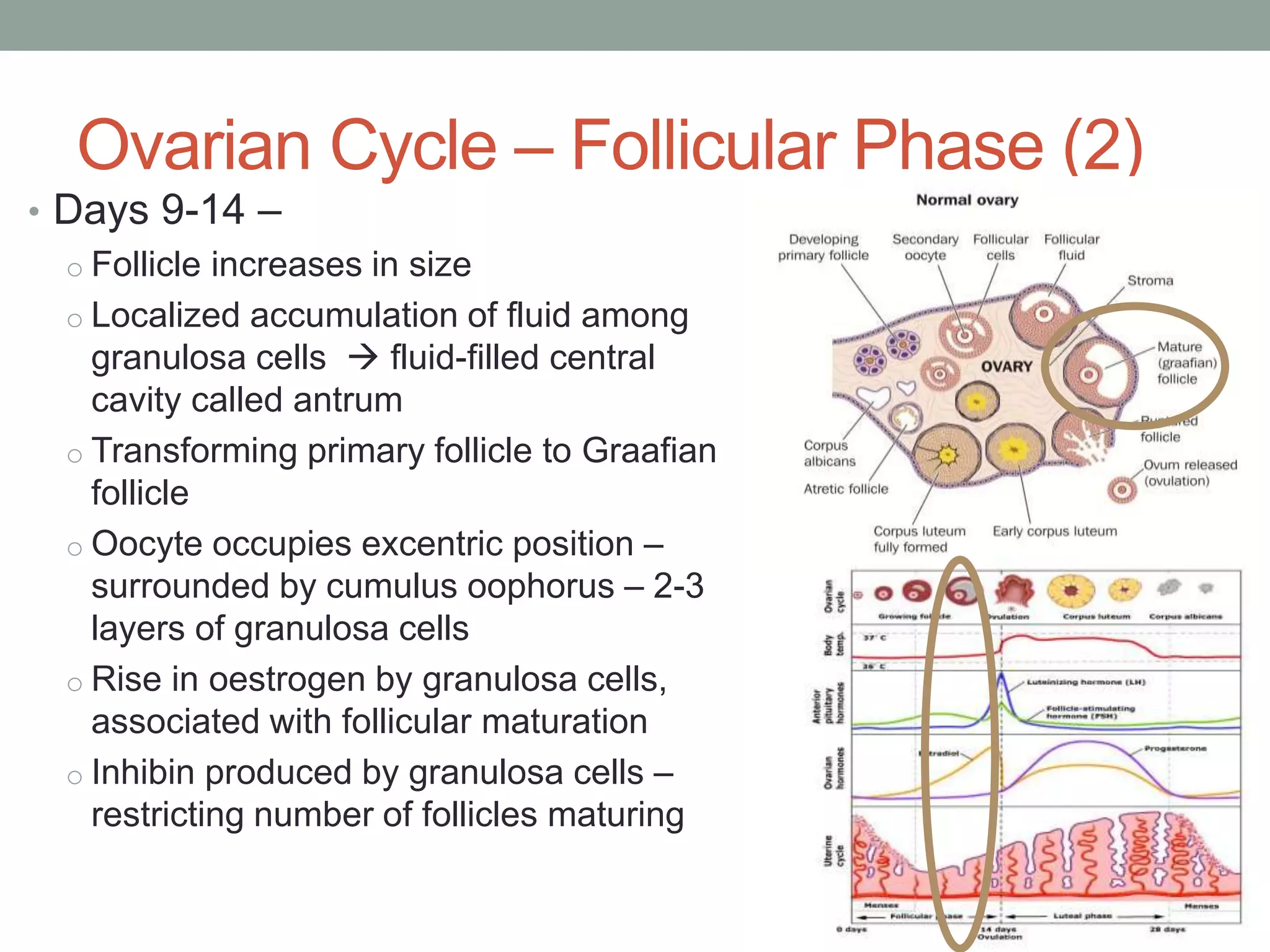
• Days 9-14 –
o Follicle increases in size
o Localized accumulation of fluid among
granulosa cells  fluid-filled central
cavity called antrum
o Transforming primary follicle to Graafian
follicle
o Oocyte occupies excentric position –
surrounded by cumulus oophorus – 2-3
layers of granulosa cells
o Rise in oestrogen by granulosa cells,
associated with follicular maturation
o Inhibin produced by granulosa cells –
restricting number of follicles maturing
Ovarian Cycle - Ovulation
• Day 14 – rapid enlargement of follicle
and rupture of the follicle with extrusion
of the oocyte and adherent cumulus
oophorus
• Some women get pain before rupture –
called Mittelschmerz
• Rise in oestrogen  mid-cycle surge of
LH and to a lesser extent FSH 
ovulation
• Immediately before ovulation there is a
drop in oestrogen and an increase in
progesterone.
• Ovulation follows within 18 hours of mid-
cycle surge of LH
• If not enough of a LH surge – then no
ovulation occurs – anovulatory
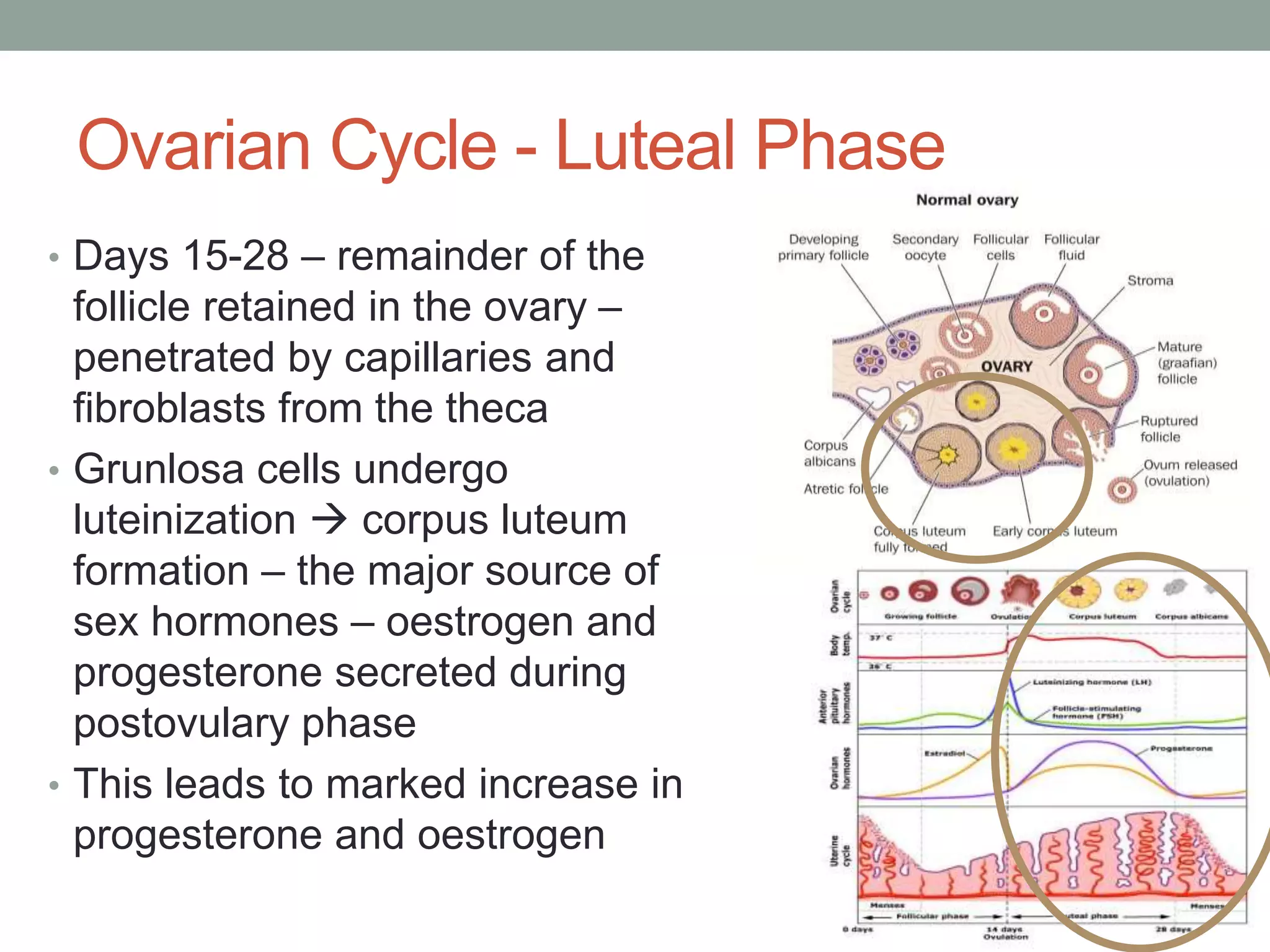
Ovarian Cycle - Luteal Phase
• Days 15-28 – remainder of the
follicle retained in the ovary –
penetrated by capillaries and
fibroblasts from the theca
• Grunlosa cells undergo
luteinization  corpus luteum
formation – the major source of
sex hormones – oestrogen and
progesterone secreted during
postovulary phase
• This leads to marked increase in
progesterone and oestrogen
Ovarian Cycle
• If conception and implantation occur:
• Corpus luteum doesn’t regress – maintained by gonadotrophins
secreted by trophoblasts
• If conception doesn’t occur successfully:
• Corpus luteum regresses and menstruation occurs
• Drops in steroid sex hormones  leads to a rise in gonadotrophin
levels (FH and LSH)  initiate next cycle
Ovarian and Uterine Cycle
Uterine Cycle
• Influenced by the cyclical
production of steroid
hormones
• Causes changes to the uterus
• Involving the endometrium
and cervical mucus
Uterine Cycle – Endometrium Overview
• Two layered
• Superficial layer that sheds during the menstrual cycle
• Basal layer that doesn’t take part, but regenerates the superficial
layer
• The basal layer has straight arterioles where as the
superficial layers has spiral ones – important in the
process of shedding
Uterine Cycle – Proliferative Phase
• Occurs during follicular phase
of ovarian cycle
• Endometrium exposed to
oestrogen  regeneration
from the last menstrual cycle
• Glands in endometrium are
straight in this phase, parallel
to one another and contain
little secretion
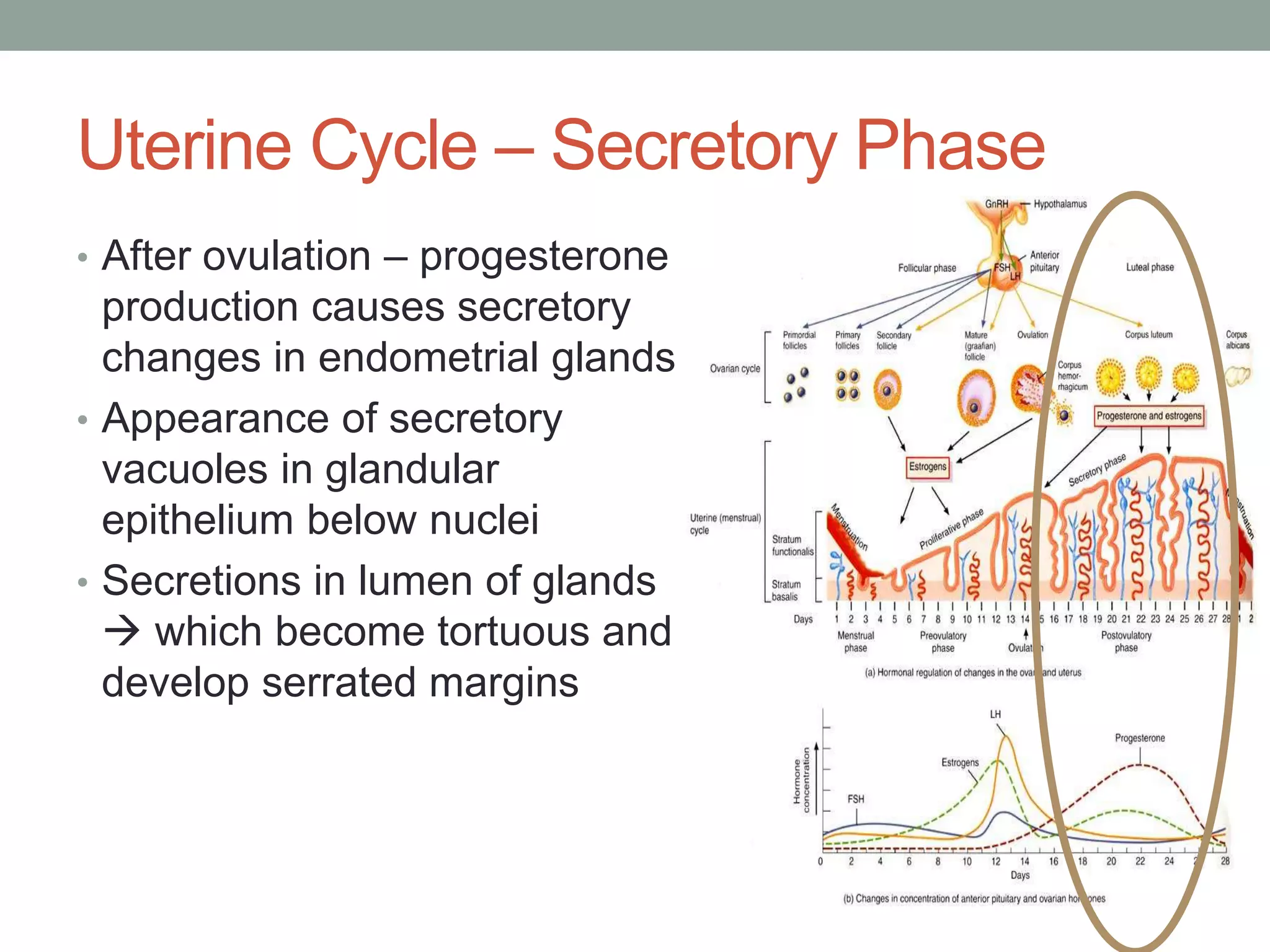
Uterine Cycle – Secretory Phase
• After ovulation – progesterone
production causes secretory
changes in endometrial glands
• Appearance of secretory
vacuoles in glandular
epithelium below nuclei
• Secretions in lumen of glands
 which become tortuous and
develop serrated margins
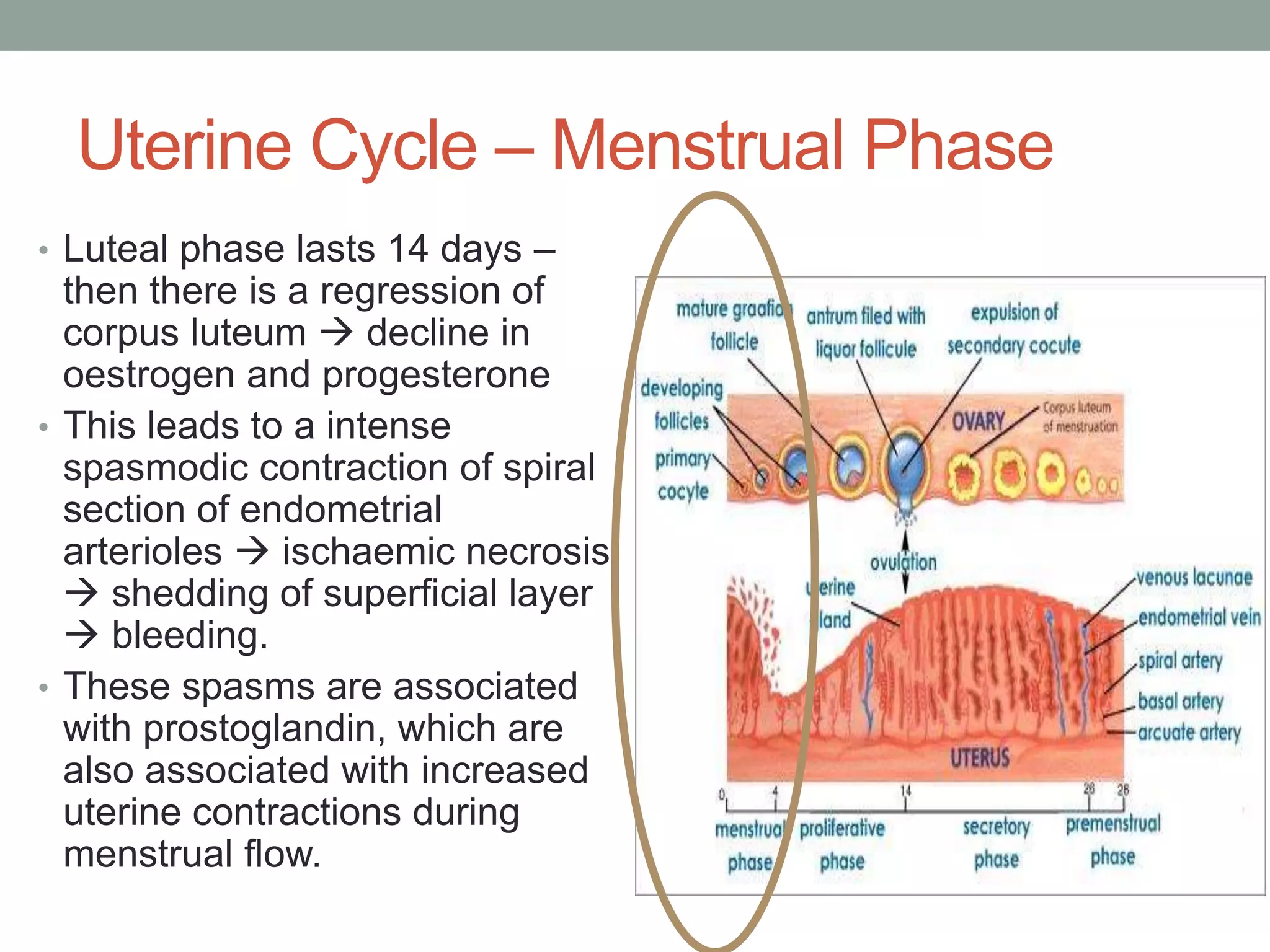
Uterine Cycle – Menstrual Phase
• Luteal phase lasts 14 days –
then there is a regression of
corpus luteum  decline in
oestrogen and progesterone
• This leads to a intense
spasmodic contraction of spiral
section of endometrial
arterioles  ischaemic necrosis
 shedding of superficial layer
 bleeding.
• These spasms are associated
with prostoglandin, which are
also associated with increased
uterine contractions during
menstrual flow.
Cervical Mucus
• Important to stop ascending infection
• Changes during the menstrual cycle
• Early follicular phase – viscid and impermeable
• Late follicular phase – increasing oestrogen levels  mucus
becomes watery and easily penetrated, allowing spermatozoa to
get through. Change is known as Spinnbarkheit
• Post-ovulation – progesterone from corpus luteum counteracts
oestrogens effects  mucus becomes impermeable and the
cervical os contracts
Other Changes
• Body temperature – Rise of 0.5°C after ovulation till onset
of menstruation. Due to progesterone levels. If conception
occurs – this temperature is maintained throughout
pregnancy
• Breast changes – breast swelling during luteal phase due
to increasing progesterone levels
• Psychological changes – change in mood and an
increase in emotional lability. Might be due to falling
progesterone levels.
Menses
• Production of 35-80ml of blood
• Over an average of 3-5 days
References
• Majority of information from
• Drife, J. & Magowan, B. (2008). The normal menstrual cycle,
Clinical Obstetrics and Gynaecology, Ch11, pp. 121-126
• All images from google.com/images

Menstrual Cycle

  • 1.
  • 2.
    Overview • Menstrual cyclehas evolved to follow lunar cycle – 28 days. This however varies month to month and can be different in different women • There is the uterine cycle and the ovarian cycle • Cycle composed of • Follicular phase • Ovulation • A postovulatory or luteal phase
  • 3.
    Overview • Necessities fornormal menstrual cycle • Intact hypothalamo-pituitary-ovarian axis • Responsive follicles in ovaries • Functional uterus • If cycle is prolonged • Follicular phase will lengthen • Luteal phase will remain constant at 14 days
  • 4.
    Hormone Control ofCycle • Hypothalamo-pituitary-ovarian axis • Cycle controlled by hypothalamus, however this can be influenced by higher centres within the brain • i.e. due to stress or anxiety • Hypothalamus releases gonadotrophin-releasing hormone in pulsatile manner  anterior pituitary  release of LH and FSH
  • 5.
    Hormone Control • Follicularstimulating hormone (FSH) – glycoprotein • Stimulates follicular maturation during follicular phase • Stimulates steroid hormone secretion – oestrogen (by the granulosa cells of mature ovarian follicle) • Lutenizing Hormone (LH) – glycoprotein • Stimulates steroid hormone secretion – oestrogen • Ovulation – mid-cycle surge of LH • Progesterone production by corpus luteum • Negative feedback mechanism controls cycle
  • 6.
    Ovarian Cycle –Follicular Phase • Days 1-8 – FSH and LH relatively high levels o Stimulate development of 10-20 follicles o Results in full maturation of a single dominant follicle – appearing in mid- follicular phase o Remainder undergo atresia o High LH and FSH triggered by drop in oestrogen and progesterone levels from last cycle . o Oestrogen levels start to rise as follicular development occurs
  • 7.
    Ovarian Cycle –Follicular Phase (2) • Days 9-14 – o Follicle increases in size o Localized accumulation of fluid among granulosa cells  fluid-filled central cavity called antrum o Transforming primary follicle to Graafian follicle o Oocyte occupies excentric position – surrounded by cumulus oophorus – 2-3 layers of granulosa cells o Rise in oestrogen by granulosa cells, associated with follicular maturation o Inhibin produced by granulosa cells – restricting number of follicles maturing
  • 8.
    Ovarian Cycle -Ovulation • Day 14 – rapid enlargement of follicle and rupture of the follicle with extrusion of the oocyte and adherent cumulus oophorus • Some women get pain before rupture – called Mittelschmerz • Rise in oestrogen  mid-cycle surge of LH and to a lesser extent FSH  ovulation • Immediately before ovulation there is a drop in oestrogen and an increase in progesterone. • Ovulation follows within 18 hours of mid- cycle surge of LH • If not enough of a LH surge – then no ovulation occurs – anovulatory
  • 9.
    Ovarian Cycle -Luteal Phase • Days 15-28 – remainder of the follicle retained in the ovary – penetrated by capillaries and fibroblasts from the theca • Grunlosa cells undergo luteinization  corpus luteum formation – the major source of sex hormones – oestrogen and progesterone secreted during postovulary phase • This leads to marked increase in progesterone and oestrogen
  • 10.
    Ovarian Cycle • Ifconception and implantation occur: • Corpus luteum doesn’t regress – maintained by gonadotrophins secreted by trophoblasts • If conception doesn’t occur successfully: • Corpus luteum regresses and menstruation occurs • Drops in steroid sex hormones  leads to a rise in gonadotrophin levels (FH and LSH)  initiate next cycle
  • 11.
  • 12.
    Uterine Cycle • Influencedby the cyclical production of steroid hormones • Causes changes to the uterus • Involving the endometrium and cervical mucus
  • 13.
    Uterine Cycle –Endometrium Overview • Two layered • Superficial layer that sheds during the menstrual cycle • Basal layer that doesn’t take part, but regenerates the superficial layer • The basal layer has straight arterioles where as the superficial layers has spiral ones – important in the process of shedding
  • 14.
    Uterine Cycle –Proliferative Phase • Occurs during follicular phase of ovarian cycle • Endometrium exposed to oestrogen  regeneration from the last menstrual cycle • Glands in endometrium are straight in this phase, parallel to one another and contain little secretion
  • 15.
    Uterine Cycle –Secretory Phase • After ovulation – progesterone production causes secretory changes in endometrial glands • Appearance of secretory vacuoles in glandular epithelium below nuclei • Secretions in lumen of glands  which become tortuous and develop serrated margins
  • 16.
    Uterine Cycle –Menstrual Phase • Luteal phase lasts 14 days – then there is a regression of corpus luteum  decline in oestrogen and progesterone • This leads to a intense spasmodic contraction of spiral section of endometrial arterioles  ischaemic necrosis  shedding of superficial layer  bleeding. • These spasms are associated with prostoglandin, which are also associated with increased uterine contractions during menstrual flow.
  • 17.
    Cervical Mucus • Importantto stop ascending infection • Changes during the menstrual cycle • Early follicular phase – viscid and impermeable • Late follicular phase – increasing oestrogen levels  mucus becomes watery and easily penetrated, allowing spermatozoa to get through. Change is known as Spinnbarkheit • Post-ovulation – progesterone from corpus luteum counteracts oestrogens effects  mucus becomes impermeable and the cervical os contracts
  • 18.
    Other Changes • Bodytemperature – Rise of 0.5°C after ovulation till onset of menstruation. Due to progesterone levels. If conception occurs – this temperature is maintained throughout pregnancy • Breast changes – breast swelling during luteal phase due to increasing progesterone levels • Psychological changes – change in mood and an increase in emotional lability. Might be due to falling progesterone levels.
  • 19.
    Menses • Production of35-80ml of blood • Over an average of 3-5 days
  • 20.
    References • Majority ofinformation from • Drife, J. & Magowan, B. (2008). The normal menstrual cycle, Clinical Obstetrics and Gynaecology, Ch11, pp. 121-126 • All images from google.com/images