PREFRONTAL
CORTEX
1. Introduction
2. Anatomy
3. Functions
4. Applied anatomy
2
PREFRONTAL CORTEX3
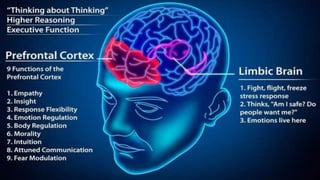
 The prefrontal cortex (PFC) is the
anterior part of the frontal lobes of
the brain, lying in front of the motor
and pre-motor areas.
 The pre- frontal cortex just lies behind
the forehead
4
ANATOMY AND CONNECTIONS OF PREFRONTAL CORTEX
 Lateral prefrontal cortex: with lots of reciprocal areas is well suited to
regulate behaviour and control of response to environmental stimuli
 Orbitomedial prefrontal cortex: via its reciprocal neocortical and
limbic connections ,is suited to integrate information about emotion
and memory related to environmental stimuli.
5
FUNCTIONS OF THE PREFRONTAL CORTEX
 Regulates thought in terms of short-term and long-term decision
making.
 Allows humans to plan ahead and create strategies, as well as to
adjust actions and
 Reactions to various situations
6
FUNCTIONS OF THE PREFRONTAL CORTEX
 Social judgements are made here
 Helps to focus thoughts
 Allows humans to pay attention, learn, and concentrate on
goals.
 evaluating complex concepts or tasks.
7
EXECUTIVE FUNCTIONING
 The most typical psychological term for functions carried out
by the prefrontal cortex area is executive function.
 Executive function relates: abilities to differentiate among
conflicting thoughts,
8
 Determine good and bad, better and best, same and different,
 Future consequences of current activities, working toward a
defined goal, prediction of outcomes, expectation based on
actions, and social "control" (the ability to suppress urges that,
if not suppressed, could lead to socially-unacceptable
outcomes).
9
10
WHAT
HAPPENS
WHEN THERE
IS DAMAGE TO
PREFRONTAL
CORTEX....????
11
 The PFC is one of the most susceptible parts of the brain to damage.
 If the PFC is damaged in some way, personality can change drastically.
For example, someone who had been outgoing can become quiet and
withdrawn after suffering injury to their pre-frontal cortex.
12
∙ Damage to the PFC can negatively impact someone’s ability
to assess situations or perform tasks, especially if they have a
moral or ethical aspect to them.
∙ People with damaged PFCs can be unable to discern
appropriate behaviour or suffer from emotional distress, such
as paranoia, anxiety, euphoria, and irritability
13
MAJOR SUBSTRUCTURES
 Superior Frontal Gyrus – involved in self awareness
 Inferior Frontal Gyrus – involved in go/no go tasks and risk
aversion
 Broca’s Area– involved in speech and language production
14
conclusion
∙ The prefrontal cortex (PFC) is the anterior part of the frontal lobes of
the brain, lying in front of the motor and pre-motor areas.
∙ Damage to the PFC can negatively impact someone’s ability to
assess situations or perform tasks, especially if they have a moral or
ethical aspect to them
15
References
 Introduction to psychology – Clifford Morgan
 Textbook of Psychiatry – Niraj Ahuja
16
17

prefrontal cortex

  • 1.
  • 2.
    1. Introduction 2. Anatomy 3.Functions 4. Applied anatomy 2
  • 3.
  • 4.
     The prefrontalcortex (PFC) is the anterior part of the frontal lobes of the brain, lying in front of the motor and pre-motor areas.  The pre- frontal cortex just lies behind the forehead 4
  • 5.
    ANATOMY AND CONNECTIONSOF PREFRONTAL CORTEX  Lateral prefrontal cortex: with lots of reciprocal areas is well suited to regulate behaviour and control of response to environmental stimuli  Orbitomedial prefrontal cortex: via its reciprocal neocortical and limbic connections ,is suited to integrate information about emotion and memory related to environmental stimuli. 5
  • 6.
    FUNCTIONS OF THEPREFRONTAL CORTEX  Regulates thought in terms of short-term and long-term decision making.  Allows humans to plan ahead and create strategies, as well as to adjust actions and  Reactions to various situations 6
  • 7.
    FUNCTIONS OF THEPREFRONTAL CORTEX  Social judgements are made here  Helps to focus thoughts  Allows humans to pay attention, learn, and concentrate on goals.  evaluating complex concepts or tasks. 7
  • 8.
    EXECUTIVE FUNCTIONING  Themost typical psychological term for functions carried out by the prefrontal cortex area is executive function.  Executive function relates: abilities to differentiate among conflicting thoughts, 8
  • 9.
     Determine goodand bad, better and best, same and different,  Future consequences of current activities, working toward a defined goal, prediction of outcomes, expectation based on actions, and social "control" (the ability to suppress urges that, if not suppressed, could lead to socially-unacceptable outcomes). 9
  • 10.
  • 11.
    WHAT HAPPENS WHEN THERE IS DAMAGETO PREFRONTAL CORTEX....???? 11
  • 12.
     The PFCis one of the most susceptible parts of the brain to damage.  If the PFC is damaged in some way, personality can change drastically. For example, someone who had been outgoing can become quiet and withdrawn after suffering injury to their pre-frontal cortex. 12
  • 13.
    ∙ Damage tothe PFC can negatively impact someone’s ability to assess situations or perform tasks, especially if they have a moral or ethical aspect to them. ∙ People with damaged PFCs can be unable to discern appropriate behaviour or suffer from emotional distress, such as paranoia, anxiety, euphoria, and irritability 13
  • 14.
    MAJOR SUBSTRUCTURES  SuperiorFrontal Gyrus – involved in self awareness  Inferior Frontal Gyrus – involved in go/no go tasks and risk aversion  Broca’s Area– involved in speech and language production 14
  • 15.
    conclusion ∙ The prefrontalcortex (PFC) is the anterior part of the frontal lobes of the brain, lying in front of the motor and pre-motor areas. ∙ Damage to the PFC can negatively impact someone’s ability to assess situations or perform tasks, especially if they have a moral or ethical aspect to them 15
  • 16.
    References  Introduction topsychology – Clifford Morgan  Textbook of Psychiatry – Niraj Ahuja 16
  • 17.