A Short
History of
BIG
DATA
1944
16years
EVERY
Fremont
Rider, Wesleyan
University
Librarian, publishes
The Scholar and the
Future of the
Research Library.
He estimates that
American university
libraries were
doubling in size every
sixteen years.
X 2
Facts taken from A Very Short History Of Big Data by Gil Press – Forbes.com
1967
The “information explosion”
noted in recent years makes it
essential that storage
requirements for all information
be kept to a minimum. A fully
automatic and rapid three-part
compressor which can be used
with “any” body of information to
greatly reduce slow external
storage requirements and to
increase the rate of information
transmission through a
computer is described in this
paper.
Automatic
Data
Compression
published by
B. A. Marron &
Paul de Maine
from the Abstract
Facts taken from A Very Short History Of Big Data by Gil Press – Forbes.com
1980
“I believe that large
amounts of data are
being retained because
users have no way of
identifying obsolete
data; the penalties for
storing obsolete data
are less apparent than
are the penalties for
discarding potentially
useful data.”
I.A. Tjomsland gives
the talk titled
“Where Do We Go
From Here?”
Facts taken from A Very Short History Of Big Data by Gil Press – Forbes.com
1996
Facts taken from A Very Short History Of Big Data by Gil Press – Forbes.com
Digital storage
becomes more
cost-effective
for storing
data than
paper
VS
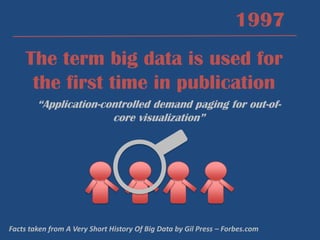
1997
Facts taken from A Very Short History Of Big Data by Gil Press – Forbes.com
The term big data is used for
the first time in publication
“Application-controlled demand paging for out-of-
core visualization”
1998
Facts taken from A Very Short History Of Big Data by Gil Press – Forbes.com
400%
1997 1998 1999 2000
GROWTH RATE OF INTERNET
200%
0%
Data Traffic
Voice Traffic
by
2002
“The Size and Growth
Rate of the Internet.”
1999
Facts taken from A Very Short History Of Big Data by Gil Press – Forbes.com
≈ 1.5
Study finds that in 1999
the world produced
exabytes of unique
information
X 250
exabytes of unique
information
For every man, woman, and child
2001
Volume
Facts taken from A Very Short History Of Big Data by Gil Press – Forbes.com
Velocity
Variety
Doug
Laney, an
analyst with
the Meta
Group, coins
the 3 V’s“3D Data Management:
Controlling Data
Volume, Velocity, and
Variety.”
2002
Facts taken from A Very Short History Of Big Data by Gil Press – Forbes.com
In 2002, digital
information storage
surpassed non-digital
for the first time
Facts taken from A Very Short History Of Big Data by Gil Press – Forbes.com
Database management
is a core competency
of Web 2.0
companies, so much
so that we have
sometimes referred to
these applications as
‘infoware’ rather than
merely software.”
Tim O’Reilly -
“What is Web 2.0”
2011
Facts taken from A Very Short History Of Big Data by Gil Press – Forbes.com
1986 2007
+ 25% per year
“The World’s Technological Capacity to
Store, Communicate, and Compute Information”
99.2% of all
storage capacity
was analog
94% of storage
capacity was
digital
VS
2012
Facts taken from A Very Short History Of Big Data by Gil Press – Forbes.com
Big Data is defined in “Critical Questions for Big Data” as
a cultural, technological, and scholarly phenomenon that
rests on the interplay of:
1. Technology: maximizing computation power and
algorithmic accuracy to gather, analyze, link, and
compare large data sets
2. Analysis: drawing on large data sets to identify
patterns in order to make economic, social, technical,
and legal claims.
3. Mythology: the widespread belief that large data sets
offer a higher form of intelligence and knowledge that
can generate insights that were previously impossible,
with the aura of truth, objectivity, and accuracy.
2013
Facts taken from TATA Consultancy Services
SALES
MARKETING
CUSTOMER SERVICE
R&D
IT
MANUFACTURING
FINANCE
LOGISTICS
HR
15.2%
15%
13.3%
11.3%
11.1%
8.3%
7.7%
6.7%
5%
Where Are Companies
Focusing Big Data
Professionals Who
Analyze Big Data
In an IT Function
In Business Functions That
Use the Data
In a Separate Big Data Group
2013
Introducing Observato™
 Independent Data Archive
 Complete Transaction Record
 Multi-system Data Tracking/History
 Fully Compliant
 Data Reporting
 Easy to Navigate UI
Helping businesses manage their big
data, in a big way.
This SlideShare is a visual presentation of the article “A
Very Short History of Big Data” by Gil Press, taken from
Forbes.com.
Additional sources are cited within the text.
Realise Data Systems is a business solution technology
provider that specializes in workforce management system
integrations and offers a one-of-a-kind data tracking
application called Observato. Our mission is to transform
service organizations worldwide with
independent, professional, and trustworthy
implementation, consulting, and enterprise auditing services
that will improve efficiency and help to deliver first-class
customer service.
Please visit www.realisedatasystems.com/observato
for more information.

A Short History of Big Data

  • 1.
  • 2.
    1944 16years EVERY Fremont Rider, Wesleyan University Librarian, publishes TheScholar and the Future of the Research Library. He estimates that American university libraries were doubling in size every sixteen years. X 2 Facts taken from A Very Short History Of Big Data by Gil Press – Forbes.com
  • 3.
    1967 The “information explosion” notedin recent years makes it essential that storage requirements for all information be kept to a minimum. A fully automatic and rapid three-part compressor which can be used with “any” body of information to greatly reduce slow external storage requirements and to increase the rate of information transmission through a computer is described in this paper. Automatic Data Compression published by B. A. Marron & Paul de Maine from the Abstract Facts taken from A Very Short History Of Big Data by Gil Press – Forbes.com
  • 4.
    1980 “I believe thatlarge amounts of data are being retained because users have no way of identifying obsolete data; the penalties for storing obsolete data are less apparent than are the penalties for discarding potentially useful data.” I.A. Tjomsland gives the talk titled “Where Do We Go From Here?” Facts taken from A Very Short History Of Big Data by Gil Press – Forbes.com
  • 5.
    1996 Facts taken fromA Very Short History Of Big Data by Gil Press – Forbes.com Digital storage becomes more cost-effective for storing data than paper VS
  • 6.
    1997 Facts taken fromA Very Short History Of Big Data by Gil Press – Forbes.com The term big data is used for the first time in publication “Application-controlled demand paging for out-of- core visualization”
  • 7.
    1998 Facts taken fromA Very Short History Of Big Data by Gil Press – Forbes.com 400% 1997 1998 1999 2000 GROWTH RATE OF INTERNET 200% 0% Data Traffic Voice Traffic by 2002 “The Size and Growth Rate of the Internet.”
  • 8.
    1999 Facts taken fromA Very Short History Of Big Data by Gil Press – Forbes.com ≈ 1.5 Study finds that in 1999 the world produced exabytes of unique information X 250 exabytes of unique information For every man, woman, and child
  • 9.
    2001 Volume Facts taken fromA Very Short History Of Big Data by Gil Press – Forbes.com Velocity Variety Doug Laney, an analyst with the Meta Group, coins the 3 V’s“3D Data Management: Controlling Data Volume, Velocity, and Variety.”
  • 10.
    2002 Facts taken fromA Very Short History Of Big Data by Gil Press – Forbes.com In 2002, digital information storage surpassed non-digital for the first time
  • 11.
    Facts taken fromA Very Short History Of Big Data by Gil Press – Forbes.com Database management is a core competency of Web 2.0 companies, so much so that we have sometimes referred to these applications as ‘infoware’ rather than merely software.” Tim O’Reilly - “What is Web 2.0”
  • 12.
    2011 Facts taken fromA Very Short History Of Big Data by Gil Press – Forbes.com 1986 2007 + 25% per year “The World’s Technological Capacity to Store, Communicate, and Compute Information” 99.2% of all storage capacity was analog 94% of storage capacity was digital VS
  • 13.
    2012 Facts taken fromA Very Short History Of Big Data by Gil Press – Forbes.com Big Data is defined in “Critical Questions for Big Data” as a cultural, technological, and scholarly phenomenon that rests on the interplay of: 1. Technology: maximizing computation power and algorithmic accuracy to gather, analyze, link, and compare large data sets 2. Analysis: drawing on large data sets to identify patterns in order to make economic, social, technical, and legal claims. 3. Mythology: the widespread belief that large data sets offer a higher form of intelligence and knowledge that can generate insights that were previously impossible, with the aura of truth, objectivity, and accuracy.
  • 14.
    2013 Facts taken fromTATA Consultancy Services SALES MARKETING CUSTOMER SERVICE R&D IT MANUFACTURING FINANCE LOGISTICS HR 15.2% 15% 13.3% 11.3% 11.1% 8.3% 7.7% 6.7% 5% Where Are Companies Focusing Big Data Professionals Who Analyze Big Data In an IT Function In Business Functions That Use the Data In a Separate Big Data Group
  • 15.
    2013 Introducing Observato™  IndependentData Archive  Complete Transaction Record  Multi-system Data Tracking/History  Fully Compliant  Data Reporting  Easy to Navigate UI Helping businesses manage their big data, in a big way.
  • 16.
    This SlideShare isa visual presentation of the article “A Very Short History of Big Data” by Gil Press, taken from Forbes.com. Additional sources are cited within the text. Realise Data Systems is a business solution technology provider that specializes in workforce management system integrations and offers a one-of-a-kind data tracking application called Observato. Our mission is to transform service organizations worldwide with independent, professional, and trustworthy implementation, consulting, and enterprise auditing services that will improve efficiency and help to deliver first-class customer service. Please visit www.realisedatasystems.com/observato for more information.