Big Data
Imagine yourself slumped on a chair on a lazy afternoon staring at the desktop, mouse in
hand, browsing through your Facebook feed. You find an Oatmeal post mildly amusing and
you click the ‘’thumbs up’ icon, thus registering a passive ‘like’ on the post. Congratulations,
you are a tiny part of the contingent that will press the ‘like’ button 2.7 billion times a day.
Data is omnipresent. Every click on your browser, comments, likes, posts on Instagram
contributes to the sea of data we are drowning in. ‘Exponential’ is an understatement to
describe the rate of growth in information that is whizzing around the web. Eventually your
storage space runs out and it’s not the size of your average hard disk (you read it right).This
huge, non-structured arrays of data as a result of the unprecedented rate of its creation is
called as Big Data. Wikipedia defines it as a blanket term for collection of large and complex
data sets. Think of the largest ocean, multiply it by a factor of 100 and fill it with random
data. You are nowhere close to reality. Big data stays true to its name, which literally is a lot
of data.
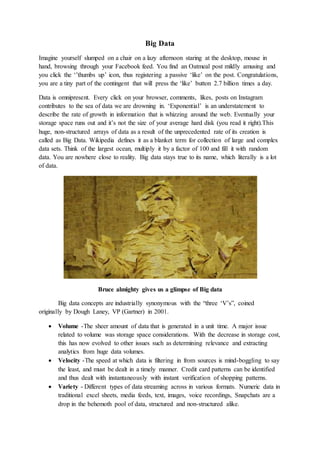
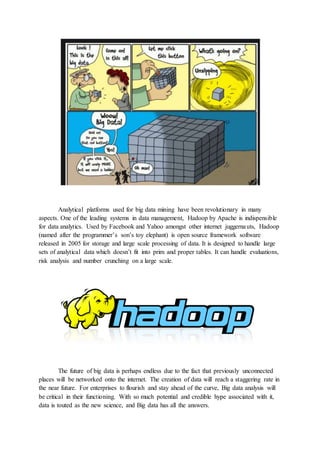
Bruce almighty gives us a glimpse of Big data
Big data concepts are industrially synonymous with the “three ‘V’s”, coined
originally by Dough Laney, VP (Gartner) in 2001.
 Volume -The sheer amount of data that is generated in a unit time. A major issue
related to volume was storage space considerations. With the decrease in storage cost,
this has now evolved to other issues such as determining relevance and extracting
analytics from huge data volumes.
 Velocity -The speed at which data is filtering in from sources is mind-boggling to say
the least, and must be dealt in a timely manner. Credit card patterns can be identified
and thus dealt with instantaneously with instant verification of shopping patterns.
 Variety - Different types of data streaming across in various formats. Numeric data in
traditional excel sheets, media feeds, text, images, voice recordings, Snapchats are a
drop in the behemoth pool of data, structured and non-structured alike.
In course of time, additional factors emerged related to Big Data which is deemed to be
integral to the concept.
 Veracity - The correctness and accuracy in the sheer messiness of data (random
hashtags on Twitter, typographical errors in slang language)
 Variability - Daily, seasonal and event-based driven data load vary over time and can
be extremely difficult to manage.
From the advent of civilization to circa 2003, we manage to create just over 5 exabytes of
information (10^18 bytes) which astoundingly is now generated in just two days. A trending
hot topic at the moment, Big Data will eventually seep into every aspect of our lives, already
affecting many genres evidently and subtly.
1. Understanding target demographics-
If the recent Indian poll campaigns were a hint, data analytics can make or break prime
ministerial bids. Narendra Modi’s campaign was a novelty in itself, targeting the youth
bracket in particular with a torrent of goodwill promises via social networking sites and other
cyber avenues culminating in 3D holographic preaching images of him around the country.
Needless to say, it worked wonders.
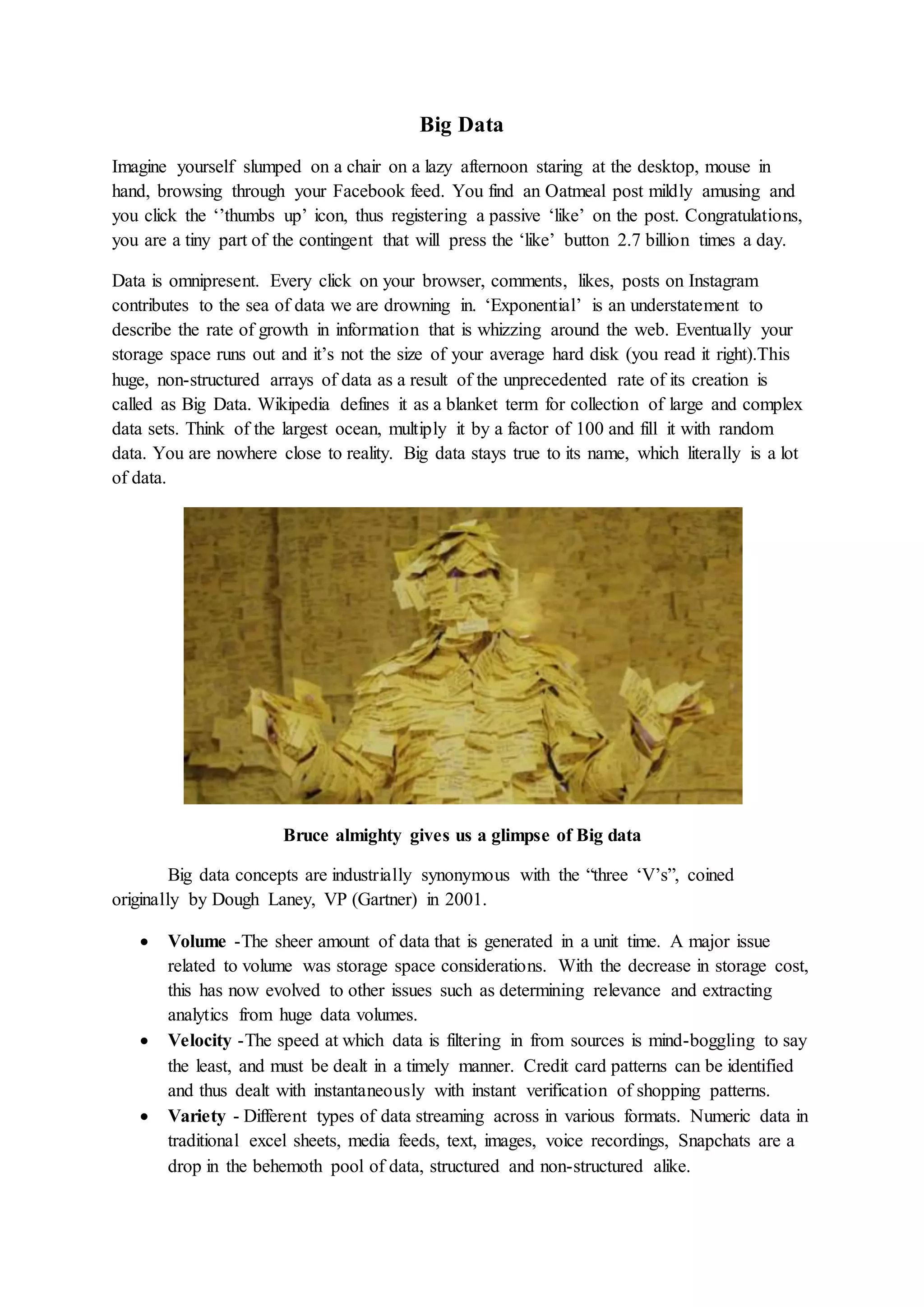
Our Prime Minister’s Twitter Handle
2. Improving business procedures-
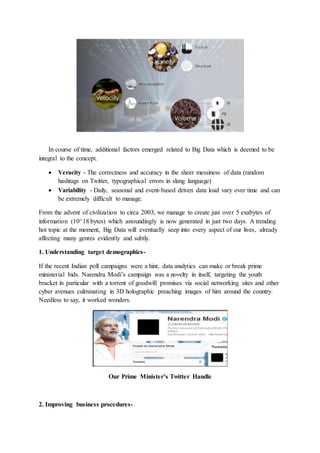
UPS, one of the largest shipment and delivery services in the world is surely no stranger to
big data management. Storing over 16 pentabytes of information in their database, they rely
on the acquisition of data primarily from sensors in their delivery vehicles. Analysis of speed,
direction, online mapping, braking and routing of vehicles consequently leading to derivation
of shorter efficient routes has saved them over 8.4 million gallons of fuel. With oil prices
skyrocketing in recent times, that is some substantial amount of saving. Optimizing of
business procedures to its zenith, Big data is also utilised in stock predictions and weather
forecasts.
3. Advancement in Sports-
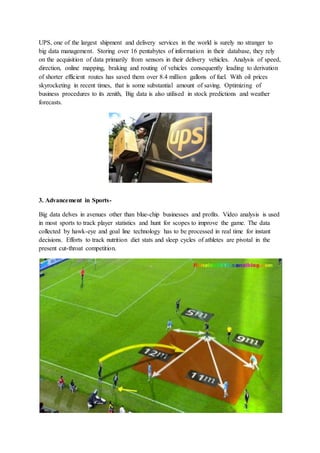
Big data delves in avenues other than blue-chip businesses and profits. Video analysis is used
in most sports to track player statistics and hunt for scopes to improve the game. The data
collected by hawk-eye and goal line technology has to be processed in real time for instant
decisions. Efforts to track nutrition diet stats and sleep cycles of athletes are pivotal in the
present cut-throat competition.
Ronaldo,tightly marked by Celta Vigo
4. Law and Security enforcement-
Interception of messages from enemy camps were ancient art.Fast forward centuries, and it is
still considered as the first line of defence. Security agencies are constantly on the lookout for
anti-patriotic messages, terrorist cell transmissions and threats. Scanning of vast relevant and
non-relevant data on an intensive level across all sources is a serious task undertaken by such
agencies. The NSA took it a step further, resulting in alleged cases of ‘snooping’ surfacing to
public uproar.
Many businesses have inkling about the ‘Big data’ elephant in the room, but not many
have completely delved into its capabilities. Dan Ariely, a Duke University Economics
professor once proclaimed “Big data is like teenage sex: everyone talks about it, nobody
really knows how to do it, and everyone thinks everyone else is doing it, so everyone claims
they are doing it”. Numerous enterprises are putting their toe in the pool and testing the
waters just yet. Use of Big data to outperform their peers in terms of consumers by analysis
of retail and social habits, frequent usage of services relating to their usage etc will emerge to
be the norm in the near future. Google and YouTube, amongst many others keep a track of
your browsing pattern and conveniently display suitable adaptive advertisements.
Analytical platforms used for big data mining have been revolutionary in many
aspects. One of the leading systems in data management, Hadoop by Apache is indispensible
for data analytics. Used by Facebook and Yahoo amongst other internet juggernauts, Hadoop
(named after the programmer’s son’s toy elephant) is open source framework software
released in 2005 for storage and large scale processing of data. It is designed to handle large
sets of analytical data which doesn’t fit into prim and proper tables. It can handle evaluations,
risk analysis and number crunching on a large scale.
The future of big data is perhaps endless due to the fact that previously unconnected
places will be networked onto the internet. The creation of data will reach a staggering rate in
the near future. For enterprises to flourish and stay ahead of the curve, Big data analysis will
be critical in their functioning. With so much potential and credible hype associated with it,
data is touted as the new science, and Big data has all the answers.
Big Data-Job 2

Big Data-Job 2

  • 1.
    Big Data Imagine yourselfslumped on a chair on a lazy afternoon staring at the desktop, mouse in hand, browsing through your Facebook feed. You find an Oatmeal post mildly amusing and you click the ‘’thumbs up’ icon, thus registering a passive ‘like’ on the post. Congratulations, you are a tiny part of the contingent that will press the ‘like’ button 2.7 billion times a day. Data is omnipresent. Every click on your browser, comments, likes, posts on Instagram contributes to the sea of data we are drowning in. ‘Exponential’ is an understatement to describe the rate of growth in information that is whizzing around the web. Eventually your storage space runs out and it’s not the size of your average hard disk (you read it right).This huge, non-structured arrays of data as a result of the unprecedented rate of its creation is called as Big Data. Wikipedia defines it as a blanket term for collection of large and complex data sets. Think of the largest ocean, multiply it by a factor of 100 and fill it with random data. You are nowhere close to reality. Big data stays true to its name, which literally is a lot of data. Bruce almighty gives us a glimpse of Big data Big data concepts are industrially synonymous with the “three ‘V’s”, coined originally by Dough Laney, VP (Gartner) in 2001.  Volume -The sheer amount of data that is generated in a unit time. A major issue related to volume was storage space considerations. With the decrease in storage cost, this has now evolved to other issues such as determining relevance and extracting analytics from huge data volumes.  Velocity -The speed at which data is filtering in from sources is mind-boggling to say the least, and must be dealt in a timely manner. Credit card patterns can be identified and thus dealt with instantaneously with instant verification of shopping patterns.  Variety - Different types of data streaming across in various formats. Numeric data in traditional excel sheets, media feeds, text, images, voice recordings, Snapchats are a drop in the behemoth pool of data, structured and non-structured alike.
  • 2.
    In course oftime, additional factors emerged related to Big Data which is deemed to be integral to the concept.  Veracity - The correctness and accuracy in the sheer messiness of data (random hashtags on Twitter, typographical errors in slang language)  Variability - Daily, seasonal and event-based driven data load vary over time and can be extremely difficult to manage. From the advent of civilization to circa 2003, we manage to create just over 5 exabytes of information (10^18 bytes) which astoundingly is now generated in just two days. A trending hot topic at the moment, Big Data will eventually seep into every aspect of our lives, already affecting many genres evidently and subtly. 1. Understanding target demographics- If the recent Indian poll campaigns were a hint, data analytics can make or break prime ministerial bids. Narendra Modi’s campaign was a novelty in itself, targeting the youth bracket in particular with a torrent of goodwill promises via social networking sites and other cyber avenues culminating in 3D holographic preaching images of him around the country. Needless to say, it worked wonders. Our Prime Minister’s Twitter Handle 2. Improving business procedures-
  • 3.
    UPS, one ofthe largest shipment and delivery services in the world is surely no stranger to big data management. Storing over 16 pentabytes of information in their database, they rely on the acquisition of data primarily from sensors in their delivery vehicles. Analysis of speed, direction, online mapping, braking and routing of vehicles consequently leading to derivation of shorter efficient routes has saved them over 8.4 million gallons of fuel. With oil prices skyrocketing in recent times, that is some substantial amount of saving. Optimizing of business procedures to its zenith, Big data is also utilised in stock predictions and weather forecasts. 3. Advancement in Sports- Big data delves in avenues other than blue-chip businesses and profits. Video analysis is used in most sports to track player statistics and hunt for scopes to improve the game. The data collected by hawk-eye and goal line technology has to be processed in real time for instant decisions. Efforts to track nutrition diet stats and sleep cycles of athletes are pivotal in the present cut-throat competition.
  • 4.
    Ronaldo,tightly marked byCelta Vigo 4. Law and Security enforcement- Interception of messages from enemy camps were ancient art.Fast forward centuries, and it is still considered as the first line of defence. Security agencies are constantly on the lookout for anti-patriotic messages, terrorist cell transmissions and threats. Scanning of vast relevant and non-relevant data on an intensive level across all sources is a serious task undertaken by such agencies. The NSA took it a step further, resulting in alleged cases of ‘snooping’ surfacing to public uproar. Many businesses have inkling about the ‘Big data’ elephant in the room, but not many have completely delved into its capabilities. Dan Ariely, a Duke University Economics professor once proclaimed “Big data is like teenage sex: everyone talks about it, nobody really knows how to do it, and everyone thinks everyone else is doing it, so everyone claims they are doing it”. Numerous enterprises are putting their toe in the pool and testing the waters just yet. Use of Big data to outperform their peers in terms of consumers by analysis of retail and social habits, frequent usage of services relating to their usage etc will emerge to be the norm in the near future. Google and YouTube, amongst many others keep a track of your browsing pattern and conveniently display suitable adaptive advertisements.
  • 5.
    Analytical platforms usedfor big data mining have been revolutionary in many aspects. One of the leading systems in data management, Hadoop by Apache is indispensible for data analytics. Used by Facebook and Yahoo amongst other internet juggernauts, Hadoop (named after the programmer’s son’s toy elephant) is open source framework software released in 2005 for storage and large scale processing of data. It is designed to handle large sets of analytical data which doesn’t fit into prim and proper tables. It can handle evaluations, risk analysis and number crunching on a large scale. The future of big data is perhaps endless due to the fact that previously unconnected places will be networked onto the internet. The creation of data will reach a staggering rate in the near future. For enterprises to flourish and stay ahead of the curve, Big data analysis will be critical in their functioning. With so much potential and credible hype associated with it, data is touted as the new science, and Big data has all the answers.