Outline• Forecasts and
Why Big data?
• What is Big
Data?
• Parts of the
Puzzle
• Quick Tutorial
• Conclusion
Photo by John Trainoron Flickr
http://www.flickr.com/photos/trainor/2902023575/, Licensed under CC
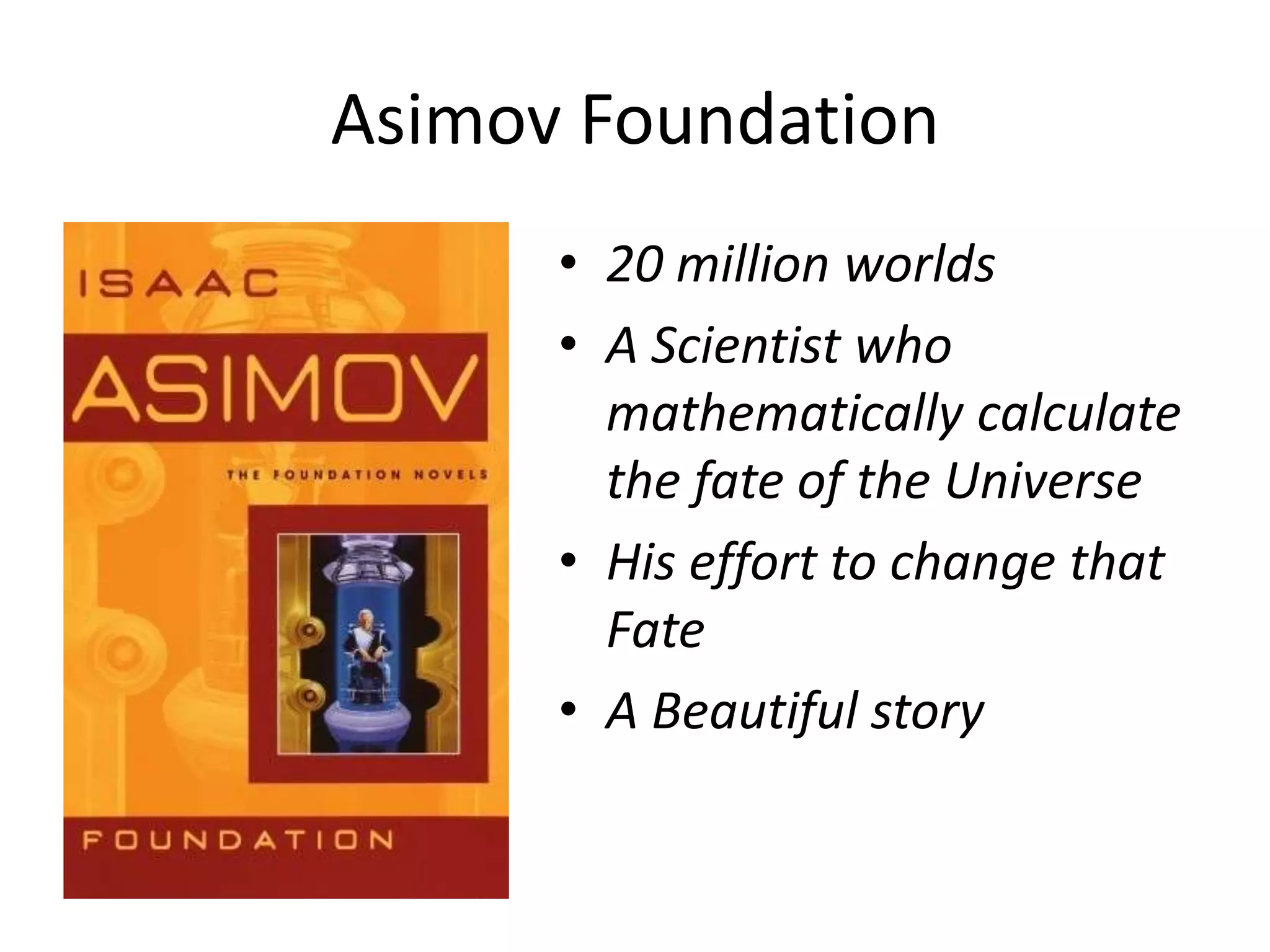
Asimov Foundation
• 20 million worlds
• A Scientist who
mathematically calculate
the fate of the Universe
• His effort to change that
Fate
• A Beautiful story
Consider a day in your life
• What is the best road to take?
• Would there be any bad
weather?
• What is the best way to invest
the money?
• Should I take that loan?
• Can I optimize my day?
• Is there a way to do this
faster?
• What have others done in
similar cases?
• Which product should I buy?
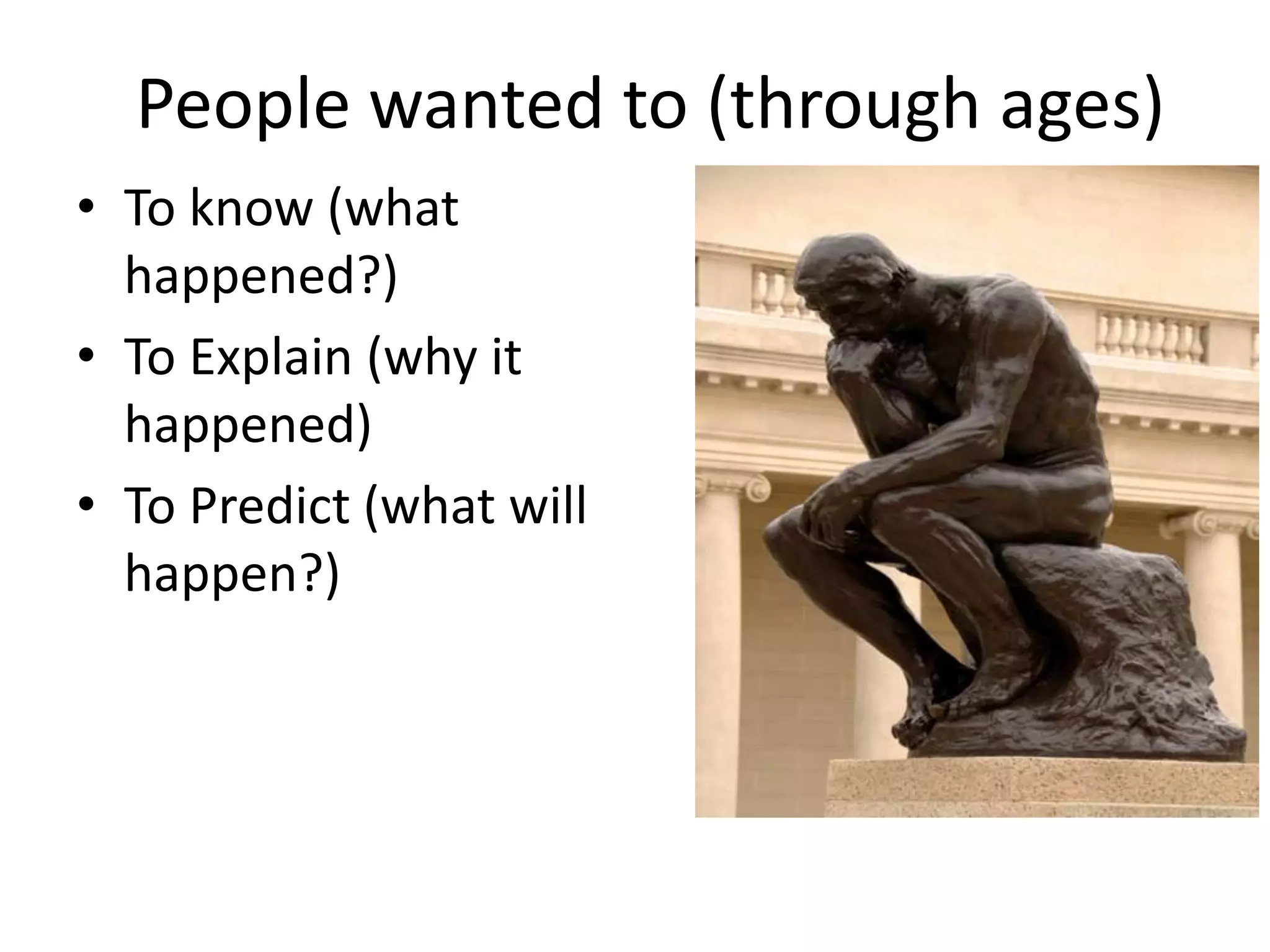
People wanted to (through ages)
• To know (what
happened?)
• To Explain (why it
happened)
• To Predict (what will
happen?)
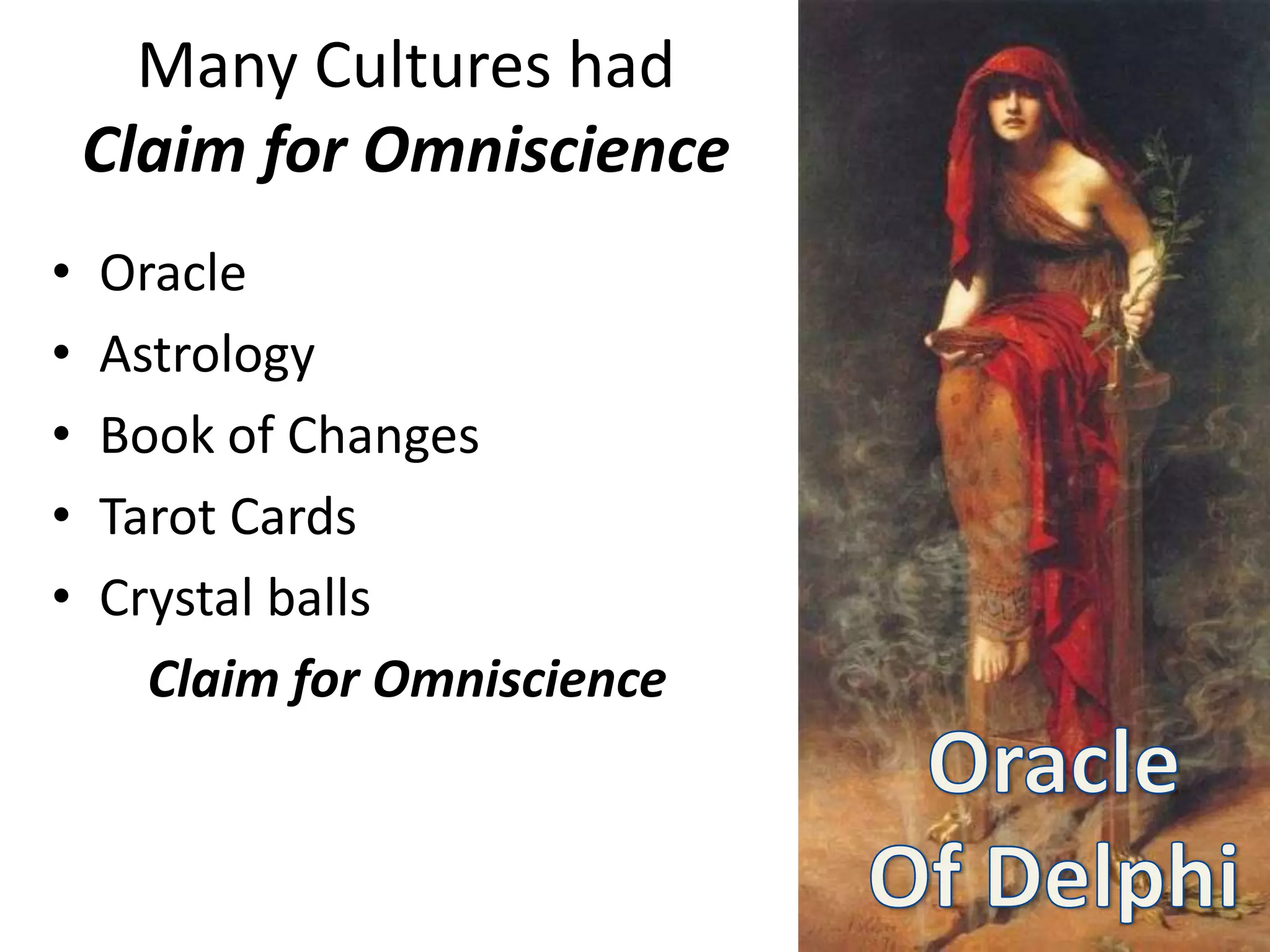
Many Cultures had
Claim for Omniscience
• Oracle
• Astrology
• Book of Changes
• Tarot Cards
• Crystal balls
Claim for Omniscience
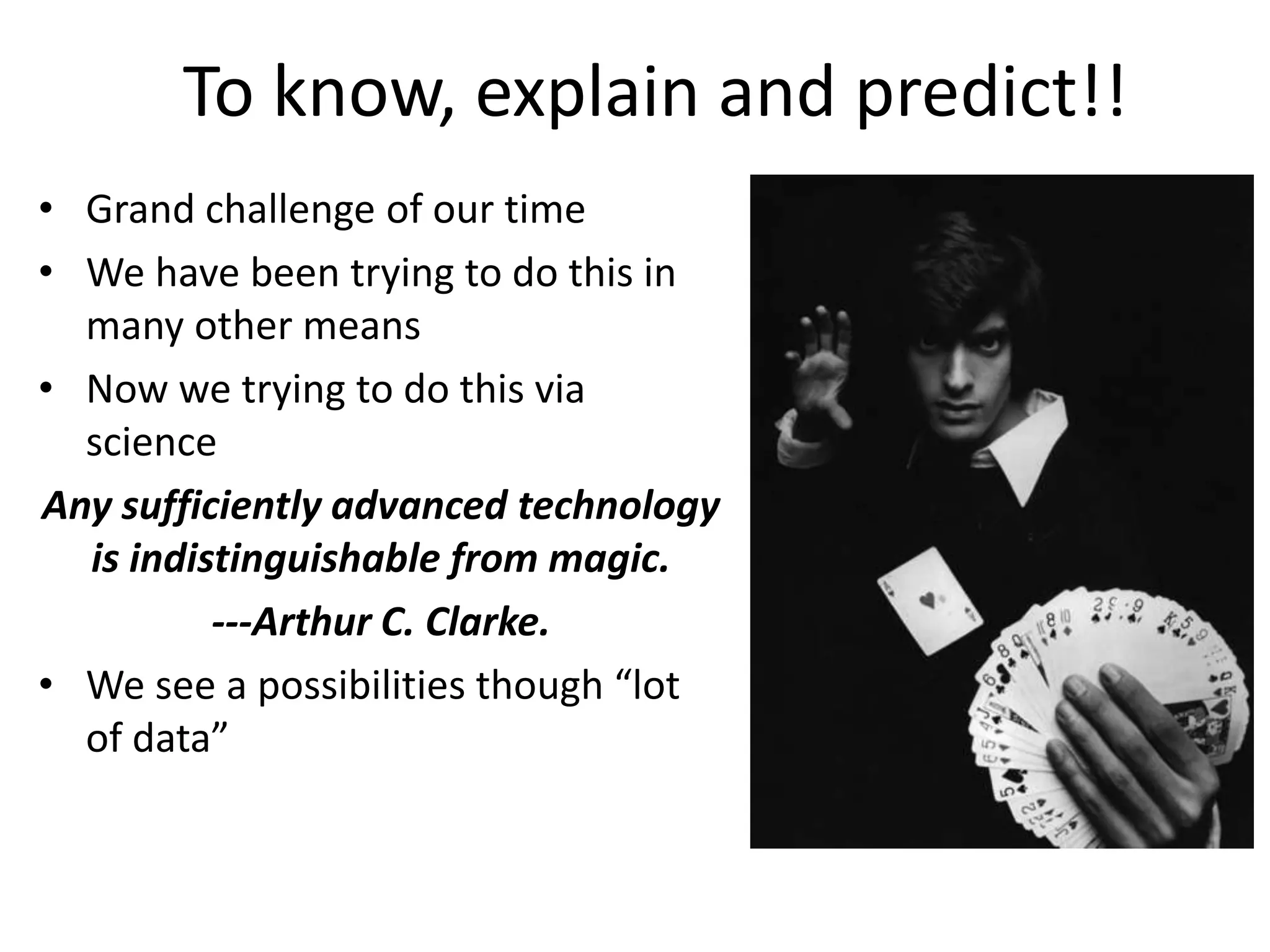
To know, explain and predict!!
• Grand challenge of our time
• We have been trying to do this in
many other means
• Now we trying to do this via
science
Any sufficiently advanced technology
is indistinguishable from magic.
---Arthur C. Clarke.
• We see a possibilities though “lot
of data”
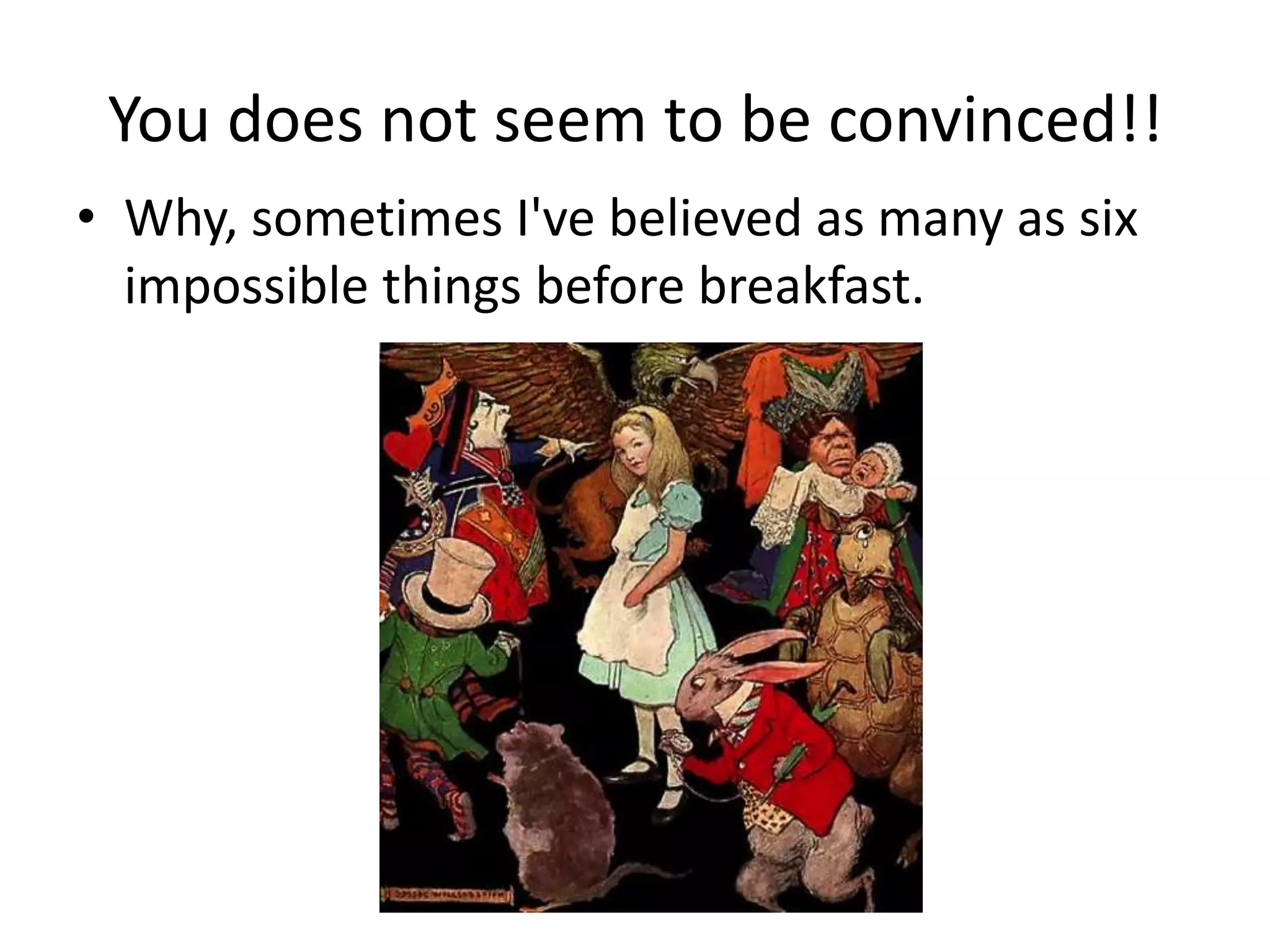
You does not seem to be convinced!!
• Why, sometimes I've believed as many as six
impossible things before breakfast.
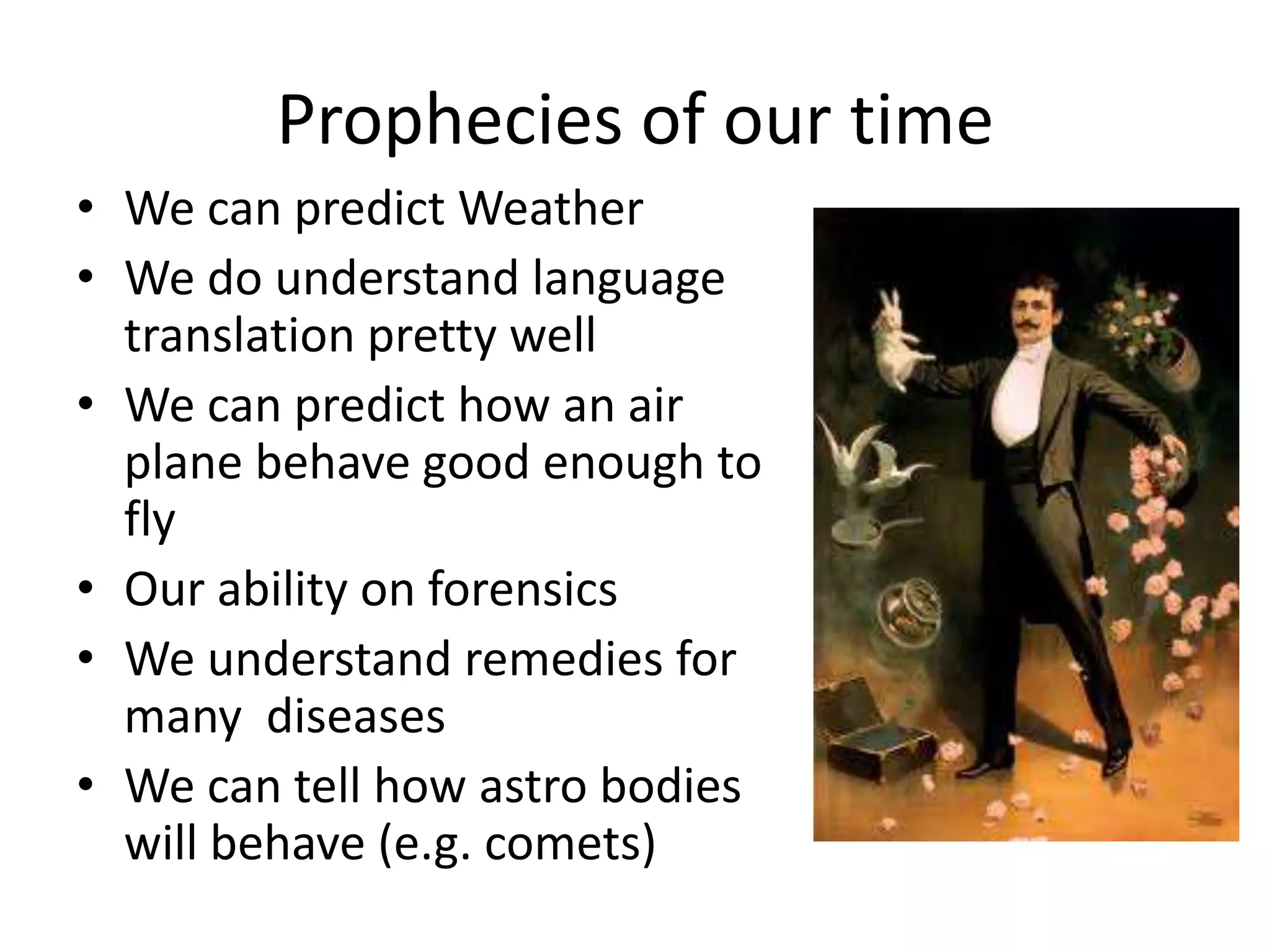
Prophecies of our time
• We can predict Weather
• We do understand language
translation pretty well
• We can predict how an air
plane behave good enough to
fly
• Our ability on forensics
• We understand remedies for
many diseases
• We can tell how astro bodies
will behave (e.g. comets)
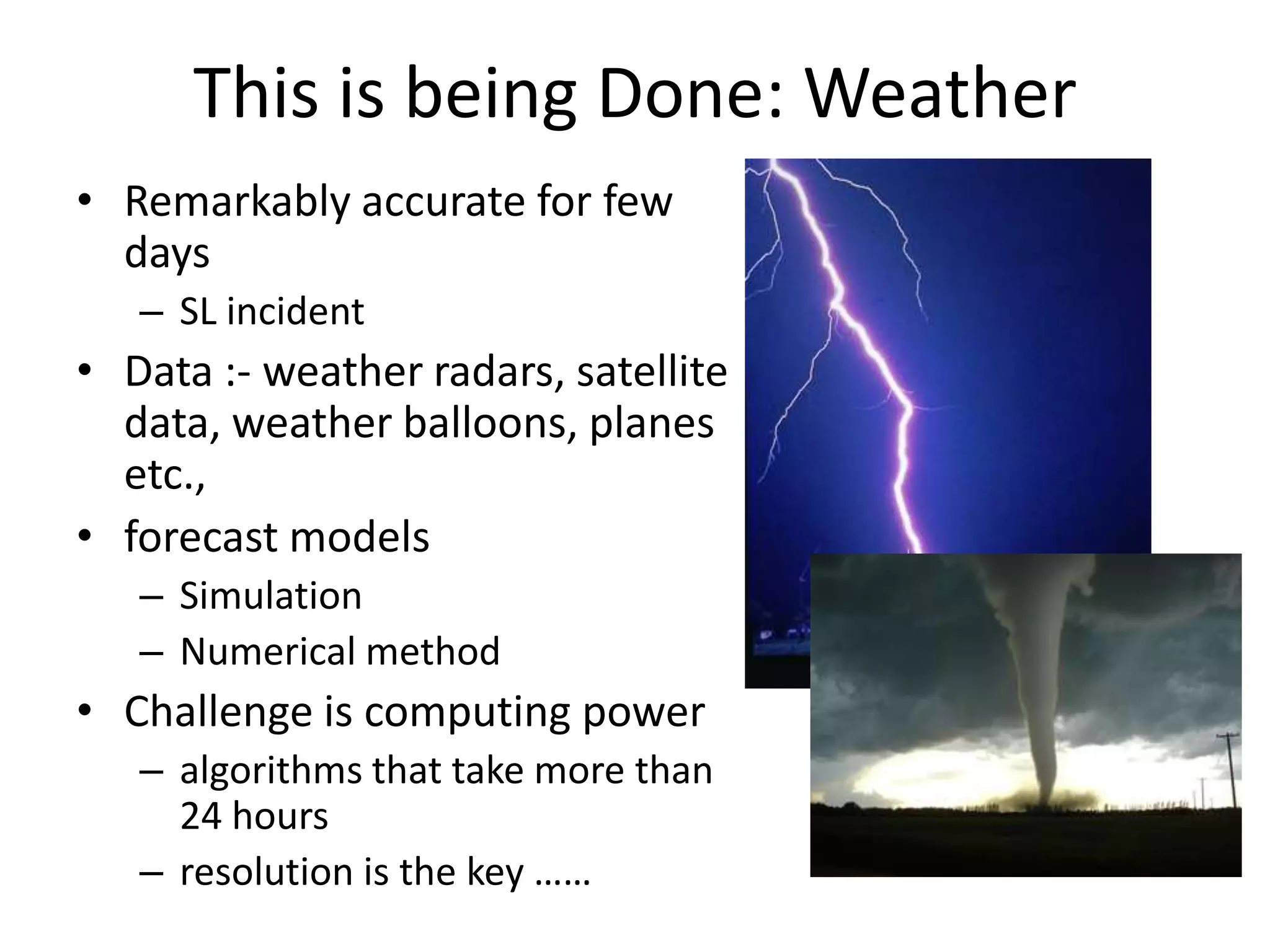
This is being Done: Weather
• Remarkably accurate for few
days
– SL incident
• Data :- weather radars, satellite
data, weather balloons, planes
etc.,
• forecast models
– Simulation
– Numerical method
• Challenge is computing power
– algorithms that take more than
24 hours
– resolution is the key ……
Democratizing Analysis
• Forecasting was done, but in limited manner
and only by few (e.g. National Labs,
Intelligence community)
• That is changing!!
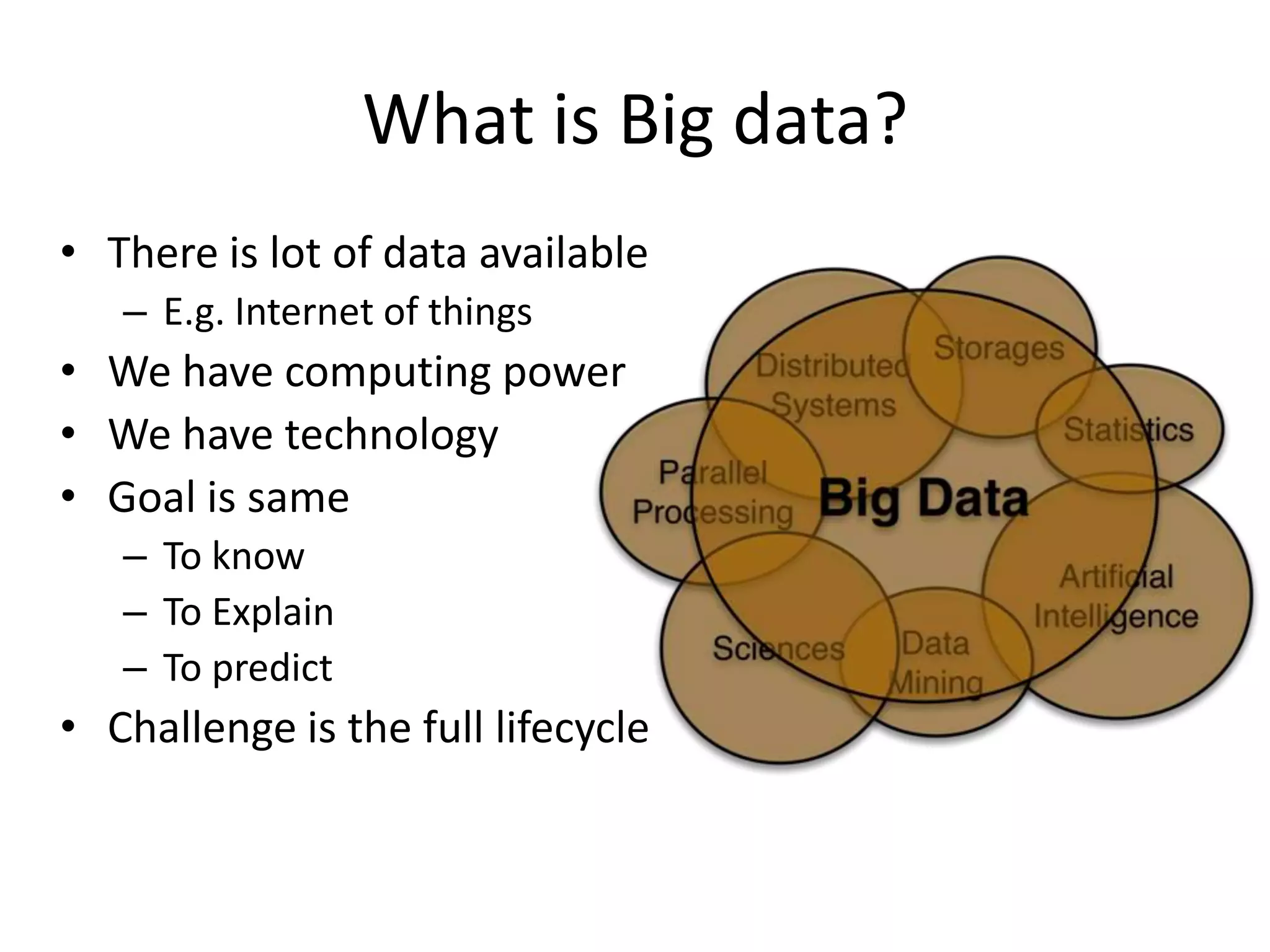
What is Big data?
• There is lot of data available
– E.g. Internet of things
• We have computing power
• We have technology
• Goal is same
– To know
– To Explain
– To predict
• Challenge is the full lifecycle
Data, the wealth of our time
"Data is a precious
thing because they last
longer than systems” -
Tim Barnes Lee
• Access to data is becoming ultimate
competitive advantage
– E.g. Google+ vs. Facebook
– Why many organizations try hard to give us free
things and keep us always logged in (e.g. Gmail,
facebook, search engine tool bars)
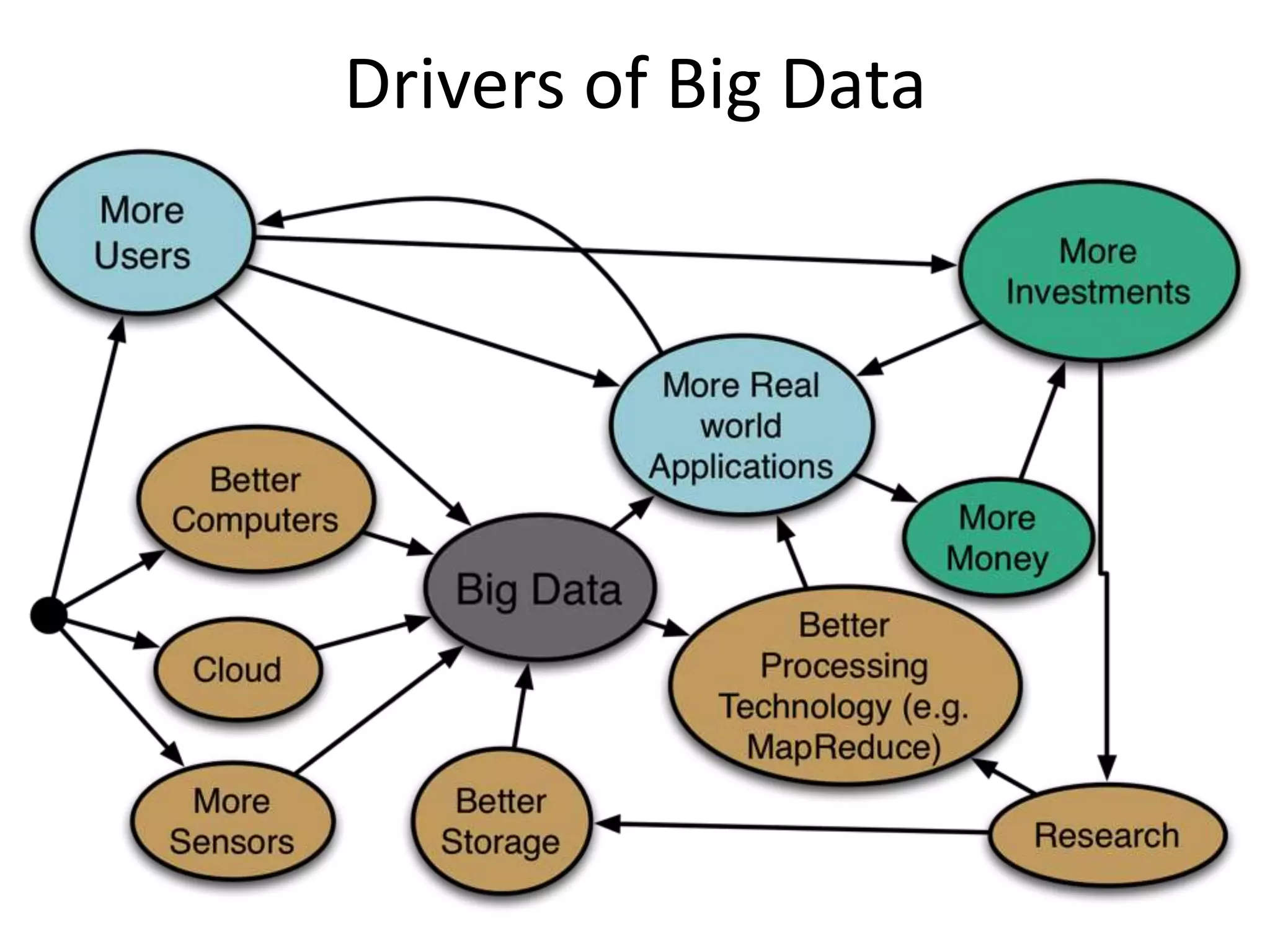
Drivers of Big Data
Data Avalanche/ Moore’s law of data
• We are now collecting and converting large amount
of data to digital forms
• 90% of the data in the world today was created
within the past two years.
• Amount of data we have doubles very fast
In real life, most data are Big
• Web does millions of activities per second, and so
much server logs are created.
• Social networks e.g. Facebook, 800 Million active
users, 40 billion photos from its user base.
• There are >4 billion phones and >25% are smart
phones. There are billions of RFID tags.
• Observational and Sensor data
– Weather Radars, Balloons
– Environmental Sensors
– Telescopes
– Complex physics simulations
Why Big Data is hard?
• How store? Assuming 1TB bytes it
takes 1000 computers to store a 1PB
• How to move? Assuming 10Gb
network, it takes 2 hours to copy 1TB,
or 83 days to copy a 1PB
• How to search? Assuming each record
is 1KB and one machine can process
1000 records per sec, it needs 277CPU
days to process a 1TB and 785 CPU
years to process a 1 PB
• How to process?
– How to convert algorithms to work in large
size
– How to create new algorithms
http://www.susanica.com/photo/9
Why it is hard (Contd.)?
• System build of many
computers
• That handles lots of data
• Running complex logic
• This pushes us to frontier of
Distributed Systems and
Databases
• More data does not mean
there is a simple model
• Some models can be complex
as the system
http://www.flickr.com/photos/mariachily/5250487136,
Licensed CC
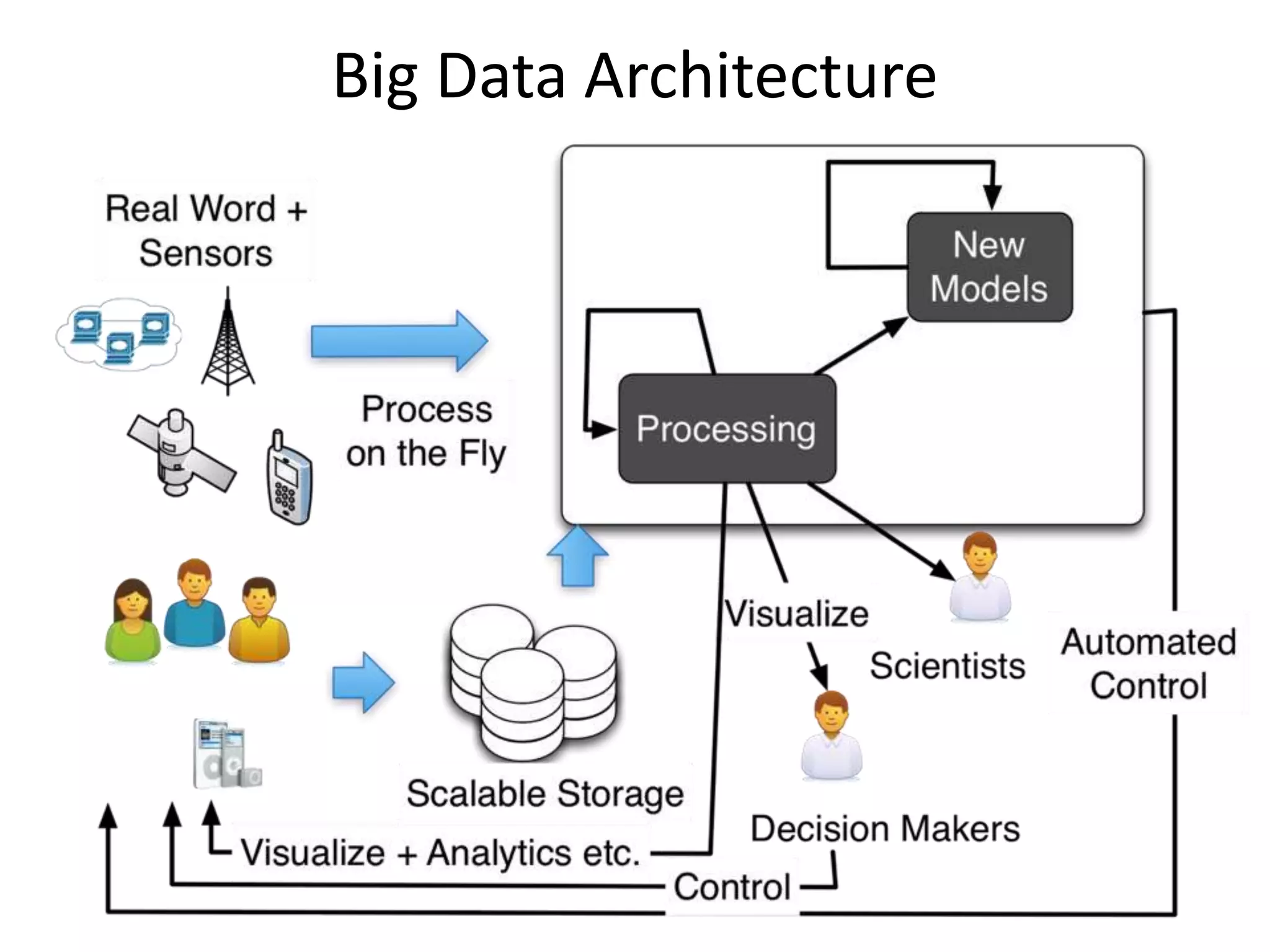
Big Data Architecture
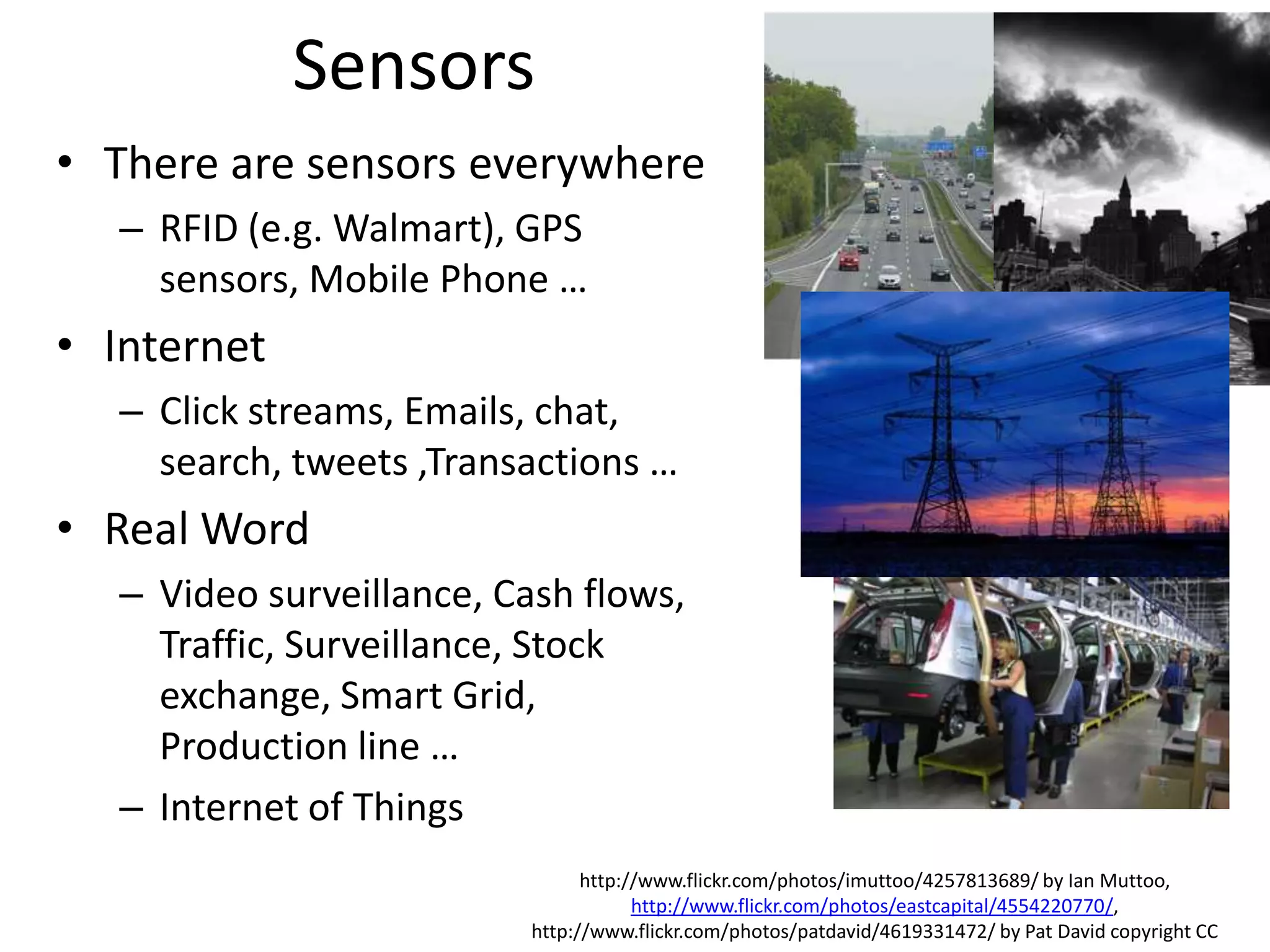
Sensors
• There are sensors everywhere
– RFID (e.g. Walmart), GPS
sensors, Mobile Phone …
• Internet
– Click streams, Emails, chat,
search, tweets ,Transactions …
• Real Word
– Video surveillance, Cash flows,
Traffic, Surveillance, Stock
exchange, Smart Grid,
Production line …
– Internet of Things
http://www.flickr.com/photos/imuttoo/4257813689/ by Ian Muttoo,
http://www.flickr.com/photos/eastcapital/4554220770/,
http://www.flickr.com/photos/patdavid/4619331472/ by Pat David copyright CC
Collecting Data
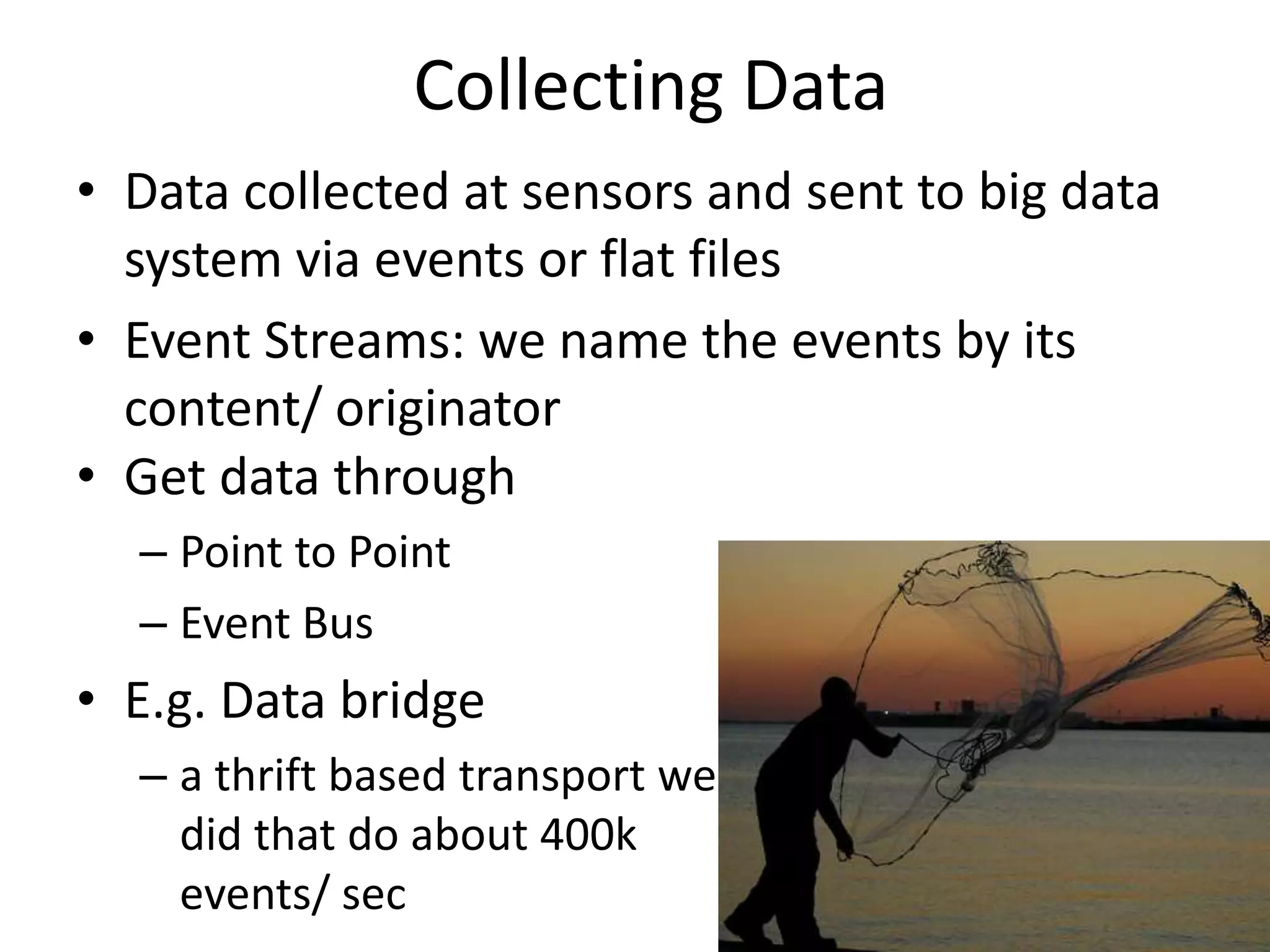
• Data collected at sensors and sent to big data
system via events or flat files
• Event Streams: we name the events by its
content/ originator
• Get data through
– Point to Point
– Event Bus
• E.g. Data bridge
– a thrift based transport we
did that do about 400k
events/ sec
Storing Data
• Historically we used databases
– Scale is a challenge: replication,
sharding
• Scalable options
– NoSQL (Cassandra, Hbase) [If
data is structured]
• Column families Gaining Ground
– Distributed file systems (e.g.
HDFS) [If data is unstructured]
• New SQL
– In Memory computing, VoltDB
• Specialized data structures
– Graph Databases, Data structure
servers http://www.flickr.com/photos/keso/3631339
67/
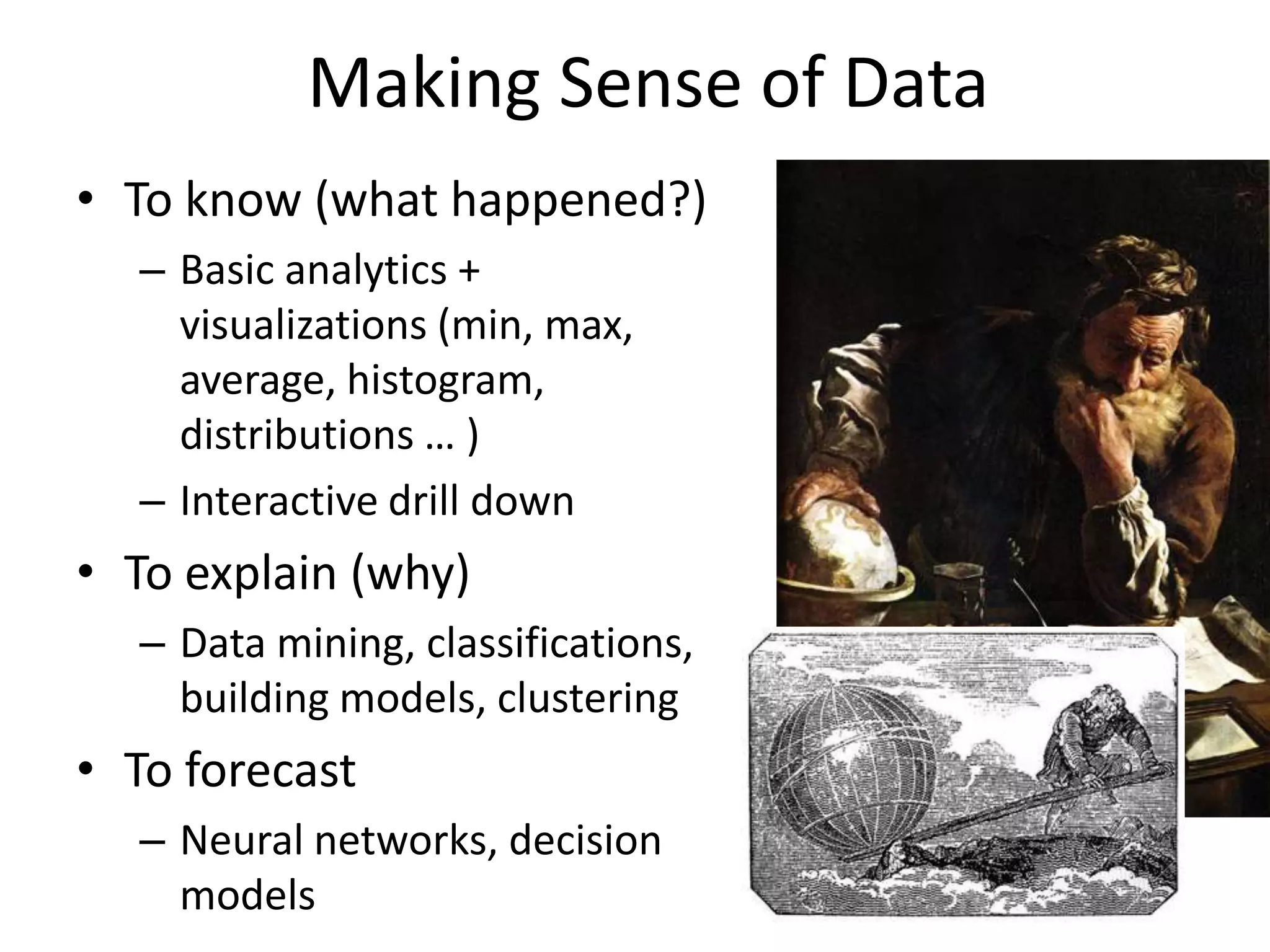
Making Sense of Data
• To know (what happened?)
– Basic analytics +
visualizations (min, max,
average, histogram,
distributions … )
– Interactive drill down
• To explain (why)
– Data mining, classifications,
building models, clustering
• To forecast
– Neural networks, decision
models
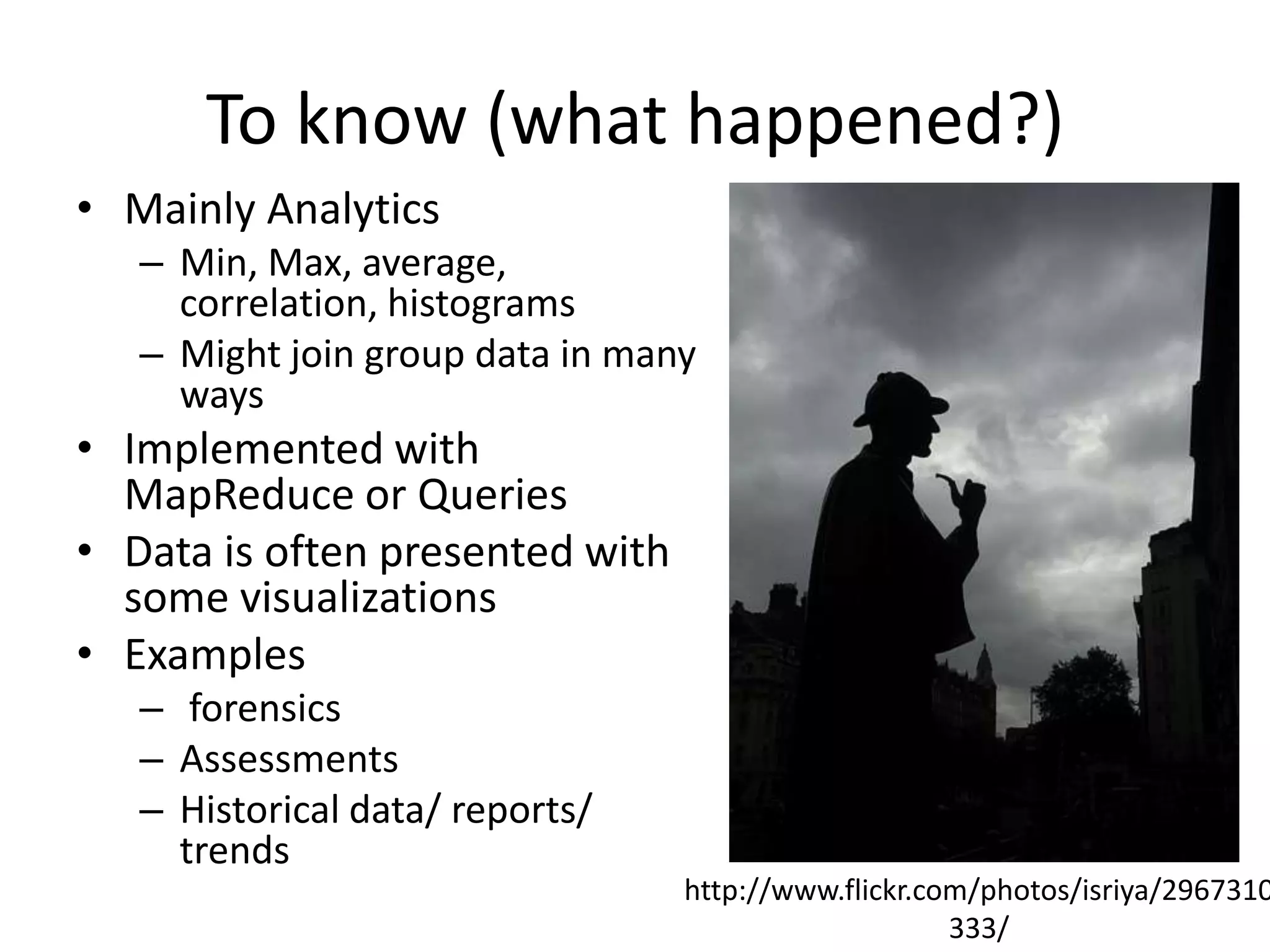
To know (what happened?)
• Mainly Analytics
– Min, Max, average,
correlation, histograms
– Might join group data in many
ways
• Implemented with
MapReduce or Queries
• Data is often presented with
some visualizations
• Examples
– forensics
– Assessments
– Historical data/ reports/
trends
http://www.flickr.com/photos/isriya/2967310
333/
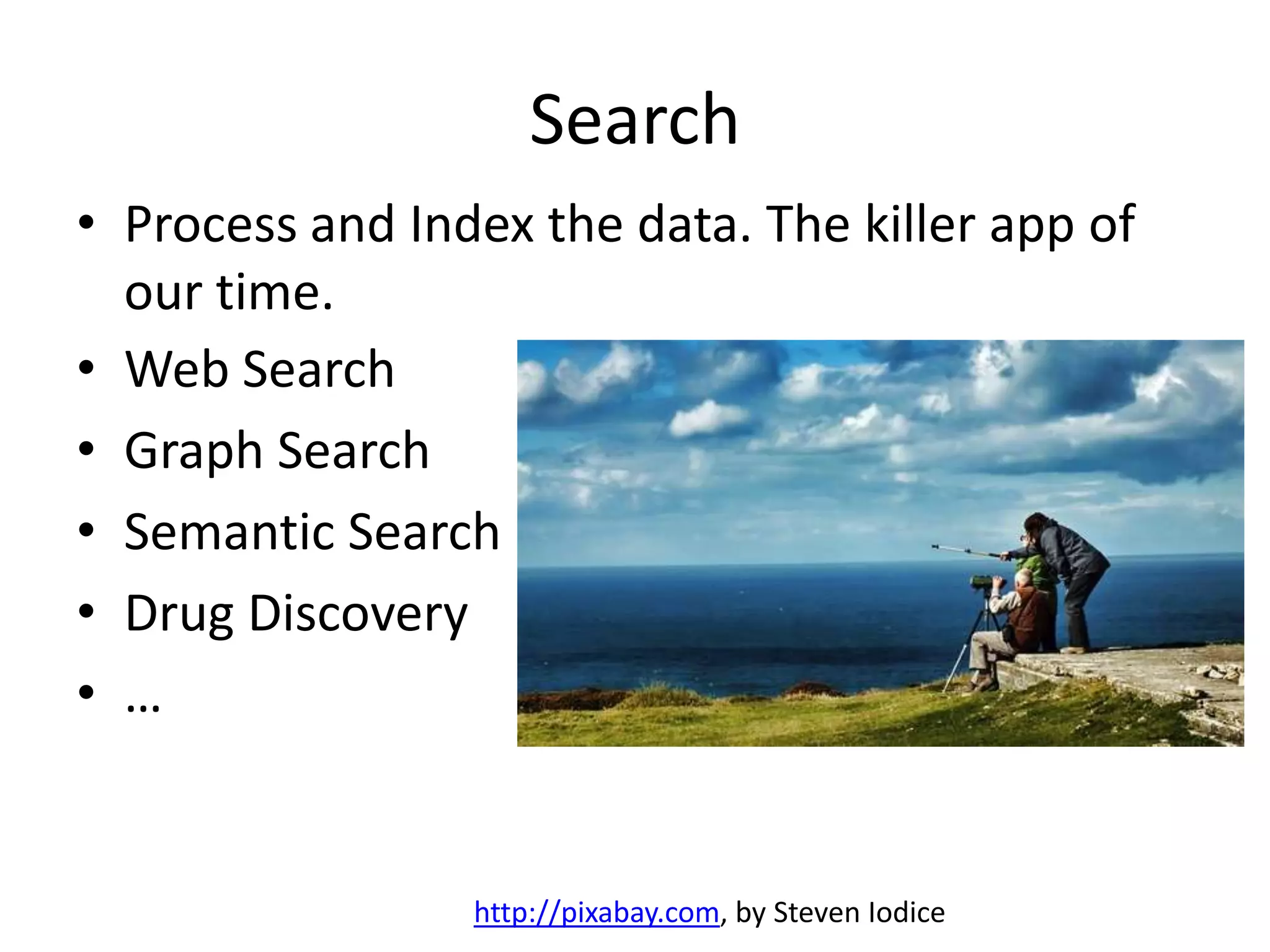
Search
• Process and Index the data. The killer app of
our time.
http://pixabay.com, by Steven Iodice
• Web Search
• Graph Search
• Semantic Search
• Drug Discovery
• …
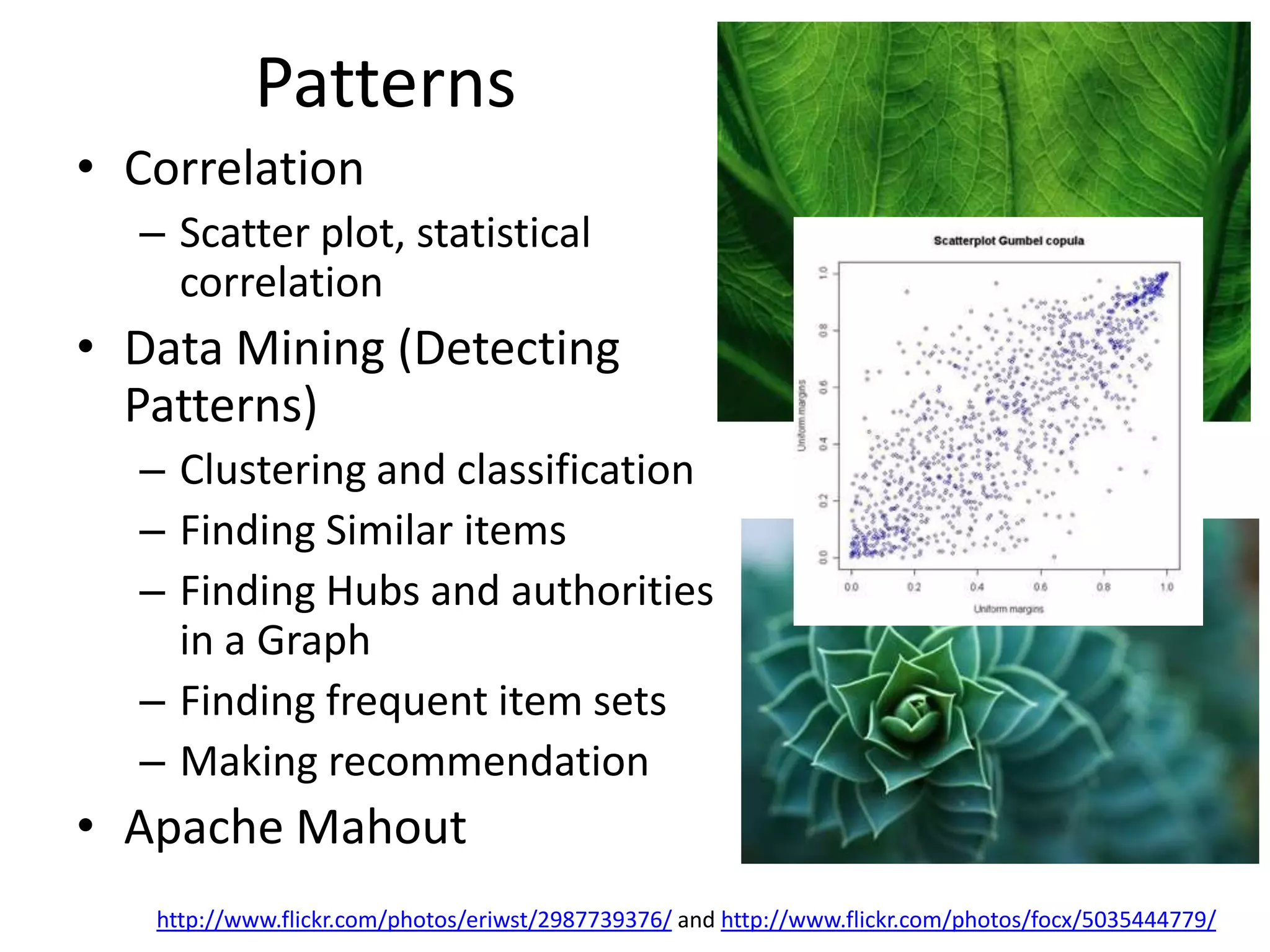
Patterns
• Correlation
– Scatter plot, statistical
correlation
• Data Mining (Detecting
Patterns)
– Clustering and classification
– Finding Similar items
– Finding Hubs and authorities
in a Graph
– Finding frequent item sets
– Making recommendation
• Apache Mahout
http://www.flickr.com/photos/eriwst/2987739376/ and http://www.flickr.com/photos/focx/5035444779/
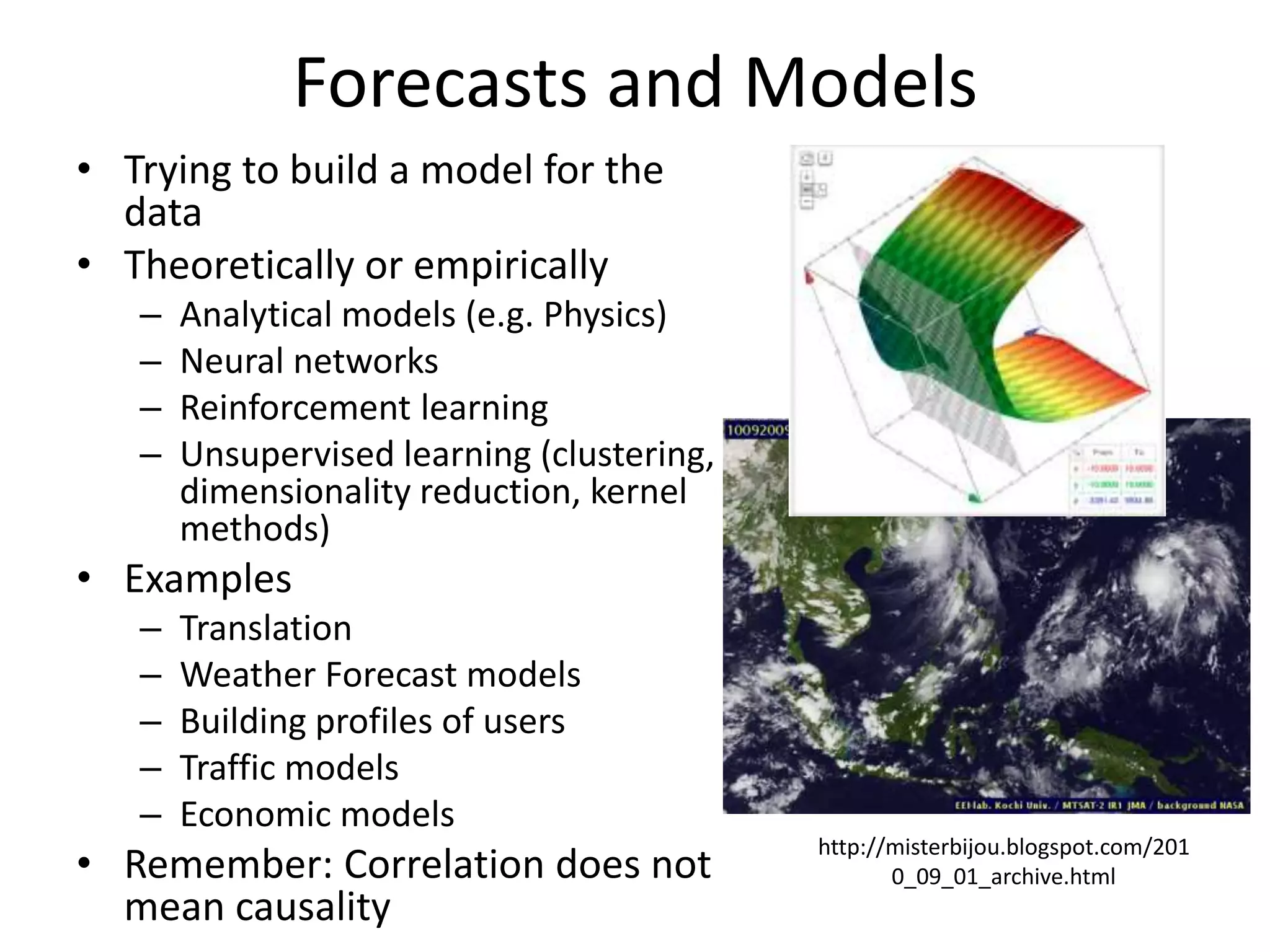
Forecasts and Models
• Trying to build a model for the
data
• Theoretically or empirically
– Analytical models (e.g. Physics)
– Neural networks
– Reinforcement learning
– Unsupervised learning (clustering,
dimensionality reduction, kernel
methods)
• Examples
– Translation
– Weather Forecast models
– Building profiles of users
– Traffic models
– Economic models
• Remember: Correlation does not
mean causality
http://misterbijou.blogspot.com/201
0_09_01_archive.html
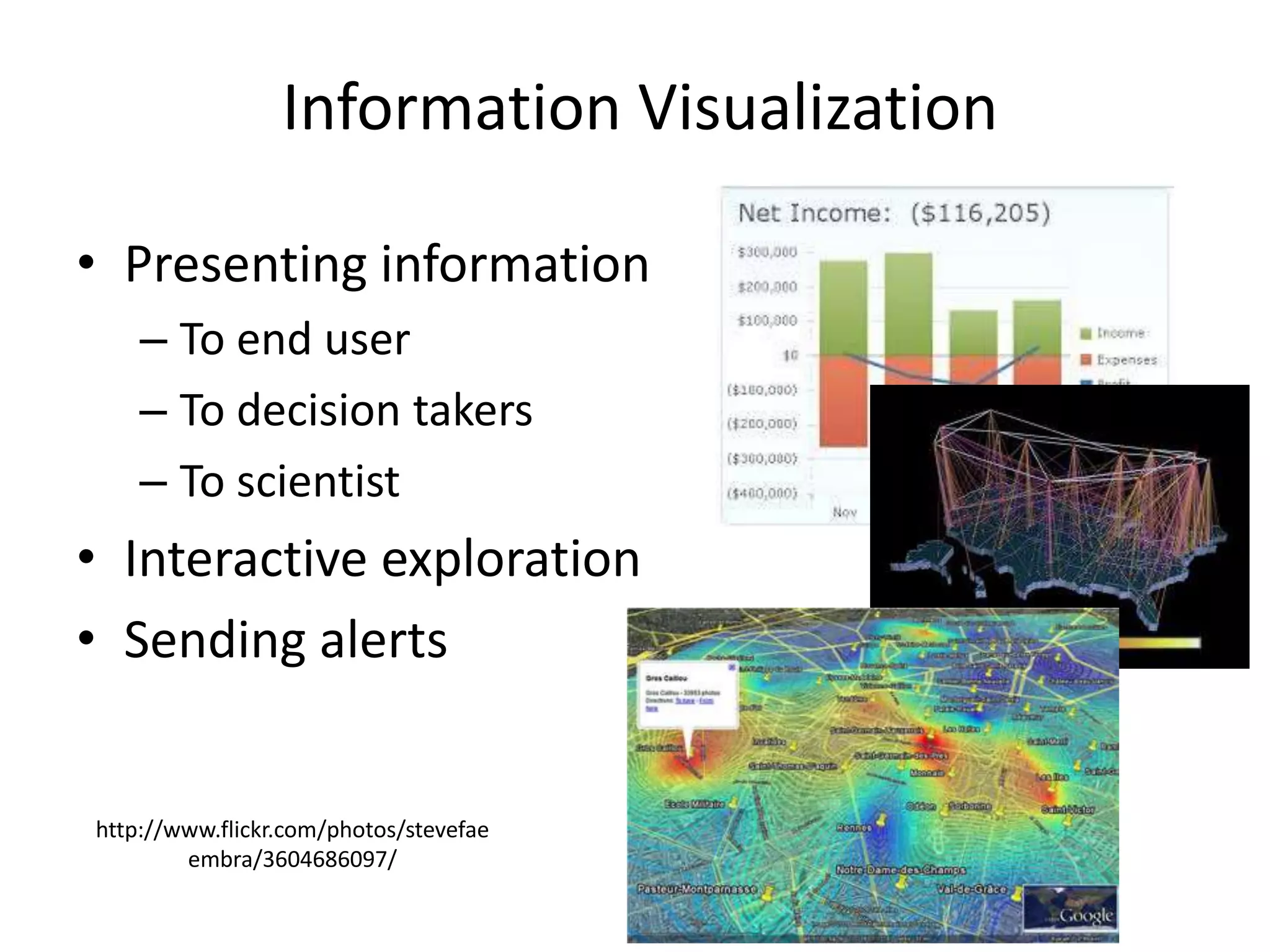
Information Visualization
• Presenting information
– To end user
– To decision takers
– To scientist
• Interactive exploration
• Sending alerts
http://www.flickr.com/photos/stevefae
embra/3604686097/
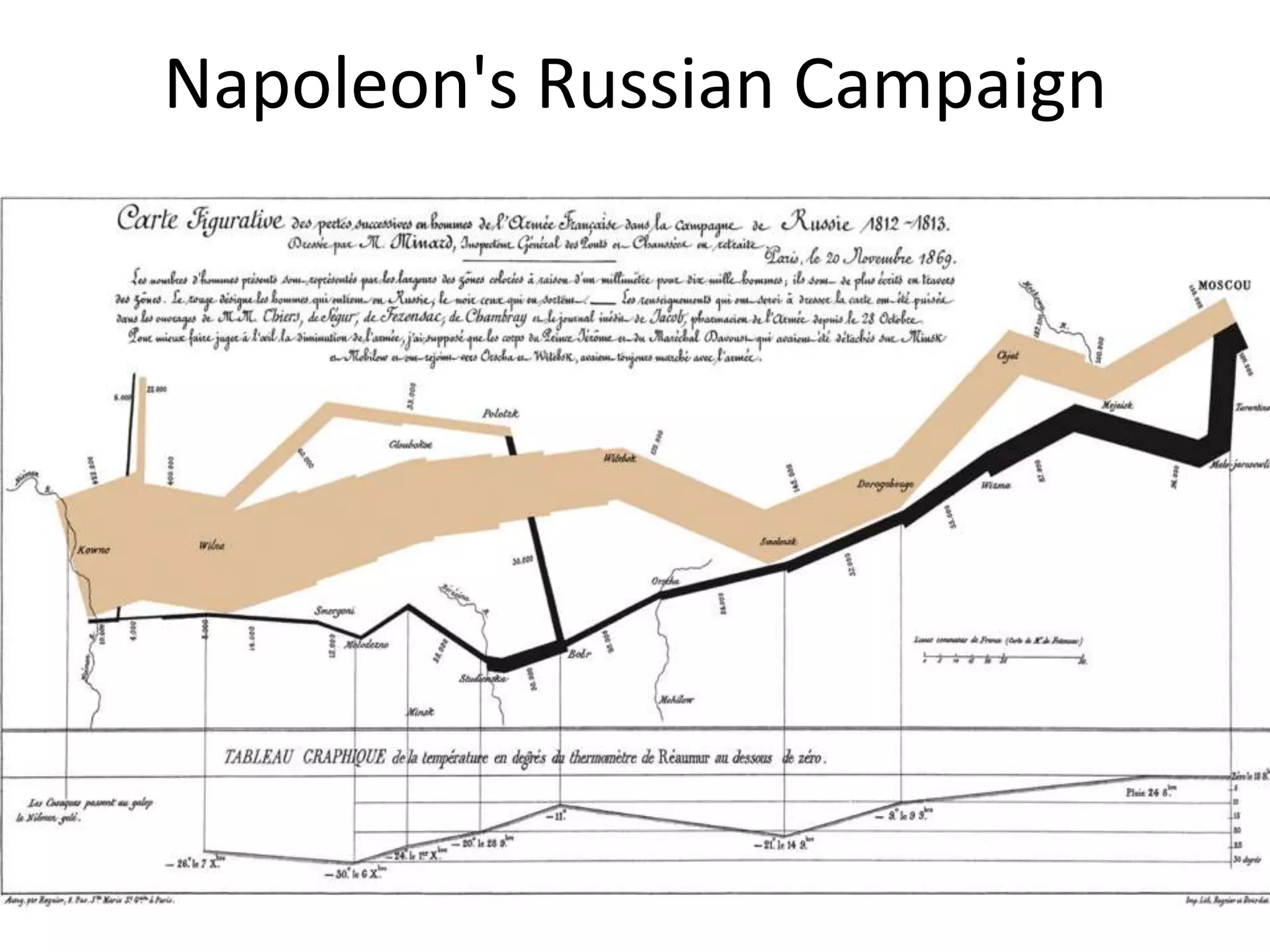
Napoleon's Russian Campaign
Show Han Rosling’s Data
• This use a tool called “Gapminder”
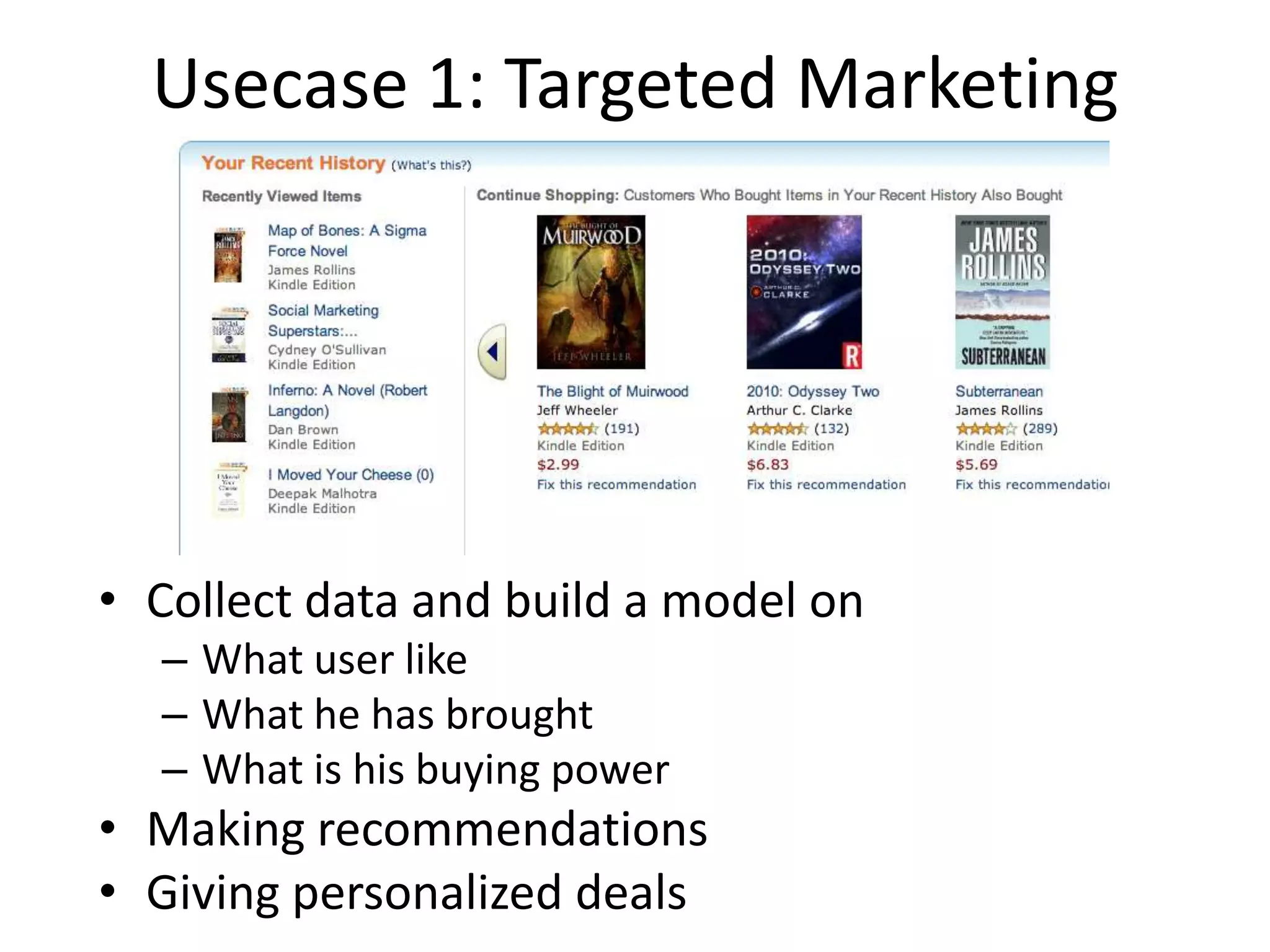
Usecase 1: Targeted Marketing
• Collect data and build a model on
– What user like
– What he has brought
– What is his buying power
• Making recommendations
• Giving personalized deals
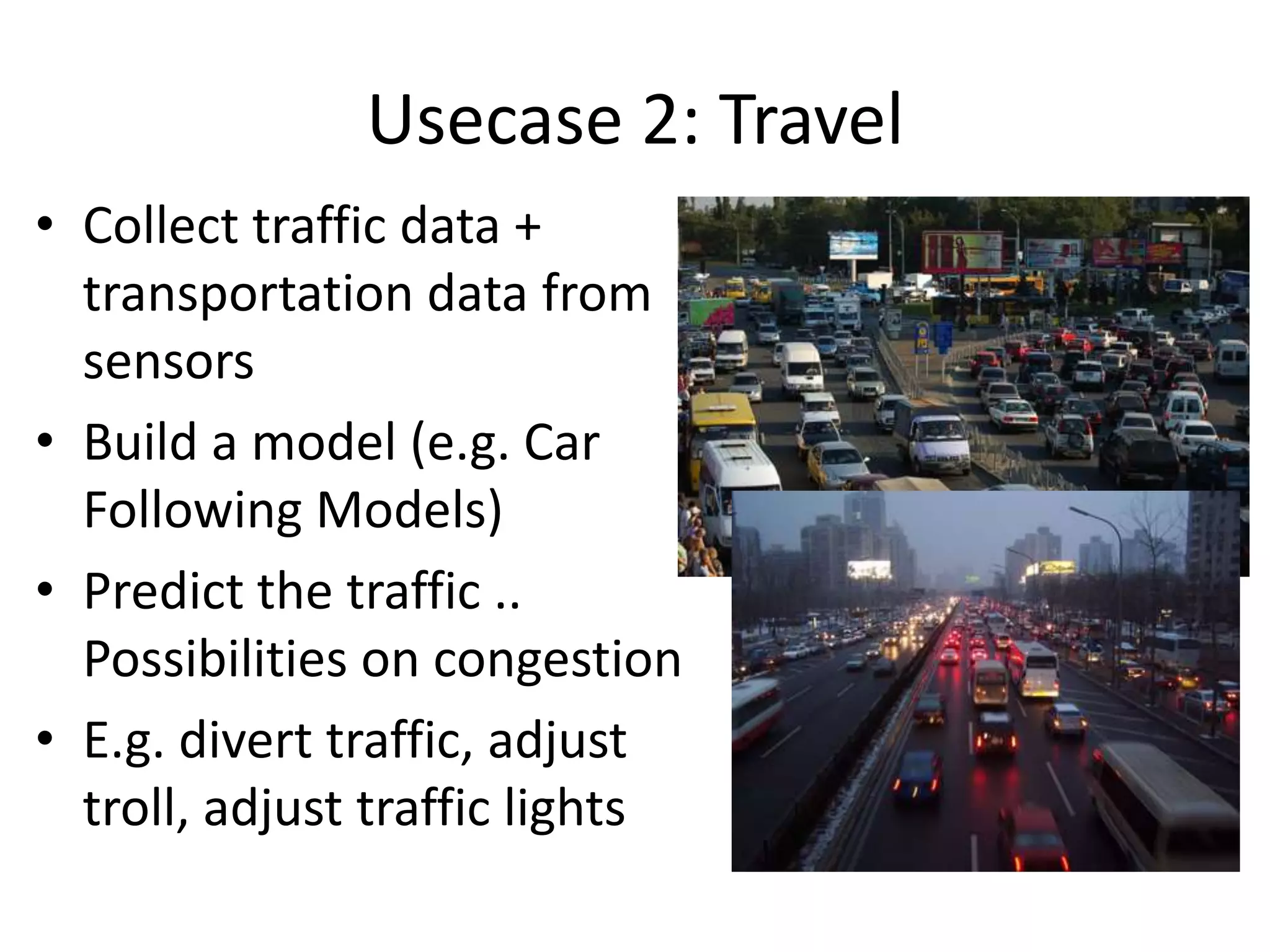
Usecase 2: Travel
• Collect traffic data +
transportation data from
sensors
• Build a model (e.g. Car
Following Models)
• Predict the traffic ..
Possibilities on congestion
• E.g. divert traffic, adjust
troll, adjust traffic lights
Practical Tutorial
• Data collection
– Pub/sub, event architectures
• Processing
– Store and Process: MapReduce/Hadoop
– Processing Moving Data: CEP
• Visualization
– GNU Plot/ R
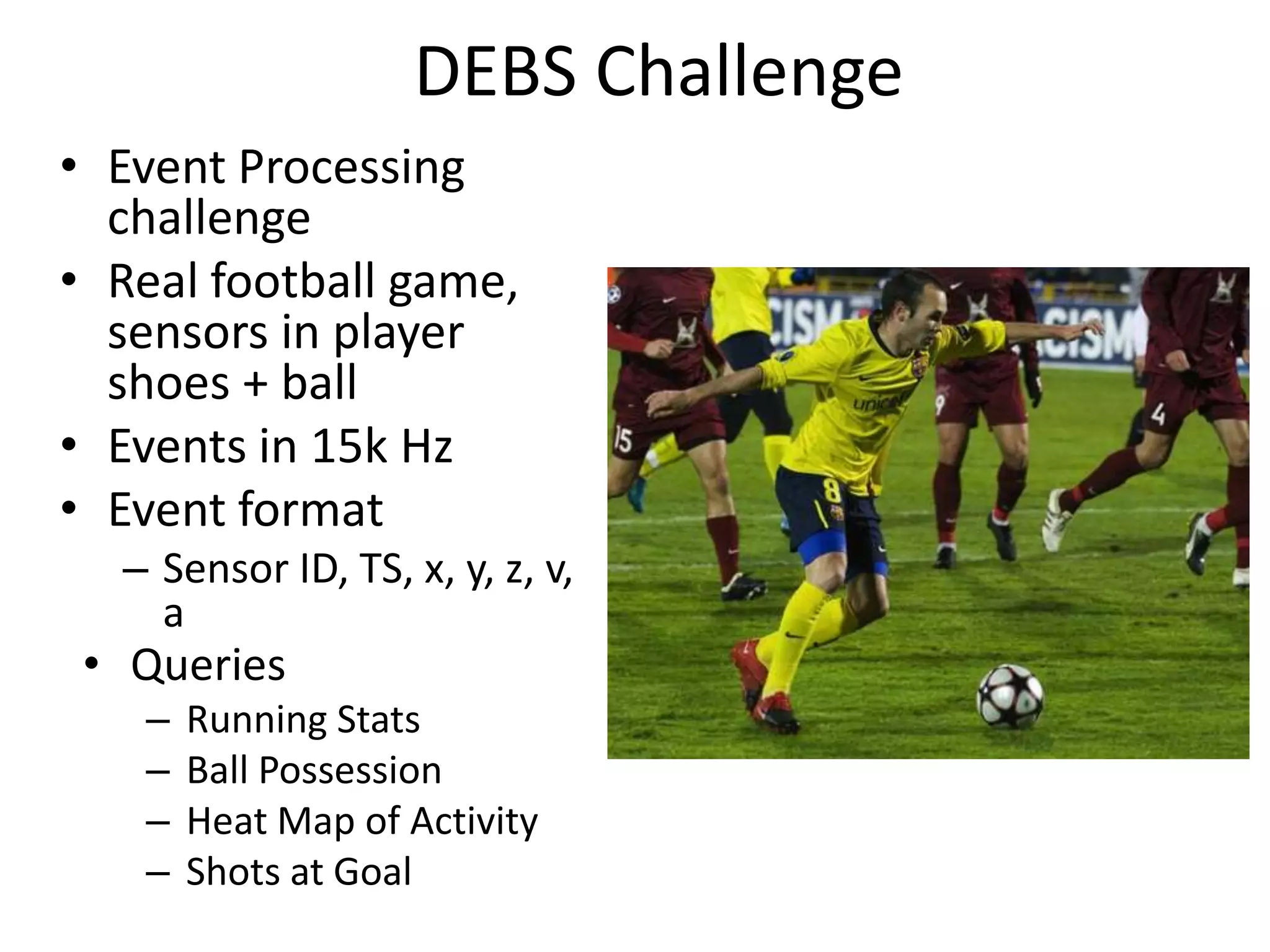
DEBS Challenge
• Event Processing
challenge
• Real football game,
sensors in player
shoes + ball
• Events in 15k Hz
• Event format
– Sensor ID, TS, x, y, z, v,
a
• Queries
– Running Stats
– Ball Possession
– Heat Map of Activity
– Shots at Goal
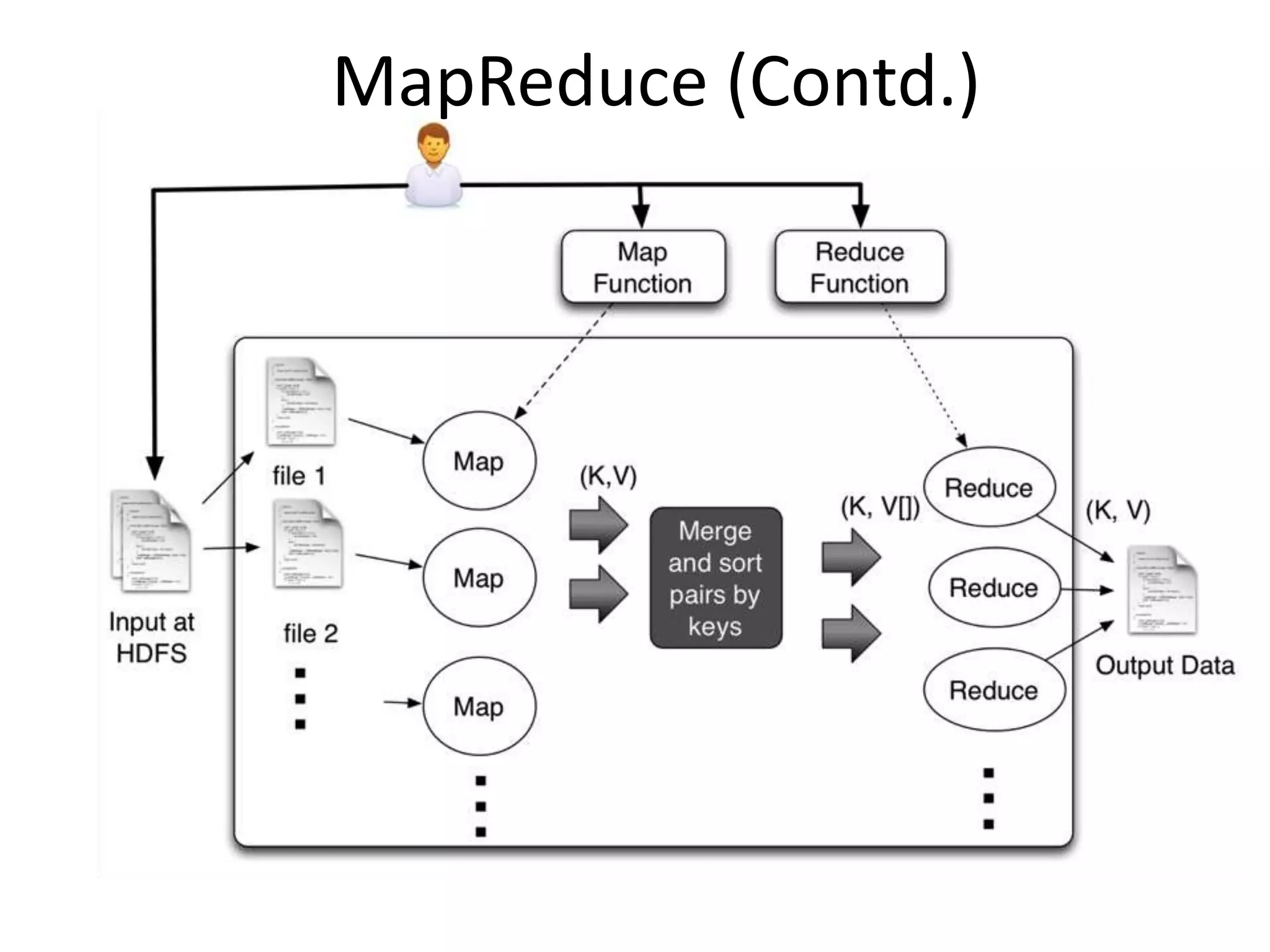
MapReduce/ Hadoop
• First introduced by Google,
and used as the processing
model for their architecture
• Implemented by opensource
projects like Apache Hadoop
and Spark
• Users writes two functions:
map and reduce
• The framework handles the
details like distributed
processing, fault tolerance,
load balancing etc.
• Widely used, and the one of
the catalyst of Big data
void map(ctx, k, v){
tokens = v.split();
for t in tokens
ctx.emit(t,1)
}
void reduce(ctx, k, values[]){
count = 0;
for v in values
count = count + v;
ctx.emit(k,count);
}
MapReduce (Contd.)
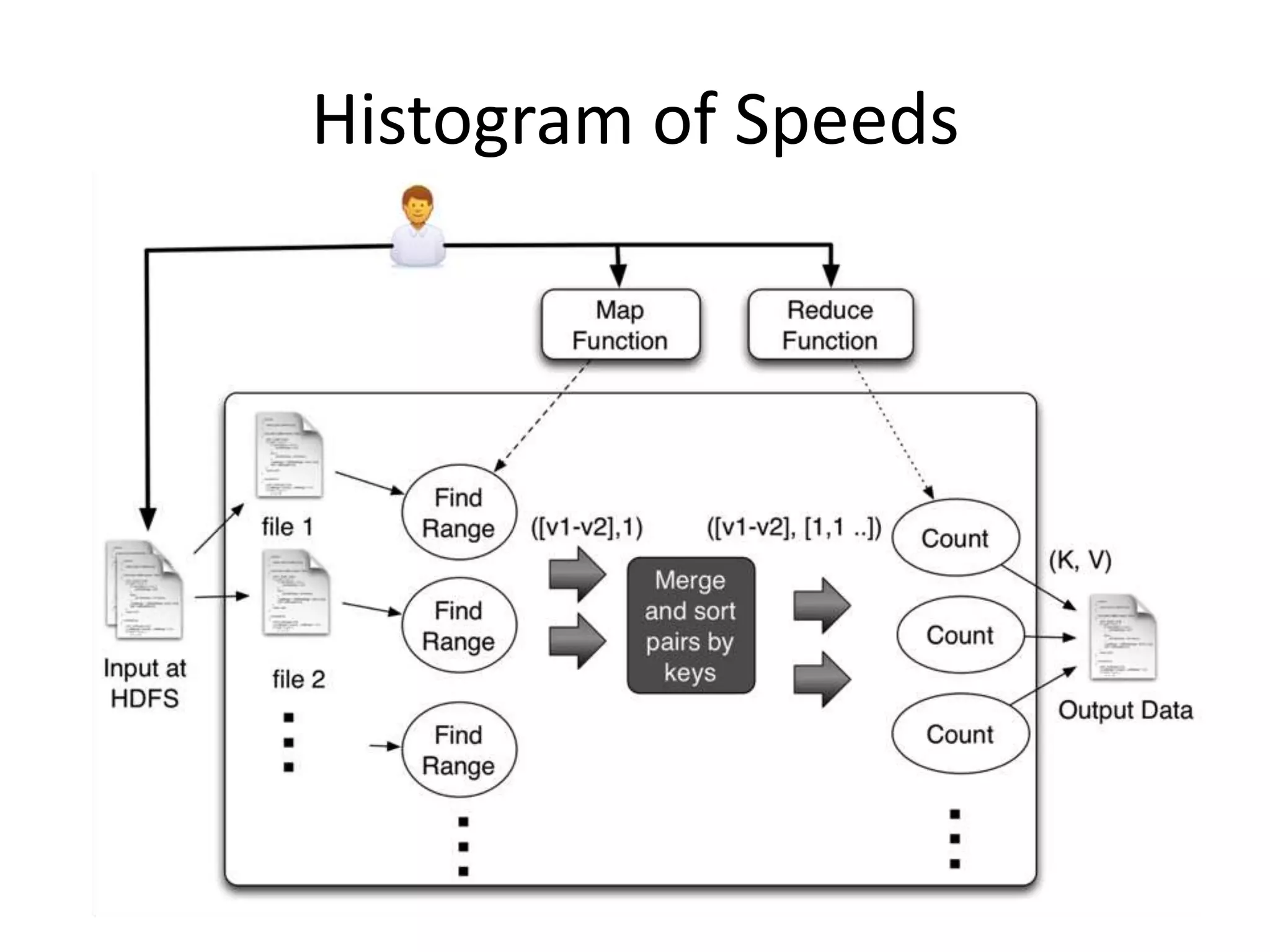
Histogram of Speeds
Histogram of Speeds(Contd.)
void map(ctx, k, v){
event = parse(v);
range = calcuateRange(event.v);
ctx.emit(range,1)
}
void reduce(ctx, k, values[]){
count = 0;
for v in values
count = count + v;
ctx.emit(k,count);
}
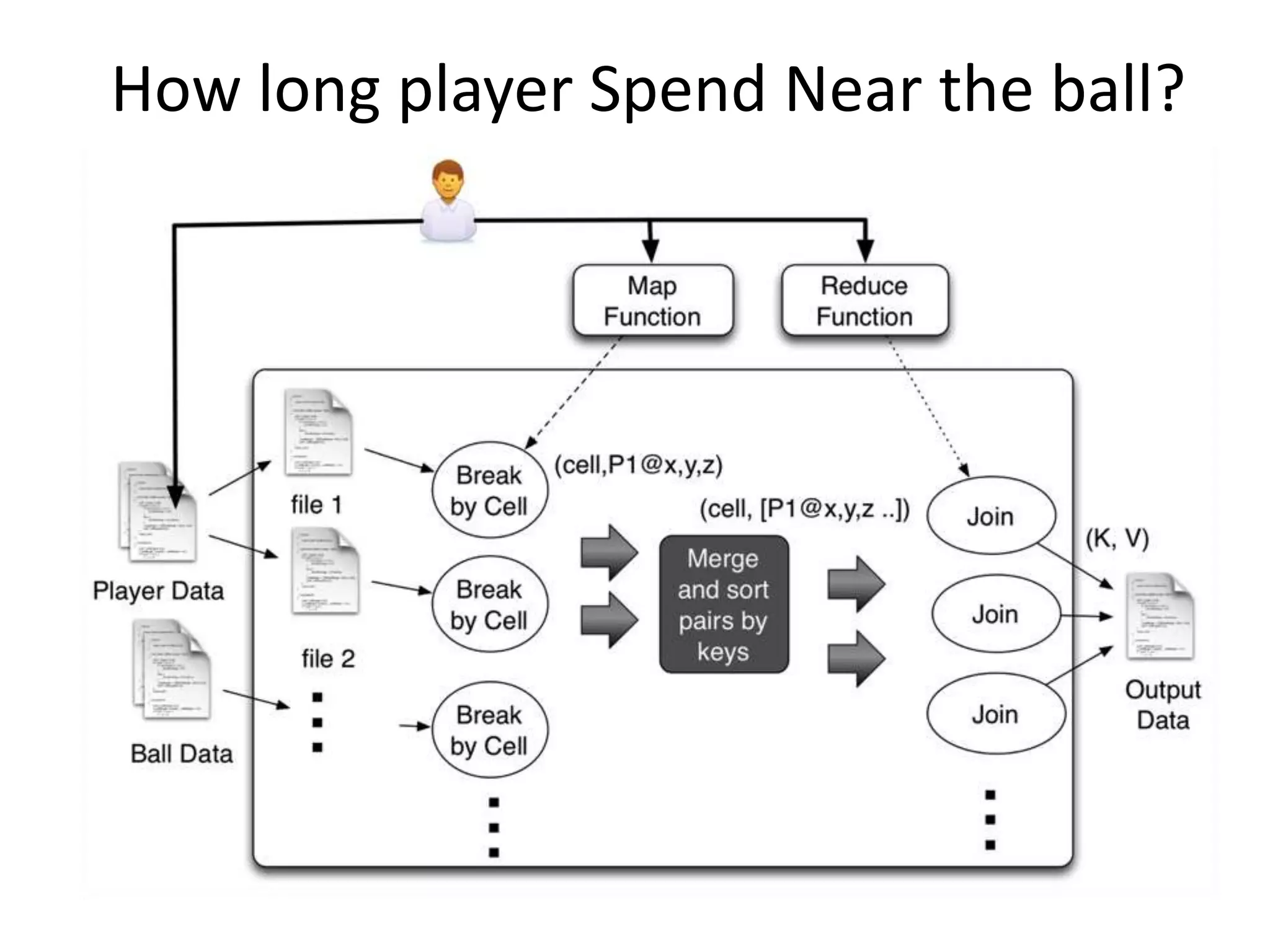
How long player Spend Near the ball?
How long player Spend Near the
ball?(Contd.)
void map(ctx, k, v){
event = parse(v);
cell = calcuateOverlappingCells(v.x,
v.y, v.z);
ctx.emit(cell,v.x, v.y, v.z);
}
Void reduce(ctx, k, values[]){
players = joinAndFindPlayersNearBall(values);
for p in players
ctx.emit(p,p);
}
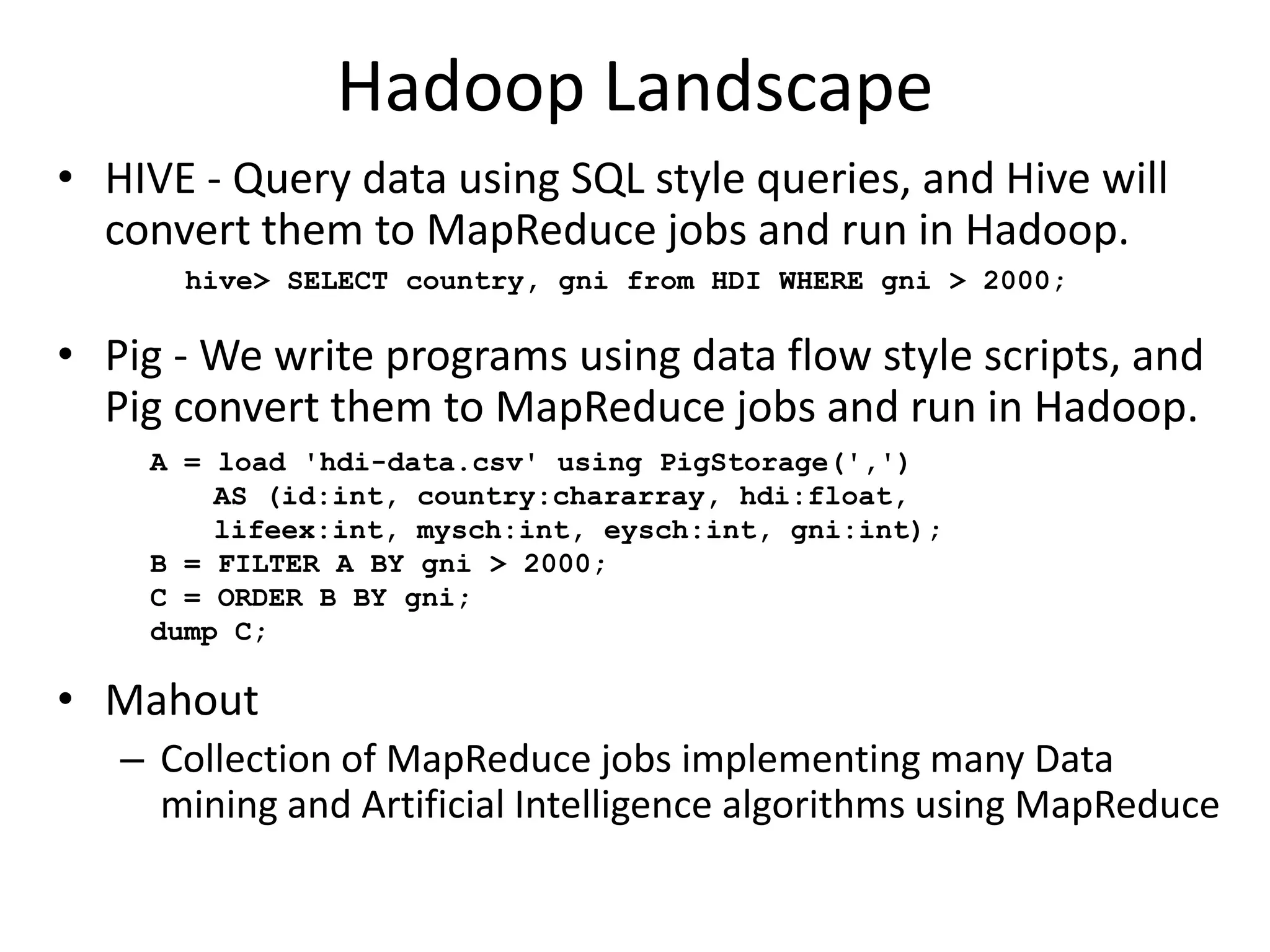
Hadoop Landscape
• HIVE - Query data using SQL style queries, and Hive will
convert them to MapReduce jobs and run in Hadoop.
• Pig - We write programs using data flow style scripts, and
Pig convert them to MapReduce jobs and run in Hadoop.
• Mahout
– Collection of MapReduce jobs implementing many Data
mining and Artificial Intelligence algorithms using MapReduce
A = load 'hdi-data.csv' using PigStorage(',')
AS (id:int, country:chararray, hdi:float,
lifeex:int, mysch:int, eysch:int, gni:int);
B = FILTER A BY gni > 2000;
C = ORDER B BY gni;
dump C;
hive> SELECT country, gni from HDI WHERE gni > 2000;
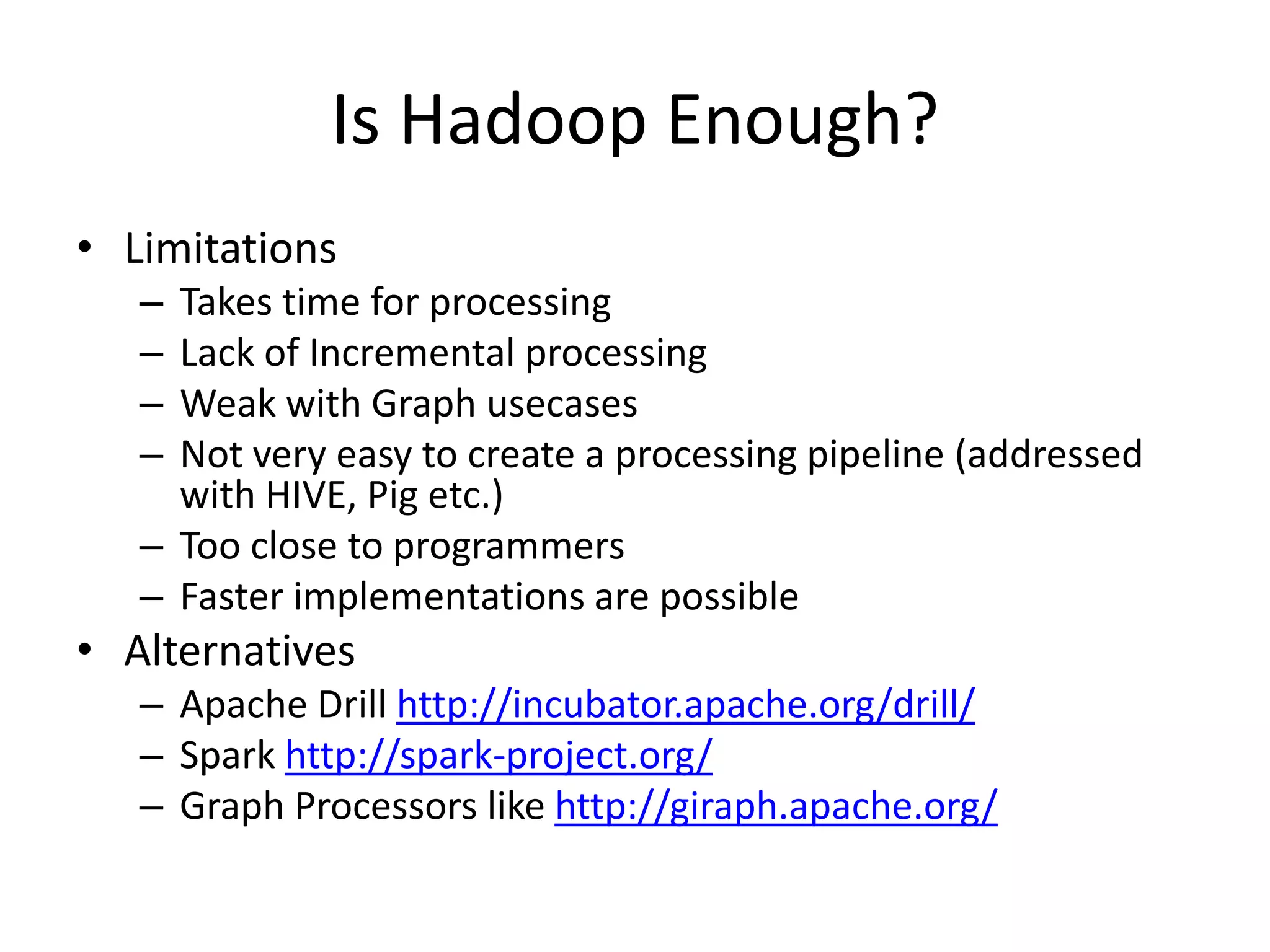
Is Hadoop Enough?
• Limitations
– Takes time for processing
– Lack of Incremental processing
– Weak with Graph usecases
– Not very easy to create a processing pipeline (addressed
with HIVE, Pig etc.)
– Too close to programmers
– Faster implementations are possible
• Alternatives
– Apache Drill http://incubator.apache.org/drill/
– Spark http://spark-project.org/
– Graph Processors like http://giraph.apache.org/
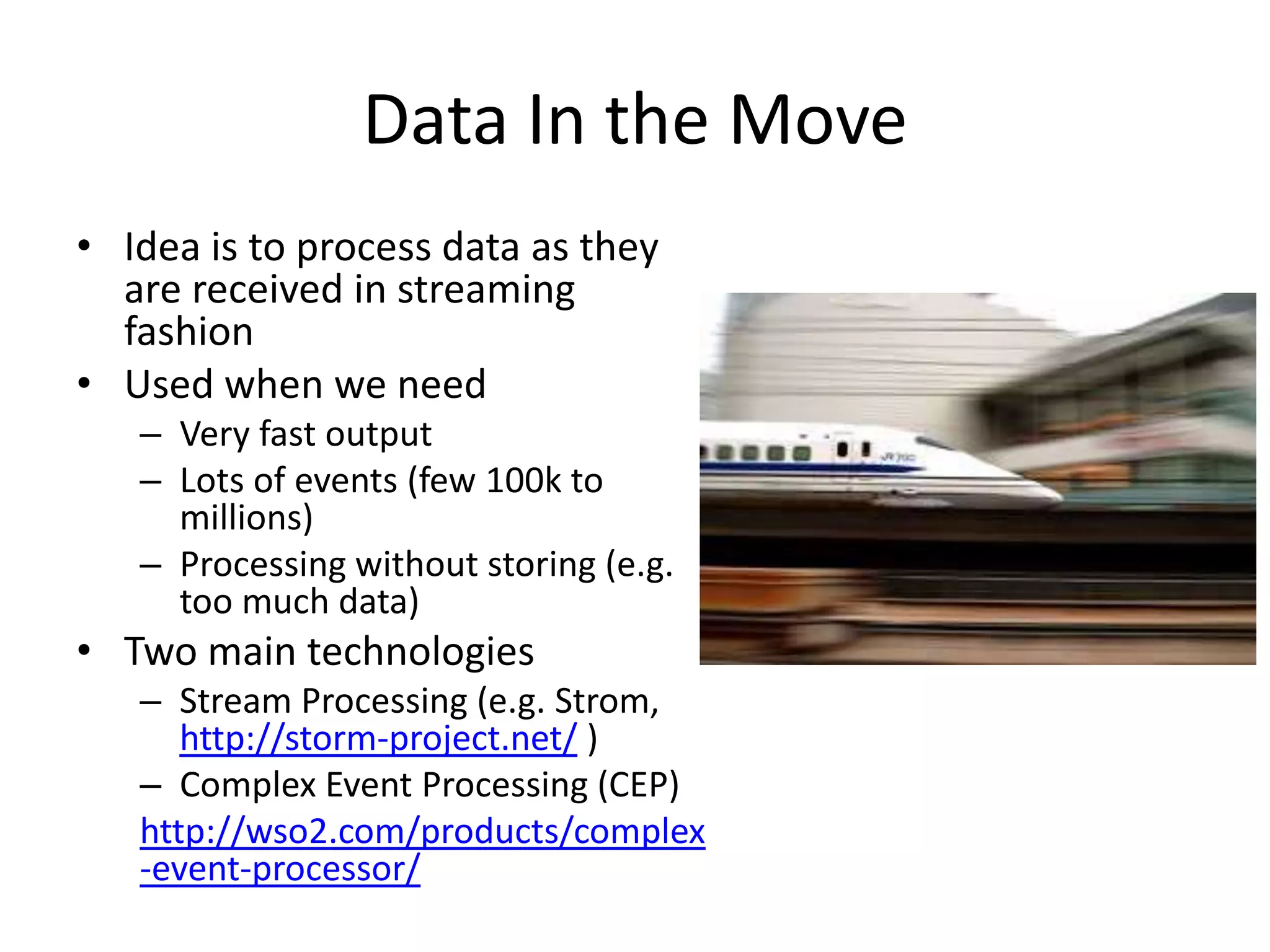
Data In the Move
• Idea is to process data as they
are received in streaming
fashion
• Used when we need
– Very fast output
– Lots of events (few 100k to
millions)
– Processing without storing (e.g.
too much data)
• Two main technologies
– Stream Processing (e.g. Strom,
http://storm-project.net/ )
– Complex Event Processing (CEP)
http://wso2.com/products/complex
-event-processor/
Complex Event Processing (CEP)
• Sees inputs as Event streams and queried with
SQL like language
• Supports Filters, Windows, Join, Patterns and
Sequences
from p=PINChangeEvents#win.time(3600) join
t=TransactionEvents[p.custid=custid][amount>1000
0] #win.time(3600)
return t.custid, t.amount;
Example: Detect ball Possession
• Possession is time a
player hit the ball
until someone else
hits it or it goes out
of the ground
from Ball#window.length(1) as b join
Players#window.length(1) as p
unidirectional
on debs: getDistance(b.x,b.y,b.z,
p.x, p.y, p.z) < 1000
and b.a > 55
select ...
insert into hitStream
from old = hitStream ,
b = hitStream [old. pid != pid ],
n= hitStream[b.pid == pid]*,
( e1 = hitStream[b.pid != pid ]
or e2= ballLeavingHitStream)
select ...
insert into BallPossessionStream
http://www.flickr.com/photos/glennharper/146164820/
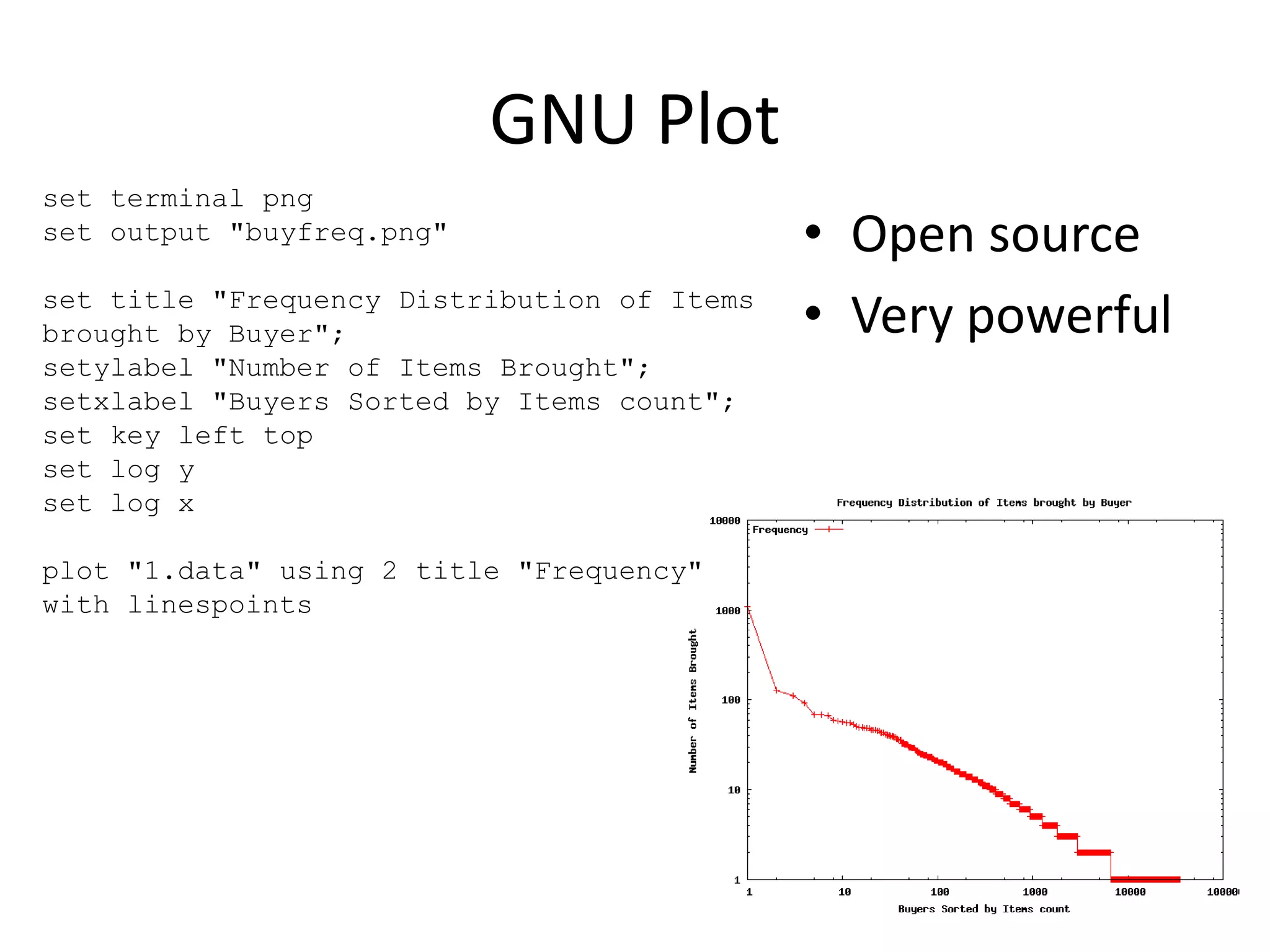
GNU Plot
set terminal png
set output "buyfreq.png"
set title "Frequency Distribution of Items
brought by Buyer";
setylabel "Number of Items Brought";
setxlabel "Buyers Sorted by Items count";
set key left top
set log y
set log x
plot "1.data" using 2 title "Frequency"
with linespoints
• Open source
• Very powerful
Big data lifecycle
• Realizing the big data lifecycle is hard
• Need wide understanding about many fields
• Big data teams will include members from
many fields working together
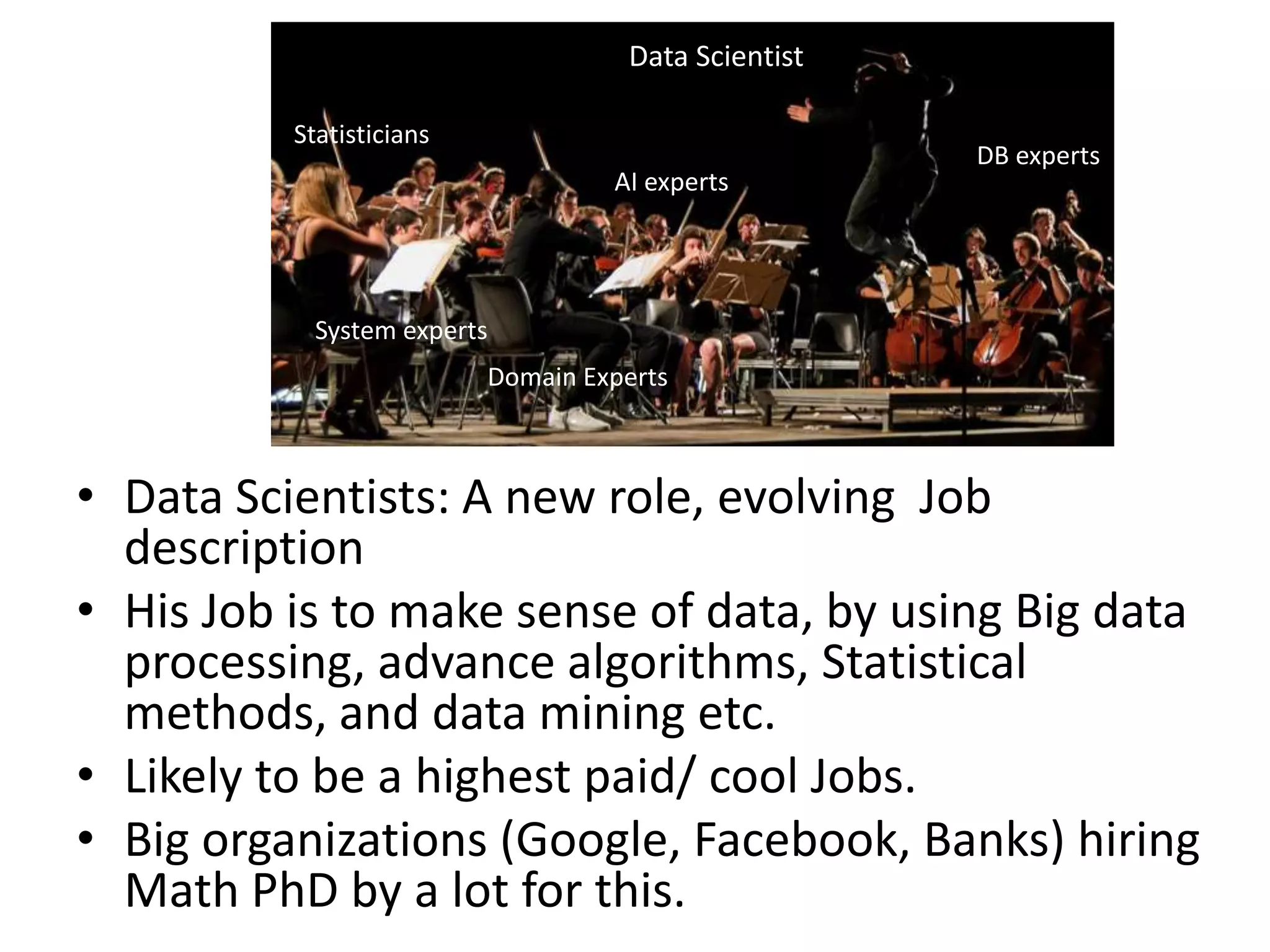
• Data Scientists: A new role, evolving Job
description
• His Job is to make sense of data, by using Big data
processing, advance algorithms, Statistical
methods, and data mining etc.
• Likely to be a highest paid/ cool Jobs.
• Big organizations (Google, Facebook, Banks) hiring
Math PhD by a lot for this.
Data Scientist
Statisticians
System experts
Domain Experts
DB experts
AI experts
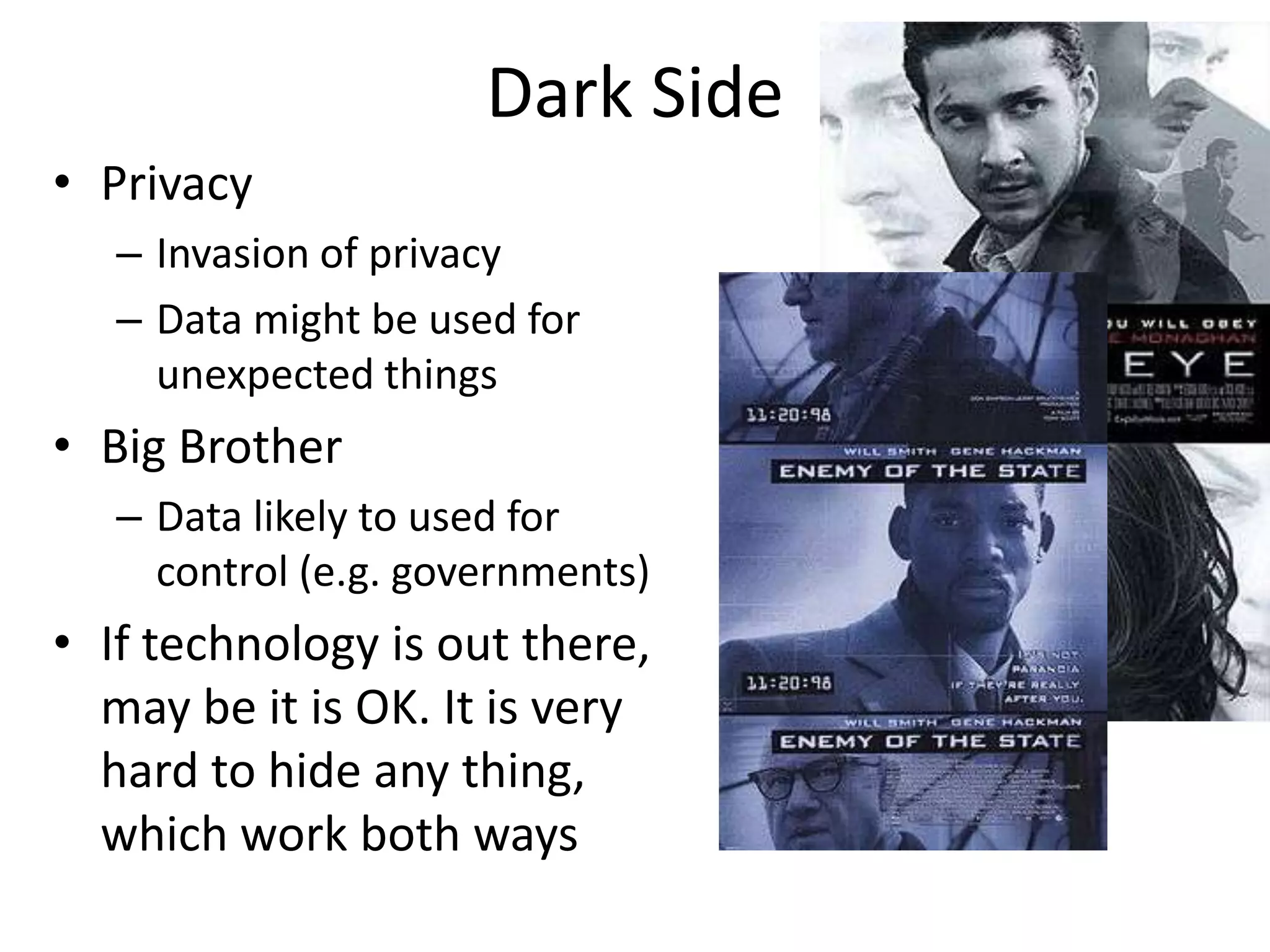
Dark Side
• Privacy
– Invasion of privacy
– Data might be used for
unexpected things
• Big Brother
– Data likely to used for
control (e.g. governments)
• If technology is out there,
may be it is OK. It is very
hard to hide any thing,
which work both ways
Challenges
• Speed (e.g. targeted advertising, reacting to data)
• Extracting semantics and handling multiple
representations and formats
• Security Data ownership, delegation, permissions,
and Privacy
• Making data accessible to all intended parties,
from anywhere, anytime, from any device,
through any format (subjected to permissions).
• Map-Reduce good enough? What about other
parallel problems?
• Handling Uncertainty
Conclusions
• Lot of data, realizing data -> insight -> predications
• We do lot of predications even now.
• There is lot between data and forecasts, OK to do
them.
– Analytics
– Visualizations
– Patterns
– Data mining
• If you looking to start, learn MapReduce, CEP, and
GNU plot.
• Visualization is the key!!
• Learn some distributed systems and AI
Questions?

Introduction to Big Data

  • 2.
    Outline• Forecasts and WhyBig data? • What is Big Data? • Parts of the Puzzle • Quick Tutorial • Conclusion Photo by John Trainoron Flickr http://www.flickr.com/photos/trainor/2902023575/, Licensed under CC
  • 3.
    Asimov Foundation • 20million worlds • A Scientist who mathematically calculate the fate of the Universe • His effort to change that Fate • A Beautiful story
  • 4.
    Consider a dayin your life • What is the best road to take? • Would there be any bad weather? • What is the best way to invest the money? • Should I take that loan? • Can I optimize my day? • Is there a way to do this faster? • What have others done in similar cases? • Which product should I buy?
  • 5.
    People wanted to(through ages) • To know (what happened?) • To Explain (why it happened) • To Predict (what will happen?)
  • 6.
    Many Cultures had Claimfor Omniscience • Oracle • Astrology • Book of Changes • Tarot Cards • Crystal balls Claim for Omniscience
  • 7.
    To know, explainand predict!! • Grand challenge of our time • We have been trying to do this in many other means • Now we trying to do this via science Any sufficiently advanced technology is indistinguishable from magic. ---Arthur C. Clarke. • We see a possibilities though “lot of data”
  • 8.
    You does notseem to be convinced!! • Why, sometimes I've believed as many as six impossible things before breakfast.
  • 9.
    Prophecies of ourtime • We can predict Weather • We do understand language translation pretty well • We can predict how an air plane behave good enough to fly • Our ability on forensics • We understand remedies for many diseases • We can tell how astro bodies will behave (e.g. comets)
  • 10.
    This is beingDone: Weather • Remarkably accurate for few days – SL incident • Data :- weather radars, satellite data, weather balloons, planes etc., • forecast models – Simulation – Numerical method • Challenge is computing power – algorithms that take more than 24 hours – resolution is the key ……
  • 11.
    Democratizing Analysis • Forecastingwas done, but in limited manner and only by few (e.g. National Labs, Intelligence community) • That is changing!!
  • 12.
    What is Bigdata? • There is lot of data available – E.g. Internet of things • We have computing power • We have technology • Goal is same – To know – To Explain – To predict • Challenge is the full lifecycle
  • 13.
    Data, the wealthof our time "Data is a precious thing because they last longer than systems” - Tim Barnes Lee • Access to data is becoming ultimate competitive advantage – E.g. Google+ vs. Facebook – Why many organizations try hard to give us free things and keep us always logged in (e.g. Gmail, facebook, search engine tool bars)
  • 14.
  • 15.
    Data Avalanche/ Moore’slaw of data • We are now collecting and converting large amount of data to digital forms • 90% of the data in the world today was created within the past two years. • Amount of data we have doubles very fast
  • 16.
    In real life,most data are Big • Web does millions of activities per second, and so much server logs are created. • Social networks e.g. Facebook, 800 Million active users, 40 billion photos from its user base. • There are >4 billion phones and >25% are smart phones. There are billions of RFID tags. • Observational and Sensor data – Weather Radars, Balloons – Environmental Sensors – Telescopes – Complex physics simulations
  • 17.
    Why Big Datais hard? • How store? Assuming 1TB bytes it takes 1000 computers to store a 1PB • How to move? Assuming 10Gb network, it takes 2 hours to copy 1TB, or 83 days to copy a 1PB • How to search? Assuming each record is 1KB and one machine can process 1000 records per sec, it needs 277CPU days to process a 1TB and 785 CPU years to process a 1 PB • How to process? – How to convert algorithms to work in large size – How to create new algorithms http://www.susanica.com/photo/9
  • 18.
    Why it ishard (Contd.)? • System build of many computers • That handles lots of data • Running complex logic • This pushes us to frontier of Distributed Systems and Databases • More data does not mean there is a simple model • Some models can be complex as the system http://www.flickr.com/photos/mariachily/5250487136, Licensed CC
  • 19.
  • 20.
    Sensors • There aresensors everywhere – RFID (e.g. Walmart), GPS sensors, Mobile Phone … • Internet – Click streams, Emails, chat, search, tweets ,Transactions … • Real Word – Video surveillance, Cash flows, Traffic, Surveillance, Stock exchange, Smart Grid, Production line … – Internet of Things http://www.flickr.com/photos/imuttoo/4257813689/ by Ian Muttoo, http://www.flickr.com/photos/eastcapital/4554220770/, http://www.flickr.com/photos/patdavid/4619331472/ by Pat David copyright CC
  • 21.
    Collecting Data • Datacollected at sensors and sent to big data system via events or flat files • Event Streams: we name the events by its content/ originator • Get data through – Point to Point – Event Bus • E.g. Data bridge – a thrift based transport we did that do about 400k events/ sec
  • 22.
    Storing Data • Historicallywe used databases – Scale is a challenge: replication, sharding • Scalable options – NoSQL (Cassandra, Hbase) [If data is structured] • Column families Gaining Ground – Distributed file systems (e.g. HDFS) [If data is unstructured] • New SQL – In Memory computing, VoltDB • Specialized data structures – Graph Databases, Data structure servers http://www.flickr.com/photos/keso/3631339 67/
  • 23.
    Making Sense ofData • To know (what happened?) – Basic analytics + visualizations (min, max, average, histogram, distributions … ) – Interactive drill down • To explain (why) – Data mining, classifications, building models, clustering • To forecast – Neural networks, decision models
  • 24.
    To know (whathappened?) • Mainly Analytics – Min, Max, average, correlation, histograms – Might join group data in many ways • Implemented with MapReduce or Queries • Data is often presented with some visualizations • Examples – forensics – Assessments – Historical data/ reports/ trends http://www.flickr.com/photos/isriya/2967310 333/
  • 25.
    Search • Process andIndex the data. The killer app of our time. http://pixabay.com, by Steven Iodice • Web Search • Graph Search • Semantic Search • Drug Discovery • …
  • 26.
    Patterns • Correlation – Scatterplot, statistical correlation • Data Mining (Detecting Patterns) – Clustering and classification – Finding Similar items – Finding Hubs and authorities in a Graph – Finding frequent item sets – Making recommendation • Apache Mahout http://www.flickr.com/photos/eriwst/2987739376/ and http://www.flickr.com/photos/focx/5035444779/
  • 27.
    Forecasts and Models •Trying to build a model for the data • Theoretically or empirically – Analytical models (e.g. Physics) – Neural networks – Reinforcement learning – Unsupervised learning (clustering, dimensionality reduction, kernel methods) • Examples – Translation – Weather Forecast models – Building profiles of users – Traffic models – Economic models • Remember: Correlation does not mean causality http://misterbijou.blogspot.com/201 0_09_01_archive.html
  • 28.
    Information Visualization • Presentinginformation – To end user – To decision takers – To scientist • Interactive exploration • Sending alerts http://www.flickr.com/photos/stevefae embra/3604686097/
  • 29.
  • 30.
    Show Han Rosling’sData • This use a tool called “Gapminder”
  • 31.
    Usecase 1: TargetedMarketing • Collect data and build a model on – What user like – What he has brought – What is his buying power • Making recommendations • Giving personalized deals
  • 32.
    Usecase 2: Travel •Collect traffic data + transportation data from sensors • Build a model (e.g. Car Following Models) • Predict the traffic .. Possibilities on congestion • E.g. divert traffic, adjust troll, adjust traffic lights
  • 33.
    Practical Tutorial • Datacollection – Pub/sub, event architectures • Processing – Store and Process: MapReduce/Hadoop – Processing Moving Data: CEP • Visualization – GNU Plot/ R
  • 34.
    DEBS Challenge • EventProcessing challenge • Real football game, sensors in player shoes + ball • Events in 15k Hz • Event format – Sensor ID, TS, x, y, z, v, a • Queries – Running Stats – Ball Possession – Heat Map of Activity – Shots at Goal
  • 35.
    MapReduce/ Hadoop • Firstintroduced by Google, and used as the processing model for their architecture • Implemented by opensource projects like Apache Hadoop and Spark • Users writes two functions: map and reduce • The framework handles the details like distributed processing, fault tolerance, load balancing etc. • Widely used, and the one of the catalyst of Big data void map(ctx, k, v){ tokens = v.split(); for t in tokens ctx.emit(t,1) } void reduce(ctx, k, values[]){ count = 0; for v in values count = count + v; ctx.emit(k,count); }
  • 36.
  • 37.
  • 38.
    Histogram of Speeds(Contd.) voidmap(ctx, k, v){ event = parse(v); range = calcuateRange(event.v); ctx.emit(range,1) } void reduce(ctx, k, values[]){ count = 0; for v in values count = count + v; ctx.emit(k,count); }
  • 39.
    How long playerSpend Near the ball?
  • 40.
    How long playerSpend Near the ball?(Contd.) void map(ctx, k, v){ event = parse(v); cell = calcuateOverlappingCells(v.x, v.y, v.z); ctx.emit(cell,v.x, v.y, v.z); } Void reduce(ctx, k, values[]){ players = joinAndFindPlayersNearBall(values); for p in players ctx.emit(p,p); }
  • 41.
    Hadoop Landscape • HIVE- Query data using SQL style queries, and Hive will convert them to MapReduce jobs and run in Hadoop. • Pig - We write programs using data flow style scripts, and Pig convert them to MapReduce jobs and run in Hadoop. • Mahout – Collection of MapReduce jobs implementing many Data mining and Artificial Intelligence algorithms using MapReduce A = load 'hdi-data.csv' using PigStorage(',') AS (id:int, country:chararray, hdi:float, lifeex:int, mysch:int, eysch:int, gni:int); B = FILTER A BY gni > 2000; C = ORDER B BY gni; dump C; hive> SELECT country, gni from HDI WHERE gni > 2000;
  • 42.
    Is Hadoop Enough? •Limitations – Takes time for processing – Lack of Incremental processing – Weak with Graph usecases – Not very easy to create a processing pipeline (addressed with HIVE, Pig etc.) – Too close to programmers – Faster implementations are possible • Alternatives – Apache Drill http://incubator.apache.org/drill/ – Spark http://spark-project.org/ – Graph Processors like http://giraph.apache.org/
  • 43.
    Data In theMove • Idea is to process data as they are received in streaming fashion • Used when we need – Very fast output – Lots of events (few 100k to millions) – Processing without storing (e.g. too much data) • Two main technologies – Stream Processing (e.g. Strom, http://storm-project.net/ ) – Complex Event Processing (CEP) http://wso2.com/products/complex -event-processor/
  • 44.
    Complex Event Processing(CEP) • Sees inputs as Event streams and queried with SQL like language • Supports Filters, Windows, Join, Patterns and Sequences from p=PINChangeEvents#win.time(3600) join t=TransactionEvents[p.custid=custid][amount>1000 0] #win.time(3600) return t.custid, t.amount;
  • 45.
    Example: Detect ballPossession • Possession is time a player hit the ball until someone else hits it or it goes out of the ground from Ball#window.length(1) as b join Players#window.length(1) as p unidirectional on debs: getDistance(b.x,b.y,b.z, p.x, p.y, p.z) < 1000 and b.a > 55 select ... insert into hitStream from old = hitStream , b = hitStream [old. pid != pid ], n= hitStream[b.pid == pid]*, ( e1 = hitStream[b.pid != pid ] or e2= ballLeavingHitStream) select ... insert into BallPossessionStream http://www.flickr.com/photos/glennharper/146164820/
  • 46.
    GNU Plot set terminalpng set output "buyfreq.png" set title "Frequency Distribution of Items brought by Buyer"; setylabel "Number of Items Brought"; setxlabel "Buyers Sorted by Items count"; set key left top set log y set log x plot "1.data" using 2 title "Frequency" with linespoints • Open source • Very powerful
  • 47.
    Big data lifecycle •Realizing the big data lifecycle is hard • Need wide understanding about many fields • Big data teams will include members from many fields working together
  • 48.
    • Data Scientists:A new role, evolving Job description • His Job is to make sense of data, by using Big data processing, advance algorithms, Statistical methods, and data mining etc. • Likely to be a highest paid/ cool Jobs. • Big organizations (Google, Facebook, Banks) hiring Math PhD by a lot for this. Data Scientist Statisticians System experts Domain Experts DB experts AI experts
  • 49.
    Dark Side • Privacy –Invasion of privacy – Data might be used for unexpected things • Big Brother – Data likely to used for control (e.g. governments) • If technology is out there, may be it is OK. It is very hard to hide any thing, which work both ways
  • 50.
    Challenges • Speed (e.g.targeted advertising, reacting to data) • Extracting semantics and handling multiple representations and formats • Security Data ownership, delegation, permissions, and Privacy • Making data accessible to all intended parties, from anywhere, anytime, from any device, through any format (subjected to permissions). • Map-Reduce good enough? What about other parallel problems? • Handling Uncertainty
  • 51.
    Conclusions • Lot ofdata, realizing data -> insight -> predications • We do lot of predications even now. • There is lot between data and forecasts, OK to do them. – Analytics – Visualizations – Patterns – Data mining • If you looking to start, learn MapReduce, CEP, and GNU plot. • Visualization is the key!! • Learn some distributed systems and AI
  • 52.