Data: A timeline
How data came to rule the world
Also read: Spotlight: How data influences the publishing industry
1881
The Hollerith Tabulating Machine
Punch cards helped US census workers to deal
with the increasing amount of information.
1932
A population boom
The introduction of social security numbers and
other methods of managing the records after a
huge population boom.
1941
The information explosion
The first time that the term ‘information explosion’
is used in the media in reference to the ever-increasing
amount of information.
1944
The first storage warning
Estimates are made that university libraries are
doubling in size every 16 years. Questions are asked
about how places can store such vast records.
1948
Shannon’s information theory
Shannon determined the minimum data requirements
to transmit over noisy channels. Set the foundations
for today’s infrastructure.
More info here
1956
Virtual memory
By German physicist Fritz-Rudolf Güntsch. The idea
finite storage was infinite.
More info here
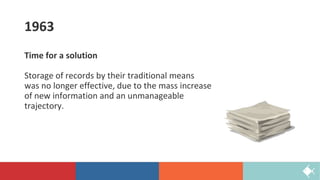
1963
Time for a solution
Storage of records by their traditional means
was no longer effective, due to the mass increase
of new information and an unmanageable
trajectory.
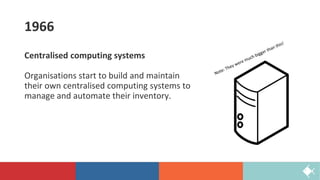
1966
Centralised computing systems
Organisations start to build and maintain
their own centralised computing systems to
manage and automate their inventory.
1970
The relational database
A huge moment. Edgar F. Codd shows how information
in large databases could be accessed easily. This is a
seminal discovery that changed the shape of computing.
1980
Parkinson’s law of data
I.A. Tjomsland says:
“Data expands to fill the space available.”
Late 1980s
Enterprise resource planning improves
ERP software starts to mature, integrating with
different departments and organisational elements.
1989
Business intelligence
Howard Dresner defines BI as "concepts and methods
to improve business decision making by using
fact-based support systems".
Mid 1990s
The world wide web skyrockets
A tumultuous and exciting period in history, as the
internet explodes in popularity and the resulting
data starts to inform the world we live in now.
1997
The problem of big data
Michael Cox and David Ellsworth highlight the problems of so much
data for modern computer systems.
Future data storage
Michael Lesk - “the typical piece of information will never be looked at
by a human being.”
1998
NoSQL
Carlo Strozzi creates the open-source relational database called NoSQL.
Google
Google is founded.
2001
SaaS
The phrase “Software as a Service” is first mentioned in the media.
The 3 Vs
Doug Laney first mentions volume, velocity, and variety with regards to
big data.
2005
Usability considerations
An increased focus on the usability of software
for end users - in enterprise and consumer markets.
2007
The expanding digital universe
Predictions that information will double every 18 months for 4 years.
These proved to be conservative estimates.
2008
Big data
The term starts to gain traction in tech and business arenas.
2009
Business intelligence takes over
Gartner research shows that BI is now priority for CIOs.
How much information?
A report highlights amazing levels of data consumption.
2011
The real growth of data
Science Magazine shows that by 2007, 94% of data storage was digital.
Also highlighted the world's capacity to store information grew at an
rate of 25% every year for 20 years up to 2007.
2012
Big data research
The US government reveals the Big Data Research & Development
Initiative, covering multiple departments.
2014
The year of IoT
The “Internet of Things” gains traction as more items
begin to contain embedded tech.
2015
Smart cities
The year of the smart city, 2015 saw an increase in connected ‘things’
used in cities to improve lives within it. Smart cities use real-time data
to enhance services and increase efficiency.
More reading
• An introduction to data encryption
• What is a hybrid database?
• What is an API? A brief introduction
Read more on the Ribbonfish blog.
Resources for this presentation: WinShuttle & GCN

Data: A Timeline - How Data Came To Rule The World

  • 1.
    Data: A timeline Howdata came to rule the world Also read: Spotlight: How data influences the publishing industry
  • 2.
    1881 The Hollerith TabulatingMachine Punch cards helped US census workers to deal with the increasing amount of information.
  • 3.
    1932 A population boom Theintroduction of social security numbers and other methods of managing the records after a huge population boom.
  • 4.
    1941 The information explosion Thefirst time that the term ‘information explosion’ is used in the media in reference to the ever-increasing amount of information.
  • 5.
    1944 The first storagewarning Estimates are made that university libraries are doubling in size every 16 years. Questions are asked about how places can store such vast records.
  • 6.
    1948 Shannon’s information theory Shannondetermined the minimum data requirements to transmit over noisy channels. Set the foundations for today’s infrastructure. More info here
  • 7.
    1956 Virtual memory By Germanphysicist Fritz-Rudolf Güntsch. The idea finite storage was infinite. More info here
  • 8.
    1963 Time for asolution Storage of records by their traditional means was no longer effective, due to the mass increase of new information and an unmanageable trajectory.
  • 9.
    1966 Centralised computing systems Organisationsstart to build and maintain their own centralised computing systems to manage and automate their inventory.
  • 10.
    1970 The relational database Ahuge moment. Edgar F. Codd shows how information in large databases could be accessed easily. This is a seminal discovery that changed the shape of computing.
  • 11.
    1980 Parkinson’s law ofdata I.A. Tjomsland says: “Data expands to fill the space available.”
  • 12.
    Late 1980s Enterprise resourceplanning improves ERP software starts to mature, integrating with different departments and organisational elements.
  • 13.
    1989 Business intelligence Howard Dresnerdefines BI as "concepts and methods to improve business decision making by using fact-based support systems".
  • 14.
    Mid 1990s The worldwide web skyrockets A tumultuous and exciting period in history, as the internet explodes in popularity and the resulting data starts to inform the world we live in now.
  • 15.
    1997 The problem ofbig data Michael Cox and David Ellsworth highlight the problems of so much data for modern computer systems. Future data storage Michael Lesk - “the typical piece of information will never be looked at by a human being.”
  • 16.
    1998 NoSQL Carlo Strozzi createsthe open-source relational database called NoSQL. Google Google is founded.
  • 17.
    2001 SaaS The phrase “Softwareas a Service” is first mentioned in the media. The 3 Vs Doug Laney first mentions volume, velocity, and variety with regards to big data.
  • 18.
    2005 Usability considerations An increasedfocus on the usability of software for end users - in enterprise and consumer markets.
  • 19.
    2007 The expanding digitaluniverse Predictions that information will double every 18 months for 4 years. These proved to be conservative estimates.
  • 20.
    2008 Big data The termstarts to gain traction in tech and business arenas.
  • 21.
    2009 Business intelligence takesover Gartner research shows that BI is now priority for CIOs. How much information? A report highlights amazing levels of data consumption.
  • 22.
    2011 The real growthof data Science Magazine shows that by 2007, 94% of data storage was digital. Also highlighted the world's capacity to store information grew at an rate of 25% every year for 20 years up to 2007.
  • 23.
    2012 Big data research TheUS government reveals the Big Data Research & Development Initiative, covering multiple departments.
  • 24.
    2014 The year ofIoT The “Internet of Things” gains traction as more items begin to contain embedded tech.
  • 25.
    2015 Smart cities The yearof the smart city, 2015 saw an increase in connected ‘things’ used in cities to improve lives within it. Smart cities use real-time data to enhance services and increase efficiency.
  • 26.
    More reading • Anintroduction to data encryption • What is a hybrid database? • What is an API? A brief introduction Read more on the Ribbonfish blog. Resources for this presentation: WinShuttle & GCN