
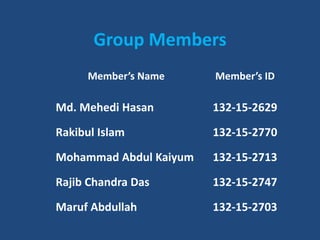

Group Members
Member’s Name Member’s ID
Md. Mehedi Hasan 132-15-2629
Rakibul Islam 132-15-2770
Mohammad Abdul Kaiyum 132-15-2713
Rajib Chandra Das 132-15-2747
Maruf Abdullah 132-15-2703
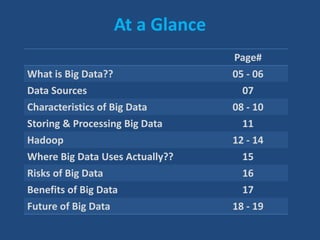
At a Glance
Page#
What is Big Data?? 05 - 06
Data Sources 07
Characteristics of Big Data 08 - 10
Storing & Processing Big Data 11
Hadoop 12 - 14
Where Big Data Uses Actually?? 15
Risks of Big Data 16
Benefits of Big Data 17
Future of Big Data 18 - 19
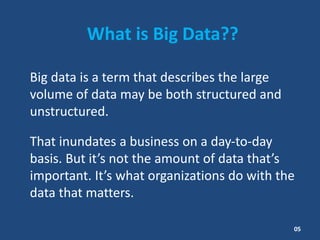
What is Big Data??
Big data is a term that describes the large
volume of data may be both structured and
unstructured.
That inundates a business on a day-to-day
basis. But it’s not the amount of data that’s
important. It’s what organizations do with the
data that matters.
05
What is Big Data??
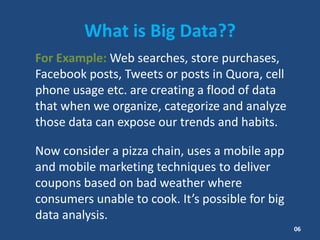
For Example: Web searches, store purchases,
Facebook posts, Tweets or posts in Quora, cell
phone usage etc. are creating a flood of data
that when we organize, categorize and analyze
those data can expose our trends and habits.
Now consider a pizza chain, uses a mobile app
and mobile marketing techniques to deliver
coupons based on bad weather where
consumers unable to cook. It’s possible for big
data analysis.
06
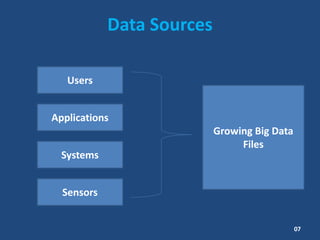
Data Sources
Users
Applications
Systems
Sensors
Growing Big Data
Files
07
Characteristics of Big Data
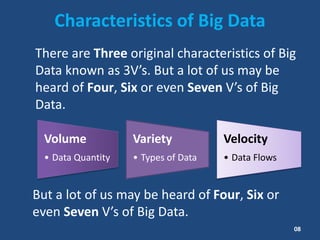
There are Three original characteristics of Big
Data known as 3V’s. But a lot of us may be
heard of Four, Six or even Seven V’s of Big
Data.
But a lot of us may be heard of Four, Six or
even Seven V’s of Big Data.
Volume
• Data Quantity
Variety
• Types of Data
Velocity
• Data Flows
08
Characteristics of Big Data
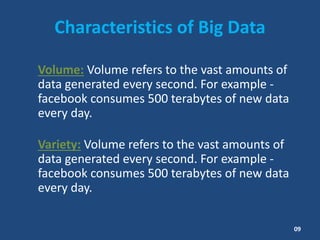
Volume: Volume refers to the vast amounts of
data generated every second. For example -
facebook consumes 500 terabytes of new data
every day.
Variety: Volume refers to the vast amounts of
data generated every second. For example -
facebook consumes 500 terabytes of new data
every day.
09
Characteristics of Big Data
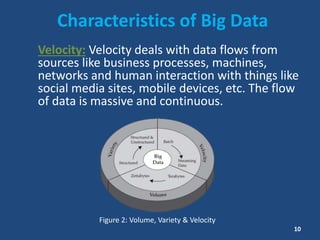
Velocity: Velocity deals with data flows from
sources like business processes, machines,
networks and human interaction with things like
social media sites, mobile devices, etc. The flow
of data is massive and continuous.
Figure 2: Volume, Variety & Velocity
10
Storing & Processing Big Data
As there may contain large amounts of
unstructured data can carry positive business
results when parsed effectively. But to get
that competitive advantage, IT experts need
to know how the technology works and what
roadblocks they should expect in getting
there.
There are many emerging technologies for
Big Data Storing & processing like Hadoop,
PIG, SkyTree, WibiData etc..
11
Storing & Processing (Hadoop)
Hadoop is most popular & open source
platform for handling Big Data. It's free to
download, use and contribute to.
The Hadoop framework breaks big data into
blocks, which are stored on clusters of
commodity hardware.
Hadoop concurrently processes large
amounts of data using multiple low-cost
computers for fast results.
12
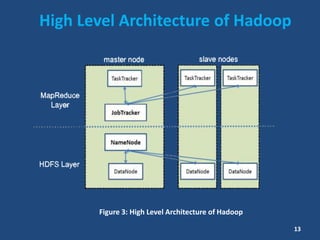
High Level Architecture of Hadoop
Figure 3: High Level Architecture of Hadoop
13
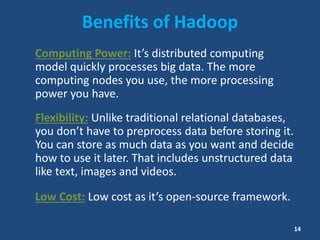
Benefits of Hadoop
Computing Power: It’s distributed computing
model quickly processes big data. The more
computing nodes you use, the more processing
power you have.
Flexibility: Unlike traditional relational databases,
you don’t have to preprocess data before storing it.
You can store as much data as you want and decide
how to use it later. That includes unstructured data
like text, images and videos.
Low Cost: Low cost as it’s open-source framework.
14
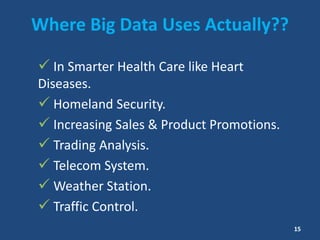
Where Big Data Uses Actually??
 In Smarter Health Care like Heart
Diseases.
 Homeland Security.
 Increasing Sales & Product Promotions.
 Trading Analysis.
 Telecom System.
 Weather Station.
 Traffic Control.
15
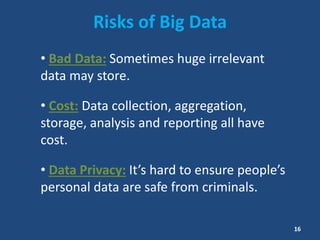
Risks of Big Data
• Bad Data: Sometimes huge irrelevant
data may store.
• Cost: Data collection, aggregation,
storage, analysis and reporting all have
cost.
• Data Privacy: It’s hard to ensure people’s
personal data are safe from criminals.
16
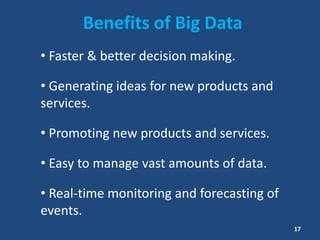
Benefits of Big Data
• Faster & better decision making.
• Generating ideas for new products and
services.
• Promoting new products and services.
• Easy to manage vast amounts of data.
• Real-time monitoring and forecasting of
events.
17
Future of Big Data
Data analytics has become a powerful force
for change, one that can be used to benefit
individuals, businesses, and government.
It has become progressively lost cost to
collect, store and analyze information
which is becoming broader and broader.
18
Future of Big Data
 $15 billion on software firms only
specializing in data management and
analytics.
 The McKinsey Global Institute estimates
that data volume is growing 40% per year and
will grow 44X within 2020.
 Prescriptive analytics can be seen as the
future of Big Data. Even Google’s self-driving
car makes extensive use of prescriptive
analytics.
19
Presentation on Big Data

Presentation on Big Data

  • 3.
    Group Members Member’s NameMember’s ID Md. Mehedi Hasan 132-15-2629 Rakibul Islam 132-15-2770 Mohammad Abdul Kaiyum 132-15-2713 Rajib Chandra Das 132-15-2747 Maruf Abdullah 132-15-2703
  • 4.
    At a Glance Page# Whatis Big Data?? 05 - 06 Data Sources 07 Characteristics of Big Data 08 - 10 Storing & Processing Big Data 11 Hadoop 12 - 14 Where Big Data Uses Actually?? 15 Risks of Big Data 16 Benefits of Big Data 17 Future of Big Data 18 - 19
  • 5.
    What is BigData?? Big data is a term that describes the large volume of data may be both structured and unstructured. That inundates a business on a day-to-day basis. But it’s not the amount of data that’s important. It’s what organizations do with the data that matters. 05
  • 6.
    What is BigData?? For Example: Web searches, store purchases, Facebook posts, Tweets or posts in Quora, cell phone usage etc. are creating a flood of data that when we organize, categorize and analyze those data can expose our trends and habits. Now consider a pizza chain, uses a mobile app and mobile marketing techniques to deliver coupons based on bad weather where consumers unable to cook. It’s possible for big data analysis. 06
  • 7.
  • 8.
    Characteristics of BigData There are Three original characteristics of Big Data known as 3V’s. But a lot of us may be heard of Four, Six or even Seven V’s of Big Data. But a lot of us may be heard of Four, Six or even Seven V’s of Big Data. Volume • Data Quantity Variety • Types of Data Velocity • Data Flows 08
  • 9.
    Characteristics of BigData Volume: Volume refers to the vast amounts of data generated every second. For example - facebook consumes 500 terabytes of new data every day. Variety: Volume refers to the vast amounts of data generated every second. For example - facebook consumes 500 terabytes of new data every day. 09
  • 10.
    Characteristics of BigData Velocity: Velocity deals with data flows from sources like business processes, machines, networks and human interaction with things like social media sites, mobile devices, etc. The flow of data is massive and continuous. Figure 2: Volume, Variety & Velocity 10
  • 11.
    Storing & ProcessingBig Data As there may contain large amounts of unstructured data can carry positive business results when parsed effectively. But to get that competitive advantage, IT experts need to know how the technology works and what roadblocks they should expect in getting there. There are many emerging technologies for Big Data Storing & processing like Hadoop, PIG, SkyTree, WibiData etc.. 11
  • 12.
    Storing & Processing(Hadoop) Hadoop is most popular & open source platform for handling Big Data. It's free to download, use and contribute to. The Hadoop framework breaks big data into blocks, which are stored on clusters of commodity hardware. Hadoop concurrently processes large amounts of data using multiple low-cost computers for fast results. 12
  • 13.
    High Level Architectureof Hadoop Figure 3: High Level Architecture of Hadoop 13
  • 14.
    Benefits of Hadoop ComputingPower: It’s distributed computing model quickly processes big data. The more computing nodes you use, the more processing power you have. Flexibility: Unlike traditional relational databases, you don’t have to preprocess data before storing it. You can store as much data as you want and decide how to use it later. That includes unstructured data like text, images and videos. Low Cost: Low cost as it’s open-source framework. 14
  • 15.
    Where Big DataUses Actually??  In Smarter Health Care like Heart Diseases.  Homeland Security.  Increasing Sales & Product Promotions.  Trading Analysis.  Telecom System.  Weather Station.  Traffic Control. 15
  • 16.
    Risks of BigData • Bad Data: Sometimes huge irrelevant data may store. • Cost: Data collection, aggregation, storage, analysis and reporting all have cost. • Data Privacy: It’s hard to ensure people’s personal data are safe from criminals. 16
  • 17.
    Benefits of BigData • Faster & better decision making. • Generating ideas for new products and services. • Promoting new products and services. • Easy to manage vast amounts of data. • Real-time monitoring and forecasting of events. 17
  • 18.
    Future of BigData Data analytics has become a powerful force for change, one that can be used to benefit individuals, businesses, and government. It has become progressively lost cost to collect, store and analyze information which is becoming broader and broader. 18
  • 19.
    Future of BigData  $15 billion on software firms only specializing in data management and analytics.  The McKinsey Global Institute estimates that data volume is growing 40% per year and will grow 44X within 2020.  Prescriptive analytics can be seen as the future of Big Data. Even Google’s self-driving car makes extensive use of prescriptive analytics. 19