The Future of the Internet
1
Payam Barnaghi
Institute for Communication Systems (ICS)
Electronic Engineering Department
University of Surrey
Guildford, United Kingdom
The Grand Challenge
(Tracking 21st Century challenges together)
University of Exeter, June 2015
2
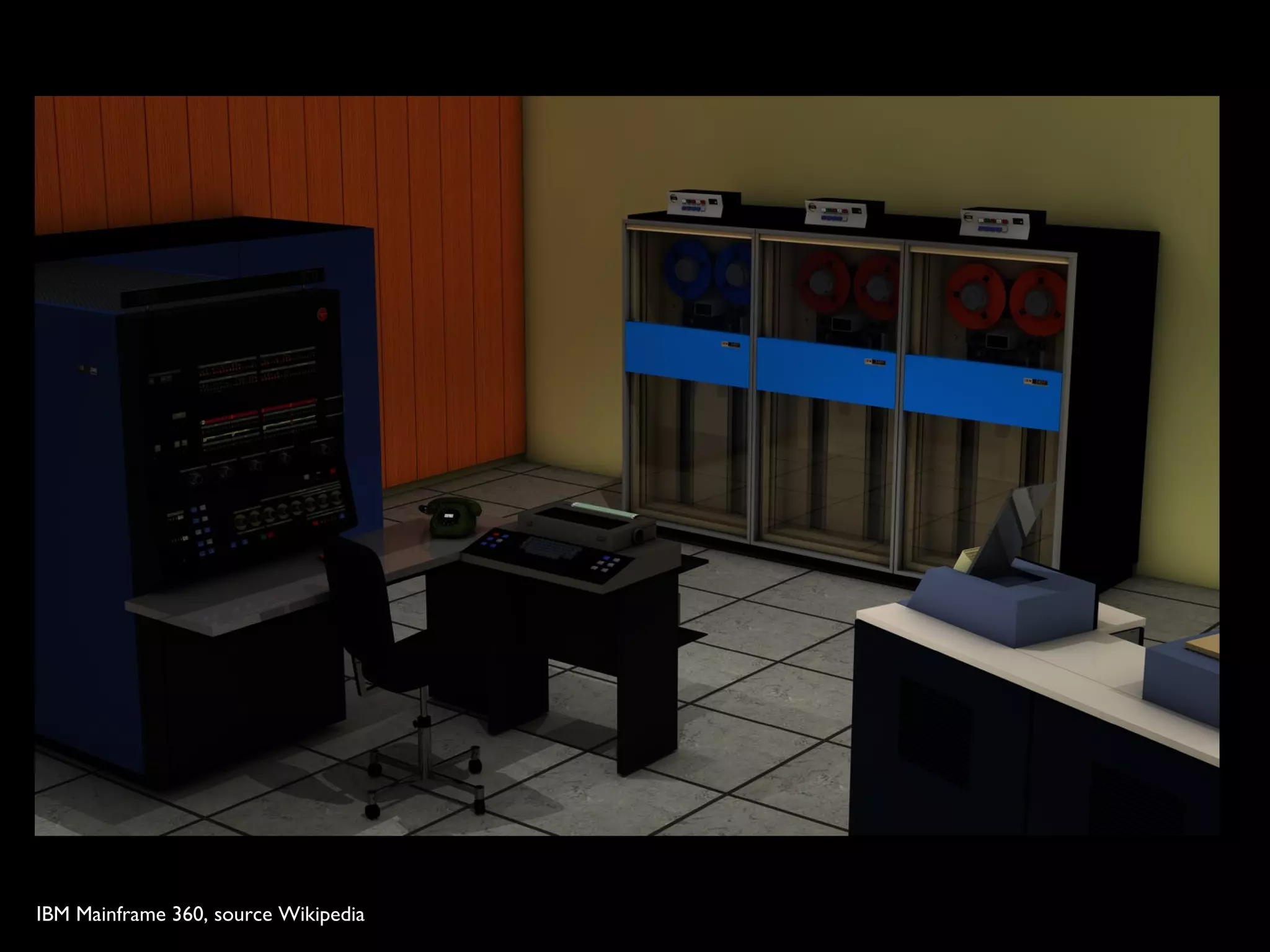
IBM Mainframe 360, source Wikipedia
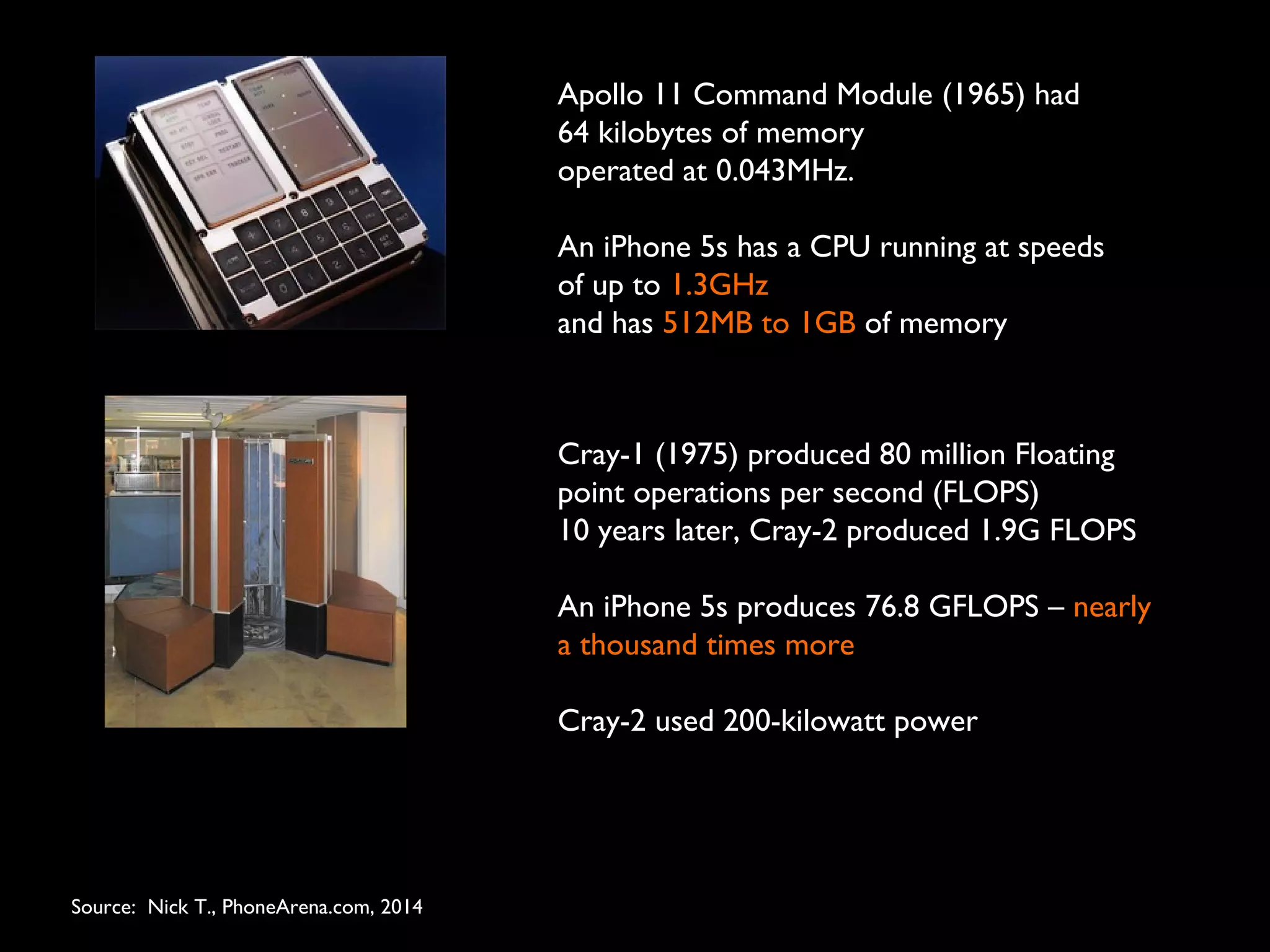
Apollo 11 Command Module (1965) had
64 kilobytes of memory
operated at 0.043MHz.
An iPhone 5s has a CPU running at speeds
of up to 1.3GHz
and has 512MB to 1GB of memory
Cray-1 (1975) produced 80 million Floating
point operations per second (FLOPS)
10 years later, Cray-2 produced 1.9G FLOPS
An iPhone 5s produces 76.8 GFLOPS – nearly
a thousand times more
Cray-2 used 200-kilowatt power
Source: Nick T., PhoneArena.com, 2014
Computing Power
4
−Smaller size
−More Powerful
−More memory and more storage
−"Moore's law" over the history of computing, the
number of transistors in a dense integrated circuit
has doubled approximately every two years.
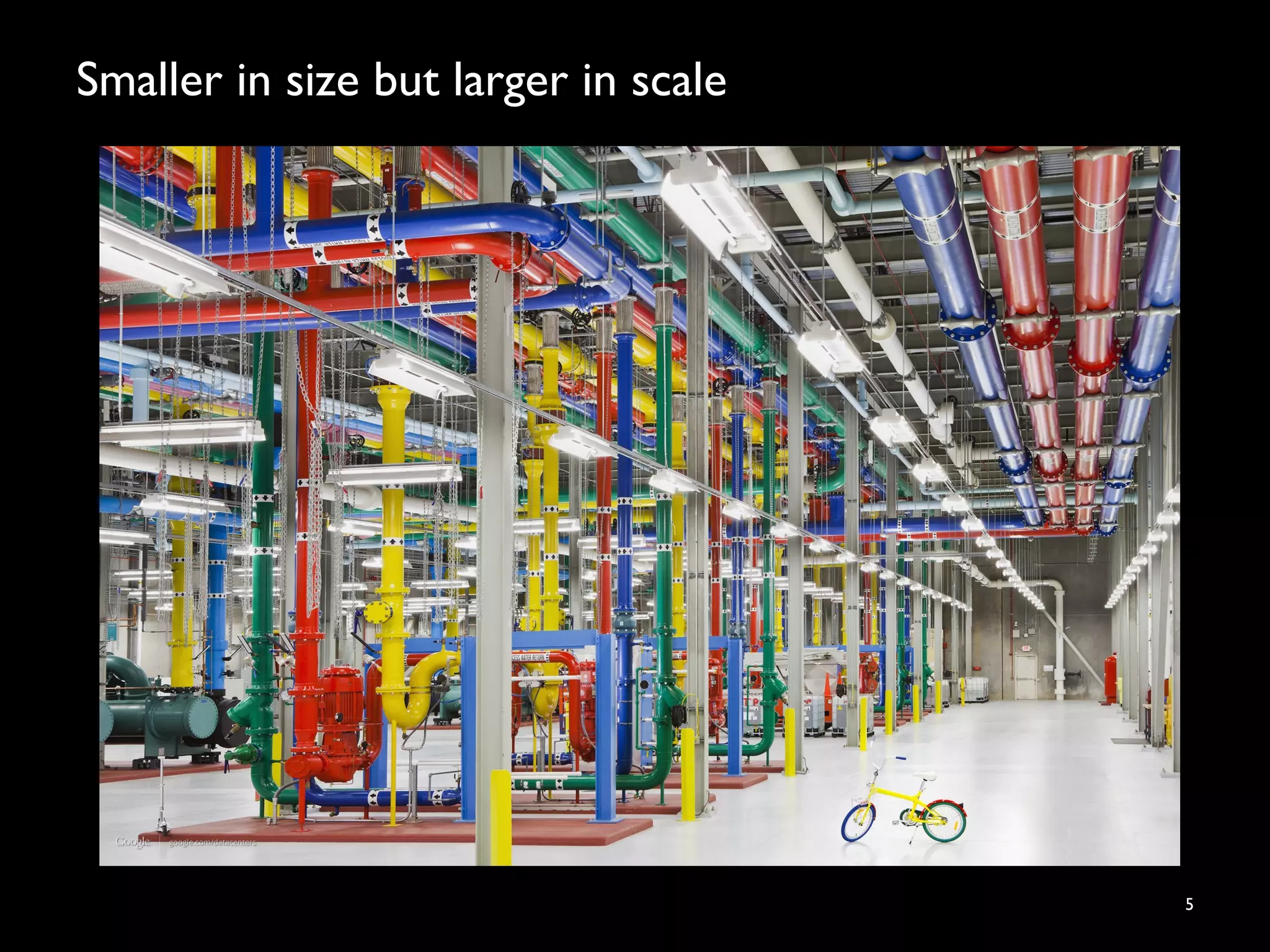
Smaller in size but larger in scale
5
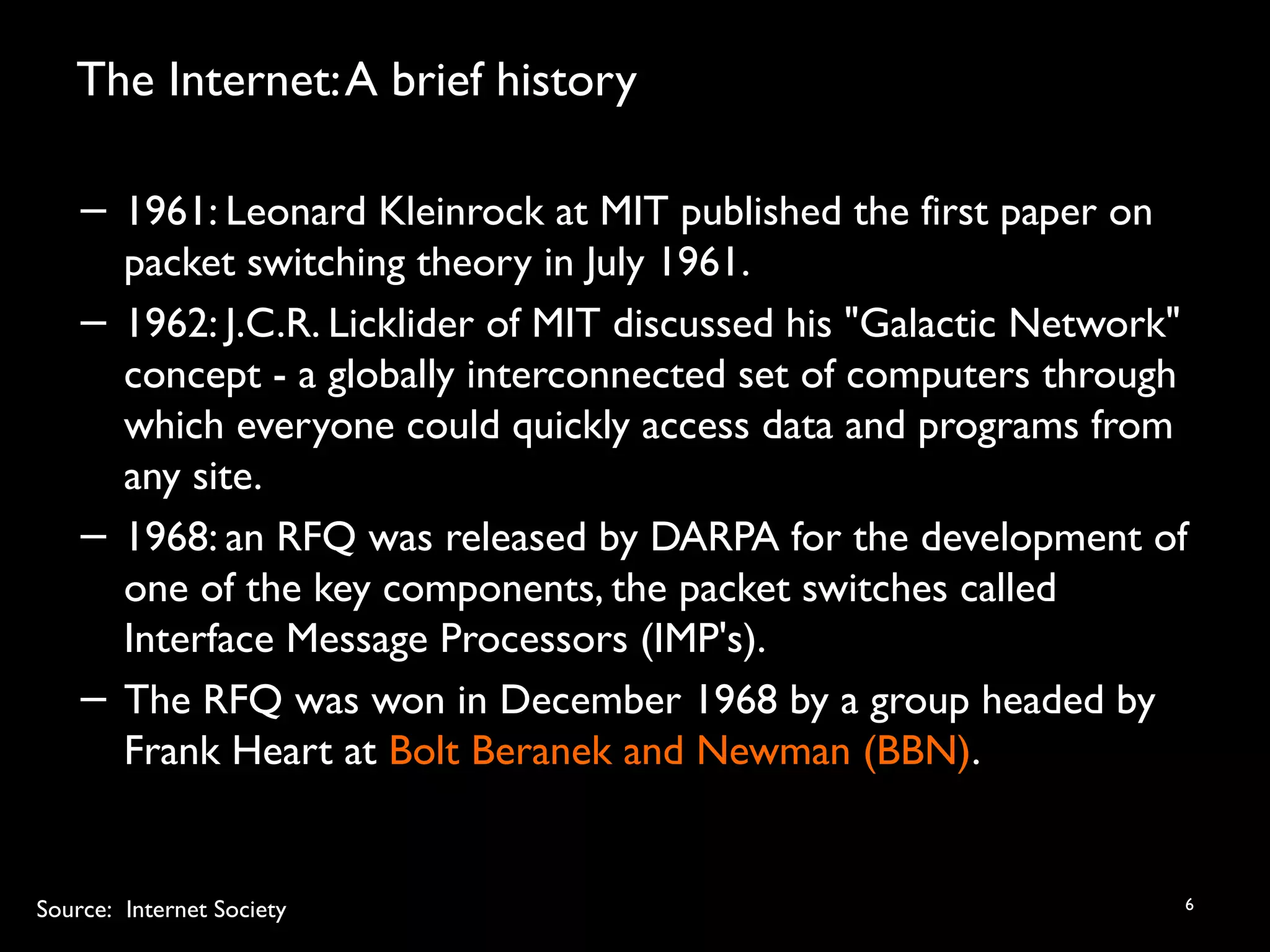
The Internet:A brief history
6
− 1961: Leonard Kleinrock at MIT published the first paper on
packet switching theory in July 1961.
− 1962: J.C.R. Licklider of MIT discussed his "Galactic Network"
concept - a globally interconnected set of computers through
which everyone could quickly access data and programs from
any site.
− 1968: an RFQ was released by DARPA for the development of
one of the key components, the packet switches called
Interface Message Processors (IMP's).
− The RFQ was won in December 1968 by a group headed by
Frank Heart at Bolt Beranek and Newman (BBN).
Source: Internet Society
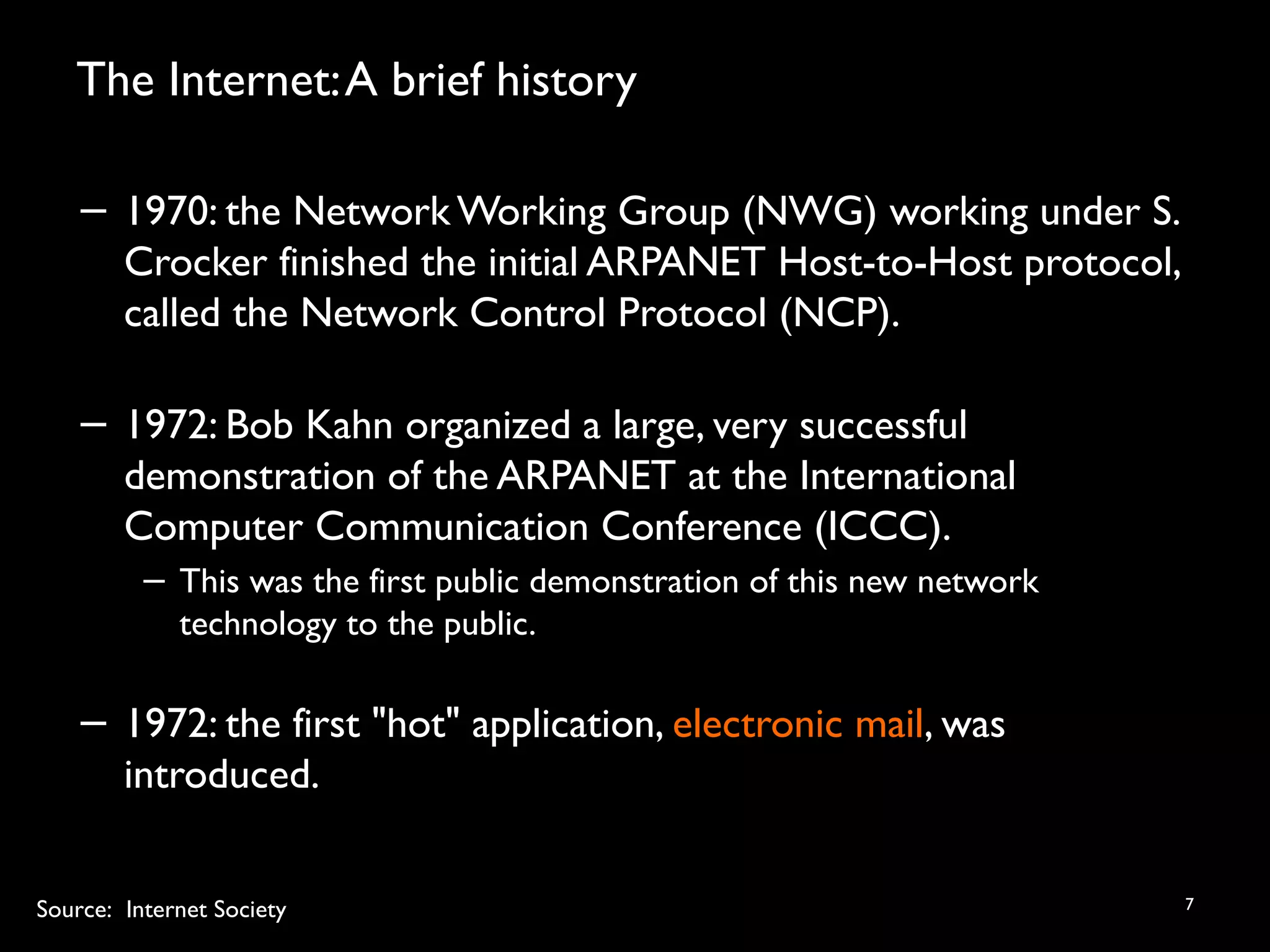
The Internet:A brief history
7
− 1970: the Network Working Group (NWG) working under S.
Crocker finished the initial ARPANET Host-to-Host protocol,
called the Network Control Protocol (NCP).
− 1972: Bob Kahn organized a large, very successful
demonstration of the ARPANET at the International
Computer Communication Conference (ICCC).
− This was the first public demonstration of this new network
technology to the public.
− 1972: the first "hot" application, electronic mail, was
introduced.
Source: Internet Society
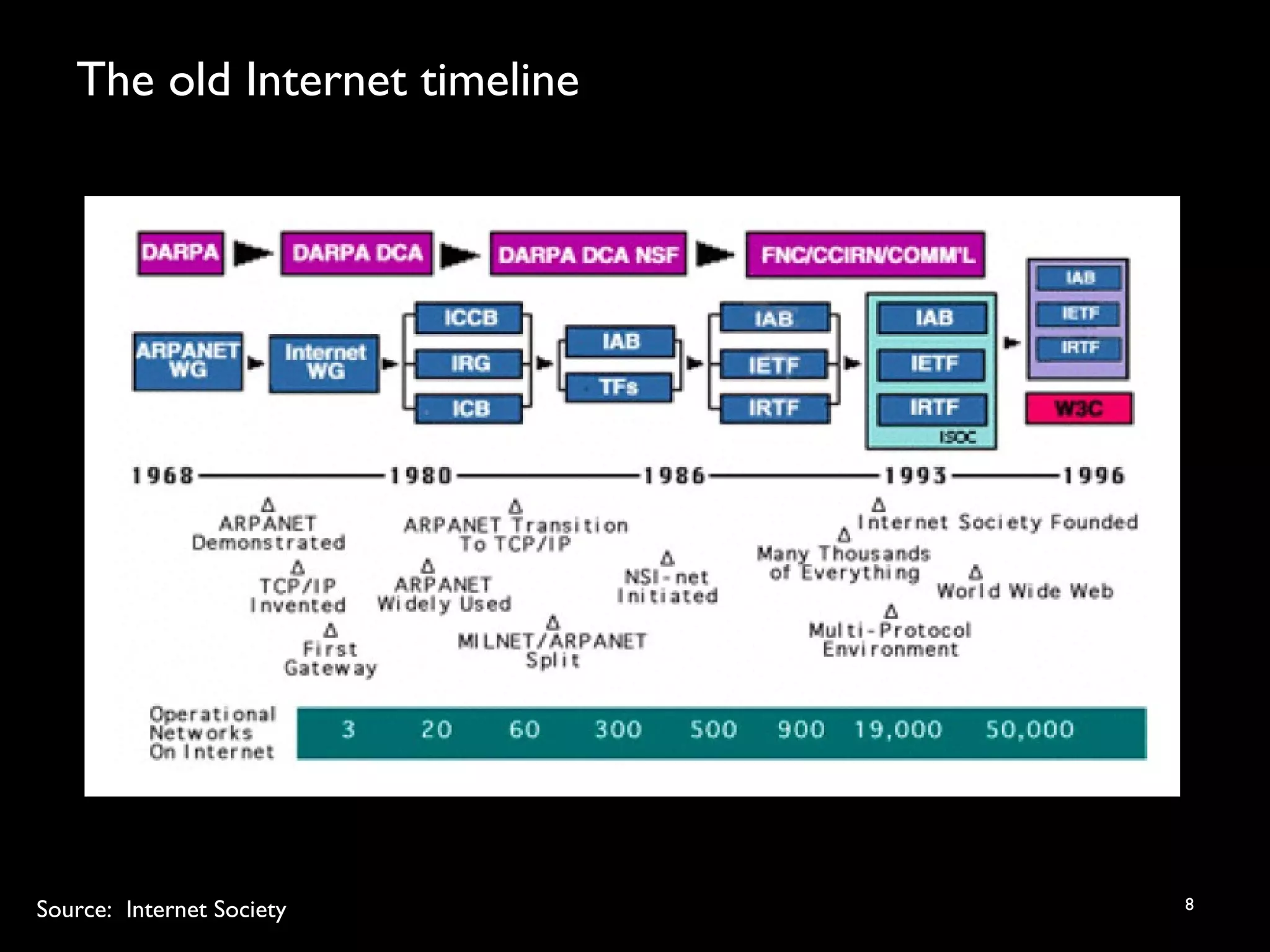
The old Internet timeline
8Source: Internet Society
TCP/IP in the early days of the Internet
9
− The original Cerf/Kahn paper on the Internet described one
protocol, called TCP, which provided all the transport and
forwarding services in the Internet.
− A 32 bit IP address was used of which the first 8 bits signified
the network and the remaining 24 bits designated the host on
that network.
− The assumption was that 256 networks would be sufficient
for the foreseeable future…
− Obviously this was before LANs (Ethernet was under
development at Xerox PARC at that time)
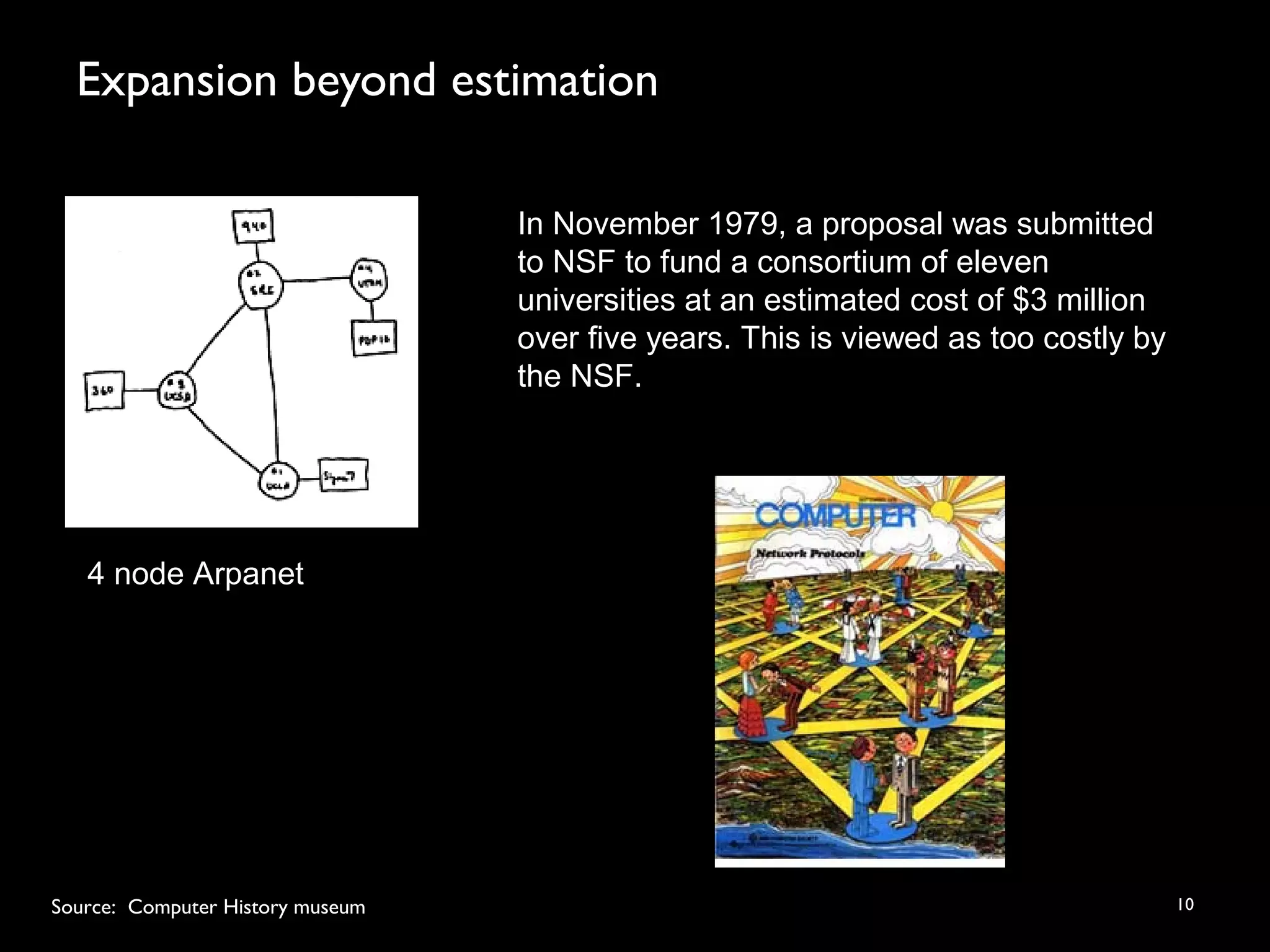
Expansion beyond estimation
10
In November 1979, a proposal was submitted
to NSF to fund a consortium of eleven
universities at an estimated cost of $3 million
over five years. This is viewed as too costly by
the NSF.
Source: Computer History museum
4 node Arpanet
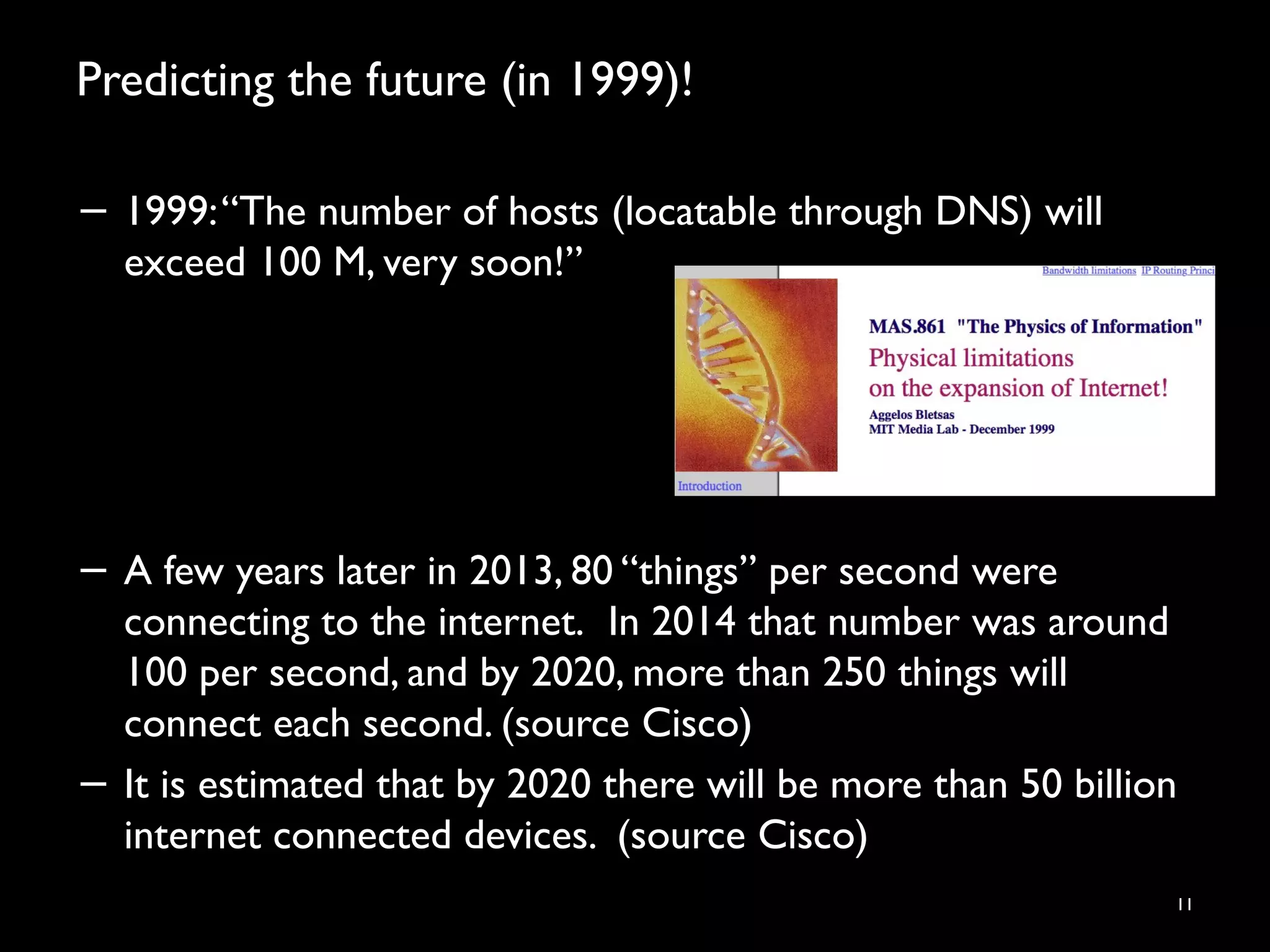
Predicting the future (in 1999)!
11
− 1999:“The number of hosts (locatable through DNS) will
exceed 100 M, very soon!”
− A few years later in 2013, 80 “things” per second were
connecting to the internet.  In 2014 that number was around
100 per second, and by 2020, more than 250 things will
connect each second. (source Cisco)
− It is estimated that by 2020 there will be more than 50 billion
internet connected devices. (source Cisco)
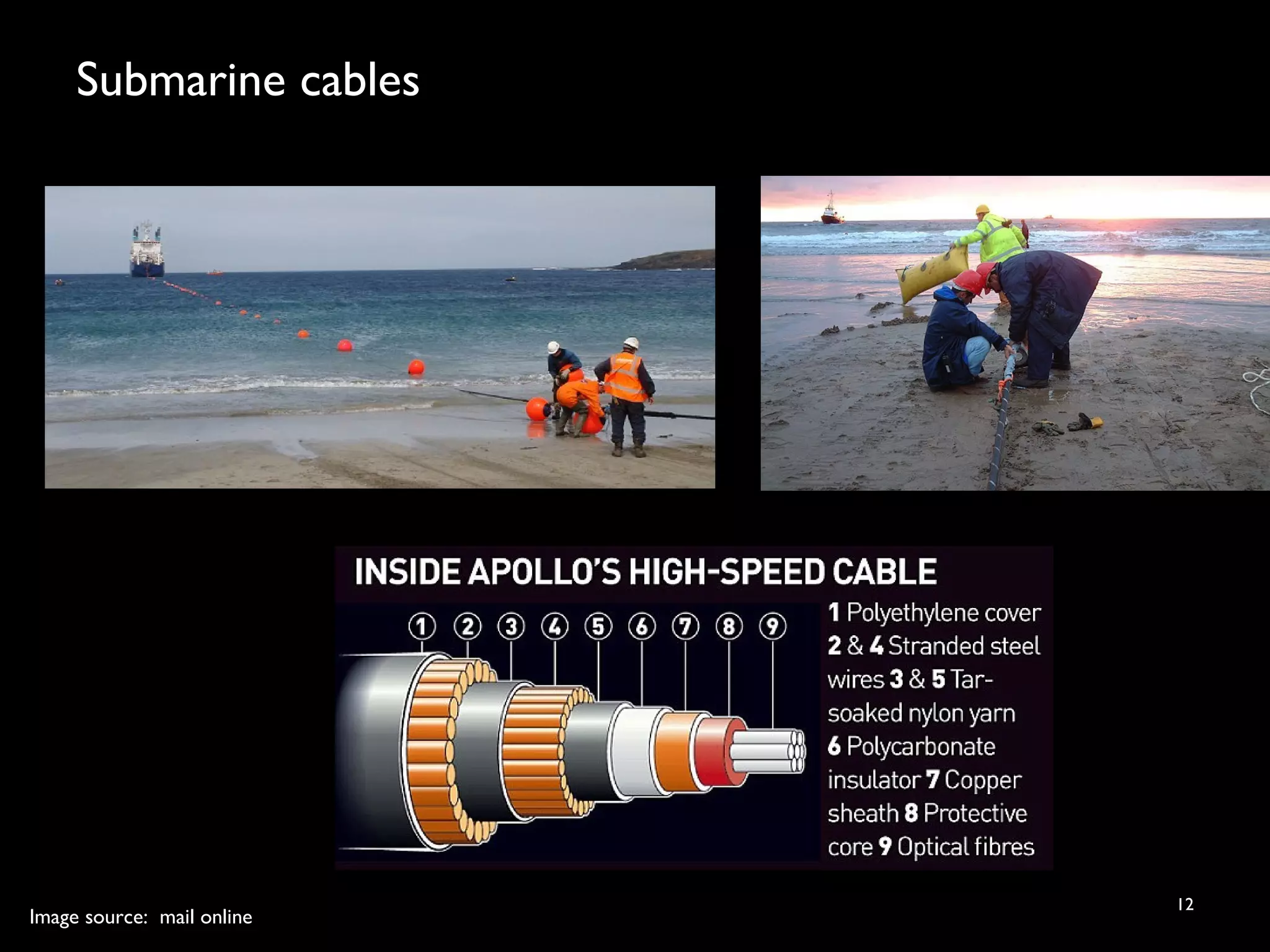
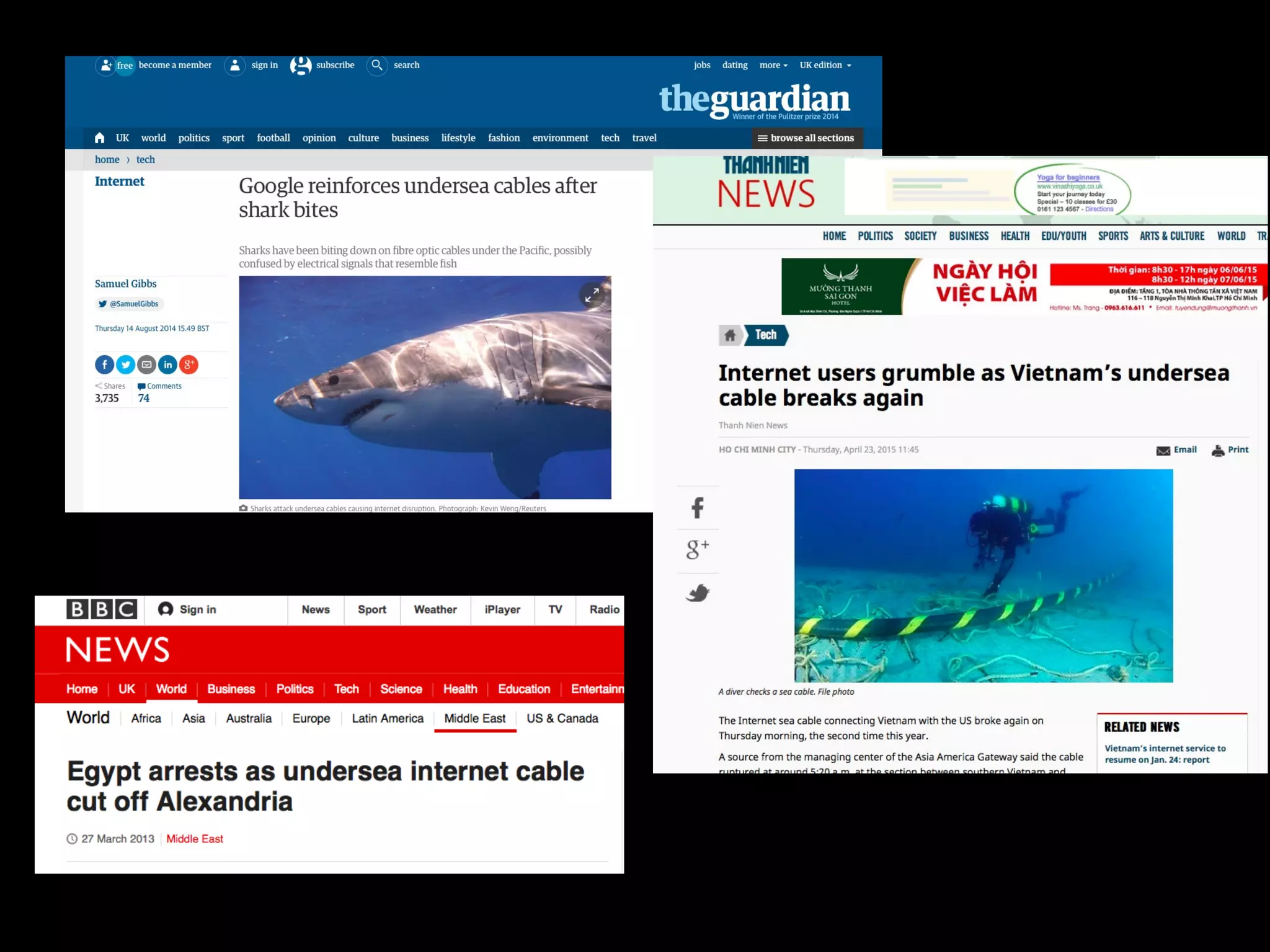
Submarine cables
12
Image source: mail online
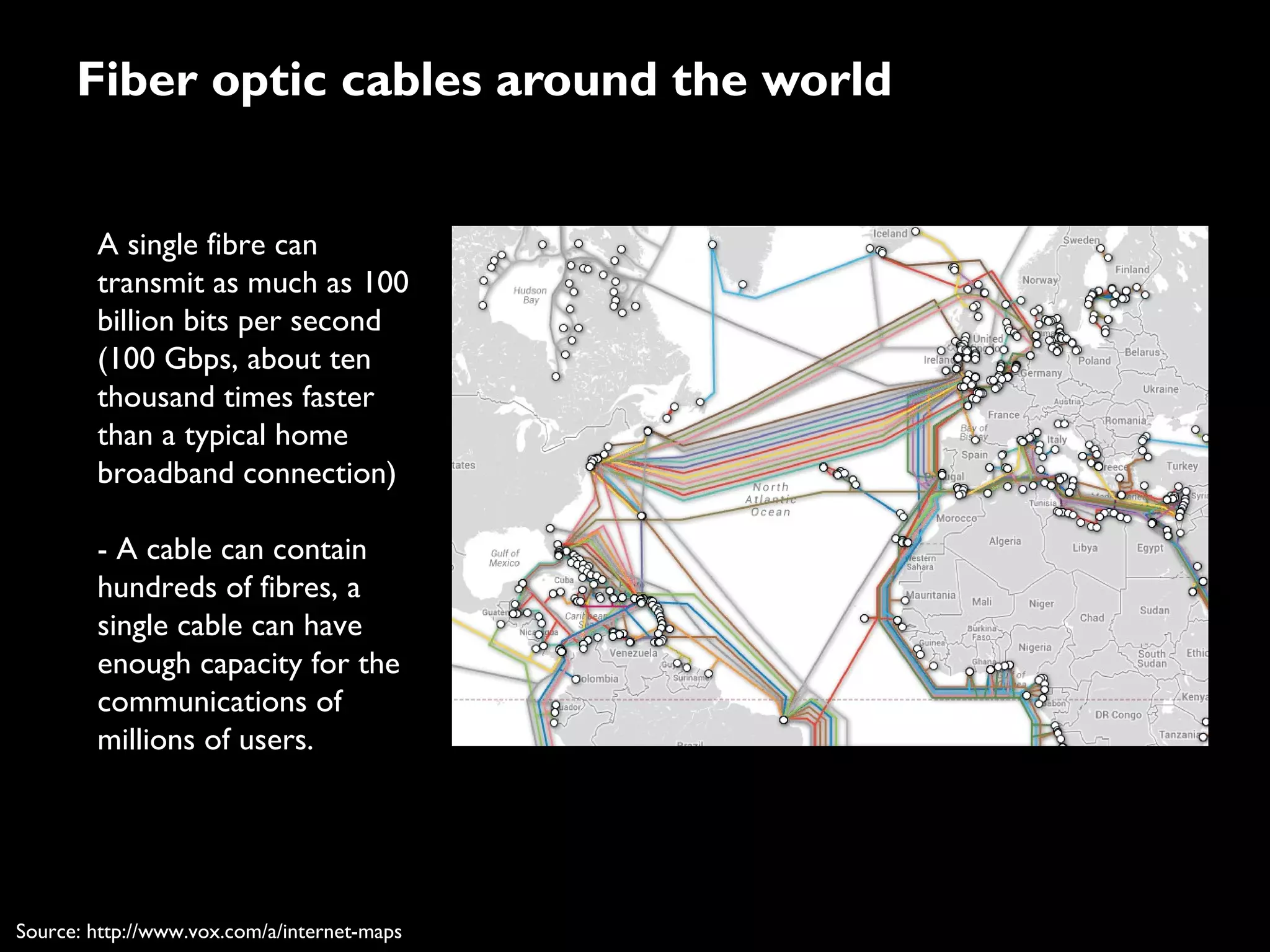
Fiber optic cables around the world
A single fibre can
transmit as much as 100
billion bits per second
(100 Gbps, about ten
thousand times faster
than a typical home
broadband connection)
- A cable can contain
hundreds of fibres, a
single cable can have
enough capacity for the
communications of
millions of users.
Source: http://www.vox.com/a/internet-maps
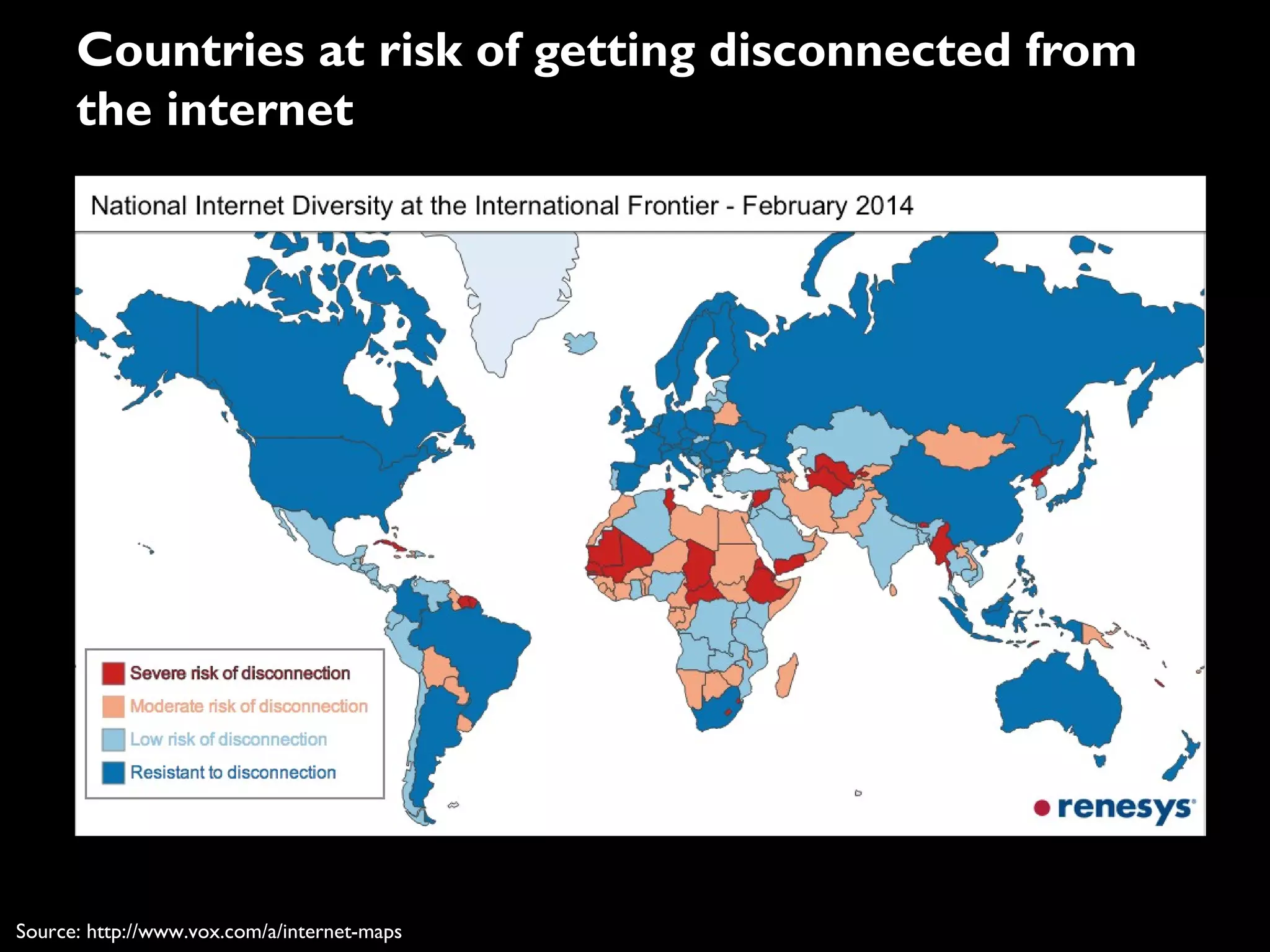
Countries at risk of getting disconnected from
the internet
Source: http://www.vox.com/a/internet-maps
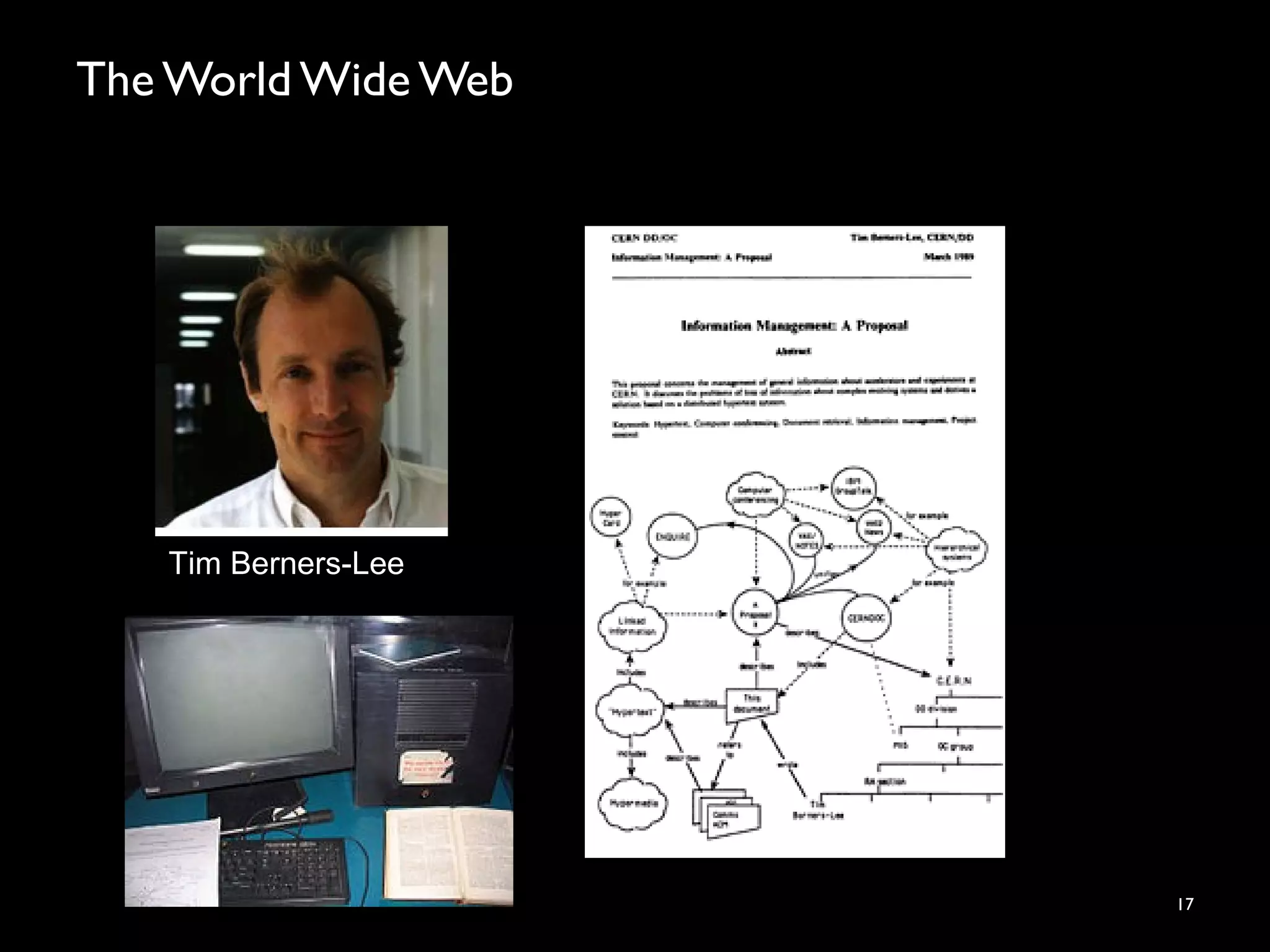
Connectivity and information exchange was
(and is ) one of the main motivations behind
the Internet; but Content and Services are
now the key elements;
and all started growing rapidly by the
introduction of the World Wide Web.
16
The World Wide Web
17
Tim Berners-Lee
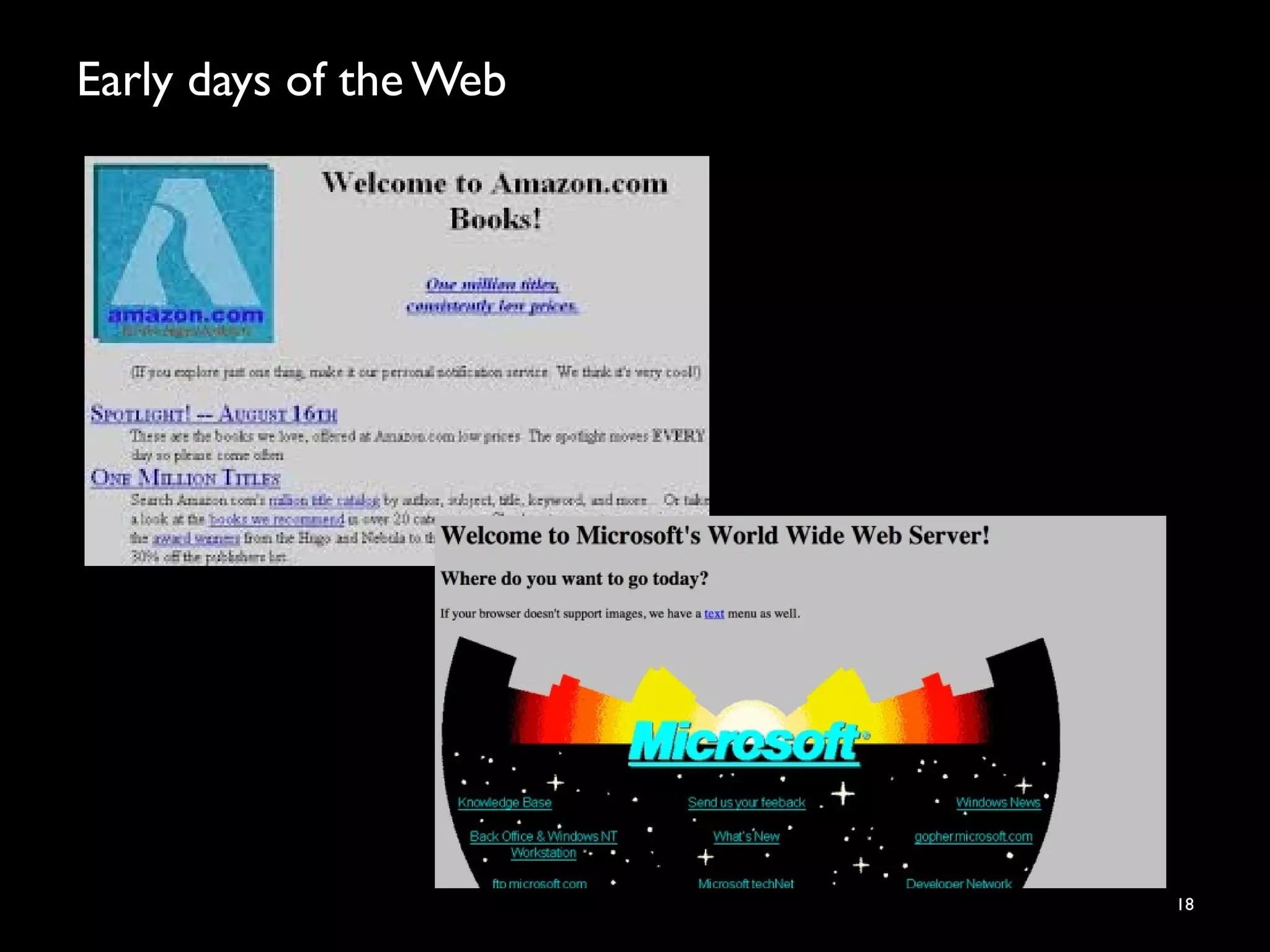
Early days of the Web
18
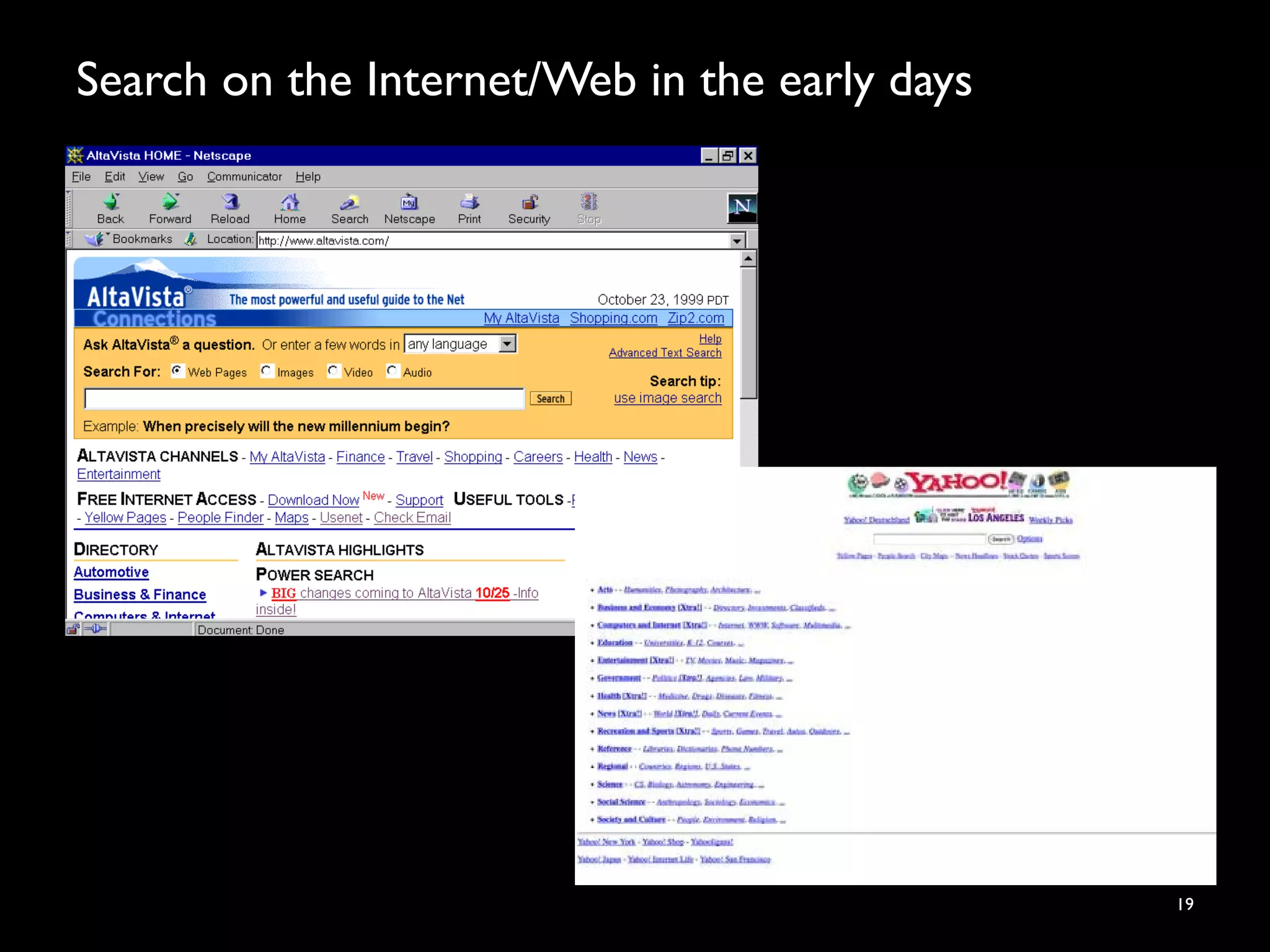
Search on the Internet/Web in the early days
19
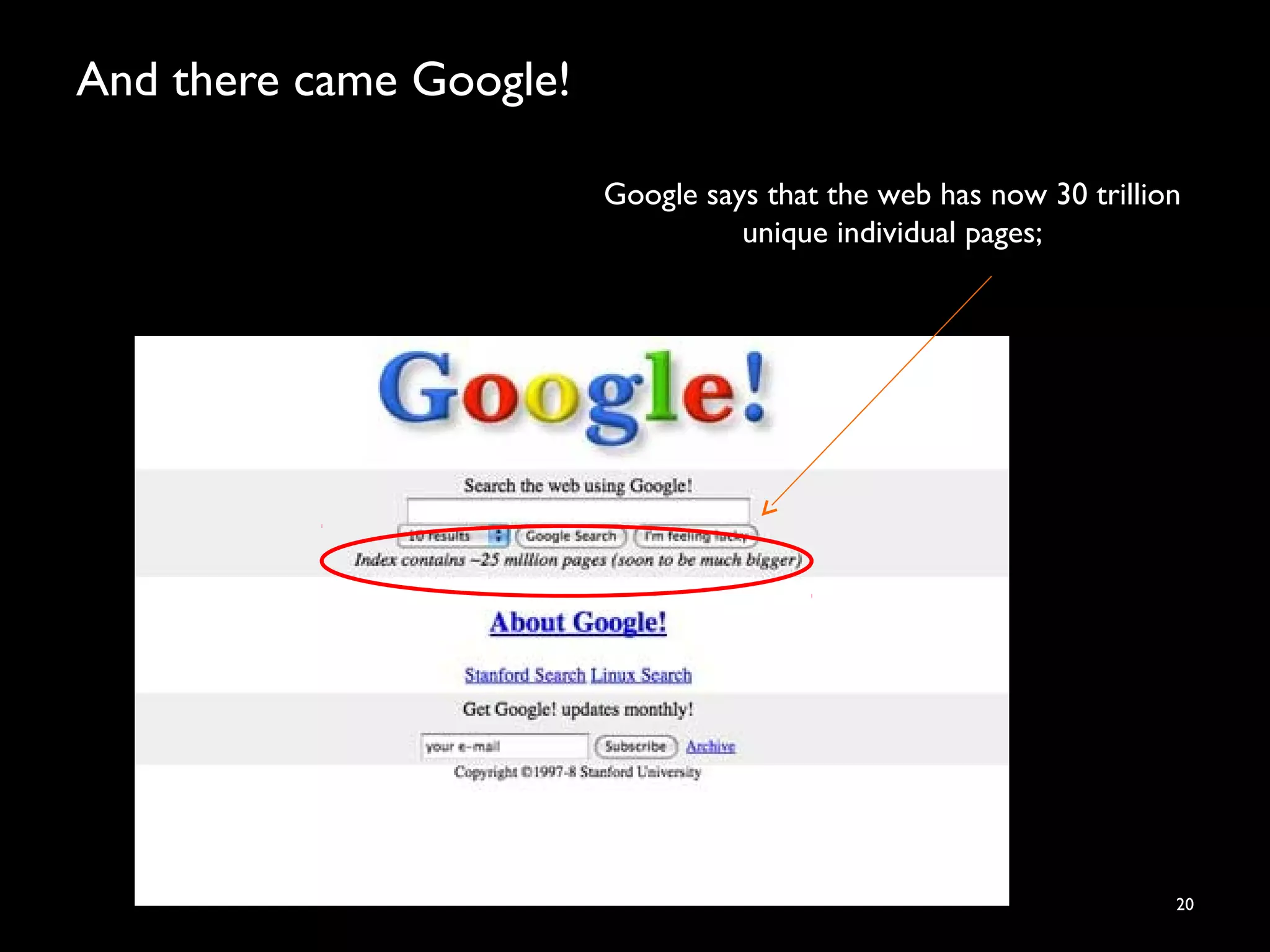
And there came Google!
20
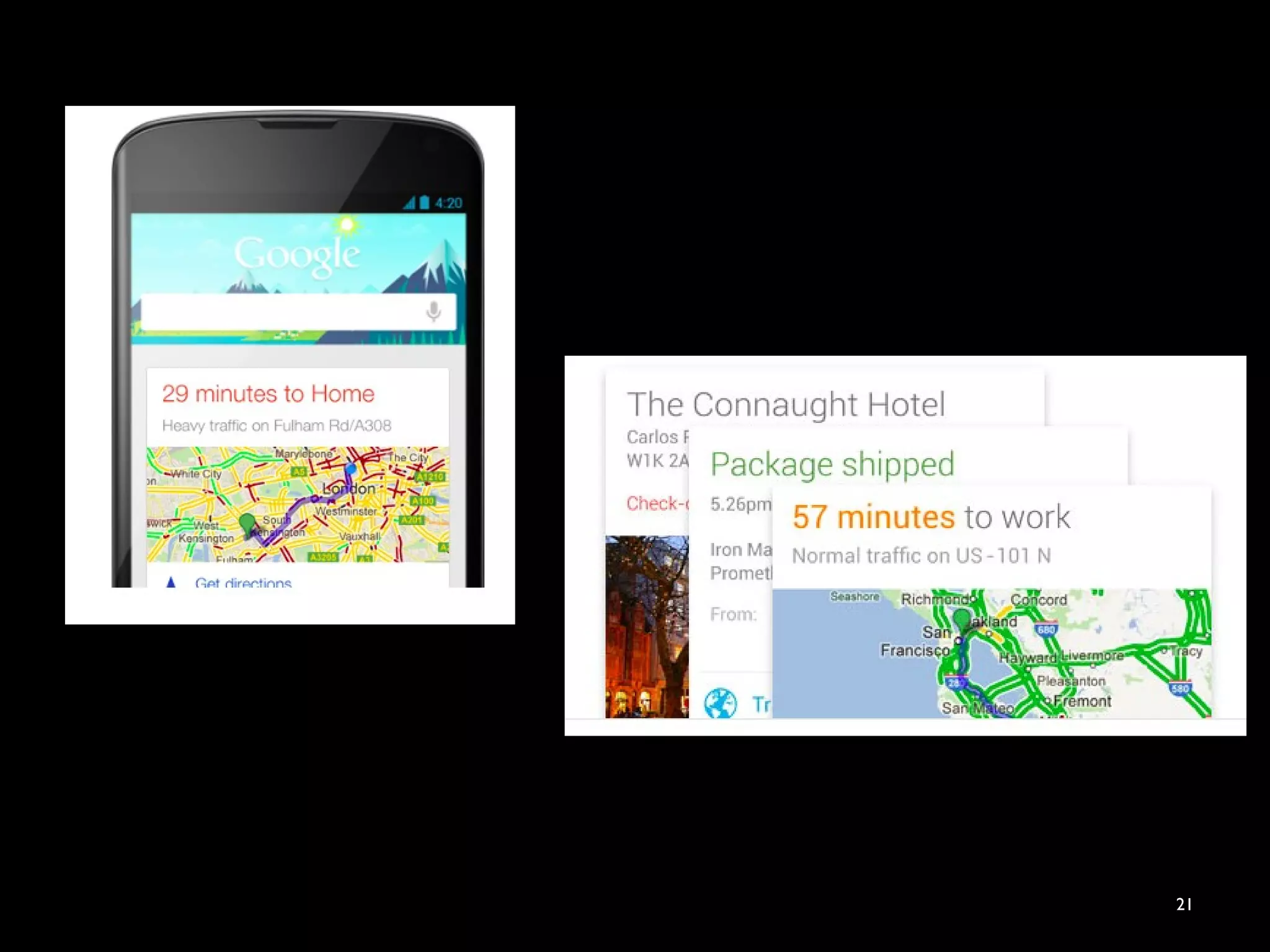
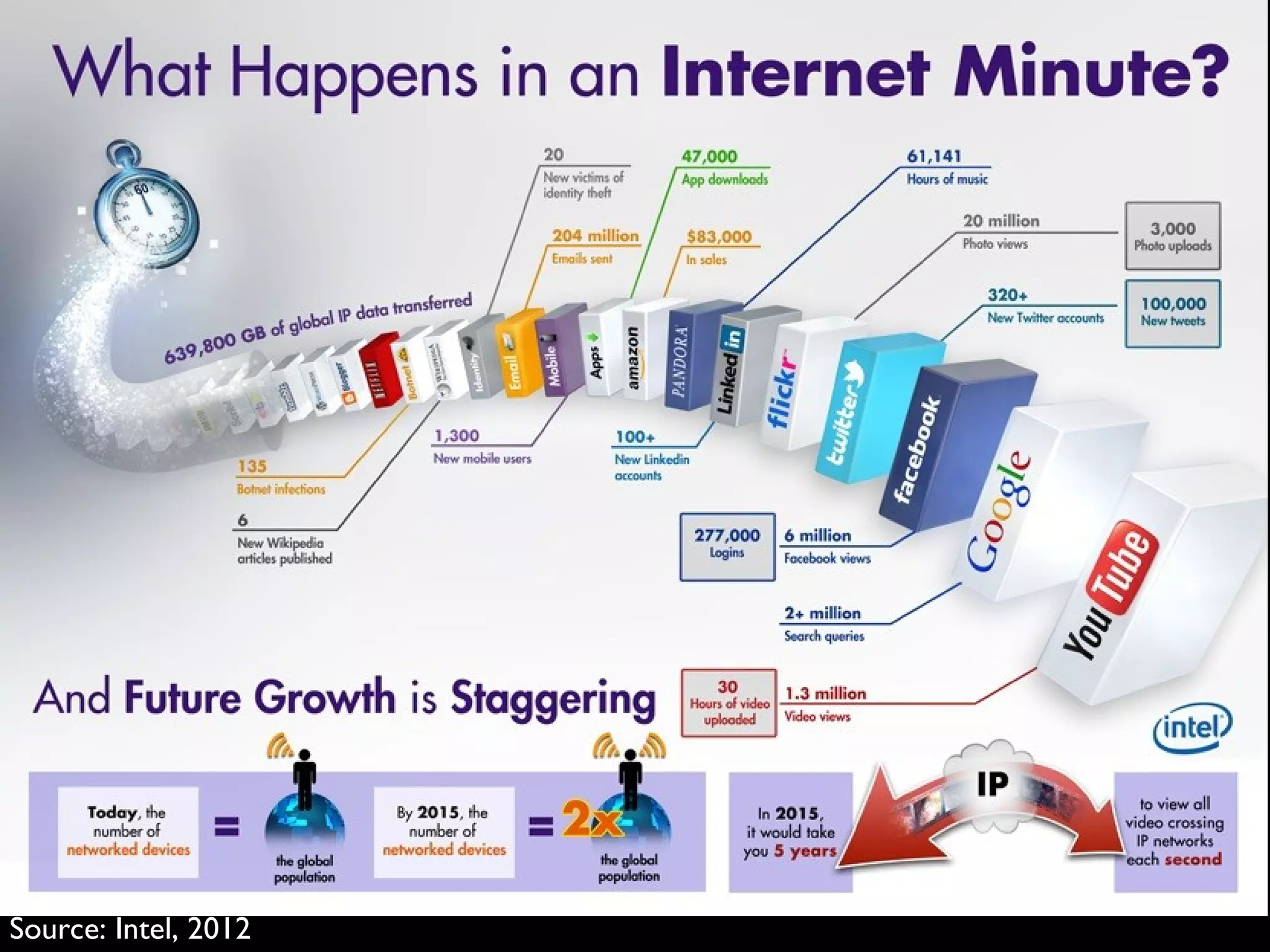
Google says that the web has now 30 trillion
unique individual pages;
21
Source: Intel, 2012
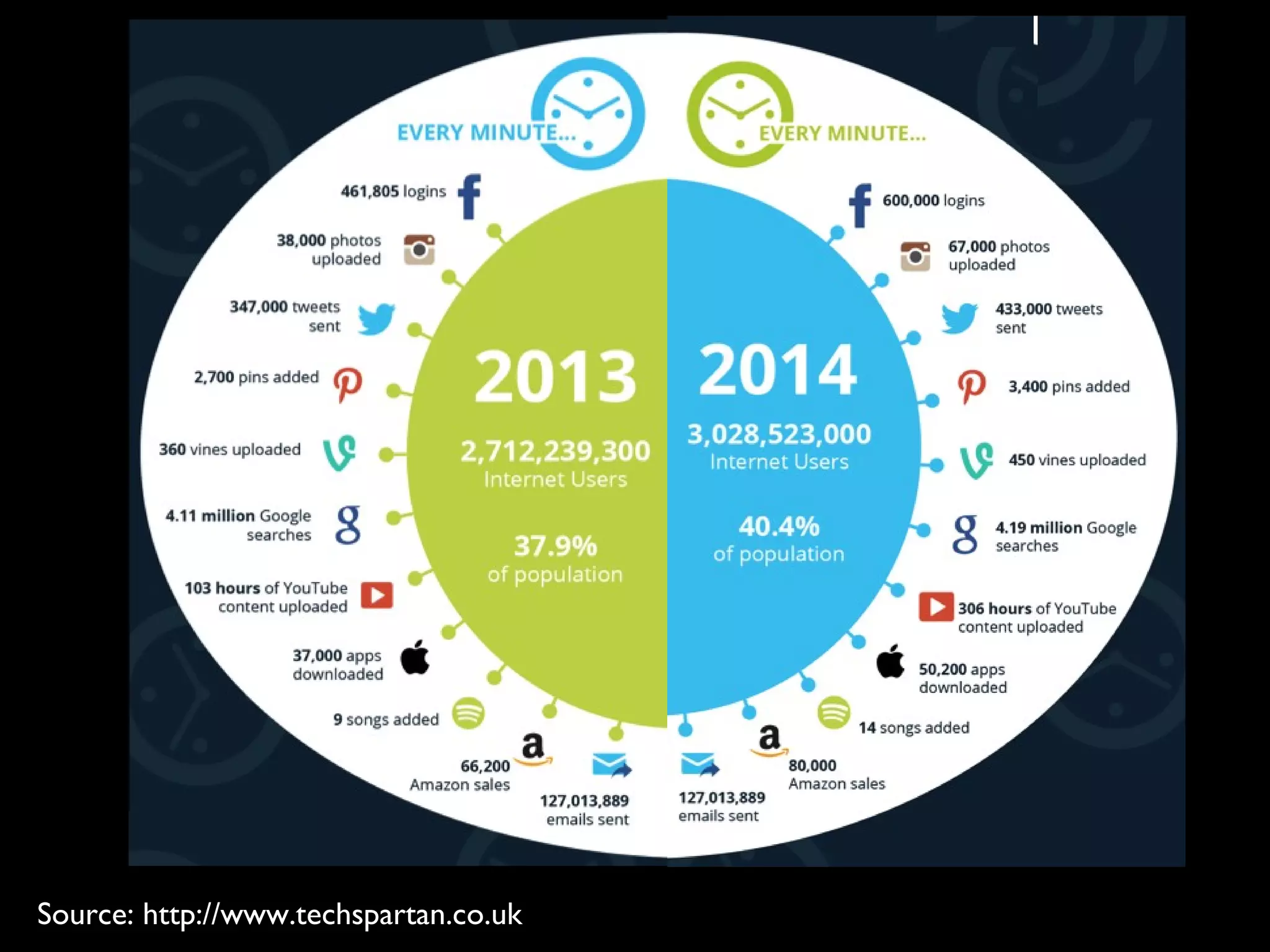
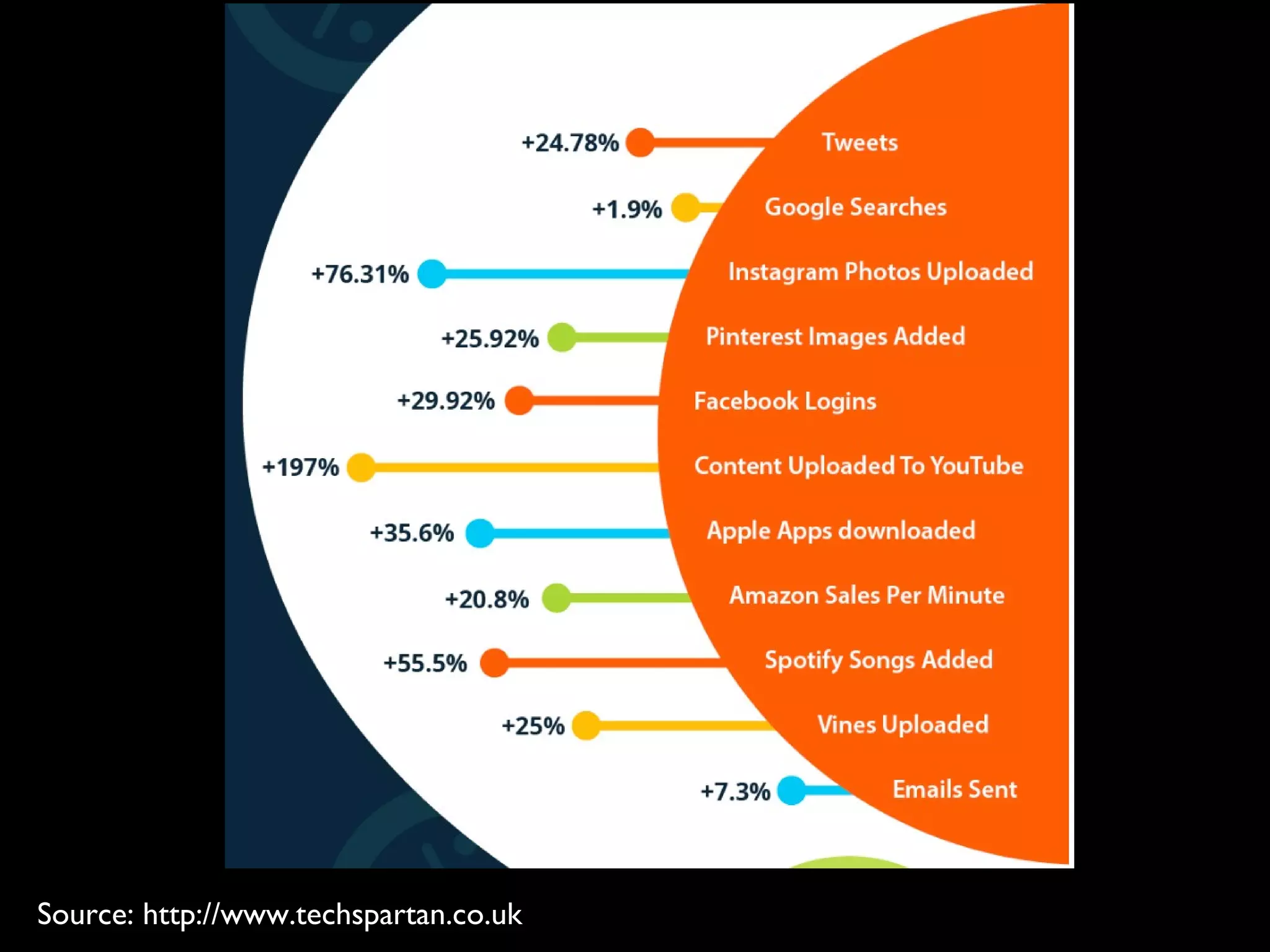
Source: http://www.techspartan.co.uk
25
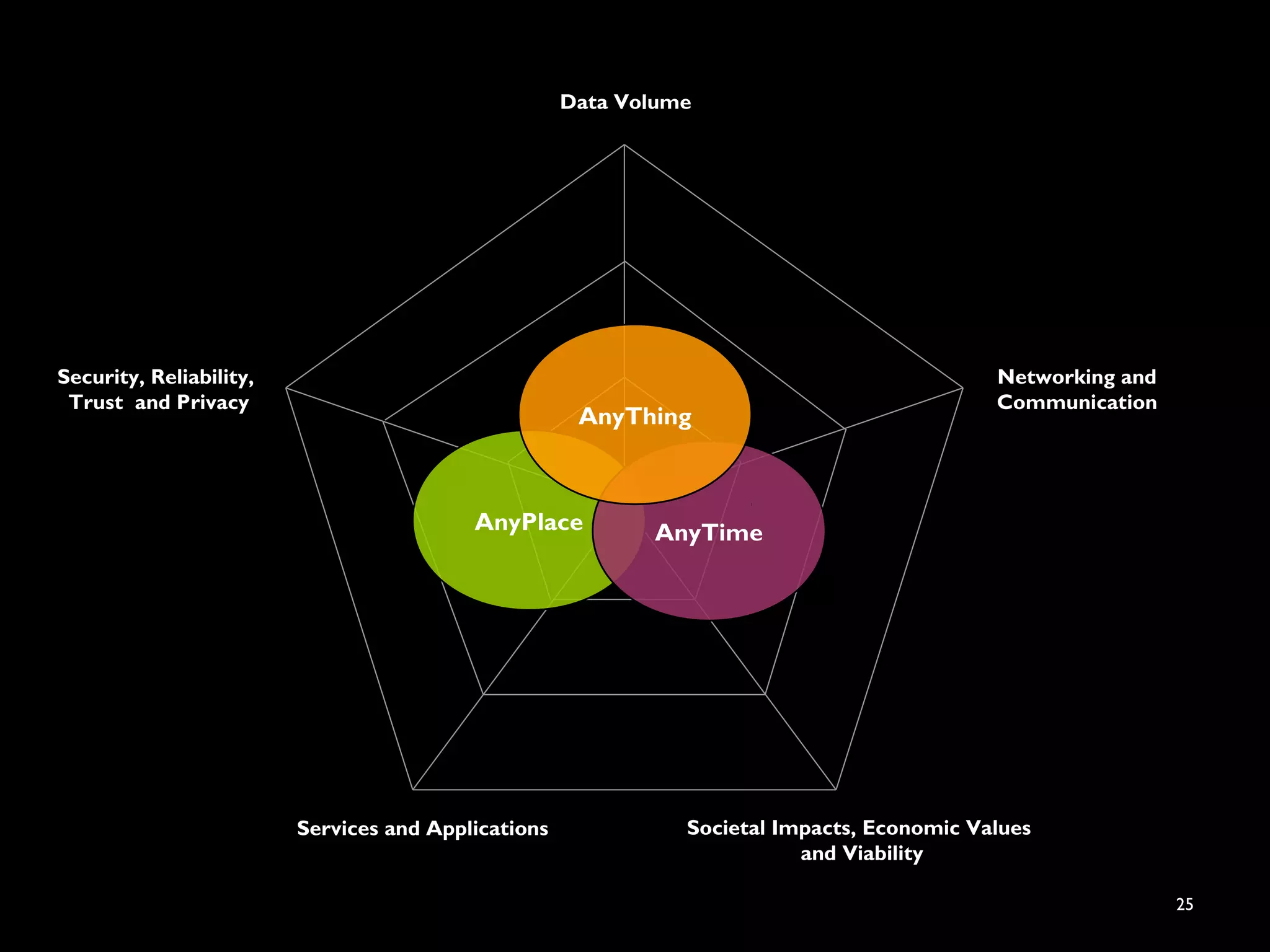
AnyPlace AnyTime
AnyThing
Data Volume
Security, Reliability,
Trust and Privacy
Societal Impacts, Economic Values
and Viability
Services and Applications
Networking and
Communication
26
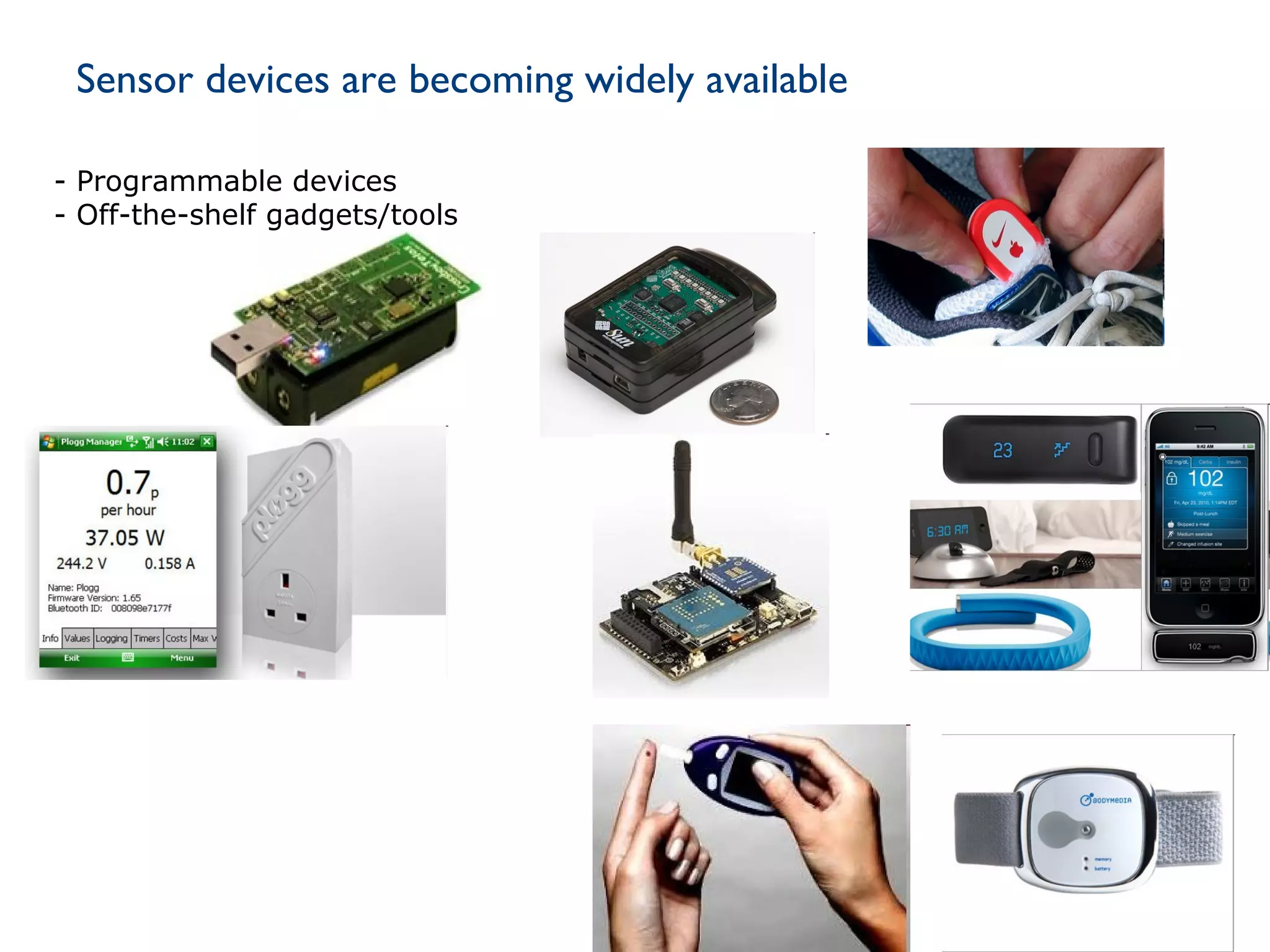
Sensor devices are becoming widely available
- Programmable devices
- Off-the-shelf gadgets/tools
27
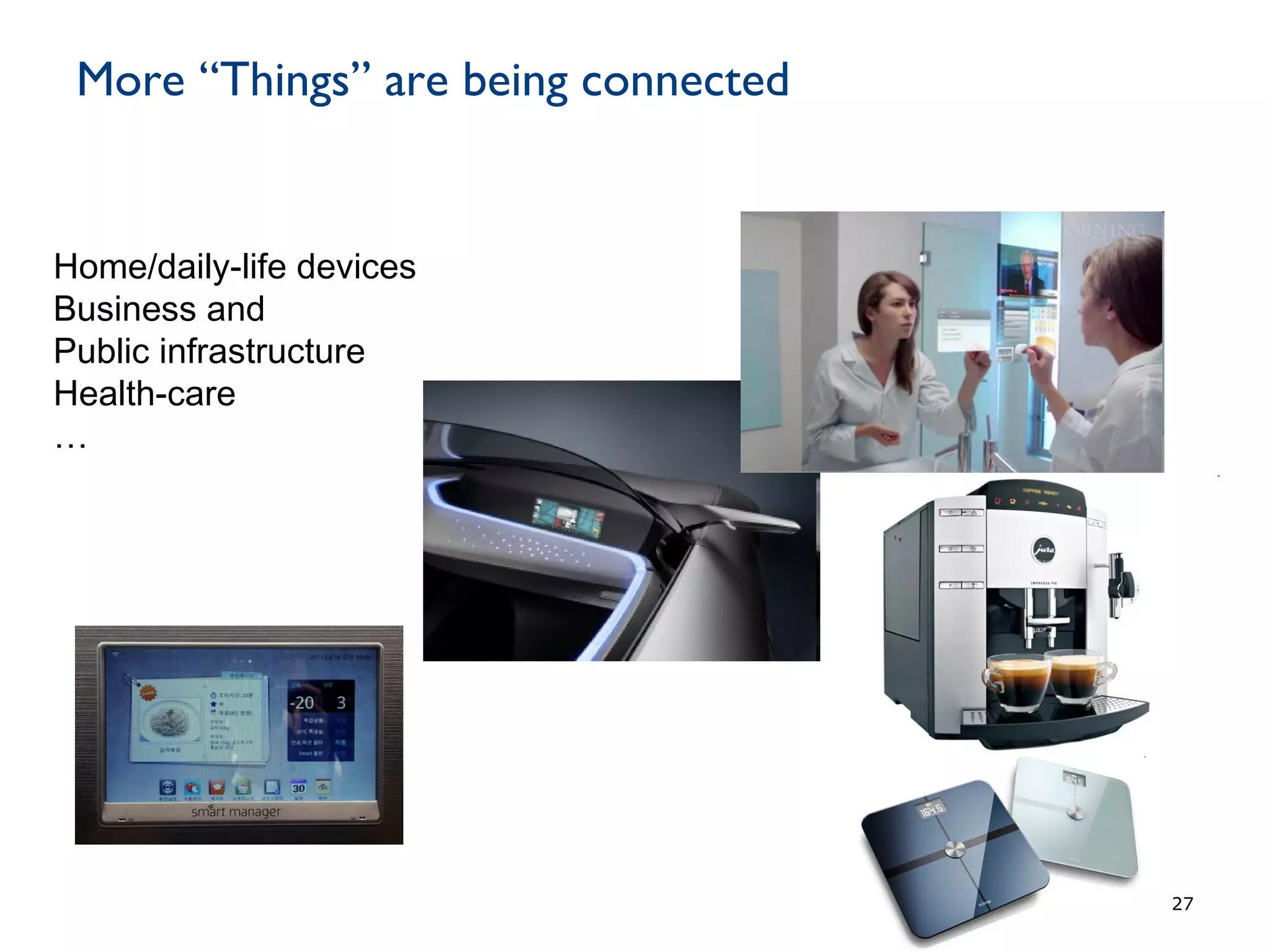
More “Things” are being connected
Home/daily-life devices
Business and
Public infrastructure
Health-care
…
28
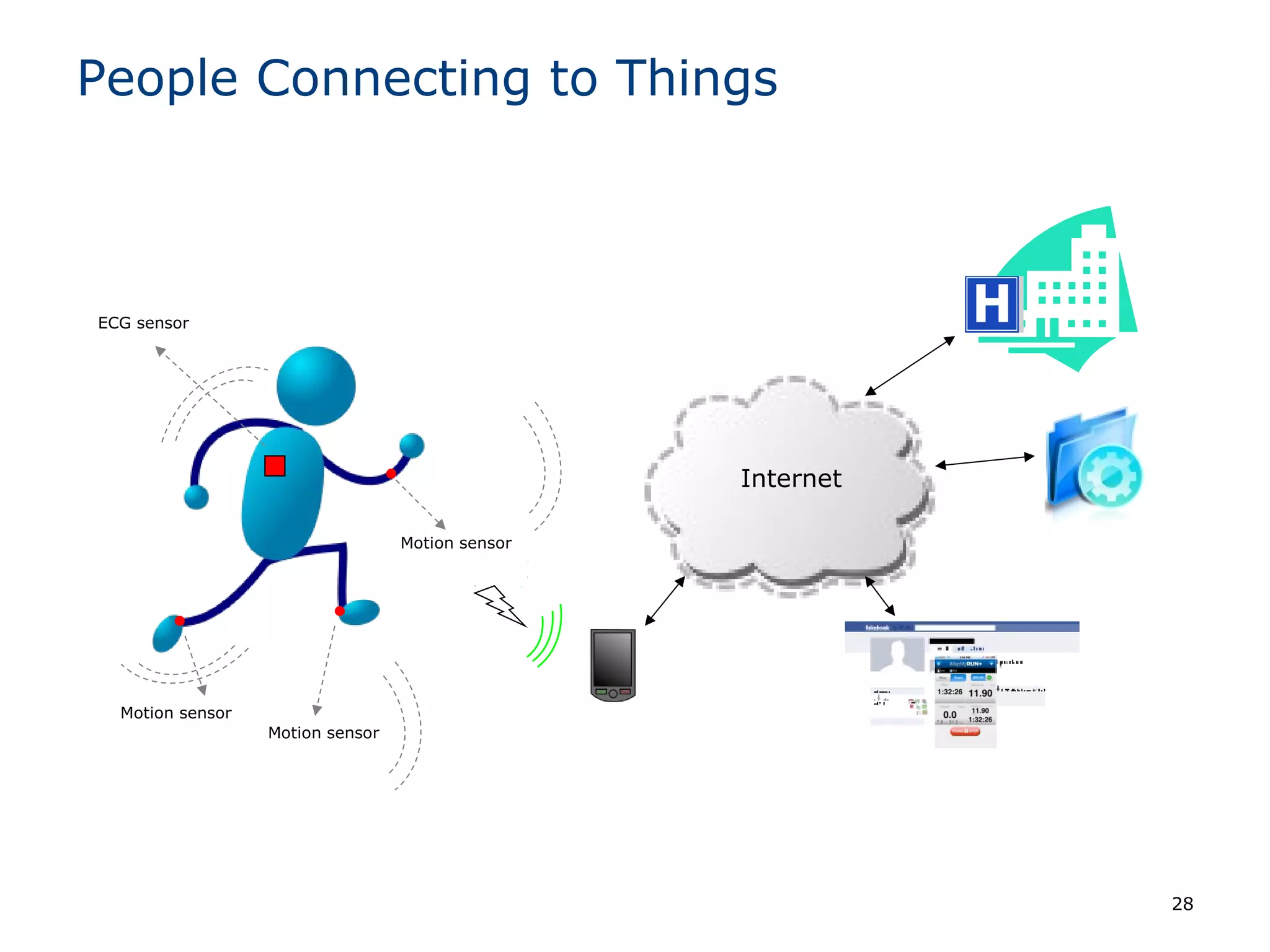
People Connecting to Things
Motion sensor
Motion sensor
Motion sensor
ECG sensor
Internet
29
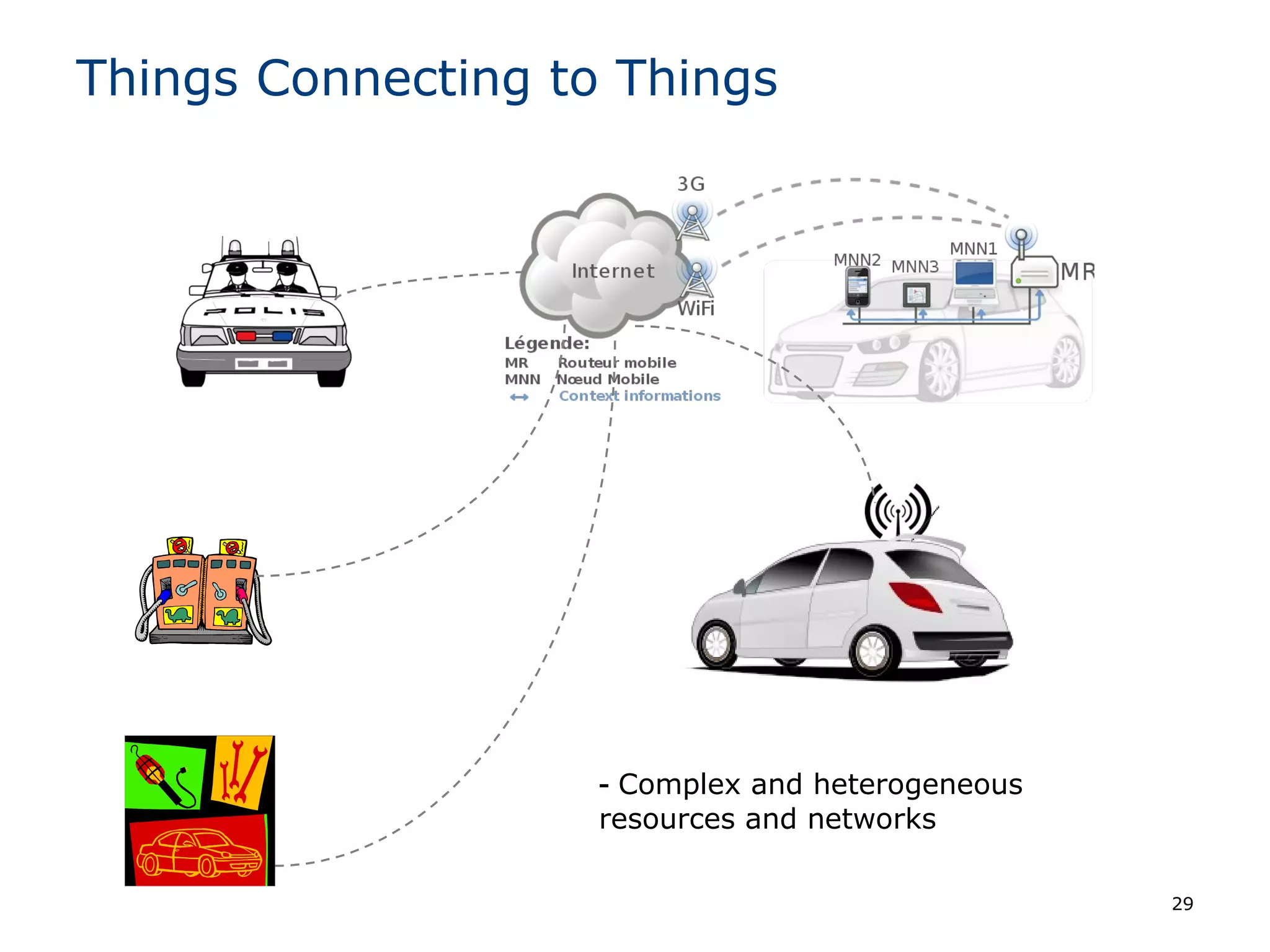
Things Connecting to Things
- Complex and heterogeneous
resources and networks
30
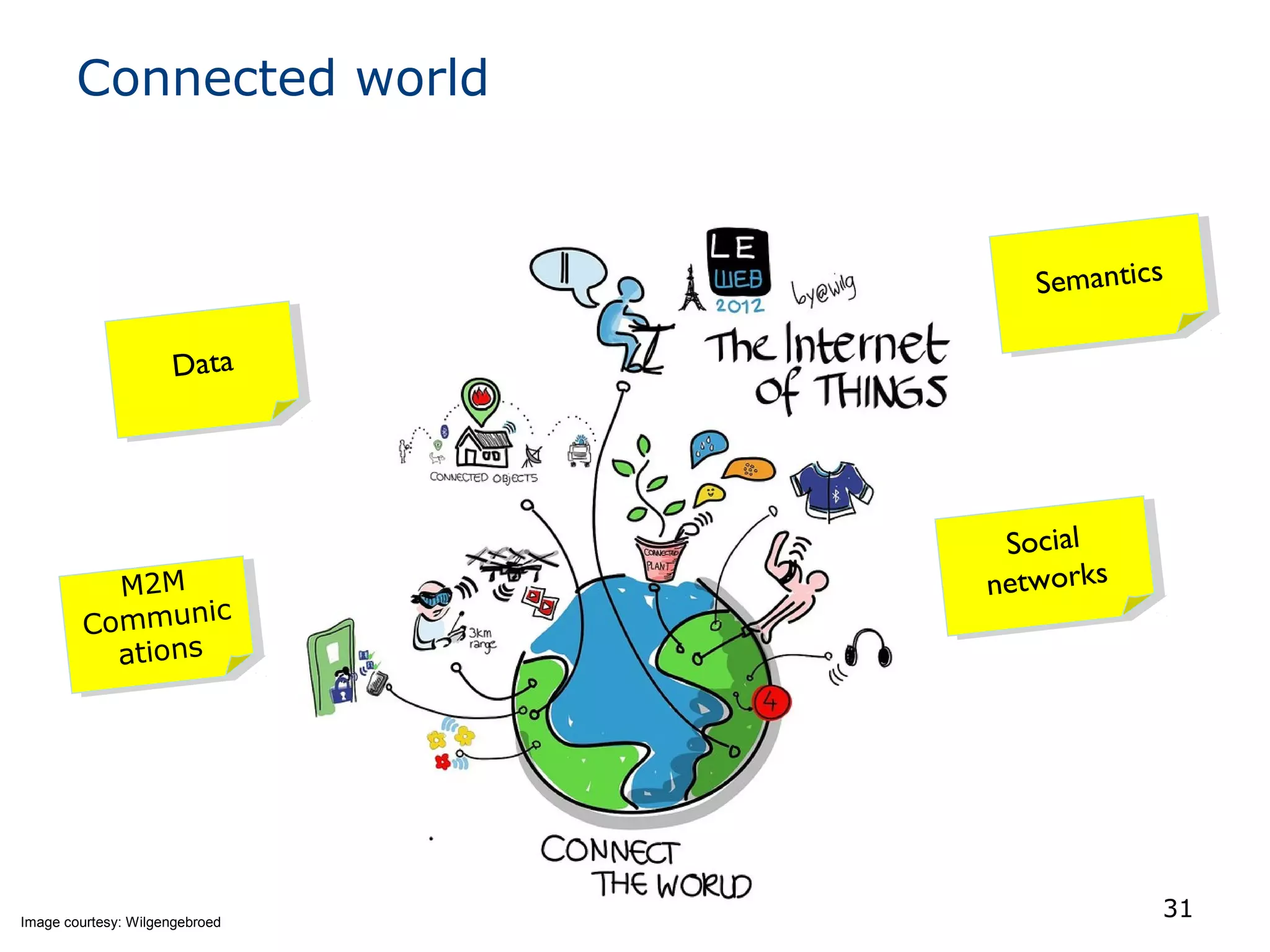
Connected world
31Image courtesy: Wilgengebroed
DataData
SemanticsSemantics
Social
networks
Social
networks
M2M
Communic
ations
M2M
Communic
ations
32
Internet of Things (IoT)
− Extending the current Internet and providing connection,
communication, and inter-networking between devices and
physical objects, or "Things," is a growing trend that is often
referred to as the Internet ofThings.
− “The technologies and solutions that enable integration of
real world data and services into the current information
networking technologies are often described under the
umbrella term of the Internet of Things (IoT)”
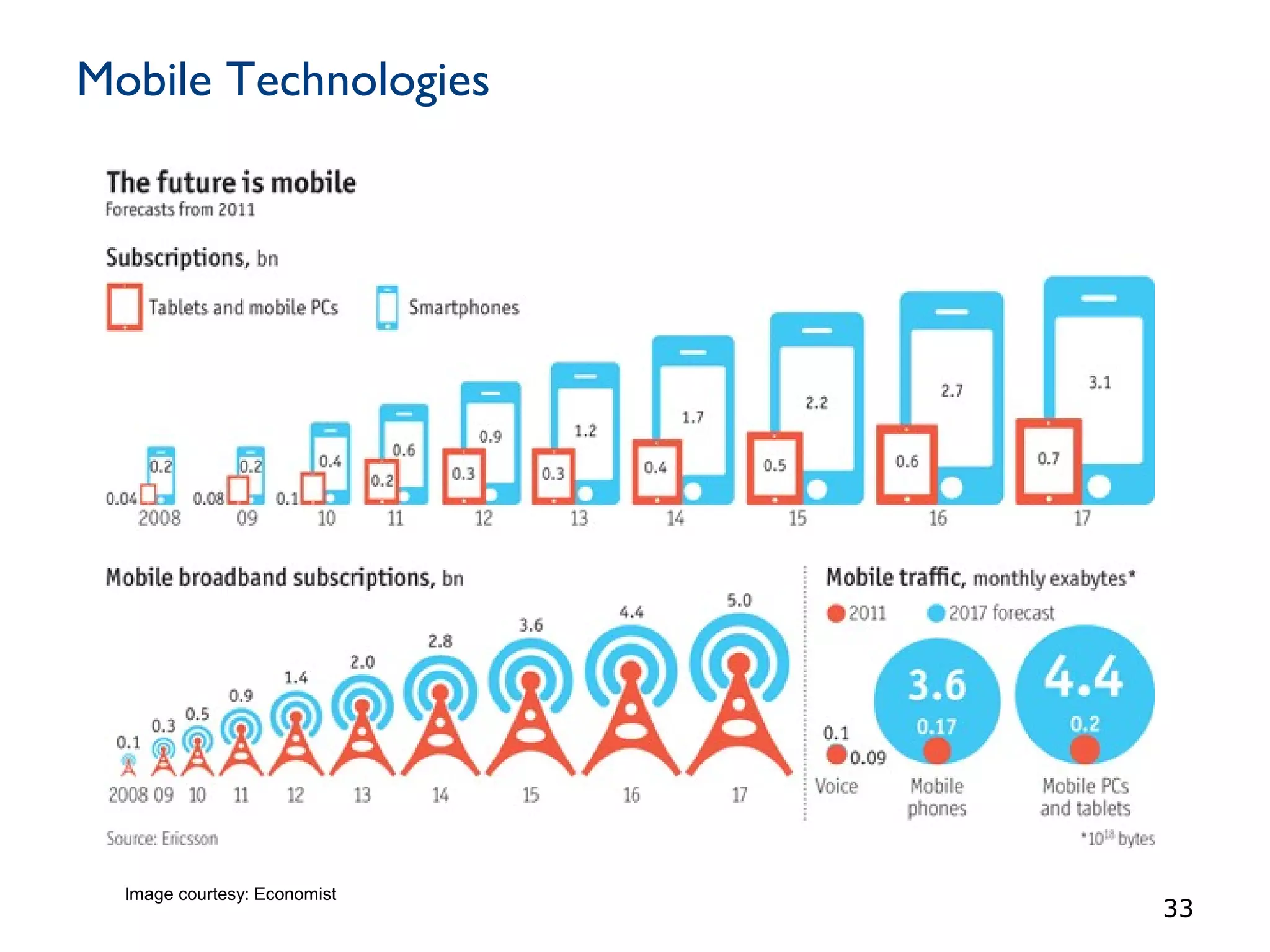
Mobile Technologies
33
Image courtesy: Economist
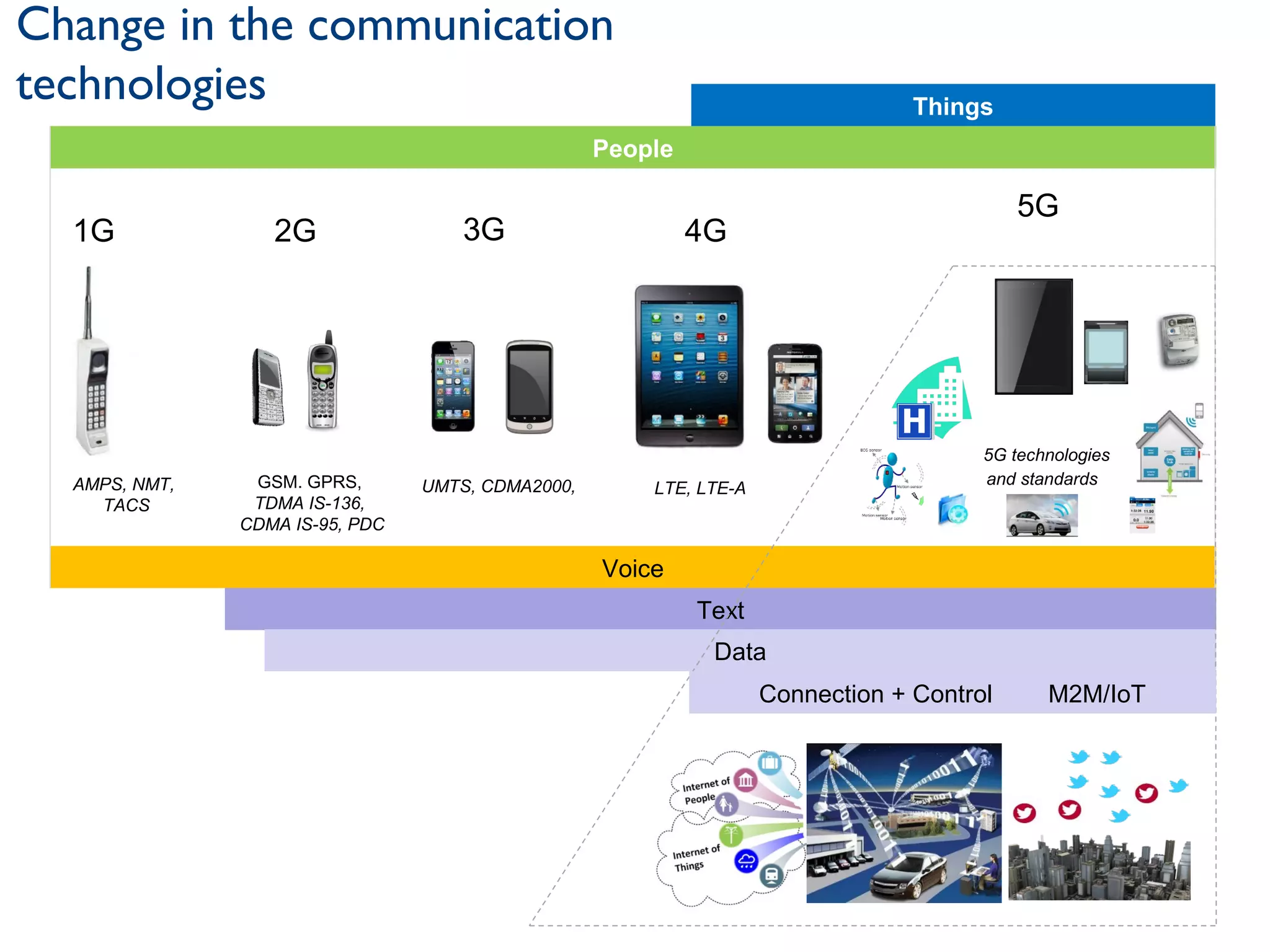
1G
AMPS, NMT,
TACS
2G
GSM. GPRS,
TDMA IS-136,
CDMA IS-95, PDC
3G
UMTS, CDMA2000,
4G
5G
LTE, LTE-A
People
Things
Voice
Text
Data
5G technologies
and standards
Connection + Control M2M/IoT
Change in the communication
technologies
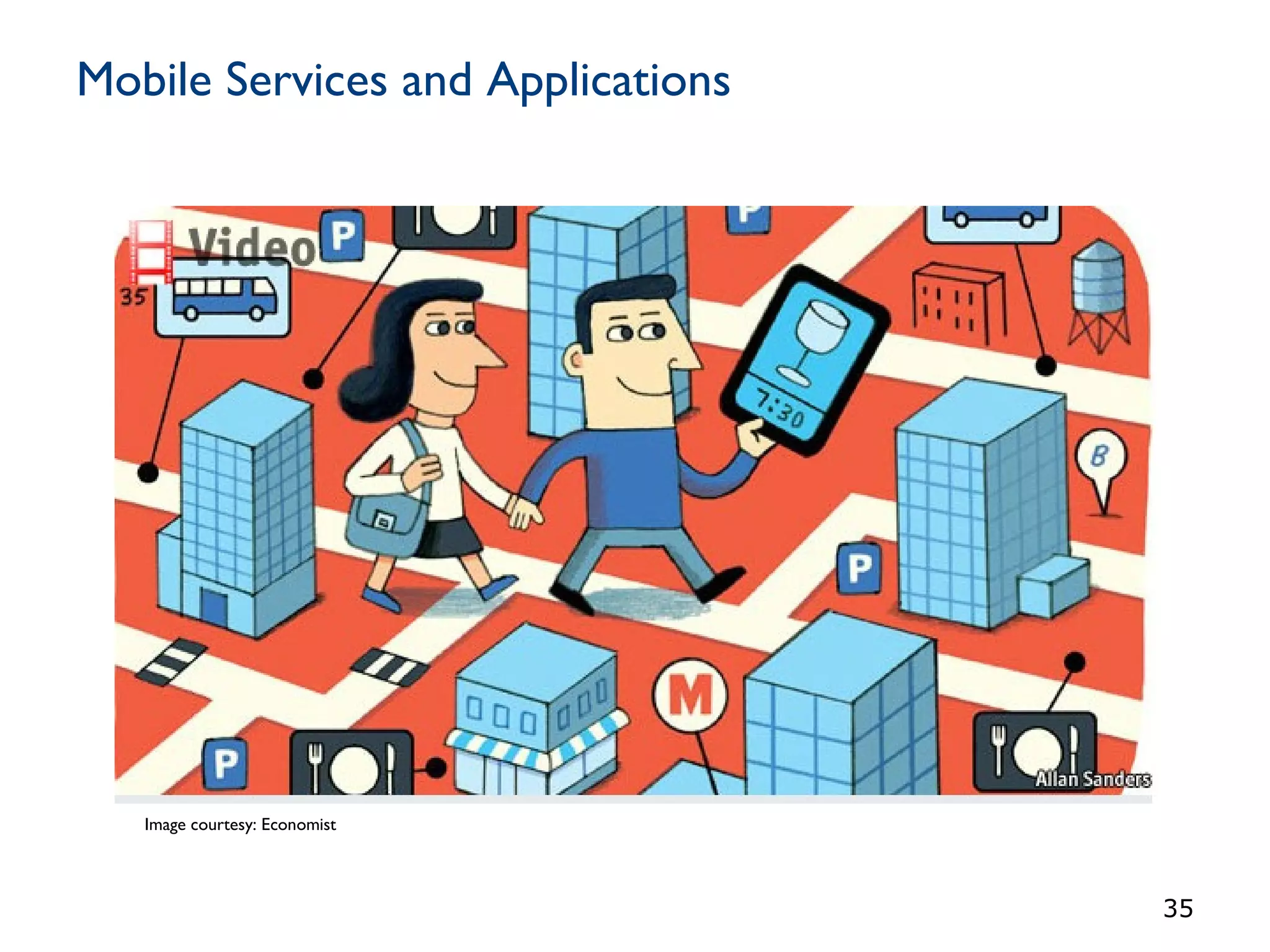
Mobile Services and Applications
35
Image courtesy: Economist
36
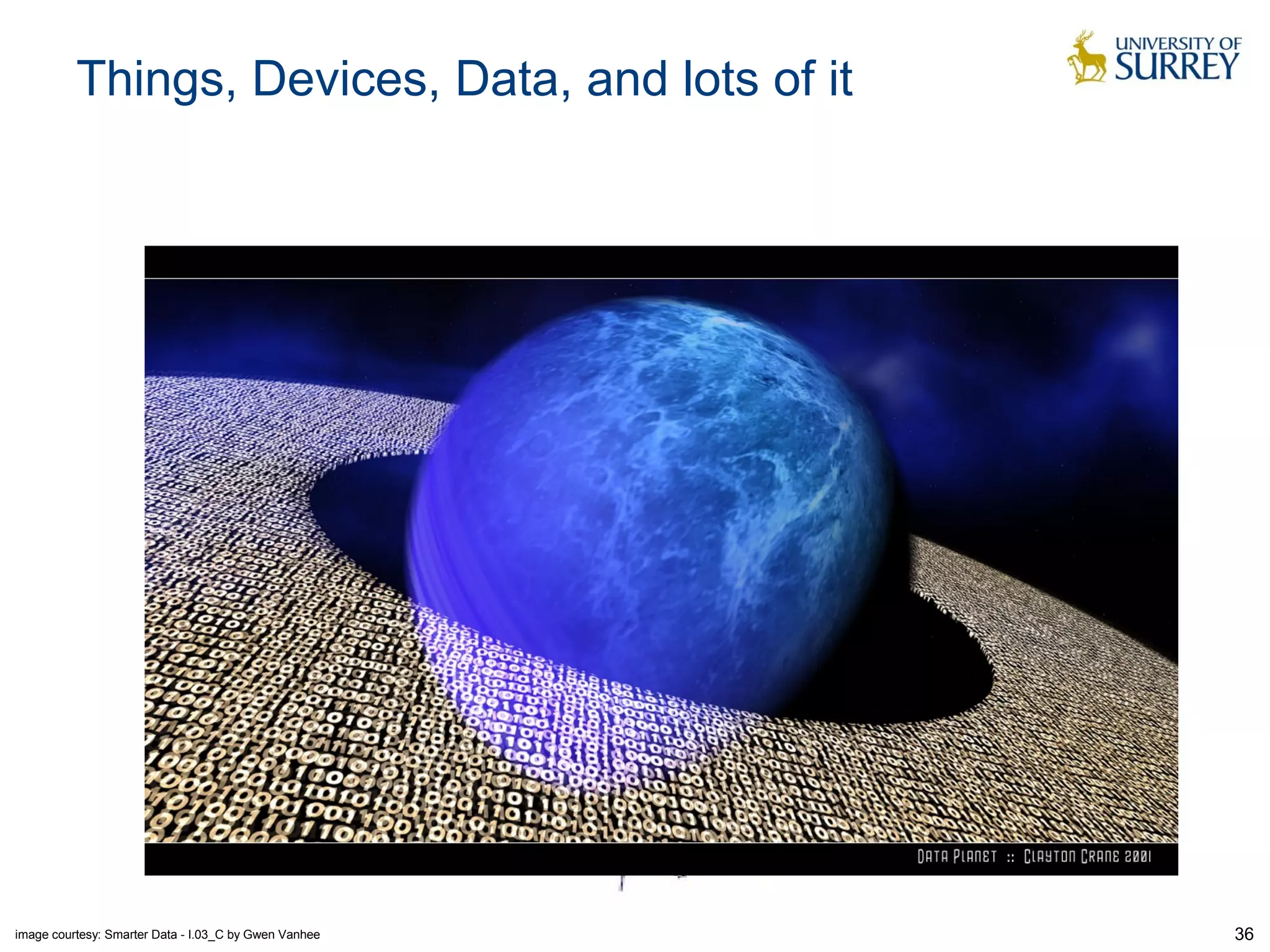
Things, Devices, Data, and lots of it
image courtesy: Smarter Data - I.03_C by Gwen Vanhee
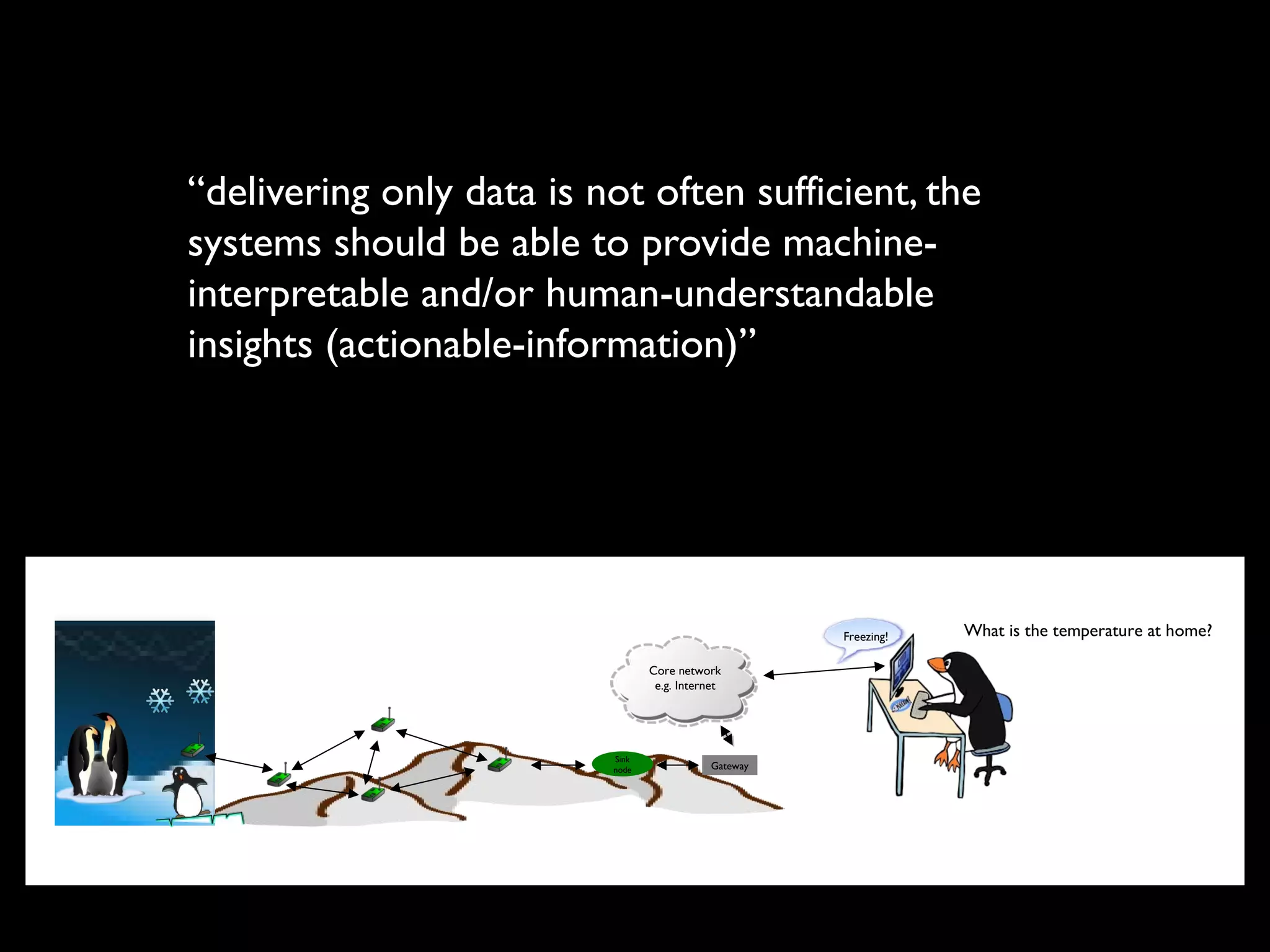
“delivering only data is not often sufficient, the
systems should be able to provide machine-
interpretable and/or human-understandable
insights (actionable-information)”
Sink
node Gateway
Core network
e.g. Internet
What is the temperature at home?Freezing!
38
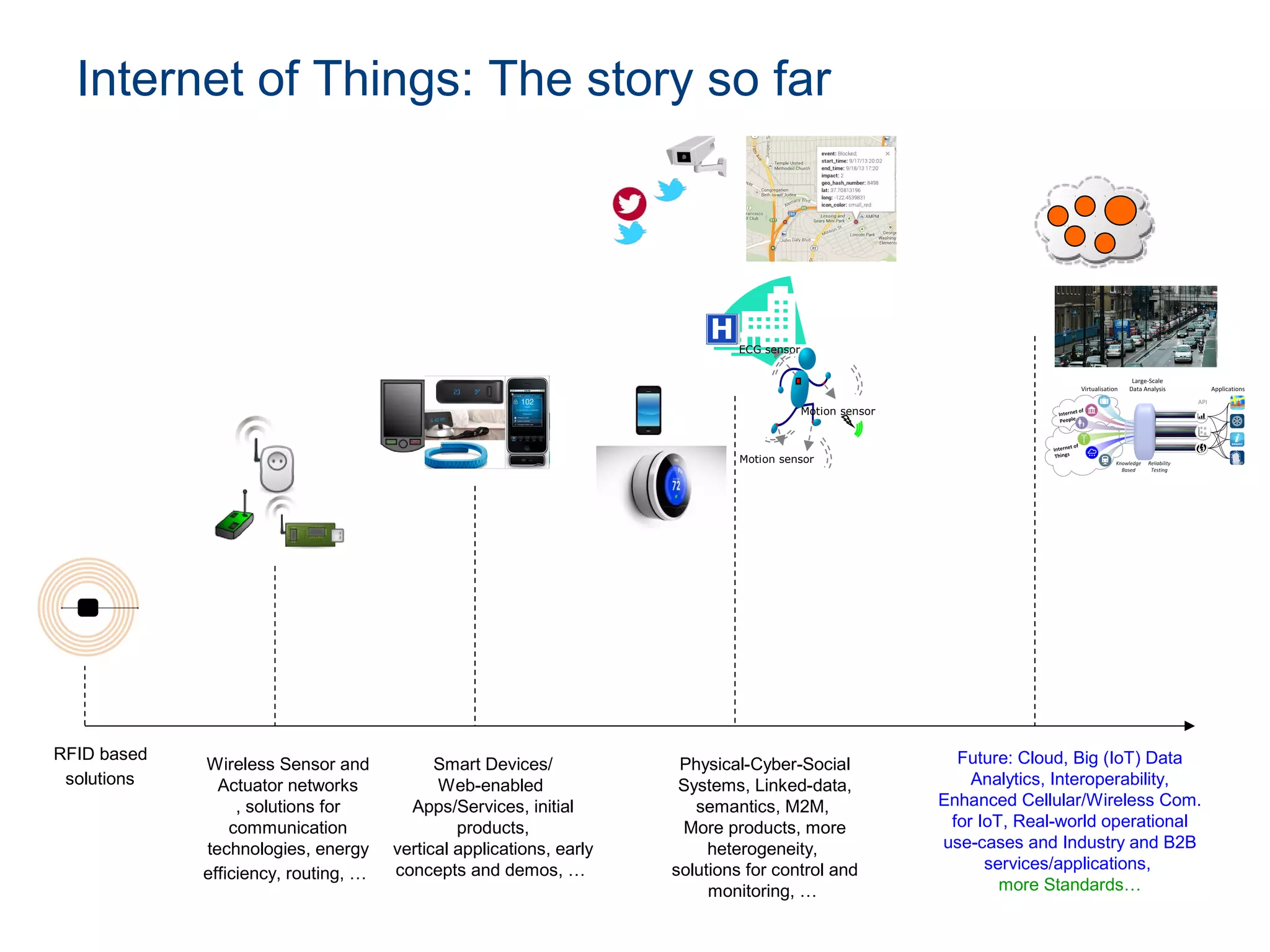
Internet of Things: The story so far
RFID based
solutions
Wireless Sensor and
Actuator networks
, solutions for
communication
technologies, energy
efficiency, routing, …
Smart Devices/
Web-enabled
Apps/Services, initial
products,
vertical applications, early
concepts and demos, …
Motion sensor
Motion sensor
ECG sensor
Physical-Cyber-Social
Systems, Linked-data,
semantics, M2M,
More products, more
heterogeneity,
solutions for control and
monitoring, …
Future: Cloud, Big (IoT) Data
Analytics, Interoperability,
Enhanced Cellular/Wireless Com.
for IoT, Real-world operational
use-cases and Industry and B2B
services/applications,
more Standards…
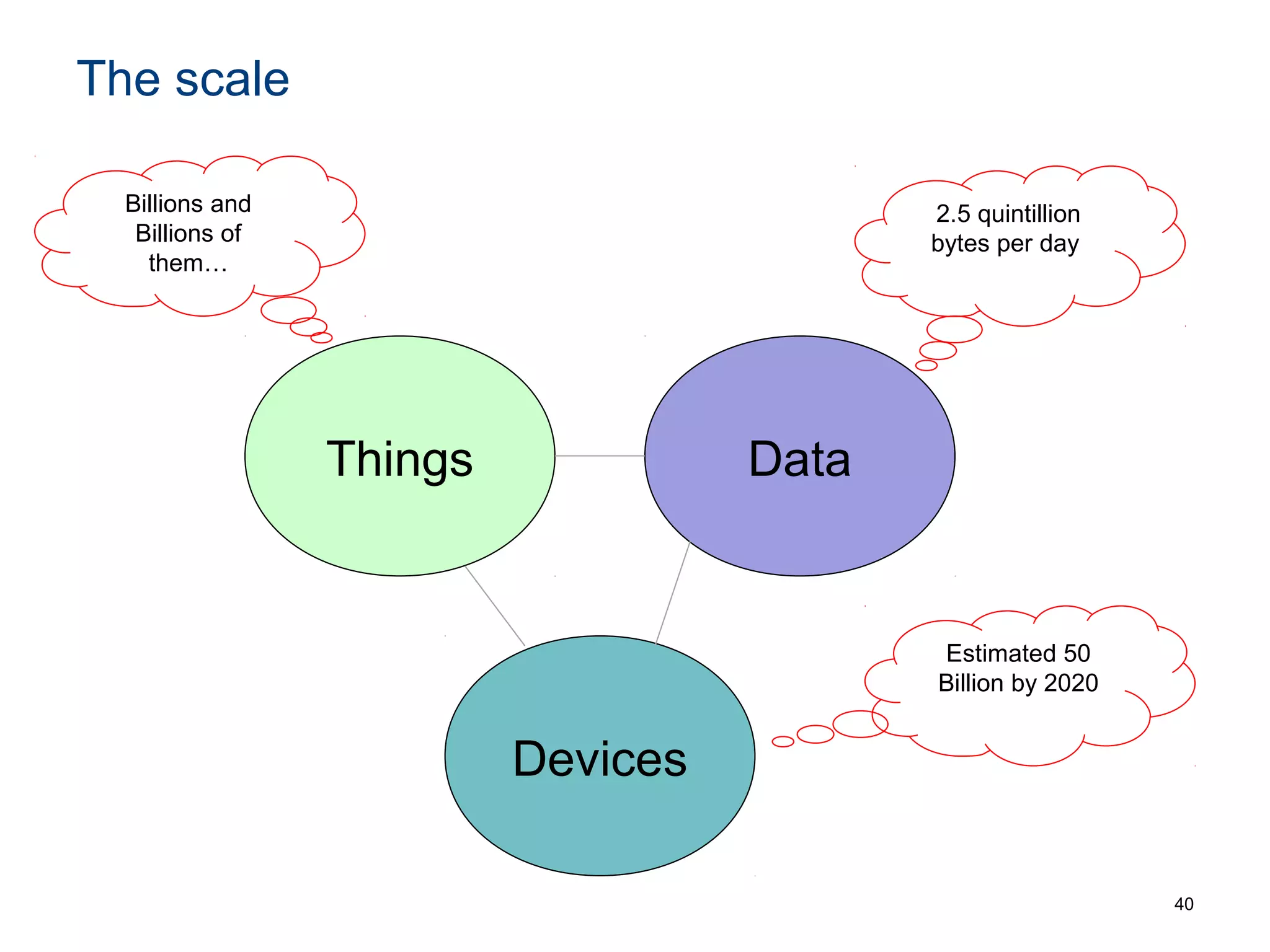
The scale
40
Things Data
Devices
2.5 quintillion
bytes per day
Billions and
Billions of
them…
Estimated 50
Billion by 2020
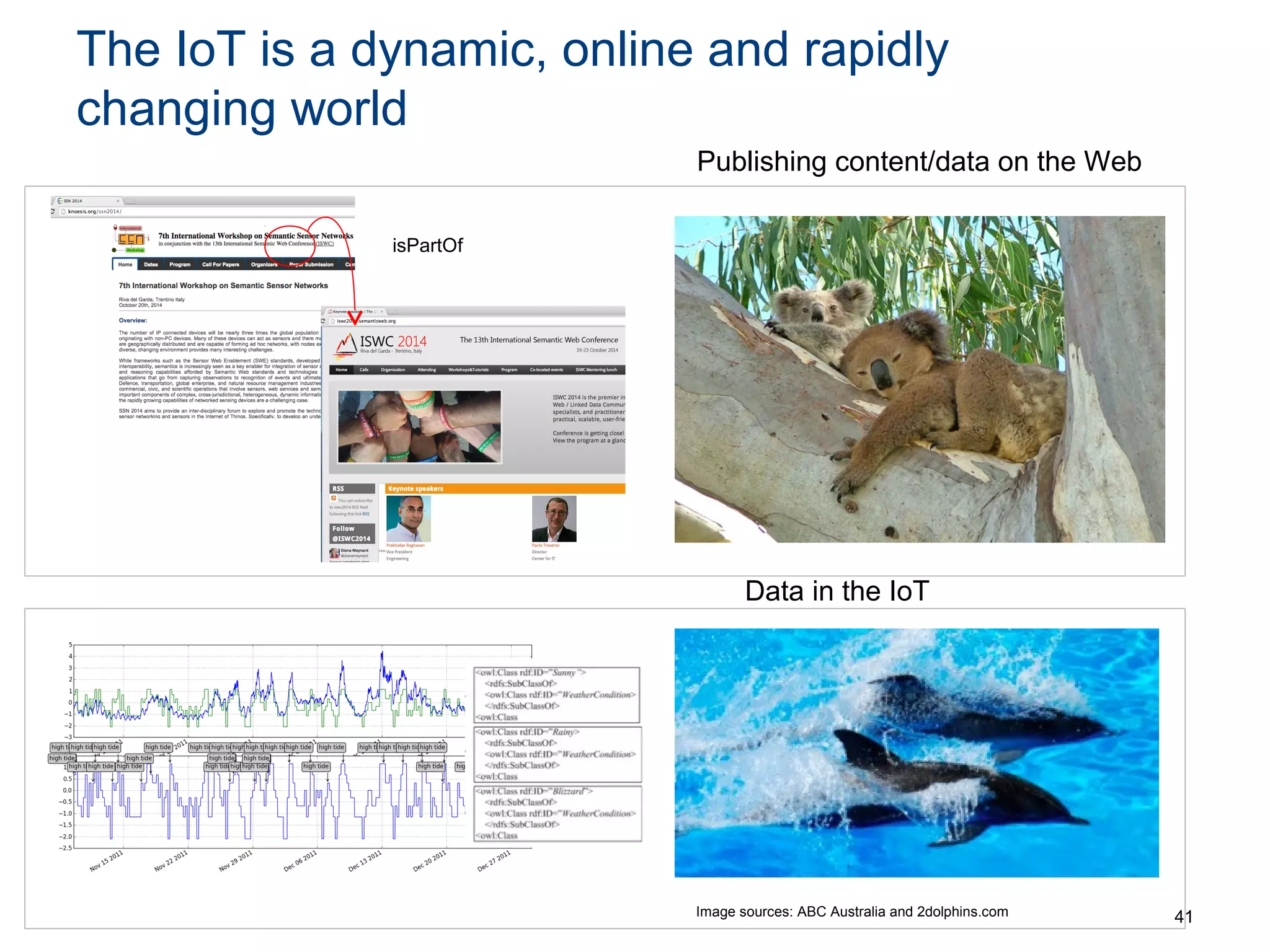
The IoT is a dynamic, online and rapidly
changing world
41
isPartOf
Publishing content/data on the Web
Data in the IoT
Image sources: ABC Australia and 2dolphins.com
What type of problems we expect to solve?
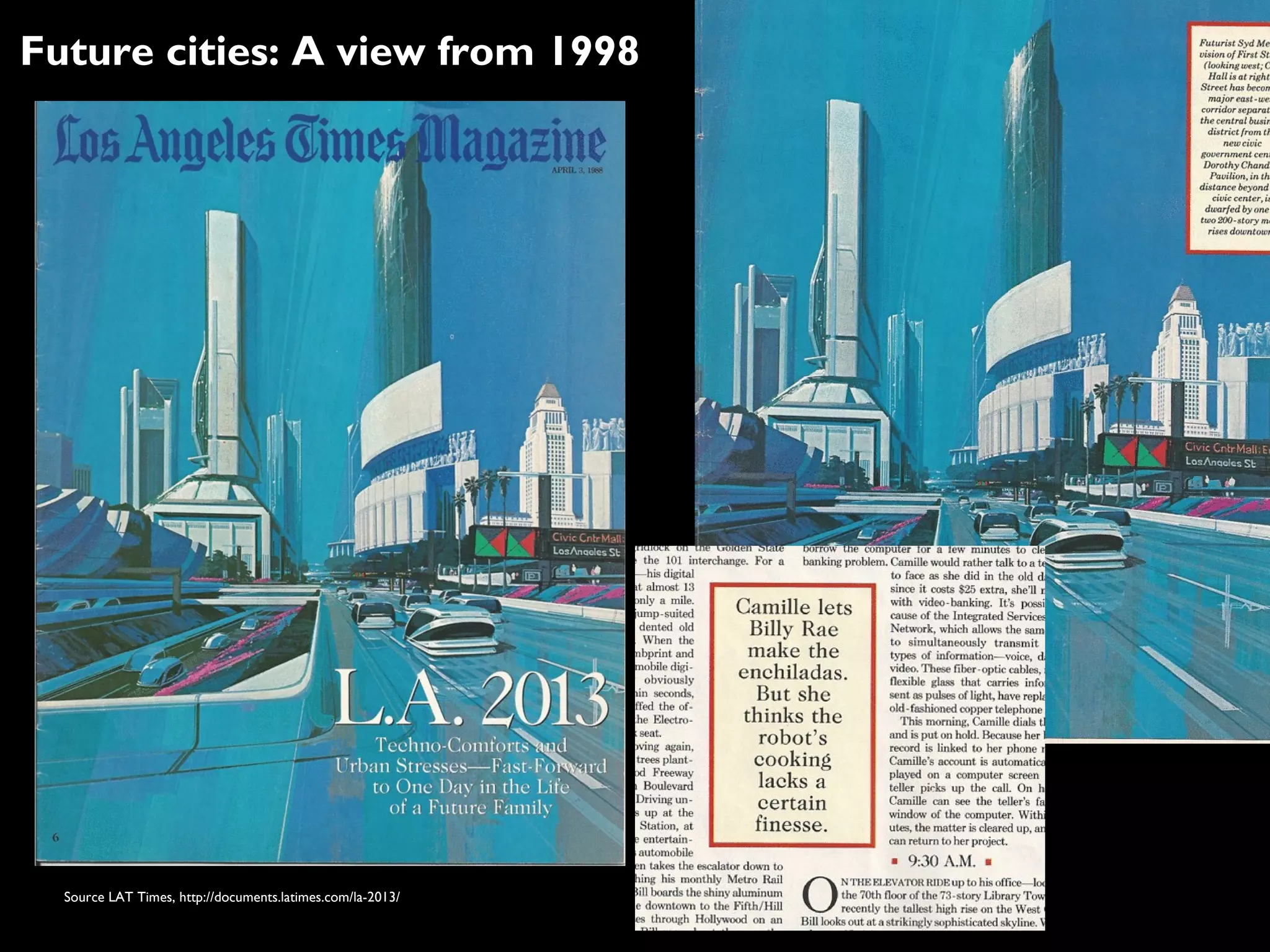
43Source LAT Times, http://documents.latimes.com/la-2013/
Future cities: A view from 1998
44
Source: http://robertluisrabello.com/denial/traffic-in-la/#gallery[default]/0/
Source: wikipedia
Back to the Future: 2013
45
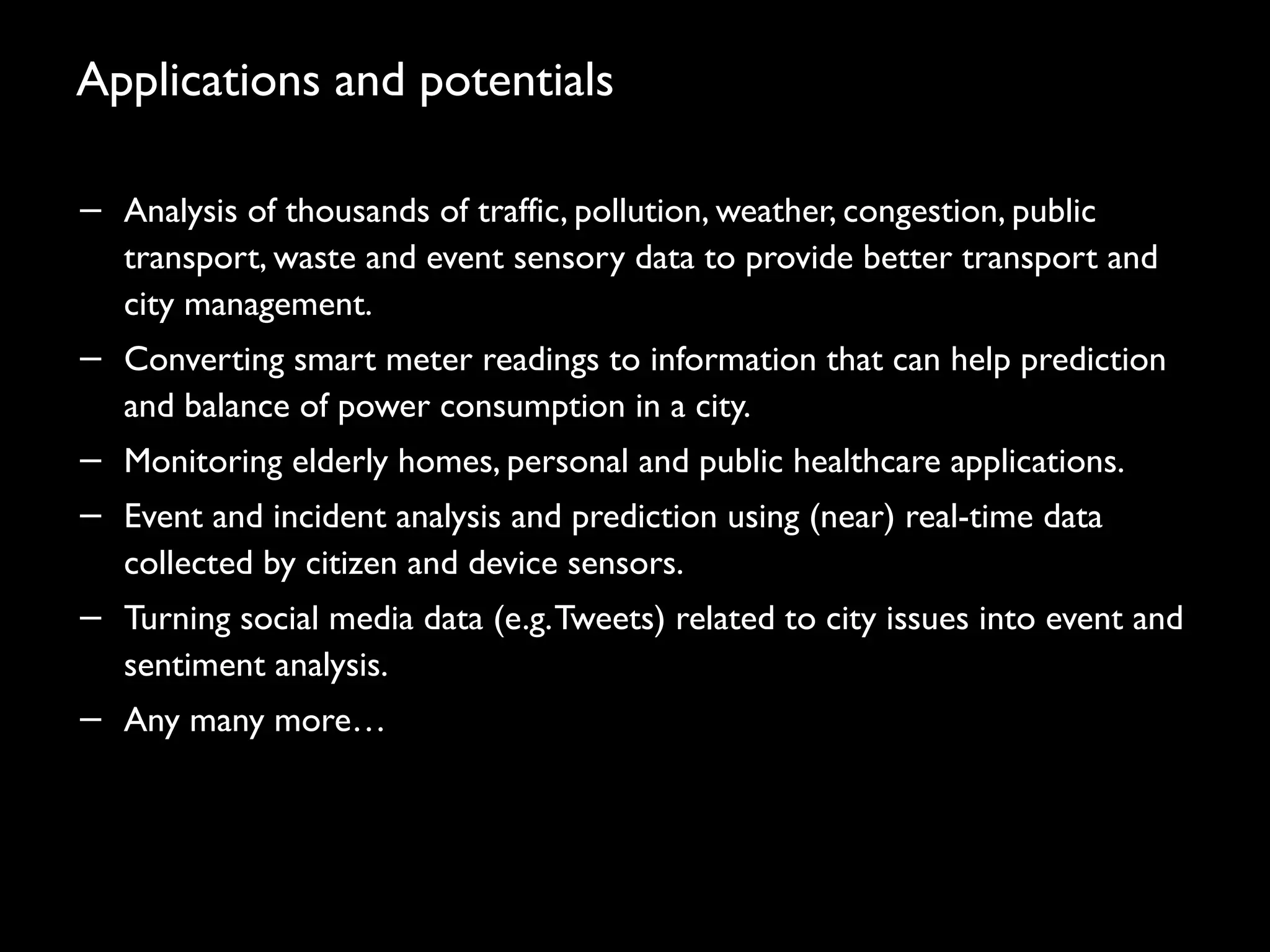
Applications and potentials
− Analysis of thousands of traffic, pollution, weather, congestion, public
transport, waste and event sensory data to provide better transport and
city management.
− Converting smart meter readings to information that can help prediction
and balance of power consumption in a city.
− Monitoring elderly homes, personal and public healthcare applications.
− Event and incident analysis and prediction using (near) real-time data
collected by citizen and device sensors.
− Turning social media data (e.g.Tweets) related to city issues into event and
sentiment analysis.
− Any many more…
46
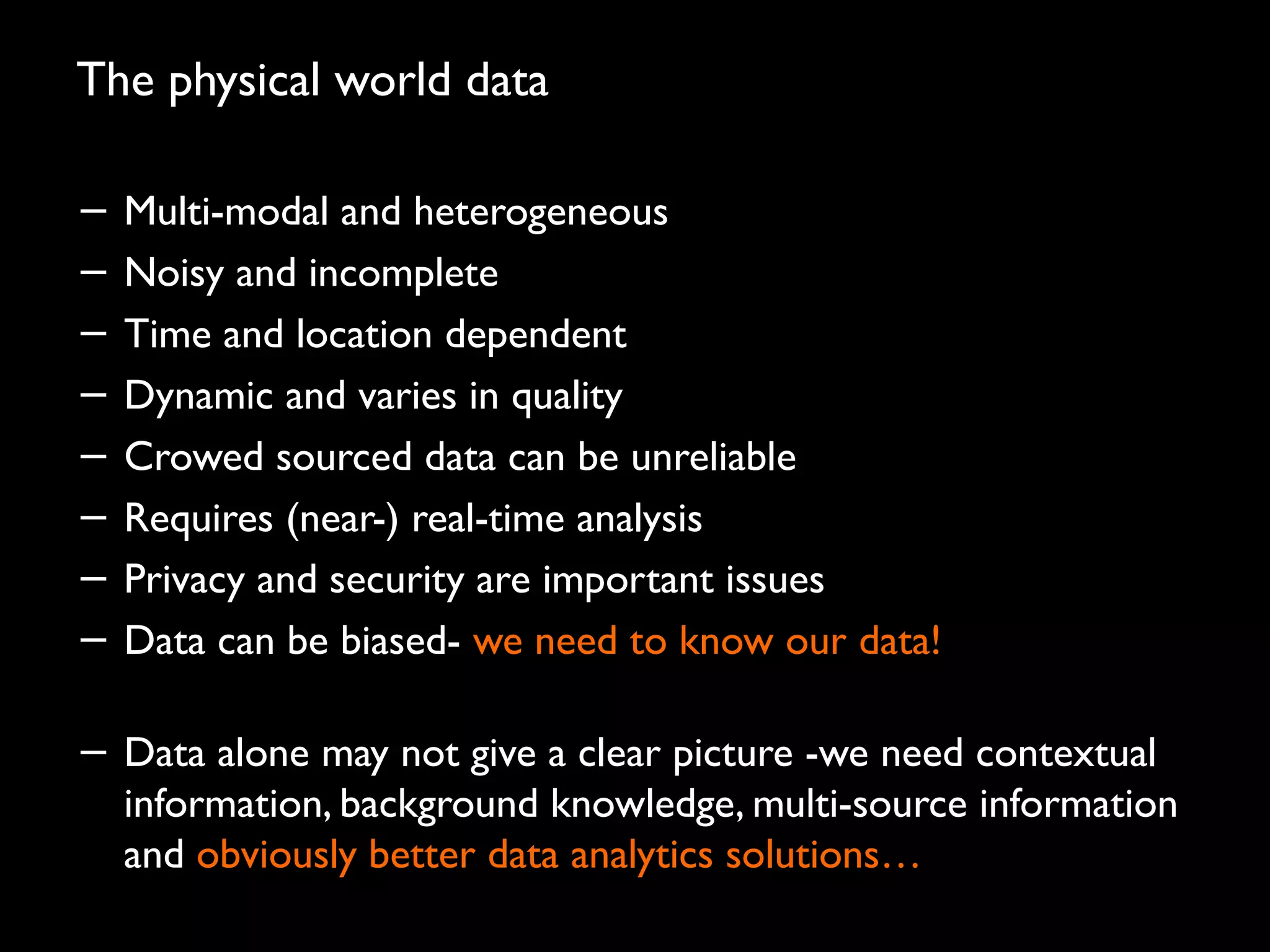
The physical world data
− Multi-modal and heterogeneous
− Noisy and incomplete
− Time and location dependent
− Dynamic and varies in quality
− Crowed sourced data can be unreliable
− Requires (near-) real-time analysis
− Privacy and security are important issues
− Data can be biased- we need to know our data!
− Data alone may not give a clear picture -we need contextual
information, background knowledge, multi-source information
and obviously better data analytics solutions…
47
Some examples
48
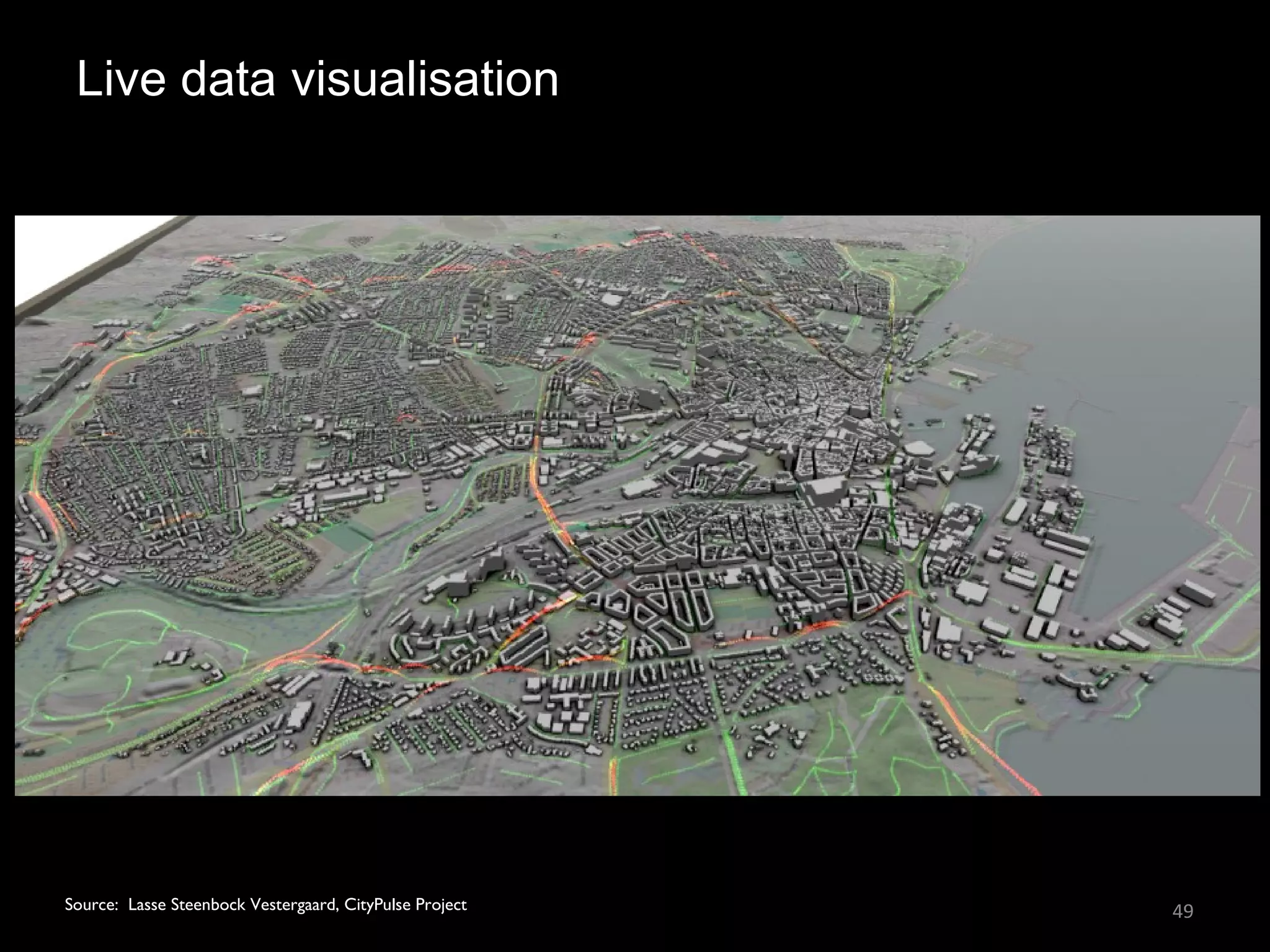
Live data visualisation
49P. Source: Lasse Steenbock Vestergaard, CityPulse Project
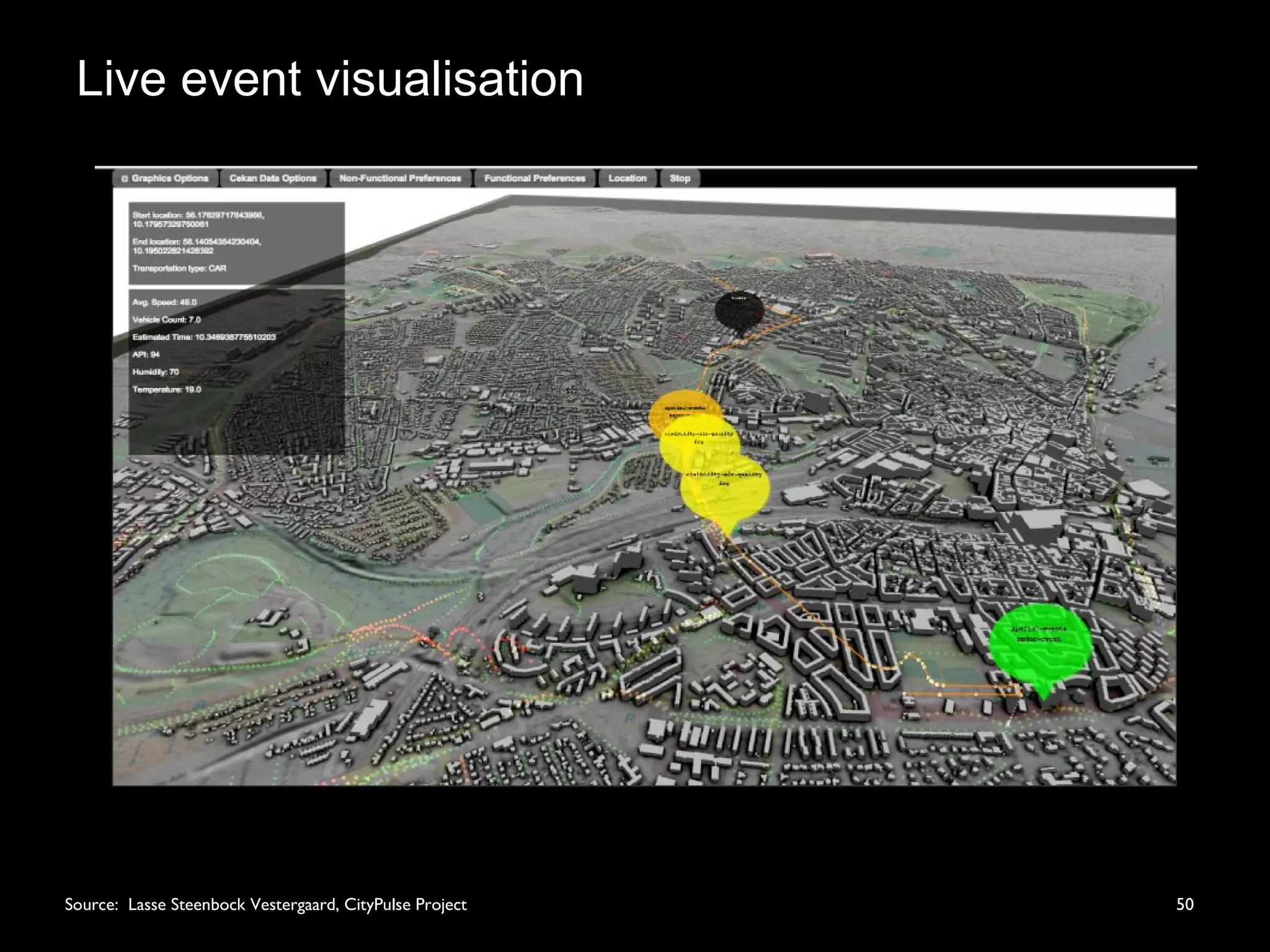
Live event visualisation
50P. Source: Lasse Steenbock Vestergaard, CityPulse Project
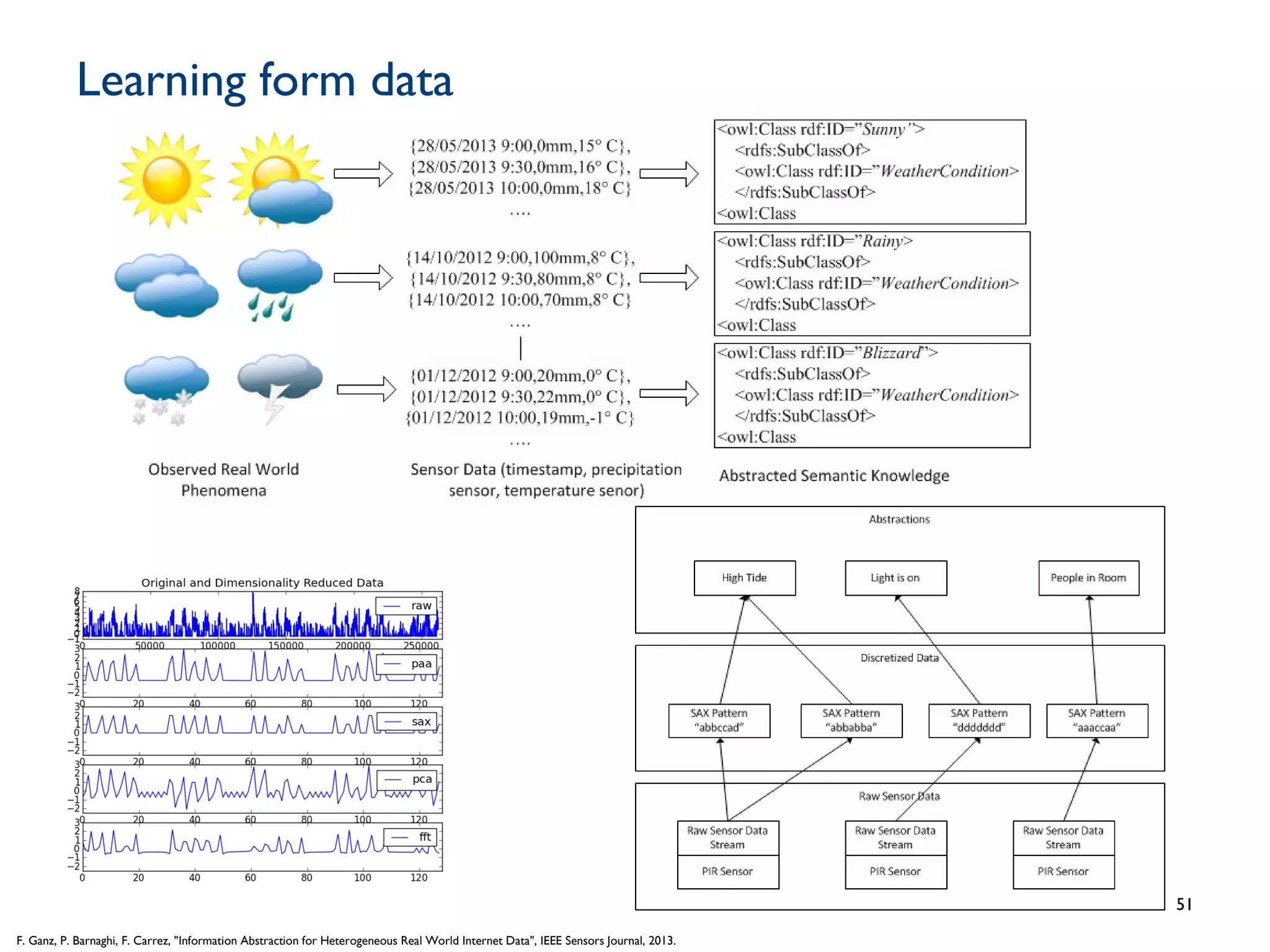
Learning form data
51
F. Ganz, P. Barnaghi, F. Carrez, "Information Abstraction for Heterogeneous Real World Internet Data", IEEE Sensors Journal, 2013.
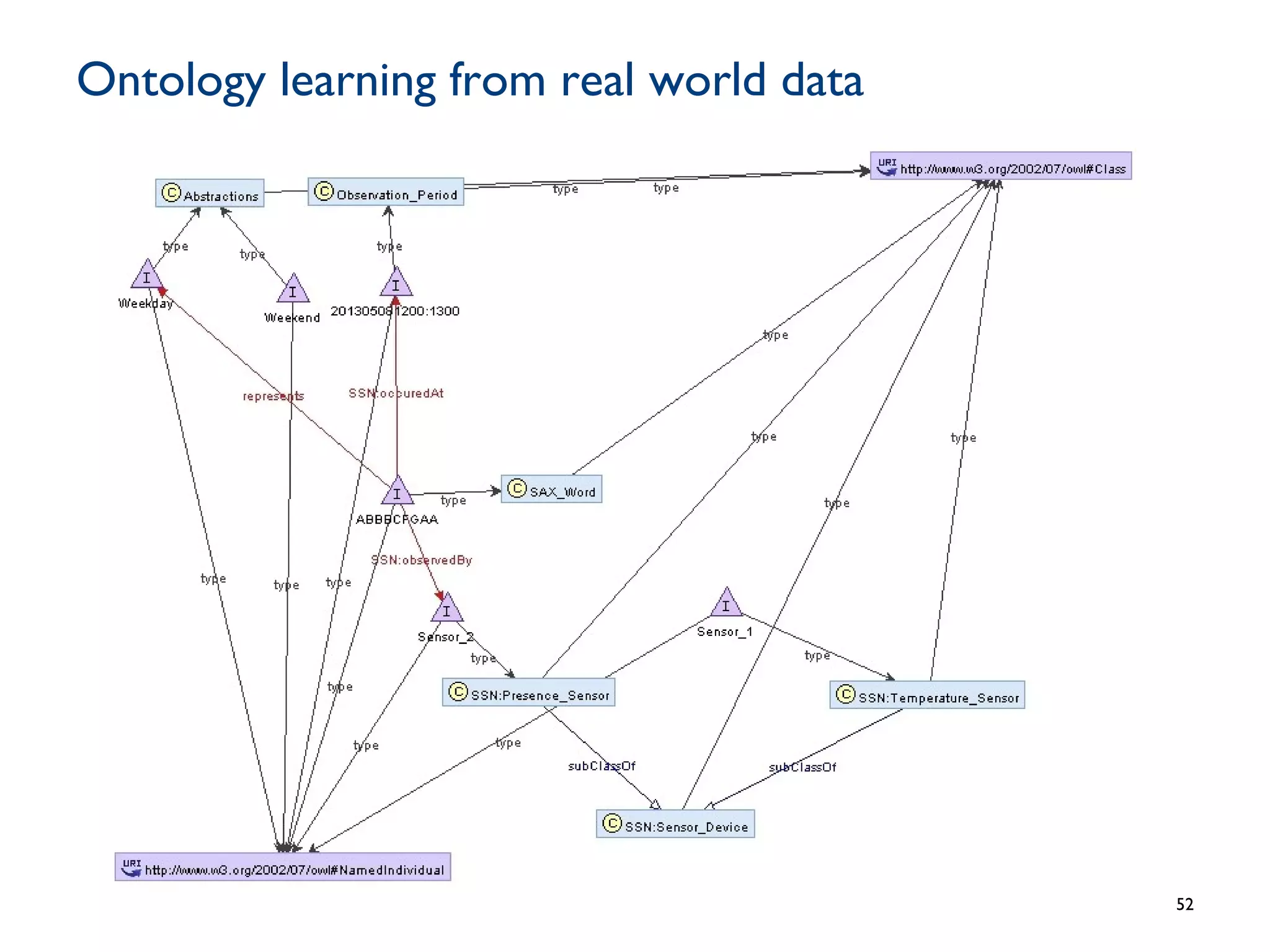
Ontology learning from real world data
52
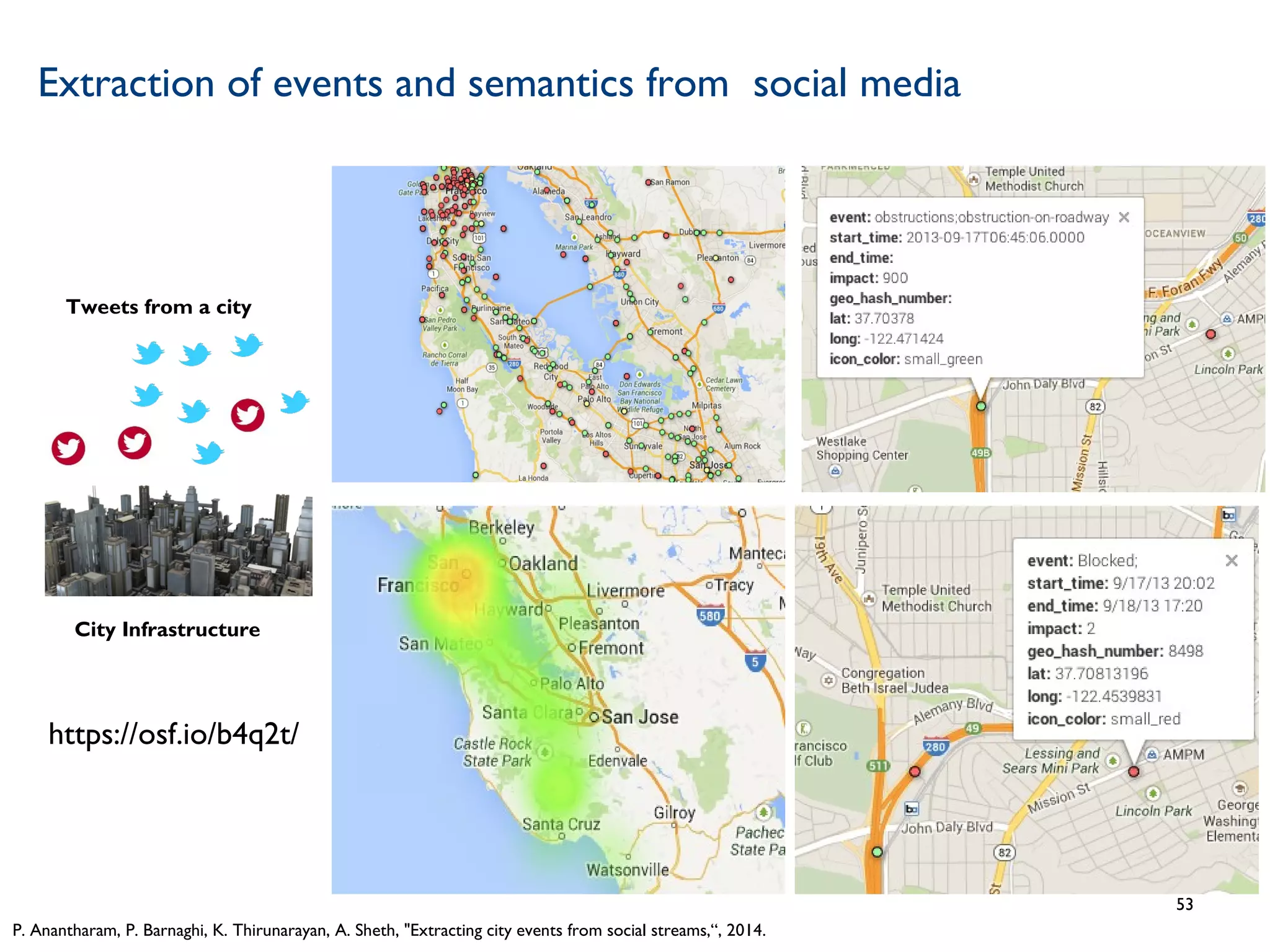
Extraction of events and semantics from social media
53
City Infrastructure
Tweets from a city
P. Anantharam, P. Barnaghi, K. Thirunarayan, A. Sheth, "Extracting city events from social streams,“, 2014.
https://osf.io/b4q2t/
The Future of the Internet
54
In next 5 years
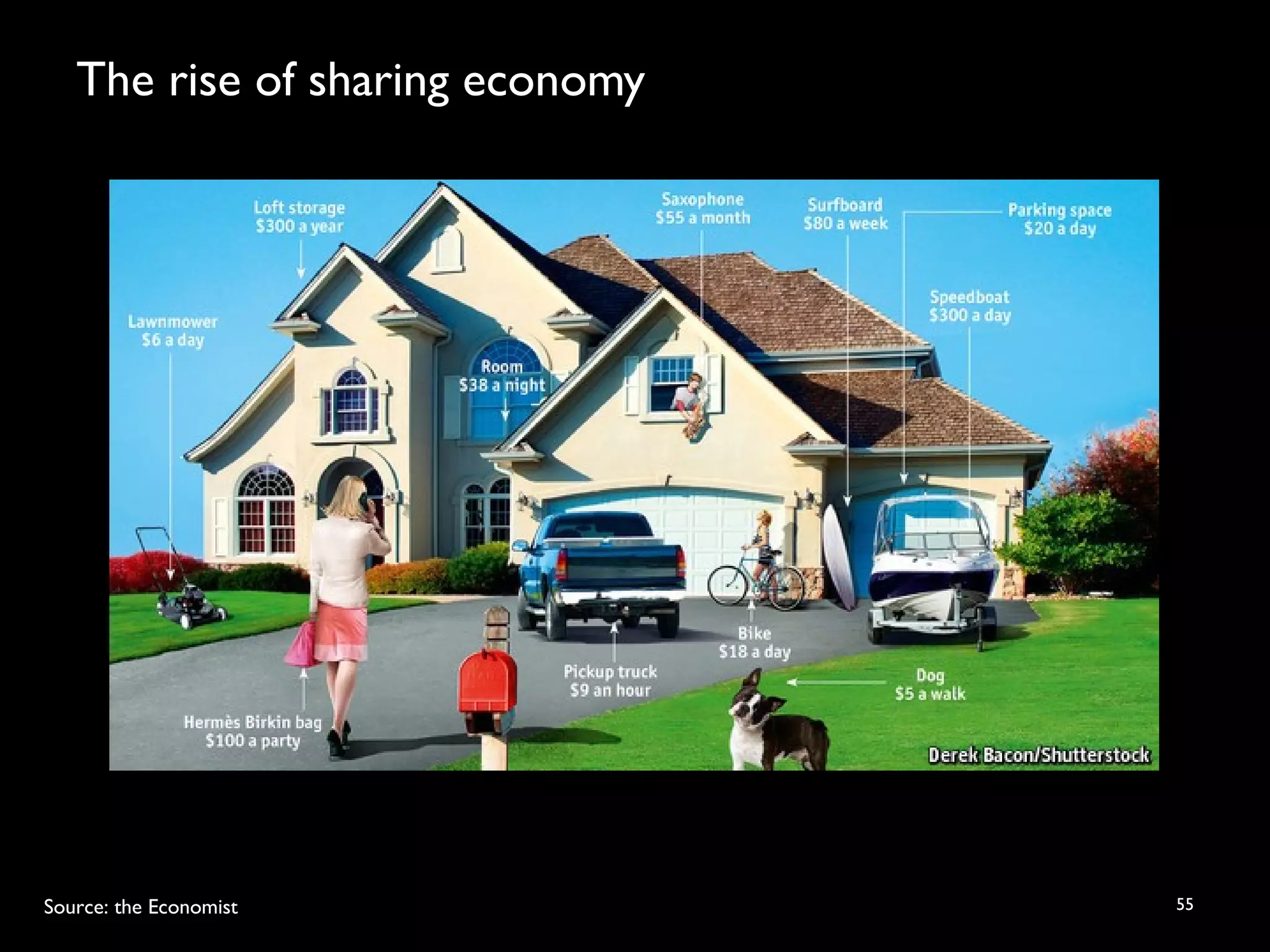
The rise of sharing economy
55Source: the Economist
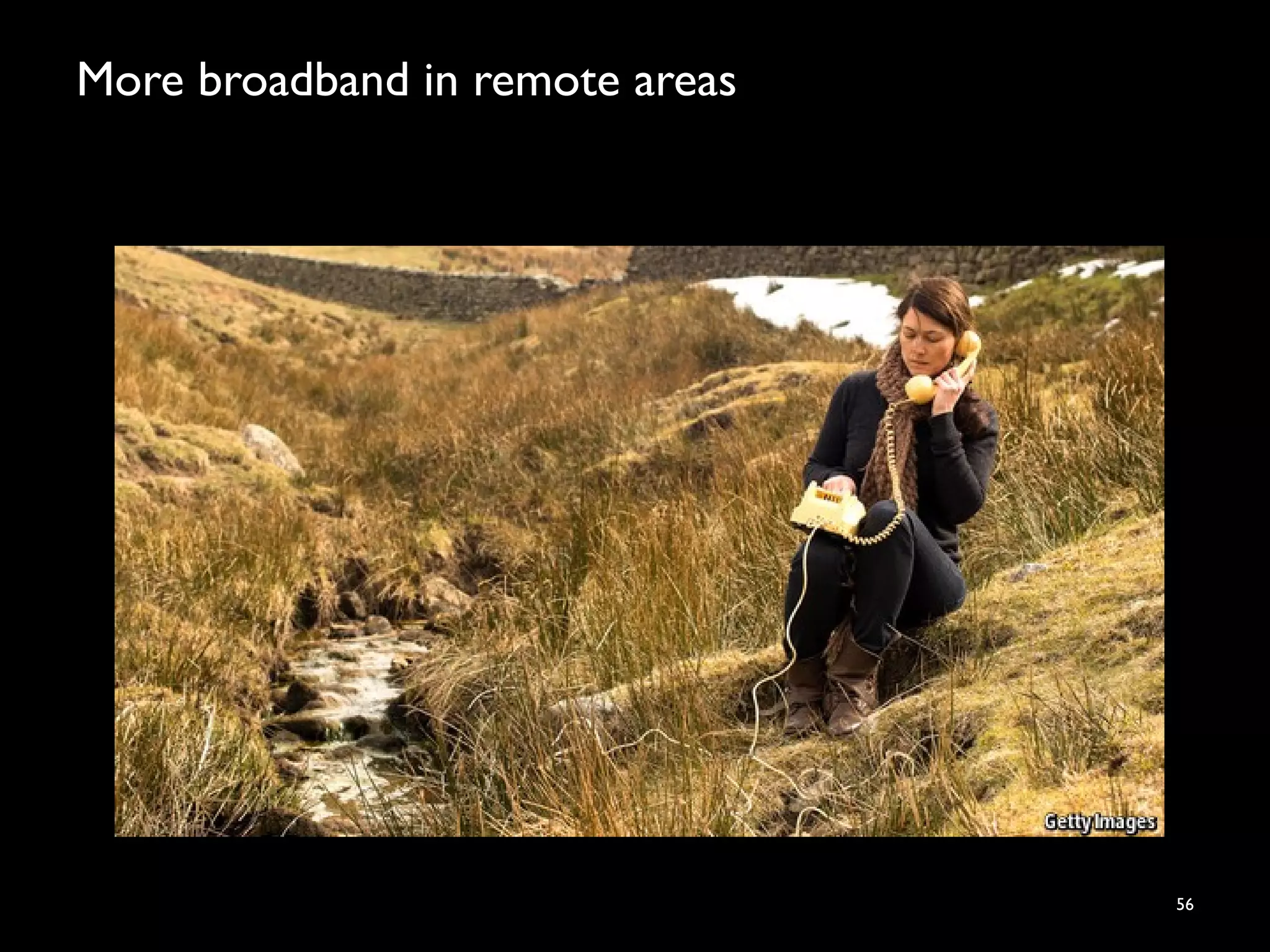
More broadband in remote areas
56
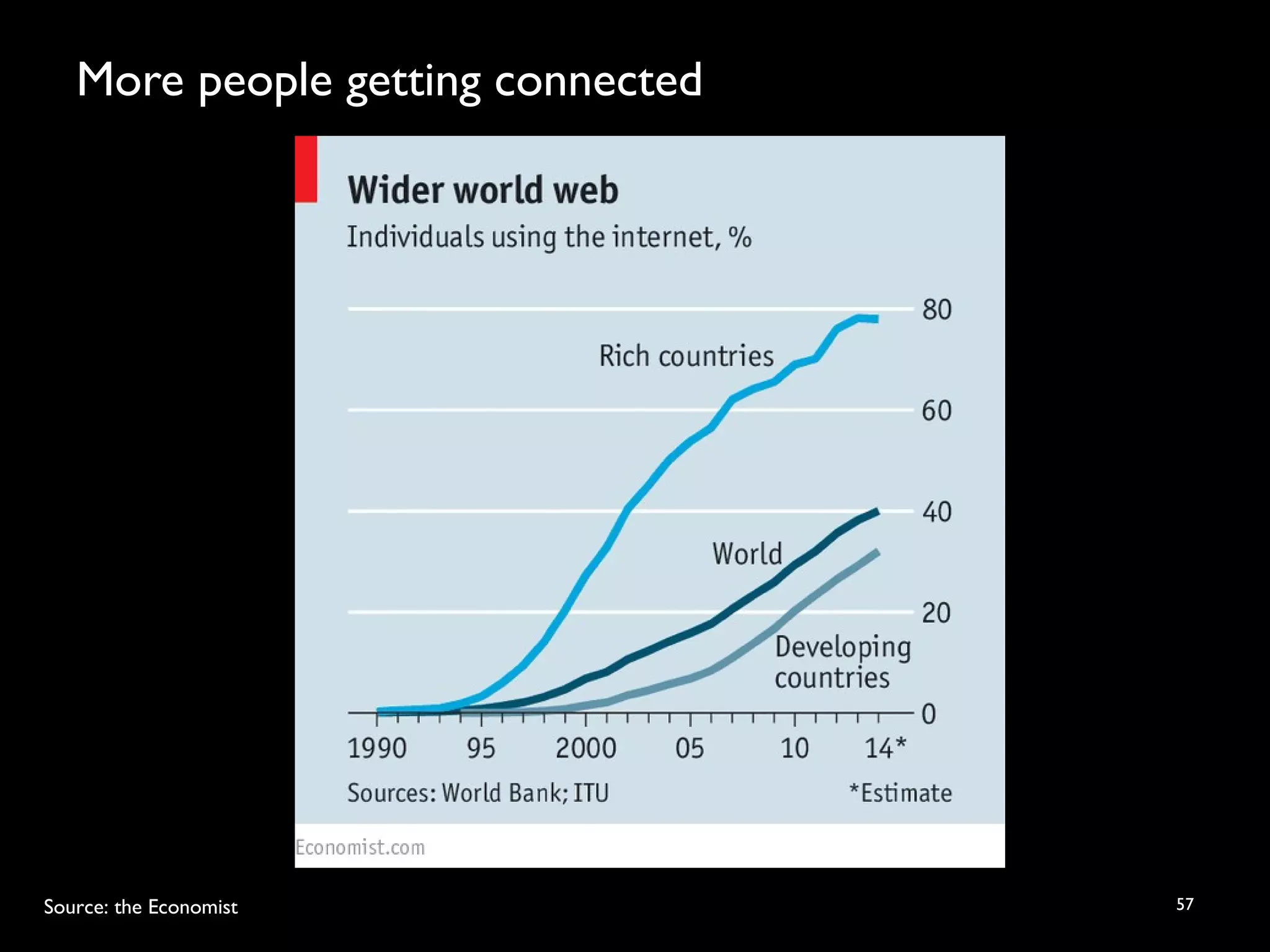
More people getting connected
57Source: the Economist
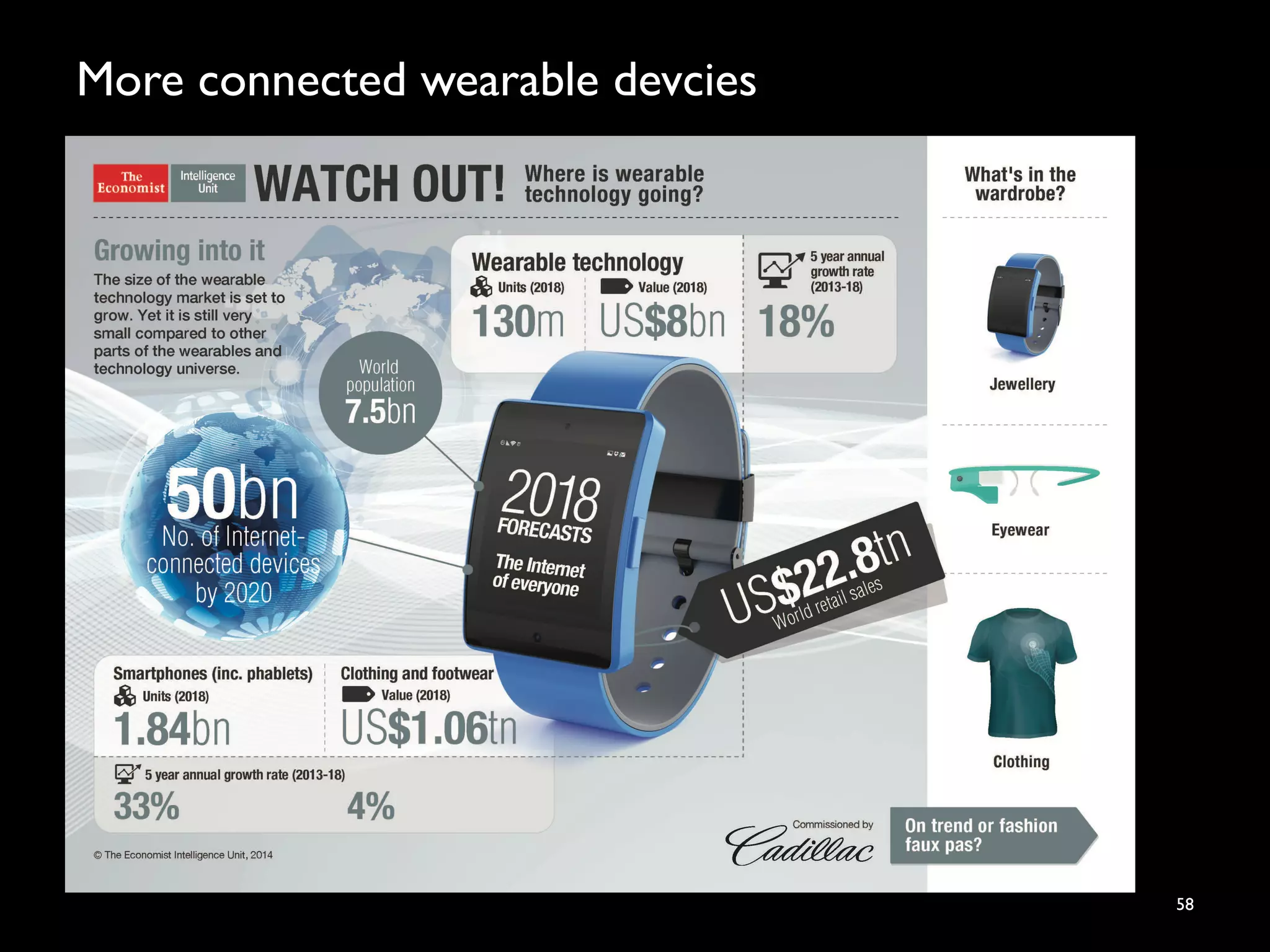
More connected wearable devcies
58
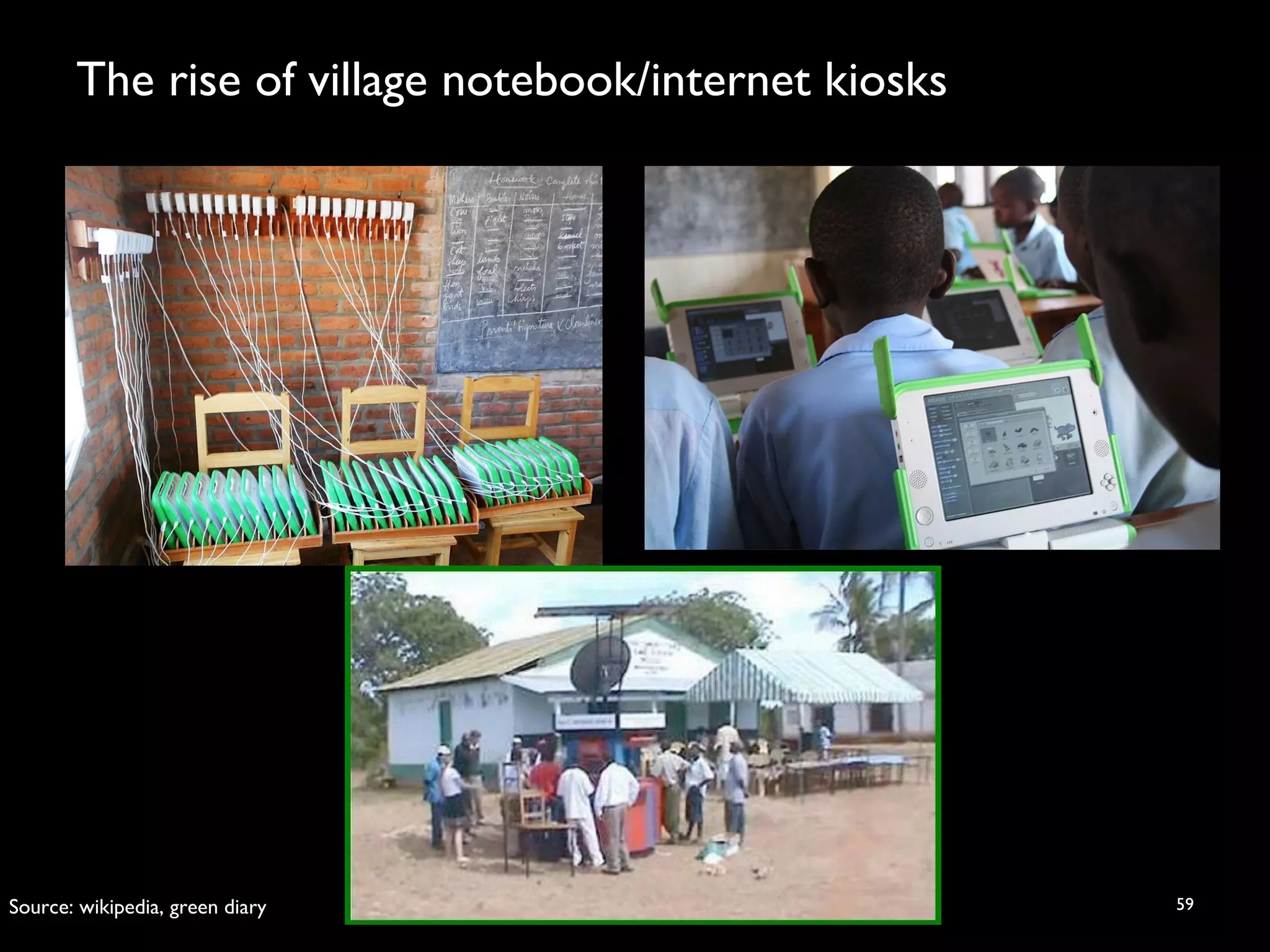
The rise of village notebook/internet kiosks
59Source: wikipedia, green diary
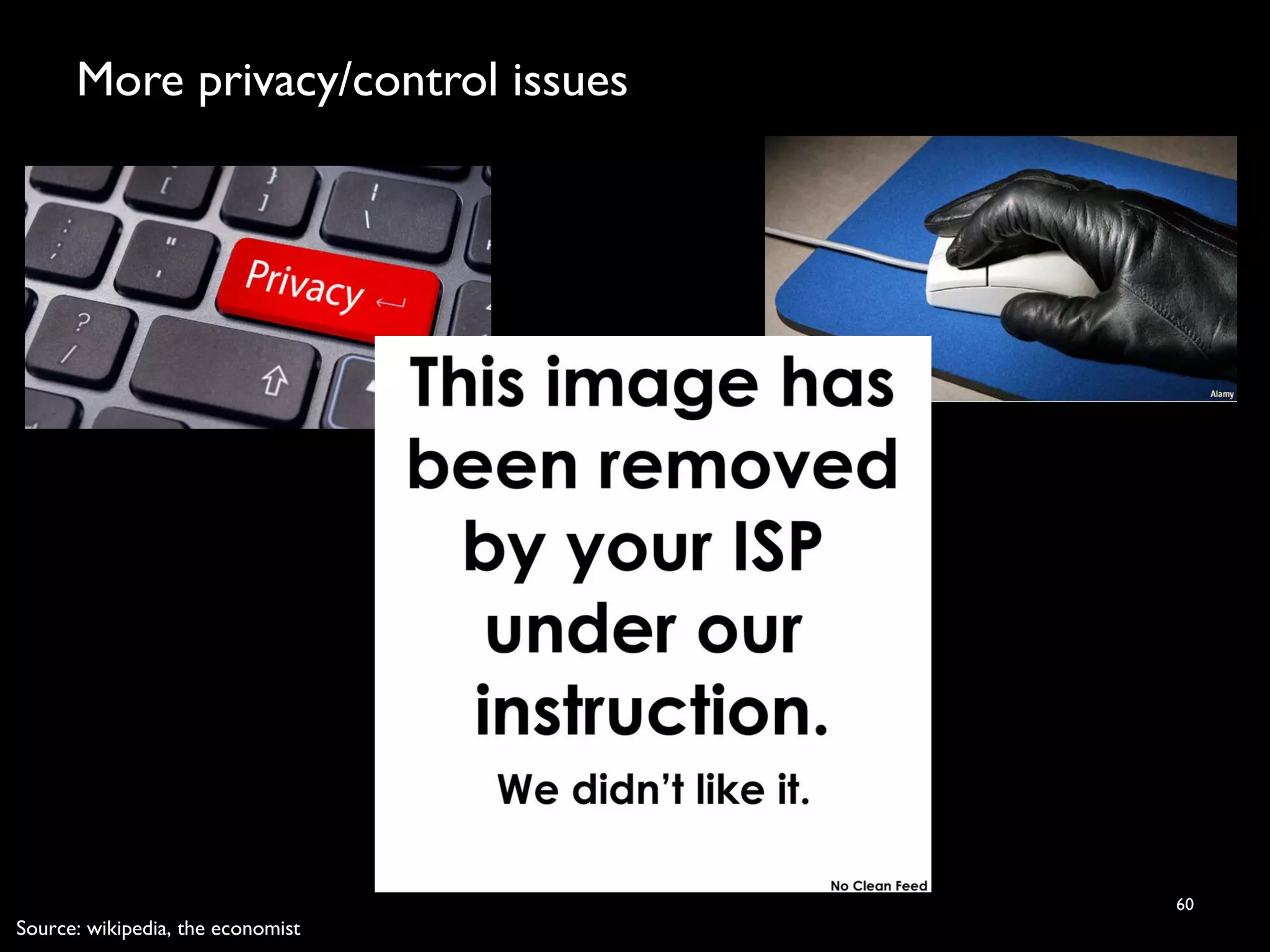
More privacy/control issues
60
Source: wikipedia, the economist
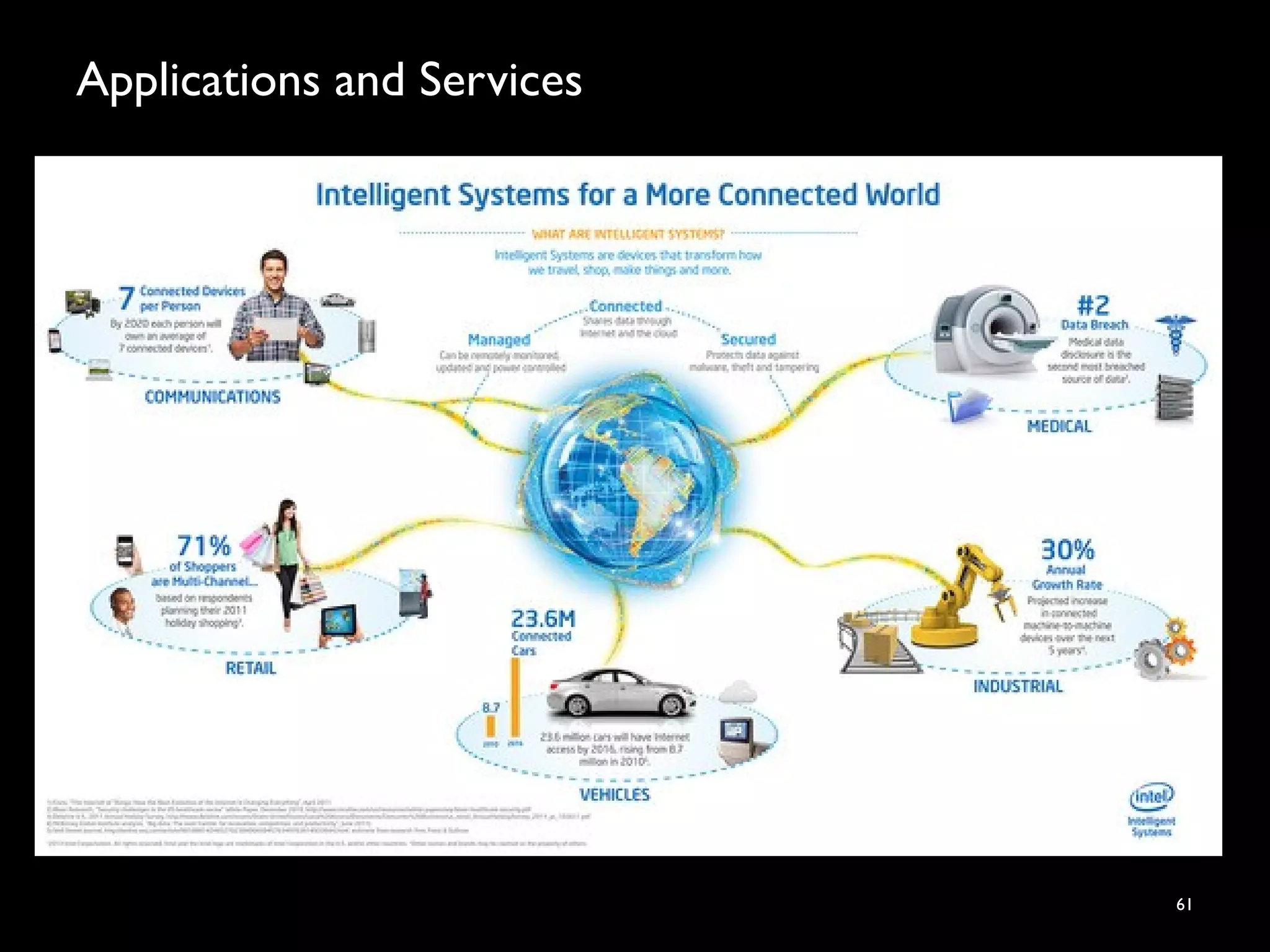
Applications and Services
61
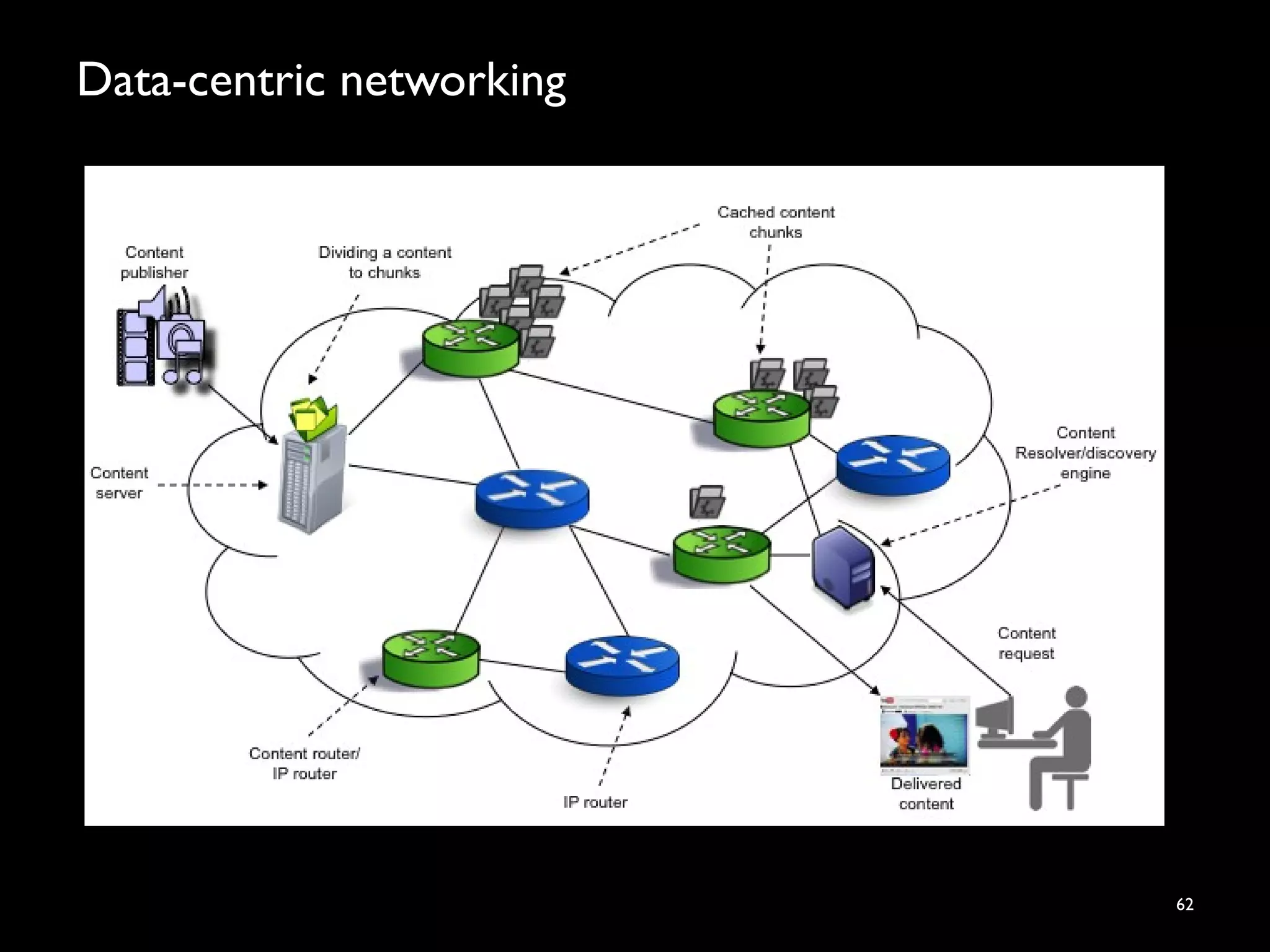
Data-centric networking
62
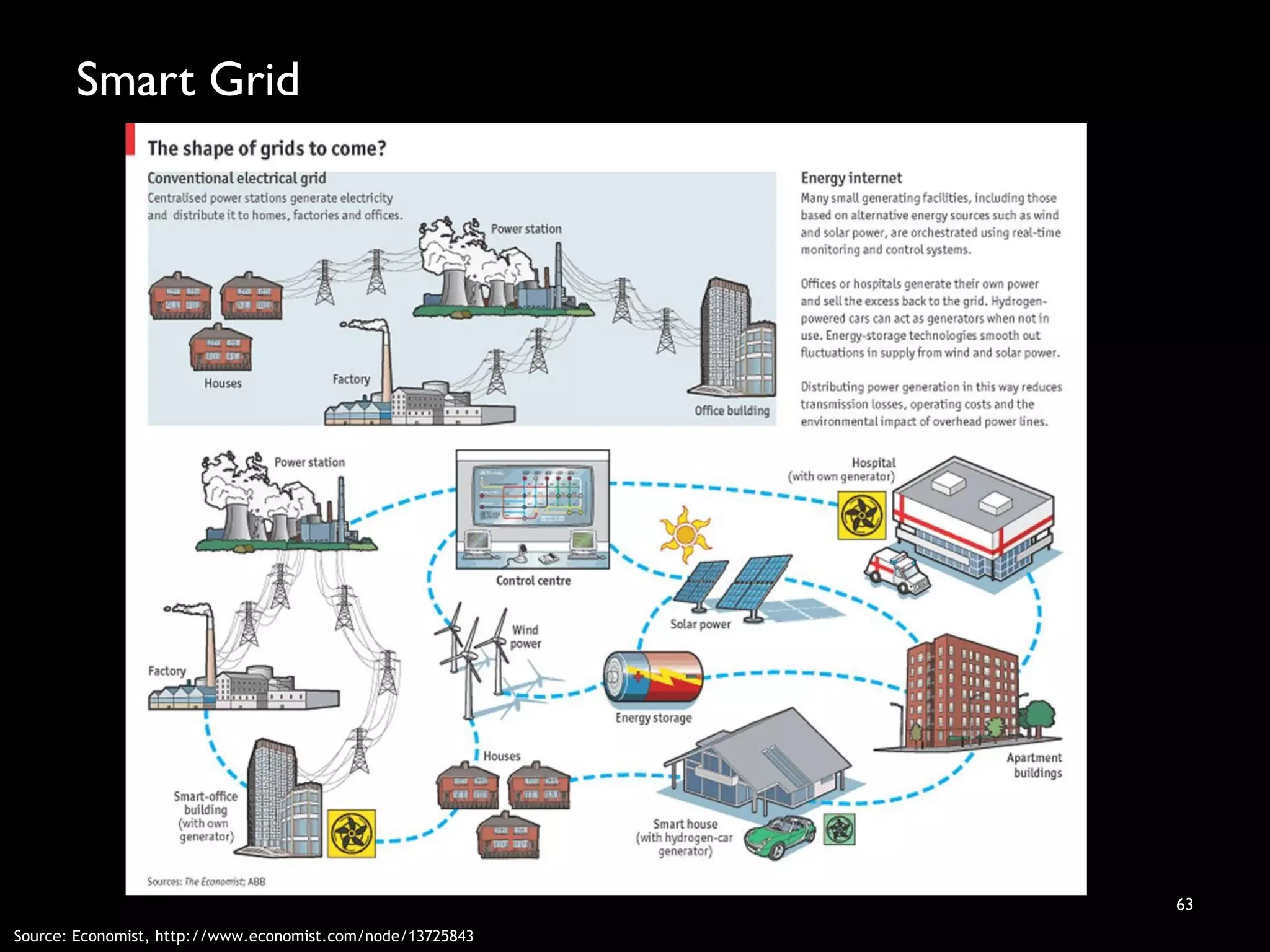
Smart Grid
63
Source: Economist, http://www.economist.com/node/13725843
The Future of the Internet
64
In next 25 years
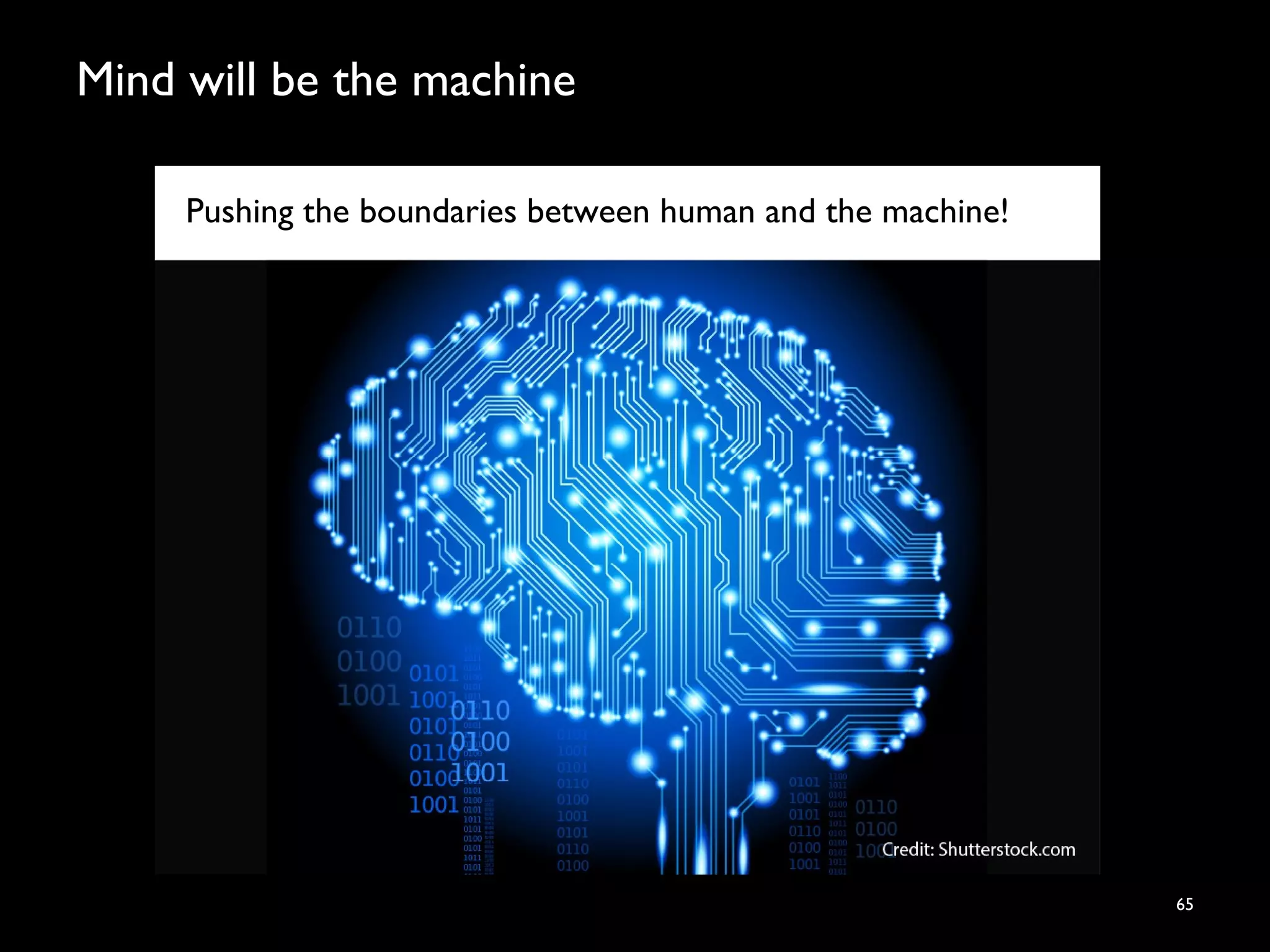
Mind will be the machine
65
Pushing the boundaries between human and the machine!
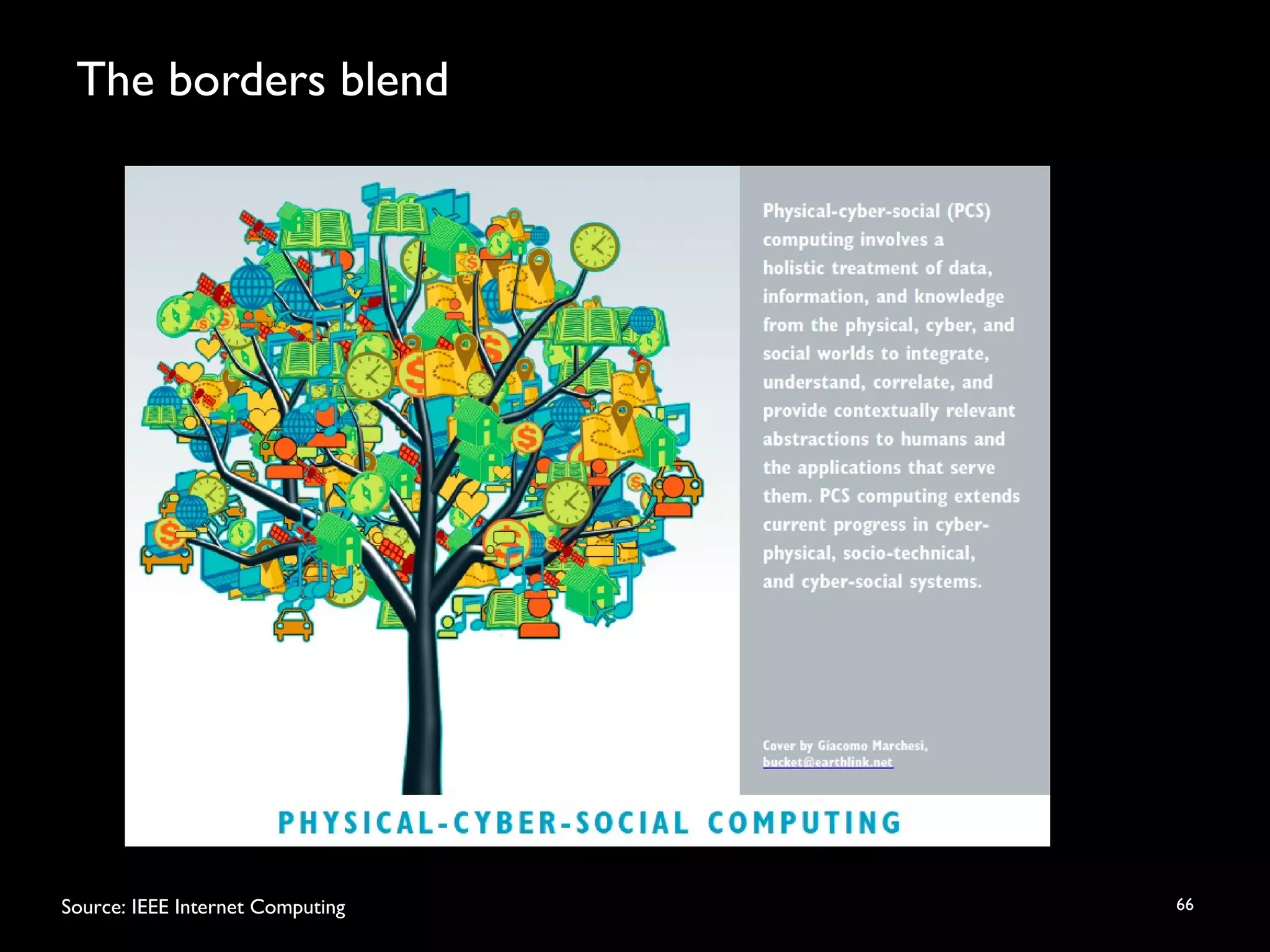
The borders blend
66Source: IEEE Internet Computing
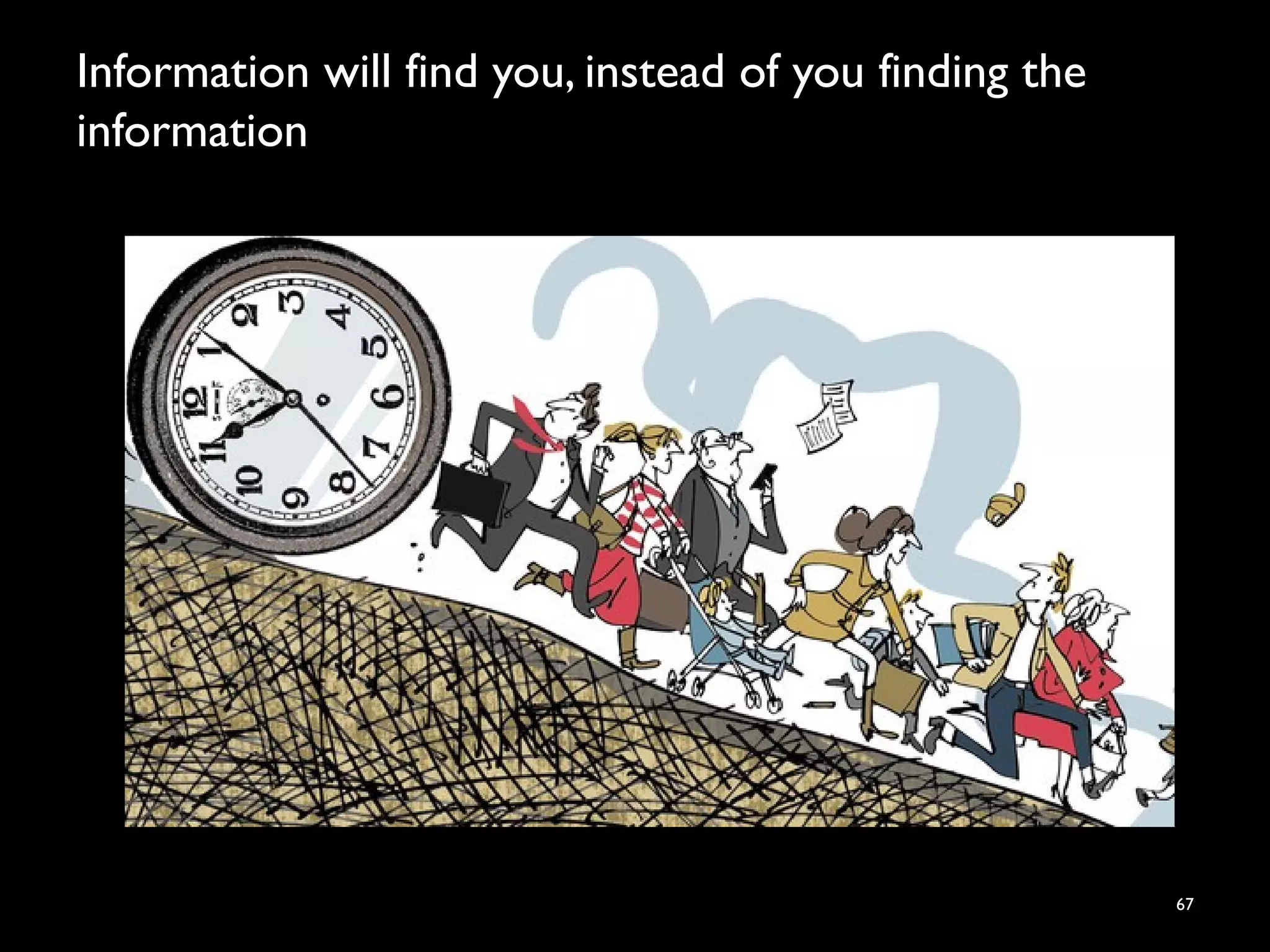
Information will find you, instead of you finding the
information
67
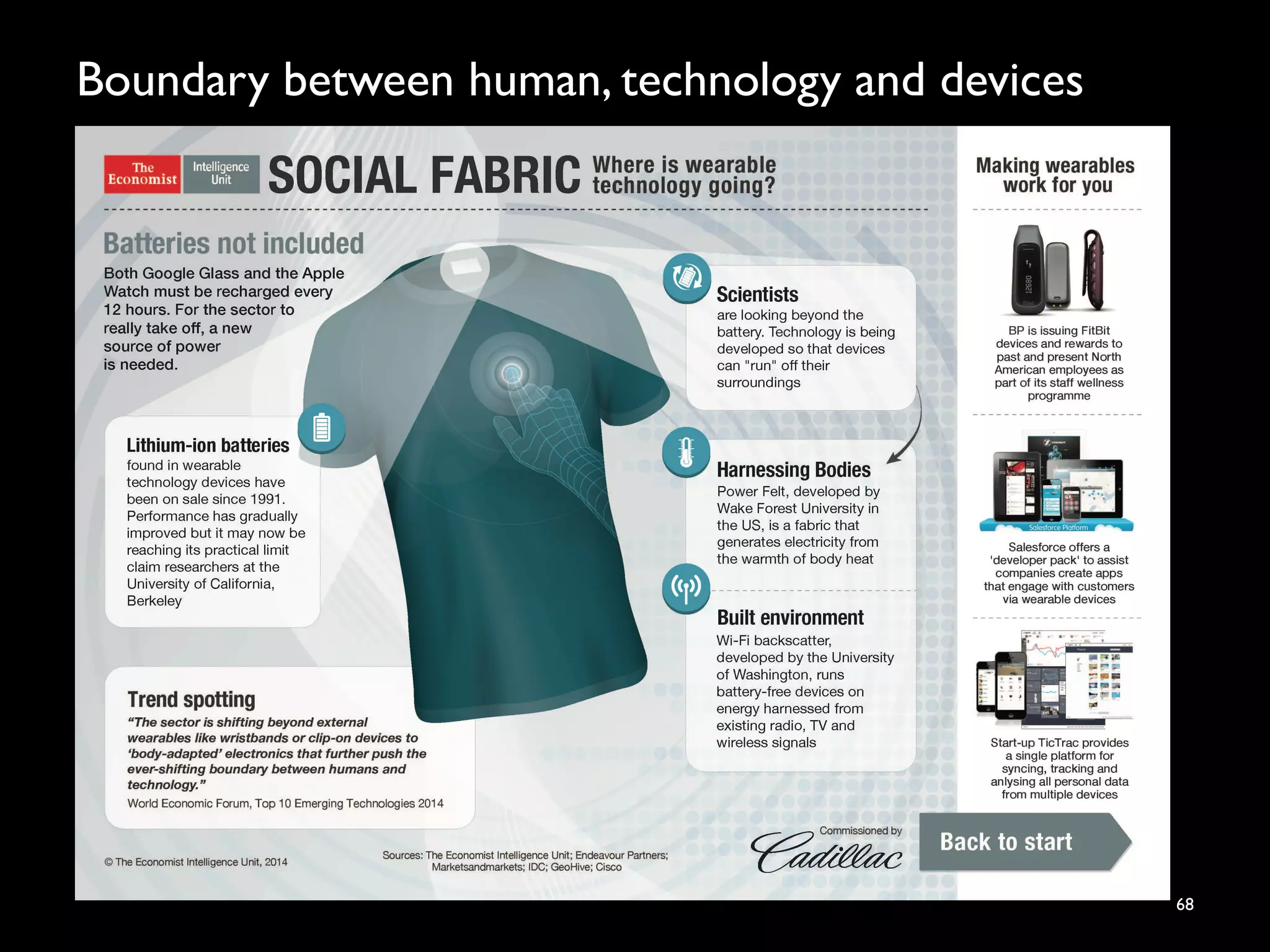
Boundary between human, technology and devices
68
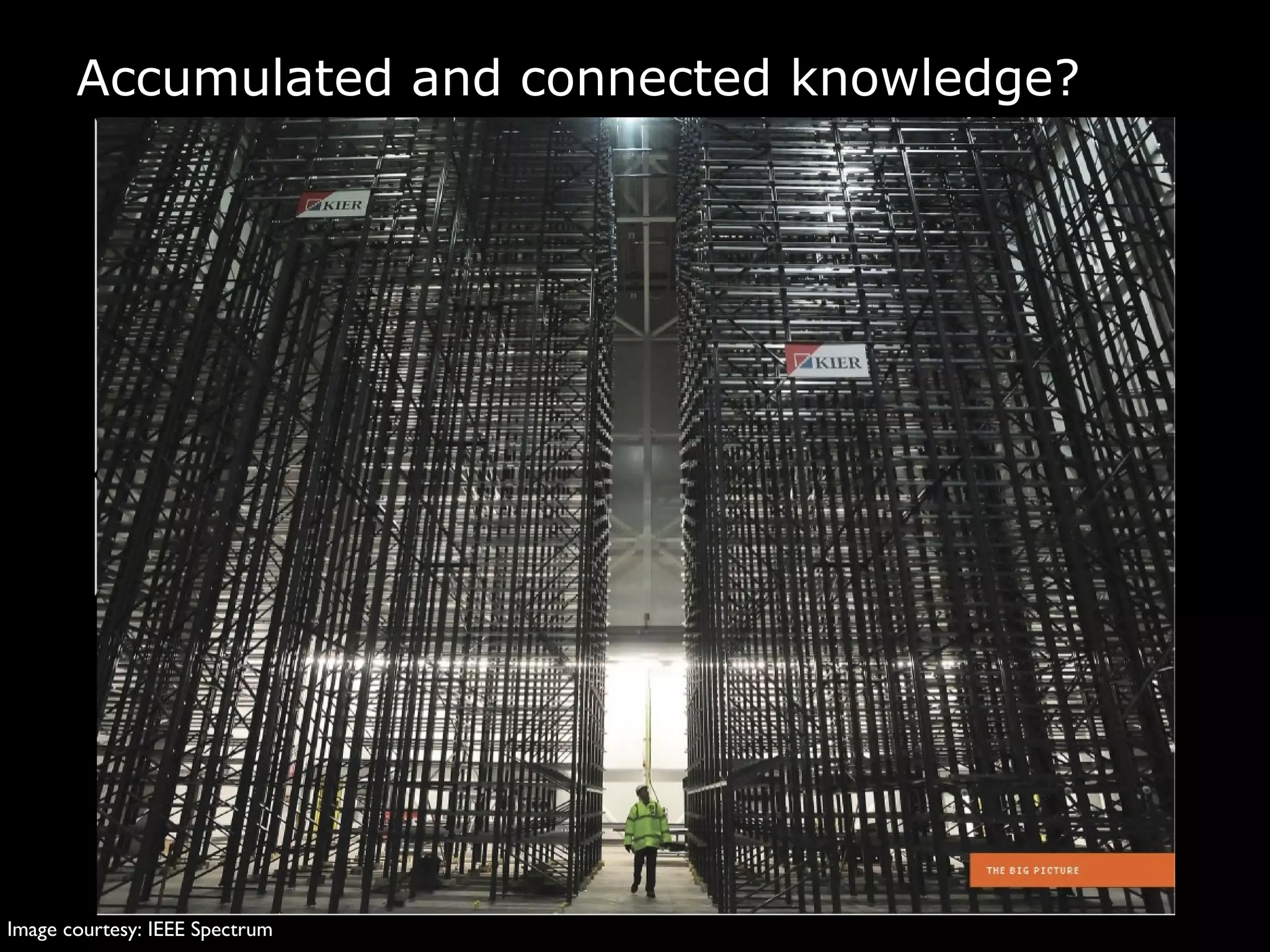
Accumulated and connected knowledge?
69
Image courtesy: IEEE Spectrum
Global Challenges
− Net neutrality
− Openness and freedom of access
− Privacy and control on personal data
− Cyber security and trust
− Dependability and resilience
− Who owns what, and who controls what
− Digital divide
− Social impacts
70
Technical challenges
− (Automated) data to actionable-information process
− Finding and linking complimentary and related information
− Energy resources and bandwidth
− Quality of Service
− (near-) real-time access to information for
everything/everywhere
− Autonomous machine-to-machine interactions
− Fast speed networking
− Security, privacy, trust for applications and servcies
71
Let’s hope
−The Internet of the Future will be
−Open and accessible for everyone, everywhere,
available at anytime,
−People will have control on their data
−Data will be used for helping people
−Smart applications will contribute to a better life
and to a better use of of our resources in the
world!
72
Thank you.
http://personal.ee.surrey.ac.uk/Personal/P.Barnaghi/
@pbarnaghi
p.barnaghi@surrey.ac.uk

The Future of the Internet

  • 1.
    The Future ofthe Internet 1 Payam Barnaghi Institute for Communication Systems (ICS) Electronic Engineering Department University of Surrey Guildford, United Kingdom The Grand Challenge (Tracking 21st Century challenges together) University of Exeter, June 2015
  • 2.
    2 IBM Mainframe 360,source Wikipedia
  • 3.
    Apollo 11 CommandModule (1965) had 64 kilobytes of memory operated at 0.043MHz. An iPhone 5s has a CPU running at speeds of up to 1.3GHz and has 512MB to 1GB of memory Cray-1 (1975) produced 80 million Floating point operations per second (FLOPS) 10 years later, Cray-2 produced 1.9G FLOPS An iPhone 5s produces 76.8 GFLOPS – nearly a thousand times more Cray-2 used 200-kilowatt power Source: Nick T., PhoneArena.com, 2014
  • 4.
    Computing Power 4 −Smaller size −MorePowerful −More memory and more storage −"Moore's law" over the history of computing, the number of transistors in a dense integrated circuit has doubled approximately every two years.
  • 5.
    Smaller in sizebut larger in scale 5
  • 6.
    The Internet:A briefhistory 6 − 1961: Leonard Kleinrock at MIT published the first paper on packet switching theory in July 1961. − 1962: J.C.R. Licklider of MIT discussed his "Galactic Network" concept - a globally interconnected set of computers through which everyone could quickly access data and programs from any site. − 1968: an RFQ was released by DARPA for the development of one of the key components, the packet switches called Interface Message Processors (IMP's). − The RFQ was won in December 1968 by a group headed by Frank Heart at Bolt Beranek and Newman (BBN). Source: Internet Society
  • 7.
    The Internet:A briefhistory 7 − 1970: the Network Working Group (NWG) working under S. Crocker finished the initial ARPANET Host-to-Host protocol, called the Network Control Protocol (NCP). − 1972: Bob Kahn organized a large, very successful demonstration of the ARPANET at the International Computer Communication Conference (ICCC). − This was the first public demonstration of this new network technology to the public. − 1972: the first "hot" application, electronic mail, was introduced. Source: Internet Society
  • 8.
    The old Internettimeline 8Source: Internet Society
  • 9.
    TCP/IP in theearly days of the Internet 9 − The original Cerf/Kahn paper on the Internet described one protocol, called TCP, which provided all the transport and forwarding services in the Internet. − A 32 bit IP address was used of which the first 8 bits signified the network and the remaining 24 bits designated the host on that network. − The assumption was that 256 networks would be sufficient for the foreseeable future… − Obviously this was before LANs (Ethernet was under development at Xerox PARC at that time)
  • 10.
    Expansion beyond estimation 10 InNovember 1979, a proposal was submitted to NSF to fund a consortium of eleven universities at an estimated cost of $3 million over five years. This is viewed as too costly by the NSF. Source: Computer History museum 4 node Arpanet
  • 11.
    Predicting the future(in 1999)! 11 − 1999:“The number of hosts (locatable through DNS) will exceed 100 M, very soon!” − A few years later in 2013, 80 “things” per second were connecting to the internet.  In 2014 that number was around 100 per second, and by 2020, more than 250 things will connect each second. (source Cisco) − It is estimated that by 2020 there will be more than 50 billion internet connected devices. (source Cisco)
  • 12.
  • 13.
    Fiber optic cablesaround the world A single fibre can transmit as much as 100 billion bits per second (100 Gbps, about ten thousand times faster than a typical home broadband connection) - A cable can contain hundreds of fibres, a single cable can have enough capacity for the communications of millions of users. Source: http://www.vox.com/a/internet-maps Source: http://www.vox.com/a/internet-maps
  • 15.
    Countries at riskof getting disconnected from the internet Source: http://www.vox.com/a/internet-maps
  • 16.
    Connectivity and informationexchange was (and is ) one of the main motivations behind the Internet; but Content and Services are now the key elements; and all started growing rapidly by the introduction of the World Wide Web. 16
  • 17.
    The World WideWeb 17 Tim Berners-Lee
  • 18.
    Early days ofthe Web 18
  • 19.
    Search on theInternet/Web in the early days 19
  • 20.
    And there cameGoogle! 20 Google says that the web has now 30 trillion unique individual pages;
  • 21.
  • 22.
  • 23.
  • 24.
  • 25.
    25 AnyPlace AnyTime AnyThing Data Volume Security,Reliability, Trust and Privacy Societal Impacts, Economic Values and Viability Services and Applications Networking and Communication
  • 26.
    26 Sensor devices arebecoming widely available - Programmable devices - Off-the-shelf gadgets/tools
  • 27.
    27 More “Things” arebeing connected Home/daily-life devices Business and Public infrastructure Health-care …
  • 28.
    28 People Connecting toThings Motion sensor Motion sensor Motion sensor ECG sensor Internet
  • 29.
    29 Things Connecting toThings - Complex and heterogeneous resources and networks
  • 30.
  • 31.
    Connected world 31Image courtesy:Wilgengebroed DataData SemanticsSemantics Social networks Social networks M2M Communic ations M2M Communic ations
  • 32.
    32 Internet of Things(IoT) − Extending the current Internet and providing connection, communication, and inter-networking between devices and physical objects, or "Things," is a growing trend that is often referred to as the Internet ofThings. − “The technologies and solutions that enable integration of real world data and services into the current information networking technologies are often described under the umbrella term of the Internet of Things (IoT)”
  • 33.
  • 34.
    1G AMPS, NMT, TACS 2G GSM. GPRS, TDMAIS-136, CDMA IS-95, PDC 3G UMTS, CDMA2000, 4G 5G LTE, LTE-A People Things Voice Text Data 5G technologies and standards Connection + Control M2M/IoT Change in the communication technologies
  • 35.
    Mobile Services andApplications 35 Image courtesy: Economist
  • 36.
    36 Things, Devices, Data,and lots of it image courtesy: Smarter Data - I.03_C by Gwen Vanhee
  • 37.
    “delivering only datais not often sufficient, the systems should be able to provide machine- interpretable and/or human-understandable insights (actionable-information)” Sink node Gateway Core network e.g. Internet What is the temperature at home?Freezing!
  • 38.
  • 39.
    Internet of Things:The story so far RFID based solutions Wireless Sensor and Actuator networks , solutions for communication technologies, energy efficiency, routing, … Smart Devices/ Web-enabled Apps/Services, initial products, vertical applications, early concepts and demos, … Motion sensor Motion sensor ECG sensor Physical-Cyber-Social Systems, Linked-data, semantics, M2M, More products, more heterogeneity, solutions for control and monitoring, … Future: Cloud, Big (IoT) Data Analytics, Interoperability, Enhanced Cellular/Wireless Com. for IoT, Real-world operational use-cases and Industry and B2B services/applications, more Standards…
  • 40.
    The scale 40 Things Data Devices 2.5quintillion bytes per day Billions and Billions of them… Estimated 50 Billion by 2020
  • 41.
    The IoT isa dynamic, online and rapidly changing world 41 isPartOf Publishing content/data on the Web Data in the IoT Image sources: ABC Australia and 2dolphins.com
  • 42.
    What type ofproblems we expect to solve?
  • 43.
    43Source LAT Times,http://documents.latimes.com/la-2013/ Future cities: A view from 1998
  • 44.
  • 45.
  • 46.
    Applications and potentials −Analysis of thousands of traffic, pollution, weather, congestion, public transport, waste and event sensory data to provide better transport and city management. − Converting smart meter readings to information that can help prediction and balance of power consumption in a city. − Monitoring elderly homes, personal and public healthcare applications. − Event and incident analysis and prediction using (near) real-time data collected by citizen and device sensors. − Turning social media data (e.g.Tweets) related to city issues into event and sentiment analysis. − Any many more… 46
  • 47.
    The physical worlddata − Multi-modal and heterogeneous − Noisy and incomplete − Time and location dependent − Dynamic and varies in quality − Crowed sourced data can be unreliable − Requires (near-) real-time analysis − Privacy and security are important issues − Data can be biased- we need to know our data! − Data alone may not give a clear picture -we need contextual information, background knowledge, multi-source information and obviously better data analytics solutions… 47
  • 48.
  • 49.
    Live data visualisation 49P.Source: Lasse Steenbock Vestergaard, CityPulse Project
  • 50.
    Live event visualisation 50P.Source: Lasse Steenbock Vestergaard, CityPulse Project
  • 51.
    Learning form data 51 F.Ganz, P. Barnaghi, F. Carrez, "Information Abstraction for Heterogeneous Real World Internet Data", IEEE Sensors Journal, 2013.
  • 52.
    Ontology learning fromreal world data 52
  • 53.
    Extraction of eventsand semantics from social media 53 City Infrastructure Tweets from a city P. Anantharam, P. Barnaghi, K. Thirunarayan, A. Sheth, "Extracting city events from social streams,“, 2014. https://osf.io/b4q2t/
  • 54.
    The Future ofthe Internet 54 In next 5 years
  • 55.
    The rise ofsharing economy 55Source: the Economist
  • 56.
    More broadband inremote areas 56
  • 57.
    More people gettingconnected 57Source: the Economist
  • 58.
  • 59.
    The rise ofvillage notebook/internet kiosks 59Source: wikipedia, green diary
  • 60.
  • 61.
  • 62.
  • 63.
    Smart Grid 63 Source: Economist,http://www.economist.com/node/13725843
  • 64.
    The Future ofthe Internet 64 In next 25 years
  • 65.
    Mind will bethe machine 65 Pushing the boundaries between human and the machine!
  • 66.
    The borders blend 66Source:IEEE Internet Computing
  • 67.
    Information will findyou, instead of you finding the information 67
  • 68.
    Boundary between human,technology and devices 68
  • 69.
    Accumulated and connectedknowledge? 69 Image courtesy: IEEE Spectrum
  • 70.
    Global Challenges − Netneutrality − Openness and freedom of access − Privacy and control on personal data − Cyber security and trust − Dependability and resilience − Who owns what, and who controls what − Digital divide − Social impacts 70
  • 71.
    Technical challenges − (Automated)data to actionable-information process − Finding and linking complimentary and related information − Energy resources and bandwidth − Quality of Service − (near-) real-time access to information for everything/everywhere − Autonomous machine-to-machine interactions − Fast speed networking − Security, privacy, trust for applications and servcies 71
  • 72.
    Let’s hope −The Internetof the Future will be −Open and accessible for everyone, everywhere, available at anytime, −People will have control on their data −Data will be used for helping people −Smart applications will contribute to a better life and to a better use of of our resources in the world! 72
  • 73.