How to make cities “smarter”?
1
Dr Payam Barnaghi
Institute for Communication Systems (ICS)/
5G Innovation Centre
University of Surrey
Guildford, United Kingdom
UKTI Workshop at Mobile World Congress 2016
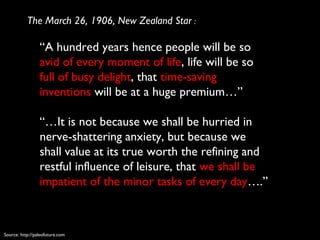
“A hundred years hence people will be so
avid of every moment of life, life will be so
full of busy delight, that time-saving
inventions will be at a huge premium…”
“…It is not because we shall be hurried in
nerve-shattering anxiety, but because we
shall value at its true worth the refining and
restful influence of leisure, that we shall be
impatient of the minor tasks of every day….”
The March 26, 1906, New Zealand Star :
Source: http://paleofuture.com
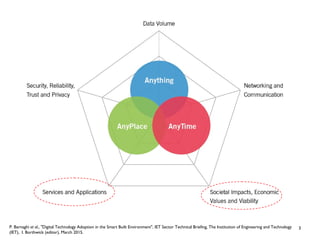
3P. Barnaghi et al., "Digital Technology Adoption in the Smart Built Environment", IET Sector Technical Briefing, The Institution of Engineering and Technology
(IET), I. Borthwick (editor), March 2015.
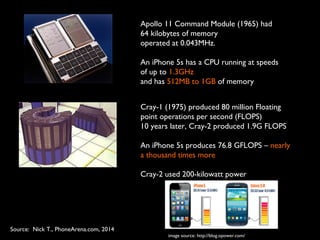
Apollo 11 Command Module (1965) had
64 kilobytes of memory
operated at 0.043MHz.
An iPhone 5s has a CPU running at speeds
of up to 1.3GHz
and has 512MB to 1GB of memory
Cray-1 (1975) produced 80 million Floating
point operations per second (FLOPS)
10 years later, Cray-2 produced 1.9G FLOPS
An iPhone 5s produces 76.8 GFLOPS – nearly
a thousand times more
Cray-2 used 200-kilowatt power
Source: Nick T., PhoneArena.com, 2014
image source: http://blog.opower.com/
Smart City
“A smart city uses digital technologies or information and
communication technologies (ICT) to enhance quality and
performance of urban services, to reduce costs and resource
consumption, and to engage more effectively and actively with
its citizens.” [Wikipedia]
5
Is this a good definition?
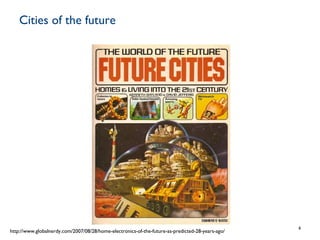
Cities of the future
6
http://www.globalnerdy.com/2007/08/28/home-electronics-of-the-future-as-predicted-28-years-ago/
7
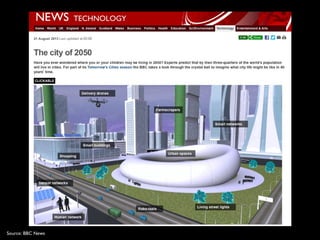
Source: BBC News
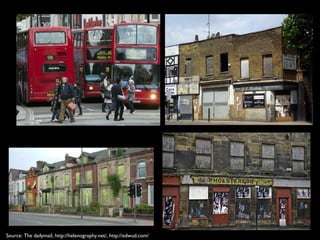
Source: The dailymail, http://helenography.net/, http://edwud.com/
What are smart cities?
9
“An ecosystem of systems enabled by the
Internet of Things and information
communication technologies.”
“People, resources, and information coming
together, operating in an ad-hoc and/or
coordinated way to improve city operations
and everyday activities.”
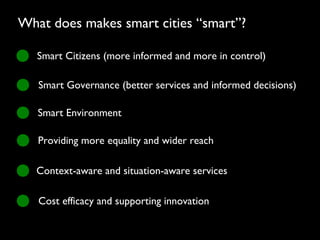
What does makes smart cities “smart”?
Smart Citizens (more informed and more in control)
Smart Governance (better services and informed decisions)
Smart Environment
Providing more equality and wider reach
Context-aware and situation-aware services
Cost efficacy and supporting innovation
What does makes smart cities “smart”?
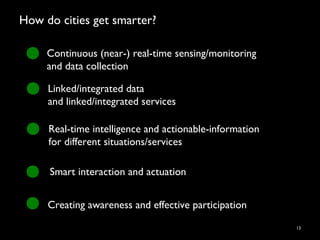
How do cities get smarter?
13
Continuous (near-) real-time sensing/monitoring
and data collection
Linked/integrated data
and linked/integrated services
Real-time intelligence and actionable-information
for different situations/services
Smart interaction and actuation
Creating awareness and effective participation
How can technology help to make
cities smarter?
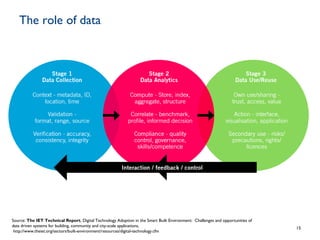
The role of data
15
Source: The IET Technical Report, Digital Technology Adoption in the Smart Built Environment: Challenges and opportunities of
data driven systems for building, community and city-scale applications,
http://www.theiet.org/sectors/built-environment/resources/digital-technology.cfm
16
“The ultimate goal is transforming the raw data
to insights and actionable information and/or
creating effective representation forms for
machines and also human users, and providing
automated services.”
This usually requires data from multiple sources,
(near-) real time analytics and visualisation
and/or semantic representations.
What type of problems we expect to solve
using the IoT and data analytics solutions?
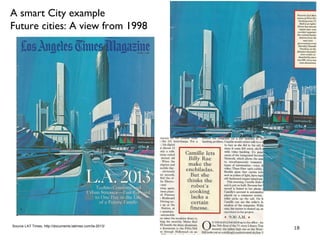
18Source LAT Times, http://documents.latimes.com/la-2013/
A smart City example
Future cities: A view from 1998
19
Source: http://robertluisrabello.com/denial/traffic-in-la/#gallery[default]/0/
Source: wikipedia
Back to the Future: 2013
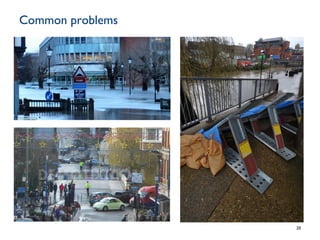
Common problems
20
Guildford, Surrey
21
Applications and potentials
− Analysis of thousands of traffic, pollution, weather, congestion,
public transport, waste and event sensory data to provide
better transport and city management.
− Converting smart meter readings to information that can help
prediction and balance of power consumption in a city.
− Monitoring elderly homes, personal and public healthcare
applications.
− Event and incident analysis and prediction using (near) real-
time data collected by citizen and device sensors.
− Turning social media data (e.g.Tweets) related to city issues
into event and sentiment analysis.
− Any many more…
22
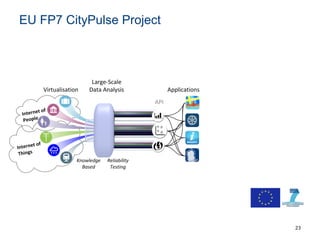
EU FP7 CityPulse Project
23
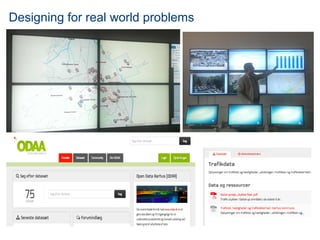
Designing for real world problems
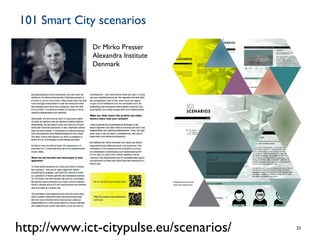
101 Smart City scenarios
25http://www.ict-citypulse.eu/scenarios/
Dr Mirko Presser
Alexandra Institute
Denmark
26
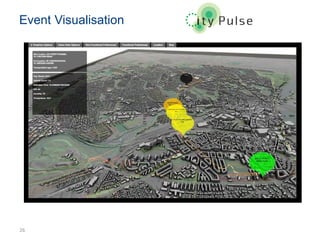
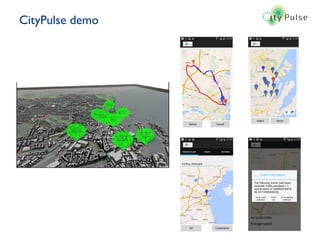
Event Visualisation
CityPulse demo
27
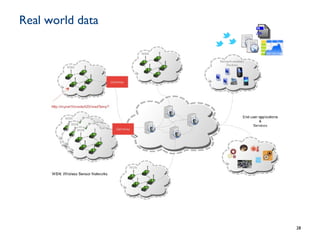
Real world data
28
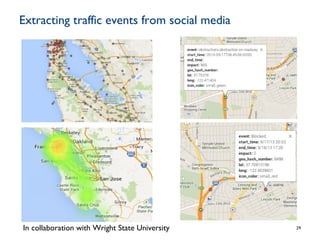
Extracting traffic events from social media
29In collaboration with Wright State University
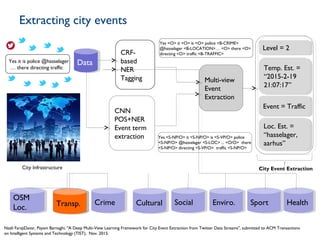
Extracting city events
30
City Infrastructure
Yes it is police @hasselager
… there directing traffic
CRF-
based
NER
Tagging Multi-view
Event
Extraction
Loc. Est. =
“hasselager,
aarhus”
Loc. Est. =
“hasselager,
aarhus”
Temp. Est. =
“2015-2-19
21:07:17”
Temp. Est. =
“2015-2-19
21:07:17”
Level = 2Level = 2
Event = TrafficEvent = Traffic
OSM
Loc.
OSM
Loc.
CrimeCrimeTransp.Transp.
City Event Extraction
CNN
POS+NER
Event term
extraction
CulturalCultural SocialSocial Enviro.Enviro. SportSport HealthHealth
DataData
Transp.Transp.
Yes <O> it <O> is <O> police <B-CRIME>
@hasselager <B-LOCATION>… <O> there <O>
directing <O> traffic <B-TRAFFIC>
Yes <S-NP/O> it <S-NP/O> is <S-VP/O> police
<S-NP/O> @hasselager <S-LOC> ... <O/O> there
<S-NP/O> directing <S-VP/O> traffic <S-NP/O>
Nazli FarajiDavar, Payam Barnaghi, "A Deep Multi-View Learning Framework for City Event Extraction from Twitter Data Streams", submitted to ACM Transactions
on Intelligent Systems and Technology (TIST), Nov. 2015.
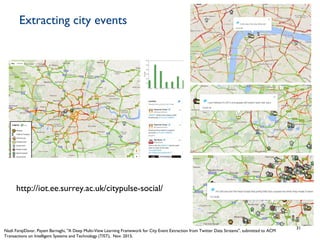
Extracting city events
31
http://iot.ee.surrey.ac.uk/citypulse-social/
Nazli FarajiDavar, Payam Barnaghi, "A Deep Multi-View Learning Framework for City Event Extraction from Twitter Data Streams", submitted to ACM
Transactions on Intelligent Systems and Technology (TIST), Nov. 2015.
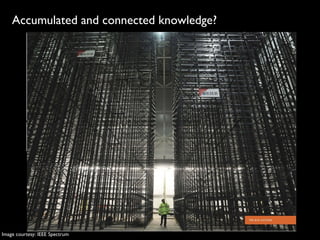
Accumulated and connected knowledge?
32
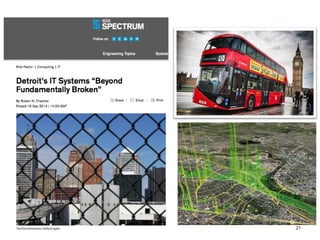
Image courtesy: IEEE Spectrum
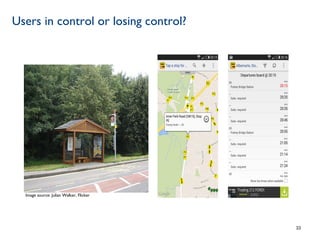
Users in control or losing control?
33
Image source: Julian Walker, Flicker
Gateway
Gatewa
y
Data Analytics
Engine
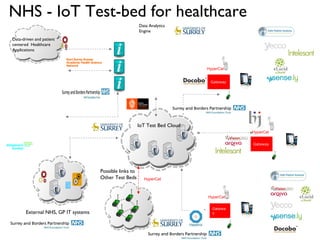
IoT Test Bed Cloud
External NHS, GP IT systems
Possible links to
Other Test Beds
HyperCat
Gateway
HyperCat
HyperCat
HyperCat
Data-driven and patient
centered Healthcare
Applications
NHS - IoT Test-bed for healthcare
In conclusion
−Smart cities are made of informed citizens, smart
environments and informed and intelligent decision
making and governance.
−Smart cities should promote innovation, equality and
wider reach of services to all citizens.
−IoT plays a key role in making cities smarter;
openness of data and interconnection and
interoperability between different data sources and
services is a key requirement.
−Technology alone won’t make cities smart.
35
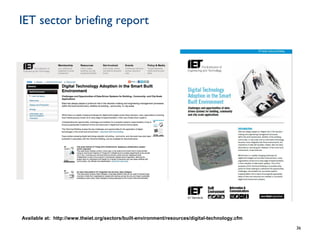
IET sector briefing report
36
Available at: http://www.theiet.org/sectors/built-environment/resources/digital-technology.cfm
37
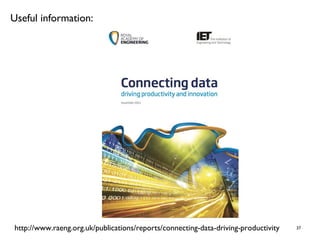
Useful information:
http://www.raeng.org.uk/publications/reports/connecting-data-driving-productivity
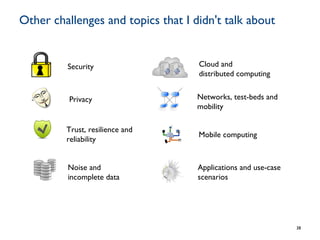
Other challenges and topics that I didn't talk about
Security
Privacy
Trust, resilience and
reliability
Noise and
incomplete data
Cloud and
distributed computing
Networks, test-beds and
mobility
Mobile computing
Applications and use-case
scenarios
38
Q&A
− Thank you.
http://personal.ee.surrey.ac.uk/Personal/P.Barnaghi/
@pbarnaghi
p.barnaghi@surrey.ac.uk
http://iot.ee.surrey.ac.uk
Acknowledgement: CityPulse Consortium
http://www.ict-citypulse.eu

How to make cities "smarter"?

  • 1.
    How to makecities “smarter”? 1 Dr Payam Barnaghi Institute for Communication Systems (ICS)/ 5G Innovation Centre University of Surrey Guildford, United Kingdom UKTI Workshop at Mobile World Congress 2016
  • 2.
    “A hundred yearshence people will be so avid of every moment of life, life will be so full of busy delight, that time-saving inventions will be at a huge premium…” “…It is not because we shall be hurried in nerve-shattering anxiety, but because we shall value at its true worth the refining and restful influence of leisure, that we shall be impatient of the minor tasks of every day….” The March 26, 1906, New Zealand Star : Source: http://paleofuture.com
  • 3.
    3P. Barnaghi etal., "Digital Technology Adoption in the Smart Built Environment", IET Sector Technical Briefing, The Institution of Engineering and Technology (IET), I. Borthwick (editor), March 2015.
  • 4.
    Apollo 11 CommandModule (1965) had 64 kilobytes of memory operated at 0.043MHz. An iPhone 5s has a CPU running at speeds of up to 1.3GHz and has 512MB to 1GB of memory Cray-1 (1975) produced 80 million Floating point operations per second (FLOPS) 10 years later, Cray-2 produced 1.9G FLOPS An iPhone 5s produces 76.8 GFLOPS – nearly a thousand times more Cray-2 used 200-kilowatt power Source: Nick T., PhoneArena.com, 2014 image source: http://blog.opower.com/
  • 5.
    Smart City “A smartcity uses digital technologies or information and communication technologies (ICT) to enhance quality and performance of urban services, to reduce costs and resource consumption, and to engage more effectively and actively with its citizens.” [Wikipedia] 5 Is this a good definition?
  • 6.
    Cities of thefuture 6 http://www.globalnerdy.com/2007/08/28/home-electronics-of-the-future-as-predicted-28-years-ago/
  • 7.
  • 8.
    Source: The dailymail,http://helenography.net/, http://edwud.com/
  • 9.
    What are smartcities? 9 “An ecosystem of systems enabled by the Internet of Things and information communication technologies.” “People, resources, and information coming together, operating in an ad-hoc and/or coordinated way to improve city operations and everyday activities.”
  • 10.
    What does makessmart cities “smart”?
  • 11.
    Smart Citizens (moreinformed and more in control) Smart Governance (better services and informed decisions) Smart Environment Providing more equality and wider reach Context-aware and situation-aware services Cost efficacy and supporting innovation What does makes smart cities “smart”?
  • 12.
    How do citiesget smarter?
  • 13.
    How do citiesget smarter? 13 Continuous (near-) real-time sensing/monitoring and data collection Linked/integrated data and linked/integrated services Real-time intelligence and actionable-information for different situations/services Smart interaction and actuation Creating awareness and effective participation
  • 14.
    How can technologyhelp to make cities smarter?
  • 15.
    The role ofdata 15 Source: The IET Technical Report, Digital Technology Adoption in the Smart Built Environment: Challenges and opportunities of data driven systems for building, community and city-scale applications, http://www.theiet.org/sectors/built-environment/resources/digital-technology.cfm
  • 16.
    16 “The ultimate goalis transforming the raw data to insights and actionable information and/or creating effective representation forms for machines and also human users, and providing automated services.” This usually requires data from multiple sources, (near-) real time analytics and visualisation and/or semantic representations.
  • 17.
    What type ofproblems we expect to solve using the IoT and data analytics solutions?
  • 18.
    18Source LAT Times,http://documents.latimes.com/la-2013/ A smart City example Future cities: A view from 1998
  • 19.
  • 20.
  • 21.
  • 22.
    Applications and potentials −Analysis of thousands of traffic, pollution, weather, congestion, public transport, waste and event sensory data to provide better transport and city management. − Converting smart meter readings to information that can help prediction and balance of power consumption in a city. − Monitoring elderly homes, personal and public healthcare applications. − Event and incident analysis and prediction using (near) real- time data collected by citizen and device sensors. − Turning social media data (e.g.Tweets) related to city issues into event and sentiment analysis. − Any many more… 22
  • 23.
    EU FP7 CityPulseProject 23
  • 24.
    Designing for realworld problems
  • 25.
    101 Smart Cityscenarios 25http://www.ict-citypulse.eu/scenarios/ Dr Mirko Presser Alexandra Institute Denmark
  • 26.
  • 27.
  • 28.
  • 29.
    Extracting traffic eventsfrom social media 29In collaboration with Wright State University
  • 30.
    Extracting city events 30 CityInfrastructure Yes it is police @hasselager … there directing traffic CRF- based NER Tagging Multi-view Event Extraction Loc. Est. = “hasselager, aarhus” Loc. Est. = “hasselager, aarhus” Temp. Est. = “2015-2-19 21:07:17” Temp. Est. = “2015-2-19 21:07:17” Level = 2Level = 2 Event = TrafficEvent = Traffic OSM Loc. OSM Loc. CrimeCrimeTransp.Transp. City Event Extraction CNN POS+NER Event term extraction CulturalCultural SocialSocial Enviro.Enviro. SportSport HealthHealth DataData Transp.Transp. Yes <O> it <O> is <O> police <B-CRIME> @hasselager <B-LOCATION>… <O> there <O> directing <O> traffic <B-TRAFFIC> Yes <S-NP/O> it <S-NP/O> is <S-VP/O> police <S-NP/O> @hasselager <S-LOC> ... <O/O> there <S-NP/O> directing <S-VP/O> traffic <S-NP/O> Nazli FarajiDavar, Payam Barnaghi, "A Deep Multi-View Learning Framework for City Event Extraction from Twitter Data Streams", submitted to ACM Transactions on Intelligent Systems and Technology (TIST), Nov. 2015.
  • 31.
    Extracting city events 31 http://iot.ee.surrey.ac.uk/citypulse-social/ NazliFarajiDavar, Payam Barnaghi, "A Deep Multi-View Learning Framework for City Event Extraction from Twitter Data Streams", submitted to ACM Transactions on Intelligent Systems and Technology (TIST), Nov. 2015.
  • 32.
    Accumulated and connectedknowledge? 32 Image courtesy: IEEE Spectrum
  • 33.
    Users in controlor losing control? 33 Image source: Julian Walker, Flicker
  • 34.
    Gateway Gatewa y Data Analytics Engine IoT TestBed Cloud External NHS, GP IT systems Possible links to Other Test Beds HyperCat Gateway HyperCat HyperCat HyperCat Data-driven and patient centered Healthcare Applications NHS - IoT Test-bed for healthcare
  • 35.
    In conclusion −Smart citiesare made of informed citizens, smart environments and informed and intelligent decision making and governance. −Smart cities should promote innovation, equality and wider reach of services to all citizens. −IoT plays a key role in making cities smarter; openness of data and interconnection and interoperability between different data sources and services is a key requirement. −Technology alone won’t make cities smart. 35
  • 36.
    IET sector briefingreport 36 Available at: http://www.theiet.org/sectors/built-environment/resources/digital-technology.cfm
  • 37.
  • 38.
    Other challenges andtopics that I didn't talk about Security Privacy Trust, resilience and reliability Noise and incomplete data Cloud and distributed computing Networks, test-beds and mobility Mobile computing Applications and use-case scenarios 38
  • 39.