The Future is Cyber-Healthcare
1
Payam Barnaghi
Institute for Communication Systems (ICS)/
5G Innovation Centre
University of Surrey
Guildford, United Kingdom
The Future is Cyber-Healthcare?
3
IBM Mainframe 360, source Wikipedia
Apollo 11 Command Module (1965) had
64 kilobytes of memory
operated at 0.043MHz.
An iPhone 5s has a CPU running at speeds
of up to 1.3GHz
and has 512MB to 1GB of memory
Cray-1 (1975) produced 80 million Floating
point operations per second (FLOPS)
10 years later, Cray-2 produced 1.9G FLOPS
An iPhone 5s produces 76.8 GFLOPS – nearly
a thousand times more
Cray-2 used 200-kilowatt power
Source: Nick T., PhoneArena.com, 2014
image source: http://blog.opower.com/
Computing Power
5
−Smaller size
−More Powerful
−More memory and more storage
−"Moore's law" over the history of computing, the
number of transistors in a dense integrated circuit
has doubled approximately every two years.
Smaller in size but larger in scale
6
The old Internet timeline
7Source: Internet Society
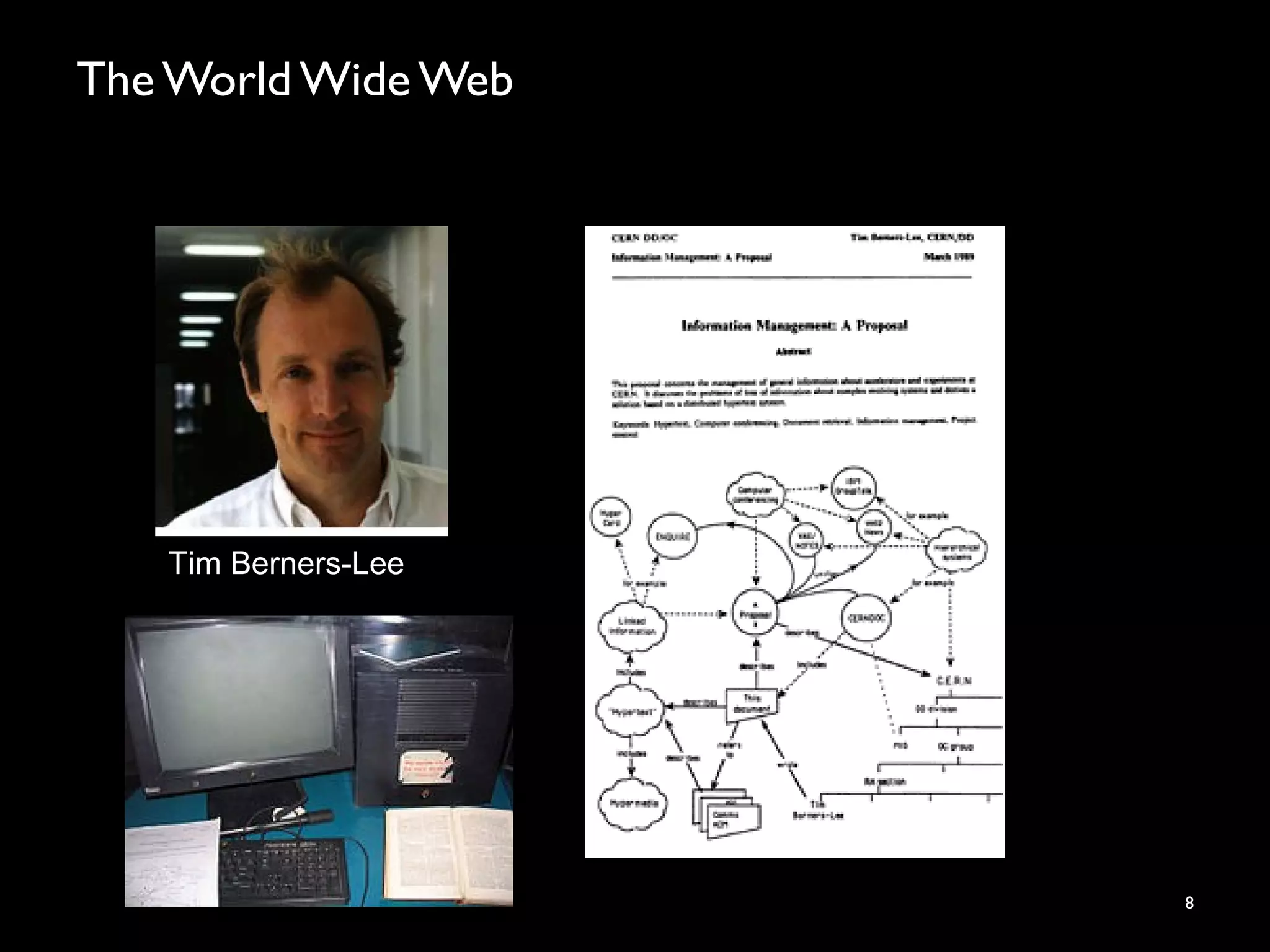
The World Wide Web
8
Tim Berners-Lee
Connectivity and information exchange was
(and is ) the main motivation behind the
Internet; but Content and Services are now
the key elements;
and all started growing rapidly by the
introduction of the World Wide Web (and
linked information and search and discovery
services).
9
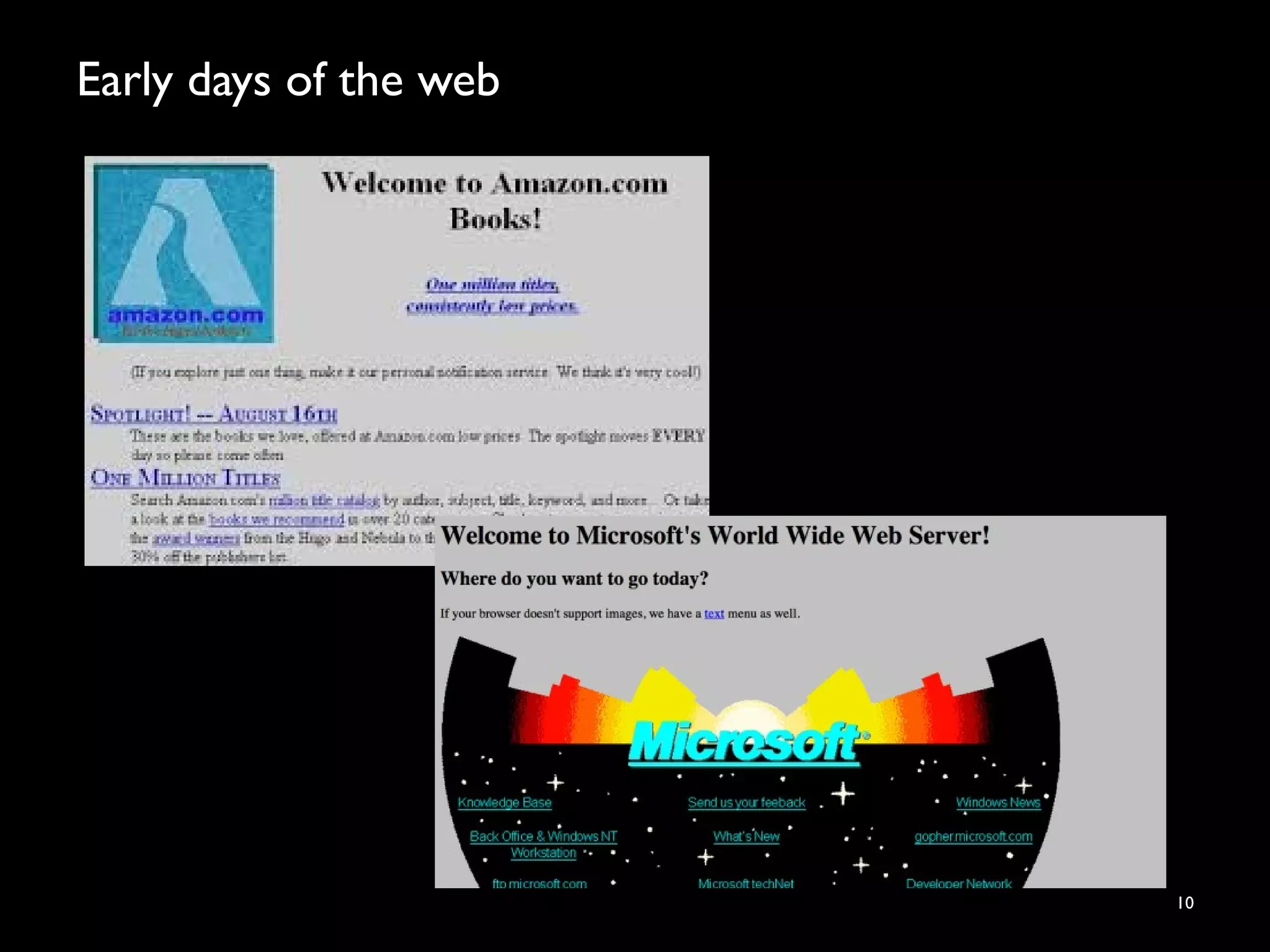
Early days of the web
10
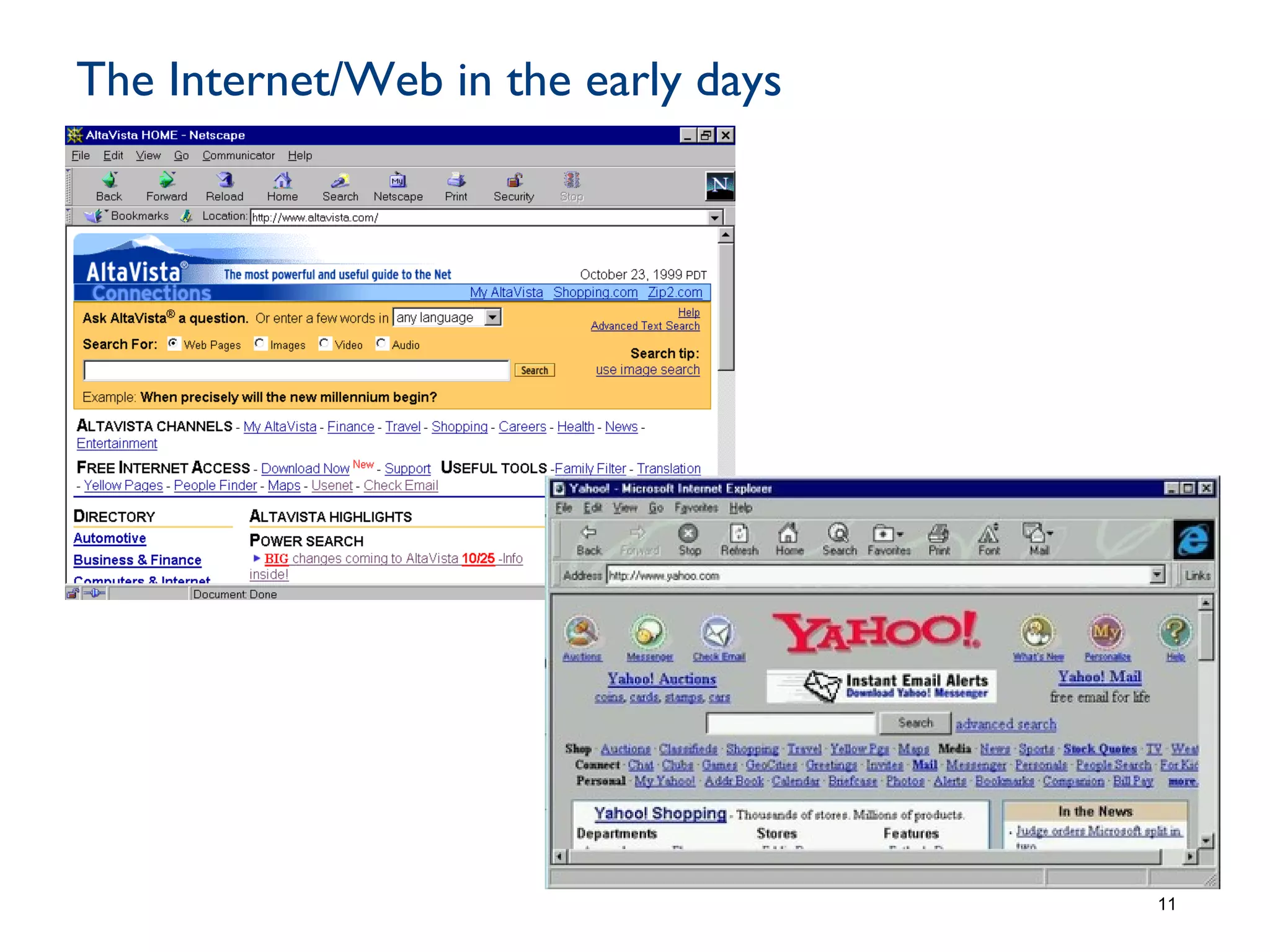
The Internet/Web in the early days
1111
Source: Intel, 2012
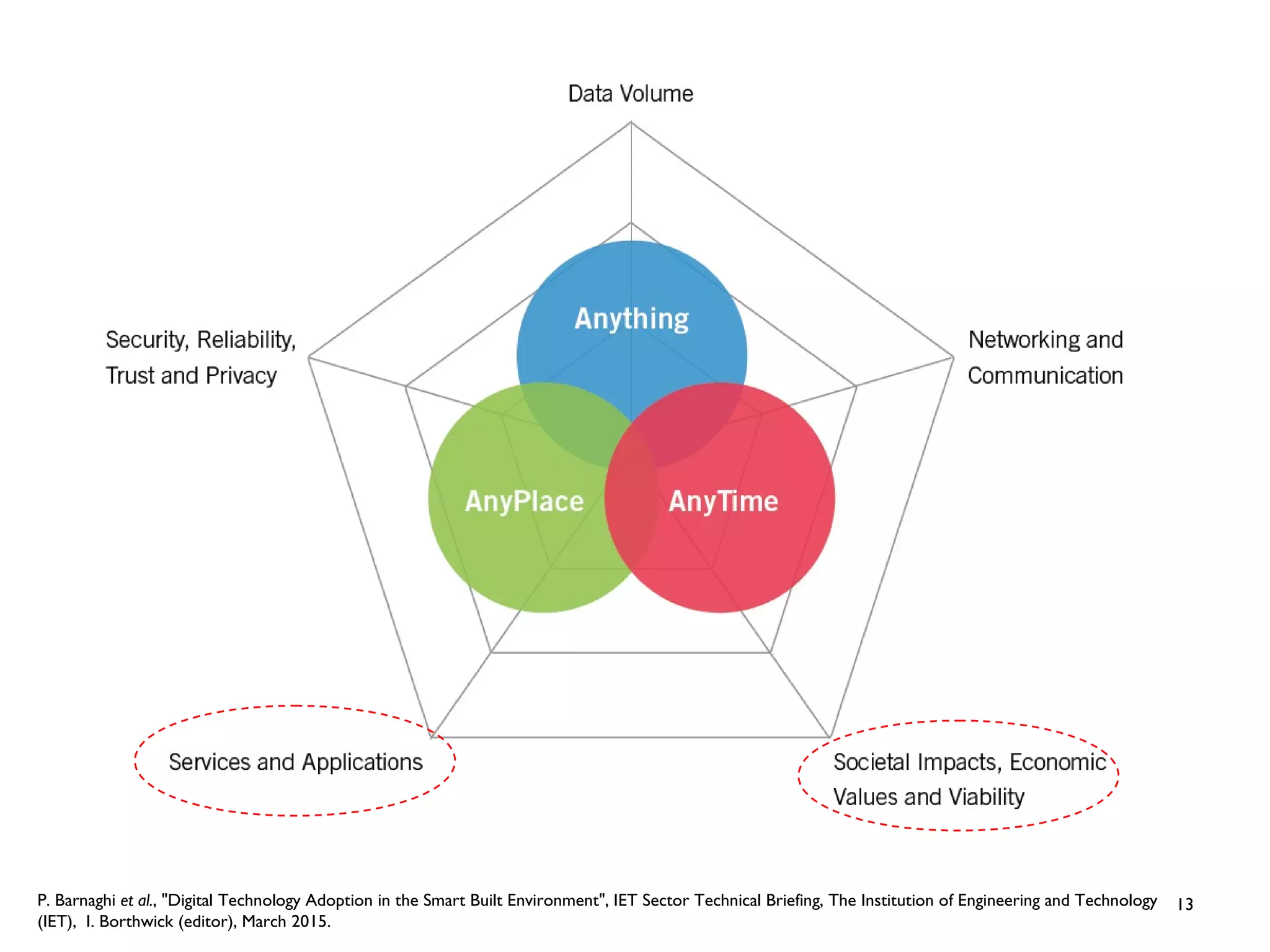
13P. Barnaghi et al., "Digital Technology Adoption in the Smart Built Environment", IET Sector Technical Briefing, The Institution of Engineering and Technology
(IET), I. Borthwick (editor), March 2015.
14
Sensor devices are becoming widely available
- Programmable devices
- Off-the-shelf gadgets/tools
Internet of Things: The story so far
RFID based
solutions
Wireless Sensor and
Actuator networks
, solutions for
communication
technologies, energy
efficiency, routing, …
Smart Devices/
Web-enabled
Apps/Services, initial
products,
vertical applications, early
concepts and demos, …
Motion sensor
Motion sensor
ECG sensor
Physical-Cyber-Social
Systems, Linked-data,
semantics, M2M,
More products, more
heterogeneity,
solutions for control and
monitoring, …
Future: Cloud, Big (IoT) Data
Analytics, Interoperability,
Enhanced Cellular/Wireless Com.
for IoT, Real-world operational
use-cases and Industry and B2B
services/applications,
more Standards…
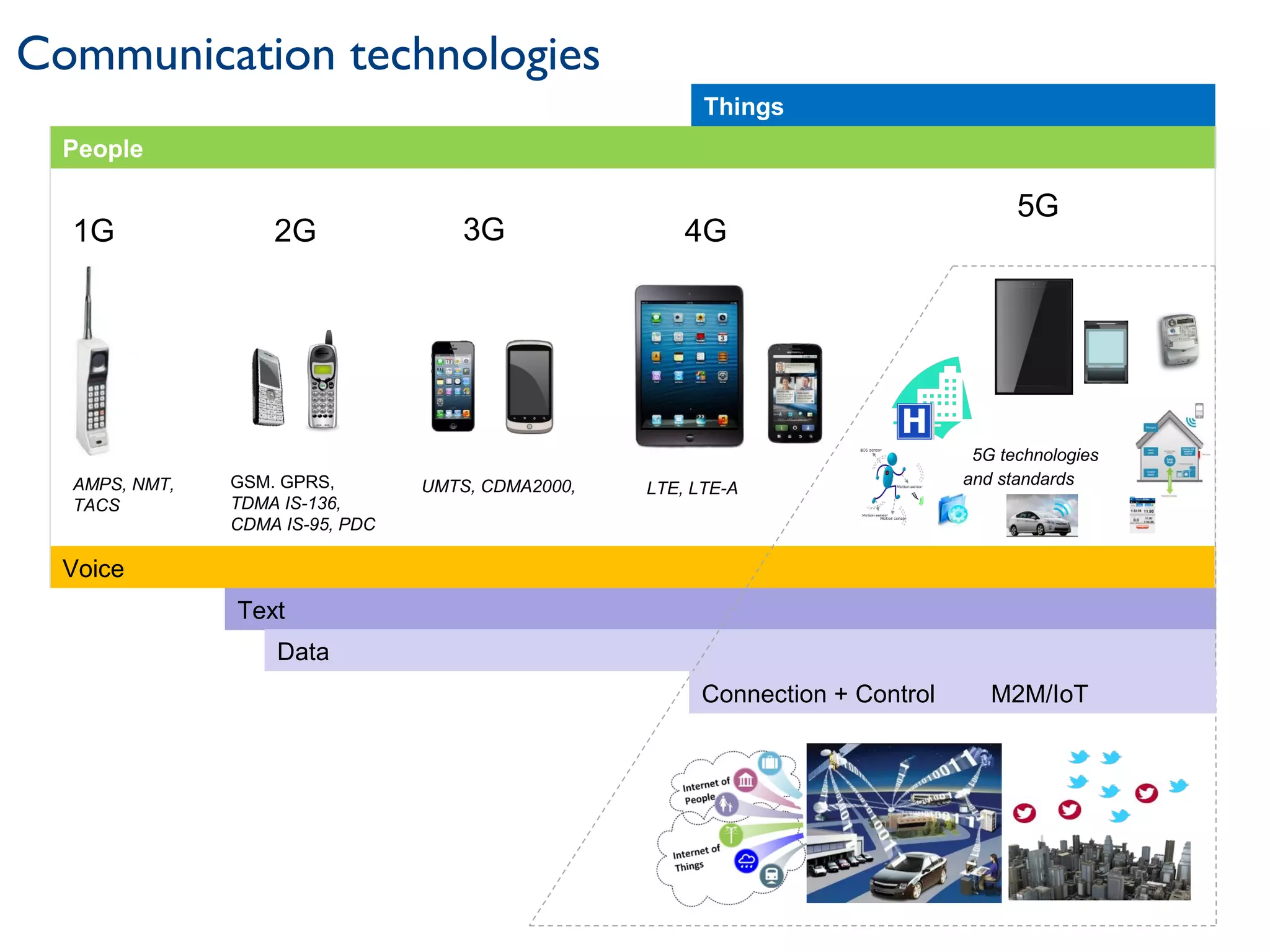
1G
AMPS, NMT,
TACS
2G
GSM. GPRS,
TDMA IS-136,
CDMA IS-95, PDC
3G
UMTS, CDMA2000,
4G
5G
LTE, LTE-A
People
Things
Voice
Text
Data
5G technologies
and standards
Connection + Control M2M/IoT
Communication technologies
5G –Vertical Applications
17
Image source: The Brain with David Eagleman, BBC
Speed of light?
The IoT is a dynamic, online and rapidly
changing world
18
Conventional (Big) Data Analytics
IoT Data Analytics
Image sources: ABC Australia and 2dolphins.com
Motion sensor
Motion sensor
ECG sensor
Live data
19
3D Map- Alexandra Institute, Aarhus, Denmark
Live events
20
Extracting city events
21
http://iot.ee.surrey.ac.uk/citypulse-social/
Nazli FarajiDavar, Payam Barnaghi, "A Deep Multi-View Learning Framework for City Event Extraction from Twitter Data Streams", submitted to ACM
Transactions on Intelligent Systems and Technology (TIST), Nov. 2015.
Medical/Health Data
− The average person is likely to generate more than one
million gigabytes of health-related data in their lifetime. This is
equivalent to 300 million books.
− Medical data is expected to double every 73 days by 2020.
− 80% of health data is invisible to current systems because it’s
unstructured.
− Less than 50% of medical decisions meet evidence-based
standards. (source: The rand corporation)
22Source: IBM Research
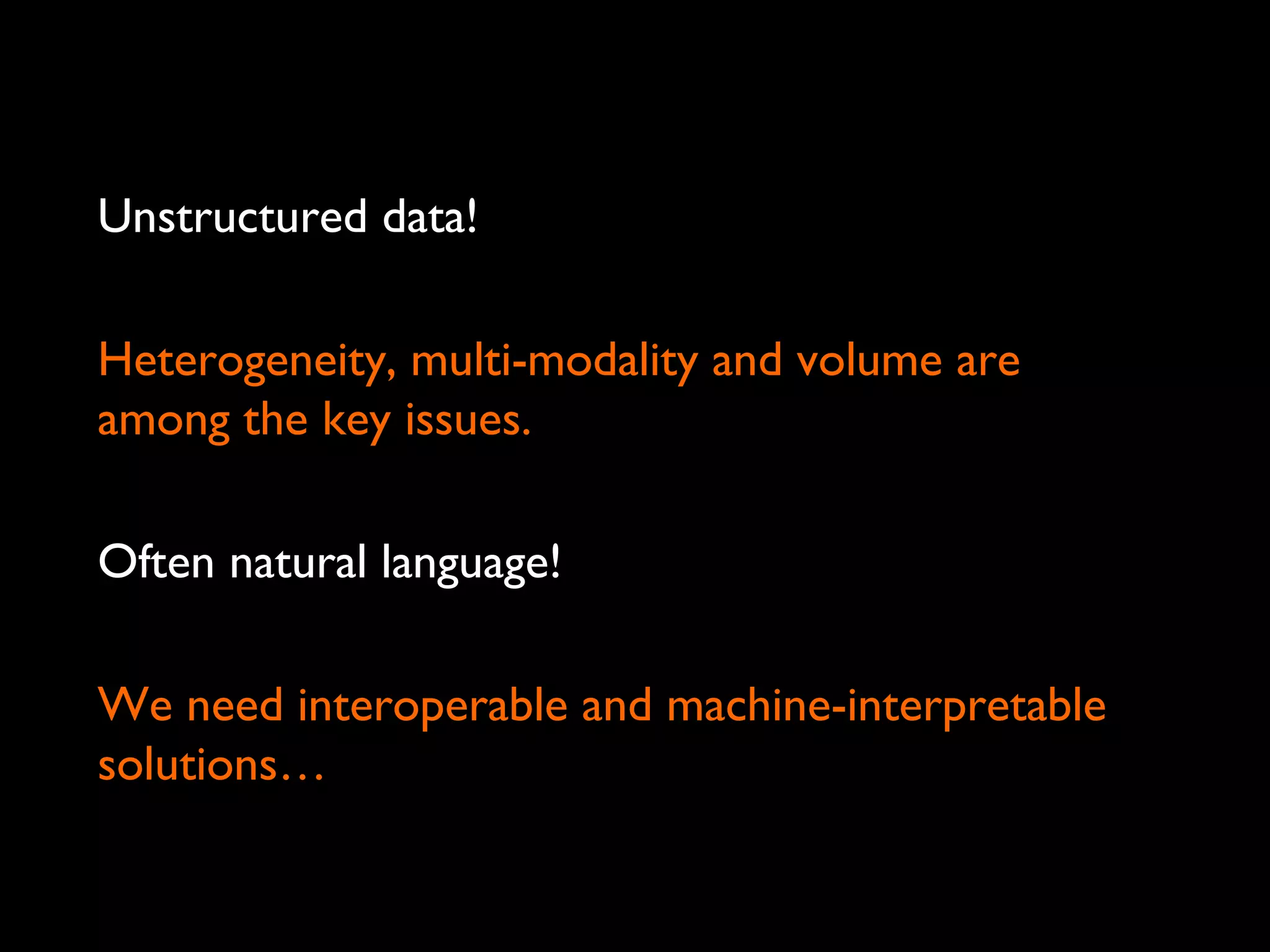
Unstructured data!
Heterogeneity, multi-modality and volume are
among the key issues.
Often natural language!
We need interoperable and machine-interpretable
solutions…
23
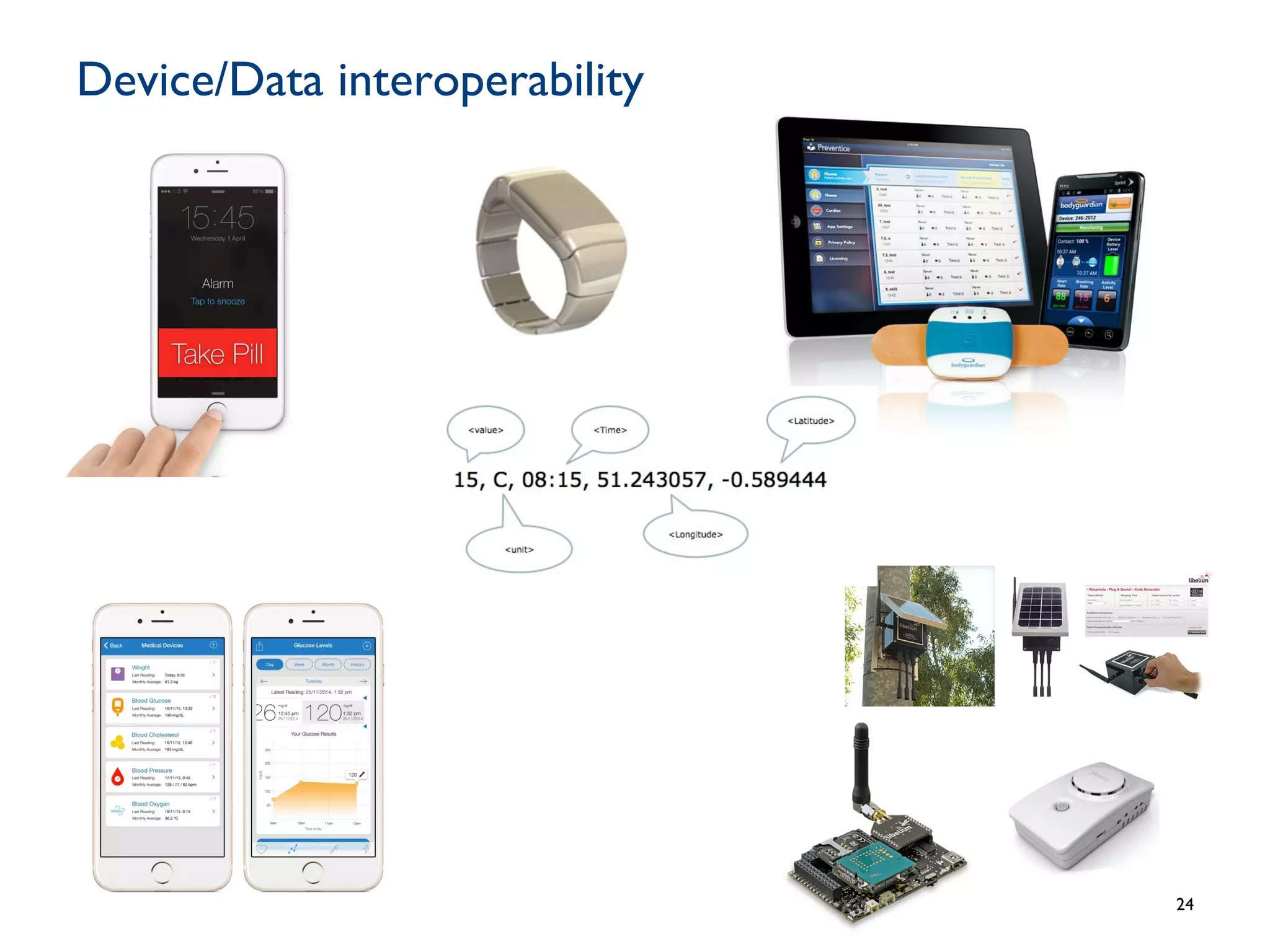
Device/Data interoperability
24
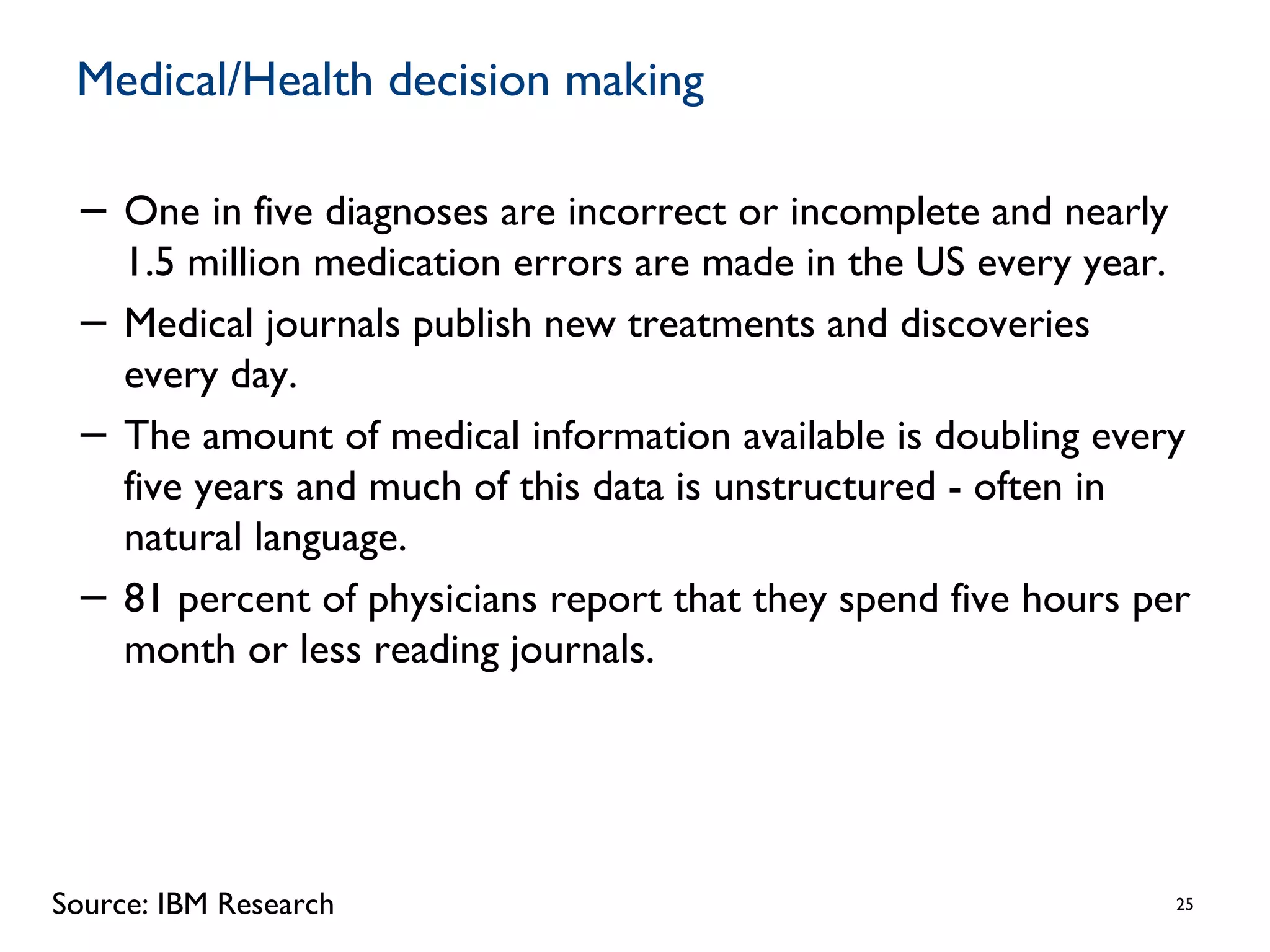
Medical/Health decision making
− One in five diagnoses are incorrect or incomplete and nearly
1.5 million medication errors are made in the US every year.
− Medical journals publish new treatments and discoveries
every day.
− The amount of medical information available is doubling every
five years and much of this data is unstructured - often in
natural language.
− 81 percent of physicians report that they spend five hours per
month or less reading journals.
25Source: IBM Research
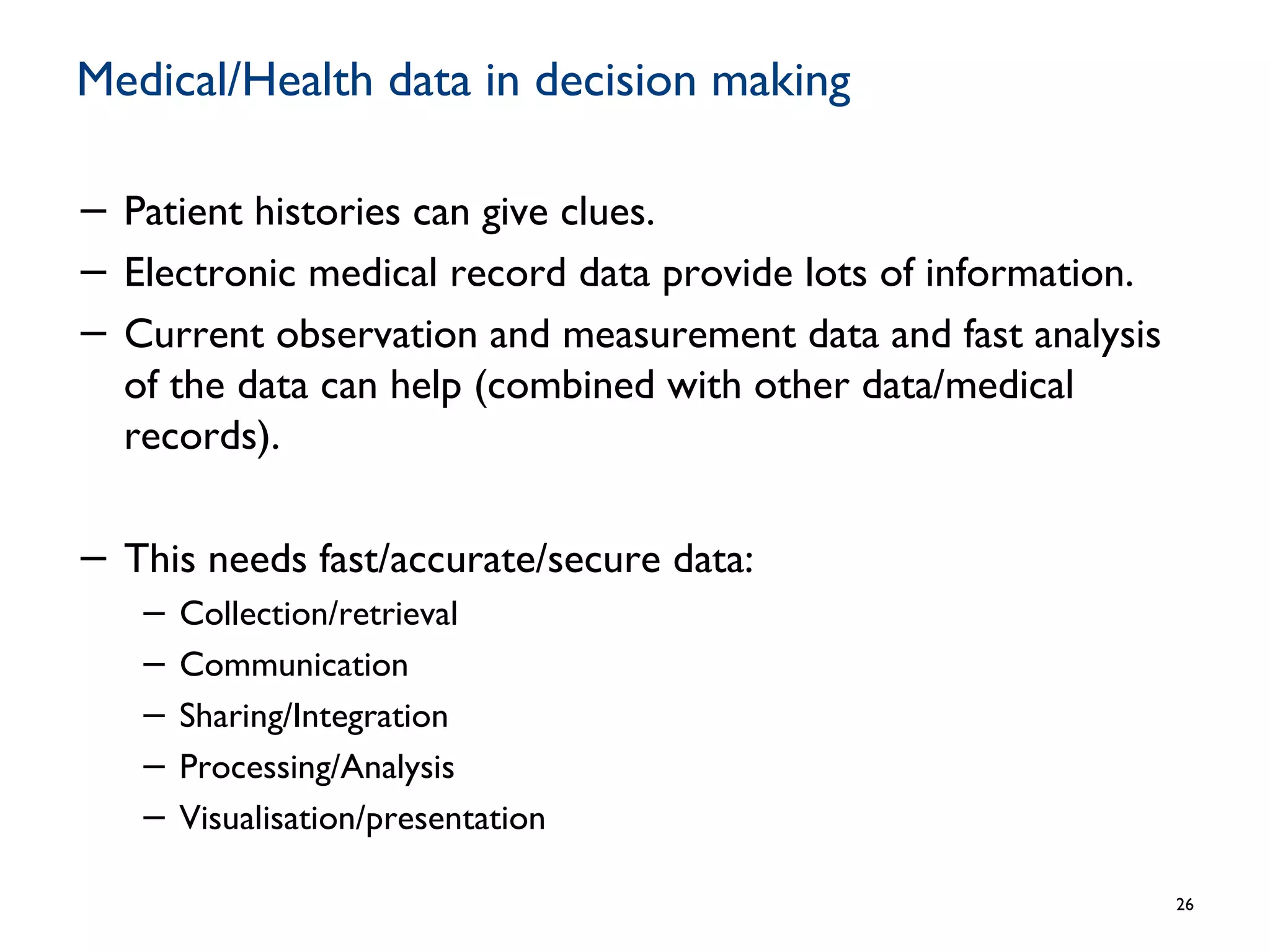
Medical/Health data in decision making
− Patient histories can give clues.
− Electronic medical record data provide lots of information.
− Current observation and measurement data and fast analysis
of the data can help (combined with other data/medical
records).
− This needs fast/accurate/secure data:
− Collection/retrieval
− Communication
− Sharing/Integration
− Processing/Analysis
− Visualisation/presentation
26
IBM Watson
27
Watson can process the patient data to find
relevant facts about family history, current
medications and other existing conditions.
It can combines this information with current
findings from tests and instruments and then
examines all available data sources to form
hypotheses and test them.
Watson can also incorporate treatment guidelines,
electronic medical record data, doctor's and
nurse's notes, research, clinical studies, journal
articles, and patient information into the data
available for analysis.
Source: IBM
Watson can read 40 million documents in 15 seconds.
Sensely
28
Source: http://sense.ly/
kHealth for Asthma
29
Source: Kno.e.sis, Wright State University
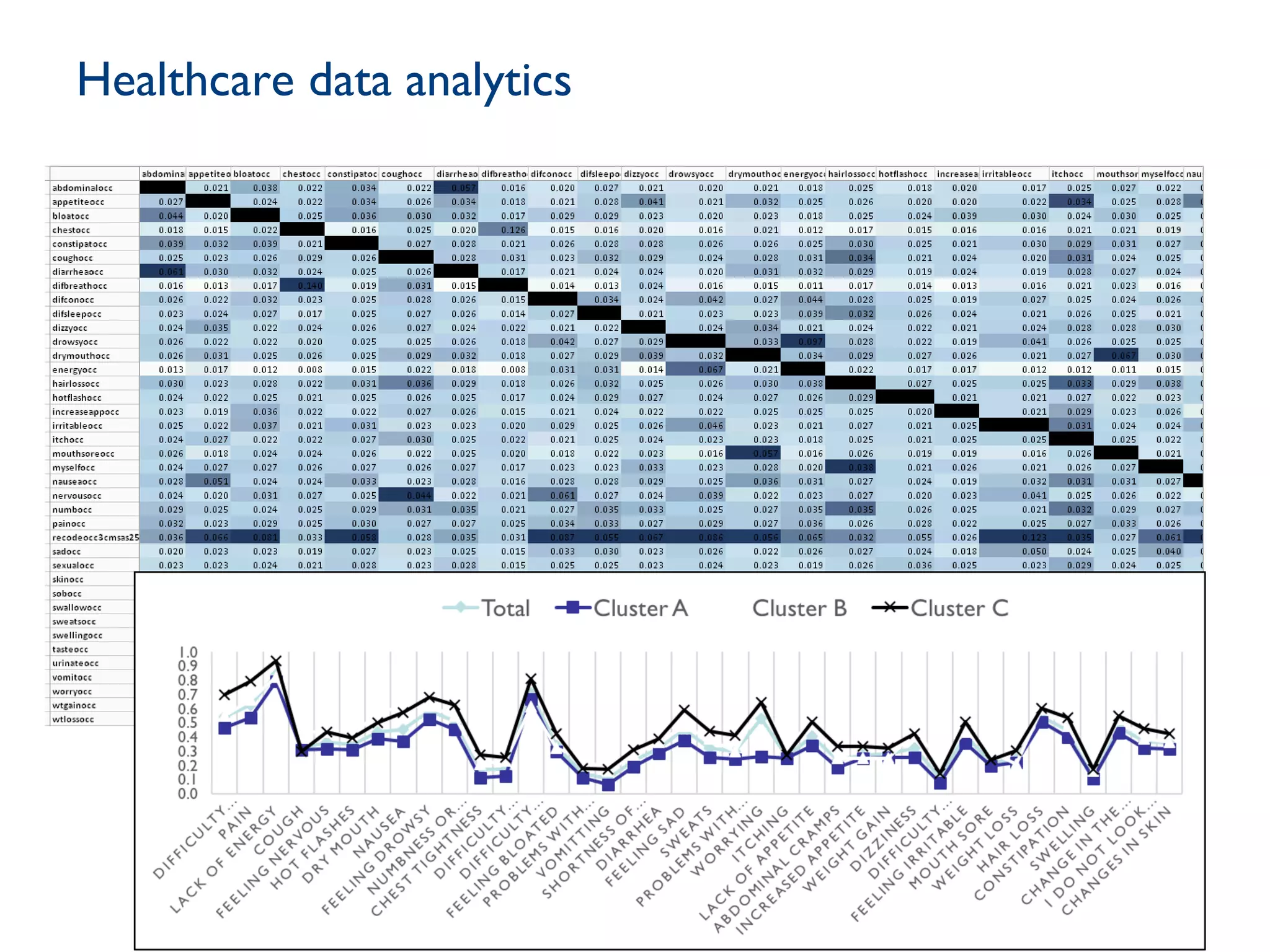
Healthcare data analytics
30
Technology Integrated Health
Management (TIHM)
31
Internet of Things testbed for healthcare
The Health Challenge: Dementia
 16,801 people with dementia in Surrey – set to rise to 19,000
by 2020 (estimated) - nationally 850,000 - estimated 1m by
2025 (Alzheimer’s Society)
 Estimated to cost £26bn p/a in the UK (Alzheimer’s Society):
health and social care (NHS and private) + unpaid care
 Devices in the IoT will provide actionable data on agitation,
mood, sleep, appetite, weight loss, anxiety and wandering – all
have a big impact on quality of life and wellbeing
TIHM
The Health Challenge: Falls
 Surrey spends £10m a year on fracture care – with 95% of hip
fractures caused by falls
 People with dementia suffer significantly higher fall rates that
cause injury – with falls the most common cause of injury-
related deaths in the over-75s
 Devices in the IoT will monitor location, activity and incident,
supporting health/care staff and carers, enabling early
intervention
TIHM
The Health Challenge: Carers
 5.4m carers supporting ill, older or disabled family members,
friends and partners in England - expected to rise by 40%
over the next 20 years.
 Value of such informal care estimated at £120bn a year – but
carer ‘burnout’ a key reason why loved ones require
admission to a care/nursing home.
 Devices in the IoT will support carers in their caring asks –
and support their own health and wellbeing.
TIHM
 Infrastructure
 Interoperability, integration
 Security
 Data governance
 Scalability
Technical Challenge
Innovation Partners
Nine companies with 25+ devices and services, including monitors, sensors,
apps, hubs, virtual assistants, location devices and wearables
Device/Data interoperability
37
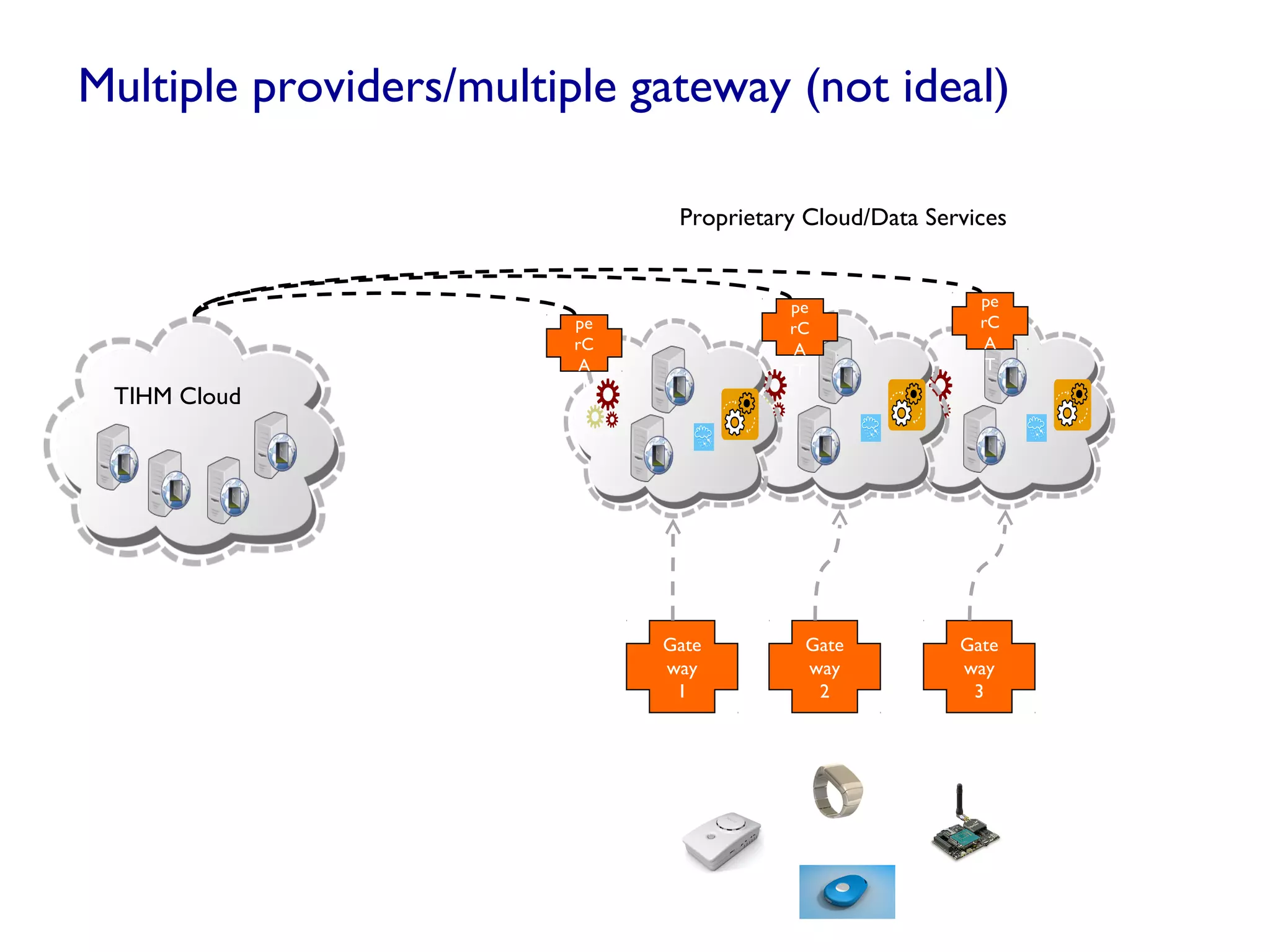
Gate
way
1
Gate
way
2
Gate
way
3
Proprietary Cloud/Data Services
TIHM Cloud
Hy
pe
rC
A
T
Hy
pe
rC
A
T
Hy
pe
rC
A
T
Multiple providers/multiple gateway (not ideal)
TIHM Middleware
Connectivity/Device Association Layer
Data Exchange/Interoperability Layer
Service/Application Layer
Blue
toot
h
WiFI
ZigB
EE
TIHM Cloud
Hyp
erC
AT
RES
T
API
Proprietary
Cloud/Data
Services Hy
pe
rC
AT
Hy
pe
rC
AT
40
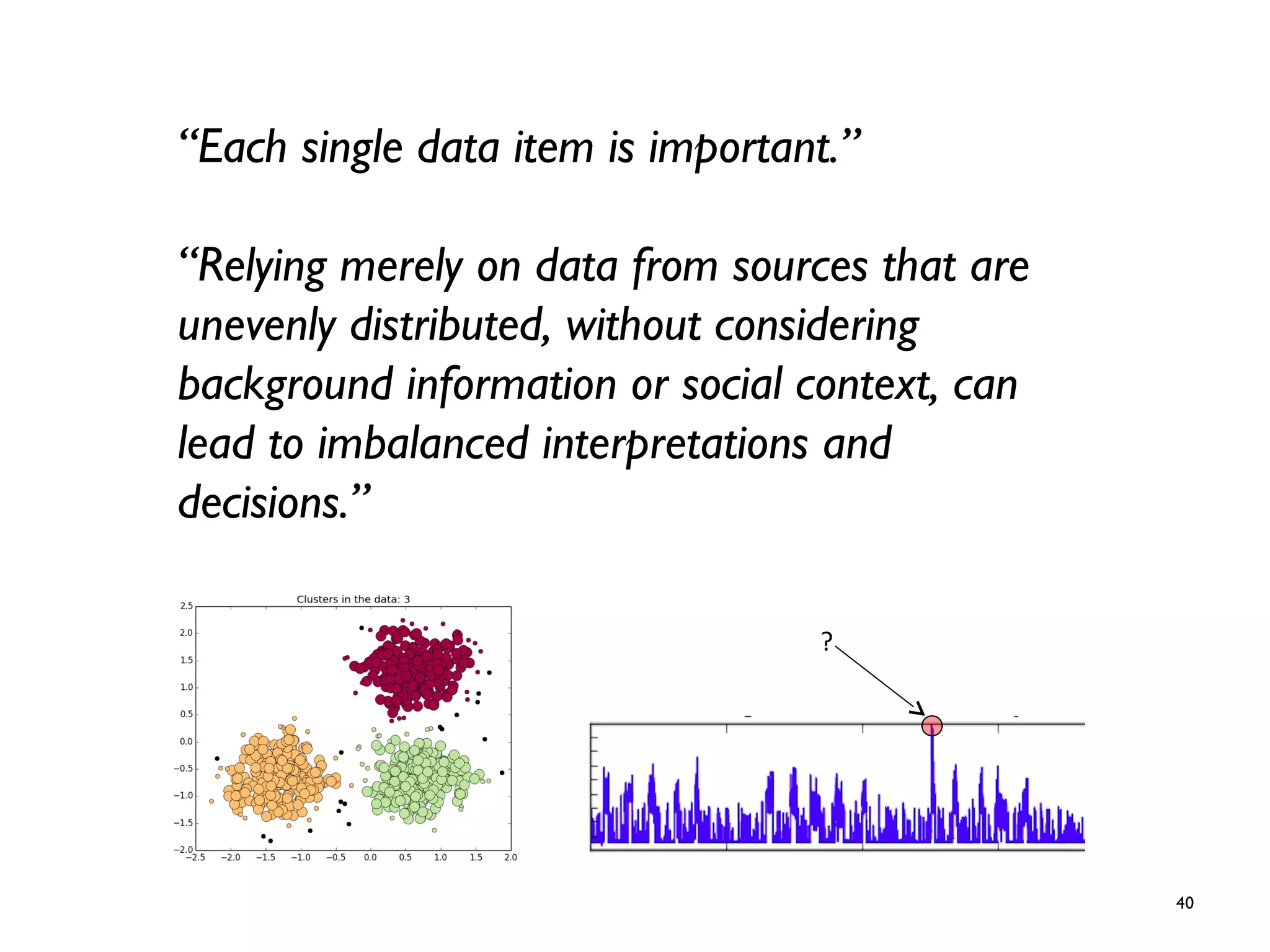
“Each single data item is important.”
“Relying merely on data from sources that are
unevenly distributed, without considering
background information or social context, can
lead to imbalanced interpretations and
decisions.”
?
KAT- Knowledge Acquisition Toolkit
http://kat.ee.surrey.ac.uk/
F. Ganz, D. Puschmann, P. Barnaghi, F. Carrez, "A Practical Evaluation of Information Processing and Abstraction Techniques for the Internet of
Things", IEEE Internet of Things Journal, 2015.
41
https://github.com/UniSurreyIoT/KAT
Gateway
Gatewa
y
Data Analytics
Engine
IoT Test Bed Cloud
External NHS, GP IT systems
Possible links to
Other Test Beds
HyperCat
Gateway
HyperCat
HyperCat
HyperCat
Data-driven and patient
centered Healthcare
Applications
TIHM Testbed Architecture
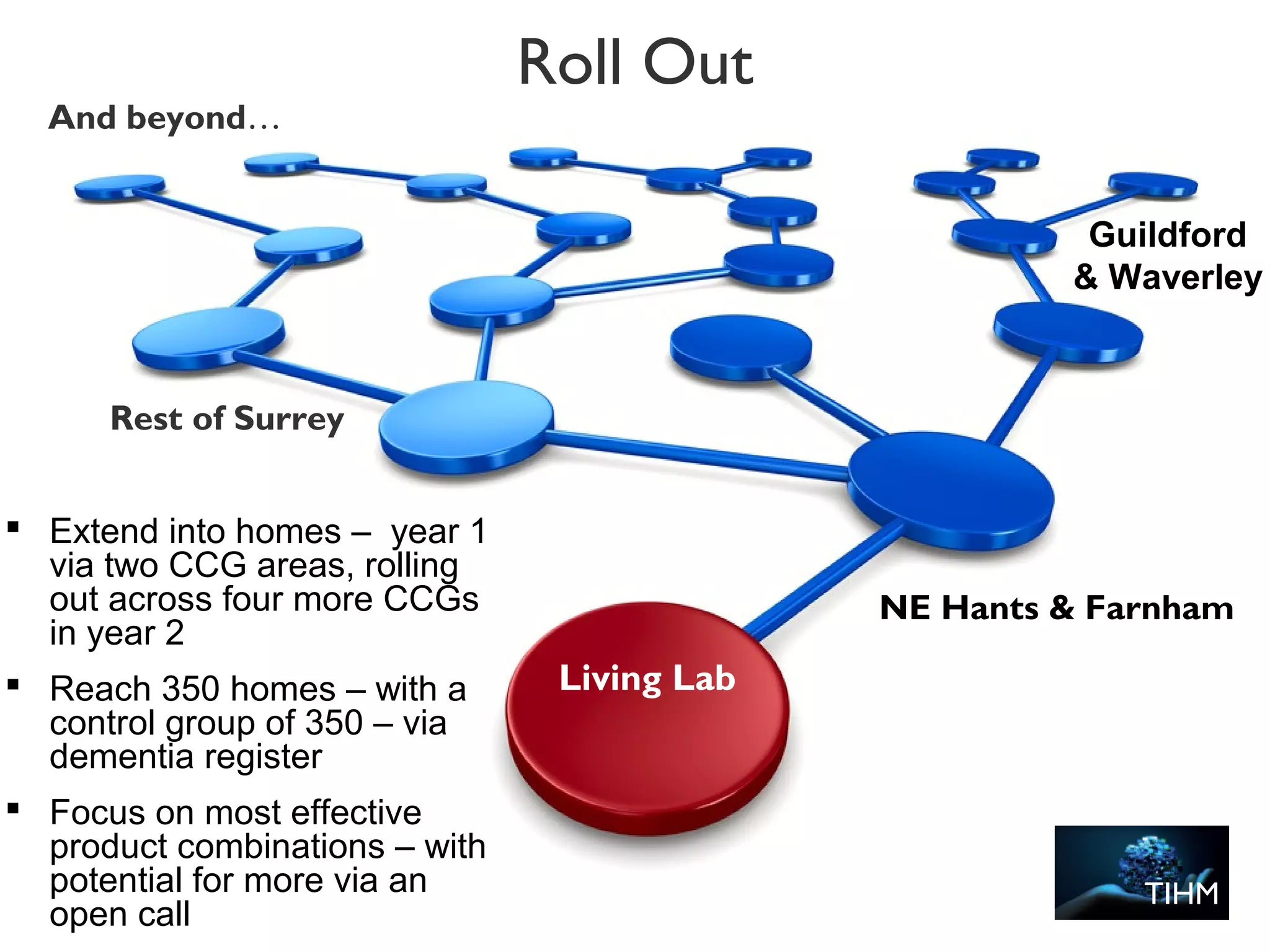
 Extend into homes – year 1
via two CCG areas, rolling
out across four more CCGs
in year 2
 Reach 350 homes – with a
control group of 350 – via
dementia register
 Focus on most effective
product combinations – with
potential for more via an
open call
Roll Out
NE Hants & Farnham
Living Lab
Guildford
& Waverley
Rest of Surrey
And beyond…
TIHM
In Conclusion
− Great opportunities and many applications;
− Enhanced and (near-) real-time insights;
− Supporting more automated decision making and in-depth
analysis of events and occurrences by combining various
sources of data;
− Providing more and better information to citizens;
− Citizens in control
− Transparency and data management issues (privacy, security,
trust, …)
− Reliability and dependability of the systems
45
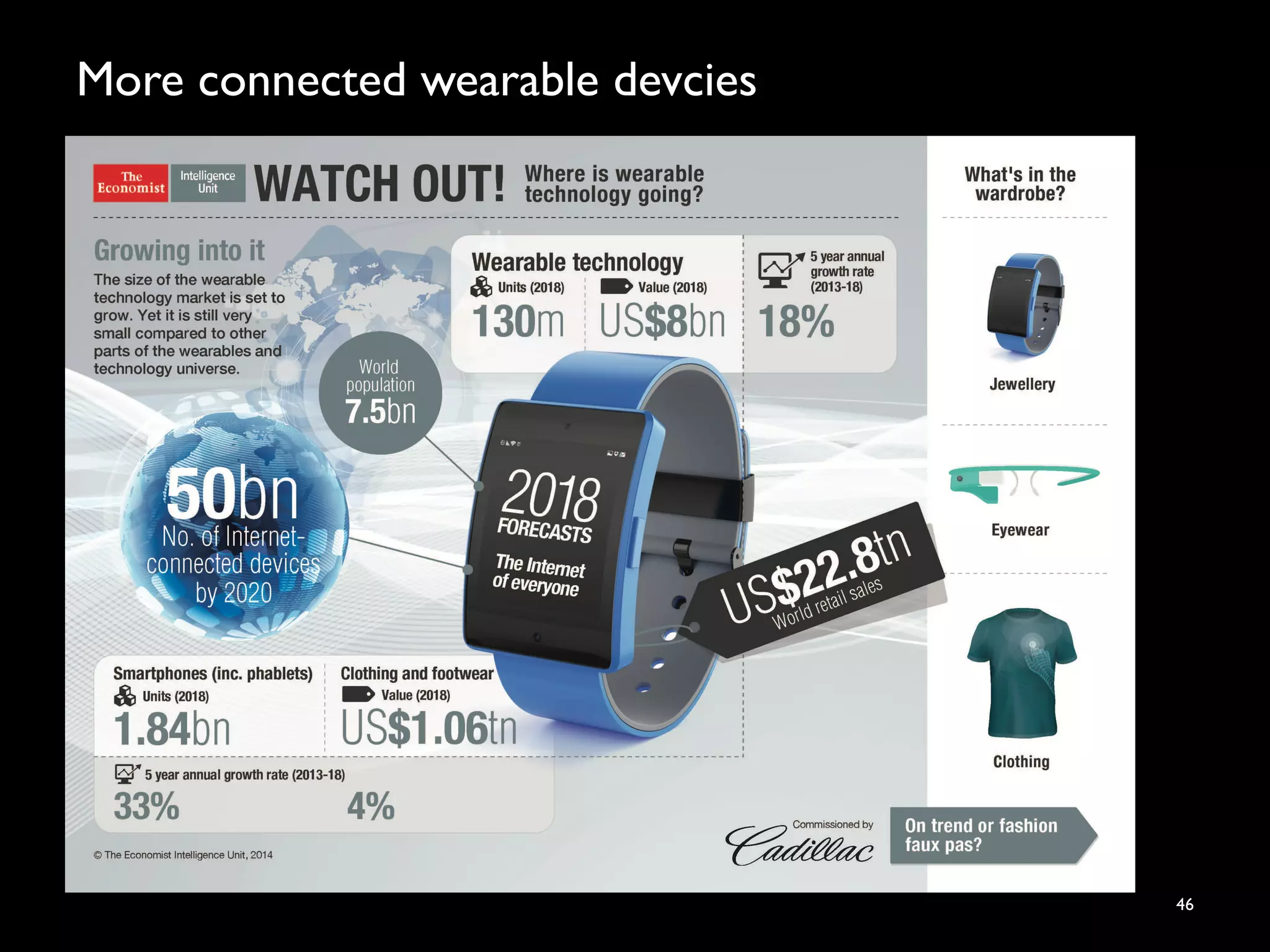
More connected wearable devcies
46
Boundary between human, technology and devices
47
Cognitive systems era
48
connected and intelligent systems
Accumulated and connected knowledge?
49
Image courtesy: IEEE Spectrum
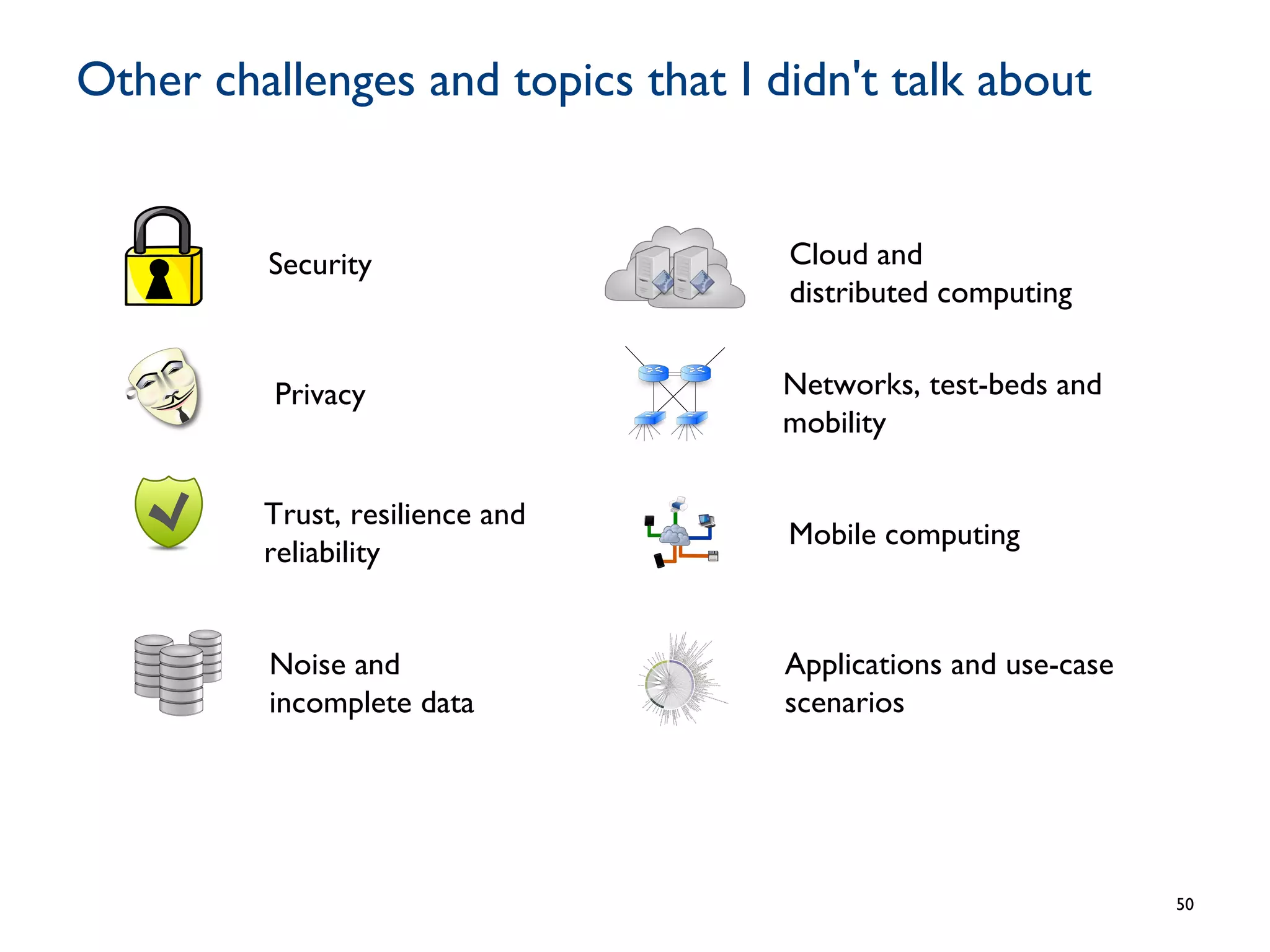
Other challenges and topics that I didn't talk about
Security
Privacy
Trust, resilience and
reliability
Noise and
incomplete data
Cloud and
distributed computing
Networks, test-beds and
mobility
Mobile computing
Applications and use-case
scenarios
50
Q&A
− Thank you.
http://personal.ee.surrey.ac.uk/Personal/P.Barnaghi/
@pbarnaghi
p.barnaghi@surrey.ac.uk
http://www.sabp.nhs.uk/tihm

The Future is Cyber-Healthcare

  • 1.
    The Future isCyber-Healthcare 1 Payam Barnaghi Institute for Communication Systems (ICS)/ 5G Innovation Centre University of Surrey Guildford, United Kingdom
  • 2.
    The Future isCyber-Healthcare?
  • 3.
    3 IBM Mainframe 360,source Wikipedia
  • 4.
    Apollo 11 CommandModule (1965) had 64 kilobytes of memory operated at 0.043MHz. An iPhone 5s has a CPU running at speeds of up to 1.3GHz and has 512MB to 1GB of memory Cray-1 (1975) produced 80 million Floating point operations per second (FLOPS) 10 years later, Cray-2 produced 1.9G FLOPS An iPhone 5s produces 76.8 GFLOPS – nearly a thousand times more Cray-2 used 200-kilowatt power Source: Nick T., PhoneArena.com, 2014 image source: http://blog.opower.com/
  • 5.
    Computing Power 5 −Smaller size −MorePowerful −More memory and more storage −"Moore's law" over the history of computing, the number of transistors in a dense integrated circuit has doubled approximately every two years.
  • 6.
    Smaller in sizebut larger in scale 6
  • 7.
    The old Internettimeline 7Source: Internet Society
  • 8.
    The World WideWeb 8 Tim Berners-Lee
  • 9.
    Connectivity and informationexchange was (and is ) the main motivation behind the Internet; but Content and Services are now the key elements; and all started growing rapidly by the introduction of the World Wide Web (and linked information and search and discovery services). 9
  • 10.
    Early days ofthe web 10
  • 11.
    The Internet/Web inthe early days 1111
  • 12.
  • 13.
    13P. Barnaghi etal., "Digital Technology Adoption in the Smart Built Environment", IET Sector Technical Briefing, The Institution of Engineering and Technology (IET), I. Borthwick (editor), March 2015.
  • 14.
    14 Sensor devices arebecoming widely available - Programmable devices - Off-the-shelf gadgets/tools
  • 15.
    Internet of Things:The story so far RFID based solutions Wireless Sensor and Actuator networks , solutions for communication technologies, energy efficiency, routing, … Smart Devices/ Web-enabled Apps/Services, initial products, vertical applications, early concepts and demos, … Motion sensor Motion sensor ECG sensor Physical-Cyber-Social Systems, Linked-data, semantics, M2M, More products, more heterogeneity, solutions for control and monitoring, … Future: Cloud, Big (IoT) Data Analytics, Interoperability, Enhanced Cellular/Wireless Com. for IoT, Real-world operational use-cases and Industry and B2B services/applications, more Standards…
  • 16.
    1G AMPS, NMT, TACS 2G GSM. GPRS, TDMAIS-136, CDMA IS-95, PDC 3G UMTS, CDMA2000, 4G 5G LTE, LTE-A People Things Voice Text Data 5G technologies and standards Connection + Control M2M/IoT Communication technologies
  • 17.
    5G –Vertical Applications 17 Imagesource: The Brain with David Eagleman, BBC Speed of light?
  • 18.
    The IoT isa dynamic, online and rapidly changing world 18 Conventional (Big) Data Analytics IoT Data Analytics Image sources: ABC Australia and 2dolphins.com Motion sensor Motion sensor ECG sensor
  • 19.
    Live data 19 3D Map-Alexandra Institute, Aarhus, Denmark
  • 20.
  • 21.
    Extracting city events 21 http://iot.ee.surrey.ac.uk/citypulse-social/ NazliFarajiDavar, Payam Barnaghi, "A Deep Multi-View Learning Framework for City Event Extraction from Twitter Data Streams", submitted to ACM Transactions on Intelligent Systems and Technology (TIST), Nov. 2015.
  • 22.
    Medical/Health Data − Theaverage person is likely to generate more than one million gigabytes of health-related data in their lifetime. This is equivalent to 300 million books. − Medical data is expected to double every 73 days by 2020. − 80% of health data is invisible to current systems because it’s unstructured. − Less than 50% of medical decisions meet evidence-based standards. (source: The rand corporation) 22Source: IBM Research
  • 23.
    Unstructured data! Heterogeneity, multi-modalityand volume are among the key issues. Often natural language! We need interoperable and machine-interpretable solutions… 23
  • 24.
  • 25.
    Medical/Health decision making −One in five diagnoses are incorrect or incomplete and nearly 1.5 million medication errors are made in the US every year. − Medical journals publish new treatments and discoveries every day. − The amount of medical information available is doubling every five years and much of this data is unstructured - often in natural language. − 81 percent of physicians report that they spend five hours per month or less reading journals. 25Source: IBM Research
  • 26.
    Medical/Health data indecision making − Patient histories can give clues. − Electronic medical record data provide lots of information. − Current observation and measurement data and fast analysis of the data can help (combined with other data/medical records). − This needs fast/accurate/secure data: − Collection/retrieval − Communication − Sharing/Integration − Processing/Analysis − Visualisation/presentation 26
  • 27.
    IBM Watson 27 Watson canprocess the patient data to find relevant facts about family history, current medications and other existing conditions. It can combines this information with current findings from tests and instruments and then examines all available data sources to form hypotheses and test them. Watson can also incorporate treatment guidelines, electronic medical record data, doctor's and nurse's notes, research, clinical studies, journal articles, and patient information into the data available for analysis. Source: IBM Watson can read 40 million documents in 15 seconds.
  • 28.
  • 29.
    kHealth for Asthma 29 Source:Kno.e.sis, Wright State University
  • 30.
  • 31.
    Technology Integrated Health Management(TIHM) 31 Internet of Things testbed for healthcare
  • 32.
    The Health Challenge:Dementia  16,801 people with dementia in Surrey – set to rise to 19,000 by 2020 (estimated) - nationally 850,000 - estimated 1m by 2025 (Alzheimer’s Society)  Estimated to cost £26bn p/a in the UK (Alzheimer’s Society): health and social care (NHS and private) + unpaid care  Devices in the IoT will provide actionable data on agitation, mood, sleep, appetite, weight loss, anxiety and wandering – all have a big impact on quality of life and wellbeing TIHM
  • 33.
    The Health Challenge:Falls  Surrey spends £10m a year on fracture care – with 95% of hip fractures caused by falls  People with dementia suffer significantly higher fall rates that cause injury – with falls the most common cause of injury- related deaths in the over-75s  Devices in the IoT will monitor location, activity and incident, supporting health/care staff and carers, enabling early intervention TIHM
  • 34.
    The Health Challenge:Carers  5.4m carers supporting ill, older or disabled family members, friends and partners in England - expected to rise by 40% over the next 20 years.  Value of such informal care estimated at £120bn a year – but carer ‘burnout’ a key reason why loved ones require admission to a care/nursing home.  Devices in the IoT will support carers in their caring asks – and support their own health and wellbeing. TIHM
  • 35.
     Infrastructure  Interoperability,integration  Security  Data governance  Scalability Technical Challenge
  • 36.
    Innovation Partners Nine companieswith 25+ devices and services, including monitors, sensors, apps, hubs, virtual assistants, location devices and wearables
  • 37.
  • 38.
    Gate way 1 Gate way 2 Gate way 3 Proprietary Cloud/Data Services TIHMCloud Hy pe rC A T Hy pe rC A T Hy pe rC A T Multiple providers/multiple gateway (not ideal)
  • 39.
    TIHM Middleware Connectivity/Device AssociationLayer Data Exchange/Interoperability Layer Service/Application Layer Blue toot h WiFI ZigB EE TIHM Cloud Hyp erC AT RES T API Proprietary Cloud/Data Services Hy pe rC AT Hy pe rC AT
  • 40.
    40 “Each single dataitem is important.” “Relying merely on data from sources that are unevenly distributed, without considering background information or social context, can lead to imbalanced interpretations and decisions.” ?
  • 41.
    KAT- Knowledge AcquisitionToolkit http://kat.ee.surrey.ac.uk/ F. Ganz, D. Puschmann, P. Barnaghi, F. Carrez, "A Practical Evaluation of Information Processing and Abstraction Techniques for the Internet of Things", IEEE Internet of Things Journal, 2015. 41 https://github.com/UniSurreyIoT/KAT
  • 42.
    Gateway Gatewa y Data Analytics Engine IoT TestBed Cloud External NHS, GP IT systems Possible links to Other Test Beds HyperCat Gateway HyperCat HyperCat HyperCat Data-driven and patient centered Healthcare Applications TIHM Testbed Architecture
  • 44.
     Extend intohomes – year 1 via two CCG areas, rolling out across four more CCGs in year 2  Reach 350 homes – with a control group of 350 – via dementia register  Focus on most effective product combinations – with potential for more via an open call Roll Out NE Hants & Farnham Living Lab Guildford & Waverley Rest of Surrey And beyond… TIHM
  • 45.
    In Conclusion − Greatopportunities and many applications; − Enhanced and (near-) real-time insights; − Supporting more automated decision making and in-depth analysis of events and occurrences by combining various sources of data; − Providing more and better information to citizens; − Citizens in control − Transparency and data management issues (privacy, security, trust, …) − Reliability and dependability of the systems 45
  • 46.
  • 47.
    Boundary between human,technology and devices 47
  • 48.
    Cognitive systems era 48 connectedand intelligent systems
  • 49.
    Accumulated and connectedknowledge? 49 Image courtesy: IEEE Spectrum
  • 50.
    Other challenges andtopics that I didn't talk about Security Privacy Trust, resilience and reliability Noise and incomplete data Cloud and distributed computing Networks, test-beds and mobility Mobile computing Applications and use-case scenarios 50
  • 51.

Editor's Notes

  • #36 We need to make the project more than the sum of its parts - blue tooth, cellular, mobile, 4G and 5G technologies – bringing together/integrating an array of devices from innovative companies Build a technical infrastructure and create a virtual healthcare system Integrate devices to combine their impact and provide actionable information through communication, data and semantic interoperability and open APIs, all tested in a Living Lab Security – test the integrity of the hardware, software, communication channels, databases etc Governance – processes in place to ensure privacy and best practice Scalability – extend into people’s homes in a phased approach throughout Surrey and, potentially, much further afield
  • #37 Will combine a variety of technologies and devices into the test bed in new ways