
The Internet of Things: What’s
next?
1
Payam Barnaghi
Institute for Communication Systems (ICS)/
5G Innovation Centre
University of Surrey
Guildford, United Kingdom
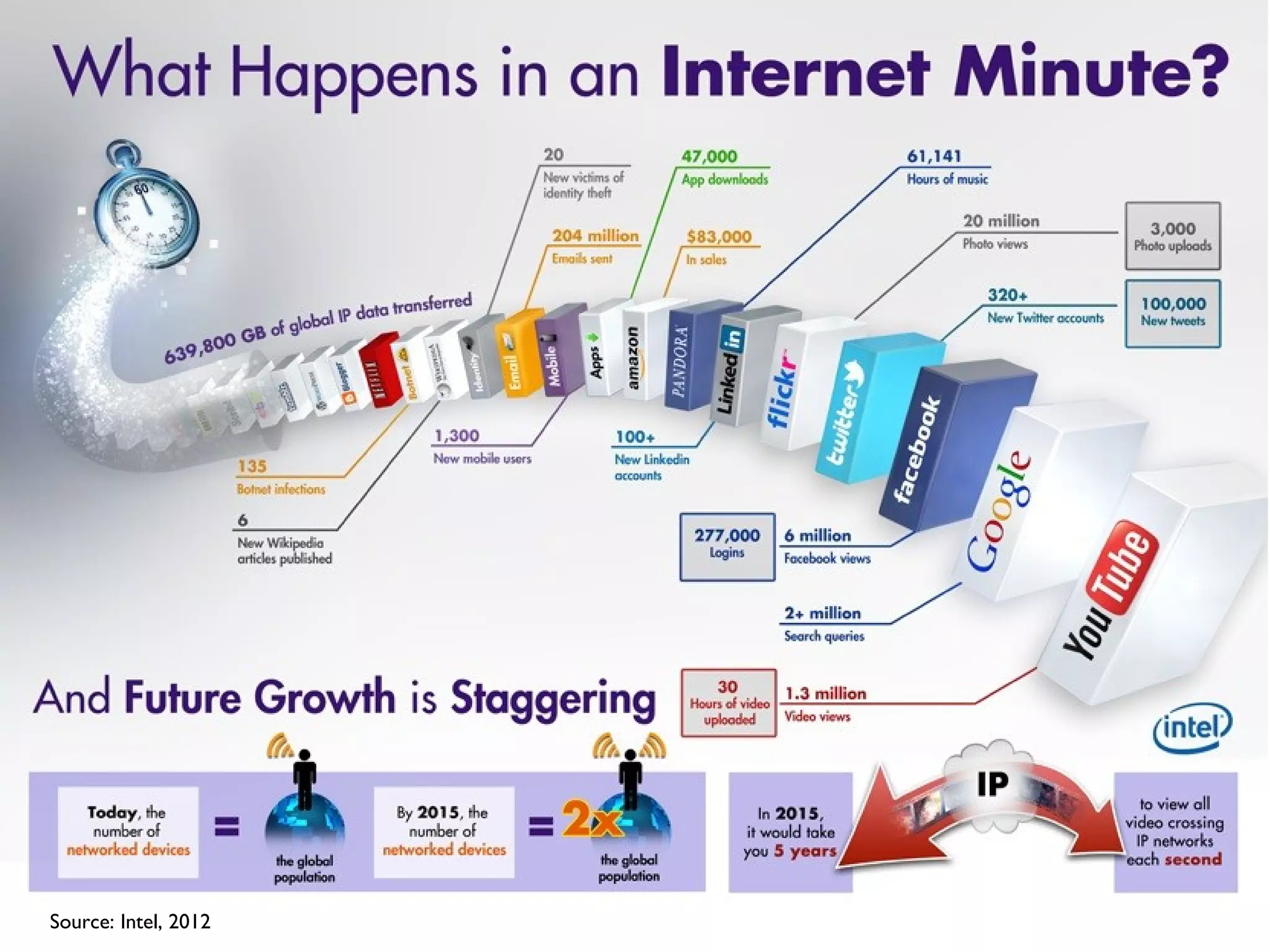
Source: Intel, 2012
3
AnyPlace AnyTime
AnyThing
Data Volume
Security, Reliability,
Trust and Privacy
Societal Impacts, Economic Values
and Viability
Services and Applications
Networking and
Communication
4
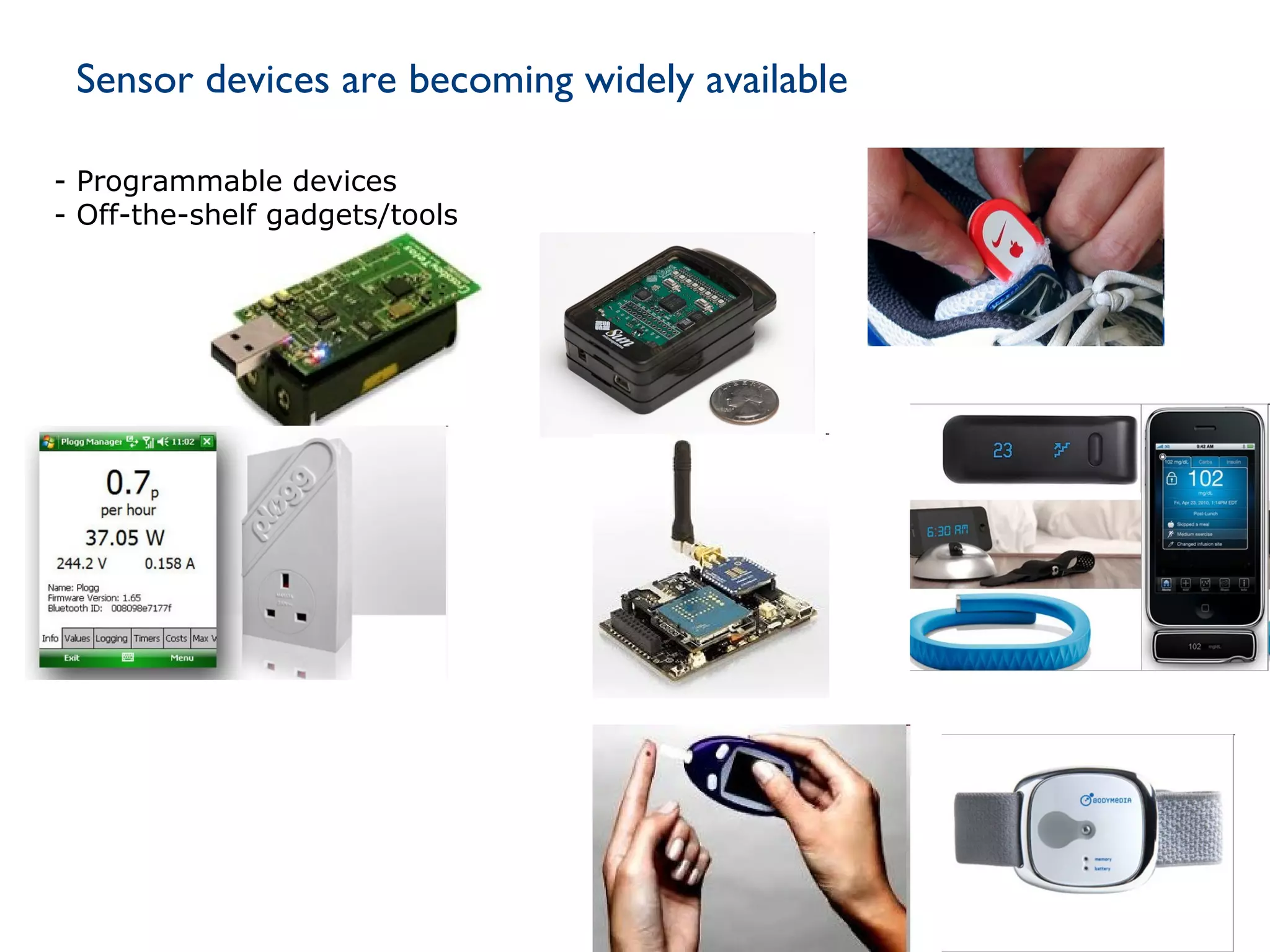
Sensor devices are becoming widely available
- Programmable devices
- Off-the-shelf gadgets/tools
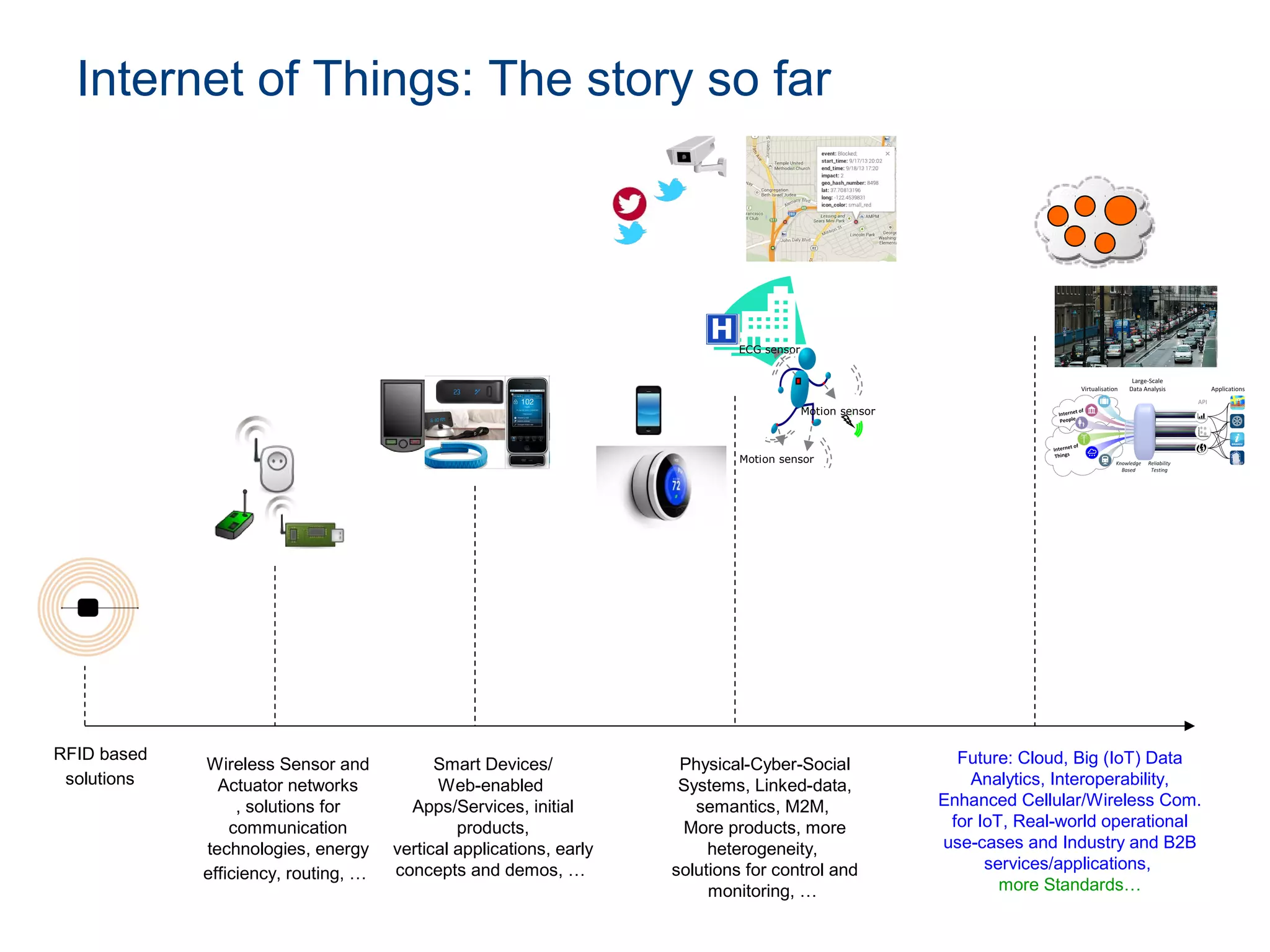
Internet of Things: The story so far
RFID based
solutions
Wireless Sensor and
Actuator networks
, solutions for
communication
technologies, energy
efficiency, routing, …
Smart Devices/
Web-enabled
Apps/Services, initial
products,
vertical applications, early
concepts and demos, …
Motion sensor
Motion sensor
ECG sensor
Physical-Cyber-Social
Systems, Linked-data,
semantics, M2M,
More products, more
heterogeneity,
solutions for control and
monitoring, …
Future: Cloud, Big (IoT) Data
Analytics, Interoperability,
Enhanced Cellular/Wireless Com.
for IoT, Real-world operational
use-cases and Industry and B2B
services/applications,
more Standards…
Speed of light?
6
Image source: The Brain with David Eagleman, BBC
Data in the IoT
− Data is collected by sensory devices and also crowd sensing
resources.
− It is time and location dependent.
− It can be noisy and the quality can vary.
− It is often continuous - streaming data.
− There are several important issues such as:
− Device/network management
− Actuation and feedback (command and control)
− Service and entity descriptions.
IoT data- challenges
− Multi-modal, distributed and heterogeneous
− Noisy and incomplete
− Time and location dependent
− Dynamic and varies in quality
− Crowdsourced data can be unreliable
− Requires (near-) real-time analysis
− Privacy and security are important issues
− Data can be biased- we need to know our data!
8
P. Barnaghi, A. Sheth, C. Henson, "From data to actionable knowledge: Big Data Challenges in the Web of Things," IEEE Intelligent Systems,
vol.28 , issue.6, Dec 2013.
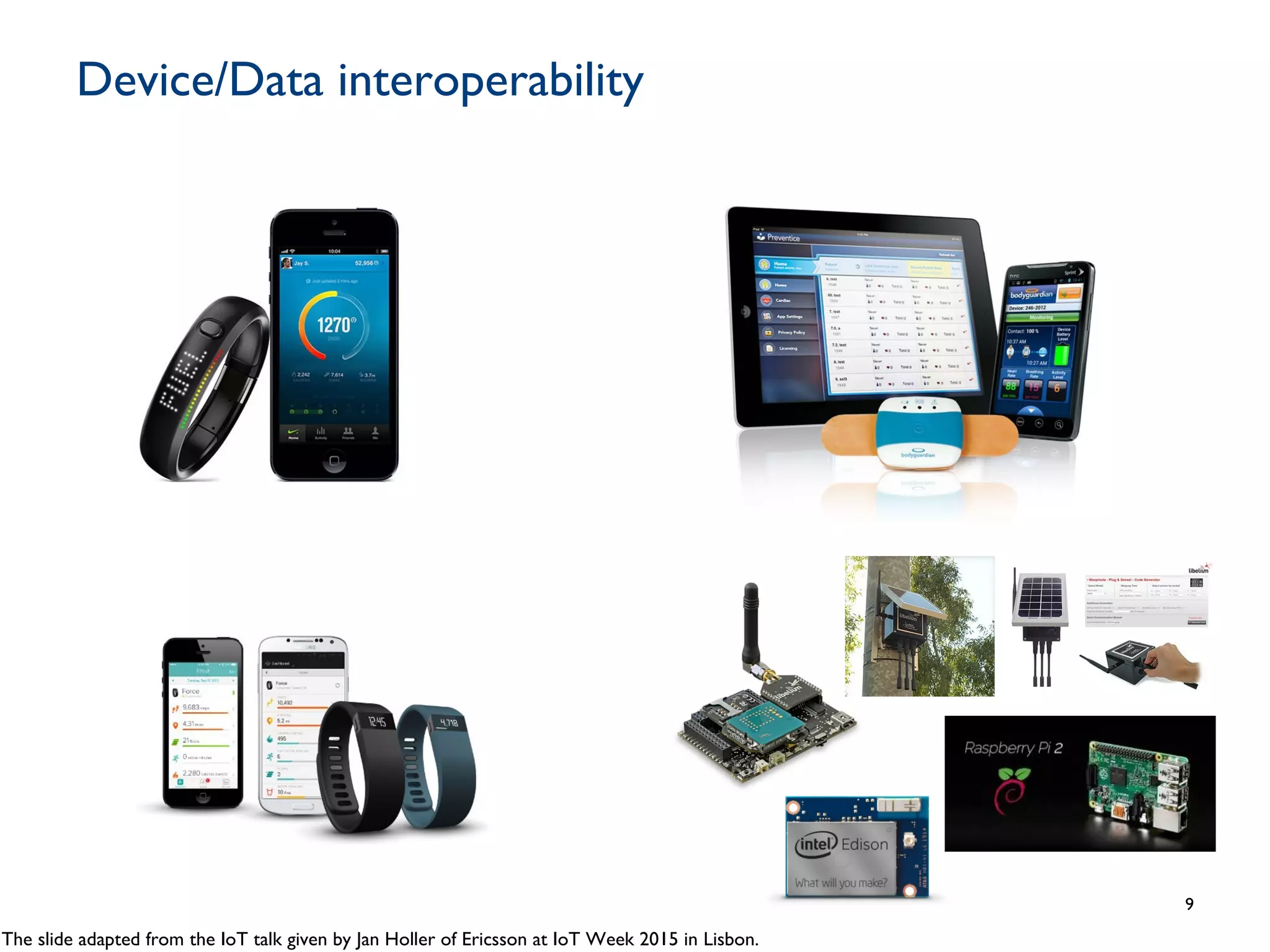
Device/Data interoperability
9
The slide adapted from the IoT talk given by Jan Holler of Ericsson at IoT Week 2015 in Lisbon.
10
There are several good models and description
frameworks;
The problem is that having good models and
developing ontologies are not enough.
Semantic descriptions are intermediary
solutions, not the end product.
They should be transparent to the end-user and
probably to the data producer as well.
Data Lifecycle
11
Source: The IET Technical Report, Digital Technology Adoption in the Smart Built Environment: Challenges and
opportunities of data driven systems for building, community and city-scale applications,
http://www.theiet.org/sectors/built-environment/resources/digital-technology.cfm
The old Internet timeline
12Source: Internet Society
Connectivity and information exchange was
(and is ) the main motivation behind the
Internet; but Content and Services are now
the key elements;
and all started growing rapidly by the
introduction of the World Wide Web (and
linked information and search and discovery
services).
13
Early days of the web
14
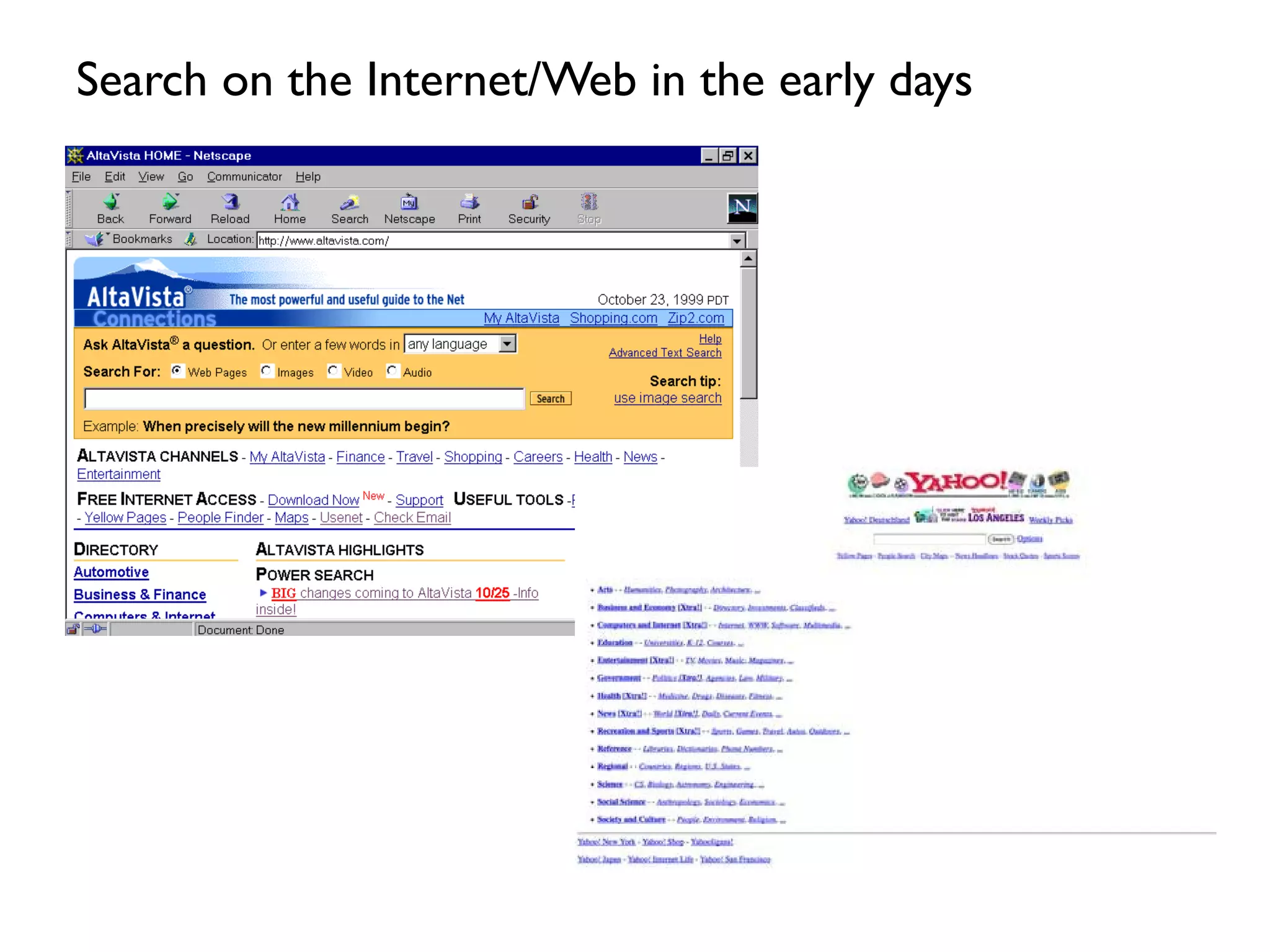
Search on the Internet/Web in the early days
15
Data-centric networking
16
Protocols
17C. Bormann, A. P. Castellani, Z. Shelby, "CoAP: An Application Protocol for Billions of Tiny Internet Nodes," IEEE Internet Computing,
vol. 16, no. 2, pp. 62-67, Feb. 2012, doi:10.1109/MIC.2012.29
Gateway Architecture
18
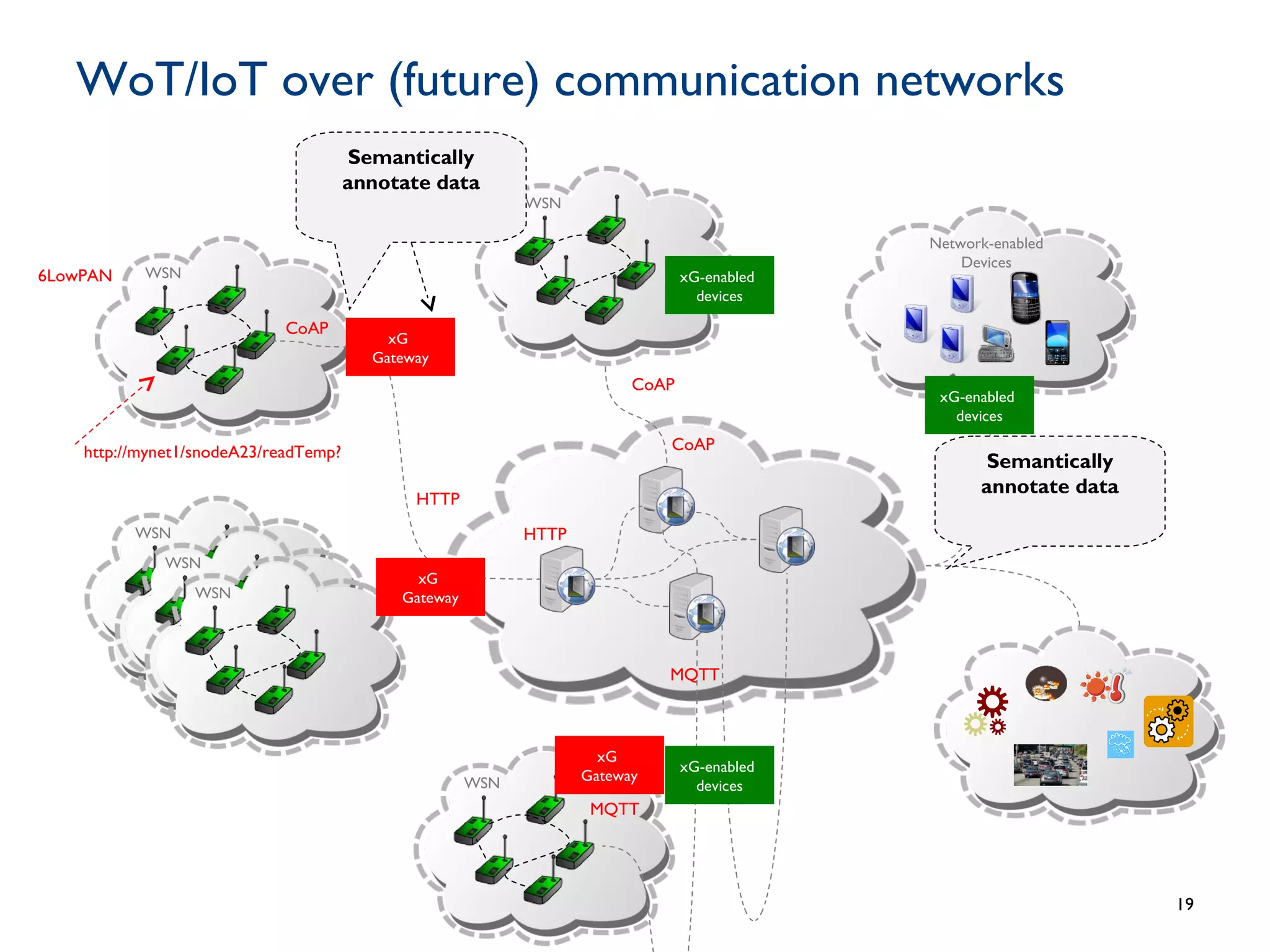
WoT/IoT over (future) communication networks
WSN
WSN
WSN
WSN
WSN
Network-enabled
Devices
Semantically
annotate data
19
xG
Gateway
CoAP
HTTP
CoAP
CoAP
HTTP
6LowPAN
Semantically
annotate data
http://mynet1/snodeA23/readTemp?
WSN
MQTT
MQTT
xG
Gateway
xG-enabled
devices
xG-enabled
devices
xG-enabled
devices
xG
Gateway
#1: Design for large-scale and provide tools and APIs.
#2: Think of who will use the data/services and how,
when you design your models.
#3: Provide means to update and change/update the
annotations.
20
Smart data collection
−Sooner or later we need to
think whether we need to
collect that data, how often we
need to collect it and what
volume.
−Intelligent data Processing
(selective attention and
information-extraction)
21
(image source: KRISTEN NICOLE, siliconangle.com)
#4: Create tools and open APIs for validation,
evaluation, and interoperability testing.
#5: Consider quality of information and quality of
service requirements when designing/deciding on your
network and communication links.
22
#6: Link your data and descriptions to other existing
resources.
#7: Define rules and/or best practices for providing the
values for each attribute.
#8: Design or (re-)use solutions for smart data
collection, processing and automated interactions.
23
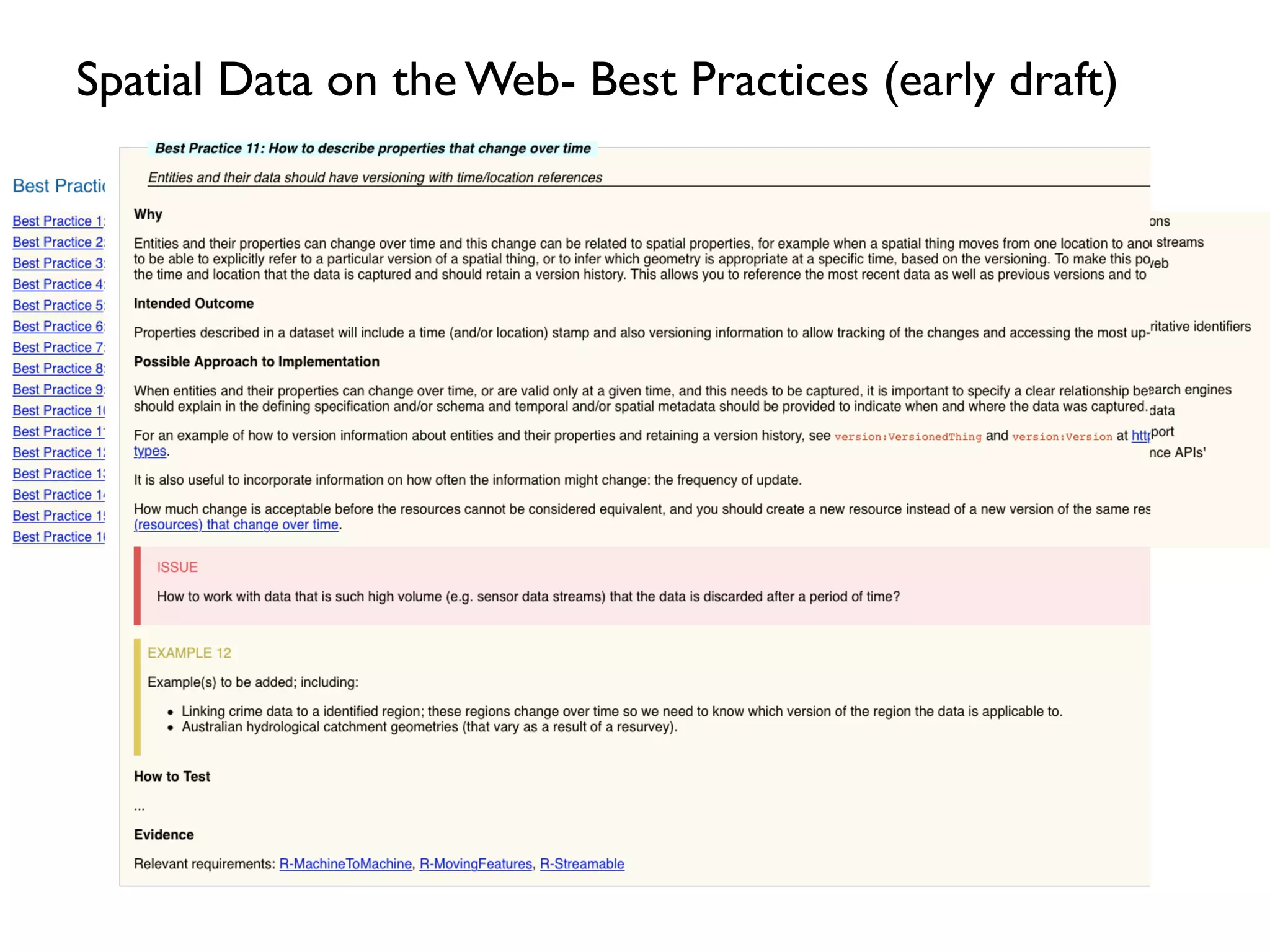
Best Practices: an example (early draft)
24
Spatial Data on the Web- Best Practices (early draft)
25
#9: Design for different audience (data/service
consumers, developers, providers) and think about real
world applications and sustainability.
#10: Specify (and encourage others to do the same)
data governance and privacy procedures, explain the
ownership and re-use rules, and give control to the
owners of data
26
Some of the technical challenges and research
directions
27
Technical (and non-technical) Challenges
− Creating common models to represent, publish, and
(re-)use and share IoT data.
− Developing common protocols and standards,
− Providing best practices, demonstrators and open
portals for IoT data/services.
− Provide governance, dependability, reliability, trust and
security models.
28
Research challenges
−Transforming raw data to actionable-information.
−Machine learning and data analytics for large-scale, multi-
modal and dynamic (streaming data).
− Making data more accessible and discoverable.
−Energy and computationally efficient data collection,
communication, aggregation and abstraction (for both
edge and Cloud processing).
−Automated feedback and control mechanisms.
29
Research challenges (continued)
−Integration and combination of Physical-Cyber-Social
data.
−Use of data for automated interactions and
autonomous services in different domains.
−Resource-aware and context-aware security, privacy
and trust solutions.
30
In conclusion
− IoT information engineering is different from common models of web data
and/or other types of big data.
− Data collection in the IoT comes at the cost of bandwidth, network,
energy and other resources.
− Data collection, delivery and processing is also depended on multiple
layers of the network.
− We need more resource-aware data analytics methods and cross-layer
optimisations (Deep IoT).
− The solutions should work across different systems and multiple platforms
(Ecosystem of systems).
− Data sources are more than physical (sensory) observation.
− The IoT requires integration and processing of physical-cyber-social data.
− The extracted insights and information should be converted to a feedback
and/or actionable information.
31
Other challenges and topics that I didn't talk about
Security
Privacy
Trust, resilience and
reliability
Noise and
incomplete data
Cloud and
distributed computing
Networks, test-beds and
mobility
Mobile computing
Applications and use-case
scenarios
32
IET sector briefing report
33
Available at: http://www.theiet.org/sectors/built-environment/resources/digital-technology.cfm
34
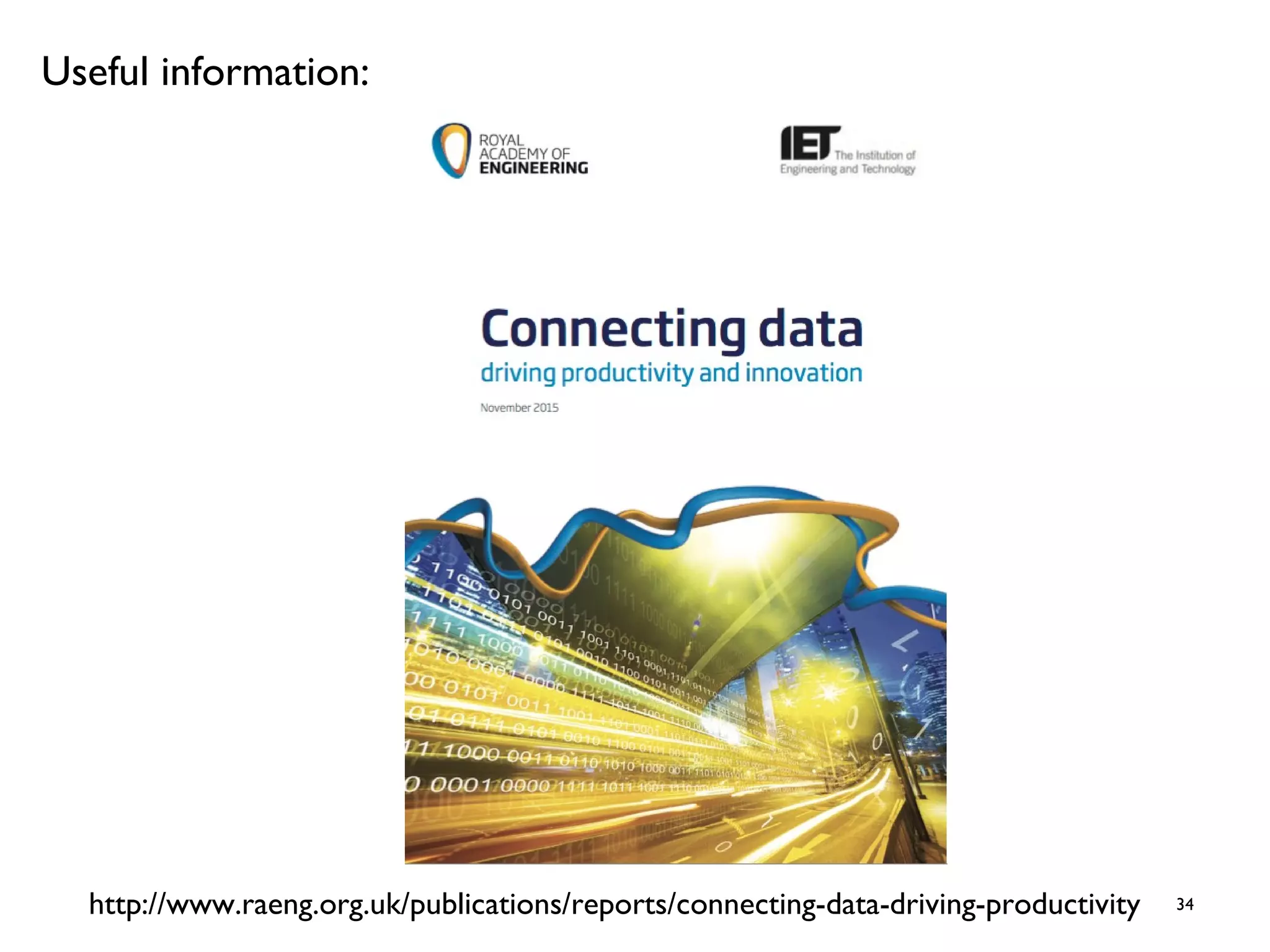
Useful information:
http://www.raeng.org.uk/publications/reports/connecting-data-driving-productivity
Q&A
− Thank you.
http://personal.ee.surrey.ac.uk/Personal/P.Barnaghi/
@pbarnaghi
p.barnaghi@surrey.ac.uk
http://iot.ee.surrey.ac.uk

The Internet of Things: What's next?

  • 1.
    The Internet ofThings: What’s next? 1 Payam Barnaghi Institute for Communication Systems (ICS)/ 5G Innovation Centre University of Surrey Guildford, United Kingdom
  • 2.
  • 3.
    3 AnyPlace AnyTime AnyThing Data Volume Security,Reliability, Trust and Privacy Societal Impacts, Economic Values and Viability Services and Applications Networking and Communication
  • 4.
    4 Sensor devices arebecoming widely available - Programmable devices - Off-the-shelf gadgets/tools
  • 5.
    Internet of Things:The story so far RFID based solutions Wireless Sensor and Actuator networks , solutions for communication technologies, energy efficiency, routing, … Smart Devices/ Web-enabled Apps/Services, initial products, vertical applications, early concepts and demos, … Motion sensor Motion sensor ECG sensor Physical-Cyber-Social Systems, Linked-data, semantics, M2M, More products, more heterogeneity, solutions for control and monitoring, … Future: Cloud, Big (IoT) Data Analytics, Interoperability, Enhanced Cellular/Wireless Com. for IoT, Real-world operational use-cases and Industry and B2B services/applications, more Standards…
  • 6.
    Speed of light? 6 Imagesource: The Brain with David Eagleman, BBC
  • 7.
    Data in theIoT − Data is collected by sensory devices and also crowd sensing resources. − It is time and location dependent. − It can be noisy and the quality can vary. − It is often continuous - streaming data. − There are several important issues such as: − Device/network management − Actuation and feedback (command and control) − Service and entity descriptions.
  • 8.
    IoT data- challenges −Multi-modal, distributed and heterogeneous − Noisy and incomplete − Time and location dependent − Dynamic and varies in quality − Crowdsourced data can be unreliable − Requires (near-) real-time analysis − Privacy and security are important issues − Data can be biased- we need to know our data! 8 P. Barnaghi, A. Sheth, C. Henson, "From data to actionable knowledge: Big Data Challenges in the Web of Things," IEEE Intelligent Systems, vol.28 , issue.6, Dec 2013.
  • 9.
    Device/Data interoperability 9 The slideadapted from the IoT talk given by Jan Holler of Ericsson at IoT Week 2015 in Lisbon.
  • 10.
    10 There are severalgood models and description frameworks; The problem is that having good models and developing ontologies are not enough. Semantic descriptions are intermediary solutions, not the end product. They should be transparent to the end-user and probably to the data producer as well.
  • 11.
    Data Lifecycle 11 Source: TheIET Technical Report, Digital Technology Adoption in the Smart Built Environment: Challenges and opportunities of data driven systems for building, community and city-scale applications, http://www.theiet.org/sectors/built-environment/resources/digital-technology.cfm
  • 12.
    The old Internettimeline 12Source: Internet Society
  • 13.
    Connectivity and informationexchange was (and is ) the main motivation behind the Internet; but Content and Services are now the key elements; and all started growing rapidly by the introduction of the World Wide Web (and linked information and search and discovery services). 13
  • 14.
    Early days ofthe web 14
  • 15.
    Search on theInternet/Web in the early days 15
  • 16.
  • 17.
    Protocols 17C. Bormann, A.P. Castellani, Z. Shelby, "CoAP: An Application Protocol for Billions of Tiny Internet Nodes," IEEE Internet Computing, vol. 16, no. 2, pp. 62-67, Feb. 2012, doi:10.1109/MIC.2012.29
  • 18.
  • 19.
    WoT/IoT over (future)communication networks WSN WSN WSN WSN WSN Network-enabled Devices Semantically annotate data 19 xG Gateway CoAP HTTP CoAP CoAP HTTP 6LowPAN Semantically annotate data http://mynet1/snodeA23/readTemp? WSN MQTT MQTT xG Gateway xG-enabled devices xG-enabled devices xG-enabled devices xG Gateway
  • 20.
    #1: Design forlarge-scale and provide tools and APIs. #2: Think of who will use the data/services and how, when you design your models. #3: Provide means to update and change/update the annotations. 20
  • 21.
    Smart data collection −Sooneror later we need to think whether we need to collect that data, how often we need to collect it and what volume. −Intelligent data Processing (selective attention and information-extraction) 21 (image source: KRISTEN NICOLE, siliconangle.com)
  • 22.
    #4: Create toolsand open APIs for validation, evaluation, and interoperability testing. #5: Consider quality of information and quality of service requirements when designing/deciding on your network and communication links. 22
  • 23.
    #6: Link yourdata and descriptions to other existing resources. #7: Define rules and/or best practices for providing the values for each attribute. #8: Design or (re-)use solutions for smart data collection, processing and automated interactions. 23
  • 24.
    Best Practices: anexample (early draft) 24
  • 25.
    Spatial Data onthe Web- Best Practices (early draft) 25
  • 26.
    #9: Design fordifferent audience (data/service consumers, developers, providers) and think about real world applications and sustainability. #10: Specify (and encourage others to do the same) data governance and privacy procedures, explain the ownership and re-use rules, and give control to the owners of data 26
  • 27.
    Some of thetechnical challenges and research directions 27
  • 28.
    Technical (and non-technical)Challenges − Creating common models to represent, publish, and (re-)use and share IoT data. − Developing common protocols and standards, − Providing best practices, demonstrators and open portals for IoT data/services. − Provide governance, dependability, reliability, trust and security models. 28
  • 29.
    Research challenges −Transforming rawdata to actionable-information. −Machine learning and data analytics for large-scale, multi- modal and dynamic (streaming data). − Making data more accessible and discoverable. −Energy and computationally efficient data collection, communication, aggregation and abstraction (for both edge and Cloud processing). −Automated feedback and control mechanisms. 29
  • 30.
    Research challenges (continued) −Integrationand combination of Physical-Cyber-Social data. −Use of data for automated interactions and autonomous services in different domains. −Resource-aware and context-aware security, privacy and trust solutions. 30
  • 31.
    In conclusion − IoTinformation engineering is different from common models of web data and/or other types of big data. − Data collection in the IoT comes at the cost of bandwidth, network, energy and other resources. − Data collection, delivery and processing is also depended on multiple layers of the network. − We need more resource-aware data analytics methods and cross-layer optimisations (Deep IoT). − The solutions should work across different systems and multiple platforms (Ecosystem of systems). − Data sources are more than physical (sensory) observation. − The IoT requires integration and processing of physical-cyber-social data. − The extracted insights and information should be converted to a feedback and/or actionable information. 31
  • 32.
    Other challenges andtopics that I didn't talk about Security Privacy Trust, resilience and reliability Noise and incomplete data Cloud and distributed computing Networks, test-beds and mobility Mobile computing Applications and use-case scenarios 32
  • 33.
    IET sector briefingreport 33 Available at: http://www.theiet.org/sectors/built-environment/resources/digital-technology.cfm
  • 34.
  • 35.