Communication medium in network
Definition
• A path through which data is
transmitted from one place to
another is known as Communication
media.
Types of Communication Media
 The communication media is divided into two
types:
o Guided media
o Unguided Media
Guided media
 communication devices are directly linked with each
other via cables or physical media is called Guided
media.
 guided media is also called Bounded media.
 The examples of guided or bounded media are:
o Twisted pair wire
o Coaxial cable
o Fiber optic cable
Twisted pair wire
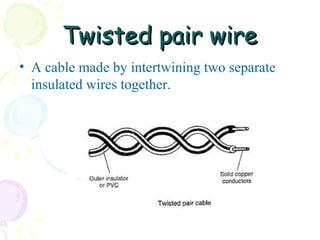
• A cable made by intertwining two separate
insulated wires together.
Contd..
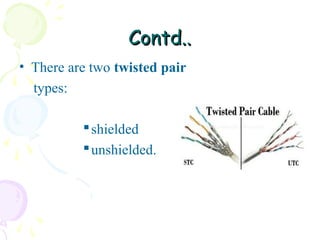
• There are two twisted pair
types:
 shielded
 unshielded.
Shielded Twisted-Pair cable
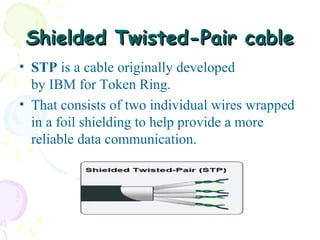
• STP is a cable originally developed
by IBM for Token Ring.
• That consists of two individual wires wrapped
in a foil shielding to help provide a more
reliable data communication.
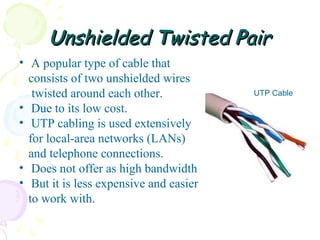
Unshielded Twisted Pair
• A popular type of cable that
consists of two unshielded wires
twisted around each other.
• Due to its low cost.
• UTP cabling is used extensively
for local-area networks (LANs)
and telephone connections.
• Does not offer as high bandwidth
• But it is less expensive and easier
to work with.

UTP Cable
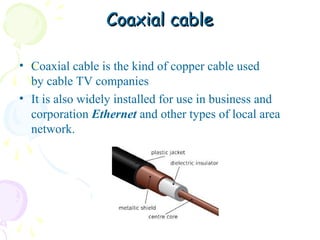
Coaxial cable
• Coaxial cable is the kind of copper cable used
by cable TV companies
• It is also widely installed for use in business and
corporation Ethernet and other types of local area
network.
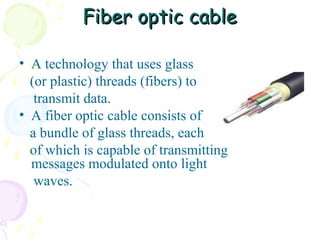
Fiber optic cable
• A technology that uses glass
(or plastic) threads (fibers) to
transmit data.
• A fiber optic cable consists of
a bundle of glass threads, each
of which is capable of transmitting
messages modulated onto light
waves.
Fiber optics has several advantages over
traditional metal communications lines:
– Fiber optic cables have a much
greater bandwidth than metal cables. This
means that they can carry more data.
– Fiber optic cables are less susceptible than
metal cables to interference.
– Fiber optic cables are much thinner and
lighter than metal wires.
– Data can be transmitted digitally (the natural
form for computer data) rather than
analogically.
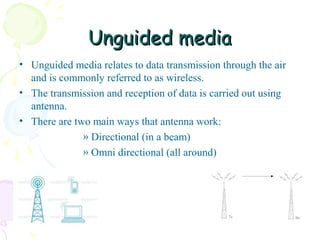
Unguided media
• Unguided media relates to data transmission through the air
and is commonly referred to as wireless.
• The transmission and reception of data is carried out using
antenna.
• There are two main ways that antenna work:
» Directional (in a beam)
» Omni directional (all around)
THANK YOU

Communication medium

  • 1.
  • 2.
    Definition • A paththrough which data is transmitted from one place to another is known as Communication media.
  • 3.
    Types of CommunicationMedia  The communication media is divided into two types: o Guided media o Unguided Media
  • 4.
    Guided media  communicationdevices are directly linked with each other via cables or physical media is called Guided media.  guided media is also called Bounded media.  The examples of guided or bounded media are: o Twisted pair wire o Coaxial cable o Fiber optic cable
  • 5.
    Twisted pair wire •A cable made by intertwining two separate insulated wires together.
  • 6.
    Contd.. • There aretwo twisted pair types:  shielded  unshielded.
  • 7.
    Shielded Twisted-Pair cable •STP is a cable originally developed by IBM for Token Ring. • That consists of two individual wires wrapped in a foil shielding to help provide a more reliable data communication.
  • 8.
    Unshielded Twisted Pair • A populartype of cable that consists of two unshielded wires twisted around each other. • Due to its low cost. • UTP cabling is used extensively for local-area networks (LANs) and telephone connections. • Does not offer as high bandwidth • But it is less expensive and easier to work with. UTP Cable
  • 9.
    Coaxial cable • Coaxialcable is the kind of copper cable used by cable TV companies • It is also widely installed for use in business and corporation Ethernet and other types of local area network.
  • 10.
    Fiber optic cable •A technology that uses glass (or plastic) threads (fibers) to transmit data. • A fiber optic cable consists of a bundle of glass threads, each of which is capable of transmitting messages modulated onto light waves.
  • 11.
    Fiber optics hasseveral advantages over traditional metal communications lines: – Fiber optic cables have a much greater bandwidth than metal cables. This means that they can carry more data. – Fiber optic cables are less susceptible than metal cables to interference. – Fiber optic cables are much thinner and lighter than metal wires. – Data can be transmitted digitally (the natural form for computer data) rather than analogically.
  • 12.
    Unguided media • Unguidedmedia relates to data transmission through the air and is commonly referred to as wireless. • The transmission and reception of data is carried out using antenna. • There are two main ways that antenna work: » Directional (in a beam) » Omni directional (all around)
  • 13.