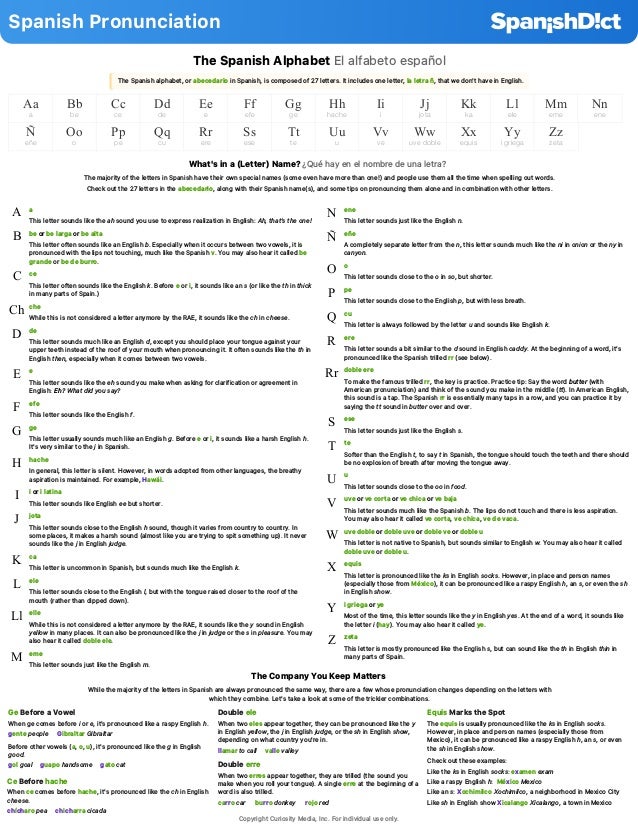
The Spanish Alphabet El alfabeto español
What's in a (Letter) Name? ¿Qué hay en el nombre de una letra?
The majority of the letters in Spanish have their own special names (some even have more than one!) and people use them all the time when spelling out words.
Check out the 27 letters in the abecedario, along with their Spanish name(s), and some tips on pronouncing them alone and in combination with other letters.
This letter often sounds like an English b. Especially when it occurs between two vowels, it is
pronounced with the lips not touching, much like the Spanish v. You may also hear it called be
grande or be de burro.
B be or be larga or be alta
This letter often sounds like the English k. Before e or i, it sounds like an s (or like the th in thick
in many parts of Spain.)
C ce
While this is not considered a letter anymore by the RAE, it sounds like the ch in cheese.
Ch che
This letter sounds much like an English d, except you should place your tongue against your
upper teeth instead of the roof of your mouth when pronouncing it. It often sounds like the th in
English then, especially when it comes between two vowels.
D de
This letter sounds like the eh sound you make when asking for clarification or agreement in
English: Eh? What did you say?
E e
This letter sounds like the English f.
F efe
This letter usually sounds much like an English g. Before e or i, it sounds like a harsh English h.
It's very similar to the j in Spanish.
G ge
In general, this letter is silent. However, in words adopted from other languages, the breathy
aspiration is maintained. For example, Hawái.
H hache
This letter sounds like English ee but shorter.
I i or i latina
This letter sounds close to the English h sound, though it varies from country to country. In
some places, it makes a harsh sound (almost like you are trying to spit something up). It never
sounds like the j in English judge.
J jota
This letter is uncommon in Spanish, but sounds much like the English k.
K ca
This letter sounds close to the English l, but with the tongue raised closer to the roof of the
mouth (rather than dipped down).
L ele
While this is not considered a letter anymore by the RAE, it sounds like the y sound in English
yellow in many places. It can also be pronounced like the j in judge or the s in pleasure. You may
also hear it called doble ele.
Ll elle
This letter sounds just like the English m.
M eme
A completely separate letter from the n, this letter sounds much like the ni in onion or the ny in
canyon.
Ñ eñe
This letter sounds close to the o in so, but shorter.
O o
This letter sounds close to the English p, but with less breath.
P pe
This letter sounds a bit similar to the d sound in English caddy. At the beginning of a word, it's
pronounced like the Spanish trilled rr (see below).
R ere
To make the famous trilled rr, the key is practice. Practice tip: Say the word butter (with
American pronunciation) and think of the sound you make in the middle (tt). In American English,
this sound is a tap. The Spanish rr is essentially many taps in a row, and you can practice it by
saying the tt sound in butter over and over.
Rr doble ere
This letter sounds just like the English s.
S ese
Softer than the English t, to say t in Spanish, the tongue should touch the teeth and there should
be no explosion of breath after moving the tongue away.
T te
This letter sounds close to the oo in food.
U u
This letter sounds much like the Spanish b. The lips do not touch and there is less aspiration.
You may also hear it called ve corta, ve chica, ve de vaca.
V uve or ve corta or ve chica or ve baja
This letter is not native to Spanish, but sounds similar to English w. You may also hear it called
doble uve or doble u.
W uve doble or doble uve or doble ve or doble u
This letter is pronounced like the ks in English socks. However, in place and person names
(especially those from México), it can be pronounced like a raspy English h, an s, or even the sh
in English show.
X equis
Most of the time, this letter sounds like the y in English yes. At the end of a word, it sounds like
the letter i (hay). You may also hear it called ye.
Y i griega or ye
This letter is mostly pronounced like the English s, but can sound like the th in English thin in
many parts of Spain.
Z zeta
This letter is always followed by the letter u and sounds like English k.
Q cu
This letter sounds like the ah sound you use to express realization in English: Ah, that's the one!
A a
This letter sounds just like the English n.
N ene
The Company You Keep Matters
The Spanish alphabet, or abecedario in Spanish, is composed of 27 letters. It includes one letter, la letra ñ, that we don't have in English.
While the majority of the letters in Spanish are always pronounced the same way, there are a few whose pronunciation changes depending on the letters with
which they combine. Let's take a look at some of the trickier combinations.
Ge Before a Vowel
When ge comes before i or e, it's pronounced like a raspy English h.
gente people Gibraltar Gibraltar
Ce Before hache
When ce comes before hache, it's pronounced like the ch in English
cheese.
chícharo pea chicharra cicada
Double erre
When two erres appear together, they are trilled (the sound you
make when you roll your tongue). A single erre at the beginning of a
word is also trilled.
carro car burro donkey rojo red
Double ele
When two eles appear together, they can be pronounced like the y
in English yellow, the j in English judge, or the sh in English show,
depending on what country you're in.
llamar to call valle valley
Equis Marks the Spot
The equis is usually pronounced like the ks in English socks.
However, in place and person names (especially those from
Mexico), it can be pronounced like a raspy English h, an s, or even
the sh in English show.
Check out these examples:
Like the ks in English socks: examen exam
Like a raspy English h: México Mexico
Like an s: Xochimilco Xochimilco, a neighborhood in Mexico City
Like sh in English show Xicalango Xicalango, a town in Mexico
Before other vowels (a, o, u), it's pronounced like the g in English
good.
gol goal guapo handsome gato cat
Aa
a
Bb
be
Cc
ce
Dd
de
Ee
e
Ff
efe
Gg
ge
Hh
hache
Ii
i
Jj
jota
Kk
ka
Ll
ele
Mm
eme
Nn
ene
Ñ
eñe
Oo
o
Pp
pe
Qq
cu
Rr
ere
Ss
ese
Tt
te
Uu
u
Vv
ve
Ww
uve doble
Xx
equis
Yy
i griega
Zz
zeta
Copyright Curiosity Media, Inc. For individual use only.
Spanish Pronunciation
Spanish Vowels Vocales españolas Spanish Word Stress Acento léxico
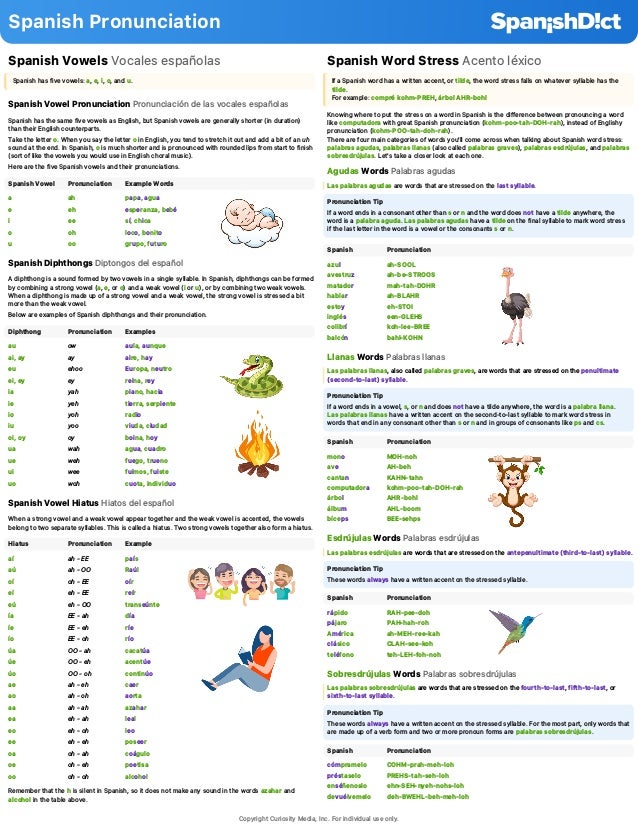
Spanish Vowel Pronunciation Pronunciación de las vocales españolas
Spanish Diphthongs Diptongos del español
Agudas Words Palabras agudas
Llanas Words Palabras llanas
Esdrújulas Words Palabras esdrújulas
Sobresdrújulas Words Palabras sobresdrújulas
Las palabras agudas are words that are stressed on the last syllable.
Las palabras llanas, also called palabras graves, are words that are stressed on the penultimate
(second-to-last) syllable.
Las palabras esdrújulas are words that are stressed on the antepenultimate (third-to-last) syllable.
Las palabras sobresdrújulas are words that are stressed on the fourth-to-last, fifth-to-last, or
sixth-to-last syllable.
Pronunciation Tip
If a word ends in a consonant other than s or n and the word does not have a tilde anywhere, the
word is a palabra aguda. Las palabras agudas have a tilde on the final syllable to mark word stress
if the last letter in the word is a vowel or the consonants s or n.
Pronunciation Tip
If a word ends in a vowel, s, or n and does not have a tilde anywhere, the word is a palabra llana.
Las palabras llanas have a written accent on the second-to-last syllable to mark word stress in
words that end in any consonant other than s or n and in groups of consonants like ps and cs.
Pronunciation Tip
These words always have a written accent on the stressed syllable.
Pronunciation Tip
These words always have a written accent on the stressed syllable. For the most part, only words that
are made up of a verb form and two or more pronoun forms are palabras sobresdrújulas.
Spanish Pronunciation
azul
avestruz
matador
hablar
estoy
inglés
colibrí
balcón
ah-SOOL
ah-be-STROOS
mah-tah-DOHR
ah-BLAHR
eh-STOI
een-GLEHS
koh-lee-BREE
bahl-KOHN
Spanish Pronunciation
mono
ave
cantan
computadora
árbol
álbum
bíceps
MOH-noh
AH-beh
KAHN-tahn
kohm-poo-tah-DOH-rah
AHR-bohl
AHL-boom
BEE-sehps
Spanish Pronunciation
rápido
pájaro
América
clásico
teléfono
RAH-pee-doh
PAH-hah-roh
ah-MEH-ree-kah
CLAH-see-koh
teh-LEH-foh-noh
Spanish Pronunciation
cómpramelo
préstaselo
enséñenoslo
devuélvemelo
COHM-prah-meh-loh
PREHS-tah-seh-loh
ehn-SEH-nyeh-nohs-loh
deh-BWEHL-beh-meh-loh
Spanish Vowel Hiatus Hiatos del español
Spanish has the same five vowels as English, but Spanish vowels are generally shorter (in duration)
than their English counterparts.
Take the letter o. When you say the letter o in English, you tend to stretch it out and add a bit of an uh
sound at the end. In Spanish, o is much shorter and is pronounced with rounded lips from start to finish
(sort of like the vowels you would use in English choral music).
Here are the five Spanish vowels and their pronunciations.
Knowing where to put the stress on a word in Spanish is the difference between pronouncing a word
like computadora with great Spanish pronunciation (kohm-poo-tah-DOH-rah), instead of Englishy
pronunciation (kohm-POO-tah-doh-rah).
There are four main categories of words you'll come across when talking about Spanish word stress:
palabras agudas, palabras llanas (also called palabras graves), palabras esdrújulas, and palabras
sobresdrújulas. Let's take a closer look at each one.
A diphthong is a sound formed by two vowels in a single syllable. In Spanish, diphthongs can be formed
by combining a strong vowel (a, e, or o) and a weak vowel (i or u), or by combining two weak vowels.
When a diphthong is made up of a strong vowel and a weak vowel, the strong vowel is stressed a bit
more than the weak vowel.
Below are examples of Spanish diphthongs and their pronunciation.
When a strong vowel and a weak vowel appear together and the weak vowel is accented, the vowels
belong to two separate syllables. This is called a hiatus. Two strong vowels together also form a hiatus.
Remember that the h is silent in Spanish, so it does not make any sound in the words azahar and
alcohol in the table above.
Spanish has five vowels: a, e, i, o, and u. If a Spanish word has a written accent, or tilde, the word stress falls on whatever syllable has the
tilde.
For example: compré kohm-PREH, árbol AHR-bohl
Spanish Vowel Pronunciation Example Words
a
e
i
o
u
ah
eh
ee
oh
oo
papa, agua
esperanza, bebé
sí, chica
loco, bonito
grupo, futuro
Diphthong Pronunciation Examples
au
ai, ay
eu
ei, ey
ia
ie
io
iu
oi, oy
ua
ue
ui
uo
ow
ay
ehoo
ey
yah
yeh
yoh
yoo
oy
wah
weh
wee
woh
aula, aunque
aire, hay
Europa, neutro
reina, rey
piano, hacia
tierra, serpiente
radio
viuda, ciudad
boina, hoy
agua, cuadro
fuego, trueno
fuimos, fuiste
cuota, individuo
Hiatus Pronunciation Example
aí
aú
oí
eí
eú
ía
íe
ío
úa
úe
úo
ae
ao
aa
ea
eo
ee
oa
oe
oo
ah - EE
ah - OO
oh - EE
eh - EE
eh - OO
EE - ah
EE - eh
EE - oh
OO - ah
OO - eh
OO - oh
ah - eh
ah - oh
ah - ah
eh - ah
eh - oh
eh - eh
oh - ah
oh - eh
oh - oh
país
Raúl
oír
reír
transeúnte
día
ríe
río
cacatúa
acentúe
continúo
caer
aorta
azahar
leal
leo
poseer
coágulo
poetisa
alcohol
Copyright Curiosity Media, Inc. For individual use only.
Spanish Pronunciation
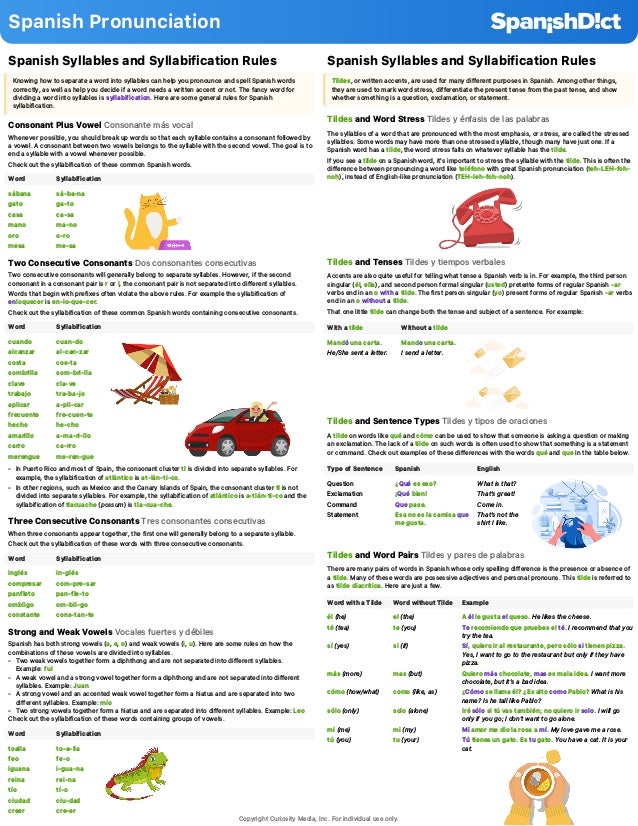
Spanish Syllables and Syllabification Rules Spanish Syllables and Syllabification Rules
Consonant Plus Vowel Consonante más vocal
Two Consecutive Consonants Dos consonantes consecutivas
Three Consecutive Consonants Tres consonantes consecutivas
Strong and Weak Vowels Vocales fuertes y débiles
Tildes and Word Stress Tildes y énfasis de las palabras
Tildes and Tenses Tildes y tiempos verbales
Tildes and Sentence Types Tildes y tipos de oraciones
Tildes and Word Pairs Tildes y pares de palabras
With a tilde Without a tilde
Mandó una carta.
He/She sent a letter.
Mando una carta.
I send a letter.
Type of Sentence Spanish English
Question
Exclamation
Command
Statement
¿Qué es eso?
¡Qué bien!
Que pase.
Esa no es la camisa que
me gusta.
What is that?
That's great!
Come in.
That's not the
shirt I like.
Word with a Tilde Word without Tilde Example
el (the)
te (you)
si (if)
mas (but)
como (like, as)
solo (alone)
mi (my)
tu (your)
él (he)
té (tea)
sí (yes)
más (more)
cómo (how/what)
sólo (only)
mí (me)
tú (you)
A él le gusta el queso. He likes the cheese.
Te recomiendo que pruebes el té. I recommend that you
try the tea.
Sí, quiero ir al restaurante, pero sólo si tienen pizza.
Yes, I want to go to the restaurant but only if they have
pizza.
Quiero más chocolate, mas es mala idea. I want more
chocolate, but it's a bad idea.
¿Cómo se llama él? ¿Es alto como Pablo? What is his
name? Is he tall like Pablo?
Iré sólo si tú vas también; no quiero ir solo. I will go
only if you go; I don't want to go alone.
Mi amor me dio la rosa a mí. My love gave me a rose.
Tú tienes un gato. Es tu gato. You have a cat. It is your
cat.
Whenever possible, you should break up words so that each syllable contains a consonant followed by
a vowel. A consonant between two vowels belongs to the syllable with the second vowel. The goal is to
end a syllable with a vowel whenever possible.
Check out the syllabification of these common Spanish words.
The syllables of a word that are pronounced with the most emphasis, or stress, are called the stressed
syllables. Some words may have more than one stressed syllable, though many have just one. If a
Spanish word has a tilde, the word stress falls on whatever syllable has the tilde.
If you see a tilde on a Spanish word, it's important to stress the syllable with the tilde. This is often the
difference between pronouncing a word like teléfono with great Spanish pronunciation (teh-LEH-foh-
noh), instead of English-like pronunciation (TEH-leh-foh-noh).
Accents are also quite useful for telling what tense a Spanish verb is in. For example, the third person
singular (él, ella), and second person formal singular (usted) preterite forms of regular Spanish -ar
verbs end in an o with a tilde. The first person singular (yo) present forms of regular Spanish -ar verbs
end in an o without a tilde.
That one little tilde can change both the tense and subject of a sentence. For example:
A tilde on words like qué and cómo can be used to show that someone is asking a question or making
an exclamation. The lack of a tilde on such words is often used to show that something is a statement
or command. Check out examples of these differences with the words qué and que in the table below.
There are many pairs of words in Spanish whose only spelling difference is the presence or absence of
a tilde. Many of these words are possessive adjectives and personal pronouns. This tilde is referred to
as tilde diacrítica. Here are just a few.
Two consecutive consonants will generally belong to separate syllables. However, if the second
consonant in a consonant pair is r or l, the consonant pair is not separated into different syllables.
Words that begin with prefixes often violate the above rules. For example the syllabification of
enloquecer is en-lo-que-cer.
Check out the syllabification of these common Spanish words containing consecutive consonants.
When three consonants appear together, the first one will generally belong to a separate syllable.
Check out the syllabification of these words with three consecutive consonants.
Spanish has both strong vowels (a, e, o) and weak vowels (i, u). Here are some rules on how the
combinations of these vowels are divided into syllables.
Check out the syllabification of these words containing groups of vowels.
Two weak vowels together form a diphthong and are not separated into different syllables.
Example: fui
A weak vowel and a strong vowel together form a diphthong and are not separated into different
syllables. Example: Juan
A strong vowel and an accented weak vowel together form a hiatus and are separated into two
different syllables. Example: mío
Two strong vowels together form a hiatus and are separated into different syllables. Example: Leo
-
-
-
-
In Puerto Rico and most of Spain, the consonant cluster tl is divided into separate syllables. For
example, the syllabification of atlántico is at-lán-ti-co.
In other regions, such as Mexico and the Canary Islands of Spain, the consonant cluster tl is not
divided into separate syllables. For example, the syllabification of atlántico is a-tlán-ti-co and the
syllabification of tlacuache (possum) is tla-cua-che.
-
-
Knowing how to separate a word into syllables can help you pronounce and spell Spanish words
correctly, as well as help you decide if a word needs a written accent or not. The fancy word for
dividing a word into syllables is syllabification. Here are some general rules for Spanish
syllabification.
Tildes, or written accents, are used for many different purposes in Spanish. Among other things,
they are used to mark word stress, differentiate the present tense from the past tense, and show
whether something is a question, exclamation, or statement.
Word Syllabification
sábana
gato
casa
mano
oro
mesa
sá-ba-na
ga-to
ca-sa
ma-no
o-ro
me-sa
Word Syllabification
cuando
alcanzar
costa
sombrilla
clave
trabajo
aplicar
frecuente
hecho
amarillo
carro
merengue
cuan-do
al-can-zar
cos-ta
som-bri-lla
cla-ve
tra-ba-jo
a-pli-car
fre-cuen-te
he-cho
a-ma-ri-llo
ca-rro
me-ren-gue
Word Syllabification
inglés
compresar
panfleto
ombligo
constante
in-glés
com-pre-sar
pan-fle-to
om-bli-go
cons-tan-te
Word Syllabification
toalla
feo
iguana
reina
tío
ciudad
creer
to-a-lla
fe-o
i-gua-na
rei-na
tí-o
ciu-dad
cre-er
Copyright Curiosity Media, Inc. For individual use only.
Spanish Pronunciation

Spanish Pronunciation-v2.pdf

  • 1.
    The Spanish AlphabetEl alfabeto español What's in a (Letter) Name? ¿Qué hay en el nombre de una letra? The majority of the letters in Spanish have their own special names (some even have more than one!) and people use them all the time when spelling out words. Check out the 27 letters in the abecedario, along with their Spanish name(s), and some tips on pronouncing them alone and in combination with other letters. This letter often sounds like an English b. Especially when it occurs between two vowels, it is pronounced with the lips not touching, much like the Spanish v. You may also hear it called be grande or be de burro. B be or be larga or be alta This letter often sounds like the English k. Before e or i, it sounds like an s (or like the th in thick in many parts of Spain.) C ce While this is not considered a letter anymore by the RAE, it sounds like the ch in cheese. Ch che This letter sounds much like an English d, except you should place your tongue against your upper teeth instead of the roof of your mouth when pronouncing it. It often sounds like the th in English then, especially when it comes between two vowels. D de This letter sounds like the eh sound you make when asking for clarification or agreement in English: Eh? What did you say? E e This letter sounds like the English f. F efe This letter usually sounds much like an English g. Before e or i, it sounds like a harsh English h. It's very similar to the j in Spanish. G ge In general, this letter is silent. However, in words adopted from other languages, the breathy aspiration is maintained. For example, Hawái. H hache This letter sounds like English ee but shorter. I i or i latina This letter sounds close to the English h sound, though it varies from country to country. In some places, it makes a harsh sound (almost like you are trying to spit something up). It never sounds like the j in English judge. J jota This letter is uncommon in Spanish, but sounds much like the English k. K ca This letter sounds close to the English l, but with the tongue raised closer to the roof of the mouth (rather than dipped down). L ele While this is not considered a letter anymore by the RAE, it sounds like the y sound in English yellow in many places. It can also be pronounced like the j in judge or the s in pleasure. You may also hear it called doble ele. Ll elle This letter sounds just like the English m. M eme A completely separate letter from the n, this letter sounds much like the ni in onion or the ny in canyon. Ñ eñe This letter sounds close to the o in so, but shorter. O o This letter sounds close to the English p, but with less breath. P pe This letter sounds a bit similar to the d sound in English caddy. At the beginning of a word, it's pronounced like the Spanish trilled rr (see below). R ere To make the famous trilled rr, the key is practice. Practice tip: Say the word butter (with American pronunciation) and think of the sound you make in the middle (tt). In American English, this sound is a tap. The Spanish rr is essentially many taps in a row, and you can practice it by saying the tt sound in butter over and over. Rr doble ere This letter sounds just like the English s. S ese Softer than the English t, to say t in Spanish, the tongue should touch the teeth and there should be no explosion of breath after moving the tongue away. T te This letter sounds close to the oo in food. U u This letter sounds much like the Spanish b. The lips do not touch and there is less aspiration. You may also hear it called ve corta, ve chica, ve de vaca. V uve or ve corta or ve chica or ve baja This letter is not native to Spanish, but sounds similar to English w. You may also hear it called doble uve or doble u. W uve doble or doble uve or doble ve or doble u This letter is pronounced like the ks in English socks. However, in place and person names (especially those from México), it can be pronounced like a raspy English h, an s, or even the sh in English show. X equis Most of the time, this letter sounds like the y in English yes. At the end of a word, it sounds like the letter i (hay). You may also hear it called ye. Y i griega or ye This letter is mostly pronounced like the English s, but can sound like the th in English thin in many parts of Spain. Z zeta This letter is always followed by the letter u and sounds like English k. Q cu This letter sounds like the ah sound you use to express realization in English: Ah, that's the one! A a This letter sounds just like the English n. N ene The Company You Keep Matters The Spanish alphabet, or abecedario in Spanish, is composed of 27 letters. It includes one letter, la letra ñ, that we don't have in English. While the majority of the letters in Spanish are always pronounced the same way, there are a few whose pronunciation changes depending on the letters with which they combine. Let's take a look at some of the trickier combinations. Ge Before a Vowel When ge comes before i or e, it's pronounced like a raspy English h. gente people Gibraltar Gibraltar Ce Before hache When ce comes before hache, it's pronounced like the ch in English cheese. chícharo pea chicharra cicada Double erre When two erres appear together, they are trilled (the sound you make when you roll your tongue). A single erre at the beginning of a word is also trilled. carro car burro donkey rojo red Double ele When two eles appear together, they can be pronounced like the y in English yellow, the j in English judge, or the sh in English show, depending on what country you're in. llamar to call valle valley Equis Marks the Spot The equis is usually pronounced like the ks in English socks. However, in place and person names (especially those from Mexico), it can be pronounced like a raspy English h, an s, or even the sh in English show. Check out these examples: Like the ks in English socks: examen exam Like a raspy English h: México Mexico Like an s: Xochimilco Xochimilco, a neighborhood in Mexico City Like sh in English show Xicalango Xicalango, a town in Mexico Before other vowels (a, o, u), it's pronounced like the g in English good. gol goal guapo handsome gato cat Aa a Bb be Cc ce Dd de Ee e Ff efe Gg ge Hh hache Ii i Jj jota Kk ka Ll ele Mm eme Nn ene Ñ eñe Oo o Pp pe Qq cu Rr ere Ss ese Tt te Uu u Vv ve Ww uve doble Xx equis Yy i griega Zz zeta Copyright Curiosity Media, Inc. For individual use only. Spanish Pronunciation
  • 2.
    Spanish Vowels Vocalesespañolas Spanish Word Stress Acento léxico Spanish Vowel Pronunciation Pronunciación de las vocales españolas Spanish Diphthongs Diptongos del español Agudas Words Palabras agudas Llanas Words Palabras llanas Esdrújulas Words Palabras esdrújulas Sobresdrújulas Words Palabras sobresdrújulas Las palabras agudas are words that are stressed on the last syllable. Las palabras llanas, also called palabras graves, are words that are stressed on the penultimate (second-to-last) syllable. Las palabras esdrújulas are words that are stressed on the antepenultimate (third-to-last) syllable. Las palabras sobresdrújulas are words that are stressed on the fourth-to-last, fifth-to-last, or sixth-to-last syllable. Pronunciation Tip If a word ends in a consonant other than s or n and the word does not have a tilde anywhere, the word is a palabra aguda. Las palabras agudas have a tilde on the final syllable to mark word stress if the last letter in the word is a vowel or the consonants s or n. Pronunciation Tip If a word ends in a vowel, s, or n and does not have a tilde anywhere, the word is a palabra llana. Las palabras llanas have a written accent on the second-to-last syllable to mark word stress in words that end in any consonant other than s or n and in groups of consonants like ps and cs. Pronunciation Tip These words always have a written accent on the stressed syllable. Pronunciation Tip These words always have a written accent on the stressed syllable. For the most part, only words that are made up of a verb form and two or more pronoun forms are palabras sobresdrújulas. Spanish Pronunciation azul avestruz matador hablar estoy inglés colibrí balcón ah-SOOL ah-be-STROOS mah-tah-DOHR ah-BLAHR eh-STOI een-GLEHS koh-lee-BREE bahl-KOHN Spanish Pronunciation mono ave cantan computadora árbol álbum bíceps MOH-noh AH-beh KAHN-tahn kohm-poo-tah-DOH-rah AHR-bohl AHL-boom BEE-sehps Spanish Pronunciation rápido pájaro América clásico teléfono RAH-pee-doh PAH-hah-roh ah-MEH-ree-kah CLAH-see-koh teh-LEH-foh-noh Spanish Pronunciation cómpramelo préstaselo enséñenoslo devuélvemelo COHM-prah-meh-loh PREHS-tah-seh-loh ehn-SEH-nyeh-nohs-loh deh-BWEHL-beh-meh-loh Spanish Vowel Hiatus Hiatos del español Spanish has the same five vowels as English, but Spanish vowels are generally shorter (in duration) than their English counterparts. Take the letter o. When you say the letter o in English, you tend to stretch it out and add a bit of an uh sound at the end. In Spanish, o is much shorter and is pronounced with rounded lips from start to finish (sort of like the vowels you would use in English choral music). Here are the five Spanish vowels and their pronunciations. Knowing where to put the stress on a word in Spanish is the difference between pronouncing a word like computadora with great Spanish pronunciation (kohm-poo-tah-DOH-rah), instead of Englishy pronunciation (kohm-POO-tah-doh-rah). There are four main categories of words you'll come across when talking about Spanish word stress: palabras agudas, palabras llanas (also called palabras graves), palabras esdrújulas, and palabras sobresdrújulas. Let's take a closer look at each one. A diphthong is a sound formed by two vowels in a single syllable. In Spanish, diphthongs can be formed by combining a strong vowel (a, e, or o) and a weak vowel (i or u), or by combining two weak vowels. When a diphthong is made up of a strong vowel and a weak vowel, the strong vowel is stressed a bit more than the weak vowel. Below are examples of Spanish diphthongs and their pronunciation. When a strong vowel and a weak vowel appear together and the weak vowel is accented, the vowels belong to two separate syllables. This is called a hiatus. Two strong vowels together also form a hiatus. Remember that the h is silent in Spanish, so it does not make any sound in the words azahar and alcohol in the table above. Spanish has five vowels: a, e, i, o, and u. If a Spanish word has a written accent, or tilde, the word stress falls on whatever syllable has the tilde. For example: compré kohm-PREH, árbol AHR-bohl Spanish Vowel Pronunciation Example Words a e i o u ah eh ee oh oo papa, agua esperanza, bebé sí, chica loco, bonito grupo, futuro Diphthong Pronunciation Examples au ai, ay eu ei, ey ia ie io iu oi, oy ua ue ui uo ow ay ehoo ey yah yeh yoh yoo oy wah weh wee woh aula, aunque aire, hay Europa, neutro reina, rey piano, hacia tierra, serpiente radio viuda, ciudad boina, hoy agua, cuadro fuego, trueno fuimos, fuiste cuota, individuo Hiatus Pronunciation Example aí aú oí eí eú ía íe ío úa úe úo ae ao aa ea eo ee oa oe oo ah - EE ah - OO oh - EE eh - EE eh - OO EE - ah EE - eh EE - oh OO - ah OO - eh OO - oh ah - eh ah - oh ah - ah eh - ah eh - oh eh - eh oh - ah oh - eh oh - oh país Raúl oír reír transeúnte día ríe río cacatúa acentúe continúo caer aorta azahar leal leo poseer coágulo poetisa alcohol Copyright Curiosity Media, Inc. For individual use only. Spanish Pronunciation
  • 3.
    Spanish Syllables andSyllabification Rules Spanish Syllables and Syllabification Rules Consonant Plus Vowel Consonante más vocal Two Consecutive Consonants Dos consonantes consecutivas Three Consecutive Consonants Tres consonantes consecutivas Strong and Weak Vowels Vocales fuertes y débiles Tildes and Word Stress Tildes y énfasis de las palabras Tildes and Tenses Tildes y tiempos verbales Tildes and Sentence Types Tildes y tipos de oraciones Tildes and Word Pairs Tildes y pares de palabras With a tilde Without a tilde Mandó una carta. He/She sent a letter. Mando una carta. I send a letter. Type of Sentence Spanish English Question Exclamation Command Statement ¿Qué es eso? ¡Qué bien! Que pase. Esa no es la camisa que me gusta. What is that? That's great! Come in. That's not the shirt I like. Word with a Tilde Word without Tilde Example el (the) te (you) si (if) mas (but) como (like, as) solo (alone) mi (my) tu (your) él (he) té (tea) sí (yes) más (more) cómo (how/what) sólo (only) mí (me) tú (you) A él le gusta el queso. He likes the cheese. Te recomiendo que pruebes el té. I recommend that you try the tea. Sí, quiero ir al restaurante, pero sólo si tienen pizza. Yes, I want to go to the restaurant but only if they have pizza. Quiero más chocolate, mas es mala idea. I want more chocolate, but it's a bad idea. ¿Cómo se llama él? ¿Es alto como Pablo? What is his name? Is he tall like Pablo? Iré sólo si tú vas también; no quiero ir solo. I will go only if you go; I don't want to go alone. Mi amor me dio la rosa a mí. My love gave me a rose. Tú tienes un gato. Es tu gato. You have a cat. It is your cat. Whenever possible, you should break up words so that each syllable contains a consonant followed by a vowel. A consonant between two vowels belongs to the syllable with the second vowel. The goal is to end a syllable with a vowel whenever possible. Check out the syllabification of these common Spanish words. The syllables of a word that are pronounced with the most emphasis, or stress, are called the stressed syllables. Some words may have more than one stressed syllable, though many have just one. If a Spanish word has a tilde, the word stress falls on whatever syllable has the tilde. If you see a tilde on a Spanish word, it's important to stress the syllable with the tilde. This is often the difference between pronouncing a word like teléfono with great Spanish pronunciation (teh-LEH-foh- noh), instead of English-like pronunciation (TEH-leh-foh-noh). Accents are also quite useful for telling what tense a Spanish verb is in. For example, the third person singular (él, ella), and second person formal singular (usted) preterite forms of regular Spanish -ar verbs end in an o with a tilde. The first person singular (yo) present forms of regular Spanish -ar verbs end in an o without a tilde. That one little tilde can change both the tense and subject of a sentence. For example: A tilde on words like qué and cómo can be used to show that someone is asking a question or making an exclamation. The lack of a tilde on such words is often used to show that something is a statement or command. Check out examples of these differences with the words qué and que in the table below. There are many pairs of words in Spanish whose only spelling difference is the presence or absence of a tilde. Many of these words are possessive adjectives and personal pronouns. This tilde is referred to as tilde diacrítica. Here are just a few. Two consecutive consonants will generally belong to separate syllables. However, if the second consonant in a consonant pair is r or l, the consonant pair is not separated into different syllables. Words that begin with prefixes often violate the above rules. For example the syllabification of enloquecer is en-lo-que-cer. Check out the syllabification of these common Spanish words containing consecutive consonants. When three consonants appear together, the first one will generally belong to a separate syllable. Check out the syllabification of these words with three consecutive consonants. Spanish has both strong vowels (a, e, o) and weak vowels (i, u). Here are some rules on how the combinations of these vowels are divided into syllables. Check out the syllabification of these words containing groups of vowels. Two weak vowels together form a diphthong and are not separated into different syllables. Example: fui A weak vowel and a strong vowel together form a diphthong and are not separated into different syllables. Example: Juan A strong vowel and an accented weak vowel together form a hiatus and are separated into two different syllables. Example: mío Two strong vowels together form a hiatus and are separated into different syllables. Example: Leo - - - - In Puerto Rico and most of Spain, the consonant cluster tl is divided into separate syllables. For example, the syllabification of atlántico is at-lán-ti-co. In other regions, such as Mexico and the Canary Islands of Spain, the consonant cluster tl is not divided into separate syllables. For example, the syllabification of atlántico is a-tlán-ti-co and the syllabification of tlacuache (possum) is tla-cua-che. - - Knowing how to separate a word into syllables can help you pronounce and spell Spanish words correctly, as well as help you decide if a word needs a written accent or not. The fancy word for dividing a word into syllables is syllabification. Here are some general rules for Spanish syllabification. Tildes, or written accents, are used for many different purposes in Spanish. Among other things, they are used to mark word stress, differentiate the present tense from the past tense, and show whether something is a question, exclamation, or statement. Word Syllabification sábana gato casa mano oro mesa sá-ba-na ga-to ca-sa ma-no o-ro me-sa Word Syllabification cuando alcanzar costa sombrilla clave trabajo aplicar frecuente hecho amarillo carro merengue cuan-do al-can-zar cos-ta som-bri-lla cla-ve tra-ba-jo a-pli-car fre-cuen-te he-cho a-ma-ri-llo ca-rro me-ren-gue Word Syllabification inglés compresar panfleto ombligo constante in-glés com-pre-sar pan-fle-to om-bli-go cons-tan-te Word Syllabification toalla feo iguana reina tío ciudad creer to-a-lla fe-o i-gua-na rei-na tí-o ciu-dad cre-er Copyright Curiosity Media, Inc. For individual use only. Spanish Pronunciation