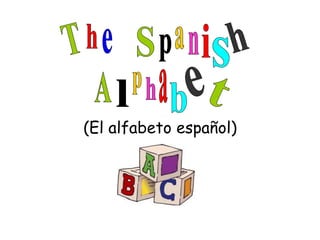
(El alfabeto español)
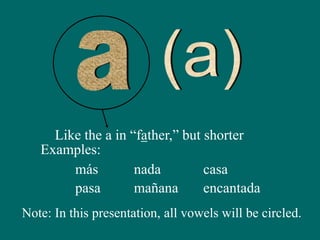
Like the a in “father,” but shorter
más
Examples:
pasa
nada
mañana
casa
encantada
Note: In this presentation, all vowels will be circled.
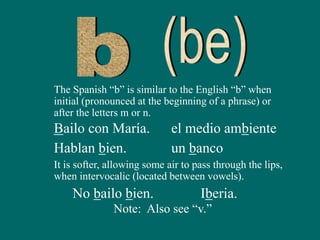
The Spanish “b” is similar to the English “b” when
initial (pronounced at the beginning of a phrase) or
after the letters m or n.
Bailo con María. el medio ambiente
It is softer, allowing some air to pass through the lips,
when intervocalic (located between vowels).
No bailo bien. Iberia.
Hablan bien. un banco
Note: Also see “v.”
The Spanish “c” has two distinct sounds,
depending on its environment, that is, how it
is located with respect to certain vowels. The
next slide provides more details.
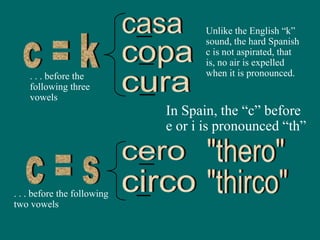
In Spain, the “c” before
e or i is pronounced “th”
. . . before the
following three
vowels
. . . before the following
two vowels
Unlike the English “k”
sound, the hard Spanish
c is not aspirated, that
is, no air is expelled
when it is pronounced.
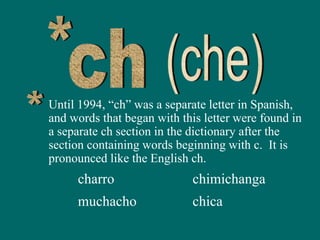
Until 1994, “ch” was a separate letter in Spanish,
and words that began with this letter were found in
a separate ch section in the dictionary after the
section containing words beginning with c. It is
pronounced like the English ch.
charro chimichanga
muchacho chica
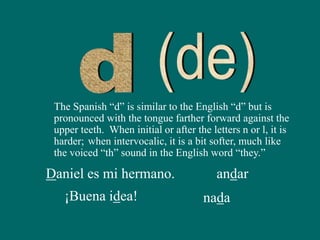
The Spanish “d” is similar to the English “d” but is
pronounced with the tongue farther forward against the
upper teeth. When initial or after the letters n or l, it is
harder;
Daniel es mi hermano. andar
¡Buena idea! nada
when intervocalic, it is a bit softer, much like
the voiced “th” sound in the English word “they.”
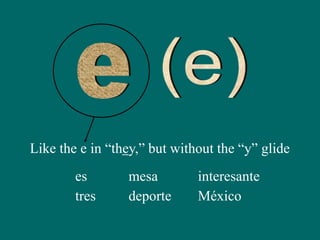
Like the e in “they,” but without the “y” glide
es
tres
mesa
deporte
interesante
México
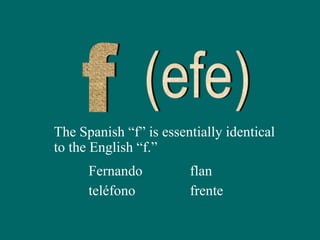
The Spanish “f” is essentially identical
to the English “f.”
Fernando
teléfono
flan
frente
The Spanish “g” has three distinct sounds,
depending on its environment. The next two
slides provide more details.
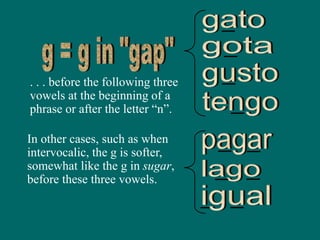
. . . before the following three
vowels at the beginning of a
phrase or after the letter “n”.
In other cases, such as when
intervocalic, the g is softer,
somewhat like the g in sugar,
before these three vowels.
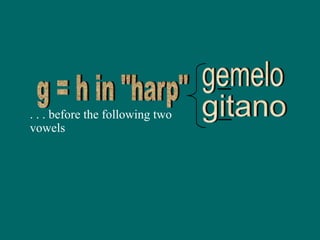
. . . before the following two
vowels
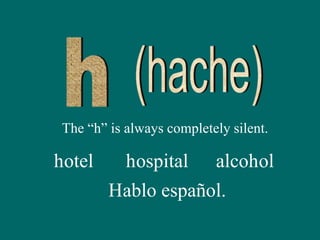
The “h” is always completely silent.
ospitalh olhalcootelh
ablo español.H
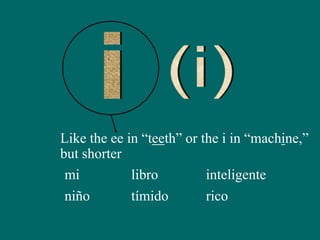
Like the ee in “teeth” or the i in “machine,”
but shorter
mi
niño
libro
tímido
inteligente
rico
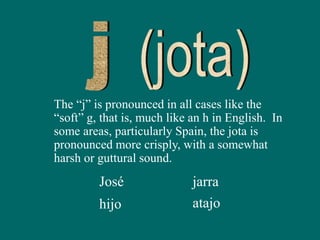
The “j” is pronounced in all cases like the
“soft” g, that is, much like an h in English. In
some areas, particularly Spain, the jota is
pronounced more crisply, with a somewhat
harsh or guttural sound.
José
hijo
jarra
atajo
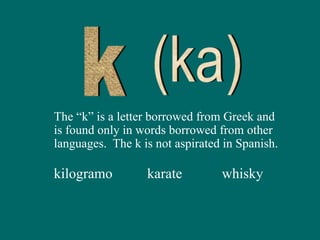
The “k” is a letter borrowed from Greek and
is found only in words borrowed from other
languages. The k is not aspirated in Spanish.
kilogramo karate whisky
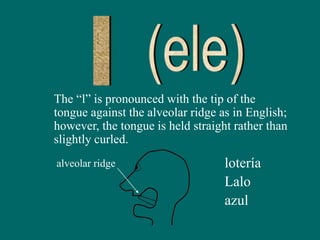
The “l” is pronounced with the tip of the
tongue against the alveolar ridge as in English;
however, the tongue is held straight rather than
slightly curled.
alveolar ridge lotería
Lalo
azul
Until 1994, “ll,” like “ch,” was a separate letter
in Spanish, and words that began with this letter
were listed separately in the dictionary. See the
next slide for more information.
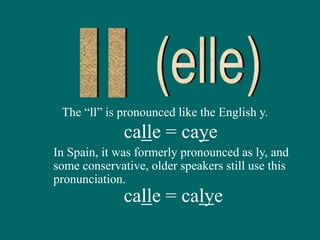
The “ll” is pronounced like the English y.
calle = caye
In Spain, it was formerly pronounced as ly, and
some conservative, older speakers still use this
pronunciation.
calle = calye
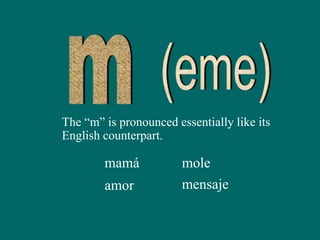
The “m” is pronounced essentially like its
English counterpart.
mamá
amor
mole
mensaje
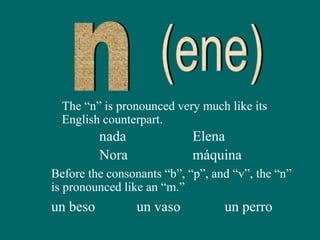
The “n” is pronounced very much like its
English counterpart.
nada
Nora
Elena
máquina
Before the consonants “b”, “p”, and “v”, the “n”
is pronounced like an “m.”
un beso un vaso un perro
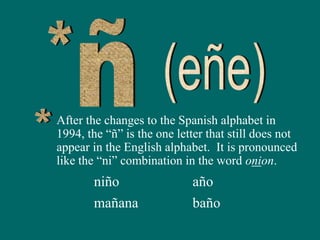
After the changes to the Spanish alphabet in
1994, the “ñ” is the one letter that still does not
appear in the English alphabet. It is pronounced
like the “ni” combination in the word onion.
niño
mañana
año
baño
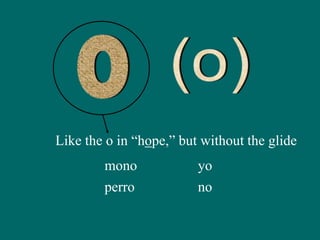
Like the o in “hope,” but without the glide
mono
perro
yo
no
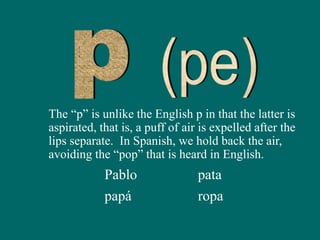
The “p” is unlike the English p in that the latter is
aspirated, that is, a puff of air is expelled after the
lips separate. In Spanish, we hold back the air,
avoiding the “pop” that is heard in English.
Pablo
papá
pata
ropa
The “q” is always followed by “u,” as in English,
except for a few foreign words such as Iraq,
although this word can also be spelled Irak, since the
sound of “q” is essentially identical to that of “k.”
Like the p and [k] sounds, the q is not aspirated.
queso
pequeño
quilate
quien
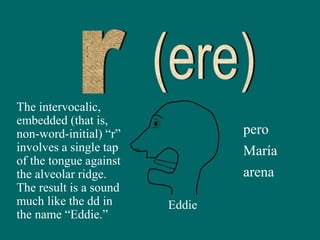
The intervocalic,
embedded (that is,
non-word-initial) “r”
involves a single tap
of the tongue against
the alveolar ridge.
The result is a sound
much like the dd in
the name “Eddie.”
Eddie
arena
pero
María
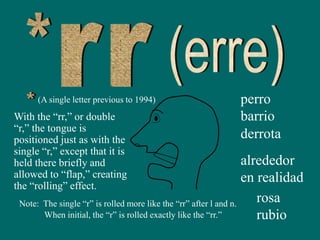
(A single letter previous to 1994)
With the “rr,” or double
“r,” the tongue is
positioned just as with the
single “r,” except that it is
held there briefly and
allowed to “flap,” creating
the “rolling” effect.
perro
barrio
derrota
Note: The single “r” is rolled more like the “rr” after l and n.
alrededor
en realidad
rosa
When initial, the “r” is rolled exactly like the “rr.” rubio
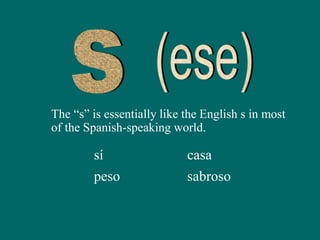
The “s” is essentially like the English s in most
of the Spanish-speaking world.
sí
peso
casa
sabroso
The “t” is similar to the English t except that it is,
again, more dental. The tongue is brought forward
against the upper teeth much as with the “d.” Like
the p and [k] sounds, the t is not aspirated.
té
Tito
tamal
patata
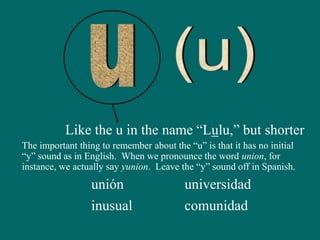
Like the u in the name “Lulu,” but shorter
The important thing to remember about the “u” is that it has no initial
“y” sound as in English. When we pronounce the word union, for
instance, we actually say yunion. Leave the “y” sound off in Spanish.
unión
inusual
universidad
comunidad
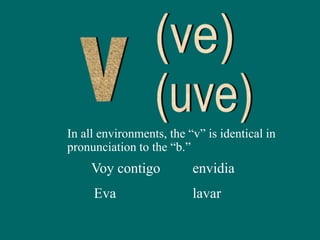
In all environments, the “v” is identical in
pronunciation to the “b.”
Voy contigo
Eva
envidia
lavar
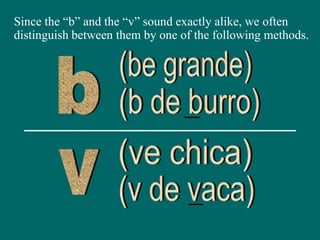
Since the “b” and the “v” sound exactly alike, we often
distinguish between them by one of the following methods.
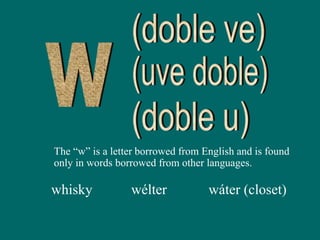
The “w” is a letter borrowed from English and is found
only in words borrowed from other languages.
whisky wélter wáter (closet)
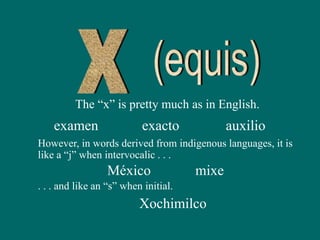
The “x” is pretty much as in English.
examen exacto auxilio
However, in words derived from indigenous languages, it is
like a “j” when intervocalic . . .
México mixe
. . . and like an “s” when initial.
Xochimilco
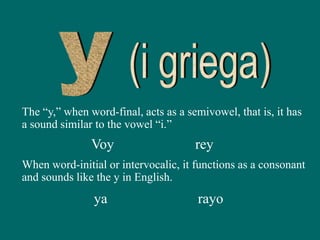
The “y,” when word-final, acts as a semivowel, that is, it has
a sound similar to the vowel “i.”
Voy
ya
rey
rayo
When word-initial or intervocalic, it functions as a consonant
and sounds like the y in English.
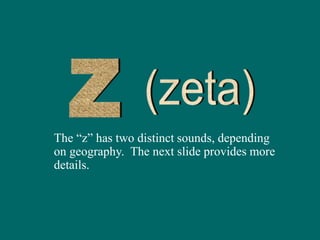
The “z” has two distinct sounds, depending
on geography. The next slide provides more
details.
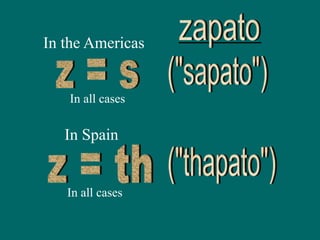
In the Americas
In Spain
In all cases
In all cases
Alphabetnotes

Alphabetnotes

  • 1.
  • 2.
    Like the ain “father,” but shorter más Examples: pasa nada mañana casa encantada Note: In this presentation, all vowels will be circled.
  • 3.
    The Spanish “b”is similar to the English “b” when initial (pronounced at the beginning of a phrase) or after the letters m or n. Bailo con María. el medio ambiente It is softer, allowing some air to pass through the lips, when intervocalic (located between vowels). No bailo bien. Iberia. Hablan bien. un banco Note: Also see “v.”
  • 4.
    The Spanish “c”has two distinct sounds, depending on its environment, that is, how it is located with respect to certain vowels. The next slide provides more details.
  • 5.
    In Spain, the“c” before e or i is pronounced “th” . . . before the following three vowels . . . before the following two vowels Unlike the English “k” sound, the hard Spanish c is not aspirated, that is, no air is expelled when it is pronounced.
  • 6.
    Until 1994, “ch”was a separate letter in Spanish, and words that began with this letter were found in a separate ch section in the dictionary after the section containing words beginning with c. It is pronounced like the English ch. charro chimichanga muchacho chica
  • 7.
    The Spanish “d”is similar to the English “d” but is pronounced with the tongue farther forward against the upper teeth. When initial or after the letters n or l, it is harder; Daniel es mi hermano. andar ¡Buena idea! nada when intervocalic, it is a bit softer, much like the voiced “th” sound in the English word “they.”
  • 8.
    Like the ein “they,” but without the “y” glide es tres mesa deporte interesante México
  • 9.
    The Spanish “f”is essentially identical to the English “f.” Fernando teléfono flan frente
  • 10.
    The Spanish “g”has three distinct sounds, depending on its environment. The next two slides provide more details.
  • 11.
    . . .before the following three vowels at the beginning of a phrase or after the letter “n”. In other cases, such as when intervocalic, the g is softer, somewhat like the g in sugar, before these three vowels.
  • 12.
    . . .before the following two vowels
  • 13.
    The “h” isalways completely silent. ospitalh olhalcootelh ablo español.H
  • 14.
    Like the eein “teeth” or the i in “machine,” but shorter mi niño libro tímido inteligente rico
  • 15.
    The “j” ispronounced in all cases like the “soft” g, that is, much like an h in English. In some areas, particularly Spain, the jota is pronounced more crisply, with a somewhat harsh or guttural sound. José hijo jarra atajo
  • 16.
    The “k” isa letter borrowed from Greek and is found only in words borrowed from other languages. The k is not aspirated in Spanish. kilogramo karate whisky
  • 17.
    The “l” ispronounced with the tip of the tongue against the alveolar ridge as in English; however, the tongue is held straight rather than slightly curled. alveolar ridge lotería Lalo azul
  • 18.
    Until 1994, “ll,”like “ch,” was a separate letter in Spanish, and words that began with this letter were listed separately in the dictionary. See the next slide for more information.
  • 19.
    The “ll” ispronounced like the English y. calle = caye In Spain, it was formerly pronounced as ly, and some conservative, older speakers still use this pronunciation. calle = calye
  • 20.
    The “m” ispronounced essentially like its English counterpart. mamá amor mole mensaje
  • 21.
    The “n” ispronounced very much like its English counterpart. nada Nora Elena máquina Before the consonants “b”, “p”, and “v”, the “n” is pronounced like an “m.” un beso un vaso un perro
  • 22.
    After the changesto the Spanish alphabet in 1994, the “ñ” is the one letter that still does not appear in the English alphabet. It is pronounced like the “ni” combination in the word onion. niño mañana año baño
  • 23.
    Like the oin “hope,” but without the glide mono perro yo no
  • 24.
    The “p” isunlike the English p in that the latter is aspirated, that is, a puff of air is expelled after the lips separate. In Spanish, we hold back the air, avoiding the “pop” that is heard in English. Pablo papá pata ropa
  • 25.
    The “q” isalways followed by “u,” as in English, except for a few foreign words such as Iraq, although this word can also be spelled Irak, since the sound of “q” is essentially identical to that of “k.” Like the p and [k] sounds, the q is not aspirated. queso pequeño quilate quien
  • 26.
    The intervocalic, embedded (thatis, non-word-initial) “r” involves a single tap of the tongue against the alveolar ridge. The result is a sound much like the dd in the name “Eddie.” Eddie arena pero María
  • 27.
    (A single letterprevious to 1994) With the “rr,” or double “r,” the tongue is positioned just as with the single “r,” except that it is held there briefly and allowed to “flap,” creating the “rolling” effect. perro barrio derrota Note: The single “r” is rolled more like the “rr” after l and n. alrededor en realidad rosa When initial, the “r” is rolled exactly like the “rr.” rubio
  • 28.
    The “s” isessentially like the English s in most of the Spanish-speaking world. sí peso casa sabroso
  • 29.
    The “t” issimilar to the English t except that it is, again, more dental. The tongue is brought forward against the upper teeth much as with the “d.” Like the p and [k] sounds, the t is not aspirated. té Tito tamal patata
  • 30.
    Like the uin the name “Lulu,” but shorter The important thing to remember about the “u” is that it has no initial “y” sound as in English. When we pronounce the word union, for instance, we actually say yunion. Leave the “y” sound off in Spanish. unión inusual universidad comunidad
  • 31.
    In all environments,the “v” is identical in pronunciation to the “b.” Voy contigo Eva envidia lavar
  • 32.
    Since the “b”and the “v” sound exactly alike, we often distinguish between them by one of the following methods.
  • 33.
    The “w” isa letter borrowed from English and is found only in words borrowed from other languages. whisky wélter wáter (closet)
  • 34.
    The “x” ispretty much as in English. examen exacto auxilio However, in words derived from indigenous languages, it is like a “j” when intervocalic . . . México mixe . . . and like an “s” when initial. Xochimilco
  • 35.
    The “y,” whenword-final, acts as a semivowel, that is, it has a sound similar to the vowel “i.” Voy ya rey rayo When word-initial or intervocalic, it functions as a consonant and sounds like the y in English.
  • 36.
    The “z” hastwo distinct sounds, depending on geography. The next slide provides more details.
  • 37.
    In the Americas InSpain In all cases In all cases