
OPENING PRAYER
PICTURE ANALYSIS
ENHANCING ACTIVITY
The Class will be divided into four group, each group will be
given a group task.
Group 1 – Slogan (Democracy Government)
Group 2 – Photo Collage (State/Elements of State)
Group 3 – Poster (Authoritarian Government)
Group 4 – Poem (Monarchy Government)
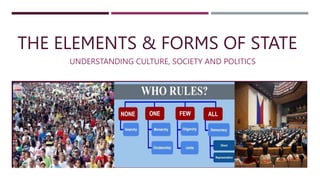
THE ELEMENTS & FORMS OF STATE
UNDERSTANDING CULTURE, SOCIETY AND POLITICS
STATE
 a state is an organized political community acting under
a government and united by common set of laws. It uses
absolute power in directing the path of a society.
 states differ in sovereignty, governance, geography, and
interests. It may be classified as sovereign if they are not
dependent on, or subject to, any other power or state.
THE STATE INTENDS TO BE A STRONG ACTOR IN THE PERFORMANCE OF THE
THREE IMPORTANT POLITICAL FUNCTIONS. THE STATE, IN FULL FORM,
1. maintains control over violence in its domain
2. allocates resources and rewards at its discretion, and
3. stands as the major focus of identity for the large
majority of the people under its authority.
ELEMENTS OF THE STATES
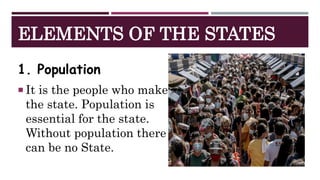
1. Population
 It is the people who make
the state. Population is
essential for the state.
Without population there
can be no State.
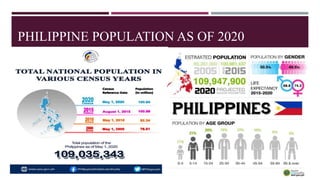
PHILIPPINE POPULATION AS OF 2020
ELEMENTS OF THE STATES
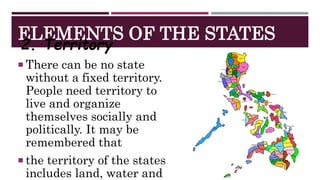
2. Territory
 There can be no state
without a fixed territory.
People need territory to
live and organize
themselves socially and
politically. It may be
remembered that
 the territory of the states
includes land, water and
ELEMENTS OF THE
STATES
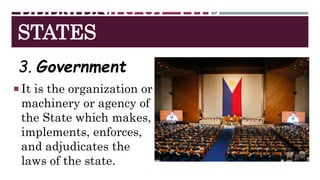
3. Government
 It is the organization or
machinery or agency of
the State which makes,
implements, enforces,
and adjudicates the
laws of the state.
ELEMENTS OF THE STATES
4. Sovereignty
 It is the most exclusive elements
of State. Without sovereignty no
state can exist. State has the
exclusive title and prerogative to
exercise supreme power over all
its people and territory. It is the
basis which the State regulates
all aspects of the life of the
people living in its territory.
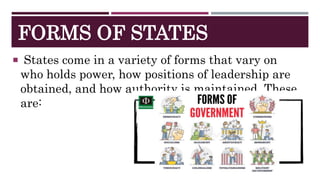
FORMS OF STATES
 States come in a variety of forms that vary on
who holds power, how positions of leadership are
obtained, and how authority is maintained. These
are:
AUTHORITARIAN GOVERNMENT
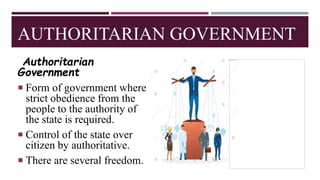
Authoritarian
Government
 Form of government where
strict obedience from the
people to the authority of
the state is required.
 Control of the state over
citizen by authoritative.
 There are several freedom.
AUTHORITARIAN GOVERNMENT
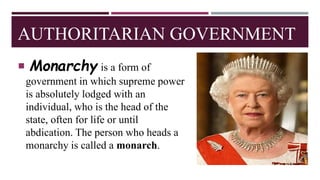
 Monarchy is a form of
government in which supreme power
is absolutely lodged with an
individual, who is the head of the
state, often for life or until
abdication. The person who heads a
monarchy is called a monarch.
AUTHORITARIAN GOVERNMENT
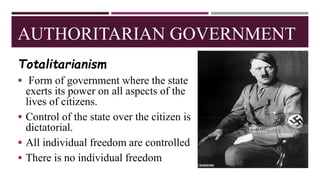
Totalitarianism
 Form of government where the state
exerts its power on all aspects of the
lives of citizens.
 Control of the state over the citizen is
dictatorial.
 All individual freedom are controlled
 There is no individual freedom
OLIGARCHIC GOVERNMENT
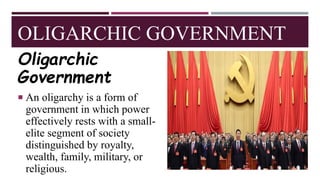
Oligarchic
Government
 An oligarchy is a form of
government in which power
effectively rests with a small-
elite segment of society
distinguished by royalty,
wealth, family, military, or
religious.
OLIGARCHIC
GOVERNMENT
 Theocracy is a
government by divine
guidance or by official who
are regarded as divinely
guided. Leaders are
members of the clergy, and
the state’s legal system is
based on religious law.
Contemporary examples of
theocracies include Saudi
Arabia, Iran, and the
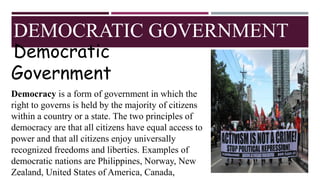
DEMOCRATIC GOVERNMENT
Democratic
Government
Democracy is a form of government in which the
right to governs is held by the majority of citizens
within a country or a state. The two principles of
democracy are that all citizens have equal access to
power and that all citizens enjoy universally
recognized freedoms and liberties. Examples of
democratic nations are Philippines, Norway, New
Zealand, United States of America, Canada,
THE ELEMENTS & FORMS OF STATE.pptx

THE ELEMENTS & FORMS OF STATE.pptx

  • 1.
  • 2.
  • 3.
    ENHANCING ACTIVITY The Classwill be divided into four group, each group will be given a group task. Group 1 – Slogan (Democracy Government) Group 2 – Photo Collage (State/Elements of State) Group 3 – Poster (Authoritarian Government) Group 4 – Poem (Monarchy Government)
  • 4.
    THE ELEMENTS &FORMS OF STATE UNDERSTANDING CULTURE, SOCIETY AND POLITICS
  • 5.
    STATE  a stateis an organized political community acting under a government and united by common set of laws. It uses absolute power in directing the path of a society.  states differ in sovereignty, governance, geography, and interests. It may be classified as sovereign if they are not dependent on, or subject to, any other power or state.
  • 6.
    THE STATE INTENDSTO BE A STRONG ACTOR IN THE PERFORMANCE OF THE THREE IMPORTANT POLITICAL FUNCTIONS. THE STATE, IN FULL FORM, 1. maintains control over violence in its domain 2. allocates resources and rewards at its discretion, and 3. stands as the major focus of identity for the large majority of the people under its authority.
  • 7.
    ELEMENTS OF THESTATES 1. Population  It is the people who make the state. Population is essential for the state. Without population there can be no State.
  • 8.
  • 9.
    ELEMENTS OF THESTATES 2. Territory  There can be no state without a fixed territory. People need territory to live and organize themselves socially and politically. It may be remembered that  the territory of the states includes land, water and
  • 10.
    ELEMENTS OF THE STATES 3.Government  It is the organization or machinery or agency of the State which makes, implements, enforces, and adjudicates the laws of the state.
  • 11.
    ELEMENTS OF THESTATES 4. Sovereignty  It is the most exclusive elements of State. Without sovereignty no state can exist. State has the exclusive title and prerogative to exercise supreme power over all its people and territory. It is the basis which the State regulates all aspects of the life of the people living in its territory.
  • 12.
    FORMS OF STATES States come in a variety of forms that vary on who holds power, how positions of leadership are obtained, and how authority is maintained. These are:
  • 13.
    AUTHORITARIAN GOVERNMENT Authoritarian Government  Formof government where strict obedience from the people to the authority of the state is required.  Control of the state over citizen by authoritative.  There are several freedom.
  • 14.
    AUTHORITARIAN GOVERNMENT  Monarchyis a form of government in which supreme power is absolutely lodged with an individual, who is the head of the state, often for life or until abdication. The person who heads a monarchy is called a monarch.
  • 15.
    AUTHORITARIAN GOVERNMENT Totalitarianism  Formof government where the state exerts its power on all aspects of the lives of citizens.  Control of the state over the citizen is dictatorial.  All individual freedom are controlled  There is no individual freedom
  • 16.
    OLIGARCHIC GOVERNMENT Oligarchic Government  Anoligarchy is a form of government in which power effectively rests with a small- elite segment of society distinguished by royalty, wealth, family, military, or religious.
  • 17.
    OLIGARCHIC GOVERNMENT  Theocracy isa government by divine guidance or by official who are regarded as divinely guided. Leaders are members of the clergy, and the state’s legal system is based on religious law. Contemporary examples of theocracies include Saudi Arabia, Iran, and the
  • 18.
    DEMOCRATIC GOVERNMENT Democratic Government Democracy isa form of government in which the right to governs is held by the majority of citizens within a country or a state. The two principles of democracy are that all citizens have equal access to power and that all citizens enjoy universally recognized freedoms and liberties. Examples of democratic nations are Philippines, Norway, New Zealand, United States of America, Canada,