Introduction to 
Politics 
lecturer: Mukhtar Abdalla Nor ( Raakici )
UNIT 2 
THE STATE AND IT IS ELEMENT 
• 2.1 Definition 
• 2.2 Elements 
• 2.3 State and society 
• 2.4 State and nation 
• 2.5 State and Government.
INTRODUCTION 
The modern term “state” is derived from the word 
“status”. It was Niccolo Machiavelli ( 1469 – 1527) 
who first used the term “state” in his writings. His 
important work is titled as “Prince”.
Definitions 
• Definitions : 
The state is the most universal and most powerful of 
all social institutions. The state is a natural institution. 
Aristotle said man is a social animal and by nature he is a 
political being. To him, to live in the state and to be a man 
were identical.
Definitions 
The state is the highest form of human association. It 
is necessary because it comes into existence out of the 
basic needs of life. It continues to remain for the sake of 
good life 
To Woodrow Wilson, “State is a people organized 
for law within a definite territory.” 
Aristotle defined the state as a “union of families 
and villages having for its end a perfect and self – sufficing 
life by which it meant a happy and good life”. Burgess 
defines the state as “a particular portion of mankind 
viewed as an organized unit.”
Definitions 
According to Sidgwick. “State is a combination or 
association of persons in the form of government and 
governed and united together into a politically organized 
people of a definite territory.” 
According to Garner, “State is a community of people live 
in a definite form of territory free of external control and 
possessing an organized government to which people 
show habitual agreement.” 
Prof. Laski defines “state as a territorial society divided 
into government and subjects whose relationships are 
determined by the exercise of supreme coercive power.”
THE ELEMENTS OF STATE 
From the above definitions, it is clear that the following are 
the elements of the state :- 
Physical bases of the State 
1. Population 
2. Territory 
Political bases of the State 
1. Government 
2. Sovereignty
THE ELEMENTS OF STATE 
Population Territory Government Sovereignty 
Population 
It is the people who make the state. Population is essential 
for the state. Greek thinkers were of the view that the 
population should neither be too big nor too small. 
According to Plato the ideal number would be 5040. 
According to Aristotle, the number should be neither too 
large nor too small. It should be large enough to be self 
sufficing and small enough to be well governed.
THE ELEMENTS OF STATE 
Greek thinkers like Plato and Aristotle thinking on the 
number was based on small city – states like Athens and 
Sparta. Modern states vary in population. India has a 
population of 102,70,15,247 people according to 2001 
census.
THE ELEMENTS OF STATE 
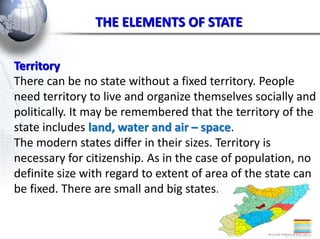
Territory 
There can be no state without a fixed territory. People 
need territory to live and organize themselves socially and 
politically. It may be remembered that the territory of the 
state includes land, water and air – space. 
The modern states differ in their sizes. Territory is 
necessary for citizenship. As in the case of population, no 
definite size with regard to extent of area of the state can 
be fixed. There are small and big states.
THE ELEMENTS OF STATE 
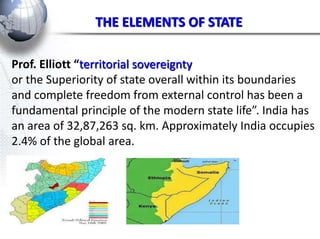
Prof. Elliott “territorial sovereignty 
or the Superiority of state overall within its boundaries 
and complete freedom from external control has been a 
fundamental principle of the modern state life”. India has 
an area of 32,87,263 sq. km. Approximately India occupies 
2.4% of the global area.
THE ELEMENTS OF STATE 
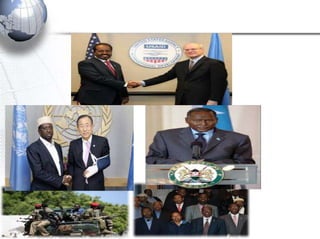
Government : Government is the third element of the 
state. There can be no state without government. 
Government is the working agency of the state. It is the 
political organization of the state. 
Prof. Appadorai defined government as the agency 
through which the force of the State is formulated, 
expressed and realized. 
According to C.F. Strong, in order to make and enforce 
laws the state must have highest authority. This is called 
the Government.
THE ELEMENTS OF STATE 
Sovereignty : 
The fourth essential element of the state is sovereignty. 
The word ”sovereignty” means supreme and final legal 
authority above and beyond which no legal power exists 
Sovereignty has two aspects : 
1) Internal sovereignty 
2) External sovereignty 
Internal sovereignty means that the State is supreme 
over all its citizens, and associations. 
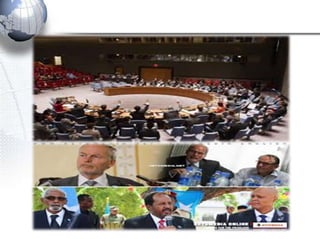
External sovereignty means that the state is 
independent and free from foreign or outside control.
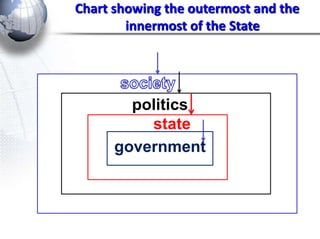
Chart showing the outermost and the 
innermost of the State 
politics 
state 
government
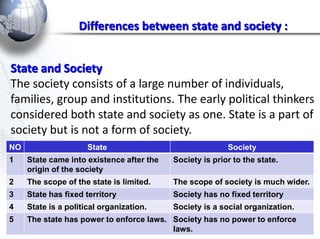
Differences between state and society : 
State and Society 
The society consists of a large number of individuals, 
families, group and institutions. The early political thinkers 
considered both state and society as one. State is a part of 
society but is not a form of society. 
NO State Society 
1 State came into existence after the 
origin of the society 
Society is prior to the state. 
2 The scope of the state is limited. The scope of society is much wider. 
3 State has fixed territory Society has no fixed territory 
4 State is a political organization. Society is a social organization. 
5 The state has power to enforce laws. Society has no power to enforce 
laws.
Differences between State and Nation : 
State and Nation: 
The word “nation” is derived from the Latin word “natio” 
hich means birth or race. The terms nation and state are 
used as synonym.
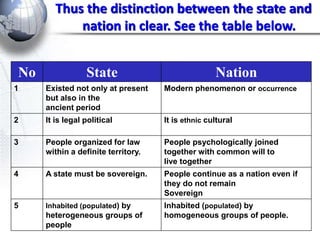
Thus the distinction between the state and 
nation in clear. See the table below. 
No State Nation 
1 Existed not only at present 
but also in the 
ancient period 
Modern phenomenon or occurrence 
2 It is legal political It is ethnic cultural 
3 People organized for law 
within a definite territory. 
People psychologically joined 
together with common will to 
live together 
4 A state must be sovereign. People continue as a nation even if 
they do not remain 
Sovereign 
5 Inhabited (populated) by 
heterogeneous groups of 
people 
Inhabited (populated) by 
homogeneous groups of people.
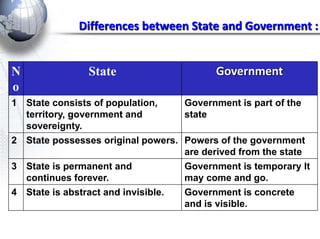
Differences between State and Government : 
State and Government: 
Government is often used with the ‘state’ as synonym. But 
both the government and the state are two different 
entities (unities). There are differences between the state 
and the government. They are explained in the table given 
below
N 
o 
Differences between State and Government : 
State Government 
1 State consists of population, 
territory, government and 
sovereignty. 
Government is part of the 
state 
2 State possesses original powers. Powers of the government 
are derived from the state 
3 State is permanent and 
continues forever. 
Government is temporary It 
may come and go. 
4 State is abstract and invisible. Government is concrete 
and is visible.
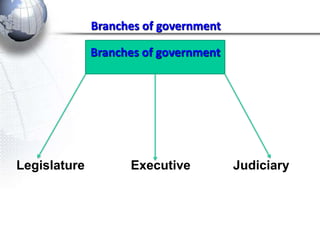
Branches of government 
Legislature Executive Judiciary
Branches of government 
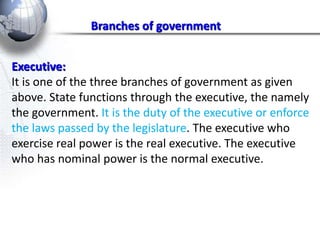
Executive: 
It is one of the three branches of government as given 
above. State functions through the executive, the namely 
the government. It is the duty of the executive or enforce 
the laws passed by the legislature. The executive who 
exercise real power is the real executive. The executive 
who has nominal power is the normal executive.
Powers and functions of executive are 
1. Enforcing law 
2. Maintaining peace and order. 
3. Repelling aggression (violence). 
4. Building friendly relations with other states 
5. When necessary to wage war to protect the country. 
6. Making appointments to higher posts. 
7. Raising money and spending them. 
8. Convening the sessions of the legislature and 
conducting business. 
9. Issues ordinances whenever the legislature is to in 
session.
10. Implement schemes and projects to improve he social 
and economic conditions of the people. 
11. Power to grant pardon, reprieve or remission of 
punishment. 
Legislature 
The legislature is the law making branch. The legislature 
has an important role in the adjustment of the 
constitution. The legislature is a deliberative body where 
matters of social, economic and political concerns are 
discussed, debated and decided.
Judiciary 
Judiciary: 
Judiciary is the third important organ of the government 
Machinery (equipment). Its main function is to interrupter 
laws and administer justice. 
Functions of Judiciary: 
1. Administration of justice. 
2. To determine what is law and what is the cope (deal 
with ) and meaning of it. 
3. To give advisory opinion on matters referred to it. 
4. To issue orders or writs for the purpose of preventing 
violation of rights and laws. 
5. To acts as guardian of the constitution
End

State and its elements

  • 1.
    Introduction to Politics lecturer: Mukhtar Abdalla Nor ( Raakici )
  • 2.
    UNIT 2 THESTATE AND IT IS ELEMENT • 2.1 Definition • 2.2 Elements • 2.3 State and society • 2.4 State and nation • 2.5 State and Government.
  • 3.
    INTRODUCTION The modernterm “state” is derived from the word “status”. It was Niccolo Machiavelli ( 1469 – 1527) who first used the term “state” in his writings. His important work is titled as “Prince”.
  • 4.
    Definitions • Definitions: The state is the most universal and most powerful of all social institutions. The state is a natural institution. Aristotle said man is a social animal and by nature he is a political being. To him, to live in the state and to be a man were identical.
  • 5.
    Definitions The stateis the highest form of human association. It is necessary because it comes into existence out of the basic needs of life. It continues to remain for the sake of good life To Woodrow Wilson, “State is a people organized for law within a definite territory.” Aristotle defined the state as a “union of families and villages having for its end a perfect and self – sufficing life by which it meant a happy and good life”. Burgess defines the state as “a particular portion of mankind viewed as an organized unit.”
  • 6.
    Definitions According toSidgwick. “State is a combination or association of persons in the form of government and governed and united together into a politically organized people of a definite territory.” According to Garner, “State is a community of people live in a definite form of territory free of external control and possessing an organized government to which people show habitual agreement.” Prof. Laski defines “state as a territorial society divided into government and subjects whose relationships are determined by the exercise of supreme coercive power.”
  • 7.
    THE ELEMENTS OFSTATE From the above definitions, it is clear that the following are the elements of the state :- Physical bases of the State 1. Population 2. Territory Political bases of the State 1. Government 2. Sovereignty
  • 8.
    THE ELEMENTS OFSTATE Population Territory Government Sovereignty Population It is the people who make the state. Population is essential for the state. Greek thinkers were of the view that the population should neither be too big nor too small. According to Plato the ideal number would be 5040. According to Aristotle, the number should be neither too large nor too small. It should be large enough to be self sufficing and small enough to be well governed.
  • 9.
    THE ELEMENTS OFSTATE Greek thinkers like Plato and Aristotle thinking on the number was based on small city – states like Athens and Sparta. Modern states vary in population. India has a population of 102,70,15,247 people according to 2001 census.
  • 10.
    THE ELEMENTS OFSTATE Territory There can be no state without a fixed territory. People need territory to live and organize themselves socially and politically. It may be remembered that the territory of the state includes land, water and air – space. The modern states differ in their sizes. Territory is necessary for citizenship. As in the case of population, no definite size with regard to extent of area of the state can be fixed. There are small and big states.
  • 11.
    THE ELEMENTS OFSTATE Prof. Elliott “territorial sovereignty or the Superiority of state overall within its boundaries and complete freedom from external control has been a fundamental principle of the modern state life”. India has an area of 32,87,263 sq. km. Approximately India occupies 2.4% of the global area.
  • 12.
    THE ELEMENTS OFSTATE Government : Government is the third element of the state. There can be no state without government. Government is the working agency of the state. It is the political organization of the state. Prof. Appadorai defined government as the agency through which the force of the State is formulated, expressed and realized. According to C.F. Strong, in order to make and enforce laws the state must have highest authority. This is called the Government.
  • 14.
    THE ELEMENTS OFSTATE Sovereignty : The fourth essential element of the state is sovereignty. The word ”sovereignty” means supreme and final legal authority above and beyond which no legal power exists Sovereignty has two aspects : 1) Internal sovereignty 2) External sovereignty Internal sovereignty means that the State is supreme over all its citizens, and associations. External sovereignty means that the state is independent and free from foreign or outside control.
  • 16.
    Chart showing theoutermost and the innermost of the State politics state government
  • 17.
    Differences between stateand society : State and Society The society consists of a large number of individuals, families, group and institutions. The early political thinkers considered both state and society as one. State is a part of society but is not a form of society. NO State Society 1 State came into existence after the origin of the society Society is prior to the state. 2 The scope of the state is limited. The scope of society is much wider. 3 State has fixed territory Society has no fixed territory 4 State is a political organization. Society is a social organization. 5 The state has power to enforce laws. Society has no power to enforce laws.
  • 18.
    Differences between Stateand Nation : State and Nation: The word “nation” is derived from the Latin word “natio” hich means birth or race. The terms nation and state are used as synonym.
  • 19.
    Thus the distinctionbetween the state and nation in clear. See the table below. No State Nation 1 Existed not only at present but also in the ancient period Modern phenomenon or occurrence 2 It is legal political It is ethnic cultural 3 People organized for law within a definite territory. People psychologically joined together with common will to live together 4 A state must be sovereign. People continue as a nation even if they do not remain Sovereign 5 Inhabited (populated) by heterogeneous groups of people Inhabited (populated) by homogeneous groups of people.
  • 20.
    Differences between Stateand Government : State and Government: Government is often used with the ‘state’ as synonym. But both the government and the state are two different entities (unities). There are differences between the state and the government. They are explained in the table given below
  • 21.
    N o Differencesbetween State and Government : State Government 1 State consists of population, territory, government and sovereignty. Government is part of the state 2 State possesses original powers. Powers of the government are derived from the state 3 State is permanent and continues forever. Government is temporary It may come and go. 4 State is abstract and invisible. Government is concrete and is visible.
  • 22.
    Branches of government Branches of government Legislature Executive Judiciary
  • 23.
    Branches of government Executive: It is one of the three branches of government as given above. State functions through the executive, the namely the government. It is the duty of the executive or enforce the laws passed by the legislature. The executive who exercise real power is the real executive. The executive who has nominal power is the normal executive.
  • 24.
    Powers and functionsof executive are 1. Enforcing law 2. Maintaining peace and order. 3. Repelling aggression (violence). 4. Building friendly relations with other states 5. When necessary to wage war to protect the country. 6. Making appointments to higher posts. 7. Raising money and spending them. 8. Convening the sessions of the legislature and conducting business. 9. Issues ordinances whenever the legislature is to in session.
  • 25.
    10. Implement schemesand projects to improve he social and economic conditions of the people. 11. Power to grant pardon, reprieve or remission of punishment. Legislature The legislature is the law making branch. The legislature has an important role in the adjustment of the constitution. The legislature is a deliberative body where matters of social, economic and political concerns are discussed, debated and decided.
  • 26.
    Judiciary Judiciary: Judiciaryis the third important organ of the government Machinery (equipment). Its main function is to interrupter laws and administer justice. Functions of Judiciary: 1. Administration of justice. 2. To determine what is law and what is the cope (deal with ) and meaning of it. 3. To give advisory opinion on matters referred to it. 4. To issue orders or writs for the purpose of preventing violation of rights and laws. 5. To acts as guardian of the constitution
  • 27.