What is the state?What is the state?
““state” v. “nation”state” v. “nation”
State – political community in a precise territory
Nation – large group of people unified by a common
race, language, custom or religion
When states are created by people unified by these
factors (nations), they are called nation-states (ie. France,
Poland)
FeaturesFeatures
Population
 consensus – states are more stable when people share
common beliefs and values
Distribution – migration of people can shift power from one
part of the state to another
Territory – established boundaries
Sovereignty – the government makes and enforces its
own laws with no interference from outsiders
Government – how a state keeps order in society,
provides services to its people, and enforces laws
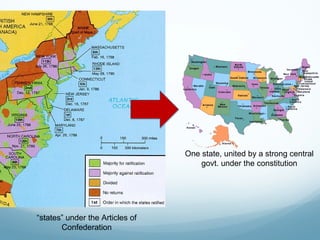
“states” under the Articles of
Confederation
One state, united by a strong central
govt. under the constitution
OriginsOrigins ofof thethe StateState
Why did people create the earliest governments? There
are several theories.
Evolutionary Theory – grew from families’ needs for more
organization
Force Theory – grew of the need to keep out enemies (ie.
City-states building walls, then coming under the control of
one person or group)
Divine Right Theory – rulers chosen by god(s) (ie. Ancient
Egypt, China)
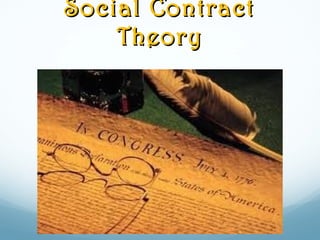
Social Contract Theory
Social ContractSocial Contract
TheoryTheory
 Challenge to divine right theory (1600s)
 Thomas Hobbes & John Locke
 There is a “state of nature” when there
is no govt
To create a govt, a social contract was
made
people gave up their rights to the
state in exchange for protection
govt. promised to preserve
people’s natural rights – LIFE,
LIBERTY, PROPERTY
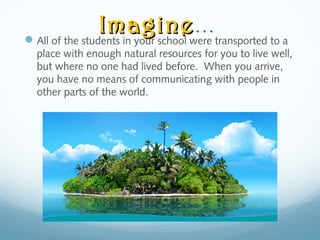
ImagineImagine…
All of the students in your school were transported to a
place with enough natural resources for you to live well,
but where no one had lived before. When you arrive,
you have no means of communicating with people in
other parts of the world.
GovernmentGovernment
When people decide to form the socialWhen people decide to form the social
contracts that we call governments, theycontracts that we call governments, they
make many different decisions about howmake many different decisions about how
their government will look.their government will look.
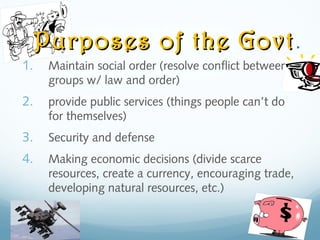
1. Maintain social order (resolve conflict between
groups w/ law and order)
2. provide public services (things people can’t do
for themselves)
3. Security and defense
4. Making economic decisions (divide scarce
resources, create a currency, encouraging trade,
developing natural resources, etc.)
Purposes of the GovtPurposes of the Govt.
How does govt fulfillHow does govt fulfill
these functions?these functions?
1. Legitimacy – willingness of the
people to obey the govt.
2. Use of force – police, courts,
military
Govt SystemsGovt Systems
1. Unitary – all power is with
central govt. (ex. France, Great
Britain)
2. Federal – power is divided
between central and state
govts. (ex. US!)
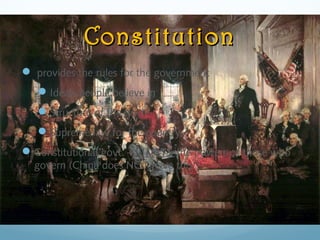
ConstitutionConstitution
 provides the rules for the government
Ideals people believe in
Structure of the govt.
Supreme law for the country
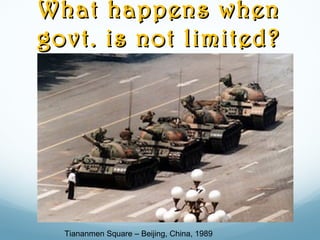
Constitutional govt. – LIMITS the powers of those who
govern (China does NOT have this!)
What happens whenWhat happens when
govt. is not limited?govt. is not limited?
Tiananmen Square – Beijing, China, 1989
Forms of GovernmentForms of Government
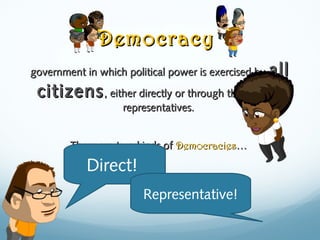
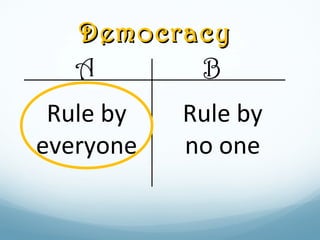
DemocracyDemocracy
government in which political power is exercised bygovernment in which political power is exercised by allall
citizenscitizens, either directly or through their elected, either directly or through their elected
representatives.representatives.
There are two kinds ofThere are two kinds of DemocraciesDemocracies……
Direct!
Representative!
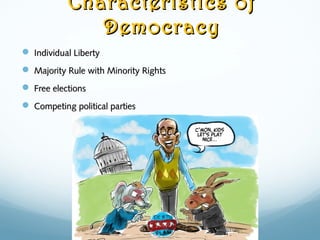
Characteristics ofCharacteristics of
DemocracyDemocracy
 Individual LibertyIndividual Liberty
 Majority Rule with Minority RightsMajority Rule with Minority Rights
 Free electionsFree elections
 Competing political partiesCompeting political parties
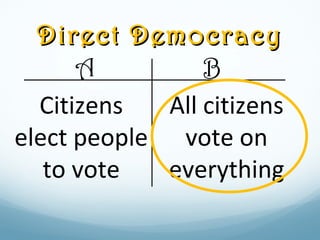
Direct DemocracyDirect Democracy
All citizens participate in governmentAll citizens participate in government..
All citizens can create public policy if they wantAll citizens can create public policy if they want
to.to.
Ex: In ancient Athens, Greece, they heldEx: In ancient Athens, Greece, they held
assemblies where citizens voted to pass laws.assemblies where citizens voted to pass laws.
no representatives in government: The citizensno representatives in government: The citizens
vote on everything!vote on everything!
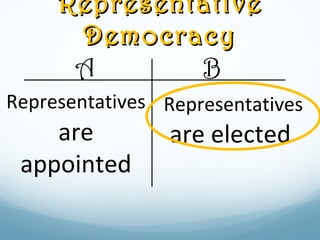
Representative DemocracyRepresentative Democracy
all citizens participate in government, BUTall citizens participate in government, BUT
People elect representatives who vote on lawsPeople elect representatives who vote on laws
for themfor them
Rep. answer to the people through electionsRep. answer to the people through elections
Rep. are held accountable by a constitutionRep. are held accountable by a constitution
Now that we’ve talked about
DIRECT
DEMOCRACY!And
REPRESENTATIVE
DEMOCRACY!
we can move on to
forms of government
where only one
person is in control…
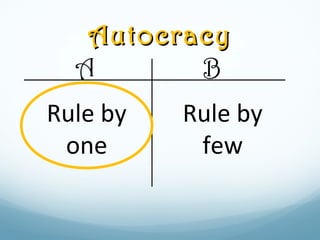
AutocracyAutocracy
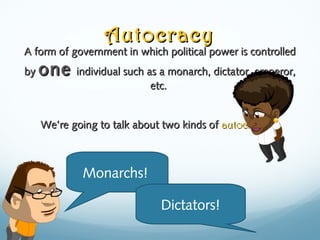
A form of government in which political power is controlledA form of government in which political power is controlled
byby oneone individual such as a monarch, dictator, emperor,individual such as a monarch, dictator, emperor,
etc.etc.
WeWe’re going to talk about two kinds of’re going to talk about two kinds of autocracyautocracy……
Monarchs!
Dictators!
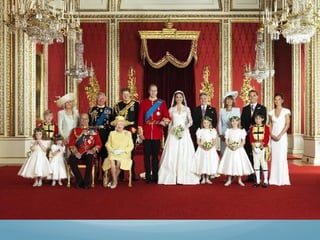
MonarchyMonarchy
Rule by kings, queens, princes, andRule by kings, queens, princes, and
princesses… sometimes by other names, butprincesses… sometimes by other names, but
always MONARCHS!always MONARCHS!
Leaders usually gain their power because theirLeaders usually gain their power because their
parents were rulers too.parents were rulers too.
Some modern monarchies like Spain and JapanSome modern monarchies like Spain and Japan
have constitutions.have constitutions.
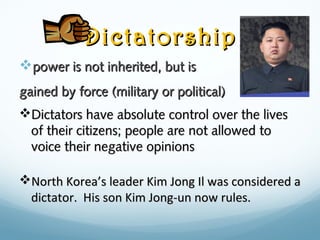
DictatorshipDictatorship
power is not inherited, but ispower is not inherited, but is
gained by force (military or political)gained by force (military or political)
Dictators have absolute control over the livesDictators have absolute control over the lives
of their citizens; people are not allowed toof their citizens; people are not allowed to
voice their negative opinionsvoice their negative opinions
North KoreaNorth Korea’s leader Kim Jong Il was considered a’s leader Kim Jong Il was considered a
dictator. His son Kim Jong-un now rules.dictator. His son Kim Jong-un now rules.
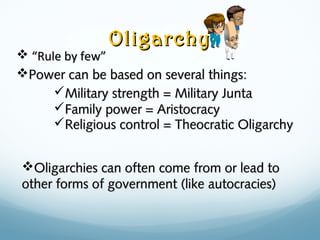
OligarchyOligarchy
 ““Rule by few”Rule by few”
Power can be based on several things:Power can be based on several things:
Military strength = Military JuntaMilitary strength = Military Junta
Family power = AristocracyFamily power = Aristocracy
Religious control = Theocratic OligarchyReligious control = Theocratic Oligarchy
Oligarchies can often come from or lead toOligarchies can often come from or lead to
other forms of government (like autocracies)other forms of government (like autocracies)
TheocracyTheocracy
““Theo” means “god” in Greek… so if aTheo” means “god” in Greek… so if a
government is THEO-cratic that means it is ruledgovernment is THEO-cratic that means it is ruled
by… That’s right! A god or higher power!by… That’s right! A god or higher power!
Leaders (Leaders (autocraticautocratic oror oligarchicoligarchic) are usually) are usually
religious leaders and society uses religious lawreligious leaders and society uses religious law
to settle its disputesto settle its disputes
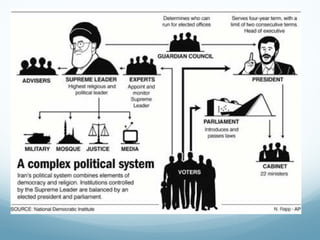
Example: The Islamic Republic of Iran is a modernExample: The Islamic Republic of Iran is a modern
theocracy that uses the holy Islamic book, Thetheocracy that uses the holy Islamic book, The
QurQur’an, as its guide.’an, as its guide.
AnarchyAnarchy
 No government at all…No government at all…
WAIT!
Then who makes and
enforces laws?
AnarchyAnarchy
 No government at all…No government at all…
In an anarchy there is no government to makeIn an anarchy there is no government to make
or enforce laws.or enforce laws.
What do you
think that would
be like?
LetLet’s Review!’s Review!
DemocracyDemocracy
A B
Rule by
everyone
Rule by
no one
Direct DemocracyDirect Democracy
A B
Citizens
elect people
to vote
All citizens
vote on
everything
RepresentativeRepresentative
DemocracyDemocracy
A B
Representatives
are
appointed
Representatives
are elected
AutocracyAutocracy
A B
Rule by
one
Rule by
few
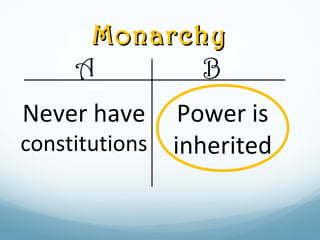
MonarchyMonarchy
A B
Never have
constitutions
Power is
inherited
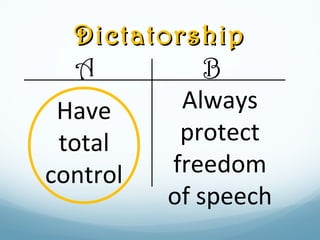
DictatorshipDictatorship
A B
Always
protect
freedom
of speech
Have
total
control
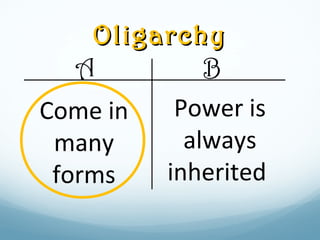
OligarchyOligarchy
A B
Power is
always
inherited
Come in
many
forms
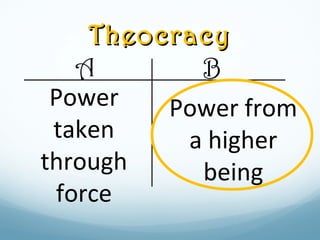
TheocracyTheocracy
A B
Power from
a higher
being
Power
taken
through
force
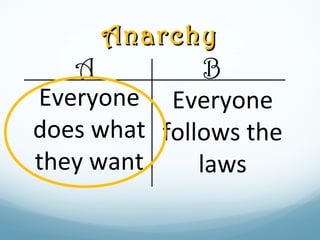
AnarchyAnarchy
A B
Everyone
follows the
laws
Everyone
does what
they want
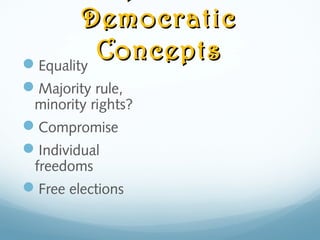
DemocraticDemocratic
ConceptsConceptsEquality
Majority rule,
minority rights?
Compromise
Individual
freedoms
Free elections
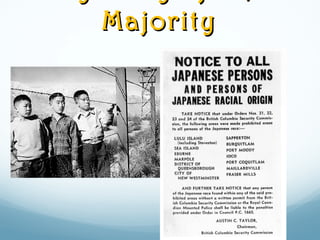
MajorityMajority
DoesDoes
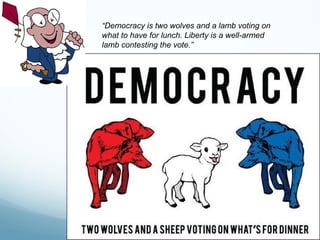
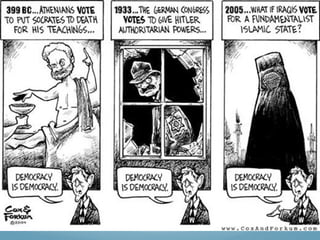
DEMOCRACY = LIBERTY?
“Democracy is two wolves and a lamb voting on
what to have for lunch. Liberty is a well-armed
lamb contesting the vote.”
Are Liberty and
Democracy Equivalent?
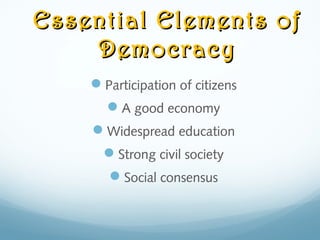
Essential Elements ofEssential Elements of
DemocracyDemocracy
Participation of citizens
A good economy
Widespread education
Strong civil society
Social consensus
Pre ClassPre Class
Imagine yourself in a community where all
order and authority have broken down. Violent
lawlessness is widespread. Do you think any
government is better than none? Explain your
answer.
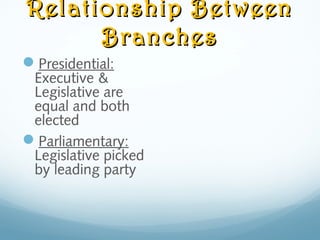
Relationship BetweenRelationship Between
BranchesBranches
Presidential:
Executive &
Legislative are
equal and both
elected
Parliamentary:
Legislative picked
by leading party
Spotlight Video:9/11 Commission

Chapter 1 - What is Government?

  • 1.
    What is thestate?What is the state?
  • 2.
    ““state” v. “nation”state”v. “nation” State – political community in a precise territory Nation – large group of people unified by a common race, language, custom or religion When states are created by people unified by these factors (nations), they are called nation-states (ie. France, Poland)
  • 3.
    FeaturesFeatures Population  consensus –states are more stable when people share common beliefs and values Distribution – migration of people can shift power from one part of the state to another Territory – established boundaries Sovereignty – the government makes and enforces its own laws with no interference from outsiders Government – how a state keeps order in society, provides services to its people, and enforces laws
  • 4.
    “states” under theArticles of Confederation One state, united by a strong central govt. under the constitution
  • 5.
    OriginsOrigins ofof thetheStateState Why did people create the earliest governments? There are several theories. Evolutionary Theory – grew from families’ needs for more organization Force Theory – grew of the need to keep out enemies (ie. City-states building walls, then coming under the control of one person or group) Divine Right Theory – rulers chosen by god(s) (ie. Ancient Egypt, China) Social Contract Theory
  • 6.
    Social ContractSocial Contract TheoryTheory Challenge to divine right theory (1600s)  Thomas Hobbes & John Locke  There is a “state of nature” when there is no govt To create a govt, a social contract was made people gave up their rights to the state in exchange for protection govt. promised to preserve people’s natural rights – LIFE, LIBERTY, PROPERTY
  • 7.
    ImagineImagine… All of thestudents in your school were transported to a place with enough natural resources for you to live well, but where no one had lived before. When you arrive, you have no means of communicating with people in other parts of the world.
  • 8.
    GovernmentGovernment When people decideto form the socialWhen people decide to form the social contracts that we call governments, theycontracts that we call governments, they make many different decisions about howmake many different decisions about how their government will look.their government will look.
  • 9.
    1. Maintain socialorder (resolve conflict between groups w/ law and order) 2. provide public services (things people can’t do for themselves) 3. Security and defense 4. Making economic decisions (divide scarce resources, create a currency, encouraging trade, developing natural resources, etc.) Purposes of the GovtPurposes of the Govt.
  • 10.
    How does govtfulfillHow does govt fulfill these functions?these functions? 1. Legitimacy – willingness of the people to obey the govt. 2. Use of force – police, courts, military
  • 11.
    Govt SystemsGovt Systems 1.Unitary – all power is with central govt. (ex. France, Great Britain) 2. Federal – power is divided between central and state govts. (ex. US!)
  • 12.
    ConstitutionConstitution  provides therules for the government Ideals people believe in Structure of the govt. Supreme law for the country Constitutional govt. – LIMITS the powers of those who govern (China does NOT have this!)
  • 13.
    What happens whenWhathappens when govt. is not limited?govt. is not limited? Tiananmen Square – Beijing, China, 1989
  • 14.
  • 15.
    DemocracyDemocracy government in whichpolitical power is exercised bygovernment in which political power is exercised by allall citizenscitizens, either directly or through their elected, either directly or through their elected representatives.representatives. There are two kinds ofThere are two kinds of DemocraciesDemocracies…… Direct! Representative!
  • 16.
    Characteristics ofCharacteristics of DemocracyDemocracy Individual LibertyIndividual Liberty  Majority Rule with Minority RightsMajority Rule with Minority Rights  Free electionsFree elections  Competing political partiesCompeting political parties
  • 17.
    Direct DemocracyDirect Democracy Allcitizens participate in governmentAll citizens participate in government.. All citizens can create public policy if they wantAll citizens can create public policy if they want to.to. Ex: In ancient Athens, Greece, they heldEx: In ancient Athens, Greece, they held assemblies where citizens voted to pass laws.assemblies where citizens voted to pass laws. no representatives in government: The citizensno representatives in government: The citizens vote on everything!vote on everything!
  • 18.
    Representative DemocracyRepresentative Democracy allcitizens participate in government, BUTall citizens participate in government, BUT People elect representatives who vote on lawsPeople elect representatives who vote on laws for themfor them Rep. answer to the people through electionsRep. answer to the people through elections Rep. are held accountable by a constitutionRep. are held accountable by a constitution
  • 19.
    Now that we’vetalked about DIRECT DEMOCRACY!And REPRESENTATIVE DEMOCRACY! we can move on to forms of government where only one person is in control…
  • 20.
    AutocracyAutocracy A form ofgovernment in which political power is controlledA form of government in which political power is controlled byby oneone individual such as a monarch, dictator, emperor,individual such as a monarch, dictator, emperor, etc.etc. WeWe’re going to talk about two kinds of’re going to talk about two kinds of autocracyautocracy…… Monarchs! Dictators!
  • 21.
    MonarchyMonarchy Rule by kings,queens, princes, andRule by kings, queens, princes, and princesses… sometimes by other names, butprincesses… sometimes by other names, but always MONARCHS!always MONARCHS! Leaders usually gain their power because theirLeaders usually gain their power because their parents were rulers too.parents were rulers too. Some modern monarchies like Spain and JapanSome modern monarchies like Spain and Japan have constitutions.have constitutions.
  • 22.
    DictatorshipDictatorship power is notinherited, but ispower is not inherited, but is gained by force (military or political)gained by force (military or political) Dictators have absolute control over the livesDictators have absolute control over the lives of their citizens; people are not allowed toof their citizens; people are not allowed to voice their negative opinionsvoice their negative opinions North KoreaNorth Korea’s leader Kim Jong Il was considered a’s leader Kim Jong Il was considered a dictator. His son Kim Jong-un now rules.dictator. His son Kim Jong-un now rules.
  • 23.
    OligarchyOligarchy  ““Rule byfew”Rule by few” Power can be based on several things:Power can be based on several things: Military strength = Military JuntaMilitary strength = Military Junta Family power = AristocracyFamily power = Aristocracy Religious control = Theocratic OligarchyReligious control = Theocratic Oligarchy Oligarchies can often come from or lead toOligarchies can often come from or lead to other forms of government (like autocracies)other forms of government (like autocracies)
  • 24.
    TheocracyTheocracy ““Theo” means “god”in Greek… so if aTheo” means “god” in Greek… so if a government is THEO-cratic that means it is ruledgovernment is THEO-cratic that means it is ruled by… That’s right! A god or higher power!by… That’s right! A god or higher power! Leaders (Leaders (autocraticautocratic oror oligarchicoligarchic) are usually) are usually religious leaders and society uses religious lawreligious leaders and society uses religious law to settle its disputesto settle its disputes Example: The Islamic Republic of Iran is a modernExample: The Islamic Republic of Iran is a modern theocracy that uses the holy Islamic book, Thetheocracy that uses the holy Islamic book, The QurQur’an, as its guide.’an, as its guide.
  • 26.
    AnarchyAnarchy  No governmentat all…No government at all… WAIT! Then who makes and enforces laws?
  • 27.
    AnarchyAnarchy  No governmentat all…No government at all… In an anarchy there is no government to makeIn an anarchy there is no government to make or enforce laws.or enforce laws. What do you think that would be like?
  • 28.
  • 29.
  • 30.
    Direct DemocracyDirect Democracy AB Citizens elect people to vote All citizens vote on everything
  • 31.
  • 32.
  • 33.
  • 34.
  • 35.
  • 36.
    TheocracyTheocracy A B Power from ahigher being Power taken through force
  • 37.
  • 38.
  • 39.
  • 40.
  • 41.
    “Democracy is twowolves and a lamb voting on what to have for lunch. Liberty is a well-armed lamb contesting the vote.”
  • 42.
  • 43.
    Essential Elements ofEssentialElements of DemocracyDemocracy Participation of citizens A good economy Widespread education Strong civil society Social consensus
  • 44.
    Pre ClassPre Class Imagineyourself in a community where all order and authority have broken down. Violent lawlessness is widespread. Do you think any government is better than none? Explain your answer.
  • 45.
    Relationship BetweenRelationship Between BranchesBranches Presidential: Executive& Legislative are equal and both elected Parliamentary: Legislative picked by leading party
  • 46.

Editor's Notes

  • #43 The cartoon was a reaction to Bush's response to a question on what would happen if Iraqi elections produced a fundamentalist Islamic government. As Bush was quoted: "I will be disappointed. But democracy is democracy," Bush said. "If that's what the people choose, that's what the people choose." What's disturbing about this quote is that it leaves the impression that Bush is unaware of what makes this country great. It's not simply that we practice democracy, it lies in the fact that we are republic based on a constitution that enshrines individual rights. This is a point that is lost in much of today's political debate, but is captured in the editorial cartoon superbly. Democracy is not an end and of itself, it must be limited by laws that protect the individual from the majority vote.