REGIMES, POWER
& LEGITIMACY
• RULES THAT A STATE SETS AND FOLLOWS IN
EXERTING IITS POWER
• The ability or right to control people or things,
political control of a country or area, a person
or organization that has a lot of control and
influence over other people or organizations
• Lawful; according to the laws or rule, genuine
or justifiable
- Government is the leadership in charge of
running the state
- If the state is a computer, the regime is the
software and the government is the operator
REGIME VS GOVERNMENT
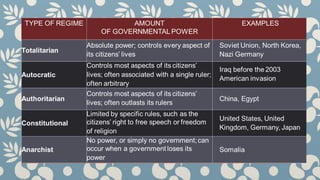
TYPES OF REGIMES
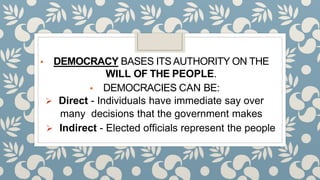
▪ DEMOCRACY BASES ITSAUTHORITY ON THE
WILL OF THE PEOPLE.
▪ DEMOCRACIES CAN BE:
 Direct - Individuals have immediate say over
many decisions that the government makes
 Indirect - Elected officials represent the people
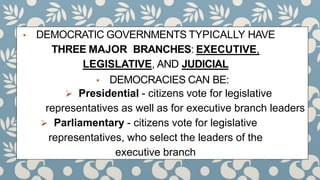
▪ DEMOCRATIC GOVERNMENTS TYPICALLY HAVE
THREE MAJOR BRANCHES: EXECUTIVE,
LEGISLATIVE, AND JUDICIAL
▪ DEMOCRACIES CAN BE:
 Presidential - citizens vote for legislative
representatives as well as for executive branch leaders
 Parliamentary - citizens vote for legislative
representatives, who select the leaders of the
executive branch
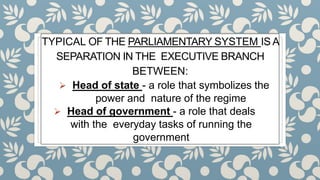
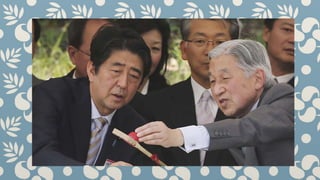
TYPICAL OF THE PARLIAMENTARY SYSTEM IS A
SEPARATION IN THE EXECUTIVE BRANCH
BETWEEN:
 Head of state - a role that symbolizes the
power and nature of the regime
 Head of government - a role that deals
with the everyday tasks of running the
government
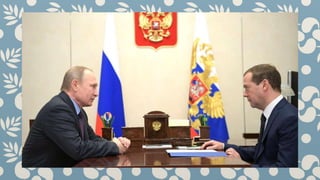
▪ Semi-Presidential System – A prime minister
coexists with a president who is directly elected
by the people and who holds a significant degree
of power
Decisions are made by political elites (those who hold
political power) without much input from citizens
AUTHORITARIANISM
- Some authoritarian regimes are based on
communism, a theory developed in the 19th
century by Karl Marx
- The communist party controls everything from
the government to the economy to social life.
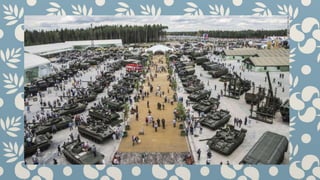
Military rule - a form of government where
political power resides with the military
Coup d’état - a forced takeover of the
government
> Co-optation - The means a regime uses to get support
from citizens
> Corporatism - An arrangement in which government
Officials interact with people/groups outside the government
before they set policy.
> Patron-clientelism - System in which the state provides
specific benefits or favors to a single person or small group in
return for public support.
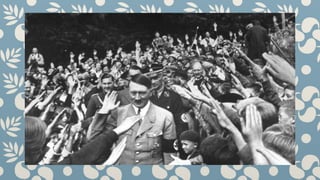
▪ Totalitarianism – Seeks to control and
transform all aspects of the political and
economic systems of the society
TYPES OF POWER
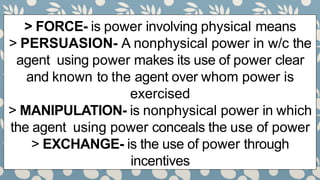
> FORCE- is power involving physical means
> PERSUASION- A nonphysical power in w/c the
agent using power makes its use of power clear
and known to the agent over whom power is
exercised
> MANIPULATION- is nonphysical power in which
the agent using power conceals the use of power
> EXCHANGE- is the use of power through
incentives
TYPES OF
LEGITIMACY
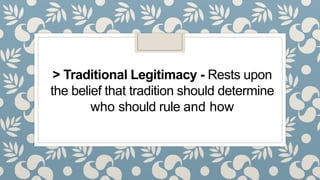
> Traditional Legitimacy - Rests upon
the belief that tradition should determine
who should rule and how
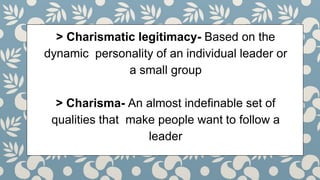
> Charismatic legitimacy- Based on the
dynamic personality of an individual leader or
a small group
> Charisma- An almost indefinable set of
qualities that make people want to follow a
leader
RATIONAL-LEGAL LEGITIMACY
Based on a system of well- established laws and
procedures. Rule of law may take two forms:
Common law - based on tradition, past practices,
and legal precedents set by the courts
Code law - based on a comprehensive system of
written rules (codes) of law divided into commercial,
civil, and criminal codes.
POLITICAL
CULTURE
- Refers to the collection of
political beliefs, values,
practices, and institutions that
the government is based on
TYPES OF POLITICAL
CULTURE
1. Consensual political culture - Citizens may
disagree on some political processes and
policies, they tend generally to agree on how
decisions are made, what issues should be
addressed, and how problems should be solved.
2. Conflictual political culture - Citizens are
sharply divided, often on both the legitimacy of
the regime and its solutions to major problems.
POLITICAL
IDEOLOGIES
- Sets of political values held by
individuals regarding the basic
goals of government and
politics.
1. Socialism- Shares the value of equality with communism but
is also influenced by the liberal value of freedom
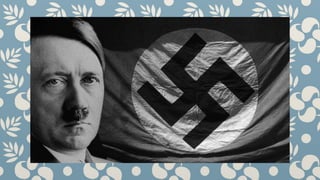
2. Fascism - The belief that the state has the right and the
responsibility to mold the society and economy and to
eliminate obstacles that might weaken them
3. Religions- Have always been an important source of group
identity and continue to be in the modern world
Regimes, Power  & Legitimacy (UCSP)

Regimes, Power & Legitimacy (UCSP)

  • 1.
  • 2.
    • RULES THATA STATE SETS AND FOLLOWS IN EXERTING IITS POWER
  • 3.
    • The abilityor right to control people or things, political control of a country or area, a person or organization that has a lot of control and influence over other people or organizations
  • 4.
    • Lawful; accordingto the laws or rule, genuine or justifiable
  • 5.
    - Government isthe leadership in charge of running the state - If the state is a computer, the regime is the software and the government is the operator REGIME VS GOVERNMENT
  • 6.
  • 9.
    ▪ DEMOCRACY BASESITSAUTHORITY ON THE WILL OF THE PEOPLE. ▪ DEMOCRACIES CAN BE:  Direct - Individuals have immediate say over many decisions that the government makes  Indirect - Elected officials represent the people
  • 10.
    ▪ DEMOCRATIC GOVERNMENTSTYPICALLY HAVE THREE MAJOR BRANCHES: EXECUTIVE, LEGISLATIVE, AND JUDICIAL ▪ DEMOCRACIES CAN BE:  Presidential - citizens vote for legislative representatives as well as for executive branch leaders  Parliamentary - citizens vote for legislative representatives, who select the leaders of the executive branch
  • 11.
    TYPICAL OF THEPARLIAMENTARY SYSTEM IS A SEPARATION IN THE EXECUTIVE BRANCH BETWEEN:  Head of state - a role that symbolizes the power and nature of the regime  Head of government - a role that deals with the everyday tasks of running the government
  • 12.
    ▪ Semi-Presidential System– A prime minister coexists with a president who is directly elected by the people and who holds a significant degree of power
  • 14.
    Decisions are madeby political elites (those who hold political power) without much input from citizens AUTHORITARIANISM
  • 16.
    - Some authoritarianregimes are based on communism, a theory developed in the 19th century by Karl Marx - The communist party controls everything from the government to the economy to social life.
  • 18.
    Military rule -a form of government where political power resides with the military Coup d’état - a forced takeover of the government
  • 19.
    > Co-optation -The means a regime uses to get support from citizens > Corporatism - An arrangement in which government Officials interact with people/groups outside the government before they set policy. > Patron-clientelism - System in which the state provides specific benefits or favors to a single person or small group in return for public support.
  • 21.
    ▪ Totalitarianism –Seeks to control and transform all aspects of the political and economic systems of the society
  • 23.
  • 24.
    > FORCE- ispower involving physical means > PERSUASION- A nonphysical power in w/c the agent using power makes its use of power clear and known to the agent over whom power is exercised > MANIPULATION- is nonphysical power in which the agent using power conceals the use of power > EXCHANGE- is the use of power through incentives
  • 25.
  • 26.
    > Traditional Legitimacy- Rests upon the belief that tradition should determine who should rule and how
  • 27.
    > Charismatic legitimacy-Based on the dynamic personality of an individual leader or a small group > Charisma- An almost indefinable set of qualities that make people want to follow a leader
  • 33.
    RATIONAL-LEGAL LEGITIMACY Based ona system of well- established laws and procedures. Rule of law may take two forms: Common law - based on tradition, past practices, and legal precedents set by the courts Code law - based on a comprehensive system of written rules (codes) of law divided into commercial, civil, and criminal codes.
  • 34.
  • 35.
    - Refers tothe collection of political beliefs, values, practices, and institutions that the government is based on
  • 36.
  • 37.
    1. Consensual politicalculture - Citizens may disagree on some political processes and policies, they tend generally to agree on how decisions are made, what issues should be addressed, and how problems should be solved. 2. Conflictual political culture - Citizens are sharply divided, often on both the legitimacy of the regime and its solutions to major problems.
  • 38.
  • 39.
    - Sets ofpolitical values held by individuals regarding the basic goals of government and politics.
  • 40.
    1. Socialism- Sharesthe value of equality with communism but is also influenced by the liberal value of freedom 2. Fascism - The belief that the state has the right and the responsibility to mold the society and economy and to eliminate obstacles that might weaken them 3. Religions- Have always been an important source of group identity and continue to be in the modern world