



IMMANUEL
KANT
Morality is not the
doctrine of how we may
make ourselves happy, but
how we may make
ourselves worthy of
happiness.
Immanuel Kant
We are not rich by what
we possess but by what
we can do without
Immanuel Kant
Immanuel Kant Biography
 A German philosopher
 Born on April 22, 1724, in Konigsberg, Prussia, or
what is now Kaliningrad, Russia.
 His death on February 12, 1804.(died at age 79.)
 His parent’s name Johann Georg Kant,& Anna Regina
Porter
 A professor of philosophy at Konigsberg, in Prussia.
 He spent his life in writing, lecturing, and
researching.
 From 1748 to 1754, Kant worked as a private tutor.
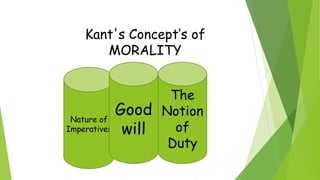
Kant's Concept’s of
MORALITY
Nature of
Imperatives
Good
will
The
Notion
of
Duty
Kant’s theory is an example of
a deontological moral theory–according
to these theories, the rightness or
wrongness of actions does not depend
on their consequences but on whether
they fulfill our duty.
THE NATURE OF
IMPERATIVES
• Imperative are commands
• For Kant there exist two:
1.Hypothetical Imperative
2.Categorical Imperative
What is an imperative?
 An imperative is a command. So,
"Pay your taxes!" is an imperative,
as are "Stop kicking me!" and "Don't
kill animals!"
Hypothetical Imperative
 Hypothetical Imperatives: these imperatives
command conditionally on your having a relevant
desire.
 E.g. “If you want to go to medical school, study
biology in college.” If you don’t want to go to
medical school, this command doesn’t apply to
you. Another example, your father says, "if you are
hungry, then go eat something!" - if you aren't
hungry, then you are free to ignore the command.
CATEGORICAL IMPERATIVE
 Categorical Imperatives: These command unconditionally. E.g.
“Don’t cheat on your taxes.” Even if you want to cheat and doing so
would serve your interests, you may not cheat.
 The categorical imperative has three different formulations.
1. The Formula of Universal Law - Act only on that maxim through
which you can at the same time will that it should become a universal
law
For example, I might make it my maxim to give at least as much to
charity each year as I spend on eating out, or I might make it my
maxim only to do what will benefit some member of my family.
2. Basic idea: The command states,
crudely, that you are not allowed to do
anything yourself that you would not be
willing to allow everyone else to do as
well. You are not allowed to make
exceptions for yourself.
For example, if you expect other people
to keep their promises, then you are
obligated to keep your own promises.
3. More detail: More accurately, it commands that every
maxim you act on must be such that you are willing to make
it the case that everyone always act on that maxim when in
a similar situation.
For example, if I wanted to lie to get something I wanted, I
would have to be willing to make it the case that everyone
always lied to get what they wanted - but if this were to
happen no one would ever believe you, so the lie would not
work and you would not get what you wanted. So, if you
willed that such a maxim (of lying) should become a
universal law, then you would thwart your goal - thus, it is
impermissible to lie, according to the categorical
imperative. It is impermissible because the only way to lie
is to make an exception for yourself.
Kant on Moral Worth
 The Moral Worth of Persons: A person's
actions determine her moral worth, but
there is more to this than merely seeing if
the actions are right or wrong.
 motivation is what matters -Moral worth only
comes when you do something because you
know that it is your duty and you would do it
regardless of whether you liked it.
 consequences don't matter - If both people act for the
right reasons, then both are morally worthy, even if the
actions of one of them happen to lead to bad
consequences by bad luck.
 wrong interpretation
- The intended consequence of feeding starving children
was good, and the actual consequences were bad. Kant
is not saying that we should look at the intended
consequences in order to make a moral evaluation.
 Kant does not forbid happiness
- You can get moral worth doing things that you enjoy,
but the reason you are doing them cannot be that you
enjoy them, the reason must be that they are required
by duty.

IMMANUEL KANT.

  • 1.
  • 2.
    Morality is notthe doctrine of how we may make ourselves happy, but how we may make ourselves worthy of happiness. Immanuel Kant
  • 3.
    We are notrich by what we possess but by what we can do without Immanuel Kant
  • 4.
    Immanuel Kant Biography A German philosopher  Born on April 22, 1724, in Konigsberg, Prussia, or what is now Kaliningrad, Russia.  His death on February 12, 1804.(died at age 79.)  His parent’s name Johann Georg Kant,& Anna Regina Porter  A professor of philosophy at Konigsberg, in Prussia.  He spent his life in writing, lecturing, and researching.  From 1748 to 1754, Kant worked as a private tutor.
  • 5.
    Kant's Concept’s of MORALITY Natureof Imperatives Good will The Notion of Duty
  • 6.
    Kant’s theory isan example of a deontological moral theory–according to these theories, the rightness or wrongness of actions does not depend on their consequences but on whether they fulfill our duty.
  • 7.
    THE NATURE OF IMPERATIVES •Imperative are commands • For Kant there exist two: 1.Hypothetical Imperative 2.Categorical Imperative
  • 8.
    What is animperative?  An imperative is a command. So, "Pay your taxes!" is an imperative, as are "Stop kicking me!" and "Don't kill animals!"
  • 9.
    Hypothetical Imperative  HypotheticalImperatives: these imperatives command conditionally on your having a relevant desire.  E.g. “If you want to go to medical school, study biology in college.” If you don’t want to go to medical school, this command doesn’t apply to you. Another example, your father says, "if you are hungry, then go eat something!" - if you aren't hungry, then you are free to ignore the command.
  • 10.
    CATEGORICAL IMPERATIVE  CategoricalImperatives: These command unconditionally. E.g. “Don’t cheat on your taxes.” Even if you want to cheat and doing so would serve your interests, you may not cheat.  The categorical imperative has three different formulations. 1. The Formula of Universal Law - Act only on that maxim through which you can at the same time will that it should become a universal law For example, I might make it my maxim to give at least as much to charity each year as I spend on eating out, or I might make it my maxim only to do what will benefit some member of my family.
  • 11.
    2. Basic idea:The command states, crudely, that you are not allowed to do anything yourself that you would not be willing to allow everyone else to do as well. You are not allowed to make exceptions for yourself. For example, if you expect other people to keep their promises, then you are obligated to keep your own promises.
  • 12.
    3. More detail:More accurately, it commands that every maxim you act on must be such that you are willing to make it the case that everyone always act on that maxim when in a similar situation. For example, if I wanted to lie to get something I wanted, I would have to be willing to make it the case that everyone always lied to get what they wanted - but if this were to happen no one would ever believe you, so the lie would not work and you would not get what you wanted. So, if you willed that such a maxim (of lying) should become a universal law, then you would thwart your goal - thus, it is impermissible to lie, according to the categorical imperative. It is impermissible because the only way to lie is to make an exception for yourself.
  • 13.
    Kant on MoralWorth  The Moral Worth of Persons: A person's actions determine her moral worth, but there is more to this than merely seeing if the actions are right or wrong.  motivation is what matters -Moral worth only comes when you do something because you know that it is your duty and you would do it regardless of whether you liked it.
  • 14.
     consequences don'tmatter - If both people act for the right reasons, then both are morally worthy, even if the actions of one of them happen to lead to bad consequences by bad luck.  wrong interpretation - The intended consequence of feeding starving children was good, and the actual consequences were bad. Kant is not saying that we should look at the intended consequences in order to make a moral evaluation.  Kant does not forbid happiness - You can get moral worth doing things that you enjoy, but the reason you are doing them cannot be that you enjoy them, the reason must be that they are required by duty.