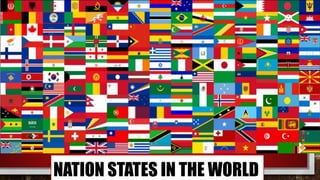
NATION STATES IN THE WORLD
WHAT IS A NATION?
•A nation is a stable community of people formed on the
basis of a common language, territory, history, ethnicity,
or a common culture. A nation is more overtly political
than an ethnic group; it has been described as "a fully
mobilized or institutionalized ethnic group"
WHAT IS STATE?
•A state is more than a government that is clear.
Government changes, but state endure. A state is the
means of rule over a defined or “sovereign” territory. It is
compromised of an executive, a bureaucracy, courts and
other institutions.
4 ELEMENTS OF STATE
POPULATION
TERRITORY
GOVERNMENT
SOVEREIGNTY
POPULATION
A total of individuals
occupying an area
Worldometers.info
TERRITORY
Area that controlled
by the government
TERRITORY
The Archipelagic Principle of Territoriality
An Archipelago is defined as a sea or part of a sea studded with the islands,
often synonymous with island groups,
or as a large group of islands in an
extensive body of water, such as sea.
(Deleon, 1997)
TERRITORY
The Archipelagic Principle of Territoriality
In various conference of the United Nations on the Law of the Sea,
the Philippines and other archipelago states proposed that an archipelago
composed of groups of islands forming a state is a single unit,
With the islands and the waters within the baselines are internal waters.
TERRITORY
Internal Waters
Internal Waters are the waters around,
between and connecting the islands of the archipelago,
regardless of their breath and dimension.
TERRITORY
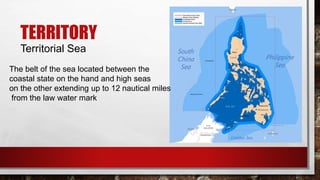
Territorial Sea
The belt of the sea located between the
coastal state on the hand and high seas
on the other extending up to 12 nautical miles
from the law water mark
TERRITORY
Exclusive Economic Zone
Body of water extending up to 200 nautical miles,
within which the state may sovereign rights to explore,
exploit, conserve and manage the natural resources
GOVERNMENT
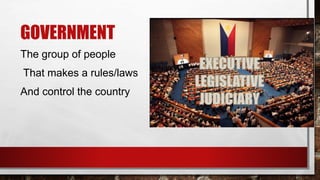
The group of people
That makes a rules/laws
And control the country
GOVERNMENT
The executive branch is composed of the president
And the vice president who are elected by direct popular vote
And serve a term of six years.
The constitution grants the president authority to appoint his cabinet.
These departments form a large portion of the country's bureaucracy.
GOVERNMENT
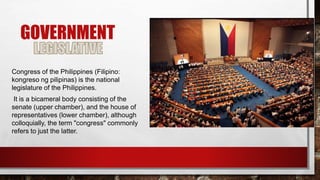
Congress of the Philippines (Filipino:
kongreso ng pilipinas) is the national
legislature of the Philippines.
It is a bicameral body consisting of the
senate (upper chamber), and the house of
representatives (lower chamber), although
colloquially, the term "congress" commonly
refers to just the latter.
GOVERNMENT
•The judicial power is vested in the supreme court of
the Philippines and lower courts established by law.
•The supreme court, which has a chief justice as its
head and 14 associate justices, occupies the highest
tier of the judiciary. The justices serve until the age of
70.
SOVEREIGNTY
• Sovereignty is the full right and power of
a governing body over itself, without any
interference from outside sources or
bodies.
• In political theory, sovereignty is a
substantive term designating supreme
legitimate authority over some polity. In
international law, sovereignty is the
exercise of power by a state.
GLOBALIZATION
GLOBALIZATION
Globalization is the word used to describe the growing
interdependence of the world’s economies, cultures, and
populations, brought about by cross-border trade in goods and
services, technology, and flows of investment, people, and
information.
Nation State and Globalization

Nation State and Globalization

  • 2.
  • 4.
    WHAT IS ANATION? •A nation is a stable community of people formed on the basis of a common language, territory, history, ethnicity, or a common culture. A nation is more overtly political than an ethnic group; it has been described as "a fully mobilized or institutionalized ethnic group"
  • 6.
    WHAT IS STATE? •Astate is more than a government that is clear. Government changes, but state endure. A state is the means of rule over a defined or “sovereign” territory. It is compromised of an executive, a bureaucracy, courts and other institutions.
  • 7.
    4 ELEMENTS OFSTATE POPULATION TERRITORY GOVERNMENT SOVEREIGNTY
  • 8.
    POPULATION A total ofindividuals occupying an area Worldometers.info
  • 9.
  • 10.
    TERRITORY The Archipelagic Principleof Territoriality An Archipelago is defined as a sea or part of a sea studded with the islands, often synonymous with island groups, or as a large group of islands in an extensive body of water, such as sea. (Deleon, 1997)
  • 11.
    TERRITORY The Archipelagic Principleof Territoriality In various conference of the United Nations on the Law of the Sea, the Philippines and other archipelago states proposed that an archipelago composed of groups of islands forming a state is a single unit, With the islands and the waters within the baselines are internal waters.
  • 12.
    TERRITORY Internal Waters Internal Watersare the waters around, between and connecting the islands of the archipelago, regardless of their breath and dimension.
  • 13.
    TERRITORY Territorial Sea The beltof the sea located between the coastal state on the hand and high seas on the other extending up to 12 nautical miles from the law water mark
  • 14.
    TERRITORY Exclusive Economic Zone Bodyof water extending up to 200 nautical miles, within which the state may sovereign rights to explore, exploit, conserve and manage the natural resources
  • 15.
    GOVERNMENT The group ofpeople That makes a rules/laws And control the country
  • 16.
    GOVERNMENT The executive branchis composed of the president And the vice president who are elected by direct popular vote And serve a term of six years. The constitution grants the president authority to appoint his cabinet. These departments form a large portion of the country's bureaucracy.
  • 18.
    GOVERNMENT Congress of thePhilippines (Filipino: kongreso ng pilipinas) is the national legislature of the Philippines. It is a bicameral body consisting of the senate (upper chamber), and the house of representatives (lower chamber), although colloquially, the term "congress" commonly refers to just the latter.
  • 19.
    GOVERNMENT •The judicial poweris vested in the supreme court of the Philippines and lower courts established by law. •The supreme court, which has a chief justice as its head and 14 associate justices, occupies the highest tier of the judiciary. The justices serve until the age of 70.
  • 21.
    SOVEREIGNTY • Sovereignty isthe full right and power of a governing body over itself, without any interference from outside sources or bodies. • In political theory, sovereignty is a substantive term designating supreme legitimate authority over some polity. In international law, sovereignty is the exercise of power by a state.
  • 22.
  • 23.
    GLOBALIZATION Globalization is theword used to describe the growing interdependence of the world’s economies, cultures, and populations, brought about by cross-border trade in goods and services, technology, and flows of investment, people, and information.