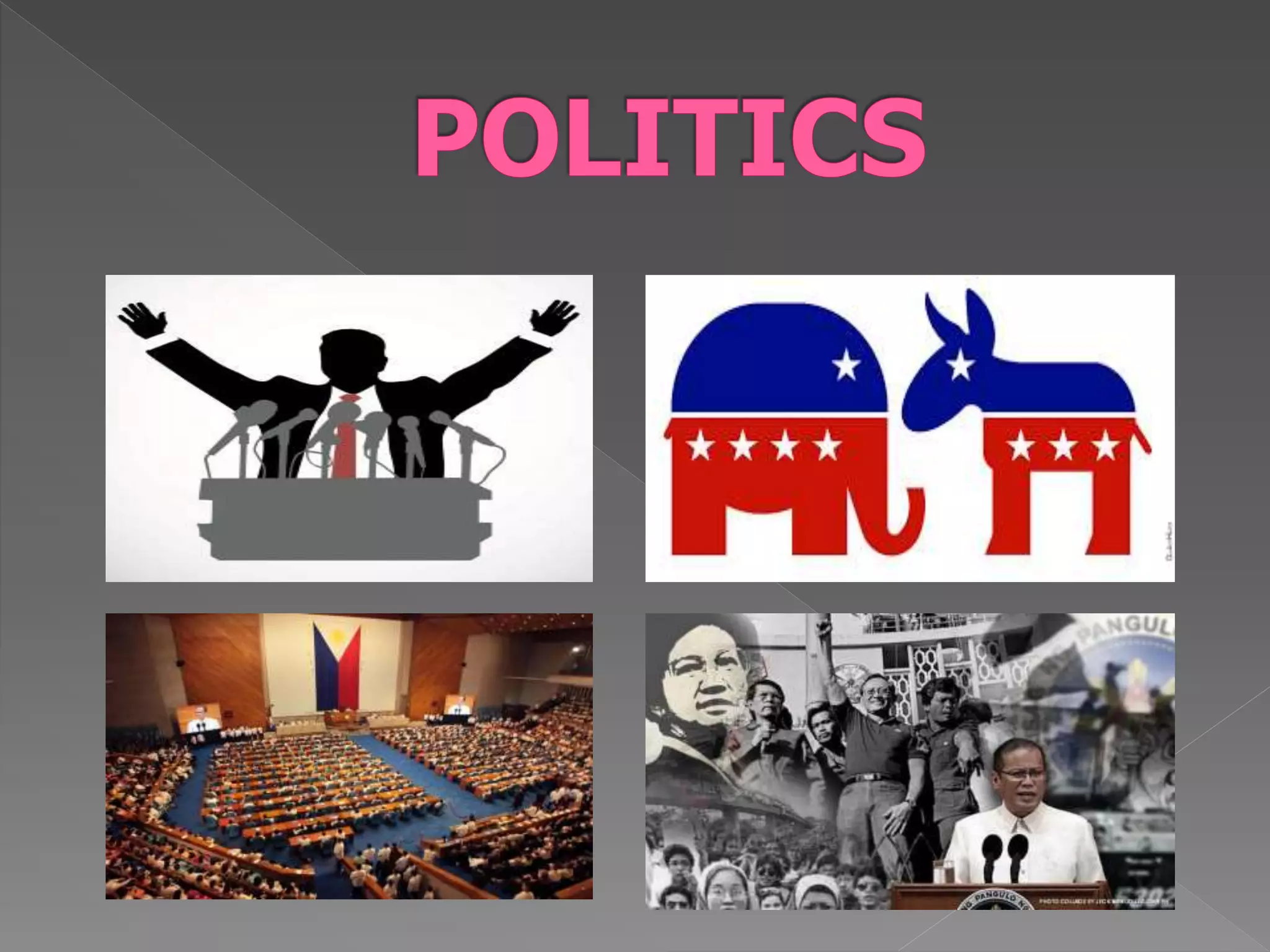
Political science is the systematic study of politics and government. It examines political systems and political behavior. Key areas studied include public policy, national politics, political theory, international relations, and comparative politics. Political science has its origins in Ancient Greece and aims to discover principles to guide public affairs and serve as models for government officials and citizens.
The term politicalscience is the
systematic study of the state and
the government
Political Science is a social
science regarding the practice
and theory of politics, the
analysis of political systems, and
the study of political behavior.
11.
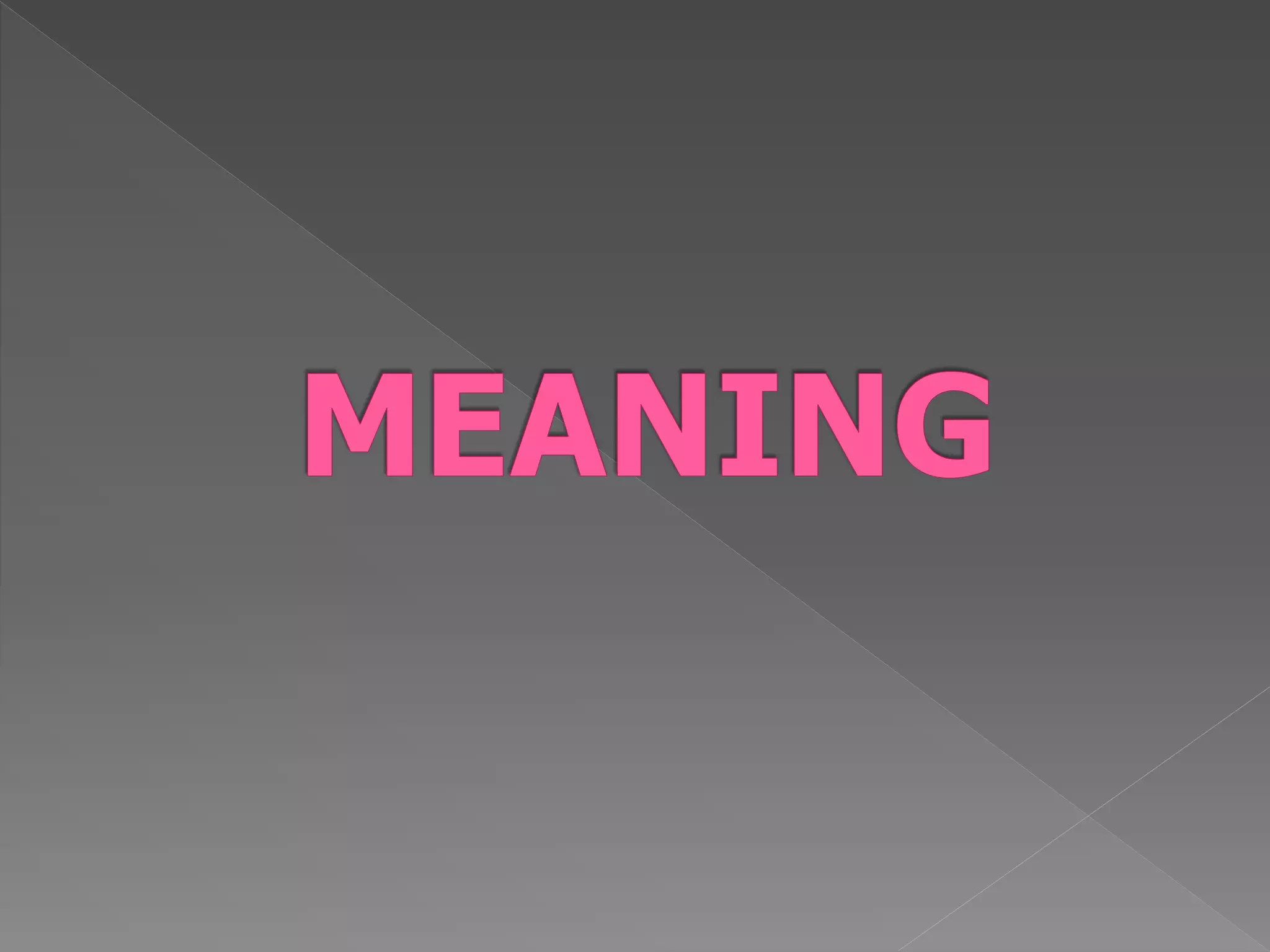
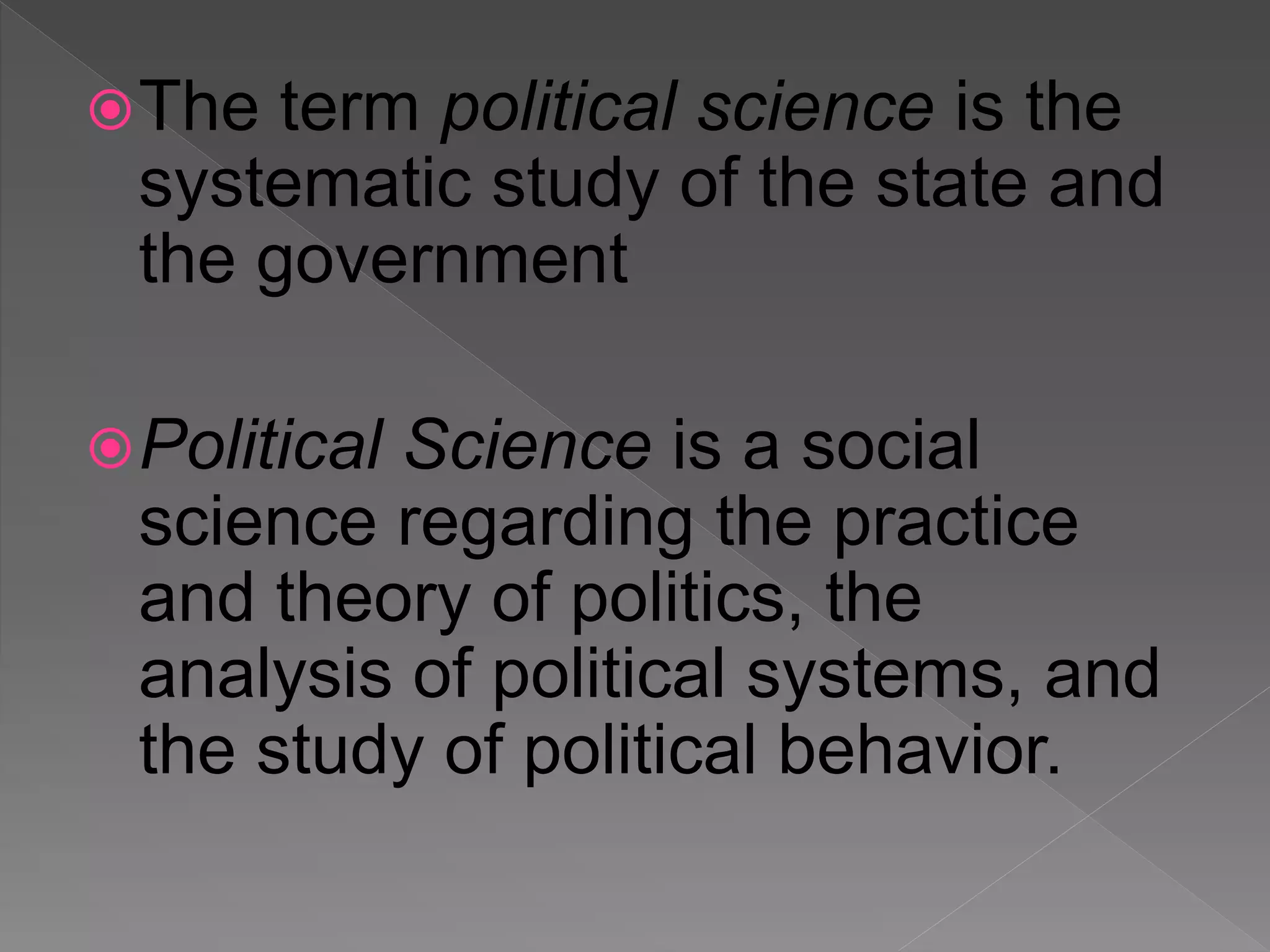
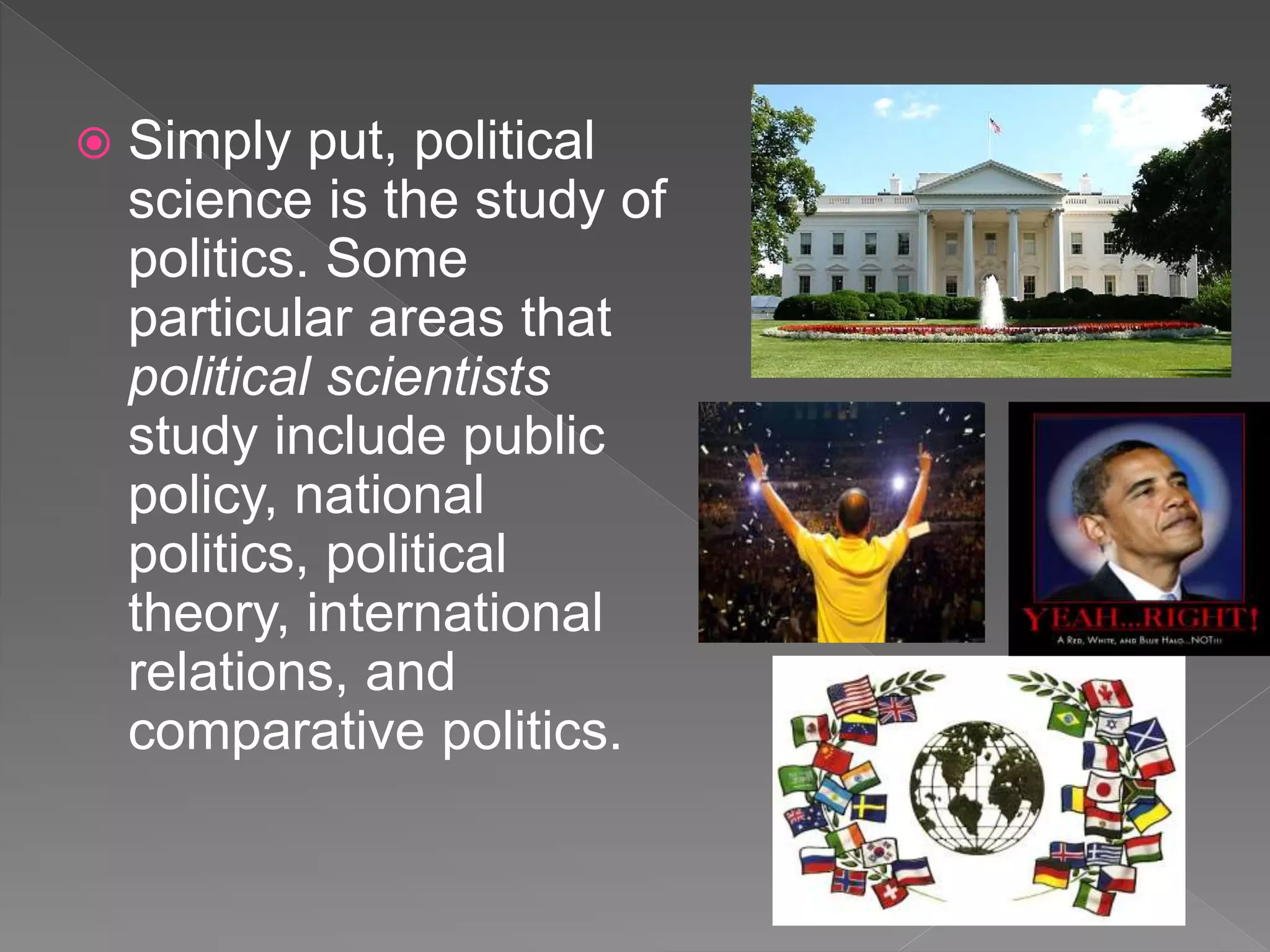
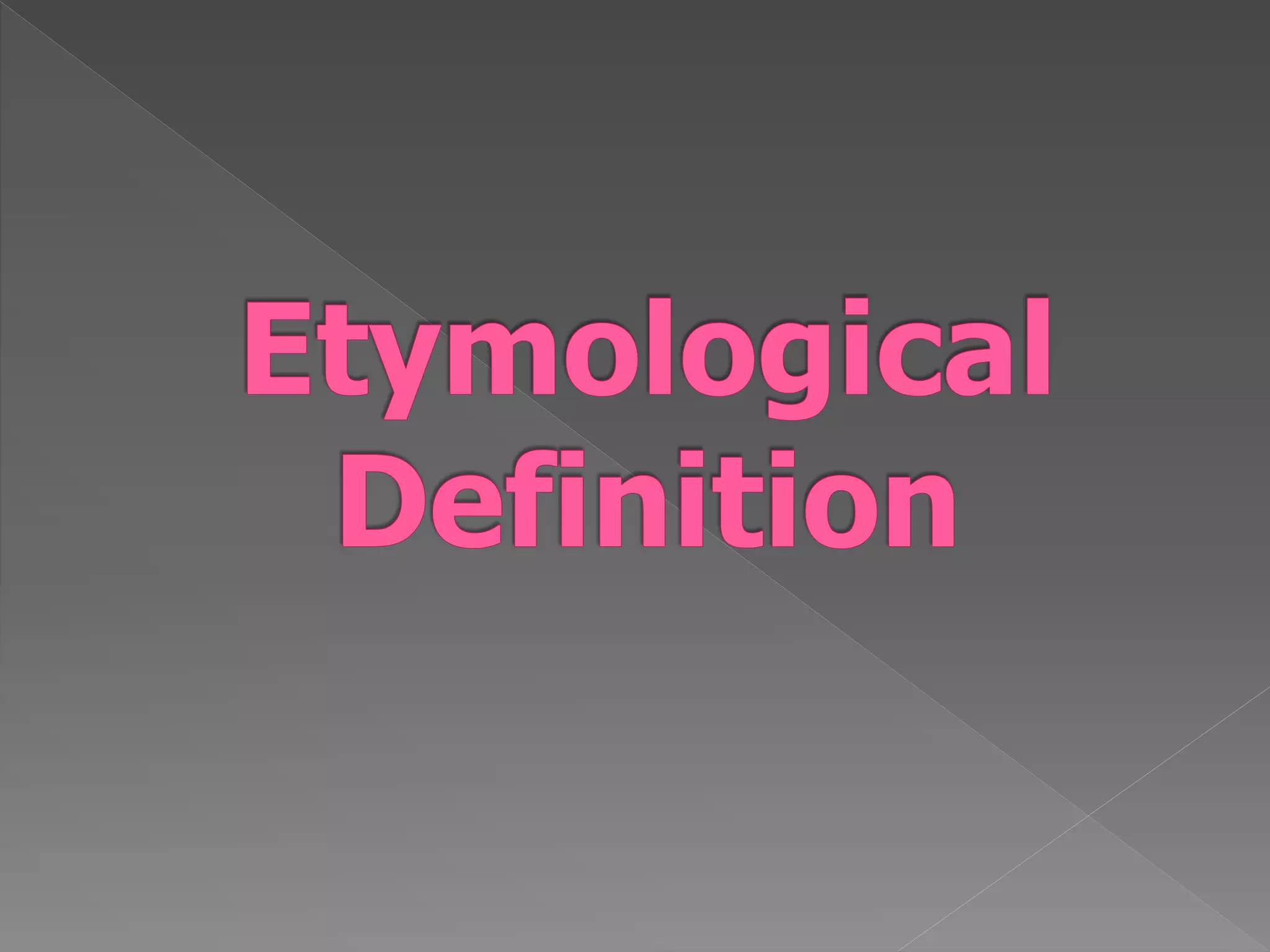
Simply put,political
science is the study of
politics. Some
particular areas that
political scientists
study include public
policy, national
politics, political
theory, international
relations, and
comparative politics.
13.
Greek
›The word politicshas its origins
in Ancient Greece. All of the
cities in Ancient Greece, such
as Athens, Sparta, and Corinth,
were referred to as city-states
and the Greek word for a city-
state was polis (πολις)
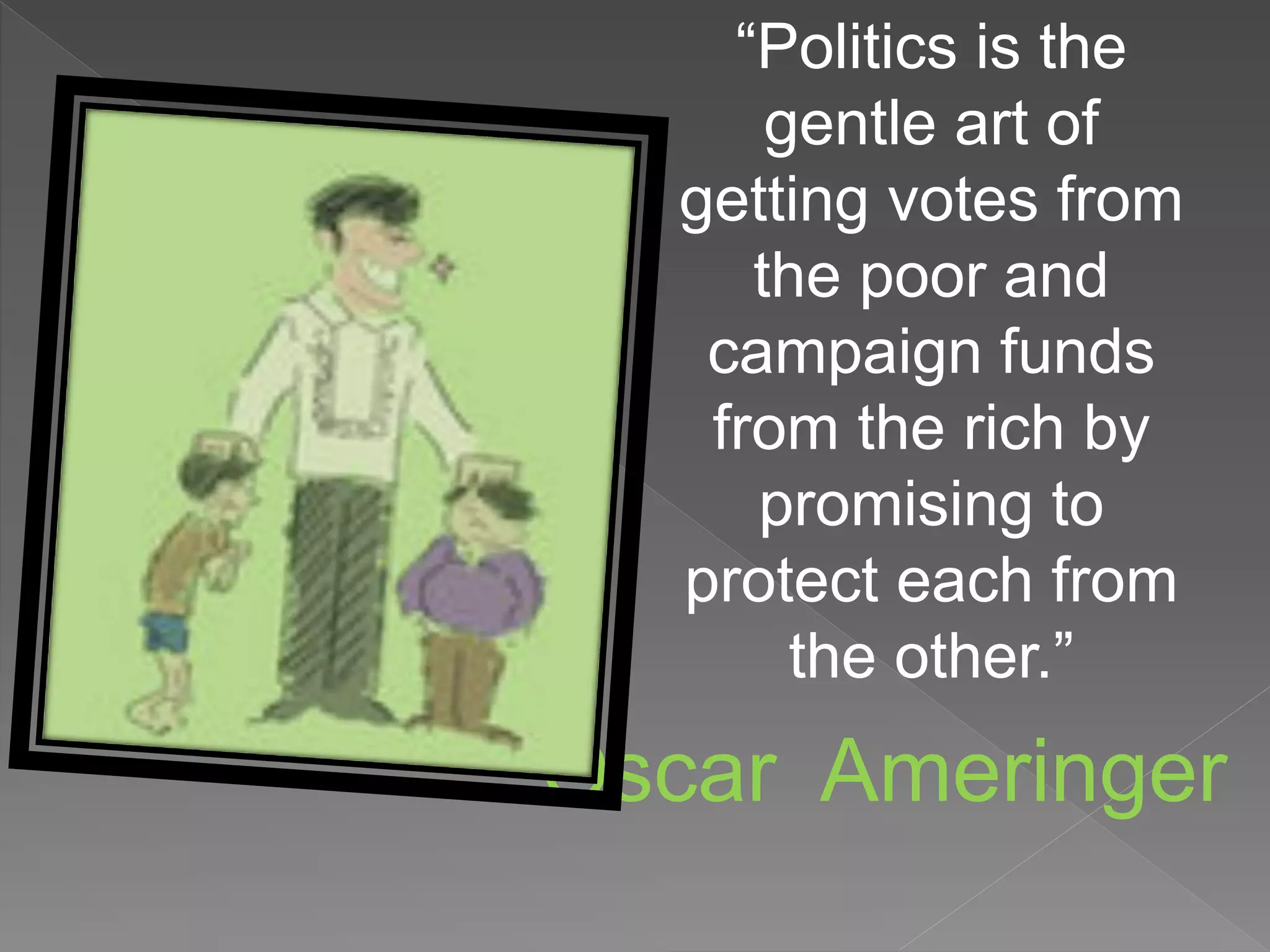
“Politics is the
gentleart of
getting votes from
the poor and
campaign funds
from the rich by
promising to
protect each from
the other.”
Oscar Ameringer
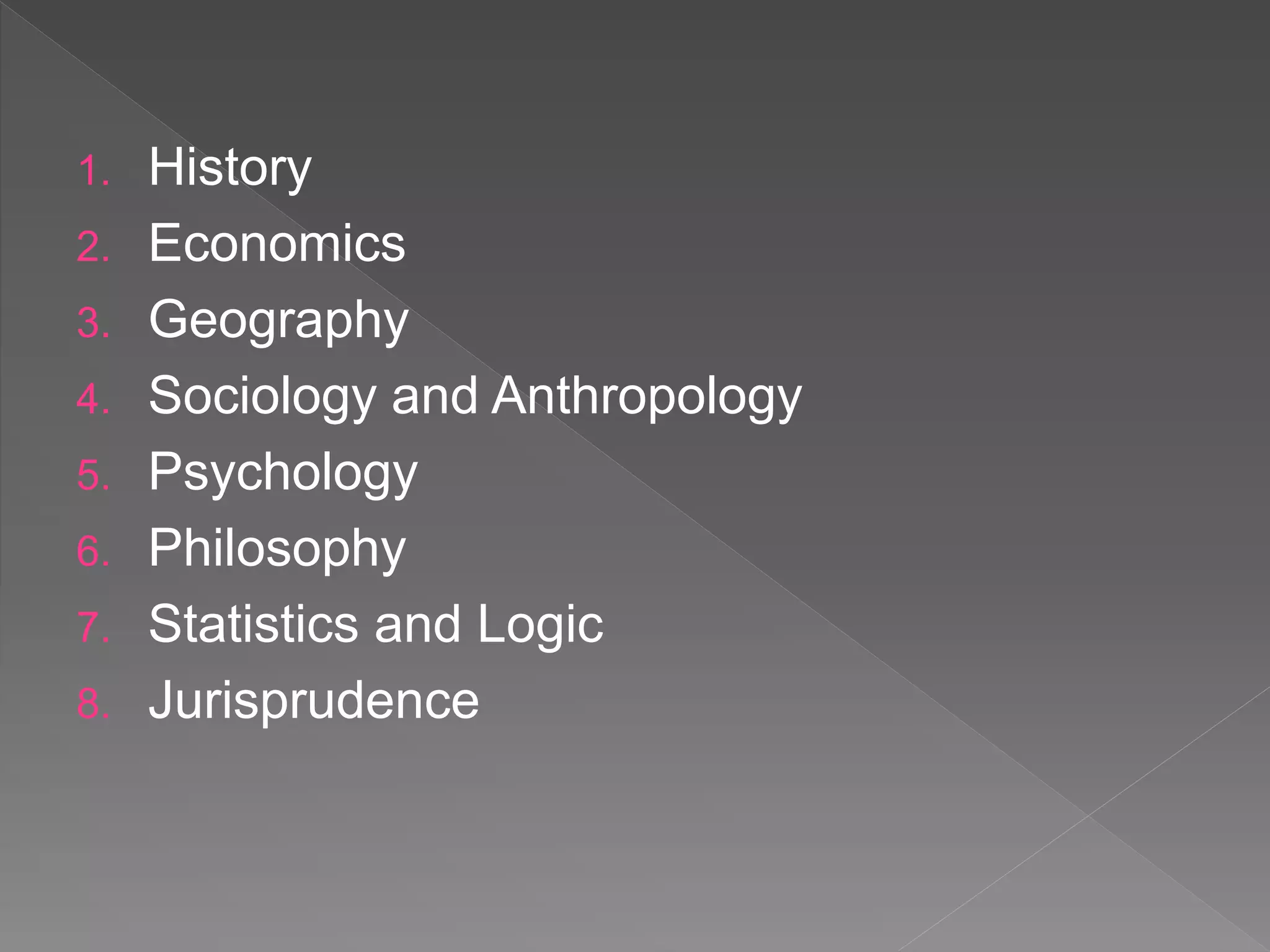
1. History
2. Economics
3.Geography
4. Sociology and Anthropology
5. Psychology
6. Philosophy
7. Statistics and Logic
8. Jurisprudence
25.
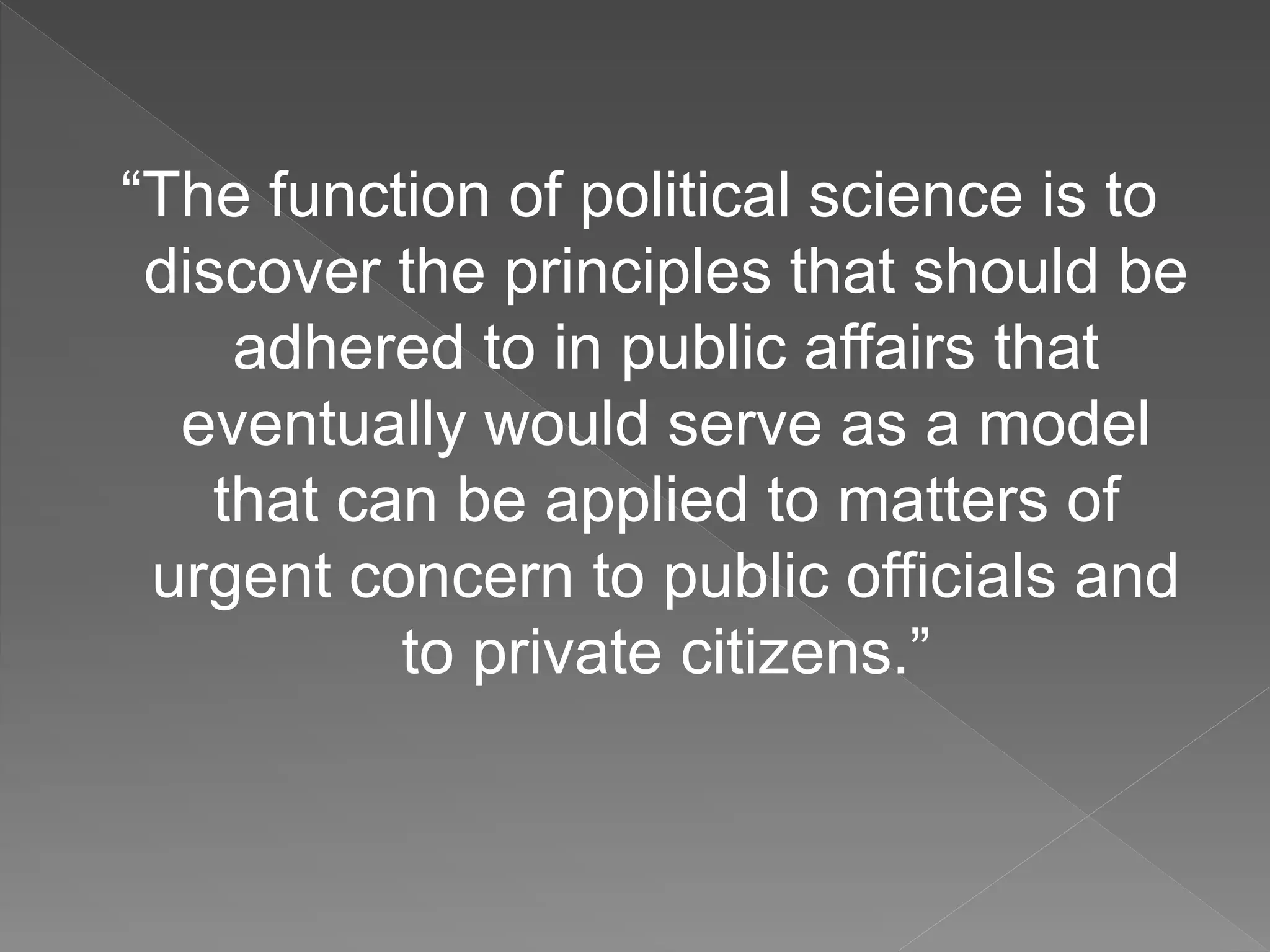
“The function ofpolitical science is to
discover the principles that should be
adhered to in public affairs that
eventually would serve as a model
that can be applied to matters of
urgent concern to public officials and
to private citizens.”
27.
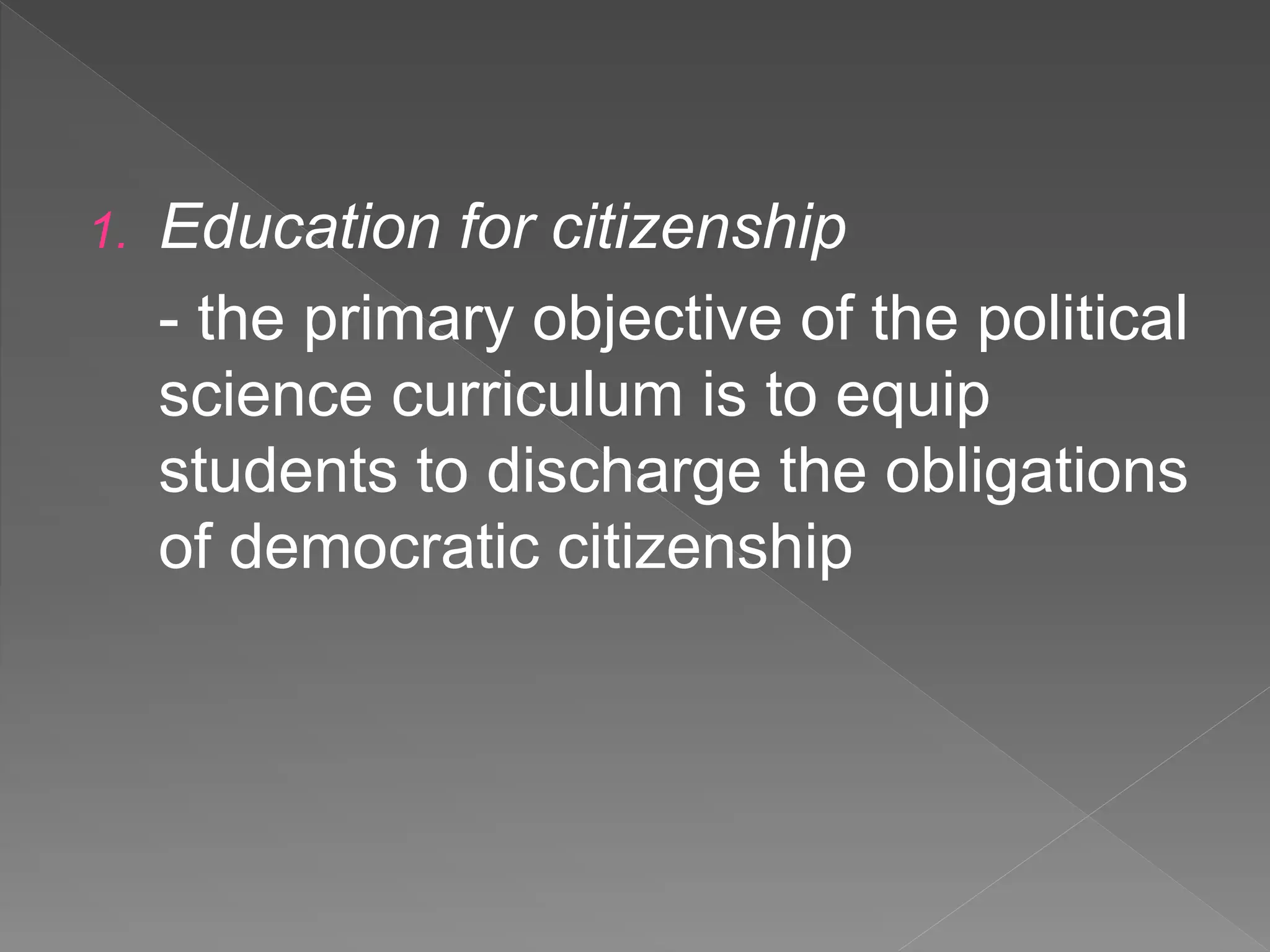
1. Education forcitizenship
- the primary objective of the political
science curriculum is to equip
students to discharge the obligations
of democratic citizenship
28.
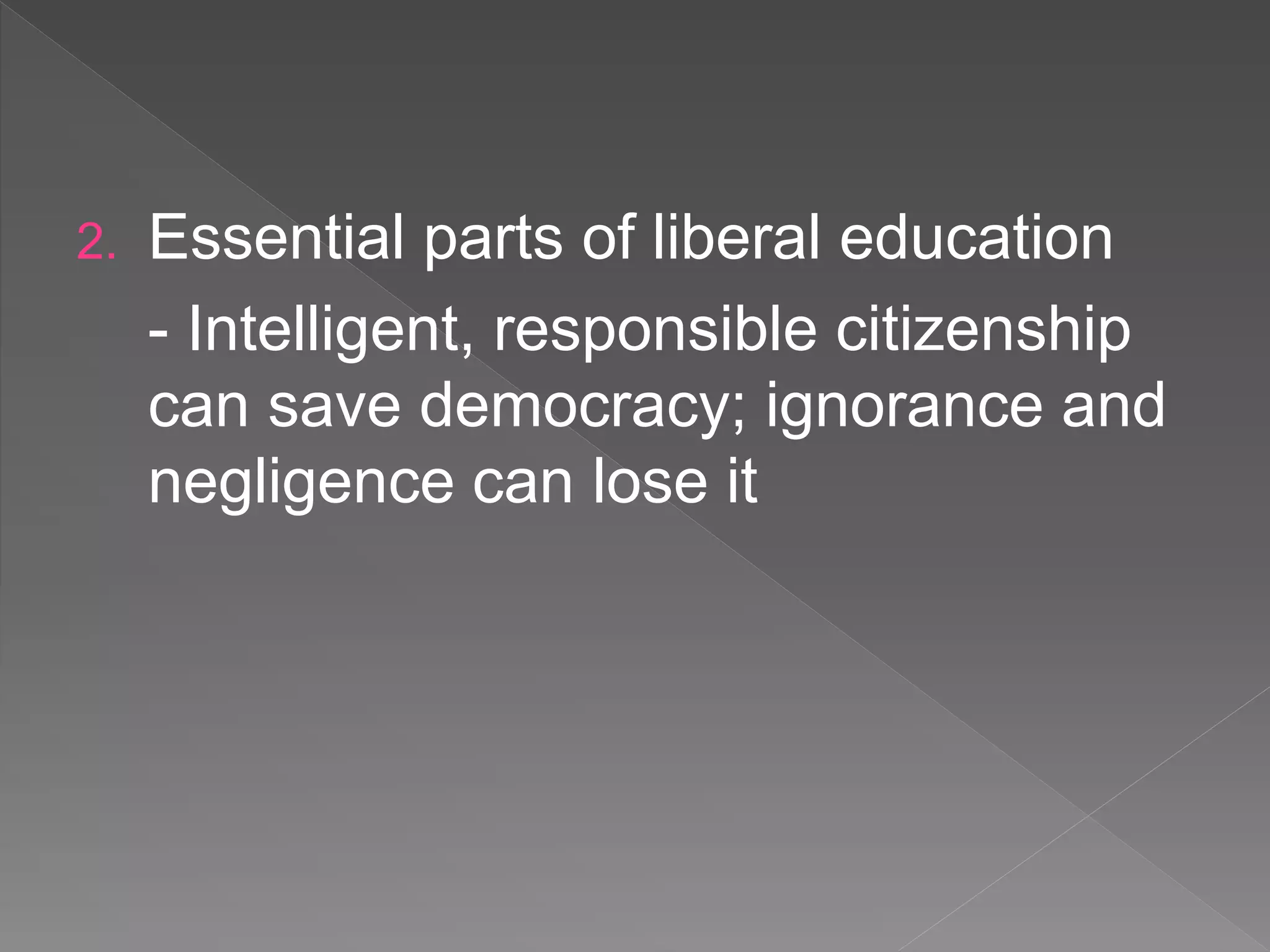
2. Essential partsof liberal education
- Intelligent, responsible citizenship
can save democracy; ignorance and
negligence can lose it
29.
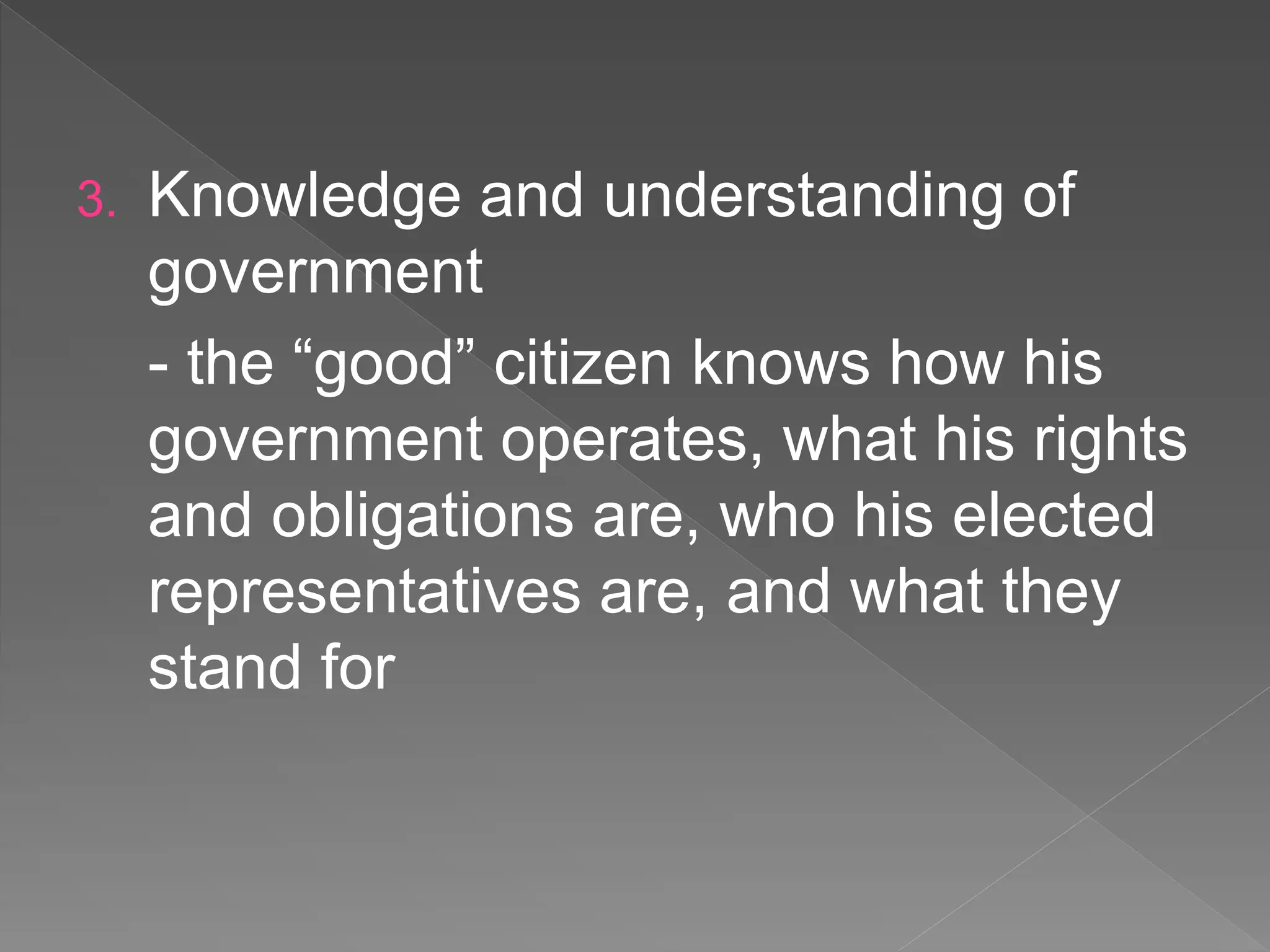
3. Knowledge andunderstanding of
government
- the “good” citizen knows how his
government operates, what his rights
and obligations are, who his elected
representatives are, and what they
stand for
31.
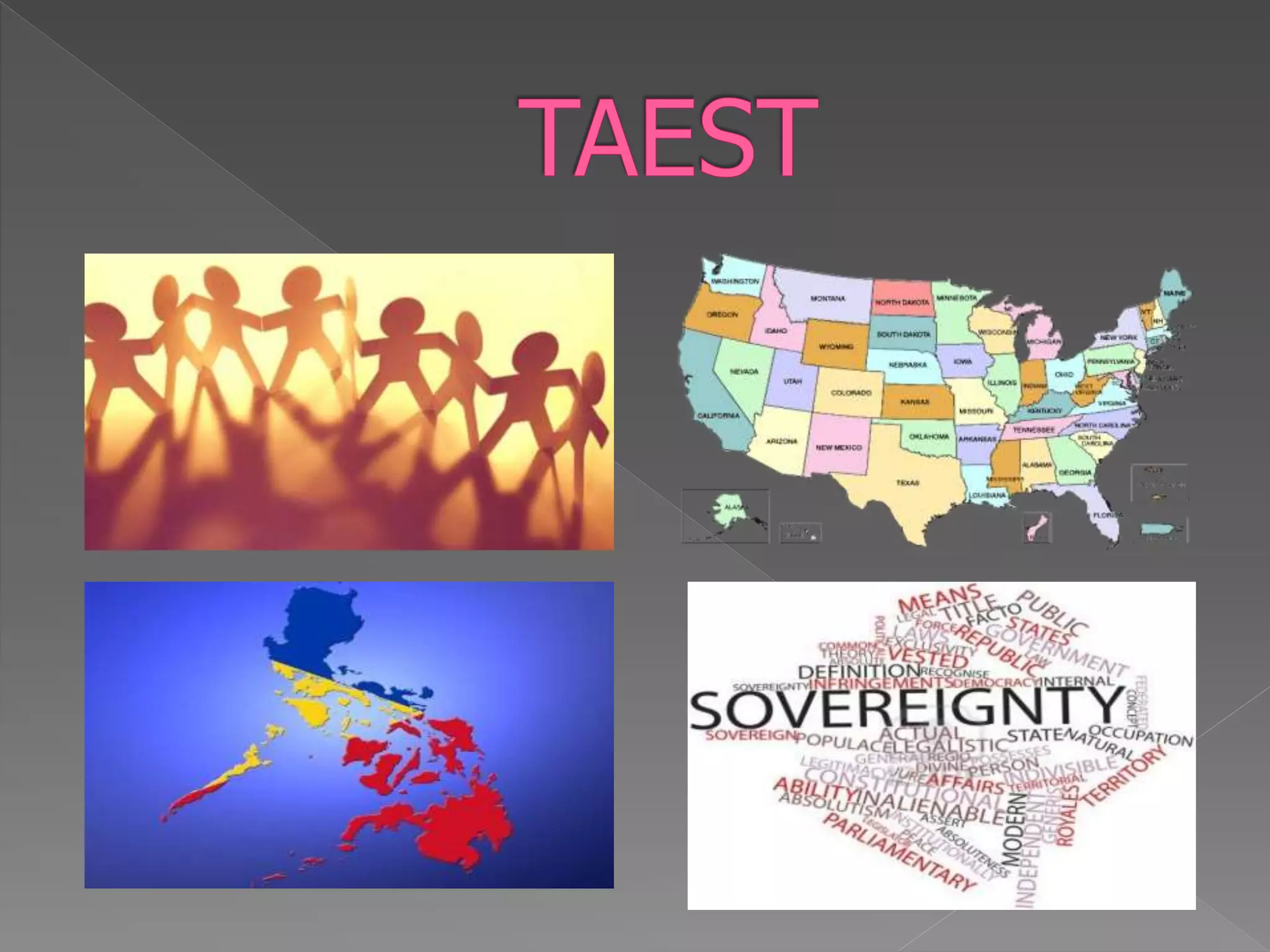
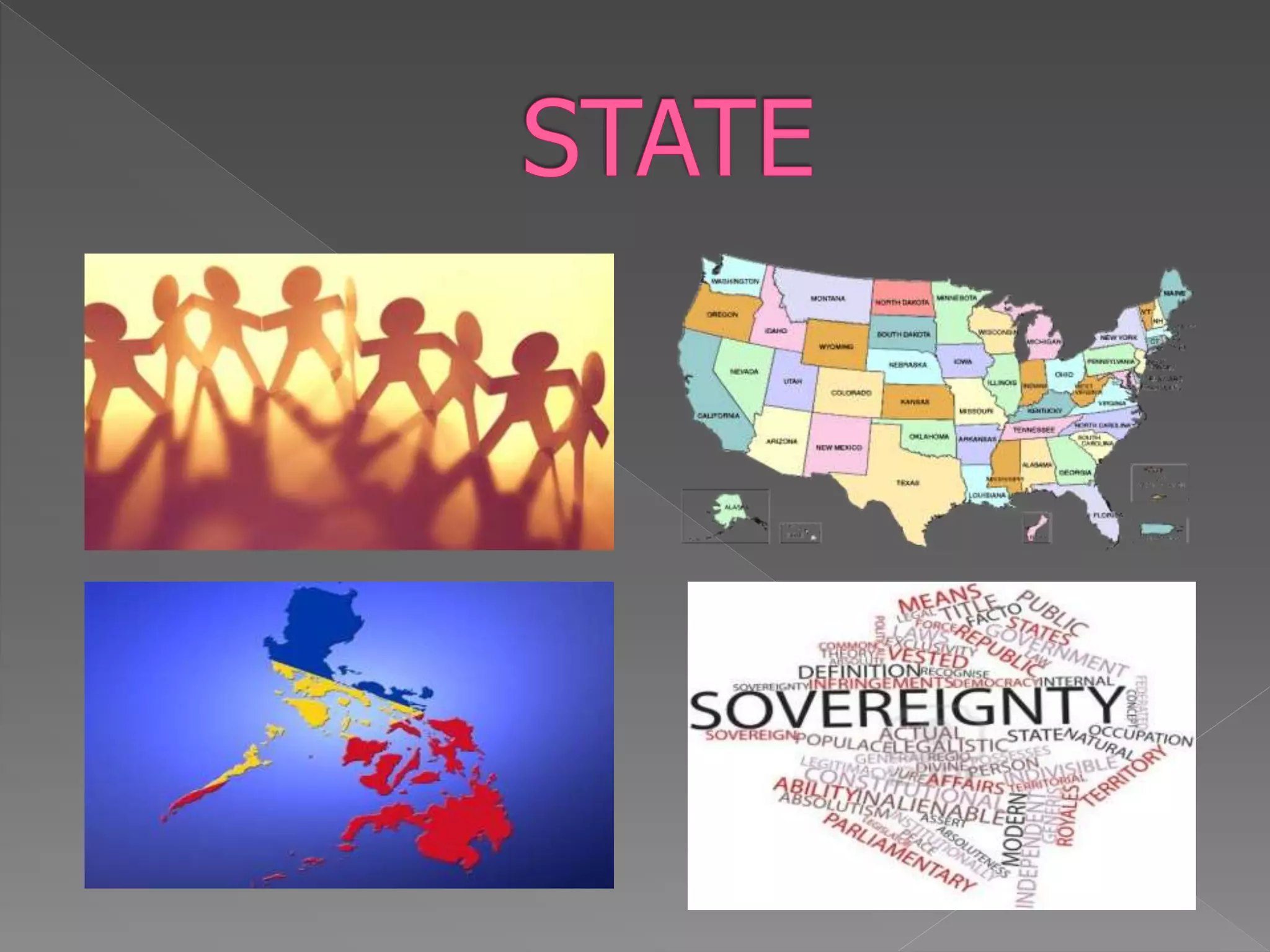
A stateis a community of persons
more or less numerous, permanently
occupying a definite portion of
territory, having a government of their
own to which the great body of
inhabitants render obedience, and
enjoying freedom from external
control.
32.
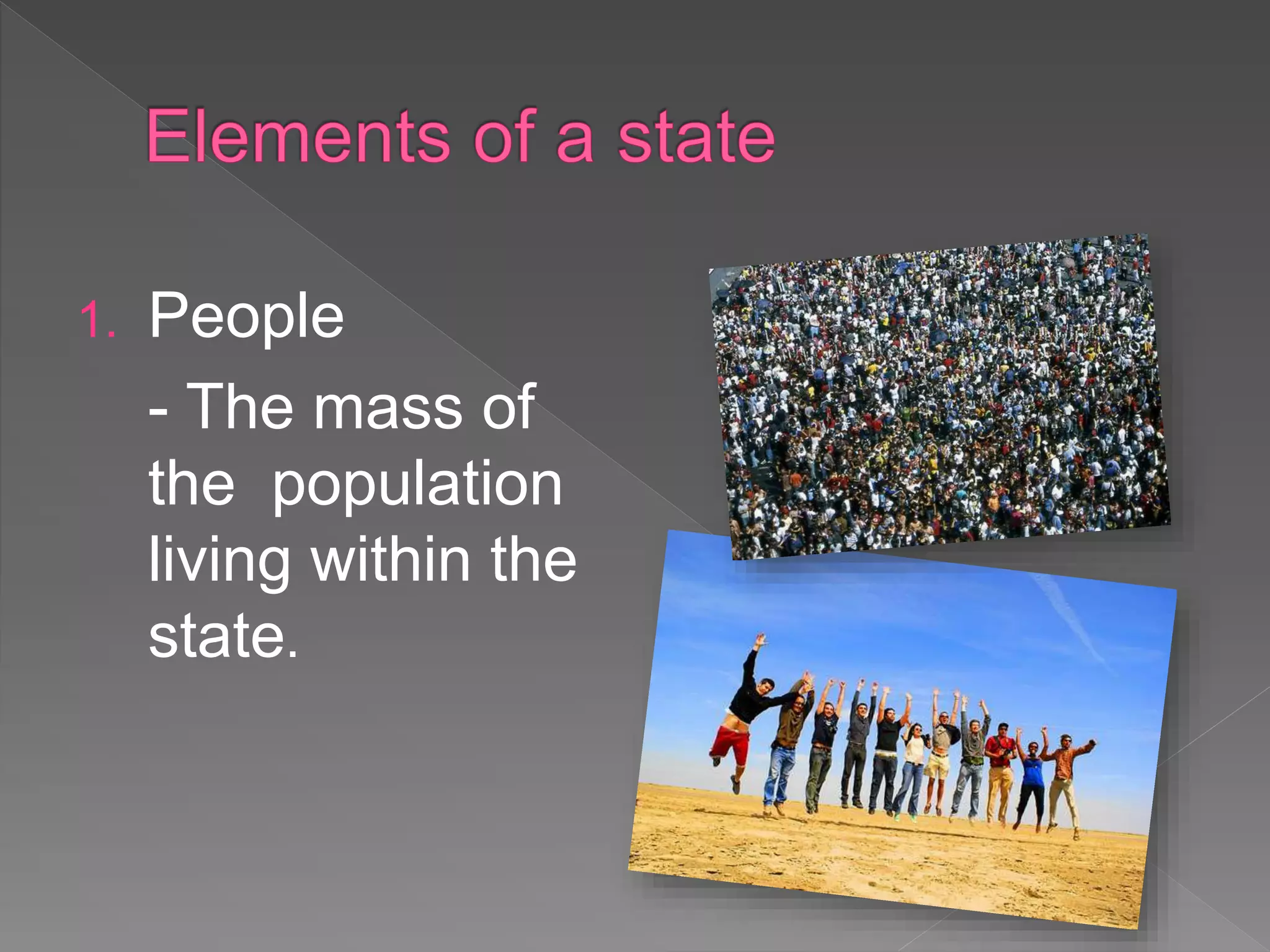
1. People
- Themass of
the population
living within the
state.
33.
answers thequestion, “who governs
whom?”
no specific number requirement
“…the state shall neither be too small
nor yet one that seems great but has
no unity.” (Plato)
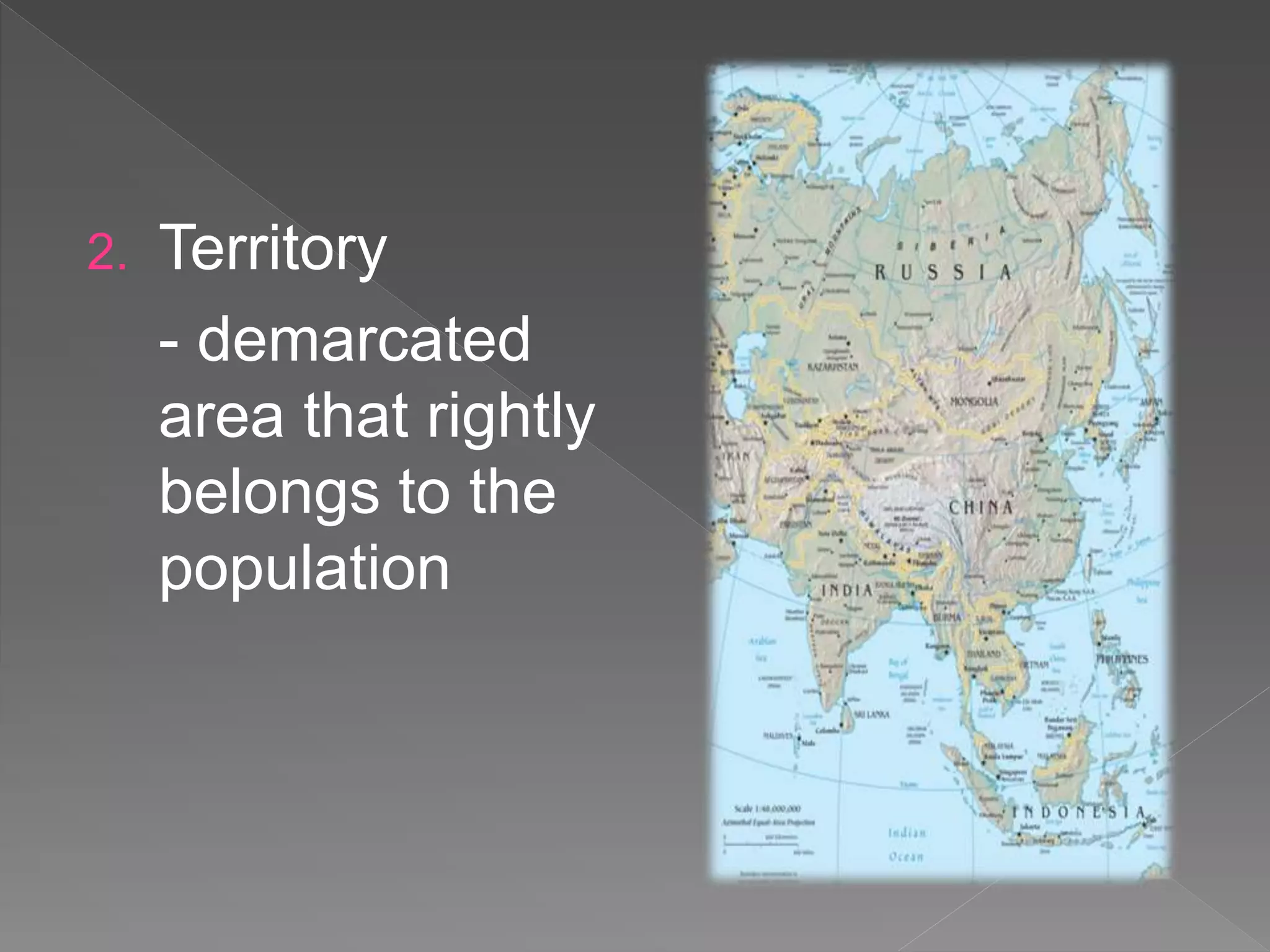
answers thequestion, “where?”
terrestrial, fluvial, maritime and aerial
should be permanent and large
enough to be self-sufficing
36.
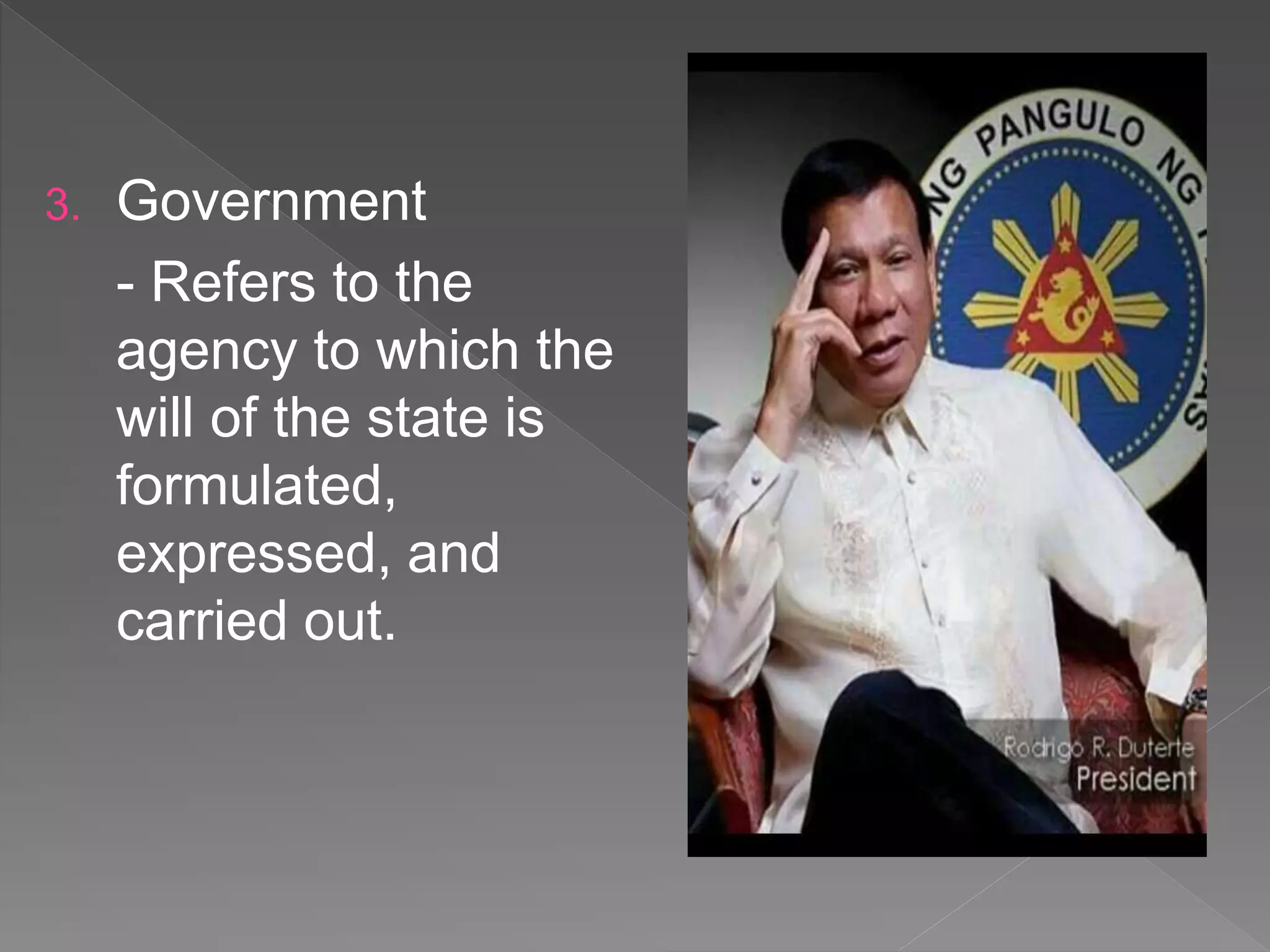
3. Government
- Refersto the
agency to which the
will of the state is
formulated,
expressed, and
carried out.
37.
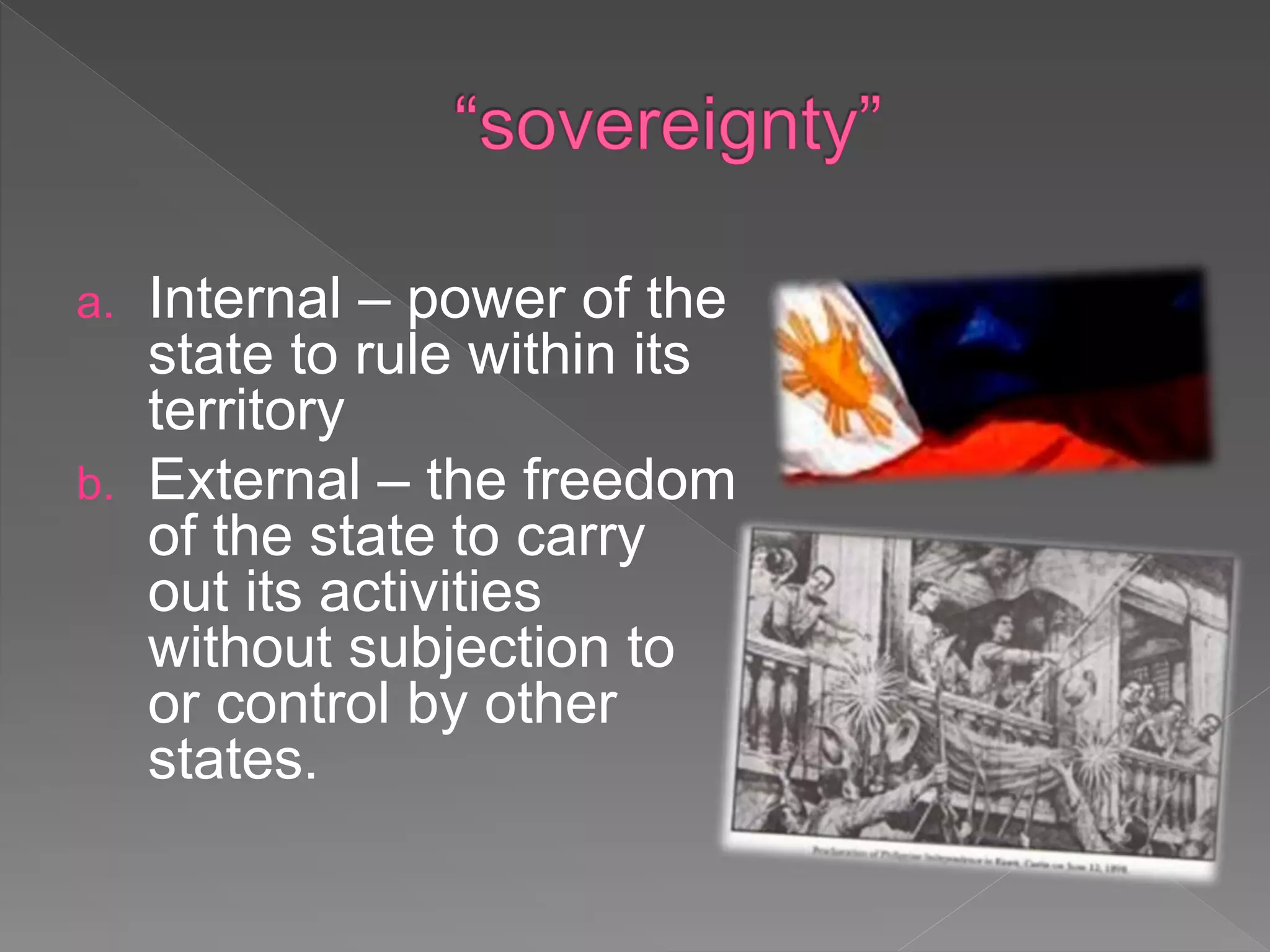
4. Sovereignty
- Maybe defined as the supreme
power of the state to command and
enforce obedience to its will from the
people within its jurisdiction and
corollarily to have freedom from
foreign control.
38.
a. Internal –power of the
state to rule within its
territory
b. External – the freedom
of the state to carry
out its activities
without subjection to
or control by other
states.
39.
“The state isa political concept while
a nation is an ethnic concept.”
40.
“A government maychange, its form
may change, but the state, as long as
its essential elements are present,
remains the same.”
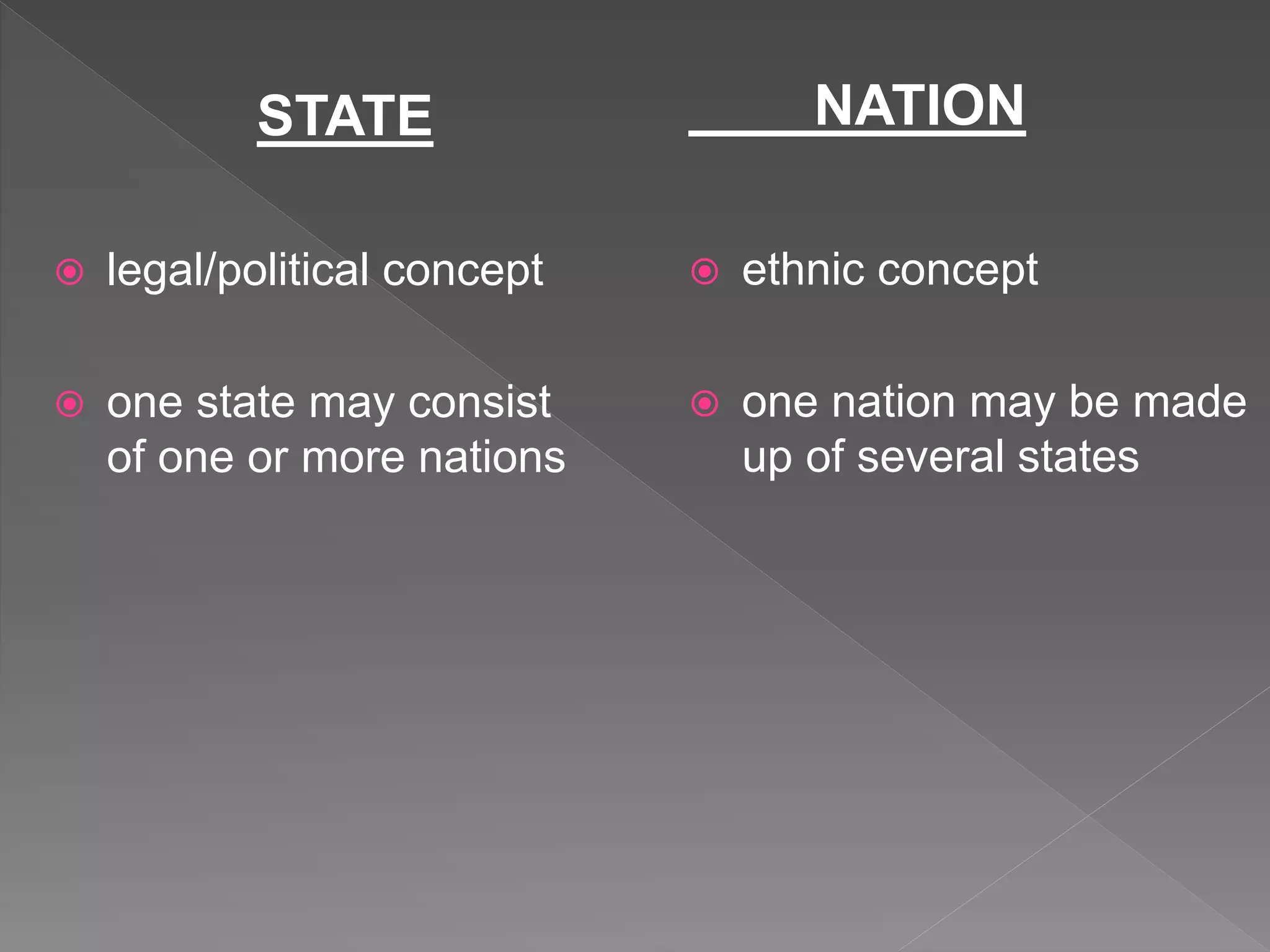
41.
STATE
legal/political concept
one state may consist
of one or more nations
NATION
ethnic concept
one nation may be made
up of several states
42.
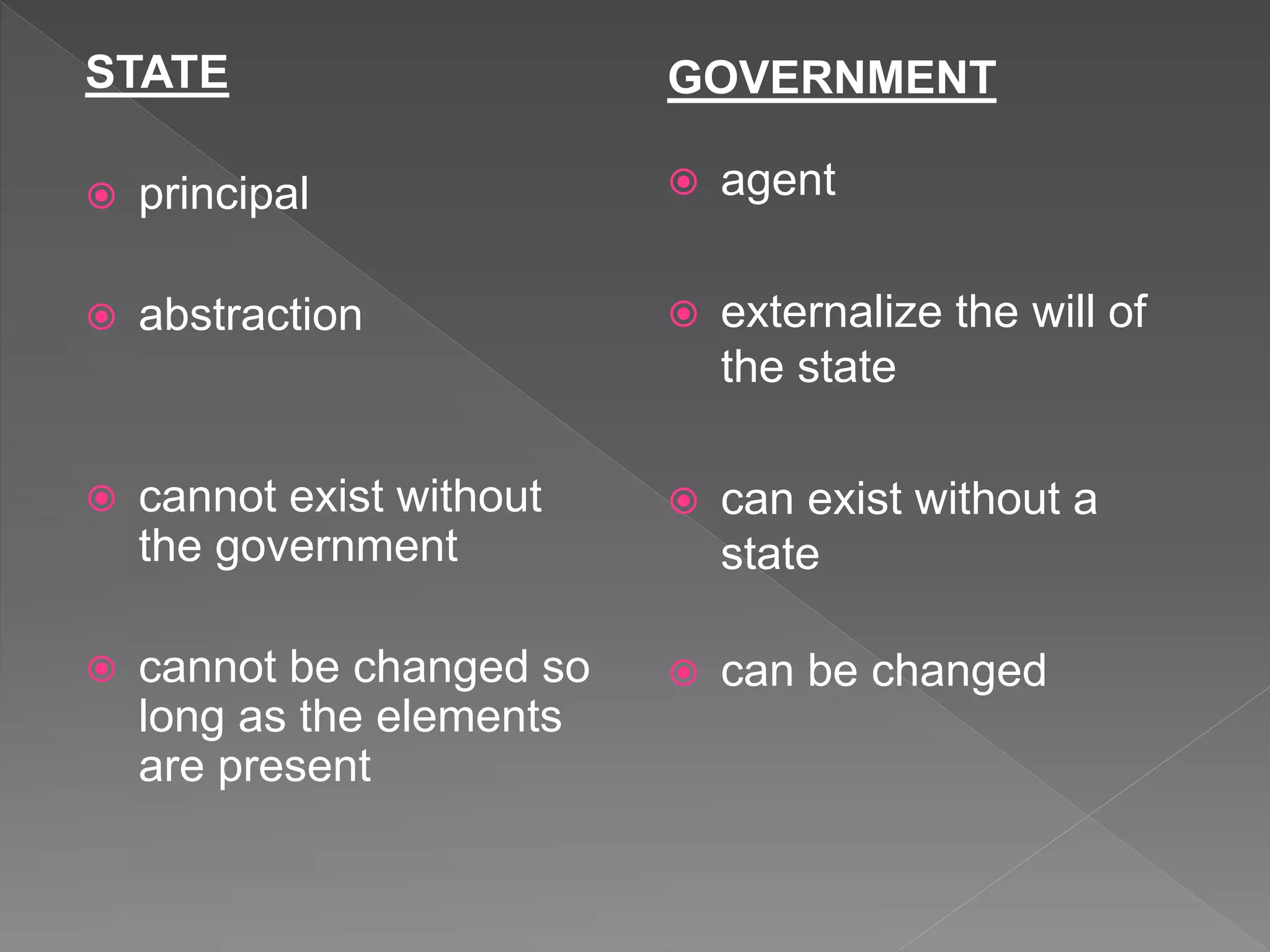
STATE
principal
abstraction
cannot exist without
the government
cannot be changed so
long as the elements
are present
GOVERNMENT
agent
externalize the will of
the state
can exist without a
state
can be changed
44.
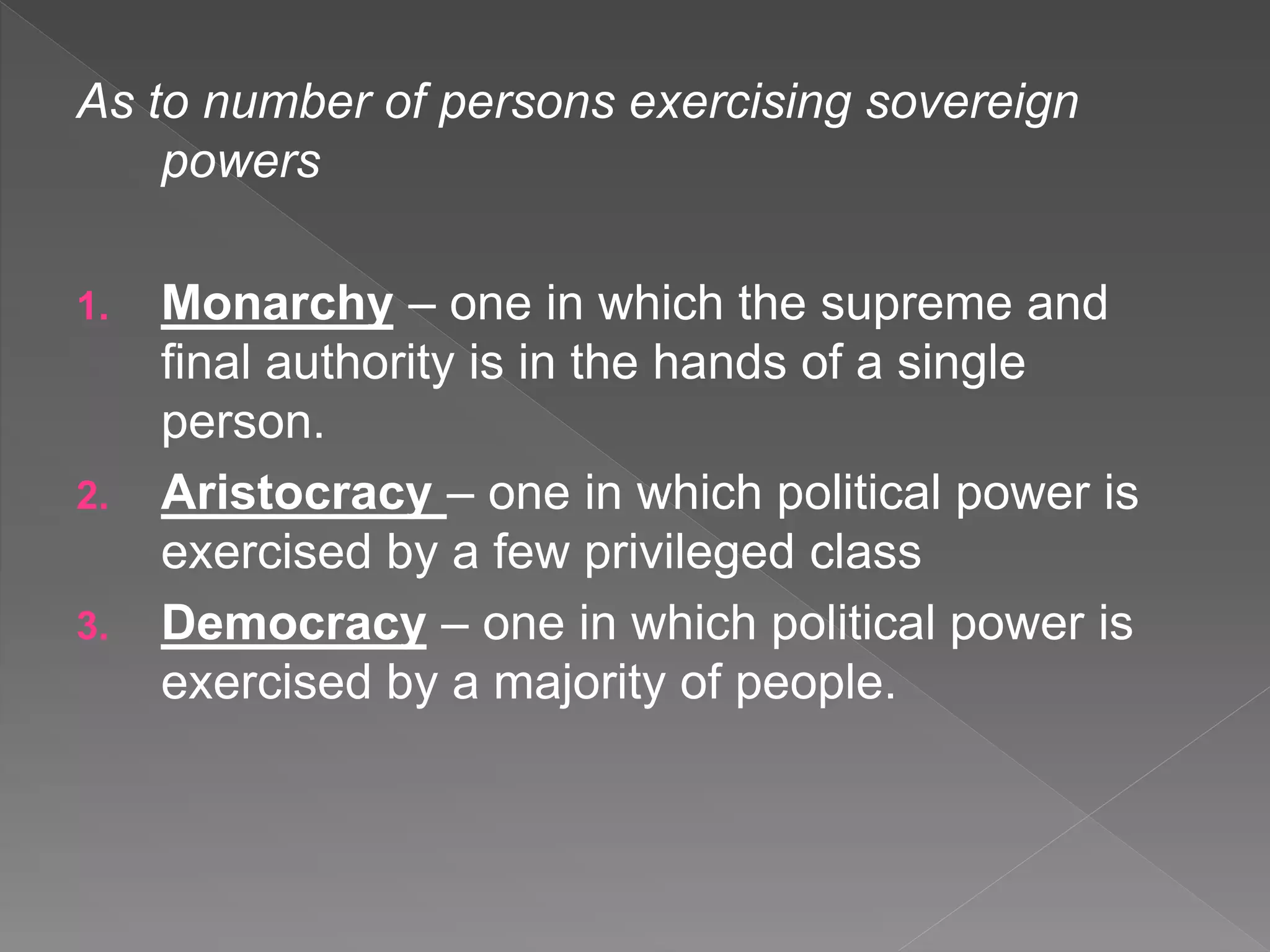
As to numberof persons exercising sovereign
powers
1. Monarchy – one in which the supreme and
final authority is in the hands of a single
person.
2. Aristocracy – one in which political power is
exercised by a few privileged class
3. Democracy – one in which political power is
exercised by a majority of people.
45.
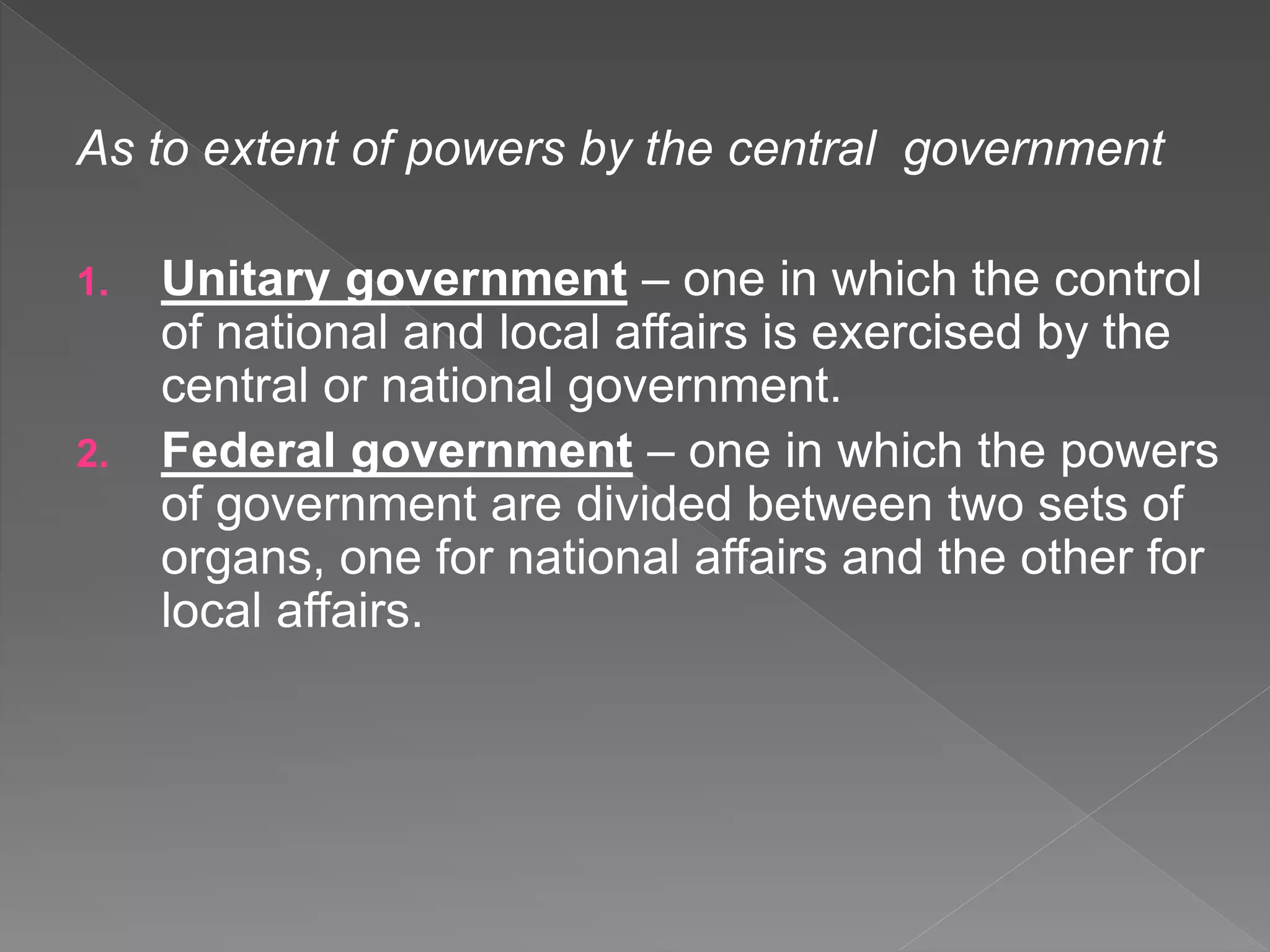
As to extentof powers by the central government
1. Unitary government – one in which the control
of national and local affairs is exercised by the
central or national government.
2. Federal government – one in which the powers
of government are divided between two sets of
organs, one for national affairs and the other for
local affairs.
46.
As to relationshipbetween the executive and the
legislative branches of the government
1. Parliamentary government – one in which
the state confers upon the legislature the
power to terminate the tenure of office of the
real executive.
2. Presidential government – one in which the
state makes the executive independent of the
legislature as regards his tenure, policies and
acts.
47.
is a writteninstrument by which the
fundamental powers of the government are
established, limited and defined by which
these powers are distributed among the
several departments/branches for the benefit
of the people.
49.
As to form
1.Brief
2. Broad
3. Definite
As to contents
1. Constitution of
government
2. Constitution of
liberty
3. Constitution of
sovereignty



![1[1].foundations of american government](https://cdn.slidesharecdn.com/ss_thumbnails/11-140907162831-phpapp01-thumbnail.jpg?width=640&height=640&fit=bounds)


![1[1].foundations of american government](https://cdn.slidesharecdn.com/ss_thumbnails/11-foundationsofamericangovernment-120923140022-phpapp02-thumbnail.jpg?width=640&height=640&fit=bounds)


