UNIT - 7
DIRECTING
TOPICS COVERED
Directing
Concept
Importance
Elements of Directing
Supervision - Concept and Functions of Supervisor
Motivation - Concept, Maslow’s Hierarchy of Needs, Financial and Non
Financial Incentives
Leadership – Concept and Style
Communication - Concept, Formal and Informal communication, Barriers
to effective Communication and how to overcome the Barriers
DIRECTING
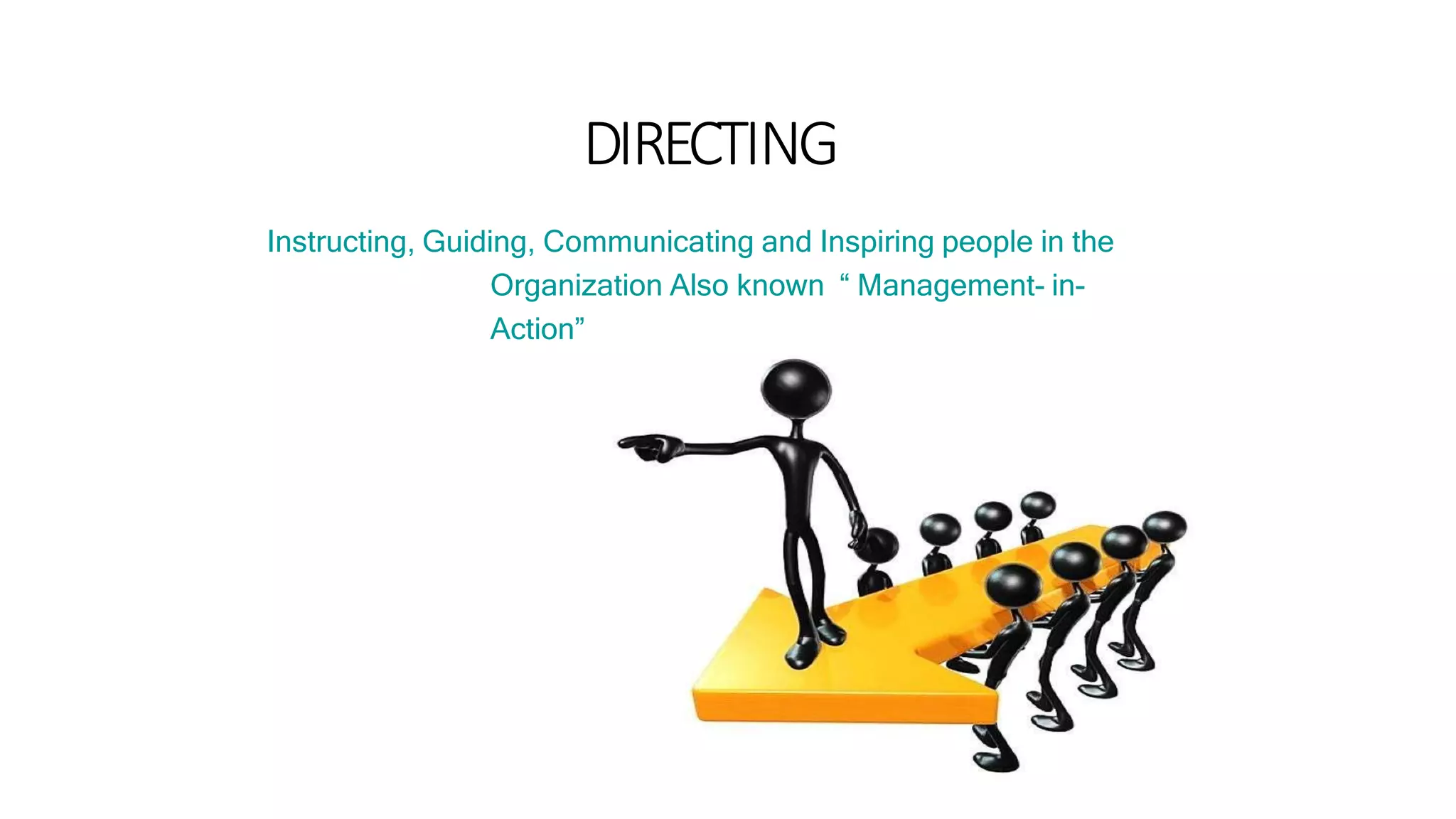
Instructing, Guiding, Communicating and Inspiring people in the
Organization Also known “ Management- in-
Action”
“Directing is the executive function of guiding and observing
subordinates”.
- Koontz and O’Donnell
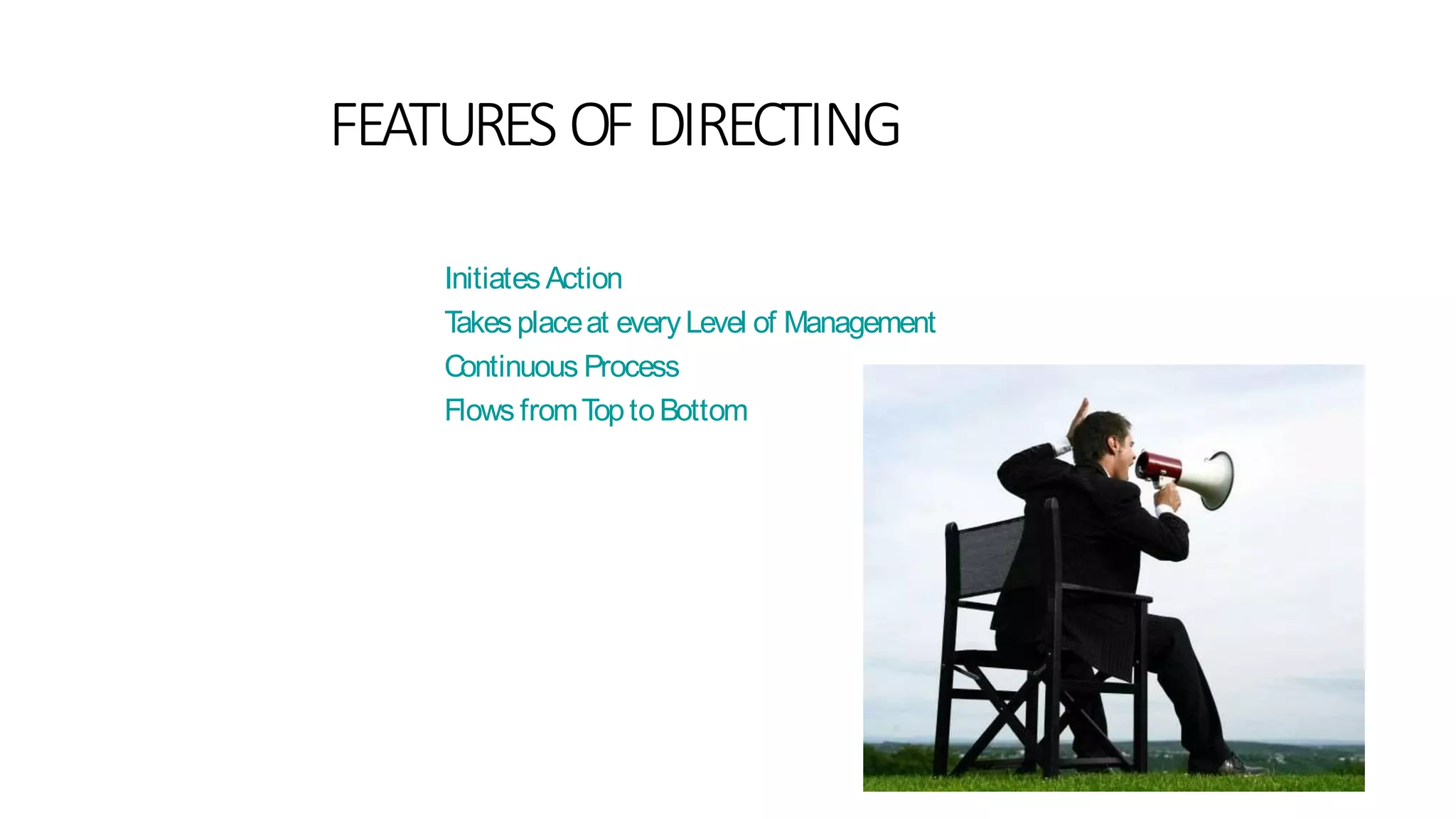
FEATURES OF DIRECTING
Initiates Action
Takes placeat everyLevel of Management
Continuous Process
Flows fromToptoBottom
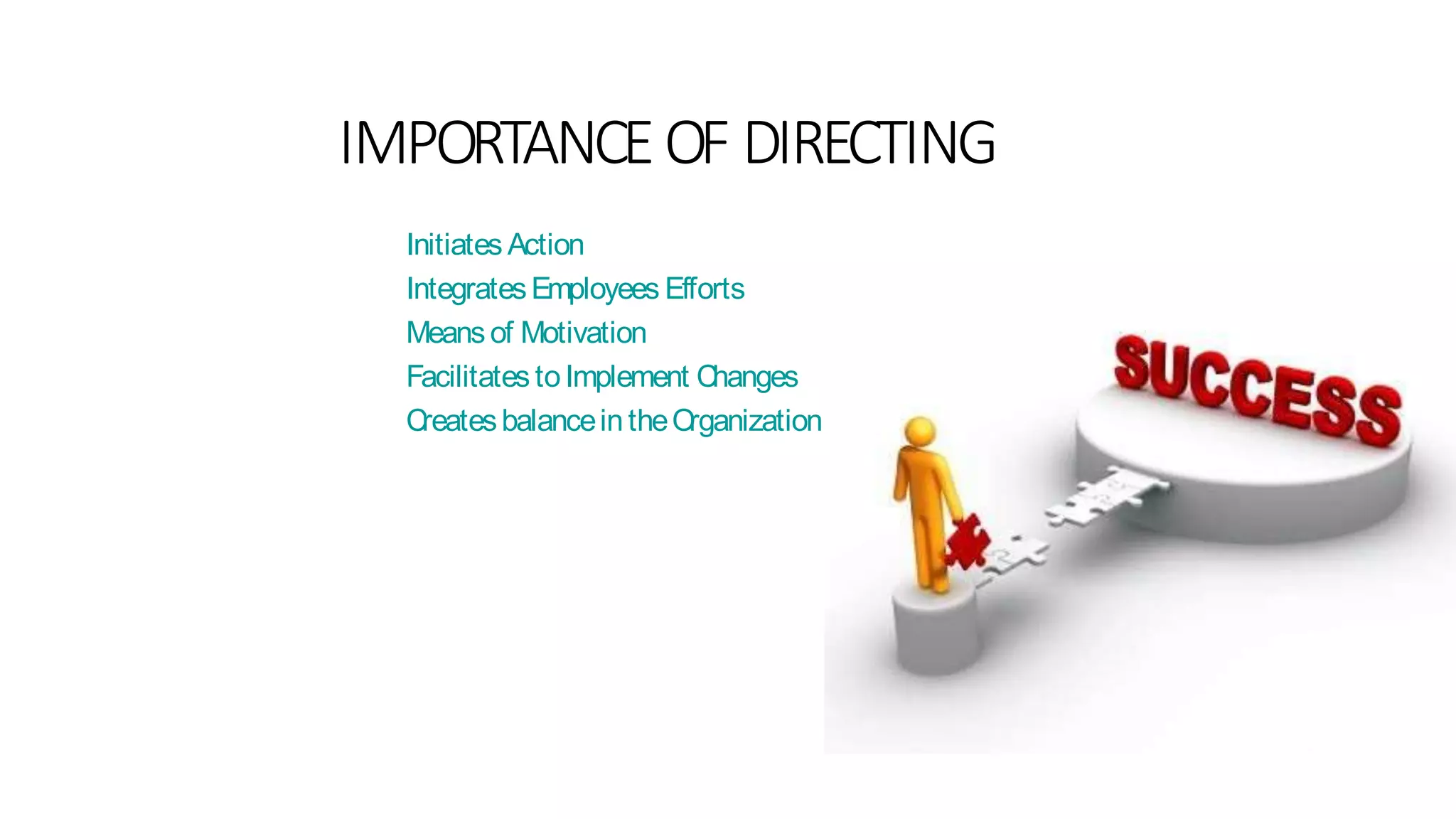
IMPORTANCEOF DIRECTING
Initiates Action
IntegratesEmployees Efforts
Meansof Motivation
Facilitates toImplement Changes
CreatesbalanceintheOrganization
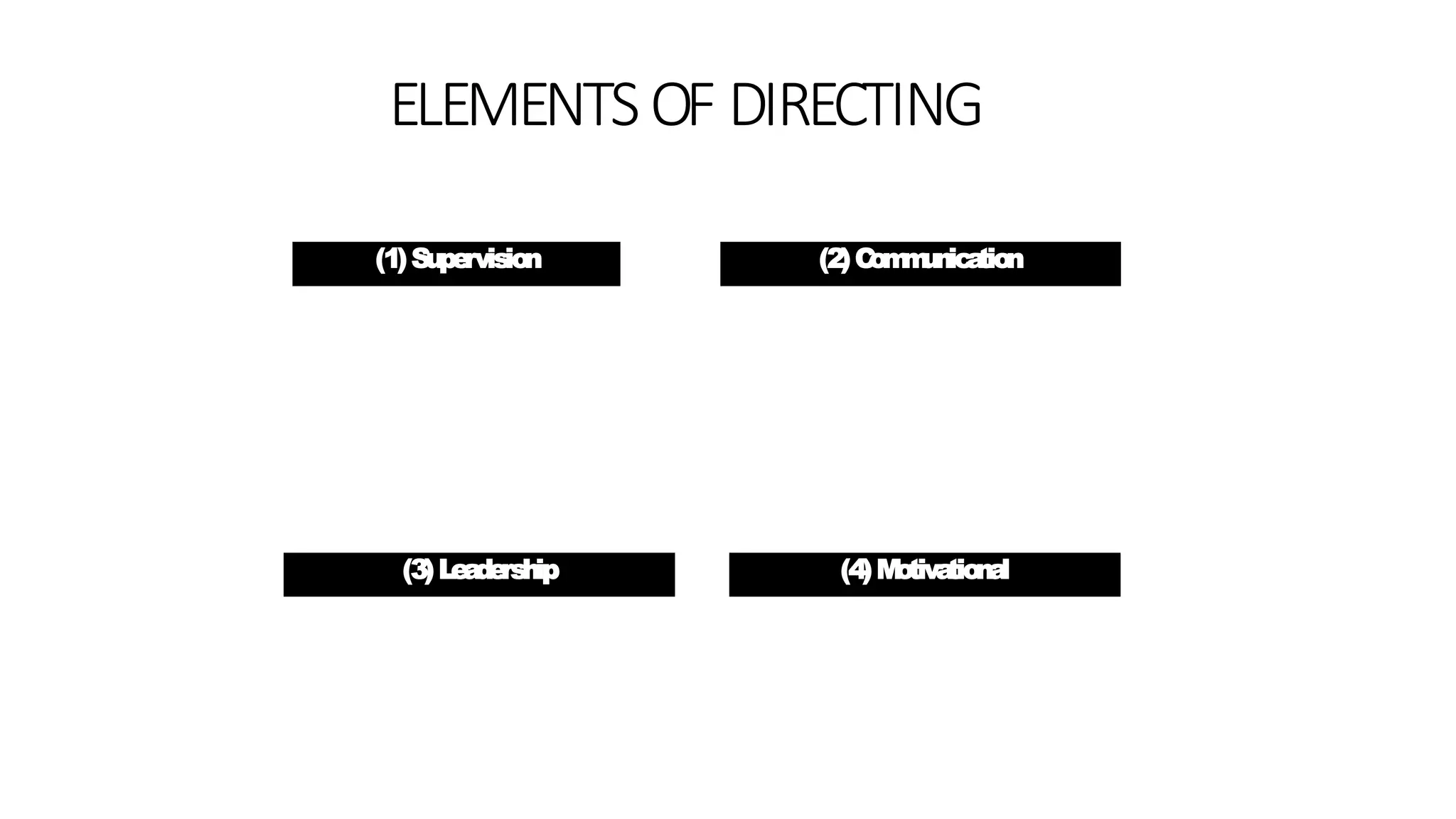
(3)Leadership
(2)Communication(1)Supervision
(4)Motivational
ELEMENTSOF DIRECTING
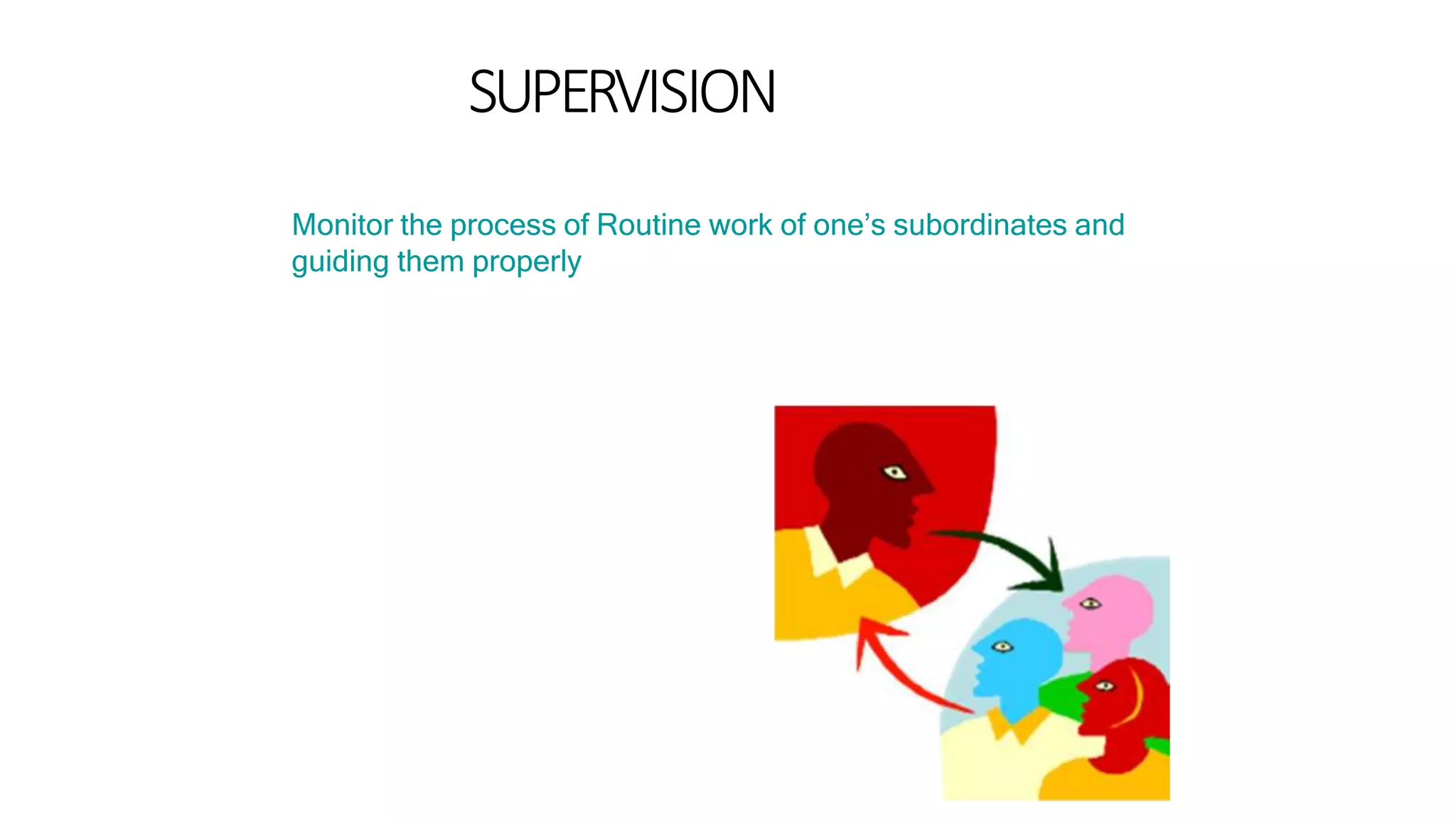
SUPERVISION
Monitor the process of Routine work of one’s subordinates and
guiding them properly
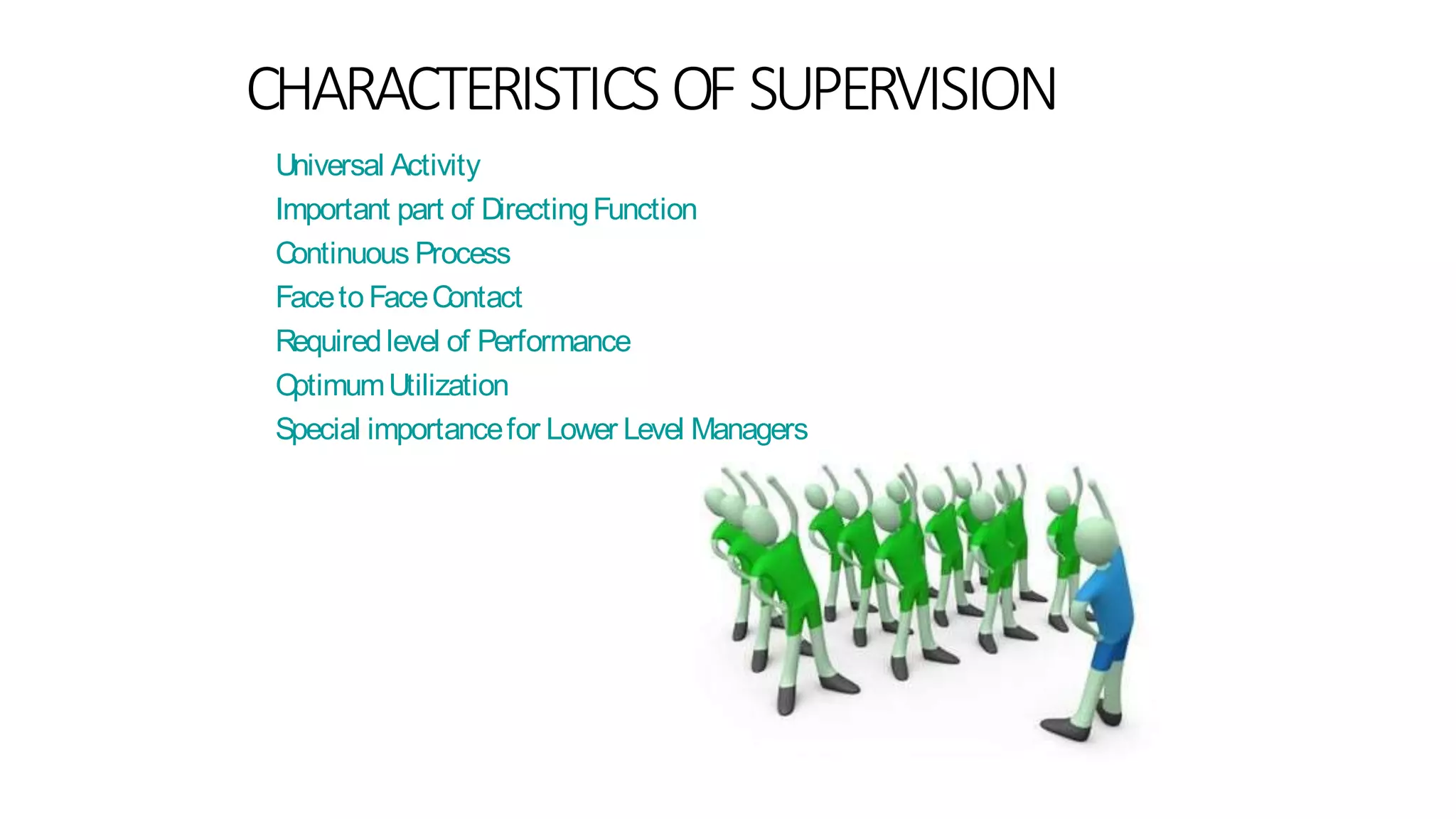
CHARACTERISTICS OF SUPERVISION
Universal Activity
Important part of DirectingFunction
Continuous Process
Faceto FaceContact
Requiredlevel of Performance
OptimumUtilization
Special importancefor Lower Level Managers
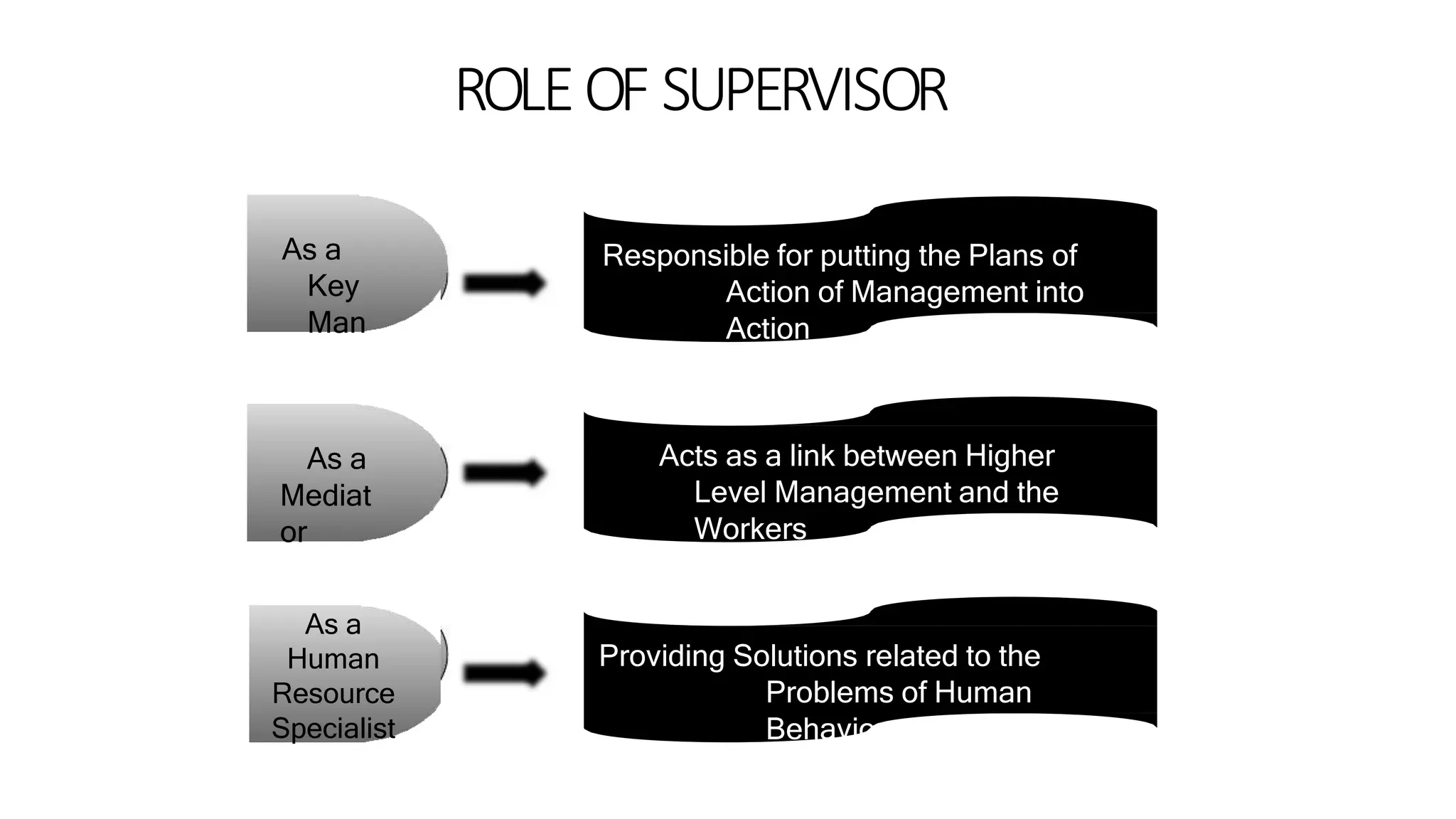
Responsible for putting the Plans of
Action of Management into
Action
Acts as a link between Higher
Level Management and the
Workers
Providing Solutions related to the
Problems of Human
Behaviour
As a
Key
Man
As a
Mediat
or
As a
Human
Resource
Specialist
ROLEOF SUPERVISOR
FUNCTIONS OF A SUPERVISOR
EnsureIssuingInstructions
Facilitates Control
OptimumUtilizationof Resources
Maintenanceof Discipline
Feedback
ImprovesCommunication
ImprovesMotivation
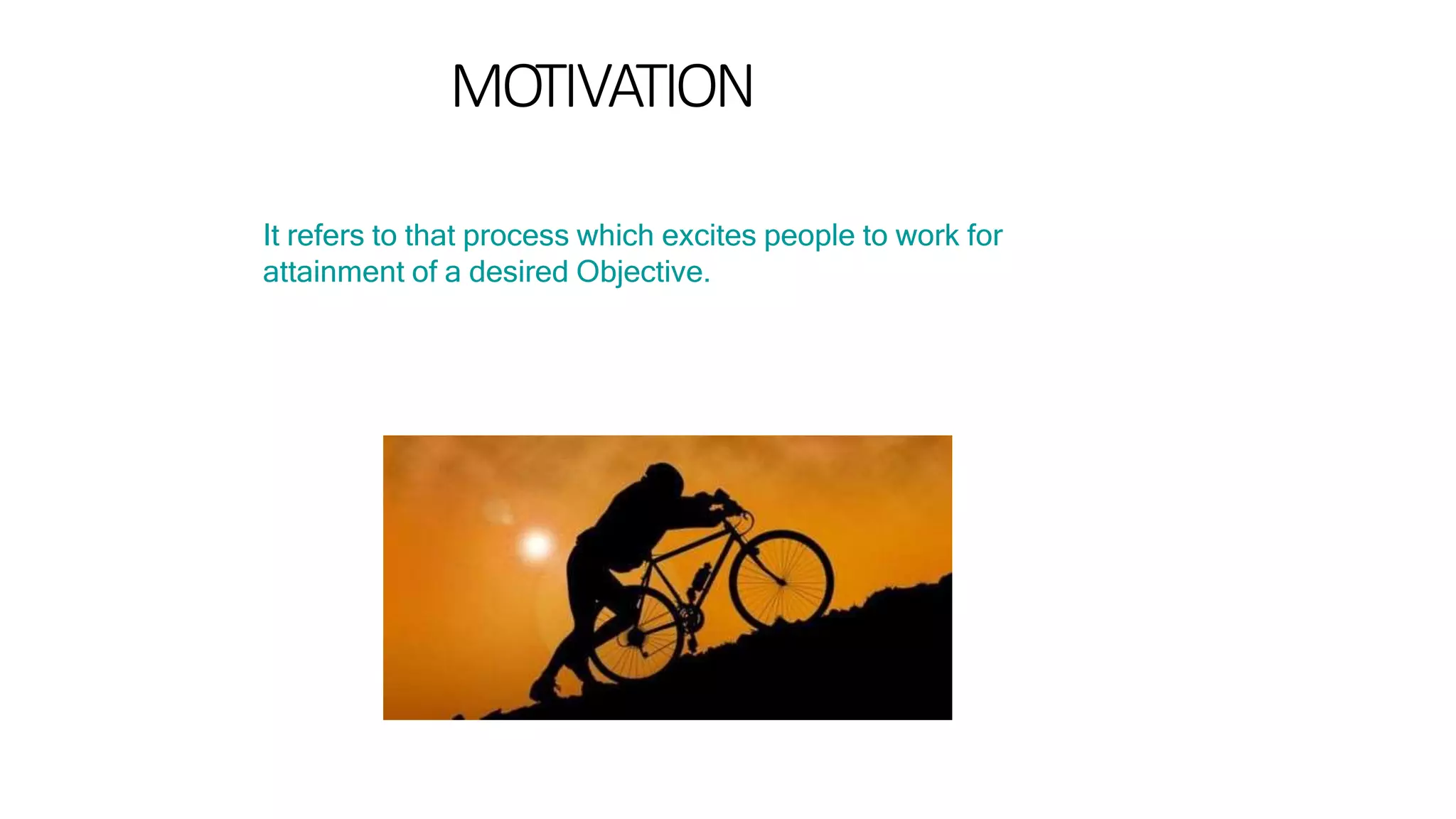
MOTIVATION
It refers to that process which excites people to work for
attainment of a desired Objective.
CHARACTERISTICS OF MOTIVATION
It is aInternal Feeling
Produces Goal DirectedBehaviour
It canbeeither Positiveor Negative
Complex Process
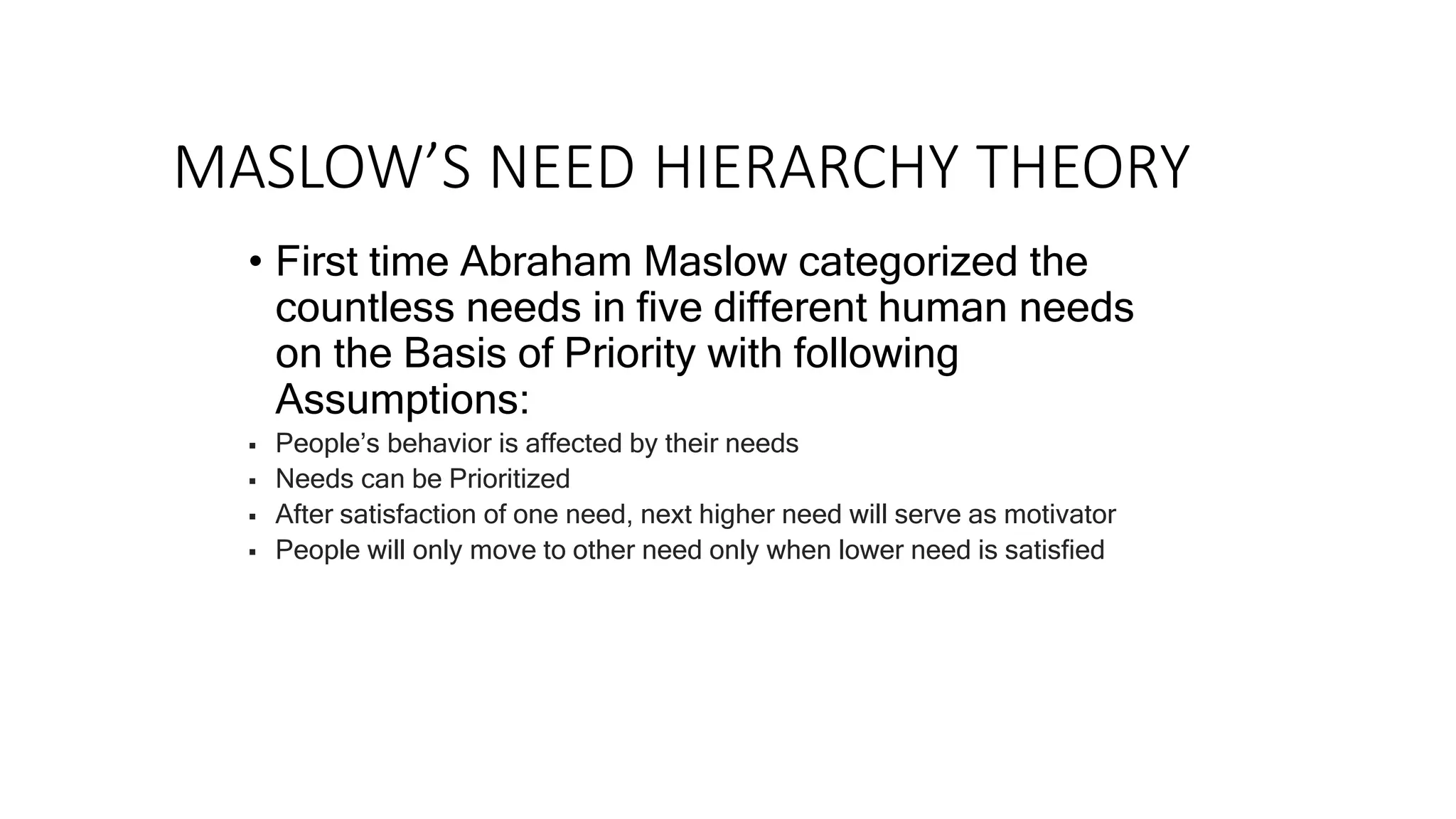
MASLOW’S NEED HIERARCHY THEORY
• First time Abraham Maslow categorized the
countless needs in five different human needs
on the Basis of Priority with following
Assumptions:
 People’s behavior is affected by their needs
 Needs can be Prioritized
 After satisfaction of one need, next higher need will serve as motivator
 People will only move to other need only when lower need is satisfied
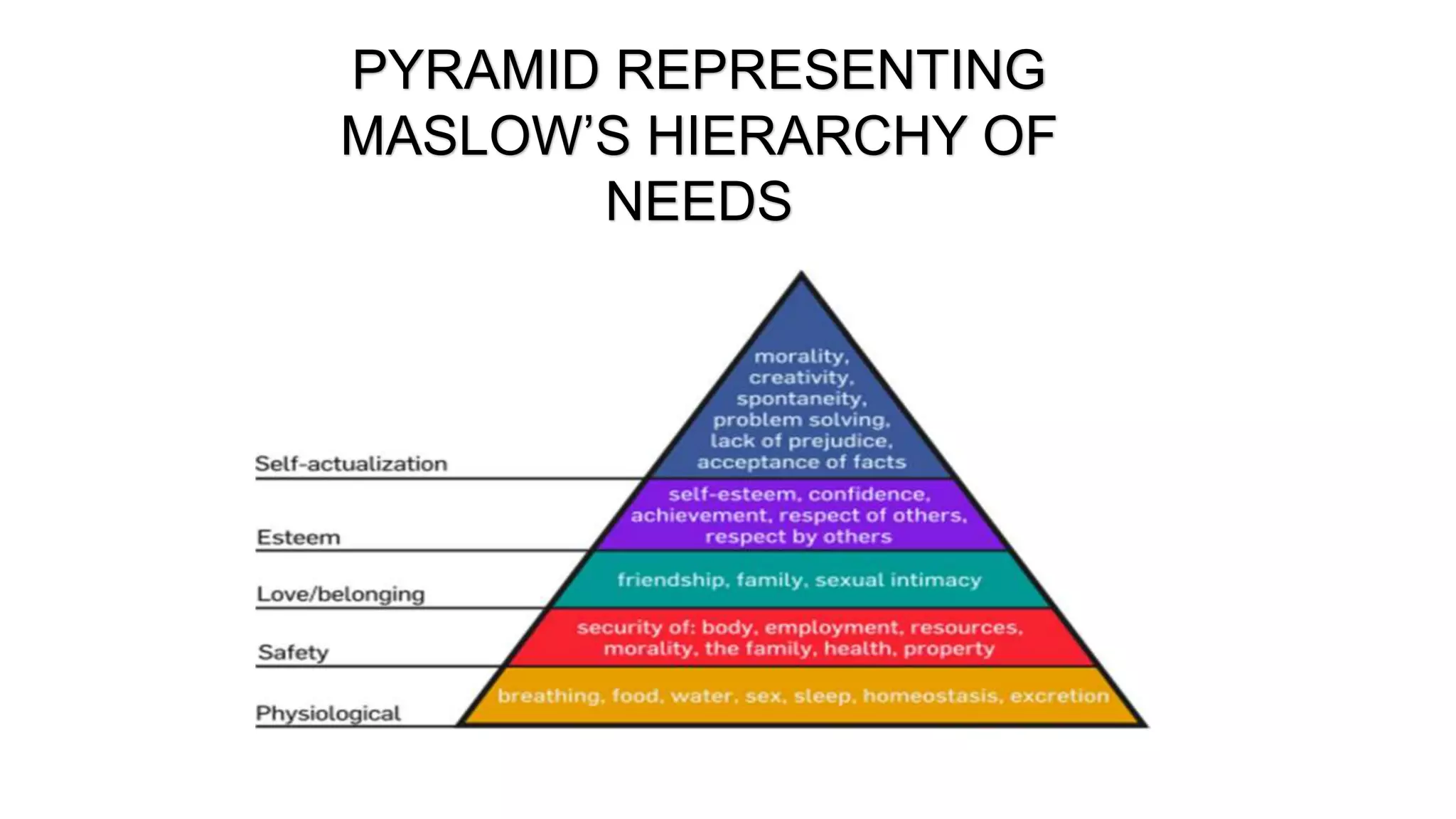
PYRAMID REPRESENTING
MASLOW’S HIERARCHY OF
NEEDS
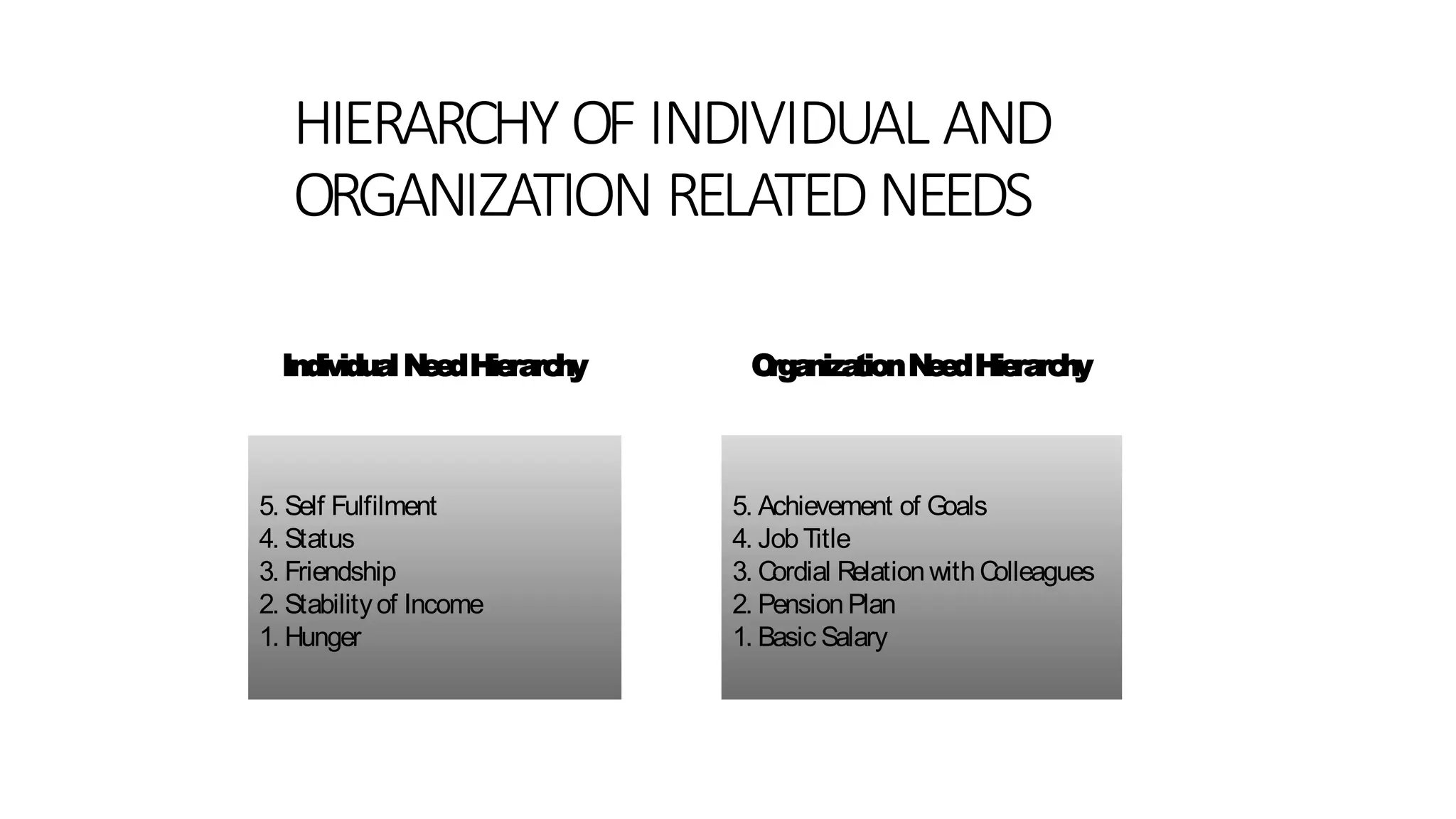
HIERARCHY OF INDIVIDUAL AND
ORGANIZATION RELATEDNEEDS
IndividualNeedHierarchy
5. Self Fulfilment
4. Status
3. Friendship
2. Stabilityof Income
1. Hunger
OrganizationNeedHierarchy
5. Achievement of Goals
4. JobTitle
3. Cordial RelationwithColleagues
2. PensionPlan
1. Basic Salary
INCENTIVES: FINANCIAL
It refers to incentives which are in direct monetary form or
measurable in monetary terms.
Pay and Allowances
Productivity linked Wage Incentive
Bonus
Profit Sharing
Co- Partnership
Retirement Benefits
Perquisites
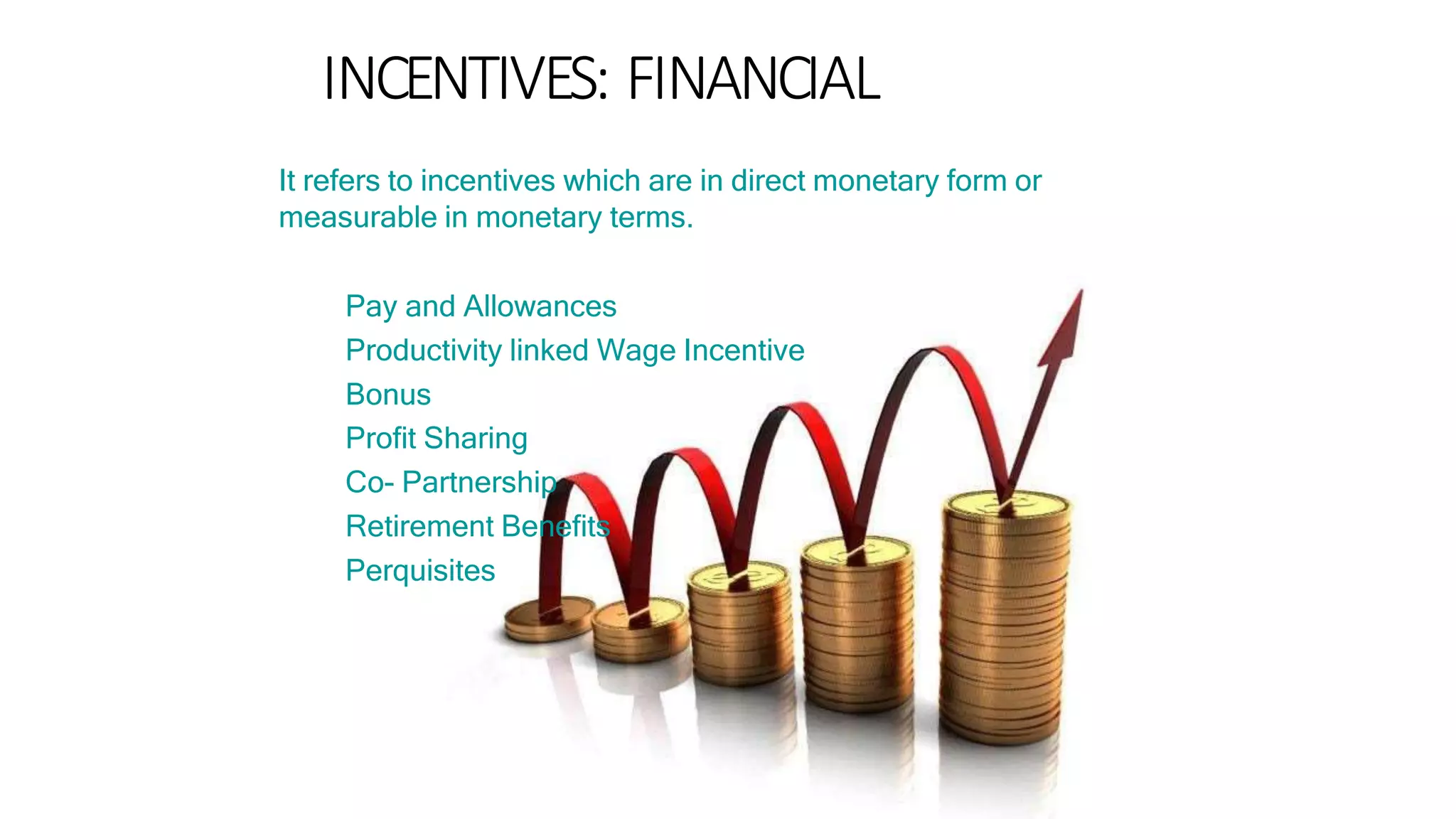
INCENTIVES: FINANCIAL
It refers to incentives which are in direct monetary form or
measurable in monetary terms.
Pay and Allowances
Productivity linked Wage Incentive
Bonus
Profit Sharing
Co- Partnership
Retirement Benefits
Perquisites
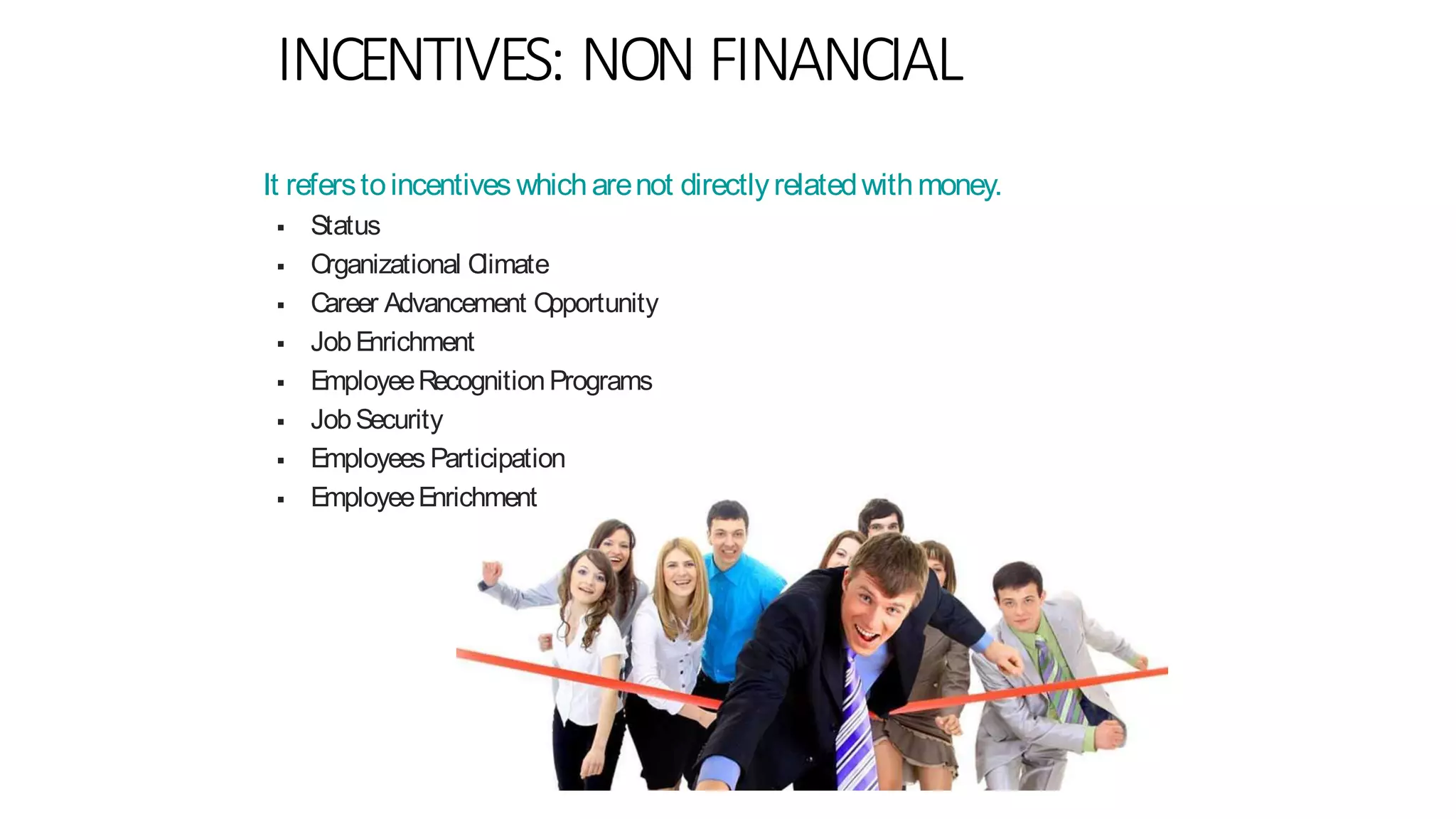
INCENTIVES: NON FINANCIAL
It referstoincentives whicharenot directlyrelatedwithmoney.
 Status
 Organizational Climate
 Career Advancement Opportunity
 JobEnrichment
 EmployeeRecognitionPrograms
 JobSecurity
 Employees Participation
 EmployeeEnrichment
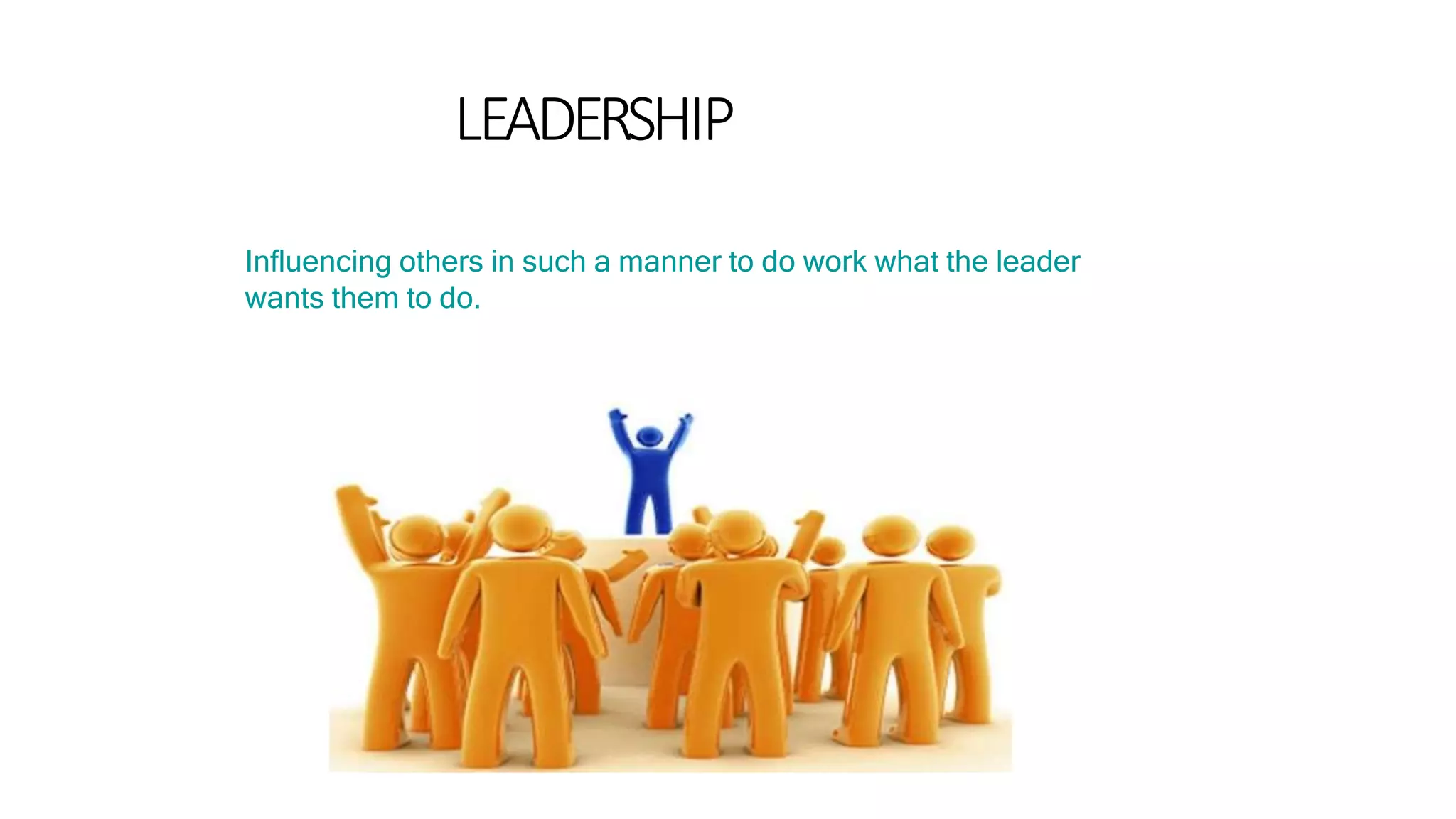
LEADERSHIP
Influencing others in such a manner to do work what the leader
wants them to do.
CHARACTERISTICS OF LEADERSHIP
InfluencingProcess
Behaviour changing process
Interpersonal Relations betweenLeader andfollowers
Common Goals Achieving
Continuous Process
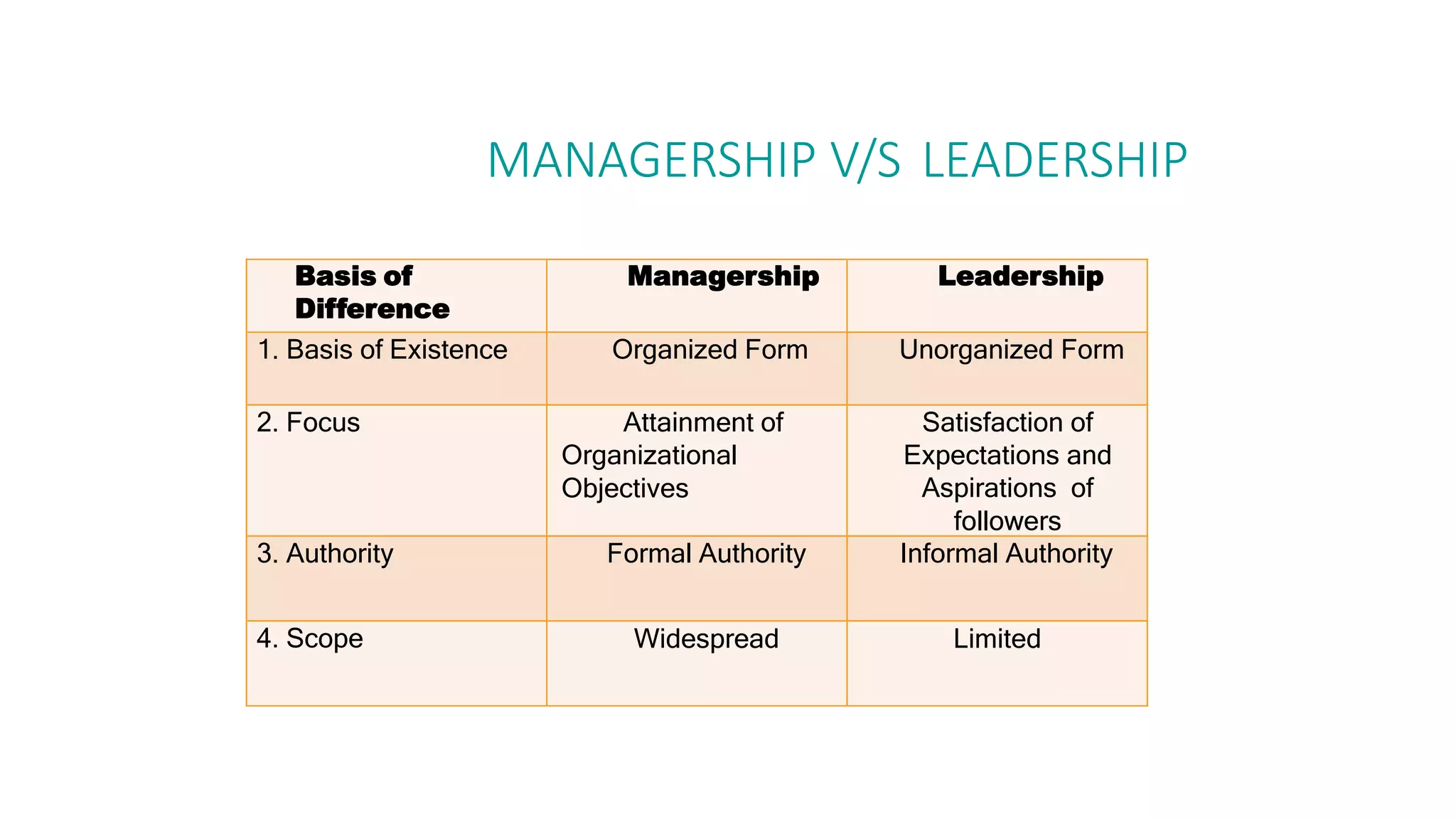
MANAGERSHIP V/S LEADERSHIP
Basis of
Difference
Managership Leadership
1. Basis of Existence Organized Form Unorganized Form
2. Focus Attainment of
Organizational
Objectives
Satisfaction of
Expectations and
Aspirations of
followers
3. Authority Formal Authority Informal Authority
4. Scope Widespread Limited
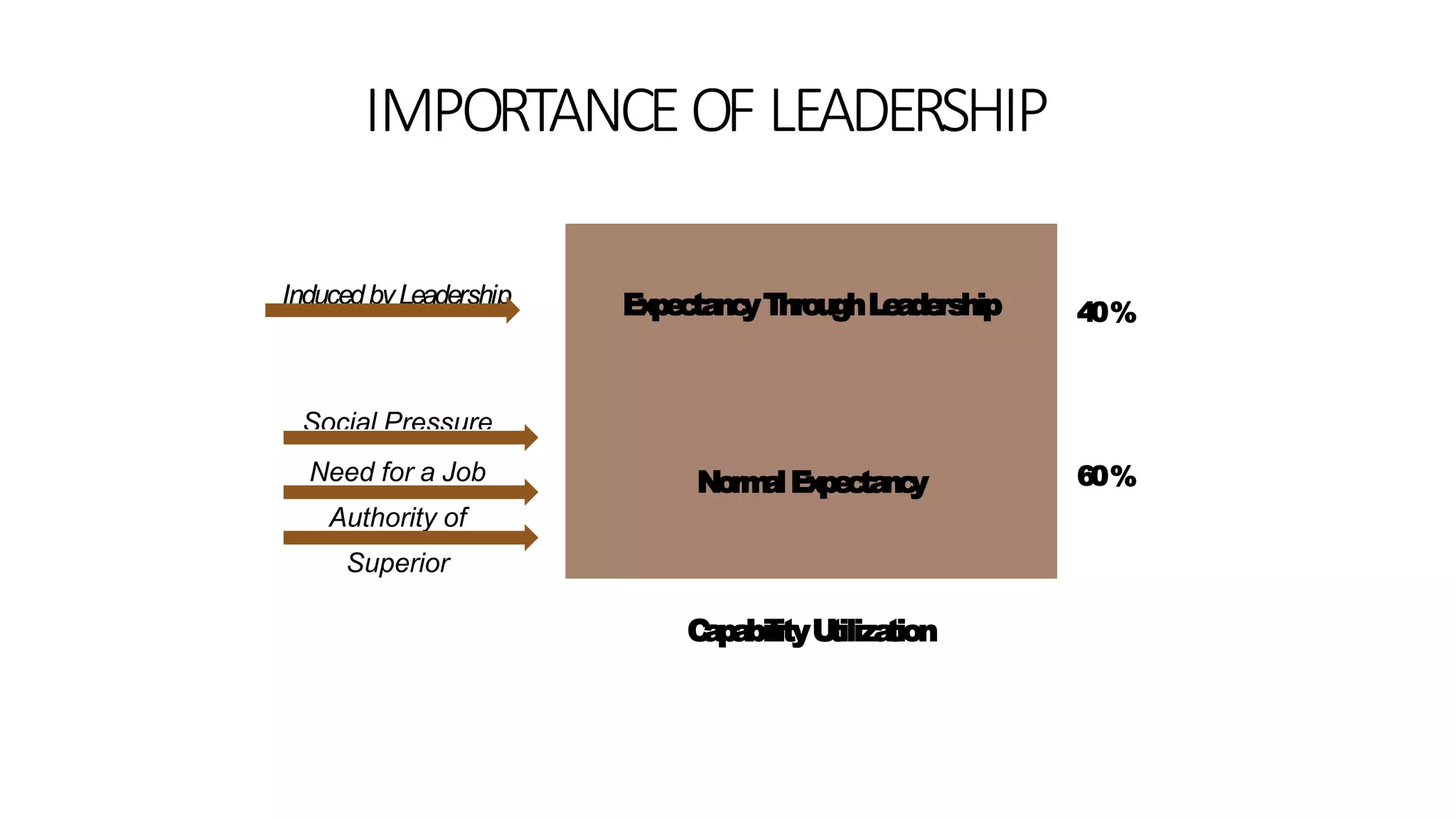
IMPORTANCEOF LEADERSHIP
ExpectancyThroughLeadership
NormalExpectancy
CapabilityUtilization
40%
60%
InducedbyLeadership
Social Pressure
Need for a Job
Authority of
Superior
InducedbyLeadership
LEADERSHIP STYLES
Leadership style is the manner and approach of providing
direction, implementing plans, and motivating people.
The three major styles of leadership are
Autocratic Leadership
Democratic Leadership
Laissez Faire Leadership
AUTOCRATIC LEADERSHIP STYLE
It refers to that leadership style in which the leader tends to run the
show all by himself.
I Want Both of You to
CHARACTERISTICS OF AUTOCRATIC
LEADERSHIP
CentralizedAuthority
SingleManDecisions
WrongBelief regardingEmployees
OnlyDownwardCommunication
AUTOCRATICLEADERSHIP STYLE
advantages of autocratic leadership
 Quick andClear Decisions
 Satisfactory work
 Necessary for Less EducatedEmployees
Disadvantages of autocratic leadership
 Lack of Motivation
 Agitationof Employees
 Possibilityof Partiality
Suitability of autocratic leadership
 Whentheleader isthemost knowledgeableinthegroup
 Whenthereislittletimefor decisionmaking
 Whensubordinates areuneducatedandunexperienced.
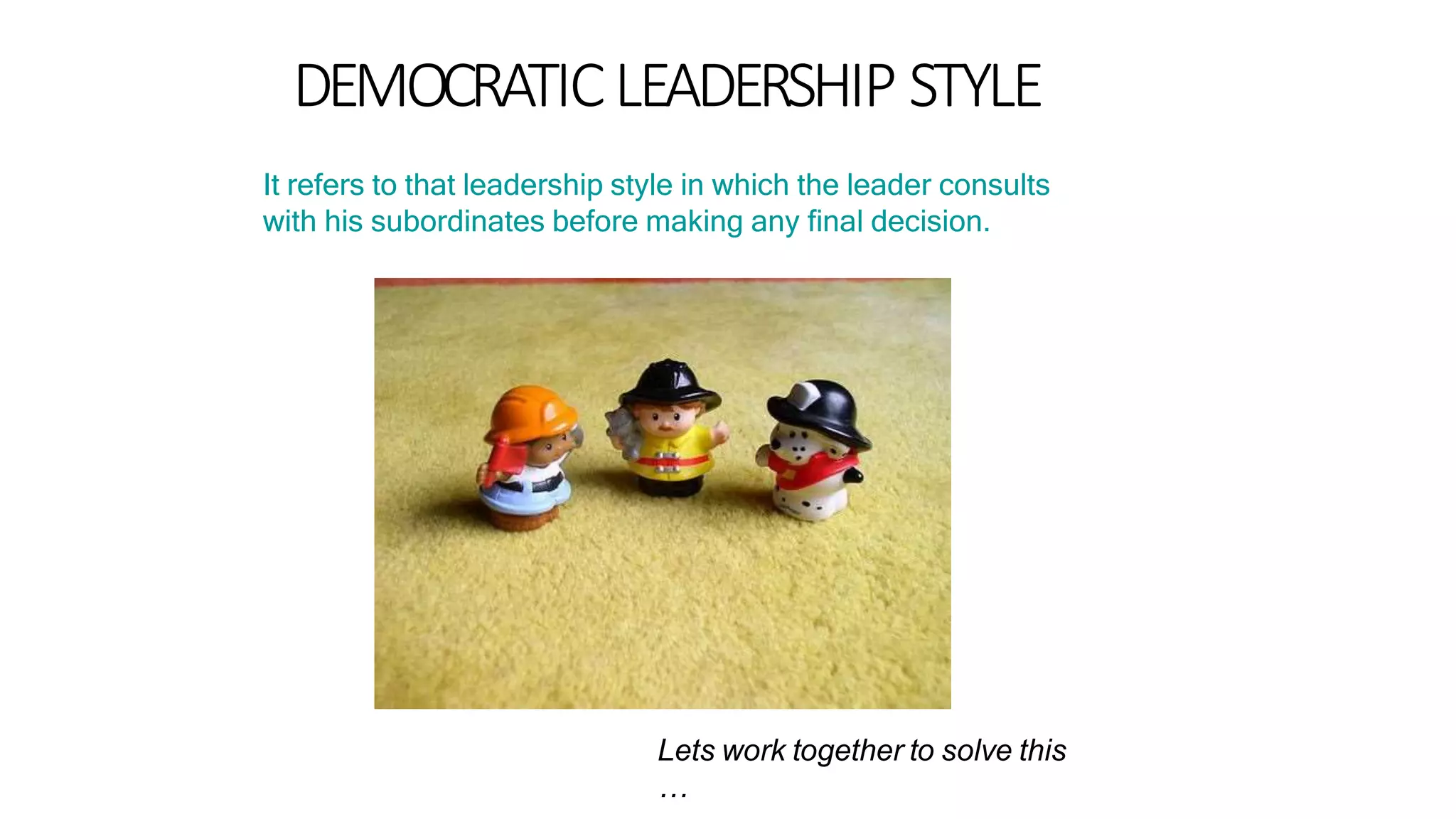
DEMOCRATICLEADERSHIP STYLE
It refers to that leadership style in which the leader consults
with his subordinates before making any final decision.
Lets work together to solve this
…
CHARACTERISTICS OF DEMOCRATIC
LEADERSHIP
CooperativeRelations
Belief inEmployees
OpenCommunication
DEMOCRATICLEADERSHIP STYLE
advantages of Democraticleadership
 HighMorale
 Creation of MoreEfficiencyandProductivity
 Availability of Sufficient timefor ConstructiveWork
Disadvantages of DEMOCRATICleadership
 Requirement of Educated Subordinates
 Delay inDecisions
 Lack of Responsibility inManagers
Suitability of DEMOCRATICleadership
 Whengroup members areskilled.
 Whenplenty of timeisavilablefor decisionmaking
 Whenleader wants toinvolvethesubordinates.
 Whenroles areclear
LAISSEZ FAIRELEADERSHIP STYLE
It refers to that leadership style in which leader allows the
employees to make the decisions.
You two take care of the problem while I go.
. .
CHARACTERISTICSOFLAISSEZFAIRE LEADERSHIP
Full FaithinSubordinates
Independent DecisionMakingSystem
Decentralizationof Authority
Self Directed
LAISSEZ FAIRELEADERSHIP STYLE
advantages of LaissezFaireleadership
 Development of Self ConfidenceinSubordinates
 HighLevel Motivation
 Helpful inDevelopment andExtension of theEnterprise
Disadvantages of LaissezFaireleadership
 DifficultyinCooperation
 Lack of Importanceof Managerial Post
 Suitableonlyfor Highly Educated Employees
Suitability of LaissezFaireleadership
 Whenfollowers arehighlyskilled,educated andexperienced
 Followers aretrustworthy
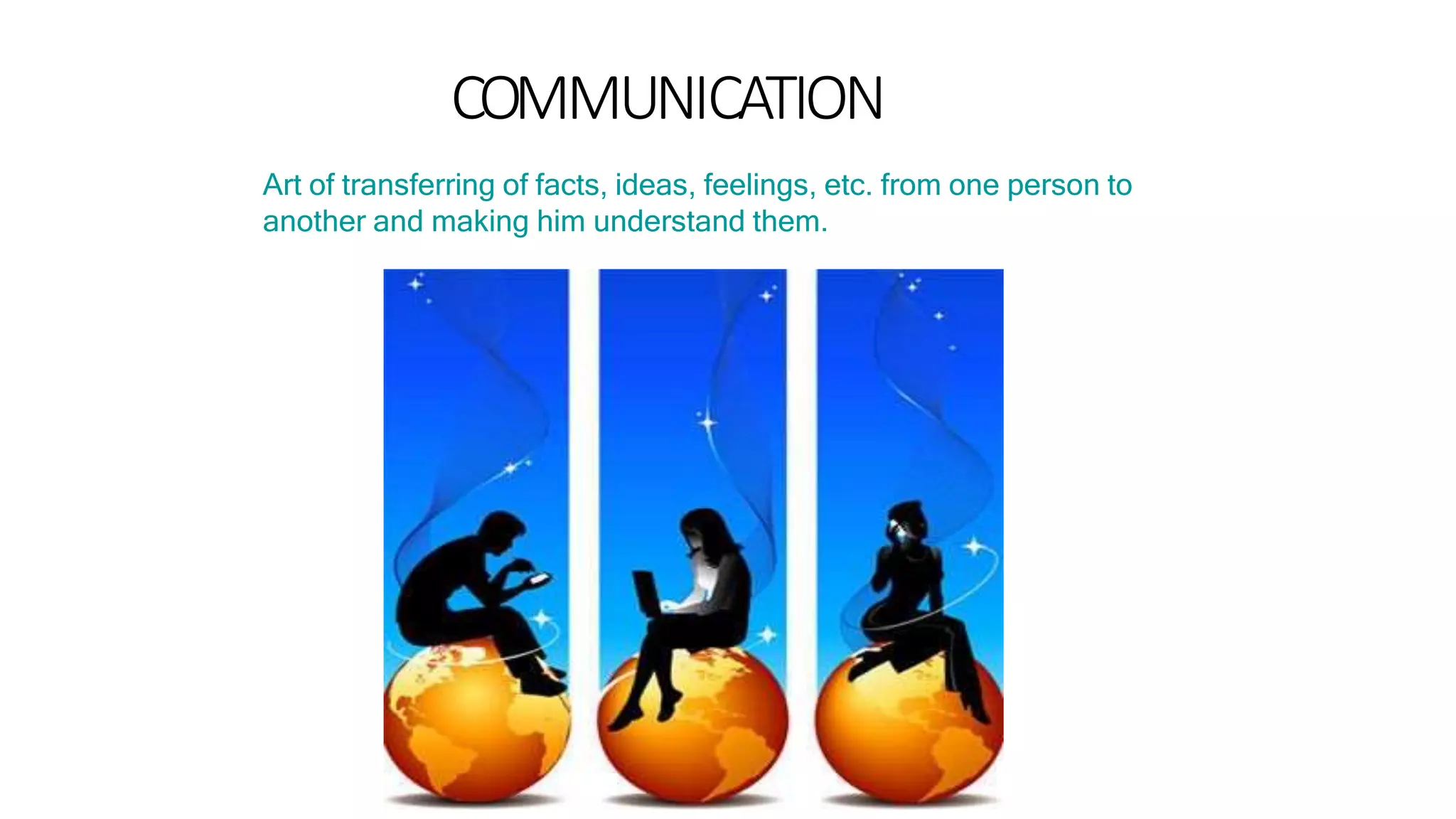
COMMUNICATION
Art of transferring of facts, ideas, feelings, etc. from one person to
another and making him understand them.
CHARACTERISTICS OF COMMUNICATION
Twoor MorePersons
Exchangeof Ideas
Mutual Understanding
Direct andIndirect Communication
Continuous Process
Useof Wordsaswell as Symbols
TYPES OF COMMUNICATION
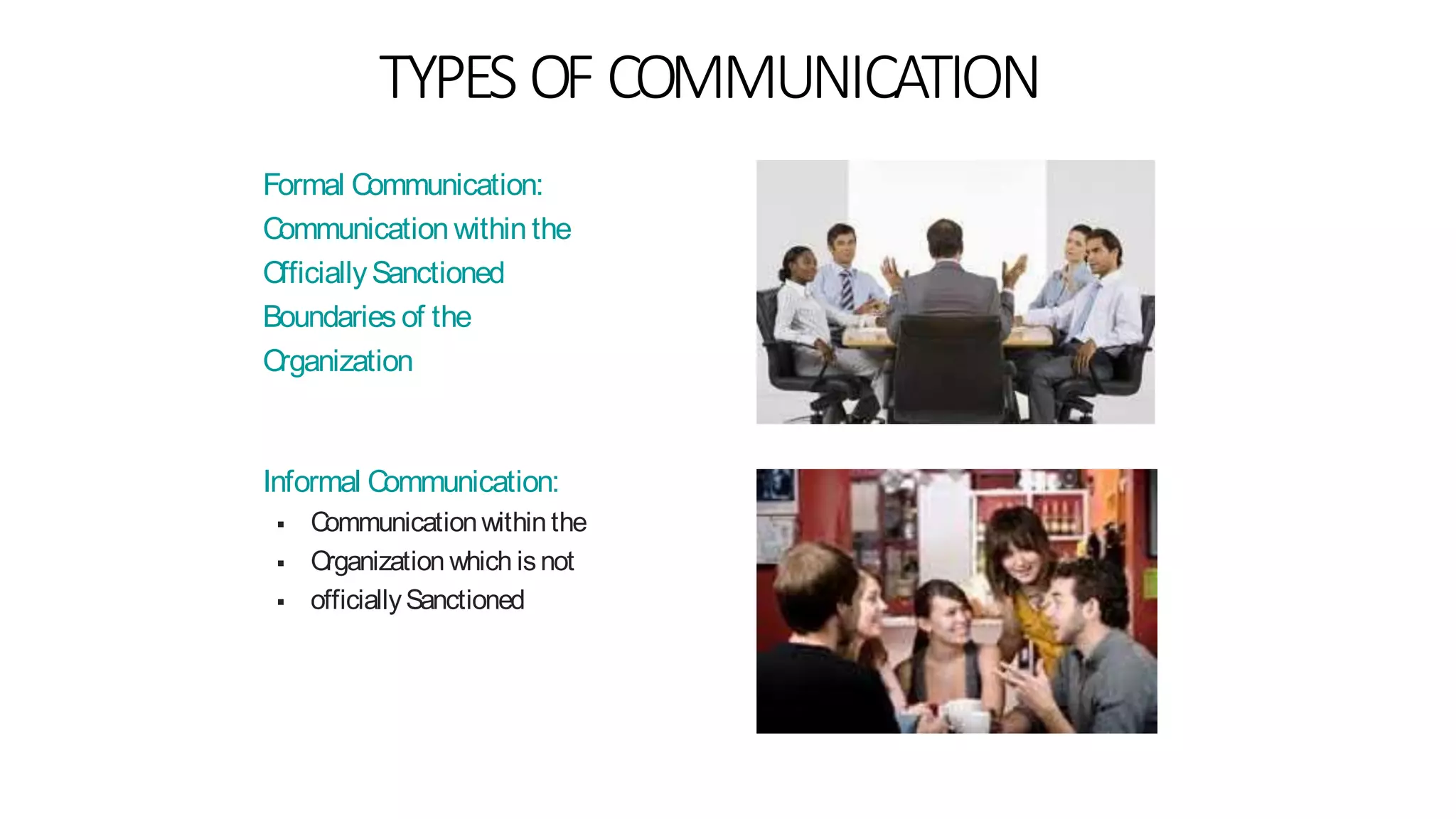
Formal Communication:
Communication within the
OfficiallySanctioned
Boundaries of the
Organization
Informal Communication:
 Communicationwithin the
 Organization which isnot
 officiallySanctioned
TYPES OF COMMUNICATION: FORMAL
Characteristicsof Formal Communication
 WrittenandOral
 Formal Relations
 Prescribed paths
 Organizational Message
 DeliberateEfforts
TYPES OF COMMUNICATION: FORMAL
Advantages of Formal Communication
 Maintenanceof Authority of theOfficers
 Clear andEffectiveCommunication
 Orderly flowof Information
 Easy knowledgeof Sourceof Information
TYPES OF COMMUNICATION: FORMAL
Limitationsof Formal Communication
 Overload of Work
 Distortionof Information
 OverlookingbytheOfficers
TYPES OF COMMUNICATION: FORMAL
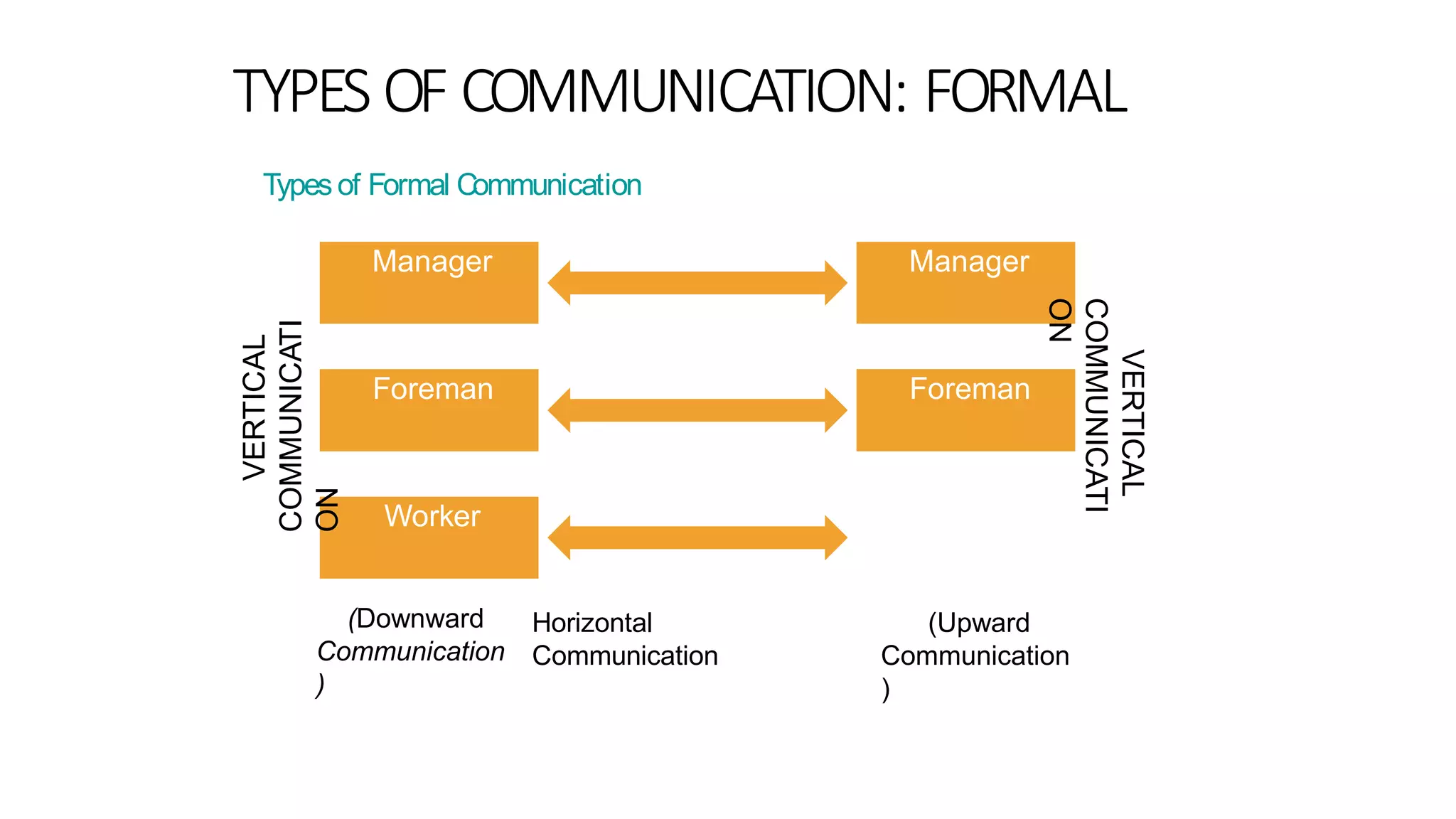
Types of Formal Communication
Manager
Foreman
Worker
Manager
Foreman
VERTICAL
COMMUNICATI
ON
VERTICAL
COMMUNICATI
ON
(Downward
Communication
)
Horizontal
Communication
(Upward
Communication
)
Characteristicsof Informal Communication
 FormationthroughSpecial Relations
 Two types of Information
• About Work
• About Individual
 Uncertain Path
 Possibilityof Rumor andDistortion
 Quick Relay
TYPES OF COMMUNICATION: INFORMAL
Advantages of Informal
Communication
Fast and Effective Communication
Free Environment
Better Human Relationships
Problems are Easily Solved
Social Needs of the Individual is Satisfied
TYPES OF COMMUNICATION: INFORMAL
Limitationsof Informal Communication
 Unsystematic Communication
 UnreliableInformation
TYPES OF COMMUNICATION: INFORMAL
Types of Informal Communication
x
1. Single
Standard
F
E
D
C
B
D
A
B C
H
G
2. Gossip
Chain
3. Probability
4. Cluster
x
1. Single
Standard
A
A
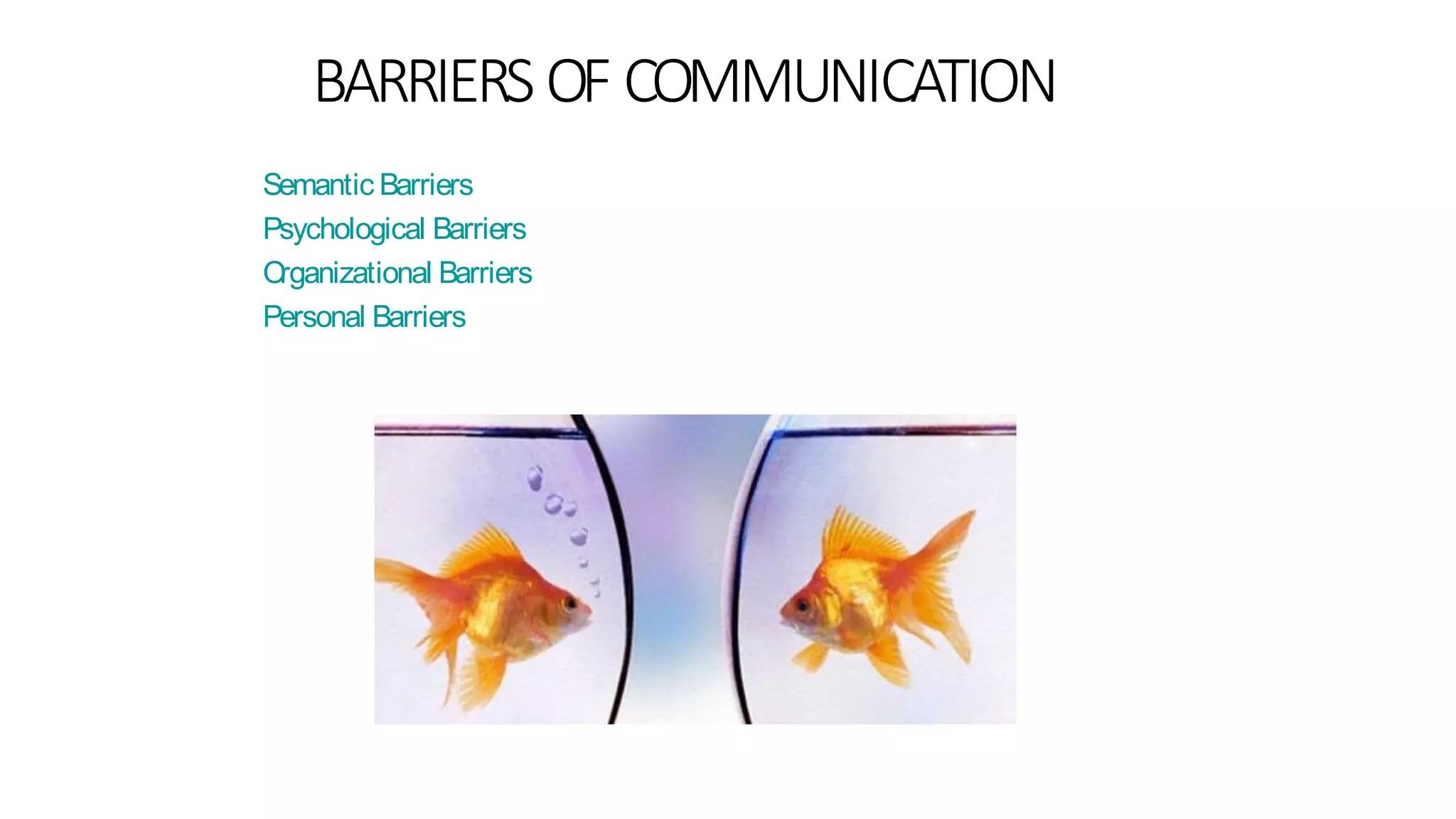
BARRIERS OF COMMUNICATION
Semantic Barriers
Psychological Barriers
Organizational Barriers
Personal Barriers
BARRIERS OF COMMUNICATION
1. Semantic Barriers:
 Badly Expressed messages
 Symbols or Words with Different Meanings
 Faulty Translation
 UnClarifiedAssumptions
 Technical Jargon
BARRIERS OF COMMUNICATION
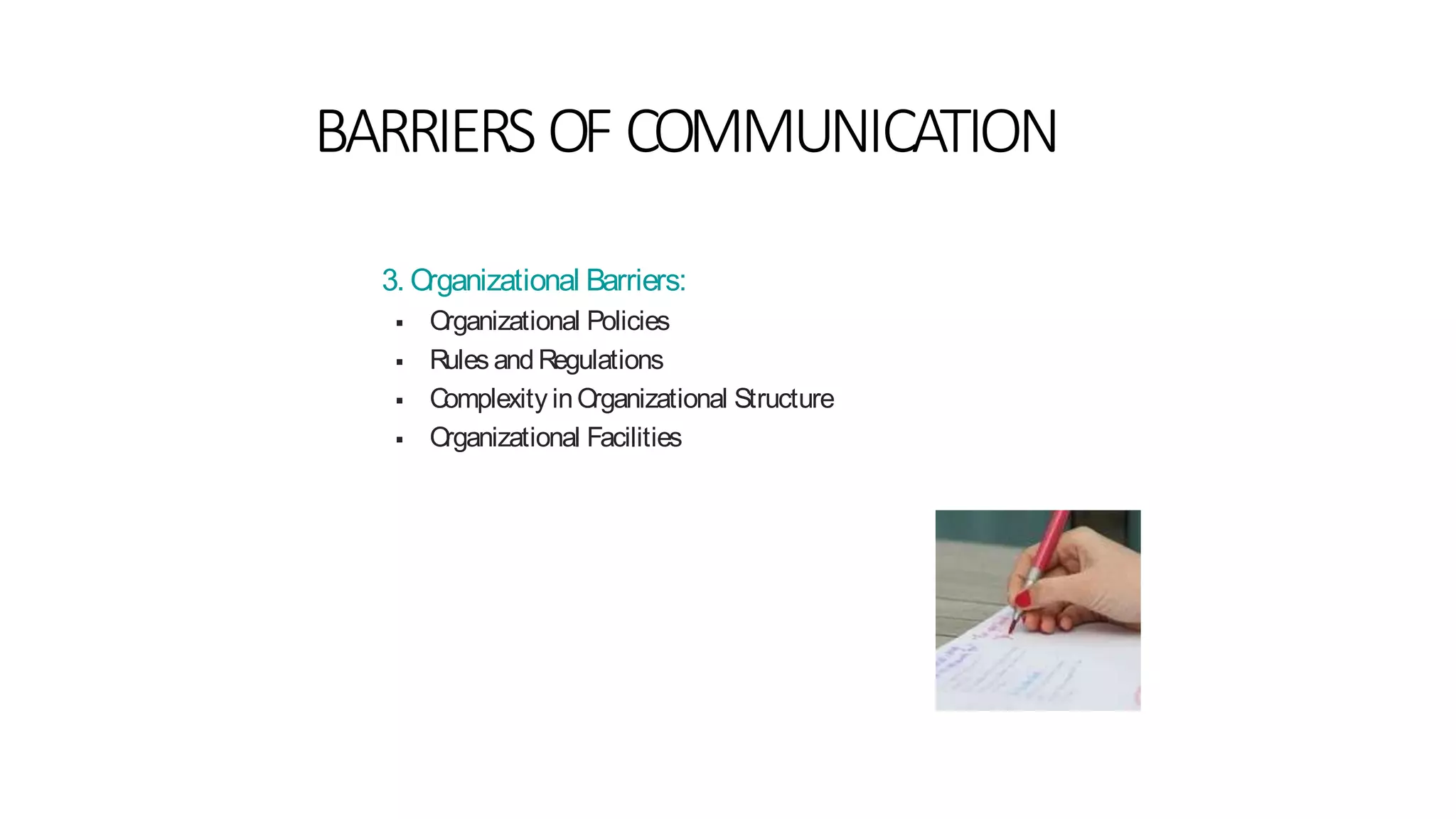
3. Organizational Barriers:
 Organizational Policies
 Rules andRegulations
 Complexity inOrganizational Structure
 Organizational Facilities
BARRIERS OF COMMUNICATION
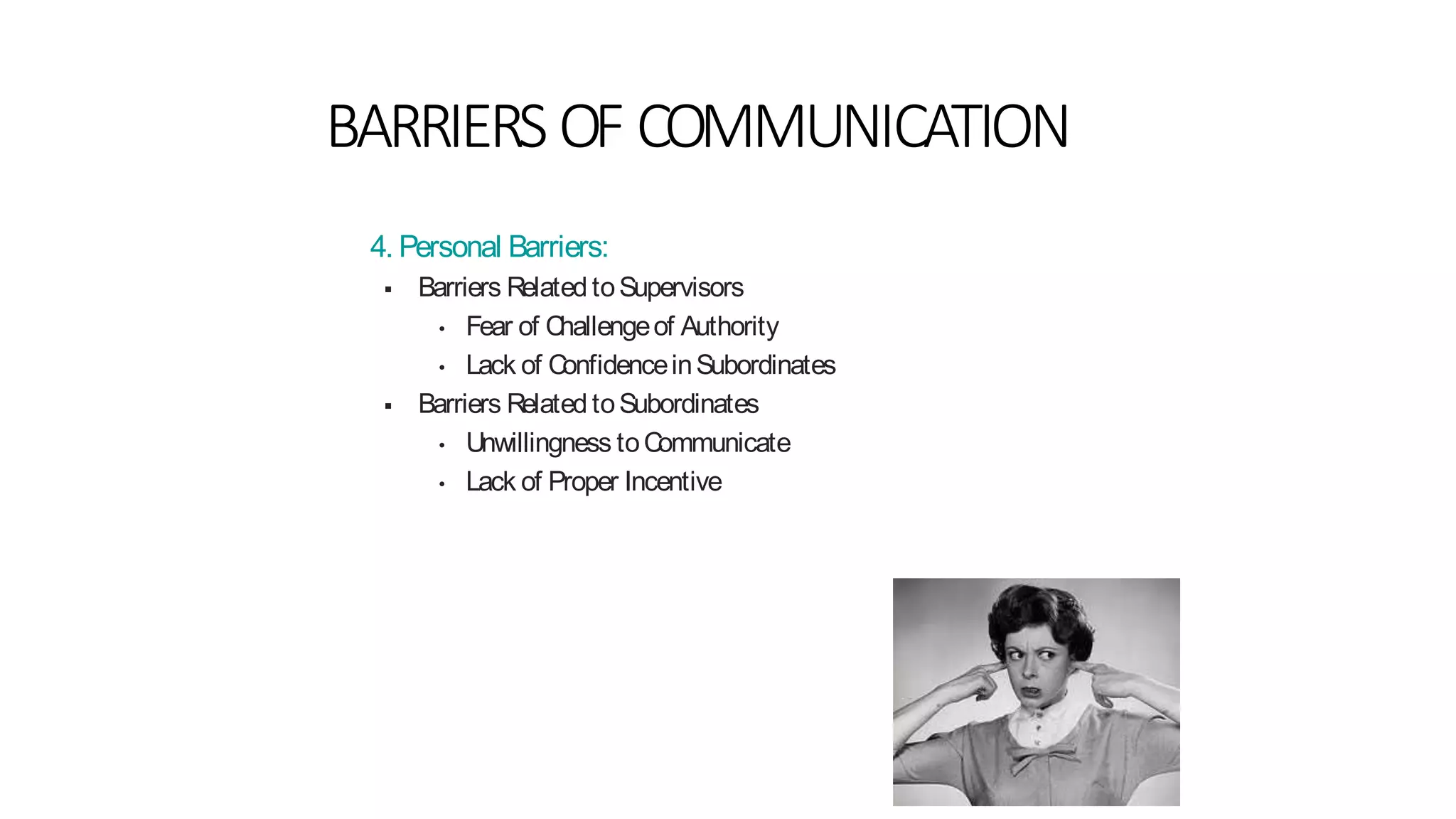
4. Personal Barriers:
 Barriers Related toSupervisors
• Fear of Challengeof Authority
• Lack of ConfidenceinSubordinates
 Barriers Related toSubordinates
• Unwillingness toCommunicate
• Lack of Proper Incentive
COMMUNICATION
Measurestoovercomethebarriersof communication
 Communicateaccording totheneedsof theReceiver
 Clarify ideas beforeCommunication
 Beawareof language,toneandContent
 Communicationfor thepresent as well asfuture
 Ensureproper feedback
 BeaGoodListener
Please be free to write query at:
Dr.Ramesh C Sharma
rameshchandersharma@gmail.com
http://rameshchandersharma.blogsspot.in
+91-94180-45154

Business studies +2 Unit 7

  • 1.
  • 2.
    TOPICS COVERED Directing Concept Importance Elements ofDirecting Supervision - Concept and Functions of Supervisor Motivation - Concept, Maslow’s Hierarchy of Needs, Financial and Non Financial Incentives Leadership – Concept and Style Communication - Concept, Formal and Informal communication, Barriers to effective Communication and how to overcome the Barriers
  • 3.
    DIRECTING Instructing, Guiding, Communicatingand Inspiring people in the Organization Also known “ Management- in- Action”
  • 4.
    “Directing is theexecutive function of guiding and observing subordinates”. - Koontz and O’Donnell
  • 5.
    FEATURES OF DIRECTING InitiatesAction Takes placeat everyLevel of Management Continuous Process Flows fromToptoBottom
  • 6.
    IMPORTANCEOF DIRECTING Initiates Action IntegratesEmployeesEfforts Meansof Motivation Facilitates toImplement Changes CreatesbalanceintheOrganization
  • 7.
  • 8.
    SUPERVISION Monitor the processof Routine work of one’s subordinates and guiding them properly
  • 9.
    CHARACTERISTICS OF SUPERVISION UniversalActivity Important part of DirectingFunction Continuous Process Faceto FaceContact Requiredlevel of Performance OptimumUtilization Special importancefor Lower Level Managers
  • 10.
    Responsible for puttingthe Plans of Action of Management into Action Acts as a link between Higher Level Management and the Workers Providing Solutions related to the Problems of Human Behaviour As a Key Man As a Mediat or As a Human Resource Specialist ROLEOF SUPERVISOR
  • 11.
    FUNCTIONS OF ASUPERVISOR EnsureIssuingInstructions Facilitates Control OptimumUtilizationof Resources Maintenanceof Discipline Feedback ImprovesCommunication ImprovesMotivation
  • 12.
    MOTIVATION It refers tothat process which excites people to work for attainment of a desired Objective.
  • 13.
    CHARACTERISTICS OF MOTIVATION Itis aInternal Feeling Produces Goal DirectedBehaviour It canbeeither Positiveor Negative Complex Process
  • 14.
    MASLOW’S NEED HIERARCHYTHEORY • First time Abraham Maslow categorized the countless needs in five different human needs on the Basis of Priority with following Assumptions:  People’s behavior is affected by their needs  Needs can be Prioritized  After satisfaction of one need, next higher need will serve as motivator  People will only move to other need only when lower need is satisfied
  • 15.
  • 16.
    HIERARCHY OF INDIVIDUALAND ORGANIZATION RELATEDNEEDS IndividualNeedHierarchy 5. Self Fulfilment 4. Status 3. Friendship 2. Stabilityof Income 1. Hunger OrganizationNeedHierarchy 5. Achievement of Goals 4. JobTitle 3. Cordial RelationwithColleagues 2. PensionPlan 1. Basic Salary
  • 17.
    INCENTIVES: FINANCIAL It refersto incentives which are in direct monetary form or measurable in monetary terms. Pay and Allowances Productivity linked Wage Incentive Bonus Profit Sharing Co- Partnership Retirement Benefits Perquisites
  • 18.
    INCENTIVES: FINANCIAL It refersto incentives which are in direct monetary form or measurable in monetary terms. Pay and Allowances Productivity linked Wage Incentive Bonus Profit Sharing Co- Partnership Retirement Benefits Perquisites
  • 19.
    INCENTIVES: NON FINANCIAL Itreferstoincentives whicharenot directlyrelatedwithmoney.  Status  Organizational Climate  Career Advancement Opportunity  JobEnrichment  EmployeeRecognitionPrograms  JobSecurity  Employees Participation  EmployeeEnrichment
  • 20.
    LEADERSHIP Influencing others insuch a manner to do work what the leader wants them to do.
  • 21.
    CHARACTERISTICS OF LEADERSHIP InfluencingProcess Behaviourchanging process Interpersonal Relations betweenLeader andfollowers Common Goals Achieving Continuous Process
  • 22.
    MANAGERSHIP V/S LEADERSHIP Basisof Difference Managership Leadership 1. Basis of Existence Organized Form Unorganized Form 2. Focus Attainment of Organizational Objectives Satisfaction of Expectations and Aspirations of followers 3. Authority Formal Authority Informal Authority 4. Scope Widespread Limited
  • 23.
  • 24.
    LEADERSHIP STYLES Leadership styleis the manner and approach of providing direction, implementing plans, and motivating people. The three major styles of leadership are Autocratic Leadership Democratic Leadership Laissez Faire Leadership
  • 25.
    AUTOCRATIC LEADERSHIP STYLE Itrefers to that leadership style in which the leader tends to run the show all by himself. I Want Both of You to
  • 26.
  • 27.
    AUTOCRATICLEADERSHIP STYLE advantages ofautocratic leadership  Quick andClear Decisions  Satisfactory work  Necessary for Less EducatedEmployees Disadvantages of autocratic leadership  Lack of Motivation  Agitationof Employees  Possibilityof Partiality Suitability of autocratic leadership  Whentheleader isthemost knowledgeableinthegroup  Whenthereislittletimefor decisionmaking  Whensubordinates areuneducatedandunexperienced.
  • 28.
    DEMOCRATICLEADERSHIP STYLE It refersto that leadership style in which the leader consults with his subordinates before making any final decision. Lets work together to solve this …
  • 29.
  • 30.
    DEMOCRATICLEADERSHIP STYLE advantages ofDemocraticleadership  HighMorale  Creation of MoreEfficiencyandProductivity  Availability of Sufficient timefor ConstructiveWork Disadvantages of DEMOCRATICleadership  Requirement of Educated Subordinates  Delay inDecisions  Lack of Responsibility inManagers Suitability of DEMOCRATICleadership  Whengroup members areskilled.  Whenplenty of timeisavilablefor decisionmaking  Whenleader wants toinvolvethesubordinates.  Whenroles areclear
  • 31.
    LAISSEZ FAIRELEADERSHIP STYLE Itrefers to that leadership style in which leader allows the employees to make the decisions. You two take care of the problem while I go. . .
  • 32.
    CHARACTERISTICSOFLAISSEZFAIRE LEADERSHIP Full FaithinSubordinates IndependentDecisionMakingSystem Decentralizationof Authority Self Directed
  • 33.
    LAISSEZ FAIRELEADERSHIP STYLE advantagesof LaissezFaireleadership  Development of Self ConfidenceinSubordinates  HighLevel Motivation  Helpful inDevelopment andExtension of theEnterprise Disadvantages of LaissezFaireleadership  DifficultyinCooperation  Lack of Importanceof Managerial Post  Suitableonlyfor Highly Educated Employees Suitability of LaissezFaireleadership  Whenfollowers arehighlyskilled,educated andexperienced  Followers aretrustworthy
  • 34.
    COMMUNICATION Art of transferringof facts, ideas, feelings, etc. from one person to another and making him understand them.
  • 35.
    CHARACTERISTICS OF COMMUNICATION TwoorMorePersons Exchangeof Ideas Mutual Understanding Direct andIndirect Communication Continuous Process Useof Wordsaswell as Symbols
  • 36.
    TYPES OF COMMUNICATION FormalCommunication: Communication within the OfficiallySanctioned Boundaries of the Organization Informal Communication:  Communicationwithin the  Organization which isnot  officiallySanctioned
  • 37.
    TYPES OF COMMUNICATION:FORMAL Characteristicsof Formal Communication  WrittenandOral  Formal Relations  Prescribed paths  Organizational Message  DeliberateEfforts
  • 38.
    TYPES OF COMMUNICATION:FORMAL Advantages of Formal Communication  Maintenanceof Authority of theOfficers  Clear andEffectiveCommunication  Orderly flowof Information  Easy knowledgeof Sourceof Information
  • 39.
    TYPES OF COMMUNICATION:FORMAL Limitationsof Formal Communication  Overload of Work  Distortionof Information  OverlookingbytheOfficers
  • 40.
    TYPES OF COMMUNICATION:FORMAL Types of Formal Communication Manager Foreman Worker Manager Foreman VERTICAL COMMUNICATI ON VERTICAL COMMUNICATI ON (Downward Communication ) Horizontal Communication (Upward Communication )
  • 41.
    Characteristicsof Informal Communication FormationthroughSpecial Relations  Two types of Information • About Work • About Individual  Uncertain Path  Possibilityof Rumor andDistortion  Quick Relay TYPES OF COMMUNICATION: INFORMAL
  • 42.
    TYPES OF COMMUNICATION:INFORMAL Advantages of Informal Communication Fast and Effective Communication Free Environment Better Human Relationships Problems are Easily Solved Social Needs of the Individual is Satisfied
  • 43.
    TYPES OF COMMUNICATION:INFORMAL Limitationsof Informal Communication  Unsystematic Communication  UnreliableInformation
  • 44.
    TYPES OF COMMUNICATION:INFORMAL Types of Informal Communication x 1. Single Standard F E D C B D A B C H G 2. Gossip Chain 3. Probability 4. Cluster x 1. Single Standard A A
  • 45.
    BARRIERS OF COMMUNICATION SemanticBarriers Psychological Barriers Organizational Barriers Personal Barriers
  • 46.
    BARRIERS OF COMMUNICATION 1.Semantic Barriers:  Badly Expressed messages  Symbols or Words with Different Meanings  Faulty Translation  UnClarifiedAssumptions  Technical Jargon
  • 47.
    BARRIERS OF COMMUNICATION 3.Organizational Barriers:  Organizational Policies  Rules andRegulations  Complexity inOrganizational Structure  Organizational Facilities
  • 48.
    BARRIERS OF COMMUNICATION 4.Personal Barriers:  Barriers Related toSupervisors • Fear of Challengeof Authority • Lack of ConfidenceinSubordinates  Barriers Related toSubordinates • Unwillingness toCommunicate • Lack of Proper Incentive
  • 49.
    COMMUNICATION Measurestoovercomethebarriersof communication  Communicateaccordingtotheneedsof theReceiver  Clarify ideas beforeCommunication  Beawareof language,toneandContent  Communicationfor thepresent as well asfuture  Ensureproper feedback  BeaGoodListener
  • 50.
    Please be freeto write query at: Dr.Ramesh C Sharma rameshchandersharma@gmail.com http://rameshchandersharma.blogsspot.in +91-94180-45154