MINI-PROJECT PRESENTATION
BY
JAMES ISSAC-(1RV10CH010)
MUSTAFA HARIS-(1RV10CH017)
S. GAUTHAM-(1RV10CH027)
JACOB JOHN- (1RV10CH042)
DRUG DISCOVERY METHODS
High throughput screening
Virtual screening
Scaffold hopping
Rational design- hand built drugs
Natural products
HITS
DRUG DISCOVERY
Drug Development
Hit Success rate:<1%
Clinical Trials
success rate: 20%
NEW DRUG!
 Dengue virus (DENV) belongs to the Flavivirus genus of the
Flaviviridae family.
 Transmitted by Aedes Aegypti.
 The Diseases:
 Dengue fever
 Dengue hemorrhagic fever (DHF)
 Dengue shock syndrome
 Threats:
 50 million infections per year
 500,000 develop DHF
 22000 deaths per year
 Current Treatment:
 No vaccine
 Limited efficiency of antiviral drugs
 Treatment for DHF is blood transfusion
 4 serotypes of the virus: DENV 1
to DENV 4
 Its genome comprises of a 10.7
kb single positive stranded RNA.
 Each serotype provides specific
lifetime immunity, and short-term
cross-immunity
 All serotypes can cause severe and fatal disease
 Genetic variation within serotypes
 most prevalent of the four dengue serotypes is Dengue virus type 2
(Den2)
Single stranded RNA
 Carries a single stranded RNA as its genome.
The genome encodes only 10 proteins.
 Out of which 3 are structural proteins and 7 are non structural
proteins.
 The 3 structural proteins (C. prM and E) form the coat of the
virus and deliver the RNA to target cells.
 The seven non structural proteins ( NS1, NS2A, NS2B, NS3,
NS4A, NS4B, NS5) known as NS proteins.
 They orchestrate the production of new viruses once the virus
gets inside the cell.
 180 identical copies of envelope (E) protein are attached to the
membrane by Transmembrane Segment.
The Protein Data Bank (PDB) is the single worldwide repository
for processing and distribution of 3D structure data of large
molecules of proteins and nucleic acids.
The outermost structural protein termed as the envelope
protein – from the PDB entry 1k4r.
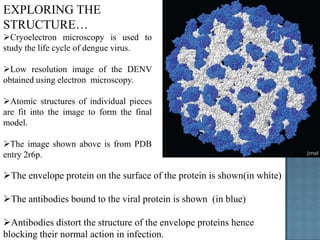
EXPLORING THE
STRUCTURE…
Cryoelectron microscopy is used to
study the life cycle of dengue virus.
Low resolution image of the DENV
obtained using electron microscopy.
Atomic structures of individual pieces
are fit into the image to form the final
model.
The image shown above is from PDB
entry 2r6p.
The envelope protein on the surface of the protein is shown(in white)
The antibodies bound to the viral protein is shown (in blue)
Antibodies distort the structure of the envelope proteins hence
blocking their normal action in infection.
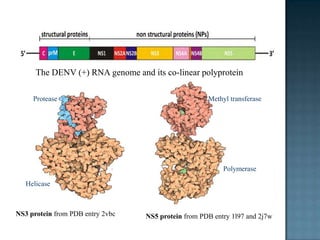
The DENV (+) RNA genome and its co-linear polyprotein
NS3 protein from PDB entry 2vbc NS5 protein from PDB entry 1l97 and 2j7w
Protease
Helicase
Methyl transferase
Polymerase
 In the infectious form of the virus, the envelope protein lays flat on the
surface forming a smooth icosahedral symmetry.
 The virus is carried into the cell and into the lysosome.
Organelles: 1.Nucleolus 2.Nucleus 3. ribosomes( little dots) 4. vescicle 5. Rough endoplasmic reticulum 6. Golgi appartus
7. Cytoskeleton 8. Smooth endoplasmic reticulum 9. Mitochondria 10. Vacuol 11. Cytosol 12. Lysosome 13. Centrriol 14. cell
membrane
 Inside the Lysosome , the acidic environment causes the protein to
snap to a trimeric shape.
 Several hydrophobic amino acids at the tip of the
spike pierce into the lyzosomal membrane .
They fuse the virus membrane with the lysosomal
membrane.
Thus releasing the viral RNA into the cytoplasm
of the cell and infection starts.
 Now the proteins in the virus help in replication
 NS3 and NS5 are two multifunctional proteins
containing 2 enzymes each.
NS3 from PDB entry 2vbc, contains a Helicase
and Protease enzymes.
NS5 from PDB entry 1l9k and 2j7w contains
Methyl Transferase and Polymerase enzymes.
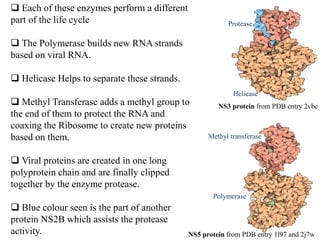
NS3 protein from PDB entry 2vbc
Protease
Helicase
NS5 protein from PDB entry 1l97 and 2j7w
Methyl transferase
Polymerase
 Each of these enzymes perform a different
part of the life cycle
 The Polymerase builds new RNA strands
based on viral RNA.
 Helicase Helps to separate these strands.
 Methyl Transferase adds a methyl group to
the end of them to protect the RNA and
coaxing the Ribosome to create new proteins
based on them.
 Viral proteins are created in one long
polyprotein chain and are finally clipped
together by the enzyme protease.
 Blue colour seen is the part of another
protein NS2B which assists the protease
activity.
ANTIVIRAL TARGETS
 The virus encoded proteins enzymes constitute the potential targets.
 Envelope , capsid, helicase, polymerase, proteases, etc
The M and E proteins are considered as targets so far.
The E protein is the most obvious target for therapeutic monoclonal
antibodies.
Out of the 7 NS proteins , NS3 and NS5 are considered as drug targets
because they exhibit enzymic activity.
NS3 becomes active only if the NS2B protein is also bound to it.
In drug design programs NS3/NS2B protein is one of the first targets.
NS5 is another potential target .
Validated target: It is any protein or cellular or viral component whose
inhibition leads to the inhibition of the growth of the virus itself.
 2/3rd of the organic compounds are aromatic heterocycles
 Majority of drugs used in pharmaceutical and biological industries
are heterocycles.
 Natural drugs : Quinine- was used to prevent and
 treat maleria in the 16th century.
 Synthetic drugs :Antipyrine- first synthetic drug for fever(1887)
 Heterocycles play an important role in biochemical processes
because the side groups of the most typical and essential constituents
of living cells are heterocycles.
Quinine
(1)N-sulfonylanthranilic acid
derivate
(2) Adenosine analogue of (1)
(3)chlorophenyl-thiophene
derivate
(4) 5-methoxyquinazoline- 2,4-
diamine
A Uracil Based multifunctional compound(fig1)was found to be a
potent inhibitor of dengue virus
But its De-aza derivative (fig 2)is inactive against the virus
 Mechanism of action-inhibition of the enzyme, inosine
monophosphate dehydrogenase (IMPDH).
Other Inhibitors
2,4-Diaminoquinazoline Derivatives
Fig(1)
Fig(2)
 Among the derivatives of 2,4-Diaminoquinazoline the one
shown in fig (2) has the most efficient antiviral activity
It is an inhibitor of the replication of Dengue 2 virus
It has a half maximal effective concentration (EC-50) value
of 0.05µM
It has a low cytotoxicity (50% cytotoxicity concentration)-
CC-50 value greater than 100μM
EXPERIMENTATION
METHODOLOGY
 we focussed on the method of scaffold hopping in drug
discovery
 2 methyl 4- hydroxy quinoline was the compound selected
for modification.
synthesis of 1-Phenyl-1,2,3,4-tetrahydro-β-carboline-3-
carboxylic Acid following general procedures.
Synthesis of hydroxy quinoline using Conrad limpach reaction
Substitution reactions of the two compounds
CHEMICALS USED
L-Tryptophan
Benzaldehyde
Sulphuric Acid
Hydrochloric Acid
Ethyl Acetoacetate
Aniline
Ethanol
Petroleum Ether
P-toluene Sulphonic acid
Silicone oil
Dimethyl Formamide (DMF)
Reaction of L-Tryptophan with Aromatic Aldehydes to
Give Tetrahydro-β-carboline(1a-cis and 1b-trans).:
PROCEDURE
 L-Tryptophan(MW=204) was taken (2.94 m.mol) in a round
bottom flask
It was dissolved in 10 ml of 0.2 N Sulphuric acid
To this solution 0.5 ml of benzaldehyde(4.4) m.mol was
added and continuously stirred for 9 days.
A precipitate was obtained –(245 mg, and 56%) as a white
solid.
It is a mixture of the cis and trans isomers.
The reaction….
Synthesis of 2-methyl-4-hydroxy quinoline:
 Conrad Limpach reaction.
In a 100 ml beaker, 0.01 mol, 4.35 mg Aniline, 0.01 mol,
6.35 mg ethyl acetoacetate and 120 mg of p-toluene
sulphonic acid were taken and mixed well.
 This was then stirred in a round bottomed flask which
was kept in an oil bath at 100 C.
The progress of the reaction was monitored using TLC
every 30 seconds.
After heating, 10ml Petroleum Ether (60 C-80 C) was
added to the mixture.
The product was collected by suction and purified by re-
crystallisation from DMF-water.
Mechanism of Conrad Limpach reaction:
Snap Shots
Conclusions
 The structure of the DENV virus and its mechanism of action
was studied and reported
 Various Heterocyclic compounds were reviewed and their
activity against Dengue Virus were listed out.
Thus we have made an attempt to synthesize 2 simple
heterocyclic compounds
• Tetrahydro-β- carboline – 3- carboxylic acid
• 2-methyl 4-hydroxyquinoline
THANK YOU

The dengue virus structure

  • 1.
    MINI-PROJECT PRESENTATION BY JAMES ISSAC-(1RV10CH010) MUSTAFAHARIS-(1RV10CH017) S. GAUTHAM-(1RV10CH027) JACOB JOHN- (1RV10CH042)
  • 2.
    DRUG DISCOVERY METHODS Highthroughput screening Virtual screening Scaffold hopping Rational design- hand built drugs Natural products HITS DRUG DISCOVERY Drug Development Hit Success rate:<1% Clinical Trials success rate: 20% NEW DRUG!
  • 3.
     Dengue virus(DENV) belongs to the Flavivirus genus of the Flaviviridae family.  Transmitted by Aedes Aegypti.  The Diseases:  Dengue fever  Dengue hemorrhagic fever (DHF)  Dengue shock syndrome  Threats:  50 million infections per year  500,000 develop DHF  22000 deaths per year  Current Treatment:  No vaccine  Limited efficiency of antiviral drugs  Treatment for DHF is blood transfusion
  • 4.
     4 serotypesof the virus: DENV 1 to DENV 4  Its genome comprises of a 10.7 kb single positive stranded RNA.  Each serotype provides specific lifetime immunity, and short-term cross-immunity  All serotypes can cause severe and fatal disease  Genetic variation within serotypes  most prevalent of the four dengue serotypes is Dengue virus type 2 (Den2) Single stranded RNA
  • 5.
     Carries asingle stranded RNA as its genome. The genome encodes only 10 proteins.  Out of which 3 are structural proteins and 7 are non structural proteins.  The 3 structural proteins (C. prM and E) form the coat of the virus and deliver the RNA to target cells.  The seven non structural proteins ( NS1, NS2A, NS2B, NS3, NS4A, NS4B, NS5) known as NS proteins.  They orchestrate the production of new viruses once the virus gets inside the cell.  180 identical copies of envelope (E) protein are attached to the membrane by Transmembrane Segment.
  • 6.
    The Protein DataBank (PDB) is the single worldwide repository for processing and distribution of 3D structure data of large molecules of proteins and nucleic acids. The outermost structural protein termed as the envelope protein – from the PDB entry 1k4r.
  • 7.
    EXPLORING THE STRUCTURE… Cryoelectron microscopyis used to study the life cycle of dengue virus. Low resolution image of the DENV obtained using electron microscopy. Atomic structures of individual pieces are fit into the image to form the final model. The image shown above is from PDB entry 2r6p. The envelope protein on the surface of the protein is shown(in white) The antibodies bound to the viral protein is shown (in blue) Antibodies distort the structure of the envelope proteins hence blocking their normal action in infection.
  • 8.
    The DENV (+)RNA genome and its co-linear polyprotein NS3 protein from PDB entry 2vbc NS5 protein from PDB entry 1l97 and 2j7w Protease Helicase Methyl transferase Polymerase
  • 9.
     In theinfectious form of the virus, the envelope protein lays flat on the surface forming a smooth icosahedral symmetry.  The virus is carried into the cell and into the lysosome. Organelles: 1.Nucleolus 2.Nucleus 3. ribosomes( little dots) 4. vescicle 5. Rough endoplasmic reticulum 6. Golgi appartus 7. Cytoskeleton 8. Smooth endoplasmic reticulum 9. Mitochondria 10. Vacuol 11. Cytosol 12. Lysosome 13. Centrriol 14. cell membrane
  • 10.
     Inside theLysosome , the acidic environment causes the protein to snap to a trimeric shape.  Several hydrophobic amino acids at the tip of the spike pierce into the lyzosomal membrane . They fuse the virus membrane with the lysosomal membrane. Thus releasing the viral RNA into the cytoplasm of the cell and infection starts.  Now the proteins in the virus help in replication  NS3 and NS5 are two multifunctional proteins containing 2 enzymes each. NS3 from PDB entry 2vbc, contains a Helicase and Protease enzymes. NS5 from PDB entry 1l9k and 2j7w contains Methyl Transferase and Polymerase enzymes.
  • 11.
    NS3 protein fromPDB entry 2vbc Protease Helicase NS5 protein from PDB entry 1l97 and 2j7w Methyl transferase Polymerase  Each of these enzymes perform a different part of the life cycle  The Polymerase builds new RNA strands based on viral RNA.  Helicase Helps to separate these strands.  Methyl Transferase adds a methyl group to the end of them to protect the RNA and coaxing the Ribosome to create new proteins based on them.  Viral proteins are created in one long polyprotein chain and are finally clipped together by the enzyme protease.  Blue colour seen is the part of another protein NS2B which assists the protease activity.
  • 12.
    ANTIVIRAL TARGETS  Thevirus encoded proteins enzymes constitute the potential targets.  Envelope , capsid, helicase, polymerase, proteases, etc The M and E proteins are considered as targets so far. The E protein is the most obvious target for therapeutic monoclonal antibodies. Out of the 7 NS proteins , NS3 and NS5 are considered as drug targets because they exhibit enzymic activity. NS3 becomes active only if the NS2B protein is also bound to it. In drug design programs NS3/NS2B protein is one of the first targets. NS5 is another potential target . Validated target: It is any protein or cellular or viral component whose inhibition leads to the inhibition of the growth of the virus itself.
  • 13.
     2/3rd ofthe organic compounds are aromatic heterocycles  Majority of drugs used in pharmaceutical and biological industries are heterocycles.  Natural drugs : Quinine- was used to prevent and  treat maleria in the 16th century.  Synthetic drugs :Antipyrine- first synthetic drug for fever(1887)  Heterocycles play an important role in biochemical processes because the side groups of the most typical and essential constituents of living cells are heterocycles. Quinine
  • 14.
    (1)N-sulfonylanthranilic acid derivate (2) Adenosineanalogue of (1) (3)chlorophenyl-thiophene derivate (4) 5-methoxyquinazoline- 2,4- diamine
  • 15.
    A Uracil Basedmultifunctional compound(fig1)was found to be a potent inhibitor of dengue virus But its De-aza derivative (fig 2)is inactive against the virus  Mechanism of action-inhibition of the enzyme, inosine monophosphate dehydrogenase (IMPDH). Other Inhibitors
  • 16.
    2,4-Diaminoquinazoline Derivatives Fig(1) Fig(2)  Amongthe derivatives of 2,4-Diaminoquinazoline the one shown in fig (2) has the most efficient antiviral activity It is an inhibitor of the replication of Dengue 2 virus It has a half maximal effective concentration (EC-50) value of 0.05µM It has a low cytotoxicity (50% cytotoxicity concentration)- CC-50 value greater than 100μM
  • 17.
    EXPERIMENTATION METHODOLOGY  we focussedon the method of scaffold hopping in drug discovery  2 methyl 4- hydroxy quinoline was the compound selected for modification. synthesis of 1-Phenyl-1,2,3,4-tetrahydro-β-carboline-3- carboxylic Acid following general procedures. Synthesis of hydroxy quinoline using Conrad limpach reaction Substitution reactions of the two compounds
  • 18.
    CHEMICALS USED L-Tryptophan Benzaldehyde Sulphuric Acid HydrochloricAcid Ethyl Acetoacetate Aniline Ethanol Petroleum Ether P-toluene Sulphonic acid Silicone oil Dimethyl Formamide (DMF)
  • 19.
    Reaction of L-Tryptophanwith Aromatic Aldehydes to Give Tetrahydro-β-carboline(1a-cis and 1b-trans).: PROCEDURE  L-Tryptophan(MW=204) was taken (2.94 m.mol) in a round bottom flask It was dissolved in 10 ml of 0.2 N Sulphuric acid To this solution 0.5 ml of benzaldehyde(4.4) m.mol was added and continuously stirred for 9 days. A precipitate was obtained –(245 mg, and 56%) as a white solid. It is a mixture of the cis and trans isomers.
  • 20.
  • 21.
    Synthesis of 2-methyl-4-hydroxyquinoline:  Conrad Limpach reaction. In a 100 ml beaker, 0.01 mol, 4.35 mg Aniline, 0.01 mol, 6.35 mg ethyl acetoacetate and 120 mg of p-toluene sulphonic acid were taken and mixed well.  This was then stirred in a round bottomed flask which was kept in an oil bath at 100 C. The progress of the reaction was monitored using TLC every 30 seconds. After heating, 10ml Petroleum Ether (60 C-80 C) was added to the mixture. The product was collected by suction and purified by re- crystallisation from DMF-water.
  • 22.
    Mechanism of ConradLimpach reaction:
  • 23.
  • 25.
    Conclusions  The structureof the DENV virus and its mechanism of action was studied and reported  Various Heterocyclic compounds were reviewed and their activity against Dengue Virus were listed out. Thus we have made an attempt to synthesize 2 simple heterocyclic compounds • Tetrahydro-β- carboline – 3- carboxylic acid • 2-methyl 4-hydroxyquinoline
  • 26.