Juan E Maldonado Weng Primary Article
Gustavo A Martínez
In Silico Research: Inhibiting binding GTP on Methyltransferase of Dengue Virus
Abstract:The objective of this paper is to present the process of identifying a drug that will easily fight against the
Dengue Virus (DNV). The process was begun using a model of the methyltransferase enzyme with a Guanosine
Triphosphate (GTP) of the virus within an active spot. Methyltransferase is an enzyme that transfers a methyl
group to the DNA of a cell. GTP is the molecule that produces the energy in order for that enzyme to transfer the
methyl group properly. The purpose of developing this drug is to find a compound that will inhibit the transfer of
methyl to the virus’ DNA. Forthis project, the Pymol program was used to generate three benzene ringspositioned
in the pocket where the GTP normally connects to the enzyme. These rings are then to be used to create the
pharmacophore model, which will show the hydrophobic regions. The hydrophobic regions are what will show
which compound will fit properly within the pocket in order to inhibit the GTP. That compound will be searched
for in the ZINC Pharmer database. After processing the model through the database, over sixty thousand hits were
found compatible in that region of the methyltransferase. These were filtered and separated into five different
groups. From these groups, the twenty-five compounds with the highest affinity were chosen, and of those, the top
three with the highest affinity were placed into the methyltransferase pocket in order to compare them with the
benzene rings and the GTP. The compound with the highest affinity (-10.4) was DENV-M2_1.For future study.
Introduction
Dengue is a serious life affecting
disease infecting thousands of people while
millions of others are at risk. The disease
can be classified as three types of disease:
Dengue Fever, Hemorrhagic Fever, or
Shock Syndrome. “Antiviral drug discovery
is becoming increasingly important due to
the global threat of viral disease pandemics.
Many members of the genus Flavivirus are
significant human pathogens, among which
dengue virus (DENV) alone poses a public
health threat to 2.5 billion worldwide,
leading to 50–100 million human infections
each year. Neither vaccine nor effective
therapeutics is currently available for
DENV. Development of a DENV vaccine
has been challenging, because of the need to
simultaneously immunize and induce a long-
lasting protection against all four serotypes
of DENV…” (Noble et al. 2010).These
diseases are very severe, and based on CDC
reports from 2013; many common
symptoms include joint and muscle pain,
elevated corporal temperatures, and severe
headaches. These diseases in severe cases
can cause death. According to CDC in 2010,
there were 12,580 confirmed cases of people
diagnosed with dengue in Puerto Rico. The
Cartogram 1- Infection
“Cartogram of the annual
number of infections for all
ages as a proportion of
National or subnational (China)
geographical area”
Obtained fromBahtt et al.
Review Paper 2013
tropical regionsare under the most danger
because the numbers ofmosquitoes that
transmit the disease prefer these areas.
The Aedes mosquito is the common
carrier of the Dengue virus. The Dengue
virus is a member of the family Flaviviridae
and the genus Flavivirus. The Dengue virus
has very similar structural properties to other
members of the family like the West Nile
Virus.The viral transmission poses a real
threat to people and, with no cure available;
the amount of cases will increase by the
incoming years.
Through research by computer
simulation, the search for a cure is easier.
Utilizing many advance software and
programming, the structure of important
proteins can be ideally researched. With
these structures, the main components, such
as amino acids with their spacing
arrangement and chemical properties, could
be studied then inhibited. Through
inhibition of certain useful structures, the
viral infection could be stopped.
In the case of the Dengue Virus, the
methyltransferase is an important proteinfor
the spread and development of the virus.
“Methyltransferases (MTases) play key roles
in normal physiology and human diseases
through methylating DNA, RNA, and
proteins. Almost all MTases use S-adenosyl-
L-methionine (SAM) as a methyl donor and
generate S-adenosyl-Lhomocysteine (SAH)
as a by-product. Pharmacological
modulation of MTases by small molecules
represents a novel approach to therapeutic
intervention in cancer and other diseases.”
(Siew Pheng Lim et al, 2011)The
methyltransferase transfers a methyl group
from a donor toan acceptor which could be a
strand of DNA or RNA. This methyl group
will help mark the genes needed to be
expressed. This protein is needed for the
virus to develop properly. The mechanism
that the protein utilizes to have the
appropriate energy is to bind with a GTP
molecule. This molecule is the energy
source that enables the methyltransferase to
complete the transfers.
The first step, which was the most
important, was to identify a biological
problem and to undergo research to
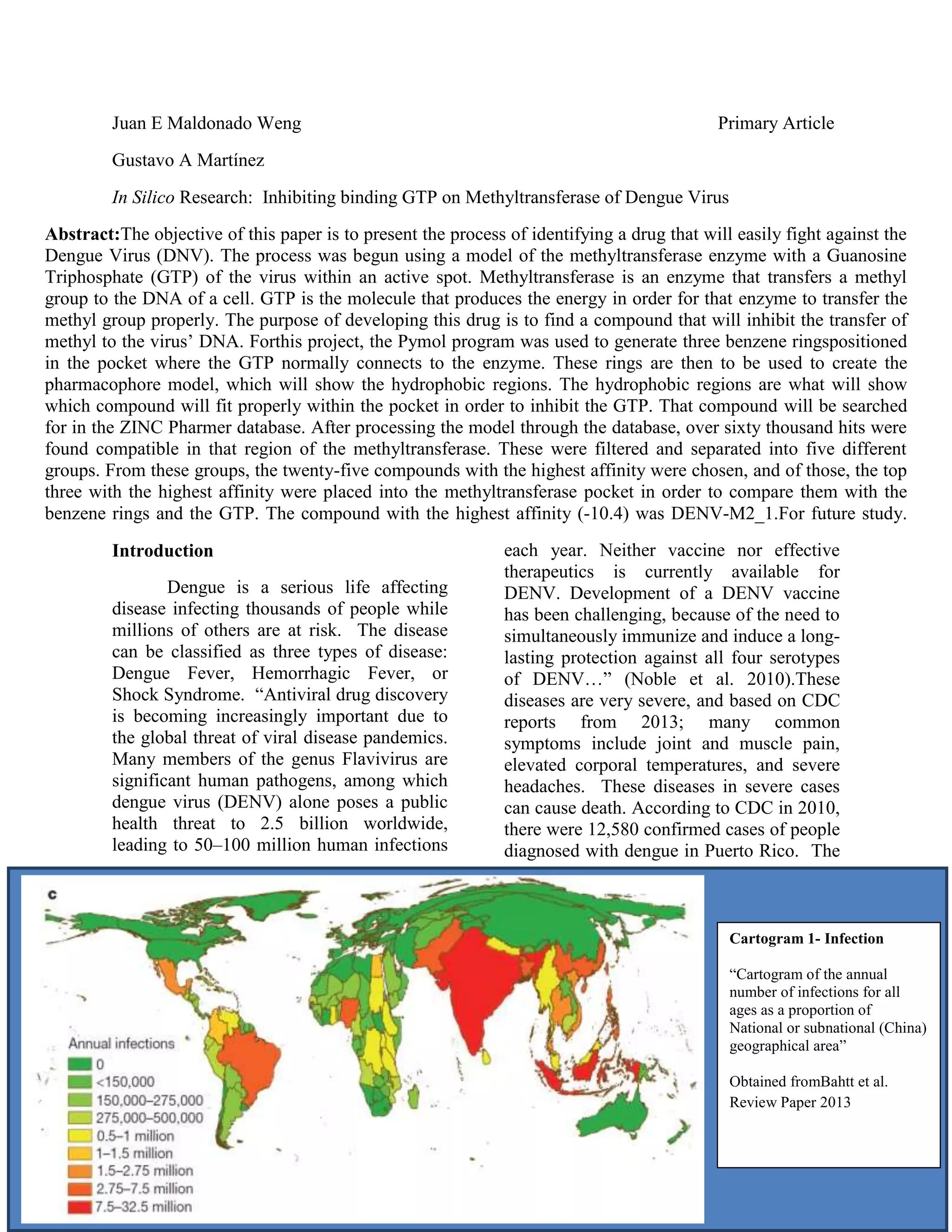
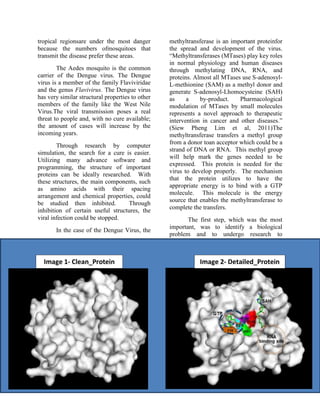
Image 1- Clean_Protein Image 2- Detailed_Protein
understand the virus. The problem trying to
be dealt with is the dengue virus. The
hypothesis states“Through In Sillico
research, the GTP, used for the
Methyltransferase of DENV-2, can be
inhibited utilizing a higher affinity
compound.” Finding a compound that could
have a stronger force of attraction towards
the site where GTP would be located would
bring forward a solution.If an alternate
compound would take GTP’s place, then
there is a possibility the protein would fail
causing a cease in the virus’ effect on the
organism.
Materials and Method
The methyltransferase 3D molecule
structure was downloaded from the online
Protein Database (pbd.org). This database
provided much needed information and was
very accessible. The molecule can be seen in
Image 1 as it would be seen in the PyMol
program. From the angle of the first image,
there is a gap or pocket where a molecule
could be placed. To see if it were true, the
molecule went through a vigorous process to
locate the “hotspots” and to observe where
the GTP would bind. From there, the model
in the PyMol program had the GTP properly
placed into the pocket and the amino acids
that interacted well around it, as seen in
Image 2.
A grid was constructed in order to
seclude the pocket and the region where the
GTP connects with the protein. Within the
grid, several benzene rings were found,and
with these, thebinding site of the GTP.
Benzenes are important structures which are
made up of carbon rings. These structures
help identify the methyltransferase’ pocket.
These three benzene rings were then
used to create a pharmacophore model with
the Ligand-Scout program. This model
depicts the hydrophobic regions, the
physical arrangement, and other chemical
properties of the compound that will be used
to filter out the search. From the millions of
compounds in the database, the
pharmacophore model will help find the
ones that fit the pocket. The search engine
utilized was ZINC Pharmer, which found
many matches. The
processes were
completed by the use of
a cluster of servers
working together.
From the
results, a long list of
compounds appeared.
Organization was the
most important asset
from this step onward.
Excel was utilized to
have all the compounds
in tables. From there,
the table was assorted
from highest to lowest
affinity, and, finally,
the compound with the
highest affinity was
chosen. This
compound, along with
the other two highest
compounds, were
modeled in PyMol and
tested to see if there is a
visual match with the
benzenes. After
visualizing the
interactions, the next
Table 1: Highest Affinity
Compounds
Rank Compound Affinity
1 DENV-M2_1 -10.4
2 DENV-M2_2 -10.3
3 DENV-M2_3 -10.2
4 DENV-M2_4 -10.2
5 DENV-M2_5 -10.2
6 DENV-M2_6 -10.2
7 DENV-M2_7 -10.1
8 DENV-M2_8 -10.1
9 DENV-M2_9 -10.1
10 DENV-M2_10 -10.0
11 DENV-M2_11 -10.0
12 DENV-M2_12 -10.0
13 DENV-M2_13 -10.0
14 DENV-M2_14 -10.0
15 DENV-M2_15 -10.0
16 DENV-M2_16 -9.9
17 DENV-M2_17 -9.9
18 DENV-M2_18 -9.9
19 DENV-M2_19 -9.9
20 DENV-M2_20 -9.9
21 DENV-M2_21 -9.9
22 DENV-M2_22 -9.9
23 DENV-M2_23 -9.9
24 DENV-M2_24 -9.8
25 DENV-M2_25 -9.8
ideal step would be Bio Assay to test these
compounds in a real world scenario.
Results
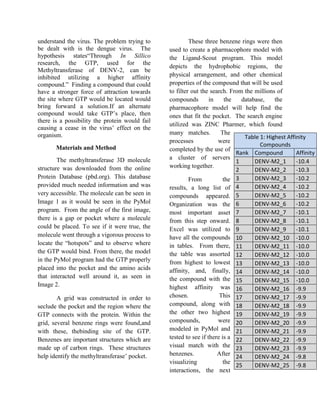
The structure of the pharmacophore
model was run through the ZINC Pharmer.
(The image of the pharmacophore model can
be seen as in Image 3; the yellow spheres
represent the benzenes and the gray spheres
the amino acids and other molecules.) This
enabled access to thousands of different
compounds that could possibly fit within the
pocket of the methyltransferase and inhibit
its interaction with the GTP. These
compounds were filtered and divided into
groups depending on their size or molecular
weight.
These compounds had varying
affinities, which means that they will attach
to the pocket of the protein at different
strengths or intensities. In a chart showing
them from highest affinities, twenty-five
compounds were separated, and the three
with the highest affinities were chosen to be
placed within the methyltransferase in order
to see their interaction with the protein.
These three proteins were denominated:
DENV-M2_1, with an affinity of -10.4;
DENV-M2_2, with an affinity of -10.3; and
DENV-M2_3, with an affinity of -10.2. The
other twenty two compounds are shown in
table 1. The affinity on the table varies from
-10.4 to -9.8. From all the compounds
collected, there were a total of a hundred
and sixty-two (162) compounds, varying
from -10.4 to -9.5, but there were over
25,000 compounds which had lesser affinity.
These three compounds were then
placed into the pocket of the
methyltransferase, and compared with the
placement of the benzene rings and the GTP
molecule. The compound that showed to
occupy the most space and position itself in
a similar way to the benzene rings was
DENV-M2_1. These factors demonstrate the
compound’s affinity of -10.4. The placement
of the DENV-M2_1 also shows that there
would not be any possibility for the GTP
molecule to make its way into the pocket.
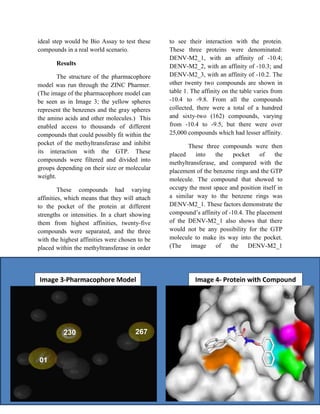
(The image of the DENV-M2_1
Image 3-Pharmacophore Model Image 4- Protein with Compound
230 267
moleculeinteracting at the target can be seen
in Image 4.) This proves the hypothesis
statedthat a high affinity compound can be
found for methyltransferase.
Discussion
After exploring many compounds
the Dengue Virus’ methyltransferase has
finally found a compound deemed worthy as
a GTP inhibitor. Thus, the hypothesis was
proven. This work has, theoretically, shown
there is an existing compound that is capable
of inhibiting the transfer of methyl to the
DNA of the Dengue Virus. Further work
with this project will be performing a
Bioassay. This means that the compound
and the protein will be tested physically and
biologically, not just within a computer
program. The compound, DENV-M2_1,
could be proven as a possible treatment for
the Dengue Virus. The virus continuously
spreads by the mosquito, but if prevented,
this possible new drug could save many
lives that are at risk.
The possible advantages for this drug
would be that it could help for the research
of other viruses including the West Nile
Virus. If the viruses have a similar
structure, then it is possible for compound to
effectively interact the same way. More
research needs to be conducted with this
compound for further implications.
Research via computer simulation is
also an impressive technique because it
helps one be more precise and accurate with
results. It would be more cost effective if a
team studies three to five compounds rather
than with every compound trying to find a
match. This could help improve the way the
scientific community confronts biological
problems. This is a big improvement than
rather taking stabs in the dark. The
scientific community can use the
opportunity to further expand its knowledge
and be more cost effective.
Acknowledgements
This research could not have been
completed without the guidance of Dr.
Héctor Maldonado and his In Sillico
Research team. We are grateful for the
opportunity to join them during the short
time. Thanks to them, we had a great
learningexperience. We hope to see the
team tackle new problems and make new
discoveries.
References
Bhatt S, Gething PW, Brady OJ, Messina
JP, Farlow AW, Moyes CL, Drake JM,
Brownstein JS, Hoen AG, Sankoh O, Myers
MF, George DB, Jaenisch T, Wint GRW,
Simmons CP, Scott TW, Farrar JJ, Hay, SI.
2013. The Global Distribution and Burden
of Dengue, [Cited 2013 21 May].
Macmillam Publishers. Doi:
10.1038/nature120 60.
Center for Disease Control. Dengue Fever.
2013 Northern Territory Government, [Cited
2013 21 may].
Lim SH, Sonntag LS, Noble C, Nilar SH,
Ng, RH, Zou G, Monaghan P, Chung KY,
Dong H, Liu B, Bodenreider C, Lee G, Ding
M, Chan WL, Wang G, Jian YL, Chao AT,
Lescar J, Yin Z, Vedananda TR, Keller T,
and Shi PY. 2011. Small Molecule
Inhibitors That Selectively Block Dengue
Virus Methyltransferase. The Journal of
Biological Chemistry, [Cited 2013 21 May].
Volume 286. 8. 6233-6240.
Noble C., Chen Y., Dong H., Gu F., Lim S.,
Schul W., Wang Q., and Shi P. 2010.
Strategies for development of Dengue virus
inhibitors. Antiviral Research [Cited 2013
21 May]. Volume 85. 3. 450-46

Juan Primary Article pub

  • 1.
    Juan E MaldonadoWeng Primary Article Gustavo A Martínez In Silico Research: Inhibiting binding GTP on Methyltransferase of Dengue Virus Abstract:The objective of this paper is to present the process of identifying a drug that will easily fight against the Dengue Virus (DNV). The process was begun using a model of the methyltransferase enzyme with a Guanosine Triphosphate (GTP) of the virus within an active spot. Methyltransferase is an enzyme that transfers a methyl group to the DNA of a cell. GTP is the molecule that produces the energy in order for that enzyme to transfer the methyl group properly. The purpose of developing this drug is to find a compound that will inhibit the transfer of methyl to the virus’ DNA. Forthis project, the Pymol program was used to generate three benzene ringspositioned in the pocket where the GTP normally connects to the enzyme. These rings are then to be used to create the pharmacophore model, which will show the hydrophobic regions. The hydrophobic regions are what will show which compound will fit properly within the pocket in order to inhibit the GTP. That compound will be searched for in the ZINC Pharmer database. After processing the model through the database, over sixty thousand hits were found compatible in that region of the methyltransferase. These were filtered and separated into five different groups. From these groups, the twenty-five compounds with the highest affinity were chosen, and of those, the top three with the highest affinity were placed into the methyltransferase pocket in order to compare them with the benzene rings and the GTP. The compound with the highest affinity (-10.4) was DENV-M2_1.For future study. Introduction Dengue is a serious life affecting disease infecting thousands of people while millions of others are at risk. The disease can be classified as three types of disease: Dengue Fever, Hemorrhagic Fever, or Shock Syndrome. “Antiviral drug discovery is becoming increasingly important due to the global threat of viral disease pandemics. Many members of the genus Flavivirus are significant human pathogens, among which dengue virus (DENV) alone poses a public health threat to 2.5 billion worldwide, leading to 50–100 million human infections each year. Neither vaccine nor effective therapeutics is currently available for DENV. Development of a DENV vaccine has been challenging, because of the need to simultaneously immunize and induce a long- lasting protection against all four serotypes of DENV…” (Noble et al. 2010).These diseases are very severe, and based on CDC reports from 2013; many common symptoms include joint and muscle pain, elevated corporal temperatures, and severe headaches. These diseases in severe cases can cause death. According to CDC in 2010, there were 12,580 confirmed cases of people diagnosed with dengue in Puerto Rico. The Cartogram 1- Infection “Cartogram of the annual number of infections for all ages as a proportion of National or subnational (China) geographical area” Obtained fromBahtt et al. Review Paper 2013
  • 2.
    tropical regionsare underthe most danger because the numbers ofmosquitoes that transmit the disease prefer these areas. The Aedes mosquito is the common carrier of the Dengue virus. The Dengue virus is a member of the family Flaviviridae and the genus Flavivirus. The Dengue virus has very similar structural properties to other members of the family like the West Nile Virus.The viral transmission poses a real threat to people and, with no cure available; the amount of cases will increase by the incoming years. Through research by computer simulation, the search for a cure is easier. Utilizing many advance software and programming, the structure of important proteins can be ideally researched. With these structures, the main components, such as amino acids with their spacing arrangement and chemical properties, could be studied then inhibited. Through inhibition of certain useful structures, the viral infection could be stopped. In the case of the Dengue Virus, the methyltransferase is an important proteinfor the spread and development of the virus. “Methyltransferases (MTases) play key roles in normal physiology and human diseases through methylating DNA, RNA, and proteins. Almost all MTases use S-adenosyl- L-methionine (SAM) as a methyl donor and generate S-adenosyl-Lhomocysteine (SAH) as a by-product. Pharmacological modulation of MTases by small molecules represents a novel approach to therapeutic intervention in cancer and other diseases.” (Siew Pheng Lim et al, 2011)The methyltransferase transfers a methyl group from a donor toan acceptor which could be a strand of DNA or RNA. This methyl group will help mark the genes needed to be expressed. This protein is needed for the virus to develop properly. The mechanism that the protein utilizes to have the appropriate energy is to bind with a GTP molecule. This molecule is the energy source that enables the methyltransferase to complete the transfers. The first step, which was the most important, was to identify a biological problem and to undergo research to Image 1- Clean_Protein Image 2- Detailed_Protein
  • 3.
    understand the virus.The problem trying to be dealt with is the dengue virus. The hypothesis states“Through In Sillico research, the GTP, used for the Methyltransferase of DENV-2, can be inhibited utilizing a higher affinity compound.” Finding a compound that could have a stronger force of attraction towards the site where GTP would be located would bring forward a solution.If an alternate compound would take GTP’s place, then there is a possibility the protein would fail causing a cease in the virus’ effect on the organism. Materials and Method The methyltransferase 3D molecule structure was downloaded from the online Protein Database (pbd.org). This database provided much needed information and was very accessible. The molecule can be seen in Image 1 as it would be seen in the PyMol program. From the angle of the first image, there is a gap or pocket where a molecule could be placed. To see if it were true, the molecule went through a vigorous process to locate the “hotspots” and to observe where the GTP would bind. From there, the model in the PyMol program had the GTP properly placed into the pocket and the amino acids that interacted well around it, as seen in Image 2. A grid was constructed in order to seclude the pocket and the region where the GTP connects with the protein. Within the grid, several benzene rings were found,and with these, thebinding site of the GTP. Benzenes are important structures which are made up of carbon rings. These structures help identify the methyltransferase’ pocket. These three benzene rings were then used to create a pharmacophore model with the Ligand-Scout program. This model depicts the hydrophobic regions, the physical arrangement, and other chemical properties of the compound that will be used to filter out the search. From the millions of compounds in the database, the pharmacophore model will help find the ones that fit the pocket. The search engine utilized was ZINC Pharmer, which found many matches. The processes were completed by the use of a cluster of servers working together. From the results, a long list of compounds appeared. Organization was the most important asset from this step onward. Excel was utilized to have all the compounds in tables. From there, the table was assorted from highest to lowest affinity, and, finally, the compound with the highest affinity was chosen. This compound, along with the other two highest compounds, were modeled in PyMol and tested to see if there is a visual match with the benzenes. After visualizing the interactions, the next Table 1: Highest Affinity Compounds Rank Compound Affinity 1 DENV-M2_1 -10.4 2 DENV-M2_2 -10.3 3 DENV-M2_3 -10.2 4 DENV-M2_4 -10.2 5 DENV-M2_5 -10.2 6 DENV-M2_6 -10.2 7 DENV-M2_7 -10.1 8 DENV-M2_8 -10.1 9 DENV-M2_9 -10.1 10 DENV-M2_10 -10.0 11 DENV-M2_11 -10.0 12 DENV-M2_12 -10.0 13 DENV-M2_13 -10.0 14 DENV-M2_14 -10.0 15 DENV-M2_15 -10.0 16 DENV-M2_16 -9.9 17 DENV-M2_17 -9.9 18 DENV-M2_18 -9.9 19 DENV-M2_19 -9.9 20 DENV-M2_20 -9.9 21 DENV-M2_21 -9.9 22 DENV-M2_22 -9.9 23 DENV-M2_23 -9.9 24 DENV-M2_24 -9.8 25 DENV-M2_25 -9.8
  • 4.
    ideal step wouldbe Bio Assay to test these compounds in a real world scenario. Results The structure of the pharmacophore model was run through the ZINC Pharmer. (The image of the pharmacophore model can be seen as in Image 3; the yellow spheres represent the benzenes and the gray spheres the amino acids and other molecules.) This enabled access to thousands of different compounds that could possibly fit within the pocket of the methyltransferase and inhibit its interaction with the GTP. These compounds were filtered and divided into groups depending on their size or molecular weight. These compounds had varying affinities, which means that they will attach to the pocket of the protein at different strengths or intensities. In a chart showing them from highest affinities, twenty-five compounds were separated, and the three with the highest affinities were chosen to be placed within the methyltransferase in order to see their interaction with the protein. These three proteins were denominated: DENV-M2_1, with an affinity of -10.4; DENV-M2_2, with an affinity of -10.3; and DENV-M2_3, with an affinity of -10.2. The other twenty two compounds are shown in table 1. The affinity on the table varies from -10.4 to -9.8. From all the compounds collected, there were a total of a hundred and sixty-two (162) compounds, varying from -10.4 to -9.5, but there were over 25,000 compounds which had lesser affinity. These three compounds were then placed into the pocket of the methyltransferase, and compared with the placement of the benzene rings and the GTP molecule. The compound that showed to occupy the most space and position itself in a similar way to the benzene rings was DENV-M2_1. These factors demonstrate the compound’s affinity of -10.4. The placement of the DENV-M2_1 also shows that there would not be any possibility for the GTP molecule to make its way into the pocket. (The image of the DENV-M2_1 Image 3-Pharmacophore Model Image 4- Protein with Compound 230 267
  • 5.
    moleculeinteracting at thetarget can be seen in Image 4.) This proves the hypothesis statedthat a high affinity compound can be found for methyltransferase. Discussion After exploring many compounds the Dengue Virus’ methyltransferase has finally found a compound deemed worthy as a GTP inhibitor. Thus, the hypothesis was proven. This work has, theoretically, shown there is an existing compound that is capable of inhibiting the transfer of methyl to the DNA of the Dengue Virus. Further work with this project will be performing a Bioassay. This means that the compound and the protein will be tested physically and biologically, not just within a computer program. The compound, DENV-M2_1, could be proven as a possible treatment for the Dengue Virus. The virus continuously spreads by the mosquito, but if prevented, this possible new drug could save many lives that are at risk. The possible advantages for this drug would be that it could help for the research of other viruses including the West Nile Virus. If the viruses have a similar structure, then it is possible for compound to effectively interact the same way. More research needs to be conducted with this compound for further implications. Research via computer simulation is also an impressive technique because it helps one be more precise and accurate with results. It would be more cost effective if a team studies three to five compounds rather than with every compound trying to find a match. This could help improve the way the scientific community confronts biological problems. This is a big improvement than rather taking stabs in the dark. The scientific community can use the opportunity to further expand its knowledge and be more cost effective. Acknowledgements This research could not have been completed without the guidance of Dr. Héctor Maldonado and his In Sillico Research team. We are grateful for the opportunity to join them during the short time. Thanks to them, we had a great learningexperience. We hope to see the team tackle new problems and make new discoveries. References Bhatt S, Gething PW, Brady OJ, Messina JP, Farlow AW, Moyes CL, Drake JM, Brownstein JS, Hoen AG, Sankoh O, Myers MF, George DB, Jaenisch T, Wint GRW, Simmons CP, Scott TW, Farrar JJ, Hay, SI. 2013. The Global Distribution and Burden of Dengue, [Cited 2013 21 May]. Macmillam Publishers. Doi: 10.1038/nature120 60. Center for Disease Control. Dengue Fever. 2013 Northern Territory Government, [Cited 2013 21 may]. Lim SH, Sonntag LS, Noble C, Nilar SH, Ng, RH, Zou G, Monaghan P, Chung KY, Dong H, Liu B, Bodenreider C, Lee G, Ding M, Chan WL, Wang G, Jian YL, Chao AT, Lescar J, Yin Z, Vedananda TR, Keller T, and Shi PY. 2011. Small Molecule Inhibitors That Selectively Block Dengue Virus Methyltransferase. The Journal of
  • 6.
    Biological Chemistry, [Cited2013 21 May]. Volume 286. 8. 6233-6240. Noble C., Chen Y., Dong H., Gu F., Lim S., Schul W., Wang Q., and Shi P. 2010. Strategies for development of Dengue virus inhibitors. Antiviral Research [Cited 2013 21 May]. Volume 85. 3. 450-46