Creativity
and IMC
Kinds of
messages
Message
consistency
Message
strategy and
execution
Message
structure
Messages
and IMC
Guidelines
for
evaluation
Barriers to
big ideas
Client
inspiration and
evaluation
Message
strategy
The big
idea
Creative
process
How to
say it
Appeals Execution
Types
of strategies
Message strategy
statement
Strategic
triad
Creativity
Persuasive Communications
The ‘right’ message:
connects emotionally with the target audience
may need to connect in different ways for different audiences
contains a key insight or big idea
is distinctive, memorable and creative.
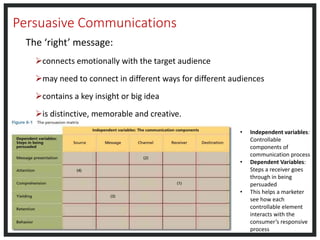
• Independent variables:
Controllable
components of
communication process
• Dependent Variables:
Steps a receiver goes
through in being
persuaded
• This helps a marketer
see how each
controllable element
interacts with the
consumer’s responsive
process
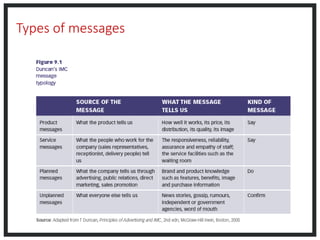
Types of messages
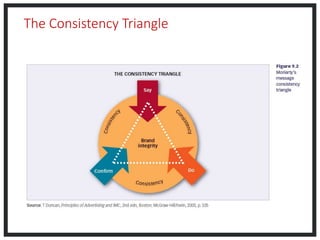
The Consistency Triangle
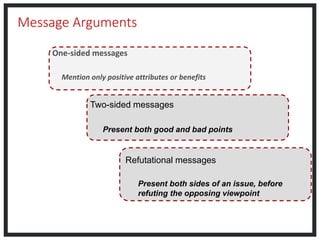
Message Arguments
One-sided messages
Mention only positive attributes or benefits
Two-sided messages
Present both good and bad points
Refutational messages
Present both sides of an issue, before
refuting the opposing viewpoint
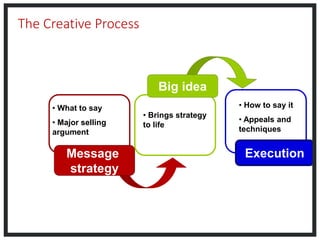
The Creative Process
Message
strategy
• What to say
• Major selling
argument
Big idea
• Brings strategy
to life
Execution
• How to say it
• Appeals and
techniques
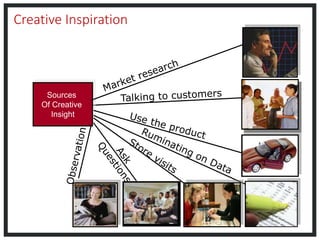
Creative Inspiration
Sources
Of Creative
Insight
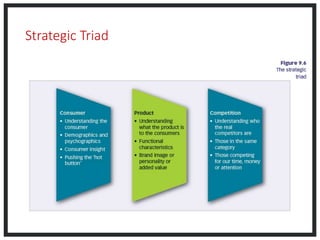
Strategic Triad
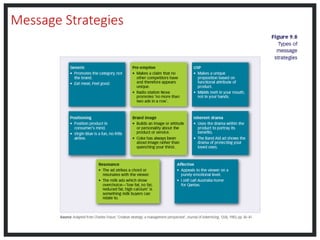
Message Strategies
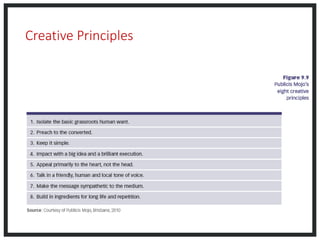
Creative Principles
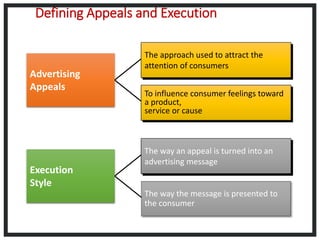
To influence consumer feelings toward
a product,
service or cause
To influence consumer feelings toward
a product,
service or cause
The approach used to attract the
attention of consumers
The way an appeal is turned into an
advertising message
The way the message is presented to
the consumer
The approach used to attract the
attention of consumers
The way an appeal is turned into an
advertising message
Defining Appeals and Execution
Advertising
Appeals
Execution
Style
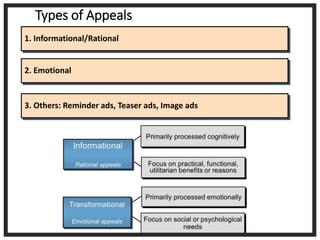
3. Others: Reminder ads, Teaser ads, Image ads
2. Emotional
1. Informational/Rational
Types of Appeals
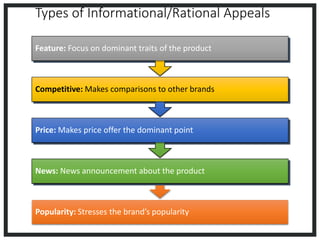
Popularity: Stresses the brand’s popularity
News: News announcement about the product
Price: Makes price offer the dominant point
Competitive: Makes comparisons to other brands
Feature: Focus on dominant traits of the product
News: News announcement about the product
Price: Makes price offer the dominant point
Competitive: Makes comparisons to other brands
Feature: Focus on dominant traits of the product
Types of Informational/Rational Appeals
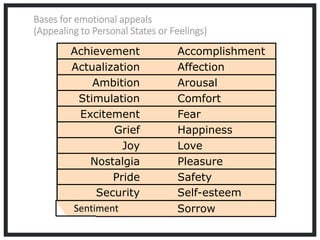
Achievement Accomplishment
Actualization Affection
Ambition Arousal
Stimulation Comfort
Excitement Fear
Grief Happiness
Joy Love
Nostalgia Pleasure
Pride Safety
Security Self-esteem
Sentiment Sorrow
Achievement Accomplishment
Actualization Affection
Ambition Arousal
Stimulation Comfort
Excitement Fear
Grief Happiness
Joy Love
Nostalgia Pleasure
Pride Safety
Security Self-esteem
Bases for emotional appeals
(Appealing to Personal States or Feelings)
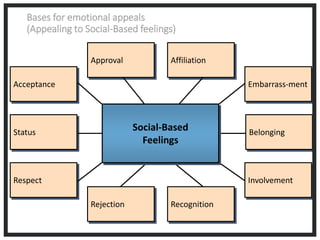
Status
Acceptance
Respect
Approval Affiliation
Belonging
Rejection Recognition
Embarrass-ment
Involvement
Acceptance
Respect
Approval Affiliation
Belonging
Rejection Recognition
Embarrass-ment
Involvement
Bases for emotional appeals
(Appealing to Social-Based feelings)
Social-Based
Feelings
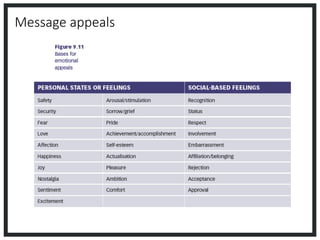
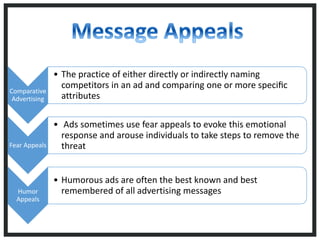
Message appeals
Comparative
Advertising
• The practice of either directly or indirectly naming
competitors in an ad and comparing one or more specific
attributes
Fear Appeals
• Ads sometimes use fear appeals to evoke this emotional
response and arouse individuals to take steps to remove the
threat
Humor
Appeals
• Humorous ads are often the best known and best
remembered of all advertising messages
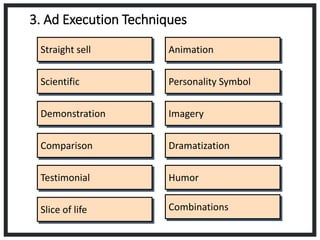
Personality SymbolPersonality Symbol
Straight sell
Scientific
Demonstration
Comparison
Testimonial Humor
Slice of life
Imagery
Animation
DramatizationDramatization
Testimonial
Comparison
Animation
Demonstration Imagery
Scientific
Slice of life
Straight sell
3. Ad Execution Techniques
Humor
Combinations
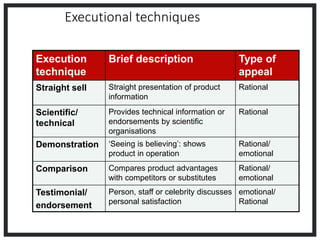
Executional techniques
Execution
technique
Brief description Type of
appeal
Straight sell Straight presentation of product
information
Rational
Scientific/
technical
Provides technical information or
endorsements by scientific
organisations
Rational
Demonstration ‘Seeing is believing’: shows
product in operation
Rational/
emotional
Comparison Compares product advantages
with competitors or substitutes
Rational/
emotional
Testimonial/
endorsement
Person, staff or celebrity discusses
personal satisfaction
emotional/
Rational
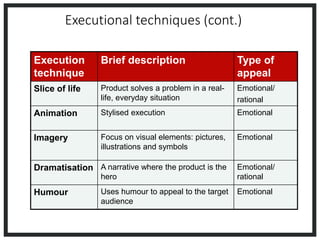
Executional techniques (cont.)
Execution
technique
Brief description Type of
appeal
Slice of life Product solves a problem in a real-
life, everyday situation
Emotional/
rational
Animation Stylised execution Emotional
Imagery Focus on visual elements: pictures,
illustrations and symbols
Emotional
Dramatisation A narrative where the product is the
hero
Emotional/
rational
Humour Uses humour to appeal to the target
audience
Emotional
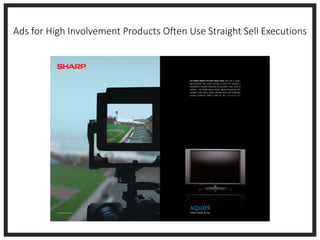
Ads for High Involvement Products Often Use Straight Sell Executions
Mentadent Uses a Demonstration
Apple Uses a Testimonial
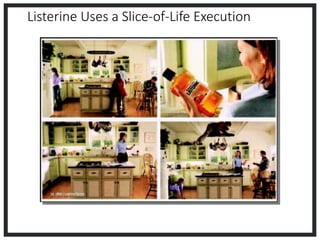
Listerine Uses a Slice-of-Life Execution
Jeep Uses Imagery for the Wrangler
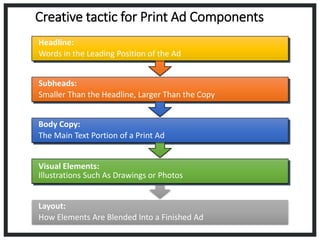
Layout:
How Elements Are Blended Into a Finished Ad
Visual Elements:
Illustrations Such As Drawings or Photos
Body Copy:
The Main Text Portion of a Print Ad
Subheads:
Smaller Than the Headline, Larger Than the Copy
Headline:
Words in the Leading Position of the Ad
Visual Elements:
Illustrations Such As Drawings or Photos
Body Copy:
The Main Text Portion of a Print Ad
Subheads:
Smaller Than the Headline, Larger Than the Copy
Headline:
Words in the Leading Position of the Ad
Creative tactic for Print Ad Components
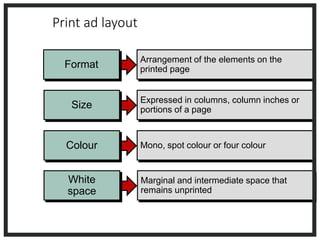
Print ad layout
Format
Arrangement of the elements on the
printed page
Size
Expressed in columns, column inches or
portions of a page
Colour Mono, spot colour or four colour
White
space
Marginal and intermediate space that
remains unprinted
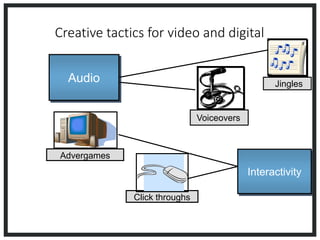
Creative tactics for video and digital
Audio Jingles
Voiceovers
Interactivity
Click throughs
Advergames
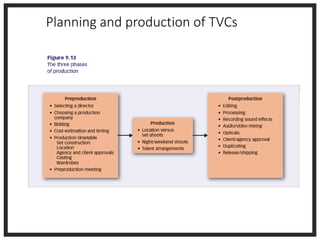
Planning and production of TVCs
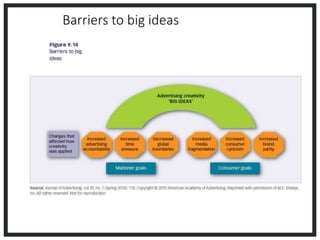
Barriers to big ideas
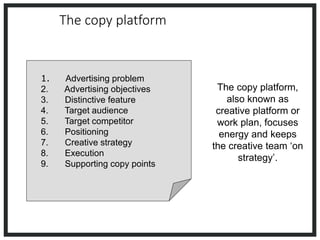
The copy platform
1. Advertising problem
2. Advertising objectives
3. Distinctive feature
4. Target audience
5. Target competitor
6. Positioning
7. Creative strategy
8. Execution
9. Supporting copy points
The copy platform,
also known as
creative platform or
work plan, focuses
energy and keeps
the creative team ‘on
strategy’.
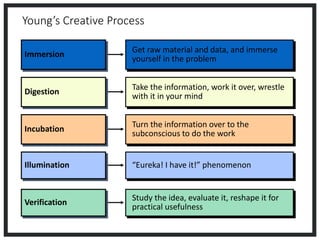
Young’s Creative Process
Get raw material and data, and immerse
yourself in the problem
Immersion
Take the information, work it over, wrestle
with it in your mind
Digestion
Turn the information over to the
subconscious to do the work
Incubation
“Eureka! I have it!” phenomenonIllumination
Study the idea, evaluate it, reshape it for
practical usefulness
Verification
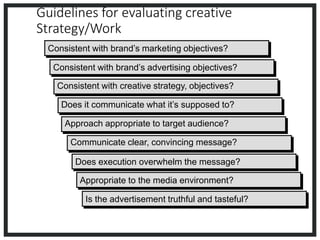
Guidelines for evaluating creative
Strategy/Work
Consistent with brand’s marketing objectives?
Consistent with brand’s advertising objectives?
Consistent with creative strategy, objectives?
Does it communicate what it’s supposed to?
Approach appropriate to target audience?
Communicate clear, convincing message?
Does execution overwhelm the message?
Appropriate to the media environment?
Is the advertisement truthful and tasteful?
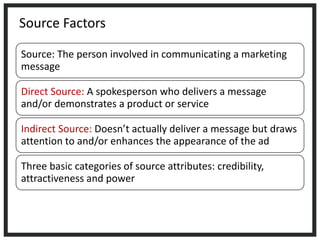
Source Factors
Source: The person involved in communicating a marketing
message
Direct Source: A spokesperson who delivers a message
and/or demonstrates a product or service
Indirect Source: Doesn’t actually deliver a message but draws
attention to and/or enhances the appearance of the ad
Three basic categories of source attributes: credibility,
attractiveness and power
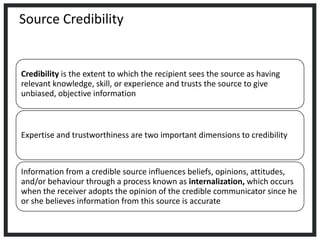
Source Credibility
Credibility is the extent to which the recipient sees the source as having
relevant knowledge, skill, or experience and trusts the source to give
unbiased, objective information
Expertise and trustworthiness are two important dimensions to credibility
Information from a credible source influences beliefs, opinions, attitudes,
and/or behaviour through a process known as internalization, which occurs
when the receiver adopts the opinion of the credible communicator since he
or she believes information from this source is accurate
Source Attractiveness
Attractiveness encompasses similarity, familiarity, and
likability
Source attractiveness leads to persuasion through a process
of identification, whereby the receiver is motivated to seek
some type of relationship with the source and thus adopts
similar beliefs, attitudes, preferences, or behaviour
Source Power
A source has power when he or she can actually administer rewards and
punishments to the receiver
The source must be perceived as being able to administer positive or
negative sanctions to the receiver (perceived control)
The receiver must think the source cares about whether or not the
receiver conforms (perceived concern)
The receiver’s estimate of the source’s ability to observe conformity is
also important (perceived scrutiny)
When a receiver perceives a source as having power, the influence
process occurs through a process known as compliance
Message structure
An important aspect of message strategy is knowing the best way to
communicate these points and overcome any opposing viewpoints audience
members may hold
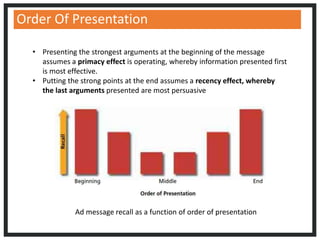
Order Of Presentation
Ad message recall as a function of order of presentation
• Presenting the strongest arguments at the beginning of the message
assumes a primacy effect is operating, whereby information presented first
is most effective.
• Putting the strong points at the end assumes a recency effect, whereby
the last arguments presented are most persuasive
Conclusion Drawing:
• Messages with explicit conclusions are more easily understood and effective in
influencing attitudes
• The effectiveness of conclusion drawing may depend on the target audience, the type of
issue or topic, and the nature of the situation
Message Sidedness:
• A one-sided message mentions only positive attributes or benefits
• One-sided messages are most effective when the target audience already holds a
favourable opinion about the topic
• A two-sided message presents both good and bad points
• Two-sided messages are more effective when the target audience holds an opposing
opinion or is highly educated
Refutation:
• The communicator presents both sides of an issue and then refutes the opposing
viewpoint
• They are more effective than one-sided messages in making consumers resistant to an
opposing message
Verbal vs. visual messages:
• The use of a visual that is inconsistent with the verbal content leads to more recall and
greater processing of the information presented
Channel factors
While a variety of methods are available to transmit marketing communications,
they can be classified into two broad categories, personal and non-personal
media. Information received from personal influence channels is generally more
persuasive than information received via the mass media.
Effects of Alternative Mass Media:
• The various mass media that advertisers use to transmit their messages differ in many
ways, including the number and type of people they reach, costs, information processing
requirements, and qualitative factors
• Information from ads in print media, such as newspapers, magazines, or direct mail, is
self-paced; readers process the ad at their own rate and can study it as long as they
desire.
• In contrast, information from the broadcast media of radio and television is externally
paced; the transmission rate is controlled by the mediumEffects of context and environment:
• A qualitative media effect is the influence the medium has on a message media
• Buyers are advised to follow the conventional wisdom of placing their ads during “feel-
good” programming, especially if the message is intended to work through a central
route to persuasion.
• Messages intended to operate through a peripheral route to persuasion might be more
effective if they are shown during more negative programs, where presumably viewers
will not analyse the ad in detail because of their negative mood state
Clutter:
• Clutter is the amount of advertising in medium
• Clutter is of increasing concern to advertisers since there are so many messages in
various media competing for the consumer’s attention
• Clutter has become a major concern among television advertisers as a result of
increases in non-program time and the trend toward shorter commercials
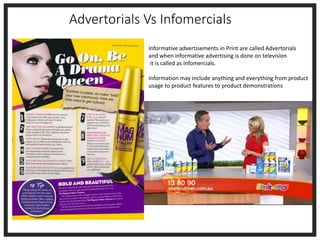
Advertorials Vs Infomercials
Informative advertisements in Print are called Advertorials
and when informative advertising is done on television
it is called as Infomercials.
Information may include anything and everything from product
usage to product features to product demonstrations
The Creative Concept Developement

The Creative Concept Developement

  • 2.
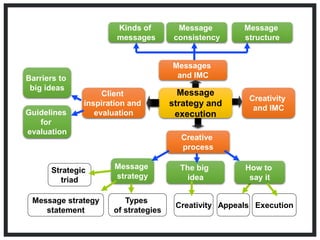
    Creativity and IMC Kinds of messages Message consistency Message strategyand execution Message structure Messages and IMC Guidelines for evaluation Barriers to big ideas Client inspiration and evaluation Message strategy The big idea Creative process How to say it Appeals Execution Types of strategies Message strategy statement Strategic triad Creativity
  • 3.
    Persuasive Communications The ‘right’message: connects emotionally with the target audience may need to connect in different ways for different audiences contains a key insight or big idea is distinctive, memorable and creative. • Independent variables: Controllable components of communication process • Dependent Variables: Steps a receiver goes through in being persuaded • This helps a marketer see how each controllable element interacts with the consumer’s responsive process
  • 4.
  • 5.
  • 6.
    Message Arguments One-sided messages Mentiononly positive attributes or benefits Two-sided messages Present both good and bad points Refutational messages Present both sides of an issue, before refuting the opposing viewpoint
  • 7.
    The Creative Process Message strategy •What to say • Major selling argument Big idea • Brings strategy to life Execution • How to say it • Appeals and techniques
  • 8.
  • 9.
  • 10.
  • 11.
  • 12.
    To influence consumerfeelings toward a product, service or cause To influence consumer feelings toward a product, service or cause The approach used to attract the attention of consumers The way an appeal is turned into an advertising message The way the message is presented to the consumer The approach used to attract the attention of consumers The way an appeal is turned into an advertising message Defining Appeals and Execution Advertising Appeals Execution Style
  • 13.
    3. Others: Reminderads, Teaser ads, Image ads 2. Emotional 1. Informational/Rational Types of Appeals
  • 14.
    Popularity: Stresses thebrand’s popularity News: News announcement about the product Price: Makes price offer the dominant point Competitive: Makes comparisons to other brands Feature: Focus on dominant traits of the product News: News announcement about the product Price: Makes price offer the dominant point Competitive: Makes comparisons to other brands Feature: Focus on dominant traits of the product Types of Informational/Rational Appeals
  • 15.
    Achievement Accomplishment Actualization Affection AmbitionArousal Stimulation Comfort Excitement Fear Grief Happiness Joy Love Nostalgia Pleasure Pride Safety Security Self-esteem Sentiment Sorrow Achievement Accomplishment Actualization Affection Ambition Arousal Stimulation Comfort Excitement Fear Grief Happiness Joy Love Nostalgia Pleasure Pride Safety Security Self-esteem Bases for emotional appeals (Appealing to Personal States or Feelings)
  • 16.
    Status Acceptance Respect Approval Affiliation Belonging Rejection Recognition Embarrass-ment Involvement Acceptance Respect ApprovalAffiliation Belonging Rejection Recognition Embarrass-ment Involvement Bases for emotional appeals (Appealing to Social-Based feelings) Social-Based Feelings
  • 17.
  • 18.
    Comparative Advertising • The practiceof either directly or indirectly naming competitors in an ad and comparing one or more specific attributes Fear Appeals • Ads sometimes use fear appeals to evoke this emotional response and arouse individuals to take steps to remove the threat Humor Appeals • Humorous ads are often the best known and best remembered of all advertising messages
  • 19.
    Personality SymbolPersonality Symbol Straightsell Scientific Demonstration Comparison Testimonial Humor Slice of life Imagery Animation DramatizationDramatization Testimonial Comparison Animation Demonstration Imagery Scientific Slice of life Straight sell 3. Ad Execution Techniques Humor Combinations
  • 20.
    Executional techniques Execution technique Brief descriptionType of appeal Straight sell Straight presentation of product information Rational Scientific/ technical Provides technical information or endorsements by scientific organisations Rational Demonstration ‘Seeing is believing’: shows product in operation Rational/ emotional Comparison Compares product advantages with competitors or substitutes Rational/ emotional Testimonial/ endorsement Person, staff or celebrity discusses personal satisfaction emotional/ Rational
  • 21.
    Executional techniques (cont.) Execution technique Briefdescription Type of appeal Slice of life Product solves a problem in a real- life, everyday situation Emotional/ rational Animation Stylised execution Emotional Imagery Focus on visual elements: pictures, illustrations and symbols Emotional Dramatisation A narrative where the product is the hero Emotional/ rational Humour Uses humour to appeal to the target audience Emotional
  • 22.
    Ads for HighInvolvement Products Often Use Straight Sell Executions
  • 23.
    Mentadent Uses aDemonstration
  • 24.
    Apple Uses aTestimonial
  • 25.
    Listerine Uses aSlice-of-Life Execution
  • 26.
    Jeep Uses Imageryfor the Wrangler
  • 27.
    Layout: How Elements AreBlended Into a Finished Ad Visual Elements: Illustrations Such As Drawings or Photos Body Copy: The Main Text Portion of a Print Ad Subheads: Smaller Than the Headline, Larger Than the Copy Headline: Words in the Leading Position of the Ad Visual Elements: Illustrations Such As Drawings or Photos Body Copy: The Main Text Portion of a Print Ad Subheads: Smaller Than the Headline, Larger Than the Copy Headline: Words in the Leading Position of the Ad Creative tactic for Print Ad Components
  • 28.
    Print ad layout Format Arrangementof the elements on the printed page Size Expressed in columns, column inches or portions of a page Colour Mono, spot colour or four colour White space Marginal and intermediate space that remains unprinted
  • 29.
    Creative tactics forvideo and digital Audio Jingles Voiceovers Interactivity Click throughs Advergames
  • 30.
  • 31.
  • 32.
    The copy platform 1.Advertising problem 2. Advertising objectives 3. Distinctive feature 4. Target audience 5. Target competitor 6. Positioning 7. Creative strategy 8. Execution 9. Supporting copy points The copy platform, also known as creative platform or work plan, focuses energy and keeps the creative team ‘on strategy’.
  • 33.
    Young’s Creative Process Getraw material and data, and immerse yourself in the problem Immersion Take the information, work it over, wrestle with it in your mind Digestion Turn the information over to the subconscious to do the work Incubation “Eureka! I have it!” phenomenonIllumination Study the idea, evaluate it, reshape it for practical usefulness Verification
  • 34.
    Guidelines for evaluatingcreative Strategy/Work Consistent with brand’s marketing objectives? Consistent with brand’s advertising objectives? Consistent with creative strategy, objectives? Does it communicate what it’s supposed to? Approach appropriate to target audience? Communicate clear, convincing message? Does execution overwhelm the message? Appropriate to the media environment? Is the advertisement truthful and tasteful?
  • 35.
    Source Factors Source: Theperson involved in communicating a marketing message Direct Source: A spokesperson who delivers a message and/or demonstrates a product or service Indirect Source: Doesn’t actually deliver a message but draws attention to and/or enhances the appearance of the ad Three basic categories of source attributes: credibility, attractiveness and power
  • 36.
    Source Credibility Credibility isthe extent to which the recipient sees the source as having relevant knowledge, skill, or experience and trusts the source to give unbiased, objective information Expertise and trustworthiness are two important dimensions to credibility Information from a credible source influences beliefs, opinions, attitudes, and/or behaviour through a process known as internalization, which occurs when the receiver adopts the opinion of the credible communicator since he or she believes information from this source is accurate
  • 37.
    Source Attractiveness Attractiveness encompassessimilarity, familiarity, and likability Source attractiveness leads to persuasion through a process of identification, whereby the receiver is motivated to seek some type of relationship with the source and thus adopts similar beliefs, attitudes, preferences, or behaviour
  • 38.
    Source Power A sourcehas power when he or she can actually administer rewards and punishments to the receiver The source must be perceived as being able to administer positive or negative sanctions to the receiver (perceived control) The receiver must think the source cares about whether or not the receiver conforms (perceived concern) The receiver’s estimate of the source’s ability to observe conformity is also important (perceived scrutiny) When a receiver perceives a source as having power, the influence process occurs through a process known as compliance
  • 39.
    Message structure An importantaspect of message strategy is knowing the best way to communicate these points and overcome any opposing viewpoints audience members may hold
  • 40.
    Order Of Presentation Admessage recall as a function of order of presentation • Presenting the strongest arguments at the beginning of the message assumes a primacy effect is operating, whereby information presented first is most effective. • Putting the strong points at the end assumes a recency effect, whereby the last arguments presented are most persuasive
  • 41.
    Conclusion Drawing: • Messageswith explicit conclusions are more easily understood and effective in influencing attitudes • The effectiveness of conclusion drawing may depend on the target audience, the type of issue or topic, and the nature of the situation Message Sidedness: • A one-sided message mentions only positive attributes or benefits • One-sided messages are most effective when the target audience already holds a favourable opinion about the topic • A two-sided message presents both good and bad points • Two-sided messages are more effective when the target audience holds an opposing opinion or is highly educated Refutation: • The communicator presents both sides of an issue and then refutes the opposing viewpoint • They are more effective than one-sided messages in making consumers resistant to an opposing message Verbal vs. visual messages: • The use of a visual that is inconsistent with the verbal content leads to more recall and greater processing of the information presented
  • 42.
    Channel factors While avariety of methods are available to transmit marketing communications, they can be classified into two broad categories, personal and non-personal media. Information received from personal influence channels is generally more persuasive than information received via the mass media.
  • 43.
    Effects of AlternativeMass Media: • The various mass media that advertisers use to transmit their messages differ in many ways, including the number and type of people they reach, costs, information processing requirements, and qualitative factors • Information from ads in print media, such as newspapers, magazines, or direct mail, is self-paced; readers process the ad at their own rate and can study it as long as they desire. • In contrast, information from the broadcast media of radio and television is externally paced; the transmission rate is controlled by the mediumEffects of context and environment: • A qualitative media effect is the influence the medium has on a message media • Buyers are advised to follow the conventional wisdom of placing their ads during “feel- good” programming, especially if the message is intended to work through a central route to persuasion. • Messages intended to operate through a peripheral route to persuasion might be more effective if they are shown during more negative programs, where presumably viewers will not analyse the ad in detail because of their negative mood state Clutter: • Clutter is the amount of advertising in medium • Clutter is of increasing concern to advertisers since there are so many messages in various media competing for the consumer’s attention • Clutter has become a major concern among television advertisers as a result of increases in non-program time and the trend toward shorter commercials
  • 44.
    Advertorials Vs Infomercials Informativeadvertisements in Print are called Advertorials and when informative advertising is done on television it is called as Infomercials. Information may include anything and everything from product usage to product features to product demonstrations