The Communications Process Dr. Eduardo Bustos Farías
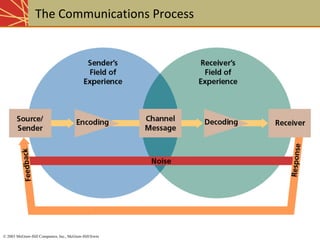
What is the Process? A Communication Loop Sender Encodes message > selects channel > sends message  Receiver Gets message > decodes message > feeds  back a reply signaling understanding or  seeking additional information
The Communications Process ©  2003 McGraw-Hill Companies, Inc., McGraw-Hill/Irwin
Source,  Message and  Channel Factors
Source Factors The  source  of a message in the communication process is where the message originates A source can be credible on: Cognitive Affective dimensions
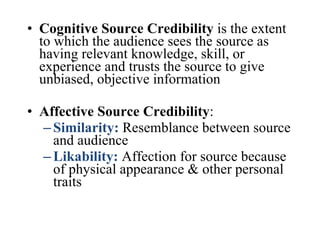
Cognitive Source Credibility  is the extent to which the audience sees the source as having relevant knowledge, skill, or experience and trusts the source to give unbiased, objective information Affective Source Credibility : Similarity:  Resemblance between source and audience Likability:  Affection for source because of physical appearance & other personal traits
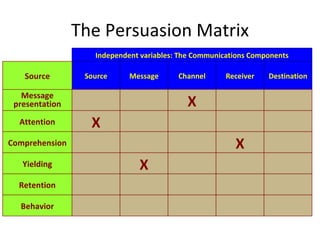
The Persuasion Matrix Independent variables: The Communications Components Source Message Channel Receiver Destination X X X Message presentation Attention Comprehension Yielding Retention Behavior Source X
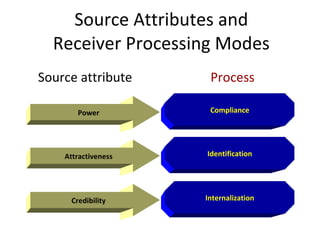
Source Attributes and Receiver Processing Modes Source attribute Process Compliance Power Identification Attractiveness Internalization Credibility
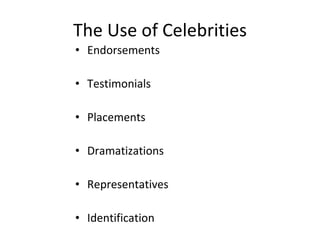
The Use of Celebrities Endorsements Testimonials Placements Dramatizations  Representatives Identification
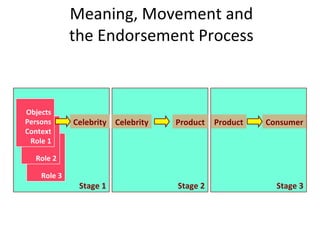
Meaning, Movement and the Endorsement Process Stage 1 Role 3 Role 2 Objects Persons Context Role 1 Celebrity Stage 2 Product Celebrity Stage 3 Consumer Product
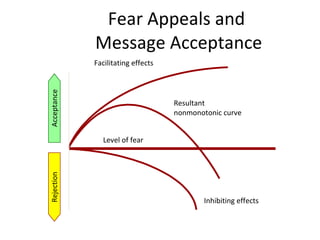
Fear Appeals and  Message Acceptance Rejection Inhibiting effects Resultant nonmonotonic curve Facilitating effects Level of fear Acceptance
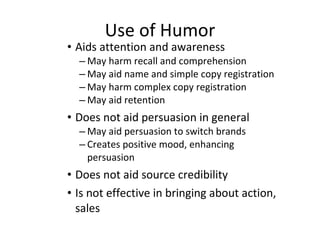
Use of Humor Aids attention and awareness May harm recall and comprehension May aid name and simple copy registration May harm complex copy registration May aid retention Does not aid persuasion in general May aid persuasion to switch brands Creates positive mood, enhancing persuasion Does not aid source credibility Is not effective in bringing about action, sales
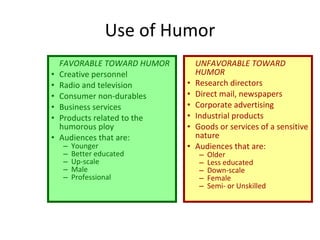
UNFAVORABLE TOWARD HUMOR Research directors Direct mail, newspapers Corporate advertising Industrial products Goods or services of a sensitive nature Audiences that are: Older Less educated Down-scale Female Semi- or Unskilled FAVORABLE TOWARD HUMOR Creative personnel Radio and television Consumer non-durables Business services Products related to the humorous ploy Audiences that are: Younger Better educated Up-scale Male Professional Use of Humor
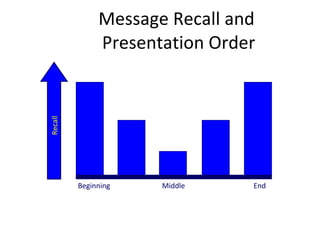
Message Recall and  Presentation Order Recall Beginning Middle End
How to increase attention: Use communications channels that consumer favors Use effective execution that makes the ad more vivid How? Color Contrast  Novelty Size
Message Interpretation Meanings assigned to the message are based on learned associations Learning can be formal or informal Based on attitude, beliefs, motives, & experiences Interpretation to support own position Marketing Objective: Intended Message = Decoded Message
How to achieve interpretation objective: Involve consumer in the development of creative ideas, e.g., brainstorming sessions
Message Retention Limited memory space    discard info that is of no use Therefore, must make info useful How to lengthen retention of message: Repeat message Use mnemonics
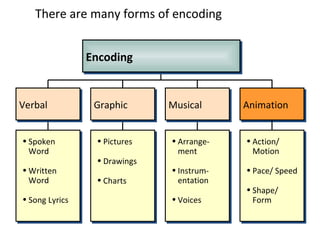
There are many forms of encoding Verbal Graphic Musical Encoding Graphic Pictures Drawings Charts Verbal Spoken Word Written Word Song Lyrics Musical Arrange-ment Instrum-entation Voices Animation Action/ Motion Pace/ Speed Shape/ Form
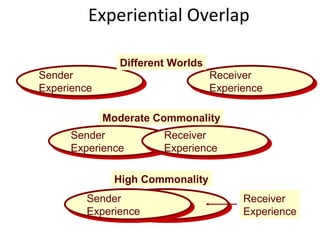
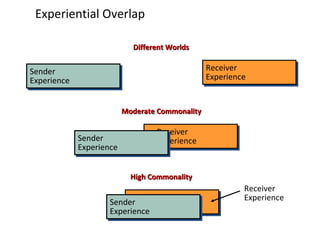
Experiential Overlap Sender Experience Receiver Experience Different Worlds Sender Experience Receiver Experience Moderate Commonality Sender Experience High Commonality Receiver Experience
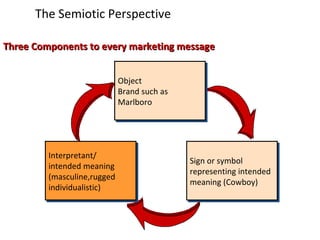
The Semiotic Perspective Object Brand such as Marlboro Object Brand such as Marlboro Sign or symbol representing intended meaning (Cowboy) Three Components to every marketing message Sign or symbol representing intended meaning (Cowboy) Interpretant/ intended meaning (masculine,rugged individualistic)
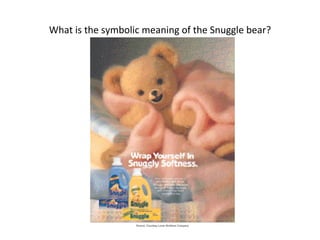
What is the symbolic meaning of the Snuggle bear?
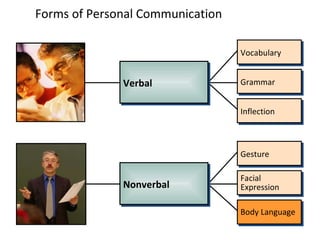
Forms of Personal Communication   Vocabulary Grammar Inflection Gesture Facial Expression Grammar Vocabulary Inflection Facial Expression Gesture Body Language Verbal Nonverbal
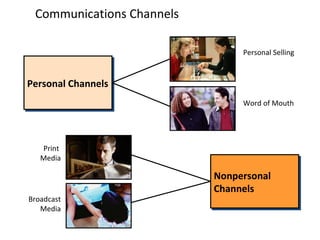
Communications Channels Personal Channels Personal Channels Nonpersonal Channels Personal Selling Word of Mouth Print  Media Broadcast Media
Communication Channels Two-way Face-to-face Conversation, interviews, presentations,  videoconferences, etc. Advantages You get the whole package! Instant feedback, able to read nonverbal signals, achieve personal connection Useful for motivating or conveying sensitive or unpleasant information
Communication Channels Two-way Not face-to-face Telephone conversations, on-line chats Advantages Instant feedback, real-time connection No nonverbal elements, so verbal element must be especially clear
Communication Channels One-way Not face-to-face Letters, memoranda, reports, e-mail, fax, voice mail, web-page Advantages Message considered more official; useful when a permanent record is required; often used when feedback is not expected Lacks nonverbal signals and instant feedback, so measures against misinterpretation must be taken
Experiential Overlap Receiver Experience Sender Experience Different Worlds Receiver Experience Sender Experience Moderate Commonality Receiver Experience Sender Experience High Commonality Receiver Experience
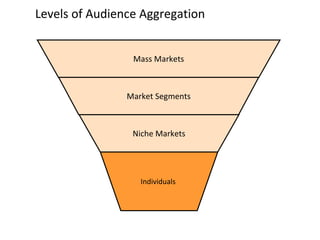
Levels of Audience Aggregation Market Segments Market Segments Mass Markets Niche Markets Individuals  Niche Markets Mass Markets
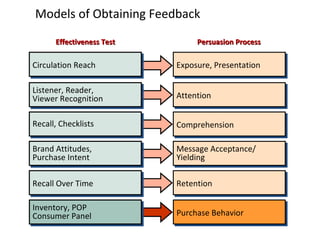
Models of Obtaining Feedback Circulation Reach Listener, Reader, Viewer Recognition Recall, Checklists Brand Attitudes, Purchase Intent Recall Over Time Inventory, POP Consumer Panel Effectiveness Test Persuasion Process Exposure, Presentation Attention Comprehension Message Acceptance/ Yielding Retention Purchase Behavior Retention Recall Over Time Message Acceptance/ Yielding Brand Attitudes, Purchase Intent Comprehension Recall, Checklists Attention Listener, Reader, Viewer Recognition Exposure, Presentation Circulation Reach
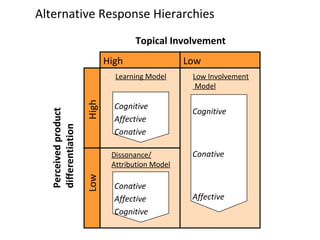
Alternative Response Hierarchies   High Low High Low Topical Involvement Perceived product differentiation Learning Model Low Involvement Model Dissonance/ Attribution Model Cognitive Affective Conative Conative Affective Cognitive Cognitive Conative Affective
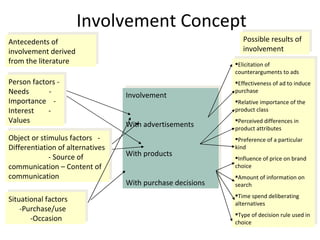
Involvement Concept Antecedents of involvement derived from the literature Person factors - Needs  - Importance  - Interest  - Values  Object or stimulus factors  - Differentiation of alternatives  - Source of communication – Content of communication  Situational factors  -Purchase/use  -Occasion Possible results of involvement Elicitation of counterarguments to ads Effectiveness of ad to induce purchase Relative importance of the product class Perceived differences in product attributes Preference of a particular kind Influence of price on brand choice Amount of information on search Time spend deliberating alternatives Type of decision rule used in choice Involvement With advertisements With products With purchase decisions
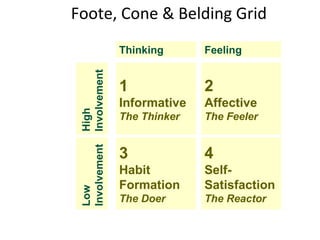
Foote, Cone & Belding Grid 1 Informative The Thinker 2 Affective The Feeler 3 Habit Formation The Doer 4 Self- Satisfaction The Reactor Thinking Feeling High Involvement Low Involvement
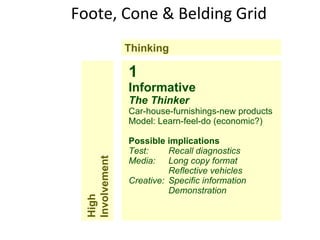
Foote, Cone & Belding Grid 1 Informative The Thinker Car-house-furnishings-new products Model: Learn-feel-do (economic?) Possible implications Test: Recall diagnostics Media: Long copy format Reflective vehicles Creative: Specific information Demonstration Thinking High Involvement
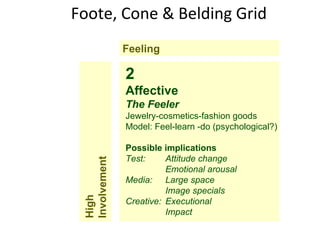
Foote, Cone & Belding Grid 2 Affective The Feeler Jewelry-cosmetics-fashion goods Model: Feel-learn -do (psychological?) Possible implications Test: Attitude change Emotional arousal Media: Large space Image specials Creative: Executional Impact Feeling High Involvement
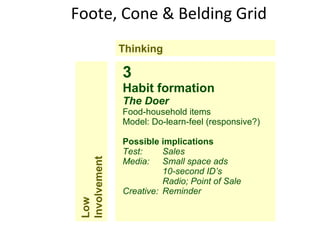
Foote, Cone & Belding Grid 3 Habit formation The Doer Food-household items Model: Do-learn-feel (responsive?) Possible implications Test: Sales Media: Small space ads 10-second ID’s Radio; Point of Sale Creative: Reminder Thinking Low Involvement
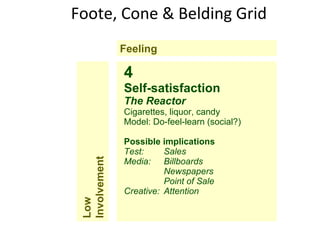
Foote, Cone & Belding Grid 4 Self-satisfaction The Reactor Cigarettes, liquor, candy Model: Do-feel-learn (social?) Possible implications Test: Sales Media: Billboards Newspapers Point of Sale Creative: Attention Feeling Low Involvement
Cognitive Response A method for examining consumers’ cognitive processing of advertising messages by looking at their cognitive responses to hearing, viewing, or reading communications Examines types of thoughts that are evoked by an advertising message
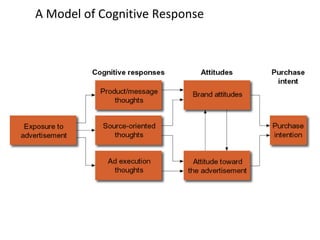
A Model of Cognitive Response
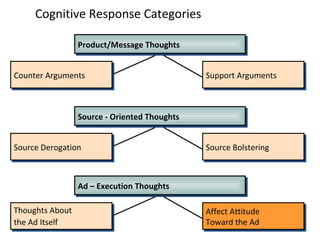
Cognitive Response Categories Thoughts About the Ad Itself Source Bolstering Source Derogation Support Arguments Counter Arguments Product/Message Thoughts Source - Oriented Thoughts Ad – Execution Thoughts Counter Arguments Support Arguments Source Derogation Source Bolstering Thoughts About the Ad Itself Affect Attitude Toward the Ad
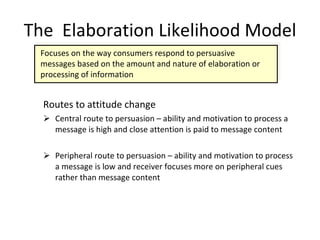
The  Elaboration Likelihood Model Routes to attitude change Central route to persuasion – ability and motivation to process a message is high and close attention is paid to message content Peripheral route to persuasion – ability and motivation to process a message is low and receiver focuses more on peripheral cues rather than message content Focuses on the way consumers respond to persuasive messages based on the amount and nature of elaboration or processing of information
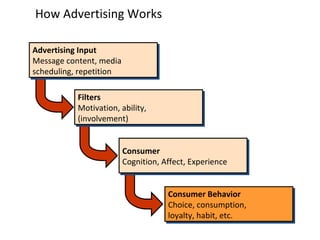
How Advertising Works Advertising Input Message content, media scheduling, repetition Advertising Input Message content, media scheduling, repetition Filters Motivation, ability, (involvement) Consumer Cognition, Affect, Experience Filters Motivation, ability, (involvement) Consumer Cognition, Affect, Experience Consumer Behavior Choice, consumption, loyalty, habit, etc.

2 the communications process

  • 1.
    The Communications ProcessDr. Eduardo Bustos Farías
  • 2.
    What is theProcess? A Communication Loop Sender Encodes message > selects channel > sends message Receiver Gets message > decodes message > feeds back a reply signaling understanding or seeking additional information
  • 3.
    The Communications Process© 2003 McGraw-Hill Companies, Inc., McGraw-Hill/Irwin
  • 4.
    Source, Messageand Channel Factors
  • 5.
    Source Factors The source of a message in the communication process is where the message originates A source can be credible on: Cognitive Affective dimensions
  • 6.
    Cognitive Source Credibility is the extent to which the audience sees the source as having relevant knowledge, skill, or experience and trusts the source to give unbiased, objective information Affective Source Credibility : Similarity: Resemblance between source and audience Likability: Affection for source because of physical appearance & other personal traits
  • 7.
    The Persuasion MatrixIndependent variables: The Communications Components Source Message Channel Receiver Destination X X X Message presentation Attention Comprehension Yielding Retention Behavior Source X
  • 8.
    Source Attributes andReceiver Processing Modes Source attribute Process Compliance Power Identification Attractiveness Internalization Credibility
  • 9.
    The Use ofCelebrities Endorsements Testimonials Placements Dramatizations Representatives Identification
  • 10.
    Meaning, Movement andthe Endorsement Process Stage 1 Role 3 Role 2 Objects Persons Context Role 1 Celebrity Stage 2 Product Celebrity Stage 3 Consumer Product
  • 11.
    Fear Appeals and Message Acceptance Rejection Inhibiting effects Resultant nonmonotonic curve Facilitating effects Level of fear Acceptance
  • 12.
    Use of HumorAids attention and awareness May harm recall and comprehension May aid name and simple copy registration May harm complex copy registration May aid retention Does not aid persuasion in general May aid persuasion to switch brands Creates positive mood, enhancing persuasion Does not aid source credibility Is not effective in bringing about action, sales
  • 13.
    UNFAVORABLE TOWARD HUMORResearch directors Direct mail, newspapers Corporate advertising Industrial products Goods or services of a sensitive nature Audiences that are: Older Less educated Down-scale Female Semi- or Unskilled FAVORABLE TOWARD HUMOR Creative personnel Radio and television Consumer non-durables Business services Products related to the humorous ploy Audiences that are: Younger Better educated Up-scale Male Professional Use of Humor
  • 14.
    Message Recall and Presentation Order Recall Beginning Middle End
  • 15.
    How to increaseattention: Use communications channels that consumer favors Use effective execution that makes the ad more vivid How? Color Contrast Novelty Size
  • 16.
    Message Interpretation Meaningsassigned to the message are based on learned associations Learning can be formal or informal Based on attitude, beliefs, motives, & experiences Interpretation to support own position Marketing Objective: Intended Message = Decoded Message
  • 17.
    How to achieveinterpretation objective: Involve consumer in the development of creative ideas, e.g., brainstorming sessions
  • 18.
    Message Retention Limitedmemory space  discard info that is of no use Therefore, must make info useful How to lengthen retention of message: Repeat message Use mnemonics
  • 19.
    There are manyforms of encoding Verbal Graphic Musical Encoding Graphic Pictures Drawings Charts Verbal Spoken Word Written Word Song Lyrics Musical Arrange-ment Instrum-entation Voices Animation Action/ Motion Pace/ Speed Shape/ Form
  • 20.
    Experiential Overlap SenderExperience Receiver Experience Different Worlds Sender Experience Receiver Experience Moderate Commonality Sender Experience High Commonality Receiver Experience
  • 21.
    The Semiotic PerspectiveObject Brand such as Marlboro Object Brand such as Marlboro Sign or symbol representing intended meaning (Cowboy) Three Components to every marketing message Sign or symbol representing intended meaning (Cowboy) Interpretant/ intended meaning (masculine,rugged individualistic)
  • 22.
    What is thesymbolic meaning of the Snuggle bear?
  • 23.
    Forms of PersonalCommunication Vocabulary Grammar Inflection Gesture Facial Expression Grammar Vocabulary Inflection Facial Expression Gesture Body Language Verbal Nonverbal
  • 24.
    Communications Channels PersonalChannels Personal Channels Nonpersonal Channels Personal Selling Word of Mouth Print Media Broadcast Media
  • 25.
    Communication Channels Two-wayFace-to-face Conversation, interviews, presentations, videoconferences, etc. Advantages You get the whole package! Instant feedback, able to read nonverbal signals, achieve personal connection Useful for motivating or conveying sensitive or unpleasant information
  • 26.
    Communication Channels Two-wayNot face-to-face Telephone conversations, on-line chats Advantages Instant feedback, real-time connection No nonverbal elements, so verbal element must be especially clear
  • 27.
    Communication Channels One-wayNot face-to-face Letters, memoranda, reports, e-mail, fax, voice mail, web-page Advantages Message considered more official; useful when a permanent record is required; often used when feedback is not expected Lacks nonverbal signals and instant feedback, so measures against misinterpretation must be taken
  • 28.
    Experiential Overlap ReceiverExperience Sender Experience Different Worlds Receiver Experience Sender Experience Moderate Commonality Receiver Experience Sender Experience High Commonality Receiver Experience
  • 29.
    Levels of AudienceAggregation Market Segments Market Segments Mass Markets Niche Markets Individuals Niche Markets Mass Markets
  • 30.
    Models of ObtainingFeedback Circulation Reach Listener, Reader, Viewer Recognition Recall, Checklists Brand Attitudes, Purchase Intent Recall Over Time Inventory, POP Consumer Panel Effectiveness Test Persuasion Process Exposure, Presentation Attention Comprehension Message Acceptance/ Yielding Retention Purchase Behavior Retention Recall Over Time Message Acceptance/ Yielding Brand Attitudes, Purchase Intent Comprehension Recall, Checklists Attention Listener, Reader, Viewer Recognition Exposure, Presentation Circulation Reach
  • 31.
    Alternative Response Hierarchies High Low High Low Topical Involvement Perceived product differentiation Learning Model Low Involvement Model Dissonance/ Attribution Model Cognitive Affective Conative Conative Affective Cognitive Cognitive Conative Affective
  • 32.
    Involvement Concept Antecedentsof involvement derived from the literature Person factors - Needs - Importance - Interest - Values Object or stimulus factors - Differentiation of alternatives - Source of communication – Content of communication Situational factors -Purchase/use -Occasion Possible results of involvement Elicitation of counterarguments to ads Effectiveness of ad to induce purchase Relative importance of the product class Perceived differences in product attributes Preference of a particular kind Influence of price on brand choice Amount of information on search Time spend deliberating alternatives Type of decision rule used in choice Involvement With advertisements With products With purchase decisions
  • 33.
    Foote, Cone &Belding Grid 1 Informative The Thinker 2 Affective The Feeler 3 Habit Formation The Doer 4 Self- Satisfaction The Reactor Thinking Feeling High Involvement Low Involvement
  • 34.
    Foote, Cone &Belding Grid 1 Informative The Thinker Car-house-furnishings-new products Model: Learn-feel-do (economic?) Possible implications Test: Recall diagnostics Media: Long copy format Reflective vehicles Creative: Specific information Demonstration Thinking High Involvement
  • 35.
    Foote, Cone &Belding Grid 2 Affective The Feeler Jewelry-cosmetics-fashion goods Model: Feel-learn -do (psychological?) Possible implications Test: Attitude change Emotional arousal Media: Large space Image specials Creative: Executional Impact Feeling High Involvement
  • 36.
    Foote, Cone &Belding Grid 3 Habit formation The Doer Food-household items Model: Do-learn-feel (responsive?) Possible implications Test: Sales Media: Small space ads 10-second ID’s Radio; Point of Sale Creative: Reminder Thinking Low Involvement
  • 37.
    Foote, Cone &Belding Grid 4 Self-satisfaction The Reactor Cigarettes, liquor, candy Model: Do-feel-learn (social?) Possible implications Test: Sales Media: Billboards Newspapers Point of Sale Creative: Attention Feeling Low Involvement
  • 38.
    Cognitive Response Amethod for examining consumers’ cognitive processing of advertising messages by looking at their cognitive responses to hearing, viewing, or reading communications Examines types of thoughts that are evoked by an advertising message
  • 39.
    A Model ofCognitive Response
  • 40.
    Cognitive Response CategoriesThoughts About the Ad Itself Source Bolstering Source Derogation Support Arguments Counter Arguments Product/Message Thoughts Source - Oriented Thoughts Ad – Execution Thoughts Counter Arguments Support Arguments Source Derogation Source Bolstering Thoughts About the Ad Itself Affect Attitude Toward the Ad
  • 41.
    The ElaborationLikelihood Model Routes to attitude change Central route to persuasion – ability and motivation to process a message is high and close attention is paid to message content Peripheral route to persuasion – ability and motivation to process a message is low and receiver focuses more on peripheral cues rather than message content Focuses on the way consumers respond to persuasive messages based on the amount and nature of elaboration or processing of information
  • 42.
    How Advertising WorksAdvertising Input Message content, media scheduling, repetition Advertising Input Message content, media scheduling, repetition Filters Motivation, ability, (involvement) Consumer Cognition, Affect, Experience Filters Motivation, ability, (involvement) Consumer Cognition, Affect, Experience Consumer Behavior Choice, consumption, loyalty, habit, etc.

Editor's Notes

  • #4 Relation to text This slide relates to material on pp.139 and Figure 5-1 of the text. Summary Overview This slide provides an overview of the basic elements of the communications process which includes: Source/Sender – the person or organization that has information to share Receiver – person(s) with whom the sender is sharing thoughts Message – the information the source hopes to convey Channel – method by which the communication travels from source to receiver Encoding – putting thoughts, ideas, or information into symbolic form Decoding – transforming the senders message back into thought Response – receiver’s reactions after seeing, hearing, or reading the message Feedback – part of the receiver’s response that is communicated back to the sender Noise – unplanned distortion or interference Use of this slide This slide can be used to introduce the communication process and discuss the basic elements in a communication system. It is important for students to understand each of these elements and the role they play in the communication process.
  • #8 Promotional Planning Receiver/comprehension Can the receiver comprehend the ad? Channel/presentation Which media will increase presentation? Message/yielding What type of message will create favorable attitudes? Source/attention Who will be effective in getting consumers’ attention?
  • #9 Source Credibility The extend to which the source is seen as having: Knowledge Skill Expertise And the information is seen to be: Trustworthy Unbiased Objective Source Attractiveness Similarity Resemblance between the source and recipient of the message Familiarity Knowledge of the source through repeated or prolonged exposure Likeability Affection for the source resulting from physical appearance, behavior, or other personal traits
  • #10 Endorsements The celebrity, whether an expert or not, merely agrees to the use of his or her name and image in the promotion for the product. Testimonials The celebrity, usually an expert with experience with the product, attests to its value and worth. Placements The brand is "placed" in a movie or TV show where it's seen by the audience and used or associated with the characters. Dramatizations Celebrity actors or models portray the brand in use during dramatic enactments designed to show the goods. Representatives The celebrity agrees to become a spokesperson for the brand through multiple media over an extended time period. Identification The celebrity, usually in partnership with a producer, introduces his or her own brand using the celebrity name as the brand name.
  • #20 Relation to text This material relates to material on p.141 of the text which discusses source encoding. Summary Overview This slide summarizes the various forms of encoding which is the process by which thoughts or ideas are put into a symbolic form. The sender’s goal is to encode the message is such a way that it will be understood by the receiver. The various forms by which a message can be encoded include: Verbal Graphic Musical Animation Use of this slide This slide can be used to explain the various forms by which as messages can be encoded by the sender. Many of these are used in the development of advertising messages.
  • #22 Relation to text This slide relates to material on p.141-143 of the text. Summary Overview The encoding process leads to the development of a message that contains information or meaning the source hopes to convey. To better understand the symbolic meaning that might be conveyed in a communication, marketing researchers have been focusing on semotics which studies the nature of meaning and asks how our reality – words, gestures, signs, products, symbols – acquire meaning. From a semiotic perspective every marketing message has three components: Object – product or brand that is the focus of the message (e.g., Marlboro) Sign or symbol – sensory imagery that represents the intended meanings of the object (Cowboy) Interpretant – intended meaning (masculine, rugged, individualistic) Use of slide This slide can be used to demonstrate the use of semiotics as a technique to develop a meaningful communications message. It can be helpful in analyzing how various aspects of the marketing program – such as advertising messages, packaging, brand names, and even the non verbal communications of sales people – are interpreted by the receivers.
  • #24 Relation to text This slide relates to material on pp.143-145 of the text. Summary Overview This slide summarizes the types of communications that can be used in advertising and promotional messages. Communications fall into two basic categories, verbal and nonverbal . Verbal communications consist of items such as vocabulary, grammar, and inflection. Non-verbal communications include gestures, facial expressions, and body language. Nonverbal forms of communication can be very important in advertising as well as personal selling situations Use of this slide This slide can be used to discuss the two basic types of communication, verbal and nonverbal. Marketers must consider how these forms of communication will be interpreted by consumers who receive them.
  • #25 Relation to text This slide relates to material on p.143 of the text. Summary Overview Communication channels can be broken into two types, personal and nonpersonal . Personal channels are direct, interpersonal (face-to-face) contact with individuals or groups. Sales people serve as personal channels when they deliver their sales messages. Social channels such as friends, family, and co-workers can be a powerful personal source of information through what is commonly referred to as word-of-mouth communications. Nonpersonal channels are those than carry a message without a personal contact between sender and receiver. Nonpersonal channels are generally referred to as mass media and include various forms of print and broadcast media. Use of this slide This slide can be used to explain the communication channels of the communication process and the difference between personal and nonpersonal channels. Both can be used very effectively in advertising and promotion programs.
  • #29 Relation to text This slide relates to material on pp.143-145 of the text. Summary Overview Decoding the message can be heavily influenced by the receiver’s frame of reference or field of experience , which refers to the experiences, perceptions, attitudes, and values he or she brings to the communication situation. Effective communication is more likely when there is some common ground between the two parties. This slide illustrates this concept by showing different levels of experiential overlap ranging from the sender and receiving being in different worlds, to moderate and high overlap or commonality. Use of this slide This slide can be used to demonstrate that for effective communication to occur the message decoding process of the receiver must match the encoding of the sender. The more overlap present in their experiences the greater chance of effective communication. This notion can cause great difficulty in the advertising communication process because marketing and advertising people often have very different fields of experience from the consumers who constitute the mass markets with whom they must communicate. These differences can result from differences in characteristics such as age, education, profession, lifestyle, and other factors.
  • #30 Relation to text This slide relates to material on pp. 146-147 and Figure 5-2 of the text. Summary Overview The marketing communications process begins with identifying the audience that will be the focus of the firm’s advertising and promotional efforts. The target audience may consist of individuals, groups, niche markets, market segments, or a mass audience. This slide shows the various levels of the audience aggregation which include: Individuals – those with specific needs for whom a message must be specifically tailored Small groups – multiple people in the audience who are involved in the purchase decision such as families or people who members of a buying center Niche markets – smaller, well-defined markets consisting of customers who have similar needs Market segments – broader classes of people who have similar needs and can be reached with similar messages Mass markets – markets consisting of large numbers of potential customers Use of this slide This slide can be used to show the various types of markets and customers that can be identified as targeted audiences. Marketers usually approach each of these audiences differently from a communications perspective.
  • #31 Relation to text This slide relates to material on p.149 and Figure 5-4 of the text. Summary Overview This slide shows that there are various stages of the persuasion process that marketers want to attain. Each stage can be measured, providing the advertiser with feedback regarding the effectiveness of various strategies designed to move the consumer closer to purchase. The types of effectiveness tests that can be used to measure each step of the persuasion process are included on this slide. Use of this slide This slide can be used to demonstrate the various methods of obtaining feedback given each stage of the persuasion process. There are a variety of measures that are appropriate to use depending on where the customer is in the persuasion process and the type of communications being used.
  • #32 Relation to text This slide relates to material on pp. 150-153 of the text. Summary Overview Michael Ray has developed a model of information processing that identifies three alternative orderings of the three stages based on perceived product differentiation and product involvement . The three alternative hierarchies include: The Standard Learning Hierarchy = learn  feel  do sequence. The consumer is viewed as an active participant and this sequence is likely when there is much differentiation among brands and the consumer is highly involved in the purchase process. The Dissonance/Attribution Hierarchy = do  feel  learn sequence. Occurs when consumers must choose between two alternatives that are similar in quality but are complex and may have unknown attributes. Focus of mass media should be on reducing dissonance after purchase. Low involvement Hierarchy = learn  –  do  feel sequence. Occurs when involvement in the purchase decision is low, there are minimal differences among brand alternatives, and mass-media advertising is important. Use of this slide This slide can be used to explain Michaels Ray’s alternative response hierarchies. Understanding these alternative response sequences is important to marketers as they must recognize that not all purchase decisions are explained adequately by the traditional response hierarchy. From a promotional perspective, it is important that marketers examine the communication situation for their product or service and determine the type of response process that is most likely to occur
  • #40 Relation to text This slide relates to material on pp. 157-158 of the text and Figure 5-8. Summary Overview This slide shows a model of the cognitive process and how these thoughts relate to traditional outcome measures such as brand attitude, attitude toward the ad, and purchase intentions. Cognitive responses are the thoughts that occur while reading, viewing, and/or hearing a communication. The assumption is that these thoughts reflect the recipient’s reactions and help shape ultimate acceptance or rejection. of a message. The categories of cognitive responses include: Product/message thoughts Source-oriented thoughts Ad execution thoughts Use of slide This model can be used to show how cognitive responses to an advertisement mediate outcome reactions such as brand attitudes and attitude toward the advertisement which in turn impact purchase intentions.
  • #41 Relation to text This slide relates to material on pp. 157-158 of the text and Figure 5-8. Summary Overview This slide shows the three basic categories of cognitive responses. These are: Product/message thoughts – directed at the product or service and/or claims being made in the communication. These types of thoughts include: Counterarguments – thoughts the recipient has that are opposed to the position taken in the message Support arguments – thoughts that affirm or support the claims made in the message Source-oriented thoughts – directed at the source of the communication and include: Source derogations – negative thoughts about the spokesperson or organization making the claims Source bolsters – favorable thoughts about the spokesperson or organization making the claims Ad execution thoughts – thoughts about the ad itself, including execution factors such as creativity, quality, colors, or voice tones. Affect/attitude toward the ad represents the receivers’ feeling of favorability or unfavorability toward the ad. Use of this slide This slide can be used to further explain the cognitive response model by providing examples of the three categories of thoughts that might occur in reaction to an advertising message.
  • #43 Relation to text This slide relates to material on pp.161-162 and Figure 5-10. Summary Overview This slide presents a framework for studying how advertising works that was developed by Vakratsas and Ambler following an extensive review of more than 250 articles and studies of the advertising response process. This framework is as follows: Advertising input – message content, media scheduling, repetition Filters – the message is mediated by factors such as motivation and ability Consumer – intermediate effects between advertising and purchase Cognition – the thinking dimension of a person’s response Affect – the feeling dimension of a person’s response Experience – the feedback dimension based on outcomes of the product purchasing and usage Consumer behavior – consumption, choice, loyalty, habit Use of this slide This chapter has presented the process consumers go through in responding to marketing communications from a number of different perspectives. This slide can be used to explain the framework for studying how advertising works and to summarize the different models. The various communication models provide insight into how consumers may process and respond to persuasive messages and help marketers make better decisions in planning and implementing their IMC programs.