Copyright © 2013 Pearson Education, Inc. Publishing as Prentice Hall.
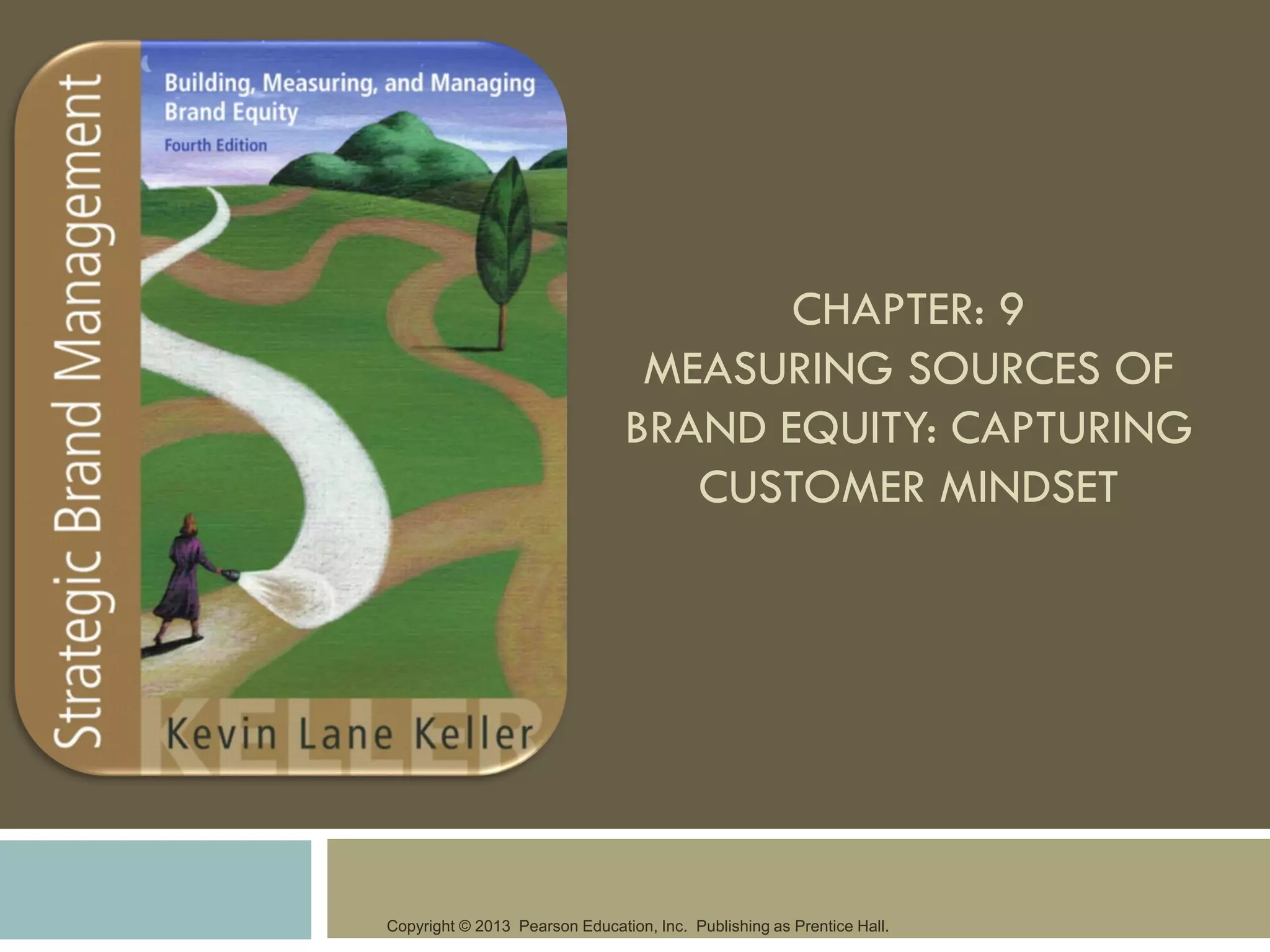
CHAPTER: 9
MEASURING SOURCES OF
BRAND EQUITY: CAPTURING
CUSTOMER MINDSET
Copyright © 2013 Pearson Education, Inc. Publishing as Prentice Hall.
Learning Objectives
 Describe effective qualitative research techniques
for tapping into consumer brand knowledge
 Identify effective quantitative research techniques
for measuring brand awareness, image, responses,
and relationships
 Profile and contrast some popular brand equity
models
Copyright © 2013 Pearson Education, Inc. Publishing as Prentice Hall.
Qualitative Research Techniques
Free Associations Projective
Techniques
Zaltman
Metaphor
Elicitation
Technique (ZMET)
Neural Research
Method
Brand Personality
and Value
Ethnographic and
Experiential
Methods
Copyright © 2013 Pearson Education, Inc. Publishing as Prentice Hall.
Free Associations
 Powerful way to profile brand associations
 Without any specific probe, consumers narrate:
 What comes to their mind when they think about the
brand or the associated product category
 Help form a rough mental map for the brand
 Indicate the relative strength, favorability, and
uniqueness of brand associations
Copyright © 2013 Pearson Education, Inc. Publishing as Prentice Hall.
Projective Techniques
 Diagnostic tools to uncover the true opinions and
feelings of consumers when:
 They are unwilling or unable to express themselves
 Present consumers with ambiguous stimulus and ask
them to make sense of it
Copyright © 2013 Pearson Education, Inc. Publishing as Prentice Hall.
Types of Projective Techniques
Completion and
Interpretation Tasks
Comparisons Task
Archetypes
Copyright © 2013 Pearson Education, Inc. Publishing as Prentice Hall.
Zaltman Metaphor Elicitation Technique
(ZMET)
 Uncovers hidden thoughts and feelings which can be
expressed using metaphors
 Elicits interconnected constructs that influence
thought and behavior
 Construct- An abstraction to capture common ideas
or themes expressed by customers
 Metaphor
 Defining one thing in terms of other
 Represents thoughts that are tacit, implicit, and
unspoken
Copyright © 2013 Pearson Education, Inc. Publishing as Prentice Hall.
Figure 9.3 - Application of ZMET to
Intimate Apparel Market
Copyright © 2013 Pearson Education, Inc. Publishing as Prentice Hall.
Neural Research Methods
 Neuromarketing - Study of how the brain responds
to marketing stimuli, including brands
 Research indicates that consumer buying decision is
a unconscious habitual process
Copyright © 2013 Pearson Education, Inc. Publishing as Prentice Hall.
Brand Personality and Values
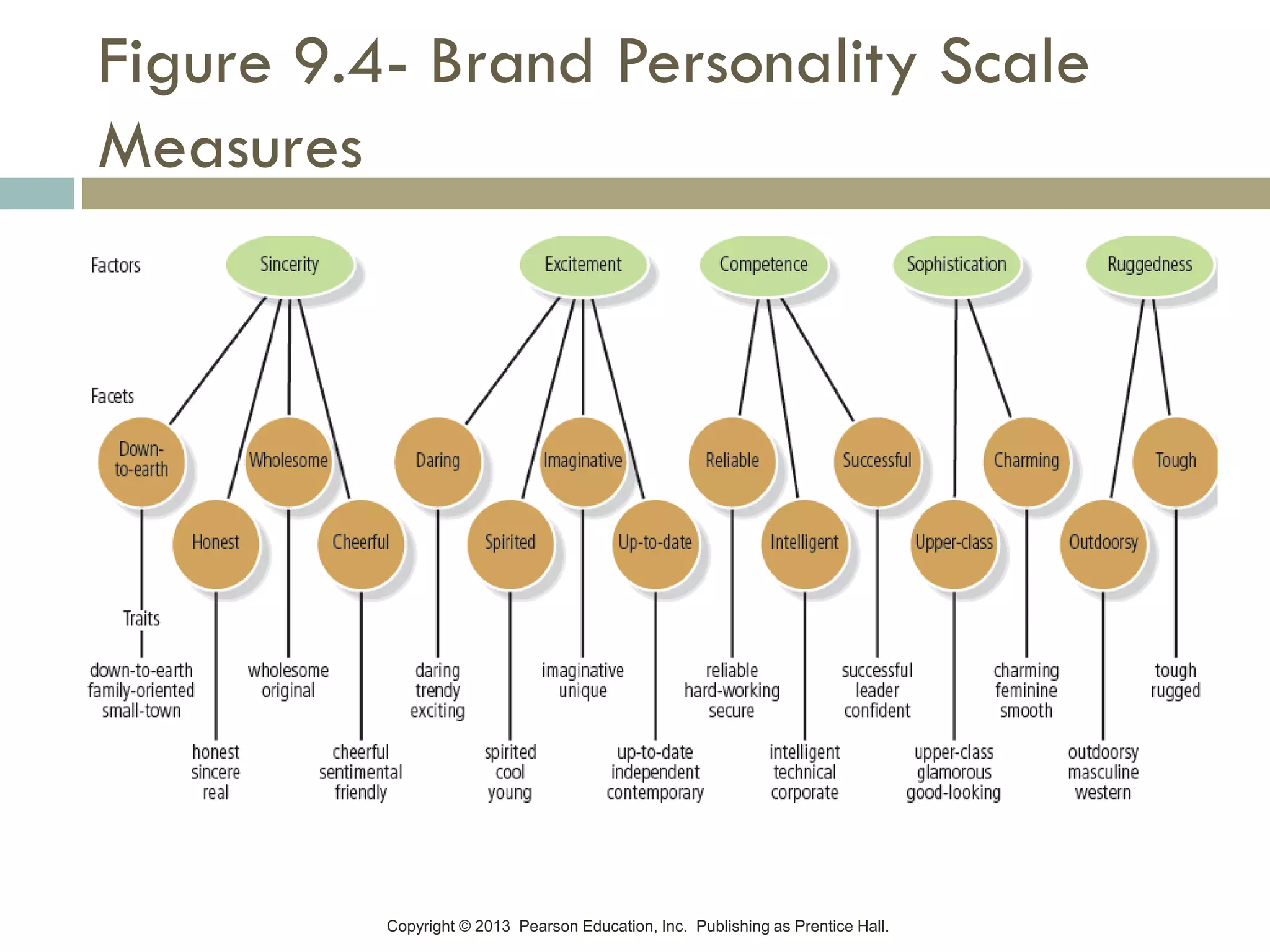
 Brand personality - Human characteristics or traits
that consumers can attribute to a brand
 The big five- Brand personality scale used to
measure:
 Sincerity
 Excitement
 Competence
 Sophistication
 Ruggedness
Copyright © 2013 Pearson Education, Inc. Publishing as Prentice Hall.
Figure 9.4- Brand Personality Scale
Measures
Copyright © 2013 Pearson Education, Inc. Publishing as Prentice Hall.
Ethnographic and Experiential Methods
 Use “thick description” based on participant
observation
 Extract and interpret the deep cultural meaning of
events and activities
Copyright © 2013 Pearson Education, Inc. Publishing as Prentice Hall.
To Sum up...
 Qualitative research techniques ascertain consumer
perceptions that are difficult to uncover
 Disadvantages
 Small sample size may not necessarily generalize to
broader populations
 Due to qualitative nature, data is open to varied
interpretations
Copyright © 2013 Pearson Education, Inc. Publishing as Prentice Hall.
Quantitative Research Techniques
Brand Awareness
Brand Image
Brand Responses
Brand Relationships
Copyright © 2013 Pearson Education, Inc. Publishing as Prentice Hall.
Brand Awareness
 Recognition
 Recall
 Corrections for guessing
 Strategic implications
 Yields insight into how brand knowledge is organized in
memory
 Identifies cues or reminders necessary for consumers to
retrieve the brand from memory
Copyright © 2013 Pearson Education, Inc. Publishing as Prentice Hall.
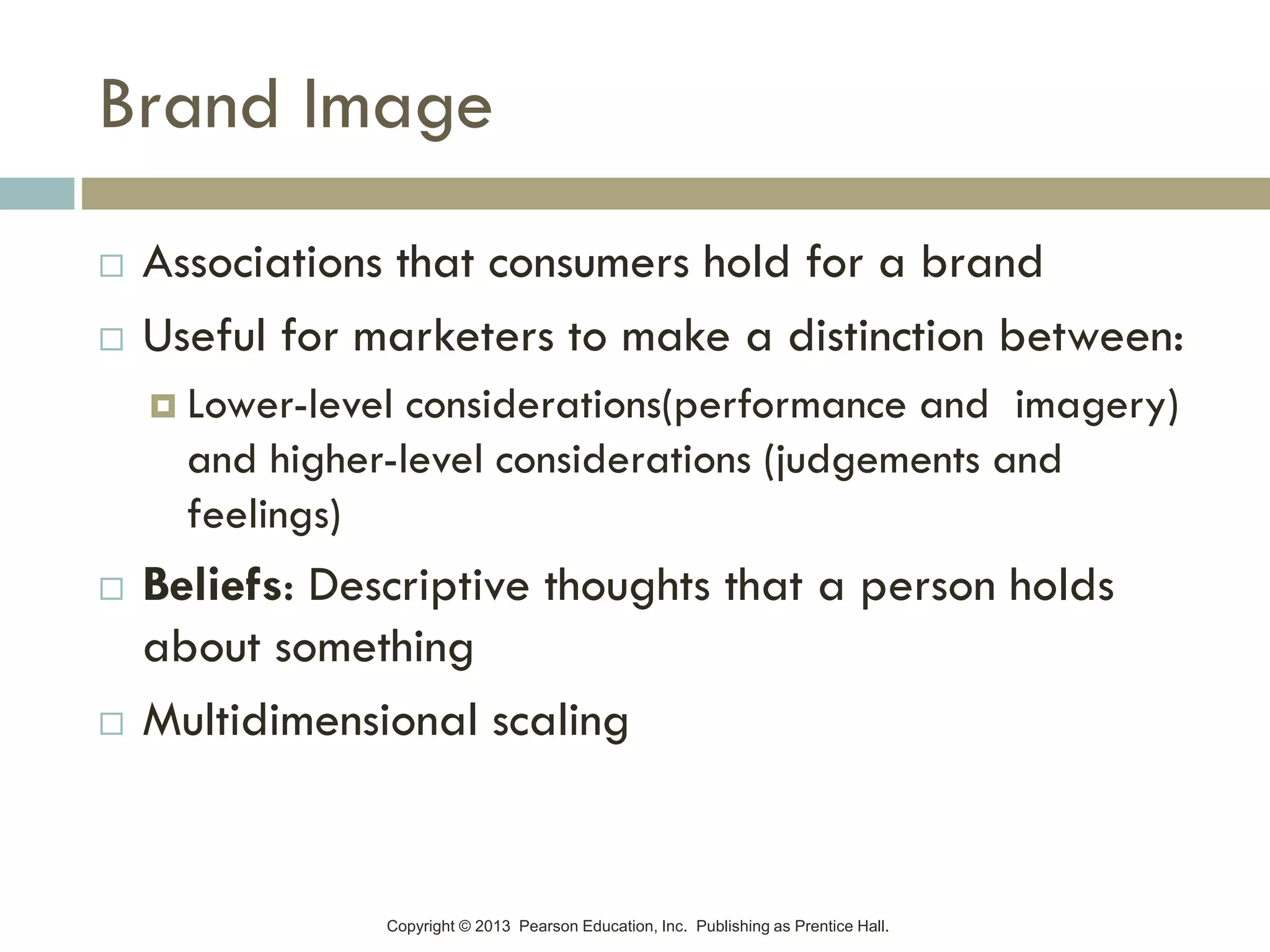
Brand Image
 Associations that consumers hold for a brand
 Useful for marketers to make a distinction between:
 Lower-level considerations(performance and imagery)
and higher-level considerations (judgements and
feelings)
 Beliefs: Descriptive thoughts that a person holds
about something
 Multidimensional scaling
Copyright © 2013 Pearson Education, Inc. Publishing as Prentice Hall.
Figure 9.8- Hypothetical Restaurant
Perceptual Map
Copyright © 2013 Pearson Education, Inc. Publishing as Prentice Hall.
Brand Responses
Purchase Intentions
Likelihood to
Recommend
Copyright © 2013 Pearson Education, Inc. Publishing as Prentice Hall.
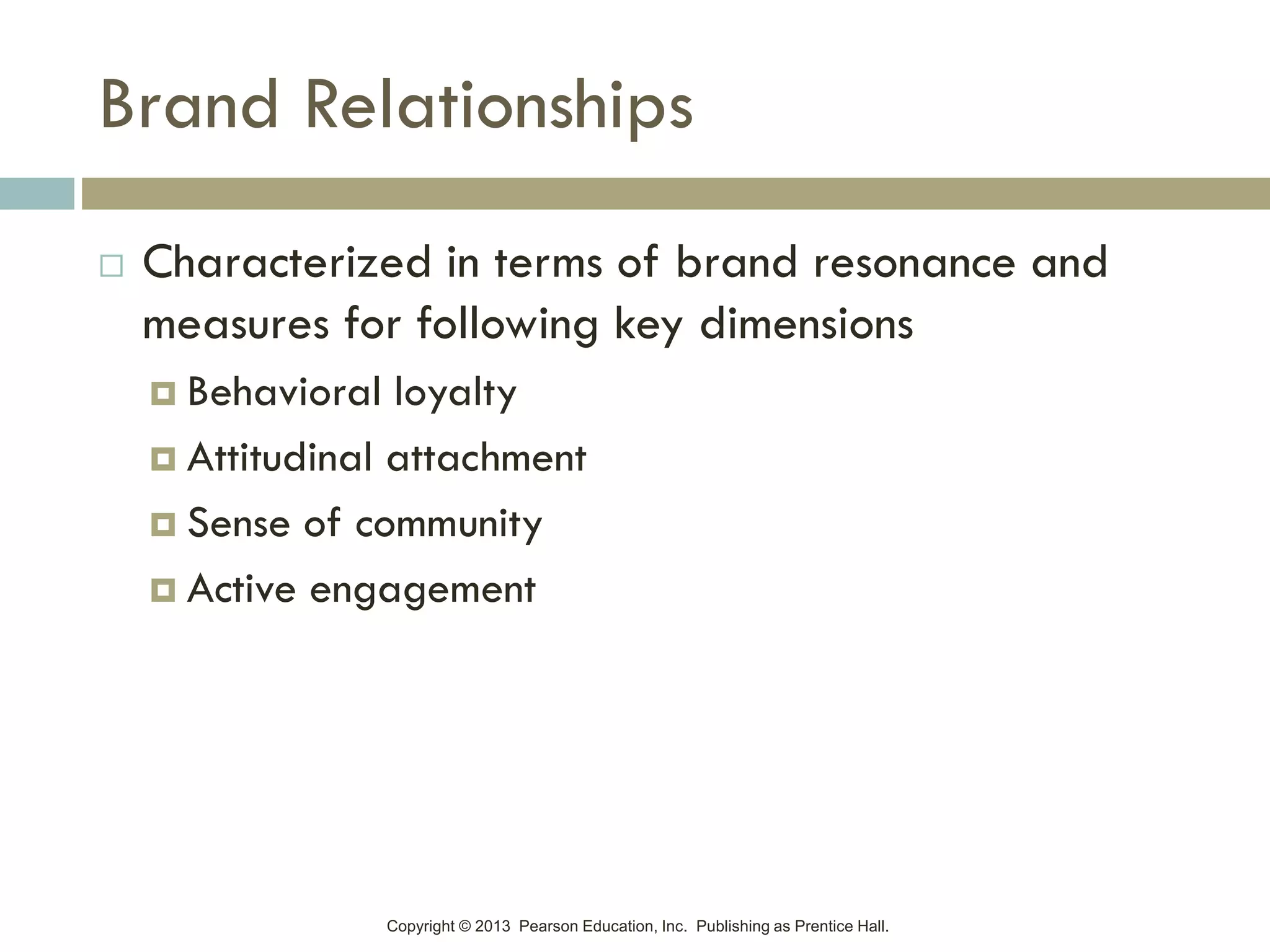
Brand Relationships
 Characterized in terms of brand resonance and
measures for following key dimensions
 Behavioral loyalty
 Attitudinal attachment
 Sense of community
 Active engagement
Copyright © 2013 Pearson Education, Inc. Publishing as Prentice Hall.
Brand Relationships
Behavioral
Loyalty
Attitudinal
Attachment
Sense of
Community
Active
Engagement
Fournier’s Brand
Relationship
Research
Copyright © 2013 Pearson Education, Inc. Publishing as Prentice Hall.
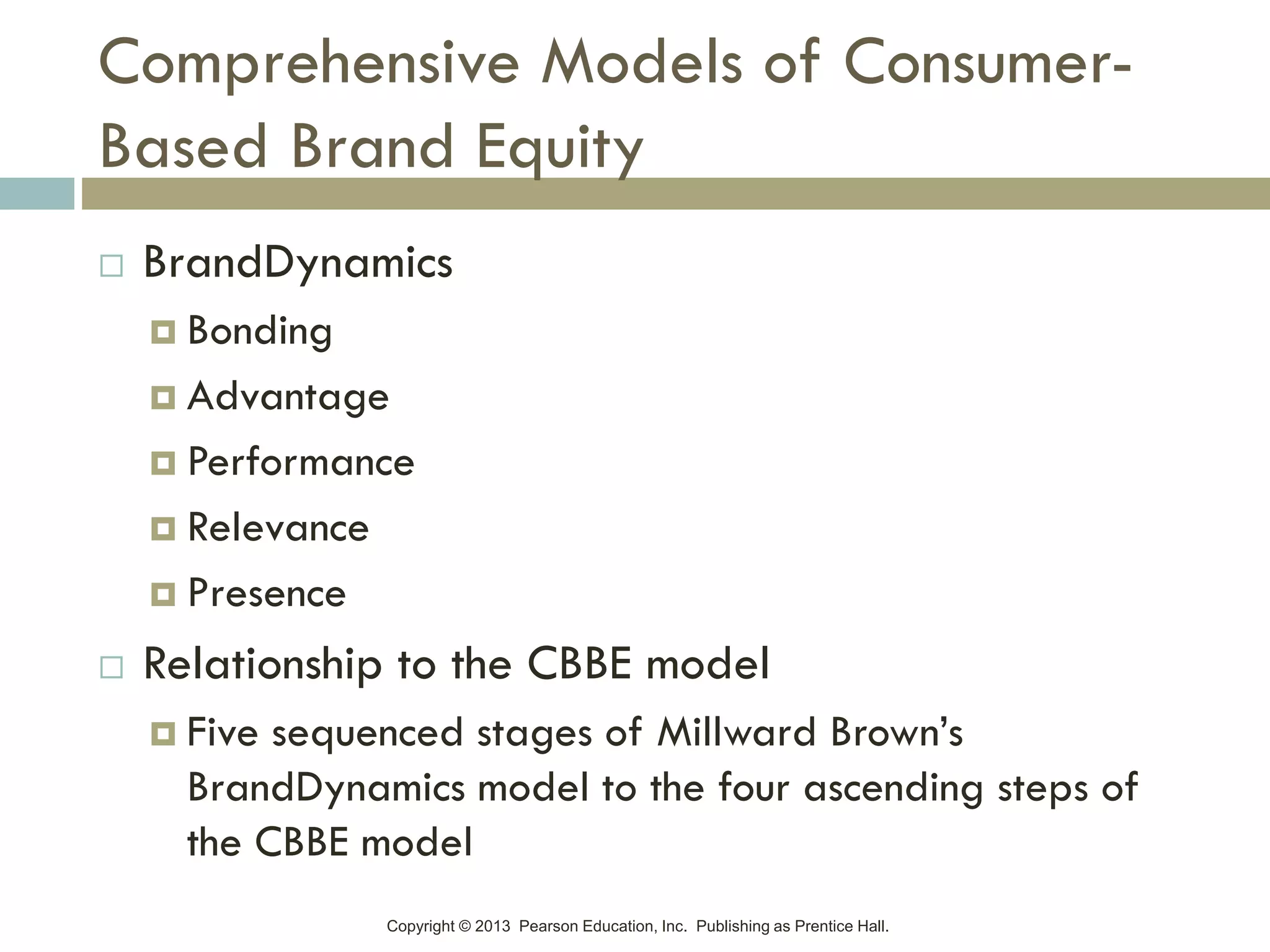
Comprehensive Models of Consumer-
Based Brand Equity
 BrandDynamics
 Bonding
 Advantage
 Performance
 Relevance
 Presence
 Relationship to the CBBE model
 Five sequenced stages of Millward Brown’s
BrandDynamics model to the four ascending steps of
the CBBE model
Copyright © 2013 Pearson Education, Inc. Publishing as Prentice Hall.
Figure 9.12- Brand Dynamics™
from Millward Brown
Copyright © 2013 Pearson Education, Inc. Publishing as Prentice Hall.
Figure 9.13- Summary of Qualitative and
Quantitative Measure

Chapter 9

  • 1.
    Copyright © 2013Pearson Education, Inc. Publishing as Prentice Hall. CHAPTER: 9 MEASURING SOURCES OF BRAND EQUITY: CAPTURING CUSTOMER MINDSET
  • 2.
    Copyright © 2013Pearson Education, Inc. Publishing as Prentice Hall. Learning Objectives  Describe effective qualitative research techniques for tapping into consumer brand knowledge  Identify effective quantitative research techniques for measuring brand awareness, image, responses, and relationships  Profile and contrast some popular brand equity models
  • 3.
    Copyright © 2013Pearson Education, Inc. Publishing as Prentice Hall. Qualitative Research Techniques Free Associations Projective Techniques Zaltman Metaphor Elicitation Technique (ZMET) Neural Research Method Brand Personality and Value Ethnographic and Experiential Methods
  • 4.
    Copyright © 2013Pearson Education, Inc. Publishing as Prentice Hall. Free Associations  Powerful way to profile brand associations  Without any specific probe, consumers narrate:  What comes to their mind when they think about the brand or the associated product category  Help form a rough mental map for the brand  Indicate the relative strength, favorability, and uniqueness of brand associations
  • 5.
    Copyright © 2013Pearson Education, Inc. Publishing as Prentice Hall. Projective Techniques  Diagnostic tools to uncover the true opinions and feelings of consumers when:  They are unwilling or unable to express themselves  Present consumers with ambiguous stimulus and ask them to make sense of it
  • 6.
    Copyright © 2013Pearson Education, Inc. Publishing as Prentice Hall. Types of Projective Techniques Completion and Interpretation Tasks Comparisons Task Archetypes
  • 7.
    Copyright © 2013Pearson Education, Inc. Publishing as Prentice Hall. Zaltman Metaphor Elicitation Technique (ZMET)  Uncovers hidden thoughts and feelings which can be expressed using metaphors  Elicits interconnected constructs that influence thought and behavior  Construct- An abstraction to capture common ideas or themes expressed by customers  Metaphor  Defining one thing in terms of other  Represents thoughts that are tacit, implicit, and unspoken
  • 8.
    Copyright © 2013Pearson Education, Inc. Publishing as Prentice Hall. Figure 9.3 - Application of ZMET to Intimate Apparel Market
  • 9.
    Copyright © 2013Pearson Education, Inc. Publishing as Prentice Hall. Neural Research Methods  Neuromarketing - Study of how the brain responds to marketing stimuli, including brands  Research indicates that consumer buying decision is a unconscious habitual process
  • 10.
    Copyright © 2013Pearson Education, Inc. Publishing as Prentice Hall. Brand Personality and Values  Brand personality - Human characteristics or traits that consumers can attribute to a brand  The big five- Brand personality scale used to measure:  Sincerity  Excitement  Competence  Sophistication  Ruggedness
  • 11.
    Copyright © 2013Pearson Education, Inc. Publishing as Prentice Hall. Figure 9.4- Brand Personality Scale Measures
  • 12.
    Copyright © 2013Pearson Education, Inc. Publishing as Prentice Hall. Ethnographic and Experiential Methods  Use “thick description” based on participant observation  Extract and interpret the deep cultural meaning of events and activities
  • 13.
    Copyright © 2013Pearson Education, Inc. Publishing as Prentice Hall. To Sum up...  Qualitative research techniques ascertain consumer perceptions that are difficult to uncover  Disadvantages  Small sample size may not necessarily generalize to broader populations  Due to qualitative nature, data is open to varied interpretations
  • 14.
    Copyright © 2013Pearson Education, Inc. Publishing as Prentice Hall. Quantitative Research Techniques Brand Awareness Brand Image Brand Responses Brand Relationships
  • 15.
    Copyright © 2013Pearson Education, Inc. Publishing as Prentice Hall. Brand Awareness  Recognition  Recall  Corrections for guessing  Strategic implications  Yields insight into how brand knowledge is organized in memory  Identifies cues or reminders necessary for consumers to retrieve the brand from memory
  • 16.
    Copyright © 2013Pearson Education, Inc. Publishing as Prentice Hall. Brand Image  Associations that consumers hold for a brand  Useful for marketers to make a distinction between:  Lower-level considerations(performance and imagery) and higher-level considerations (judgements and feelings)  Beliefs: Descriptive thoughts that a person holds about something  Multidimensional scaling
  • 17.
    Copyright © 2013Pearson Education, Inc. Publishing as Prentice Hall. Figure 9.8- Hypothetical Restaurant Perceptual Map
  • 18.
    Copyright © 2013Pearson Education, Inc. Publishing as Prentice Hall. Brand Responses Purchase Intentions Likelihood to Recommend
  • 19.
    Copyright © 2013Pearson Education, Inc. Publishing as Prentice Hall. Brand Relationships  Characterized in terms of brand resonance and measures for following key dimensions  Behavioral loyalty  Attitudinal attachment  Sense of community  Active engagement
  • 20.
    Copyright © 2013Pearson Education, Inc. Publishing as Prentice Hall. Brand Relationships Behavioral Loyalty Attitudinal Attachment Sense of Community Active Engagement Fournier’s Brand Relationship Research
  • 21.
    Copyright © 2013Pearson Education, Inc. Publishing as Prentice Hall. Comprehensive Models of Consumer- Based Brand Equity  BrandDynamics  Bonding  Advantage  Performance  Relevance  Presence  Relationship to the CBBE model  Five sequenced stages of Millward Brown’s BrandDynamics model to the four ascending steps of the CBBE model
  • 22.
    Copyright © 2013Pearson Education, Inc. Publishing as Prentice Hall. Figure 9.12- Brand Dynamics™ from Millward Brown
  • 23.
    Copyright © 2013Pearson Education, Inc. Publishing as Prentice Hall. Figure 9.13- Summary of Qualitative and Quantitative Measure