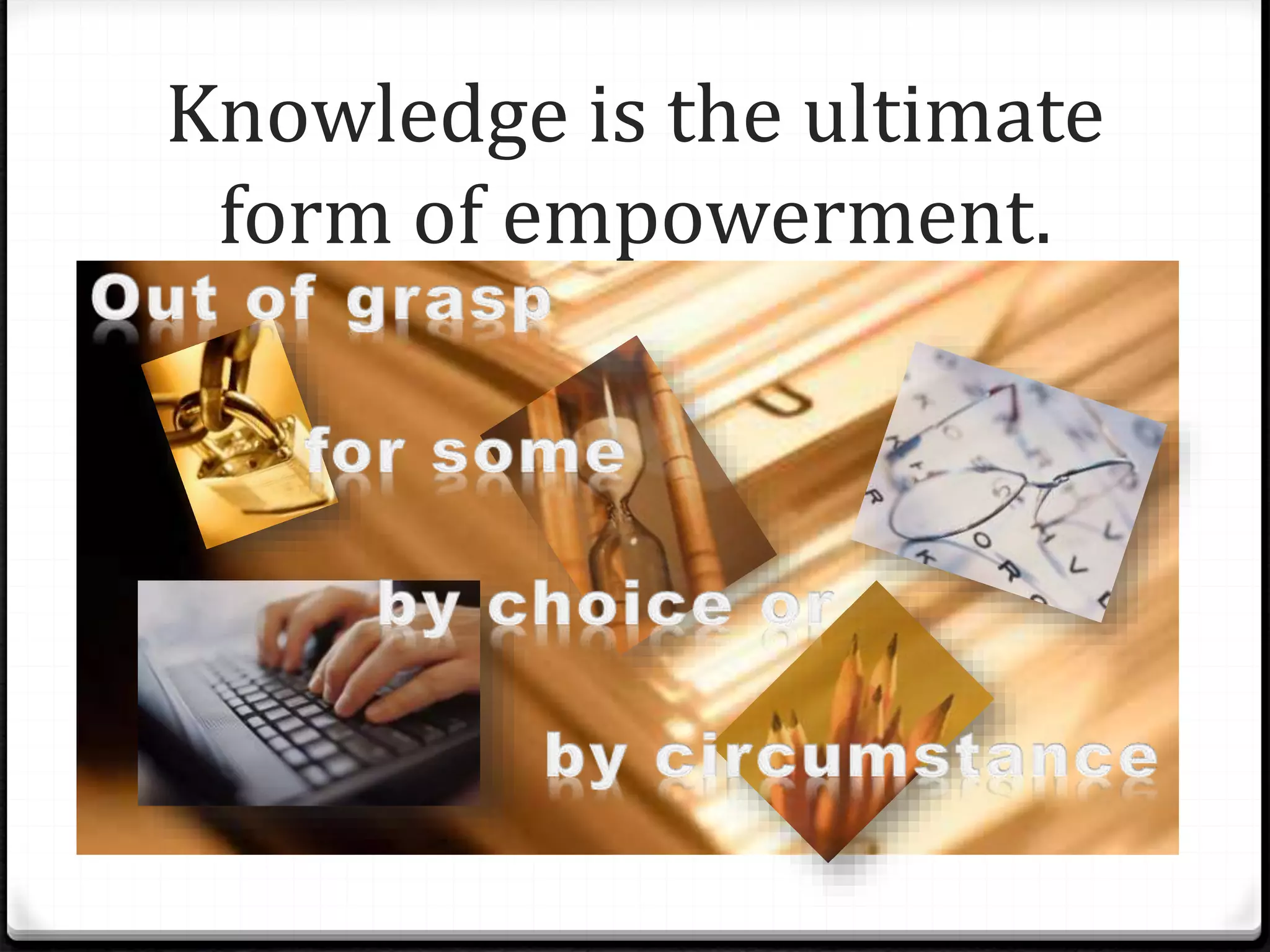
Knowledge is the ultimate
form of empowerment.
What would you do???
If someone who had never
touched a computer,
could neither read nor write.
had a WISH
~to learn basic computer skills~
Step One
Adopt a logical approach to the granting the
WISH
Spock- “Logic clearly dictates that the needs
of the many outweigh the needs of the few.”
Captain Kirk answers, “Or the one.”
Assume the best in all the individuals involved
in the planning.
Develop a common language for the success
of everyone involved
Ensure decisions are by consensus and fairly
reflect the consistencies necessary for
success
Step Two
Meet and plan…Repeat
Productivity is never an accident. It is always the result of
a commitment to
excellence, intelligent planning, and focused effort, ~
Paul J. Meyer
Continually restate the goal
Maintain a focus on the clients and
their needs
Create a calendar of events
Step Three
Cascade your Strategy
 Identify the
objectives for your
curriculum
Teach a little,
test a little
Never assume
anything about
the students
Step Four
Reflect
 Be prepared to revisit
the failures as well as the
successes
 Measure the depth of
success by the expressed
satisfaction of the learner
 Ask for input from all
the stakeholders
 Rebuild the curriculum
Step Four
Celebrate
 Celebrate the smallest increments of success
 Issue certificates for mastery and graduation
Expand the curriculum to
encompass new concepts and
skills
Communicate, communicate,
communicate!
The Story of
Erlinda’s Wish Program
Erlinda is a Housekeeper for the university. She spent her evenings
maintaining offices. For three weeks, she established a rapport with the
instructor, building her courage to ask a life changing question. She
watched as students attended Instructional Technology Classes in the
computer lab.
She gathered her courage and approached the instructor with a
request.
Would she teach her how to use the computer?
As a reluctant student in her youth, she shared her story of familial
responsibility and dropping out of school. She had never learned to read
and struggled to write.
She shared how she had learned to sort the janitorial supplies by
color and bottle shape as a method for ensuring she used the correct
tool for the job.
After the Instructor agreed to teach her basic computer
skills, Erlinda suggested the inclusion of all 125
Housekeepers.
Again, agreeing to provide classes for all the
Housekeepers brought with it a slew of logistical concerns
from obtaining department approvals to scheduling
manageable class sizes.
The curriculum was created under the assumption that
many had experience with a computer.
The objectives quickly changed when it was
discovered at the first class that using a mouse proved to
be a new experience. It took 2 semesters for many of the
Housekeepers to move beyond the computer log in
requirement.
Not because of the log in process but because of
their limited literacy skills.
Progress was slow but deliberate. The smallest
increment of mastery was cause for celebration.
The level of mastery increased incrementally of a 4
year period.
The confidence in problem solving skills, strength of
voice and confidence in self rose in relationship to mastery
of computer skills.
The journey continues. Classes have expanded to
include English as a Second Language (ESL). A
curriculum was purchased and books provided for for all
the Housekeepers.
Their interactions are driven by empowerment as well
as a need to succeed. They strive to be the resource for
someone else in the class.
With power comes responsibility and with responsibility
comes awareness.
The Wish program was born of one individual’s wish to
Improve not just her life but those of others.
Learning is an amazing process at any age. The privilege
of teaching and guiding students to success never ceases
to amaze.
The story of this journey will be shared in detail.

The Courage to Learn

  • 2.
    Knowledge is theultimate form of empowerment.
  • 3.
    What would youdo??? If someone who had never touched a computer, could neither read nor write. had a WISH ~to learn basic computer skills~
  • 5.
    Step One Adopt alogical approach to the granting the WISH Spock- “Logic clearly dictates that the needs of the many outweigh the needs of the few.” Captain Kirk answers, “Or the one.” Assume the best in all the individuals involved in the planning. Develop a common language for the success of everyone involved Ensure decisions are by consensus and fairly reflect the consistencies necessary for success
  • 6.
    Step Two Meet andplan…Repeat Productivity is never an accident. It is always the result of a commitment to excellence, intelligent planning, and focused effort, ~ Paul J. Meyer Continually restate the goal Maintain a focus on the clients and their needs Create a calendar of events
  • 7.
    Step Three Cascade yourStrategy  Identify the objectives for your curriculum Teach a little, test a little Never assume anything about the students
  • 8.
    Step Four Reflect  Beprepared to revisit the failures as well as the successes  Measure the depth of success by the expressed satisfaction of the learner  Ask for input from all the stakeholders  Rebuild the curriculum
  • 9.
    Step Four Celebrate  Celebratethe smallest increments of success  Issue certificates for mastery and graduation Expand the curriculum to encompass new concepts and skills Communicate, communicate, communicate!
  • 10.
    The Story of Erlinda’sWish Program Erlinda is a Housekeeper for the university. She spent her evenings maintaining offices. For three weeks, she established a rapport with the instructor, building her courage to ask a life changing question. She watched as students attended Instructional Technology Classes in the computer lab. She gathered her courage and approached the instructor with a request. Would she teach her how to use the computer? As a reluctant student in her youth, she shared her story of familial responsibility and dropping out of school. She had never learned to read and struggled to write. She shared how she had learned to sort the janitorial supplies by color and bottle shape as a method for ensuring she used the correct tool for the job.
  • 11.
    After the Instructoragreed to teach her basic computer skills, Erlinda suggested the inclusion of all 125 Housekeepers. Again, agreeing to provide classes for all the Housekeepers brought with it a slew of logistical concerns from obtaining department approvals to scheduling manageable class sizes. The curriculum was created under the assumption that many had experience with a computer. The objectives quickly changed when it was discovered at the first class that using a mouse proved to be a new experience. It took 2 semesters for many of the Housekeepers to move beyond the computer log in requirement. Not because of the log in process but because of their limited literacy skills.
  • 12.
    Progress was slowbut deliberate. The smallest increment of mastery was cause for celebration. The level of mastery increased incrementally of a 4 year period. The confidence in problem solving skills, strength of voice and confidence in self rose in relationship to mastery of computer skills. The journey continues. Classes have expanded to include English as a Second Language (ESL). A curriculum was purchased and books provided for for all the Housekeepers. Their interactions are driven by empowerment as well as a need to succeed. They strive to be the resource for someone else in the class.
  • 13.
    With power comesresponsibility and with responsibility comes awareness. The Wish program was born of one individual’s wish to Improve not just her life but those of others. Learning is an amazing process at any age. The privilege of teaching and guiding students to success never ceases to amaze. The story of this journey will be shared in detail.