Rebecca Ferguson, Mark Childs, Ale Okada, Kieron Sheehy,
Mimi Tatlow-Golden, Anna Childs –The Rumpus Group
Creating a Framework
of Fun and Learning:
Using Balloons
To Build Consensus
ECGBL 2020
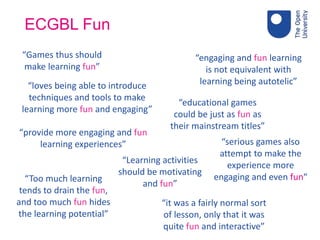
ECGBL Fun
“Games thus should
make learning fun”
“loves being able to introduce
techniques and tools to make
learning more fun and engaging”
“provide more engaging and fun
learning experiences”
“Too much learning
tends to drain the fun,
and too much fun hides
the learning potential”
“engaging and fun learning
is not equivalent with
learning being autotelic”
“educational games
could be just as fun as
their mainstream titles”
“serious games also
attempt to make the
experience more
engaging and even fun“
“Learning activities
should be motivating
and fun”
“it was a fairly normal sort
of lesson, only that it was
quite fun and interactive”
H
Reflection moment
Name one thing that
is definitely fun.
If you can, Tweet
your answer.
#ECGBL20
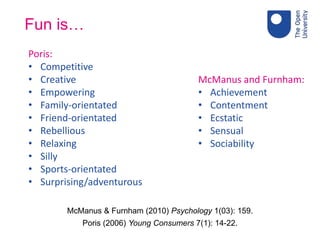
Fun is…
Poris:
• Competitive
• Creative
• Empowering
• Family-orientated
• Friend-orientated
• Rebellious
• Relaxing
• Silly
• Sports-orientated
• Surprising/adventurous
McManus & Furnham (2010) Psychology 1(03): 159.
Poris (2006) Young Consumers 7(1): 14-22.
McManus and Furnham:
• Achievement
• Contentment
• Ecstatic
• Sensual
• Sociability
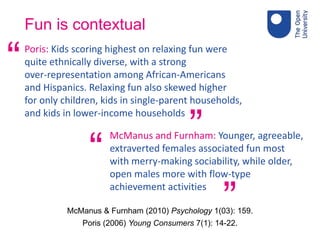
Fun is contextual
Poris: Kids scoring highest on relaxing fun were
quite ethnically diverse, with a strong
over-representation among African-Americans
and Hispanics. Relaxing fun also skewed higher
for only children, kids in single-parent households,
and kids in lower-income households
“
”McManus and Furnham: Younger, agreeable,
extraverted females associated fun most
with merry-making sociability, while older,
open males more with flow-type
achievement activities
McManus & Furnham (2010) Psychology 1(03): 159.
Poris (2006) Young Consumers 7(1): 14-22.
“
”
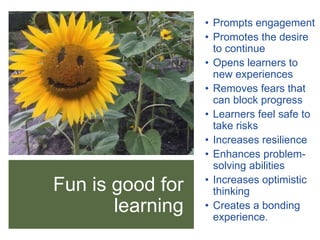
Fun is good for
learning
• Prompts learners to
engage
• Promotes the desire
to continue
• Opens learners to
new experiences
• Removes fears that
can block progress
• Learners feel safe to
take risks
• Increases emotional
and physical resilience
• Enhances problem-
solving abilities
• Increases optimistic
thinking
• Creates a bonding
experience.
• Prompts engagement
• Promotes the desire
to continue
• Opens learners to
new experiences
• Removes fears that
can block progress
• Learners feel safe to
take risks
• Increases resilience
• Enhances problem-
solving abilities
• Increases optimistic
thinking
• Creates a bonding
experience.
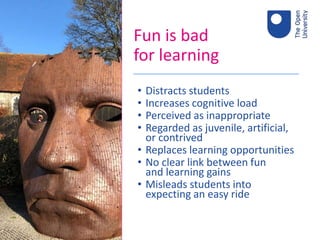
Fun is bad
for learning
• Distracts students
• Increases cognitive load
• Perceived as inappropriate
• Regarded as juvenile, artificial,
or contrived
• Replaces learning opportunities
• No clear link between fun
and learning gains
• Misleads students into
expecting an easy ride
Research questions
• What elements of fun do a group of educational
practitioners identify within a Consensus Workshop?
• How do these participants see these elements translating
to a learning scenario?
• Can a Consensus Workshop be used to collaboratively
create a taxonomy of fun?
• What practical and conceptual issues present barriers to
this being conducted effectively?
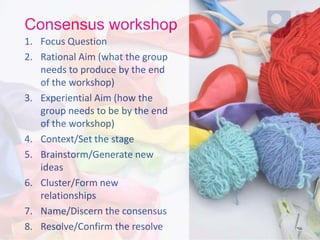
Consensus workshop
1. Focus Question
2. Rational Aim (what the group
needs to produce by the end
of the workshop)
3. Experiential Aim (how the
group needs to be by the end
of the workshop)
4. Context/Set the stage
5. Brainstorm/Generate new
ideas
6. Cluster/Form new
relationships
7. Name/Discern the consensus
8. Resolve/Confirm the resolve
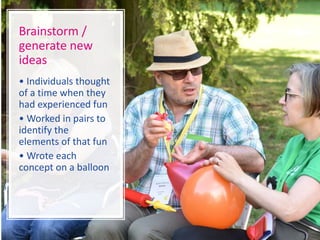
Brainstorm /
generate new
ideas
• Individuals thought
of a time when they
had experienced fun
• Worked in pairs to
identify the
elements of that fun
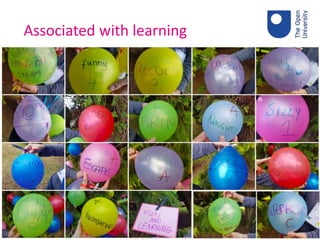
• Wrote each
concept on a balloon
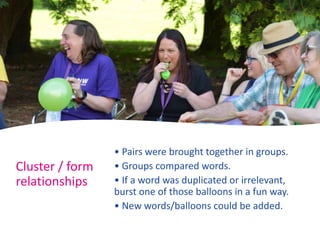
Cluster / form
relationships
• Pairs were brought together in groups.
• Groups compared words.
• If a word was duplicated or irrelevant,
burst one of those balloons in a fun way.
• New words/balloons could be added.
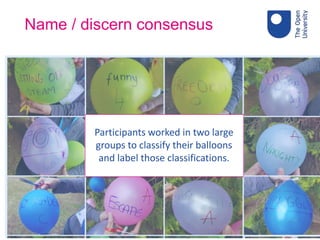
Name / discern consensus
Participants worked in two large
groups to classify their balloons
and label those classifications.
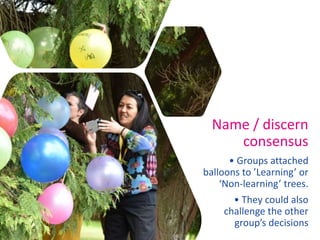
Name / discern
consensus
• Groups attached
balloons to ’Learning’ or
‘Non-learning’ trees.
• They could also
challenge the other
group’s decisions
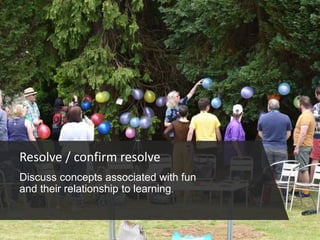
Resolve / confirm resolve
Discuss concepts associated with fun
and their relationship to learning.
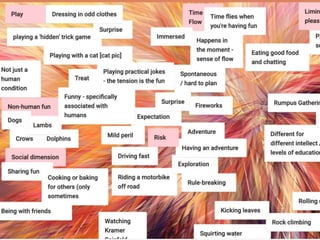
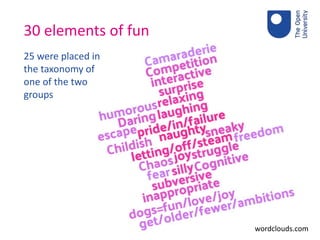
30 elements of fun
25 were placed in
the taxonomy of
one of the two
groups
wordclouds.com
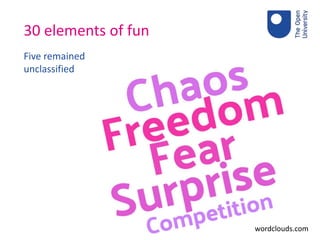
30 elements of fun
Five remained
unclassified
wordclouds.com
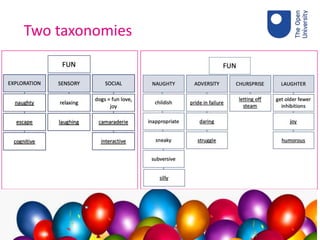
Two taxonomies
Associated with learning
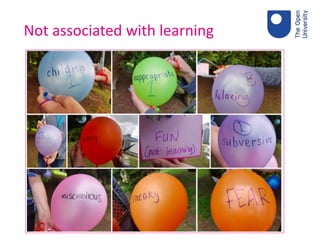
Not associated with learning
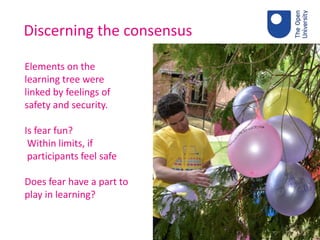
Discerning the consensus
Elements on the
learning tree were
linked by feelings of
safety and security.
Is fear fun?
Within limits, if
participants feel safe
Does fear have a part to
play in learning?
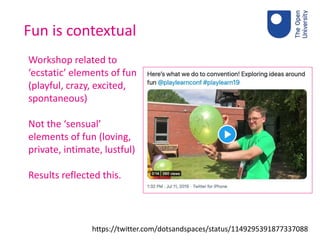
Fun is contextual
https://twitter.com/dotsandspaces/status/1149295391877337088
Workshop related to
‘ecstatic’ elements of fun
(playful, crazy, excited,
spontaneous)
Not the ‘sensual’
elements of fun (loving,
private, intimate, lustful)
Results reflected this.
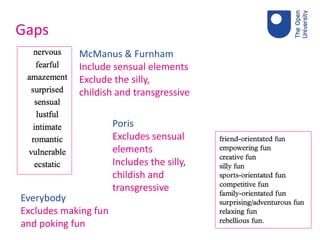
Gaps
McManus & Furnham
Include sensual elements
Exclude the silly,
childish and transgressive
Poris
Excludes sensual
elements
Includes the silly,
childish and
transgressive
Everybody
Excludes making fun
and poking fun
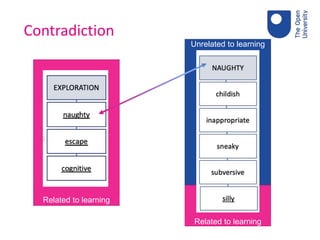
Contradiction
Related to learning
Related to learning
Unrelated to learning
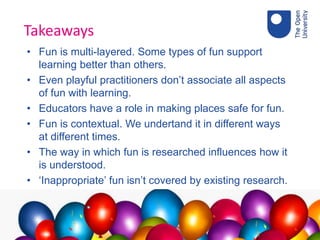
Takeaways
• Fun is multi-layered. Some types of fun support
learning better than others.
• Even playful practitioners don’t associate all aspects
of fun with learning.
• Educators have a role in making places safe for fun.
• Fun is contextual. We undertand it in different ways
at different times.
• The way in which fun is researched influences how it
is understood.
• ‘Inappropriate’ fun isn’t covered by existing research.
wels.open.ac.uk/rumpus
www.slideshare.net/R3beccaF

Fun and learning

  • 1.
    Rebecca Ferguson, MarkChilds, Ale Okada, Kieron Sheehy, Mimi Tatlow-Golden, Anna Childs –The Rumpus Group Creating a Framework of Fun and Learning: Using Balloons To Build Consensus ECGBL 2020
  • 3.
    ECGBL Fun “Games thusshould make learning fun” “loves being able to introduce techniques and tools to make learning more fun and engaging” “provide more engaging and fun learning experiences” “Too much learning tends to drain the fun, and too much fun hides the learning potential” “engaging and fun learning is not equivalent with learning being autotelic” “educational games could be just as fun as their mainstream titles” “serious games also attempt to make the experience more engaging and even fun“ “Learning activities should be motivating and fun” “it was a fairly normal sort of lesson, only that it was quite fun and interactive”
  • 4.
    H Reflection moment Name onething that is definitely fun. If you can, Tweet your answer. #ECGBL20
  • 6.
    Fun is… Poris: • Competitive •Creative • Empowering • Family-orientated • Friend-orientated • Rebellious • Relaxing • Silly • Sports-orientated • Surprising/adventurous McManus & Furnham (2010) Psychology 1(03): 159. Poris (2006) Young Consumers 7(1): 14-22. McManus and Furnham: • Achievement • Contentment • Ecstatic • Sensual • Sociability
  • 7.
    Fun is contextual Poris:Kids scoring highest on relaxing fun were quite ethnically diverse, with a strong over-representation among African-Americans and Hispanics. Relaxing fun also skewed higher for only children, kids in single-parent households, and kids in lower-income households “ ”McManus and Furnham: Younger, agreeable, extraverted females associated fun most with merry-making sociability, while older, open males more with flow-type achievement activities McManus & Furnham (2010) Psychology 1(03): 159. Poris (2006) Young Consumers 7(1): 14-22. “ ”
  • 8.
    Fun is goodfor learning • Prompts learners to engage • Promotes the desire to continue • Opens learners to new experiences • Removes fears that can block progress • Learners feel safe to take risks • Increases emotional and physical resilience • Enhances problem- solving abilities • Increases optimistic thinking • Creates a bonding experience. • Prompts engagement • Promotes the desire to continue • Opens learners to new experiences • Removes fears that can block progress • Learners feel safe to take risks • Increases resilience • Enhances problem- solving abilities • Increases optimistic thinking • Creates a bonding experience.
  • 9.
    Fun is bad forlearning • Distracts students • Increases cognitive load • Perceived as inappropriate • Regarded as juvenile, artificial, or contrived • Replaces learning opportunities • No clear link between fun and learning gains • Misleads students into expecting an easy ride
  • 10.
    Research questions • Whatelements of fun do a group of educational practitioners identify within a Consensus Workshop? • How do these participants see these elements translating to a learning scenario? • Can a Consensus Workshop be used to collaboratively create a taxonomy of fun? • What practical and conceptual issues present barriers to this being conducted effectively?
  • 11.
    Consensus workshop 1. FocusQuestion 2. Rational Aim (what the group needs to produce by the end of the workshop) 3. Experiential Aim (how the group needs to be by the end of the workshop) 4. Context/Set the stage 5. Brainstorm/Generate new ideas 6. Cluster/Form new relationships 7. Name/Discern the consensus 8. Resolve/Confirm the resolve
  • 12.
    Brainstorm / generate new ideas •Individuals thought of a time when they had experienced fun • Worked in pairs to identify the elements of that fun • Wrote each concept on a balloon
  • 13.
    Cluster / form relationships •Pairs were brought together in groups. • Groups compared words. • If a word was duplicated or irrelevant, burst one of those balloons in a fun way. • New words/balloons could be added.
  • 14.
    Name / discernconsensus Participants worked in two large groups to classify their balloons and label those classifications.
  • 15.
    Name / discern consensus •Groups attached balloons to ’Learning’ or ‘Non-learning’ trees. • They could also challenge the other group’s decisions
  • 16.
    Resolve / confirmresolve Discuss concepts associated with fun and their relationship to learning.
  • 17.
    30 elements offun 25 were placed in the taxonomy of one of the two groups wordclouds.com
  • 18.
    30 elements offun Five remained unclassified wordclouds.com
  • 19.
  • 20.
  • 21.
  • 22.
    Discerning the consensus Elementson the learning tree were linked by feelings of safety and security. Is fear fun? Within limits, if participants feel safe Does fear have a part to play in learning?
  • 23.
    Fun is contextual https://twitter.com/dotsandspaces/status/1149295391877337088 Workshoprelated to ‘ecstatic’ elements of fun (playful, crazy, excited, spontaneous) Not the ‘sensual’ elements of fun (loving, private, intimate, lustful) Results reflected this.
  • 24.
    Gaps McManus & Furnham Includesensual elements Exclude the silly, childish and transgressive Poris Excludes sensual elements Includes the silly, childish and transgressive Everybody Excludes making fun and poking fun
  • 25.
    Contradiction Related to learning Relatedto learning Unrelated to learning
  • 26.
    Takeaways • Fun ismulti-layered. Some types of fun support learning better than others. • Even playful practitioners don’t associate all aspects of fun with learning. • Educators have a role in making places safe for fun. • Fun is contextual. We undertand it in different ways at different times. • The way in which fun is researched influences how it is understood. • ‘Inappropriate’ fun isn’t covered by existing research.
  • 27.