A High Relevancy
Education Program
that brings RESULTS!
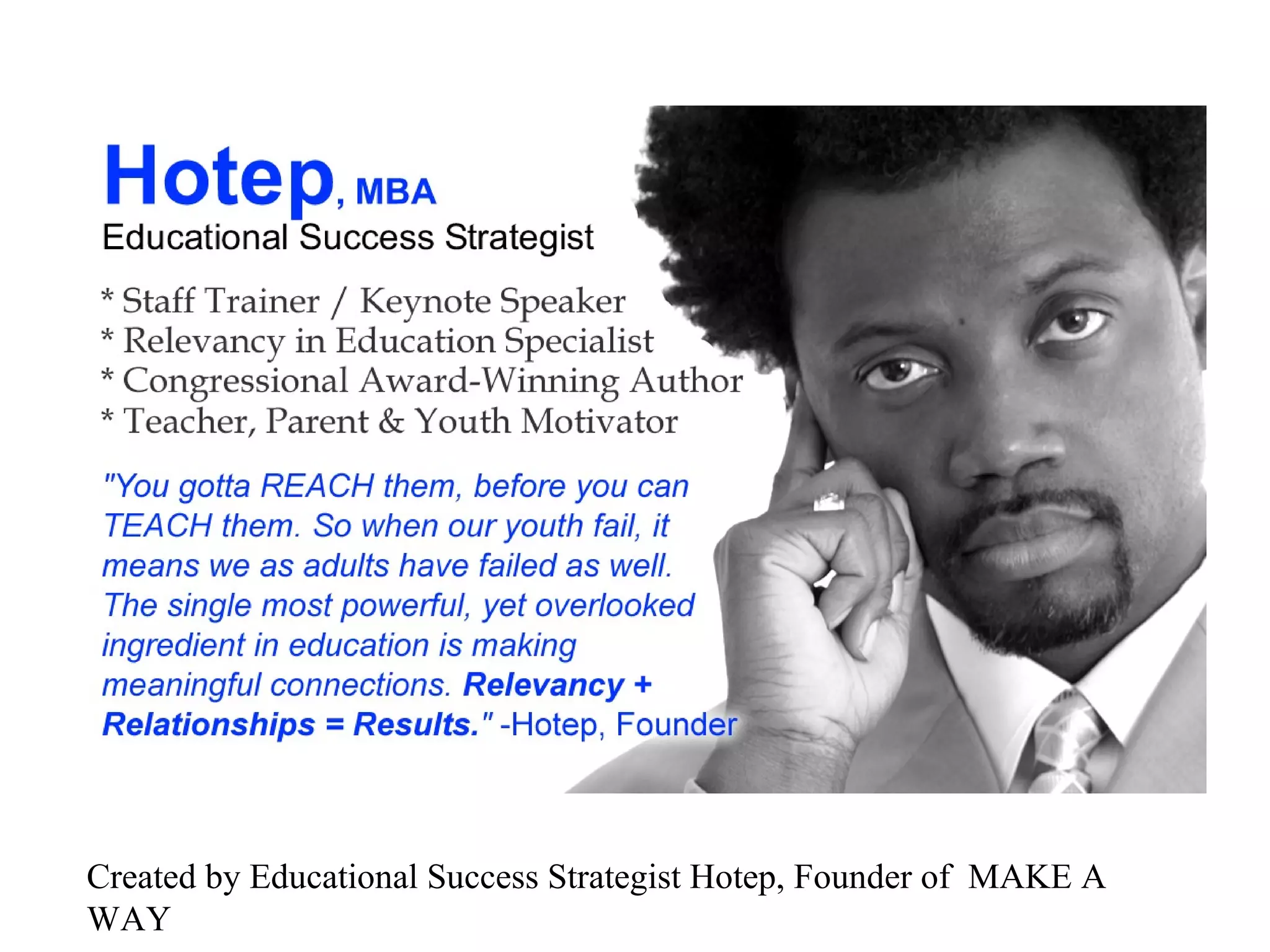
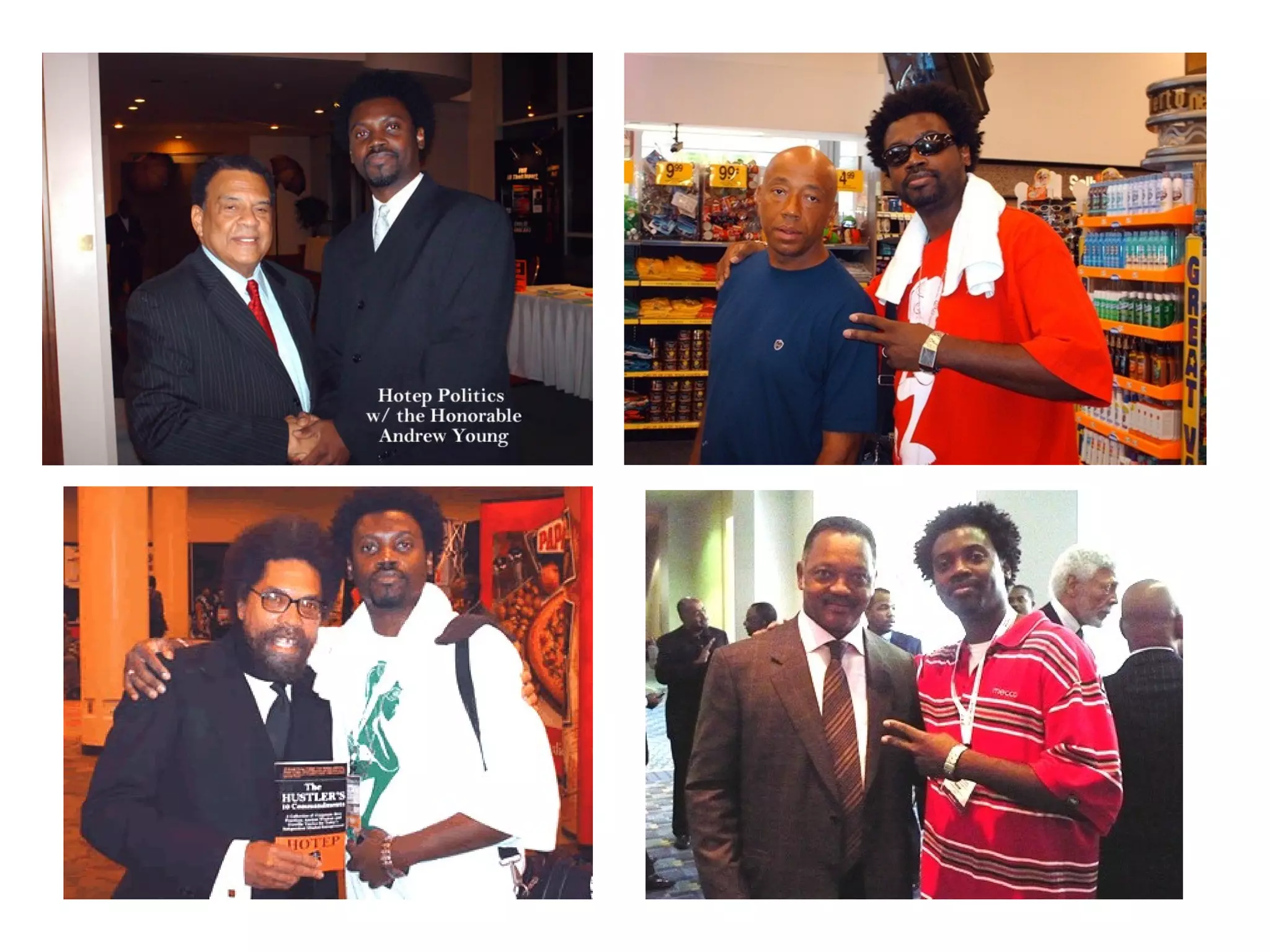
Created by Educational Success Strategist Hotep, Founder of MAKE A
WAY
MAKE A WAY is a high relevancy educational
program that targets at-risk and underserved
populations of youth and adults to transform the
climate and culture of poverty, excuse making
and helplessness into one of empowerment,
resiliency and success!
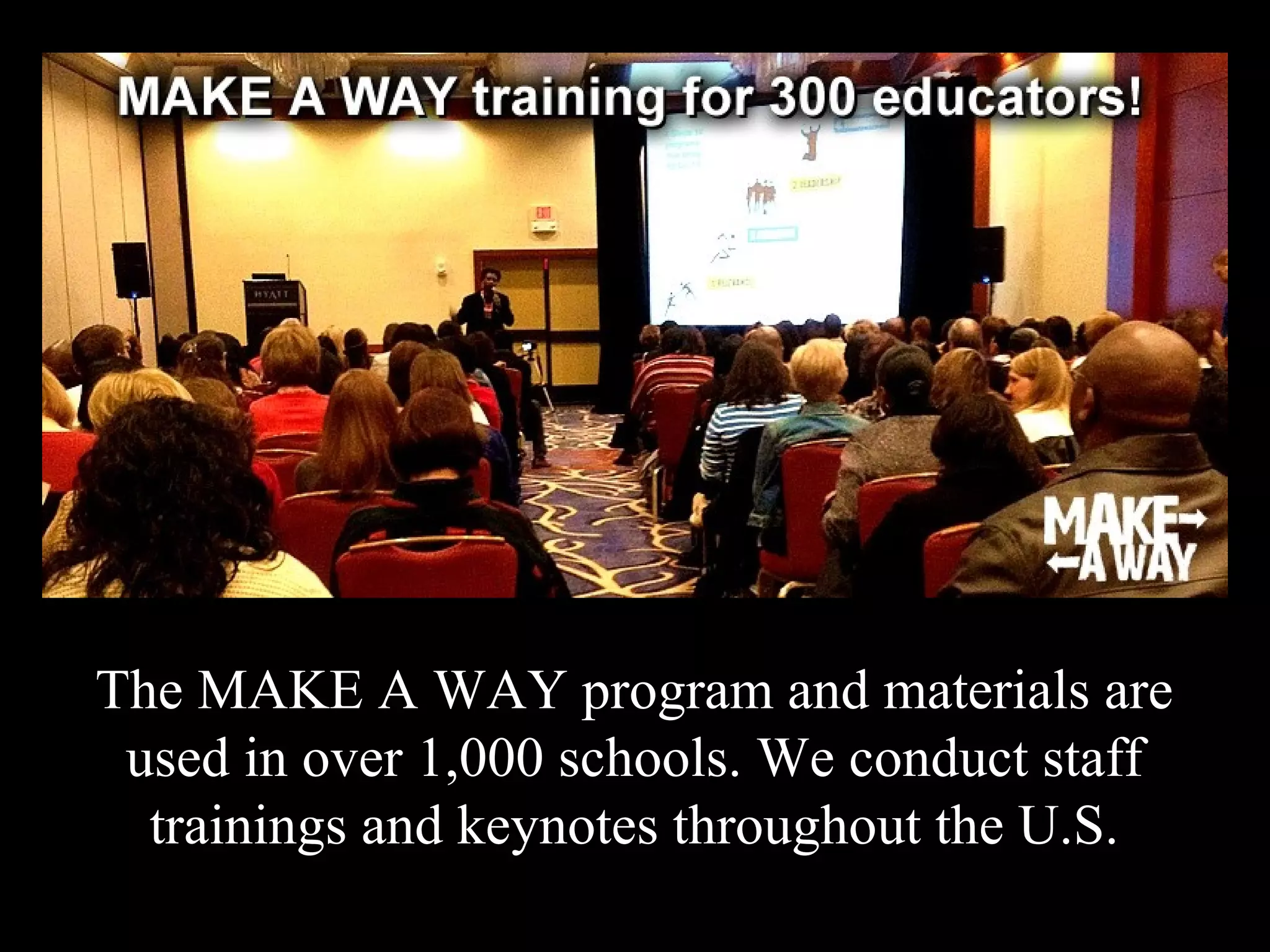
The MAKE A WAY program and materials are
used in over 1,000 schools. We conduct staff
trainings and keynotes throughout the U.S.
How was
MAKE A WAY
started?
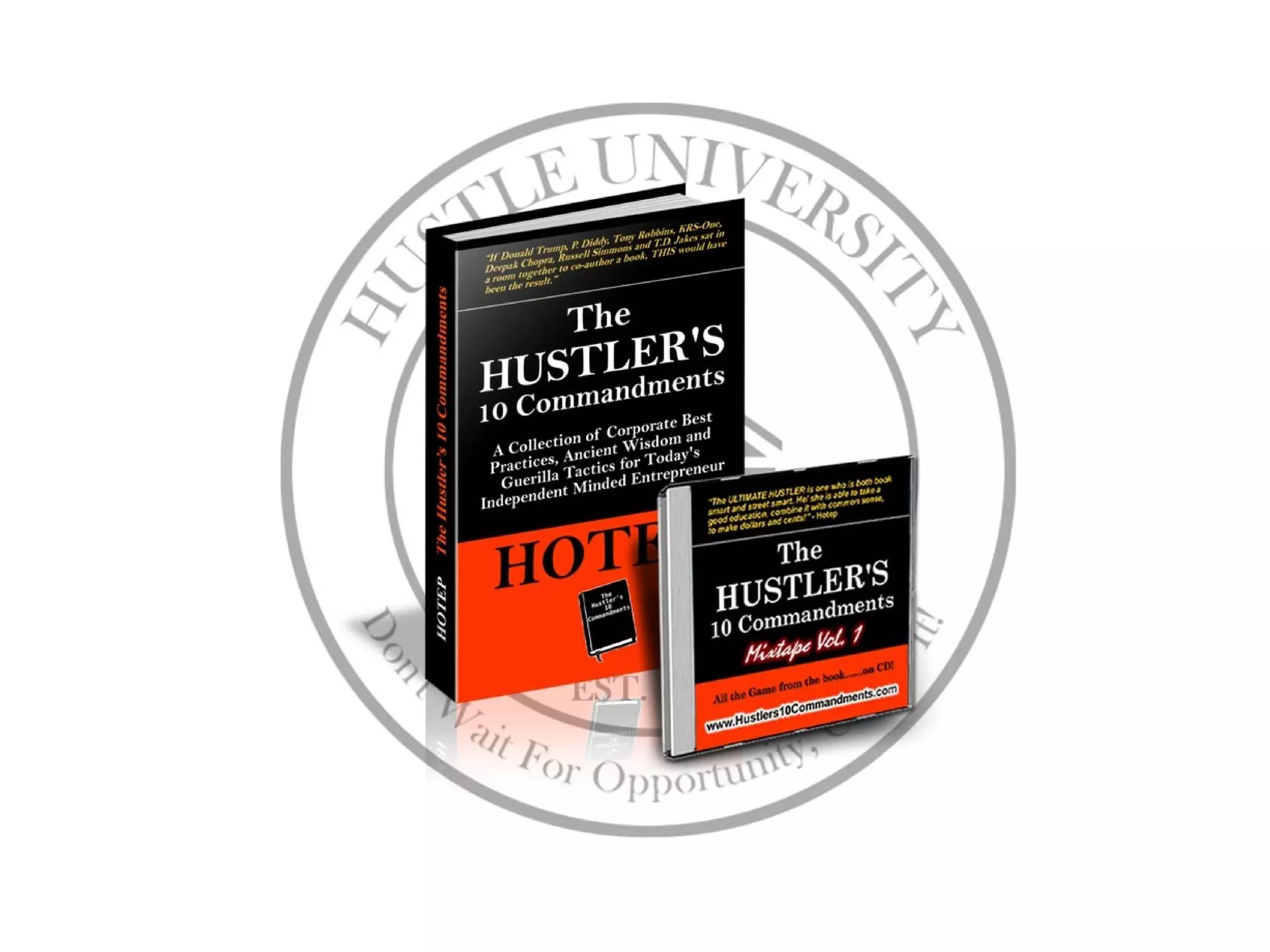
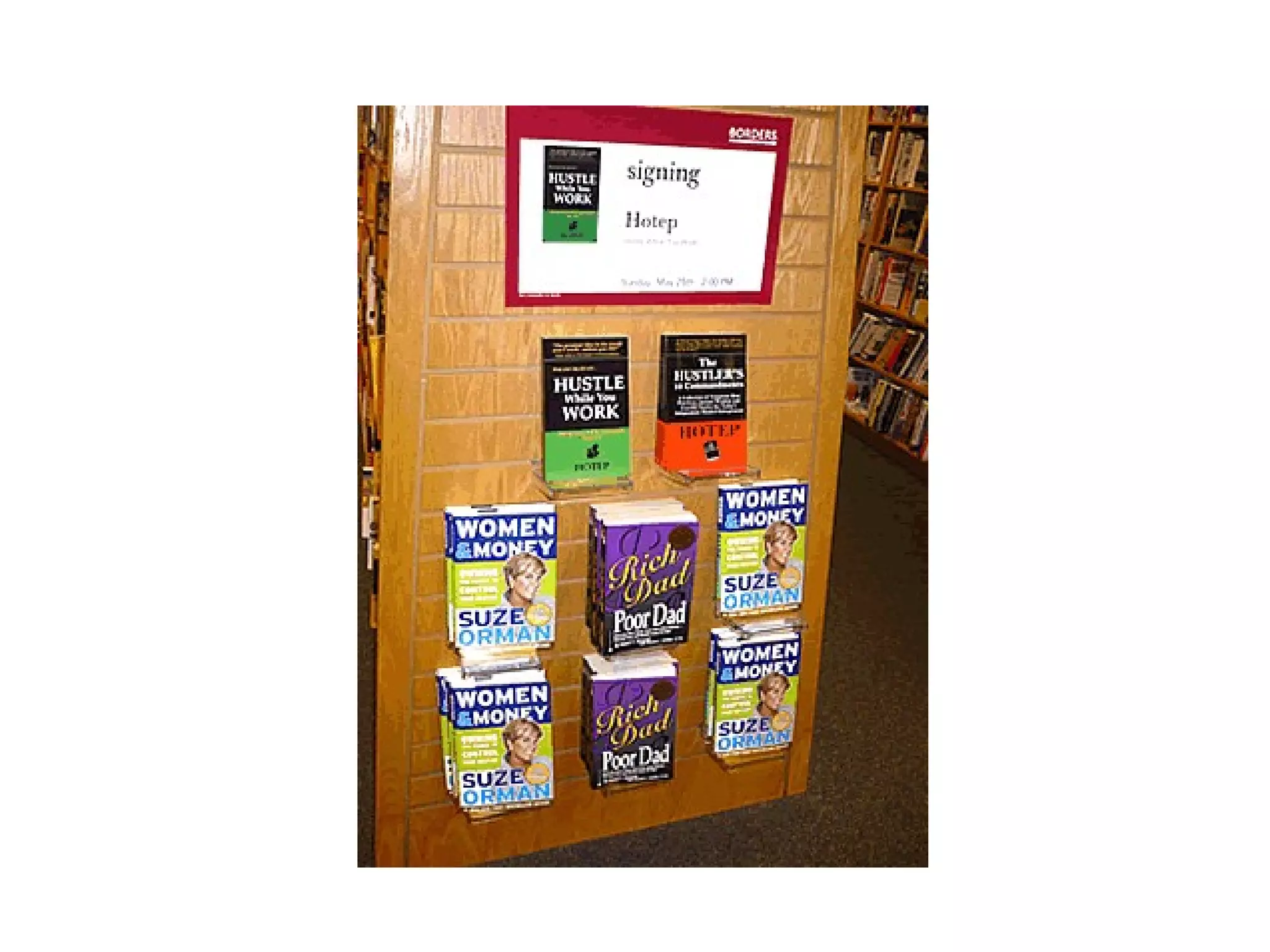
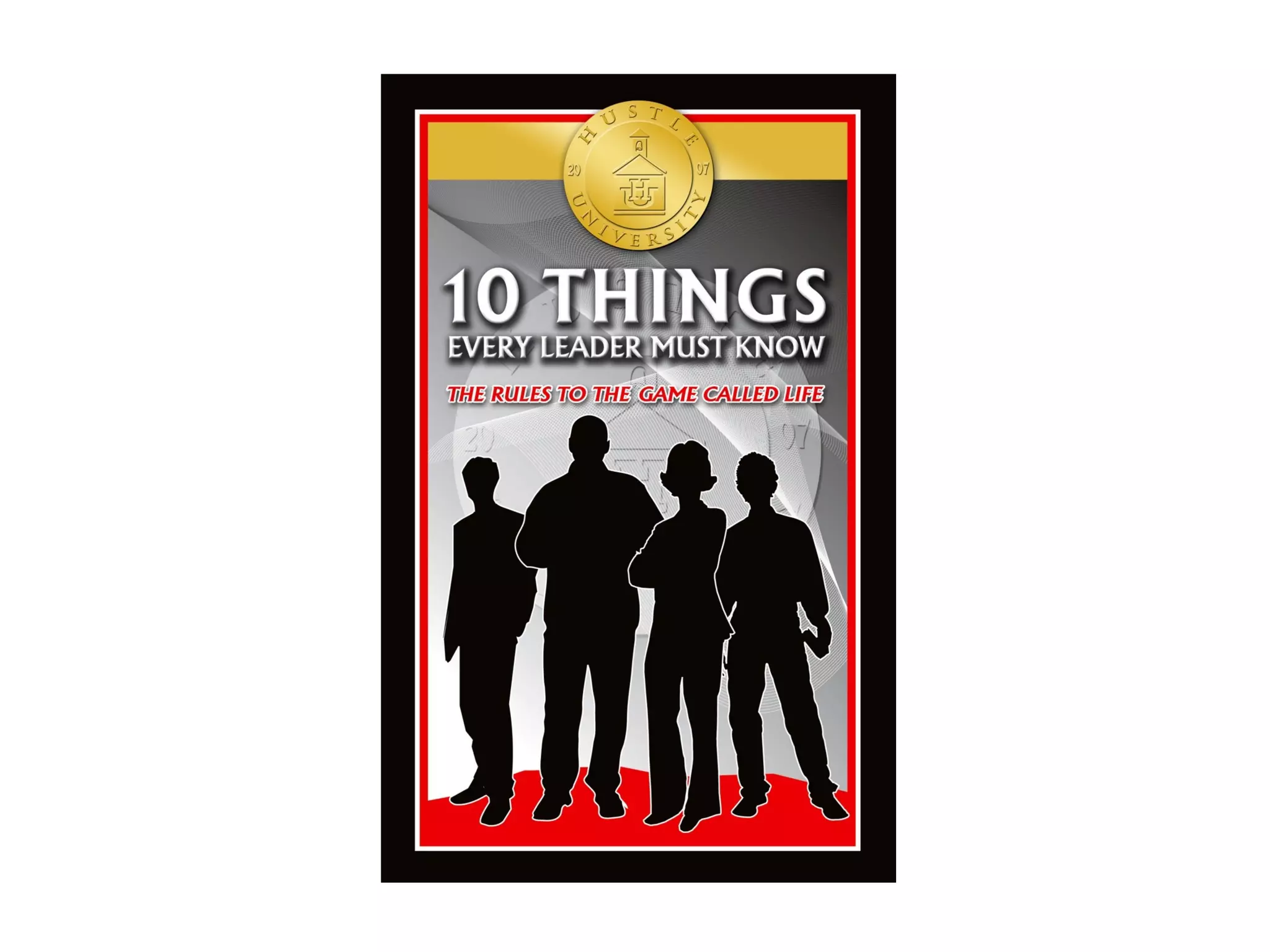
The Hustler’s 10 Commandments
has been compared to:
Think and Grow Rich
The Art of War
Rich Dad, Poor Dad
7 Habits of Highly Effective People
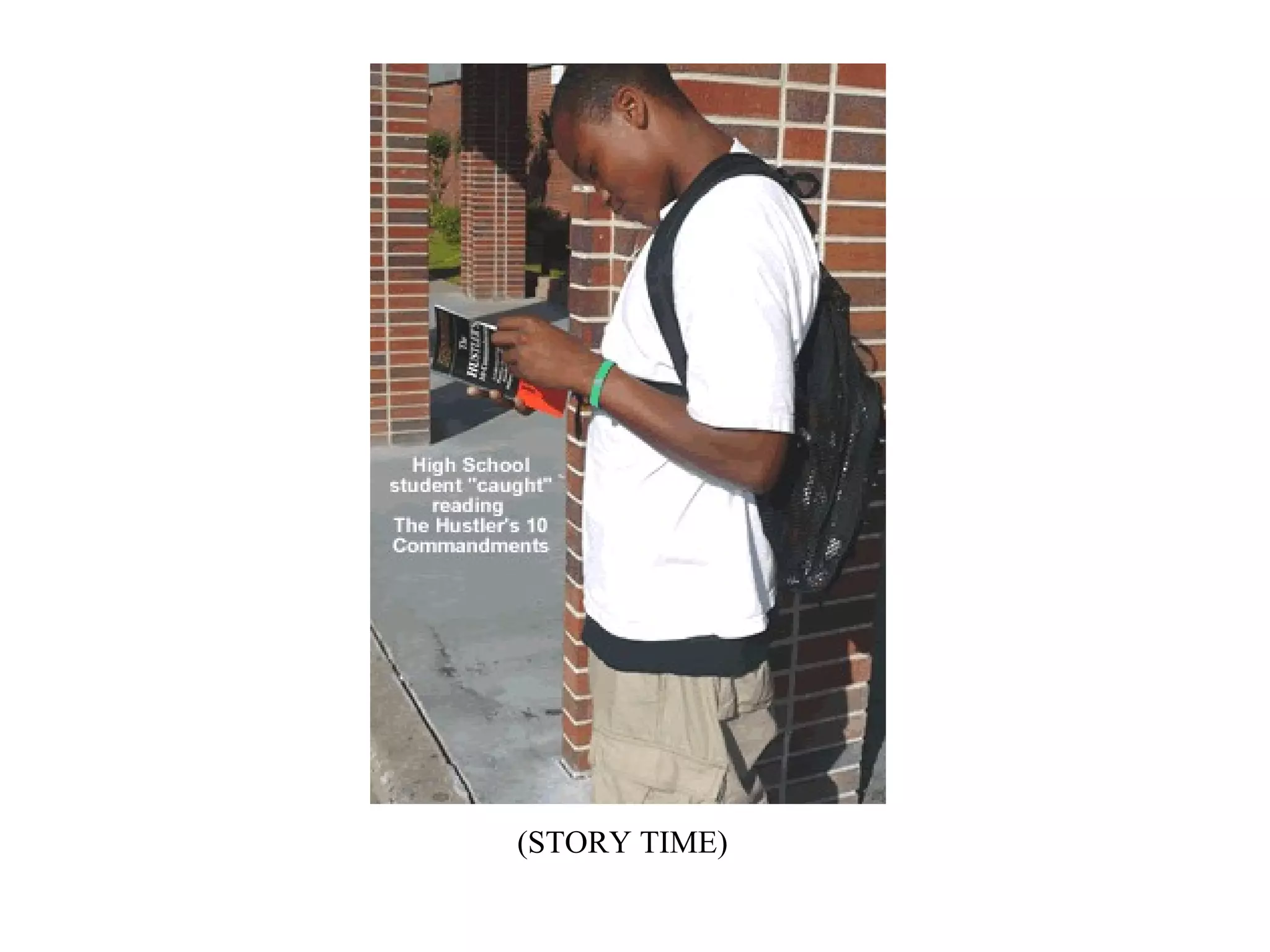
(STORY TIME)
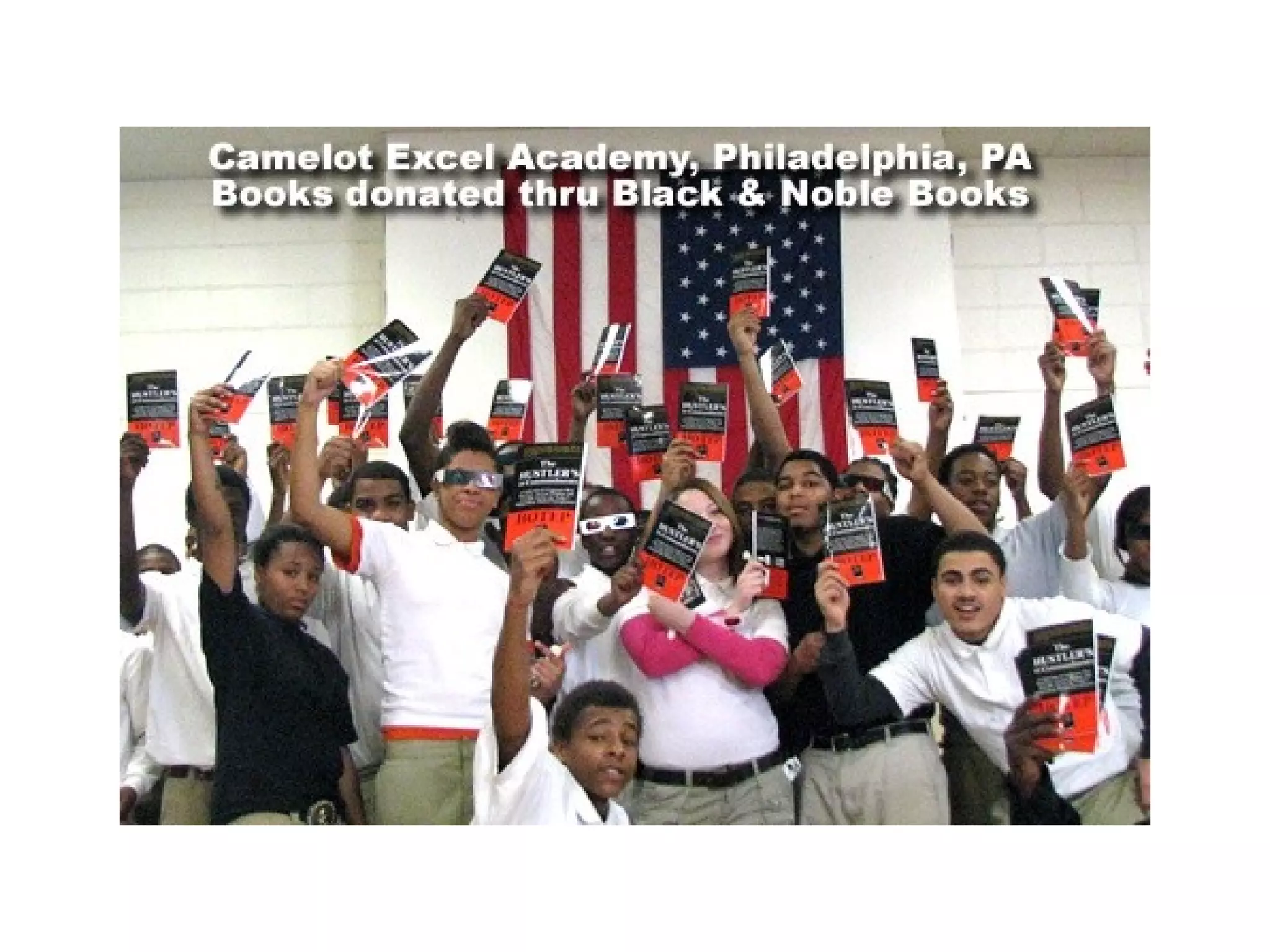
And then the teachers
started catching on…
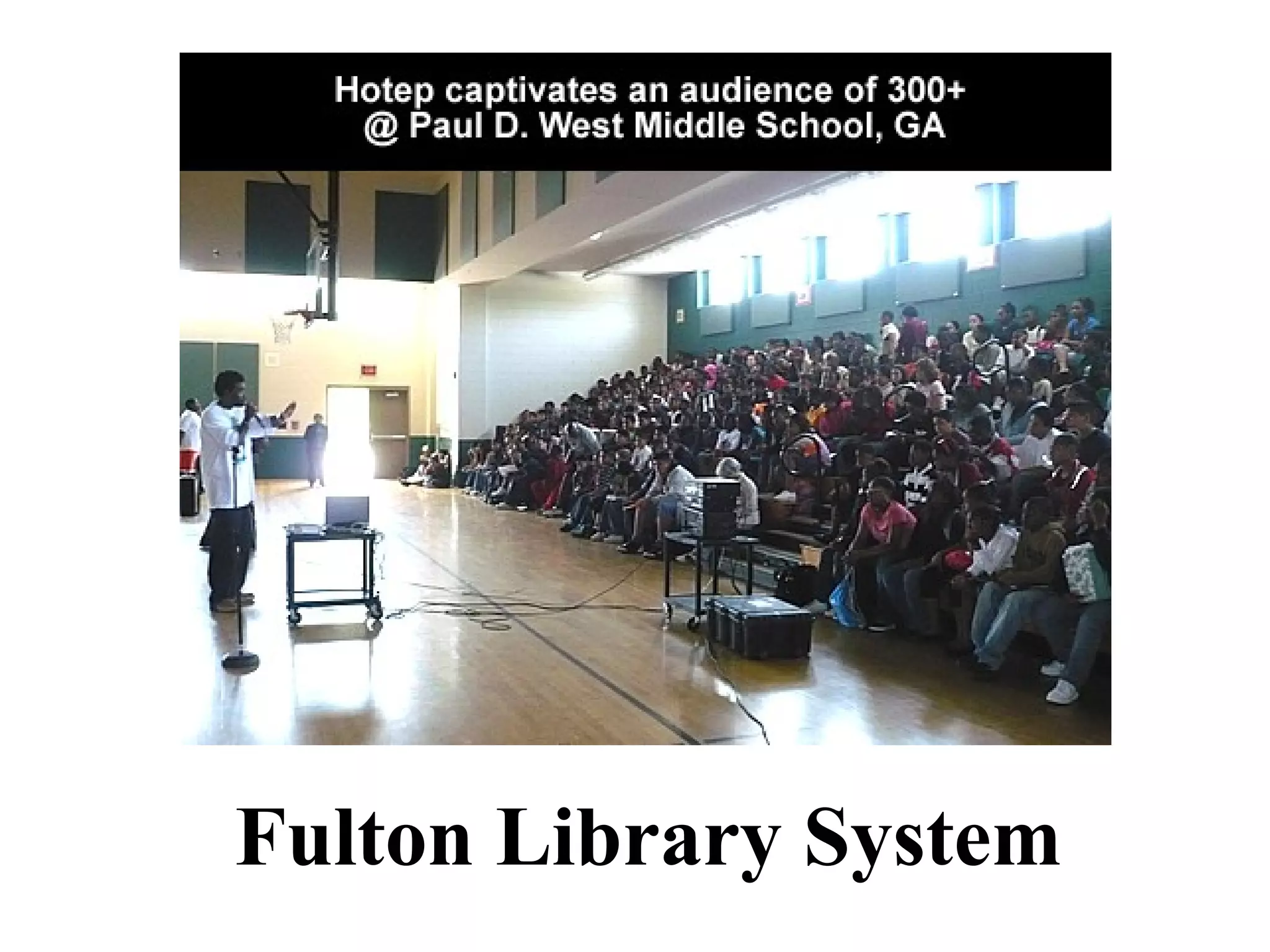
Fulton Library System
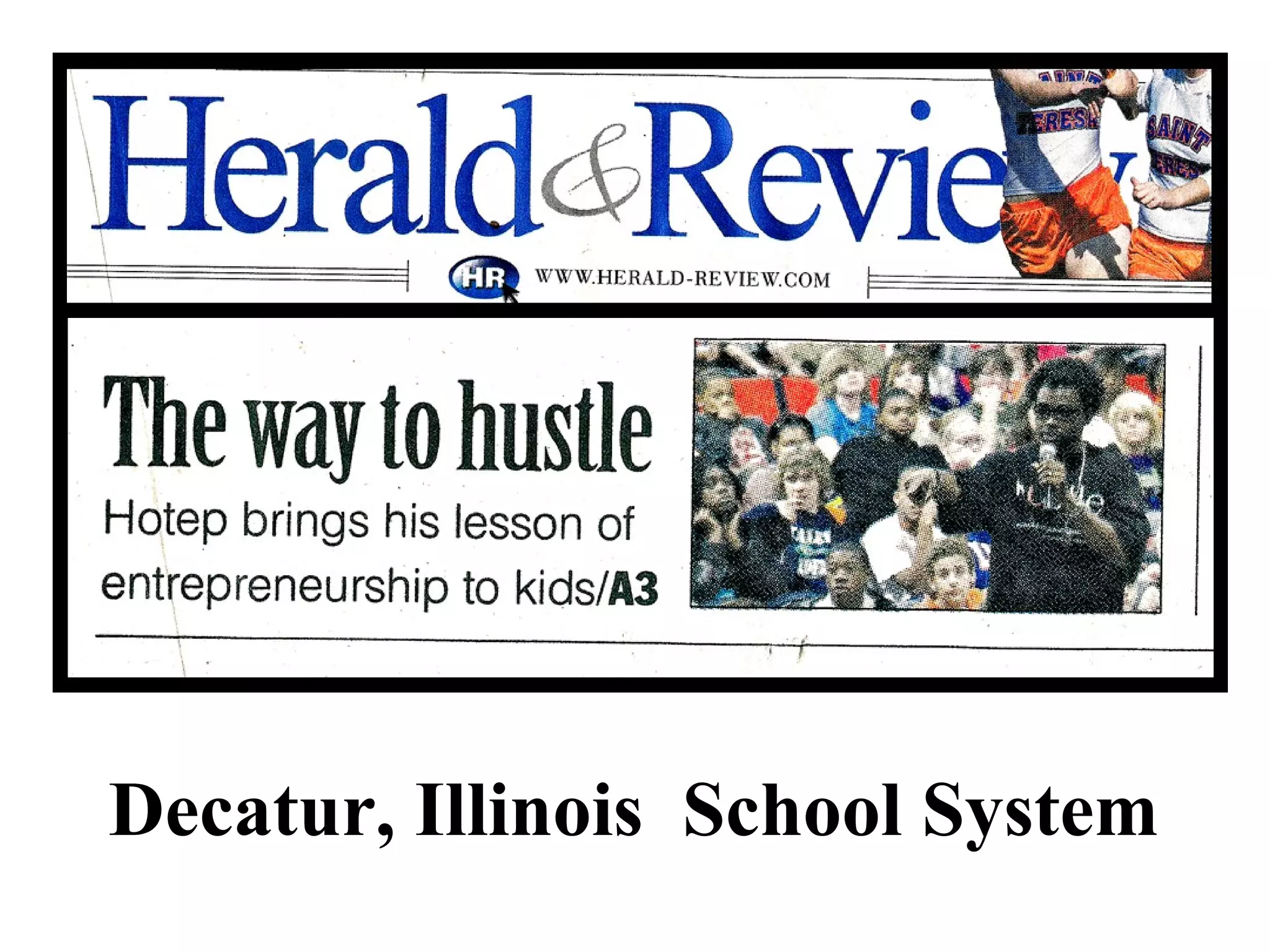
Decatur, Illinois School System
And that’s when he realized
why the book was successful…
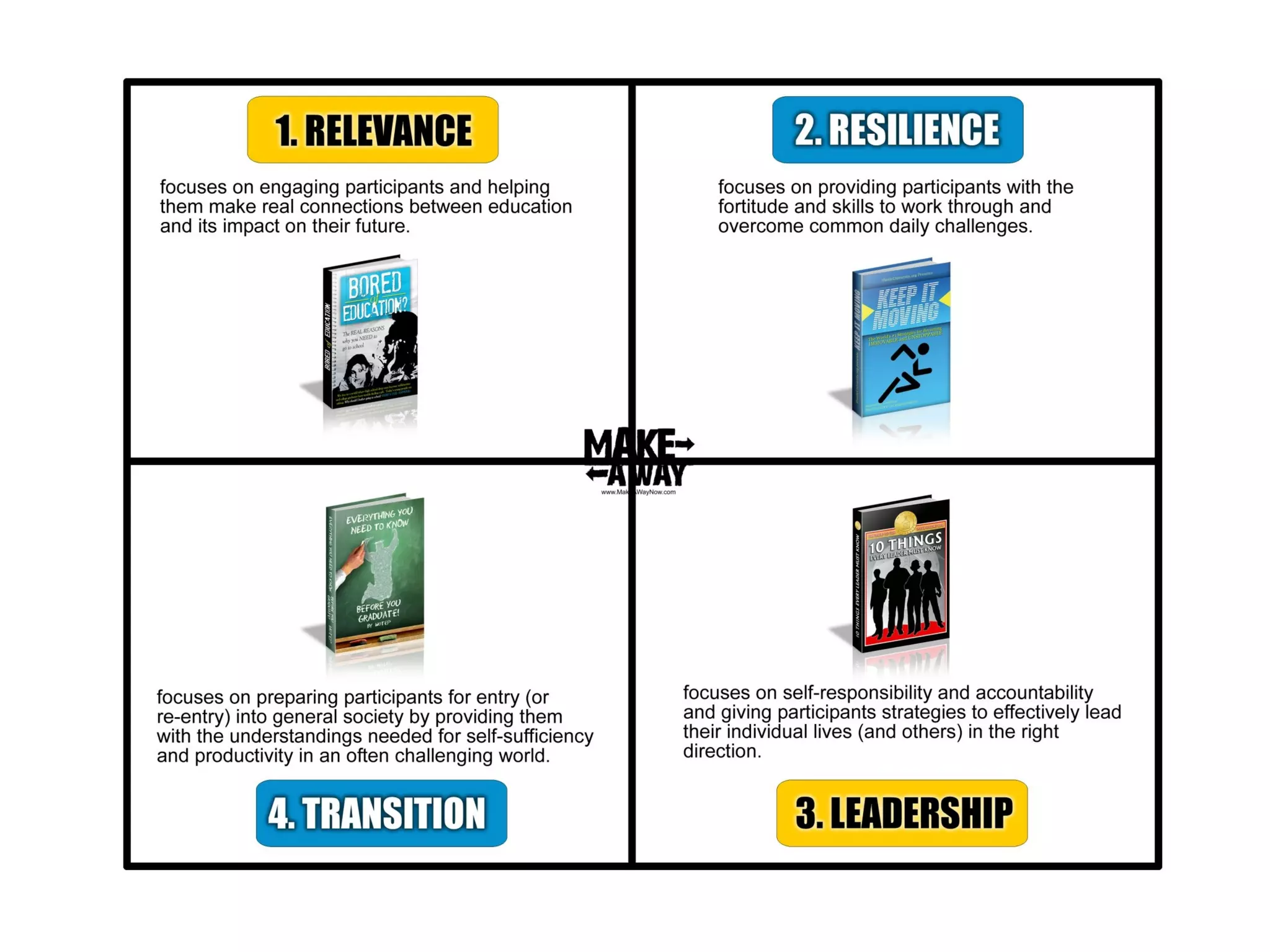
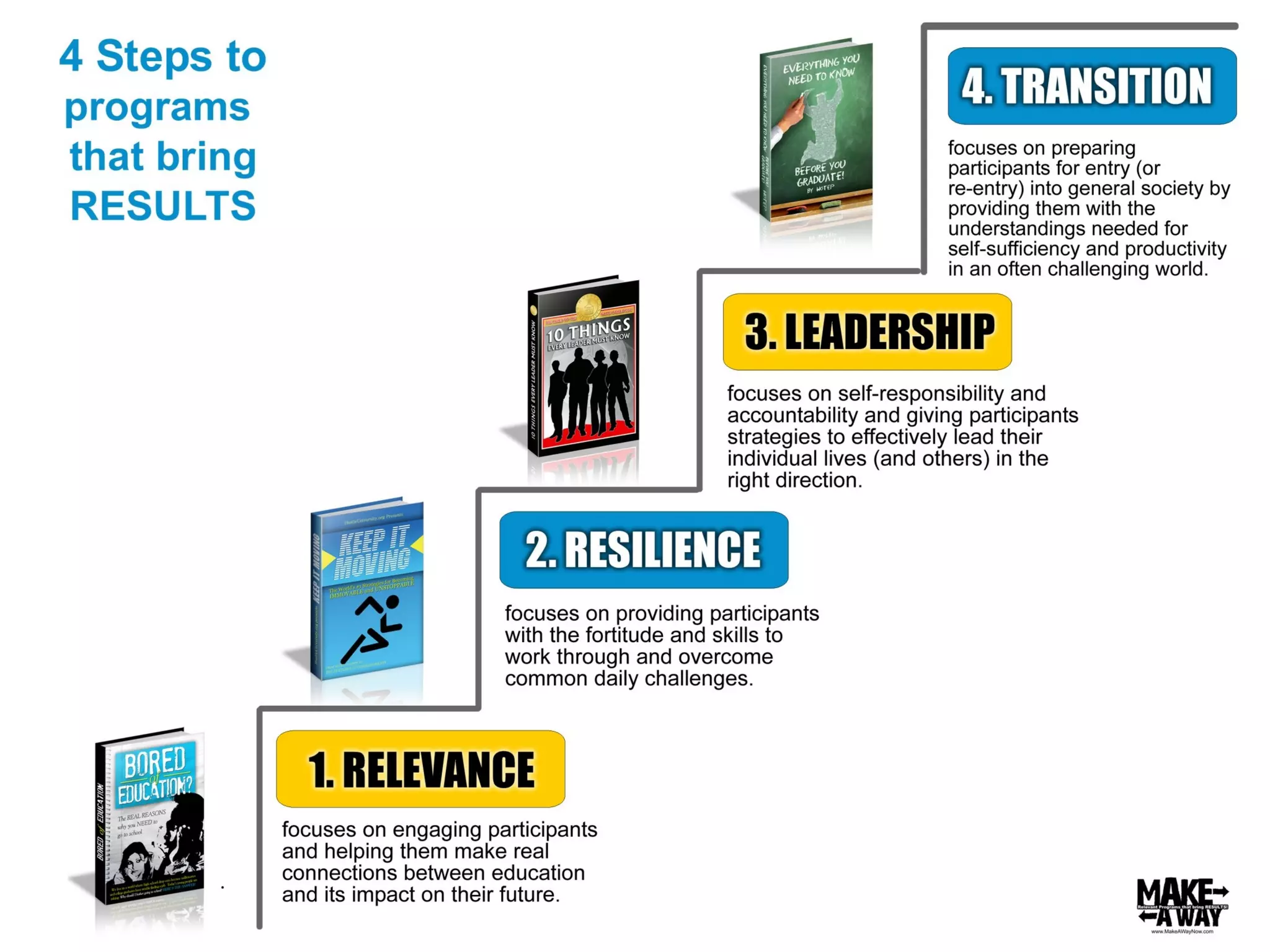
Relevant
Resilient
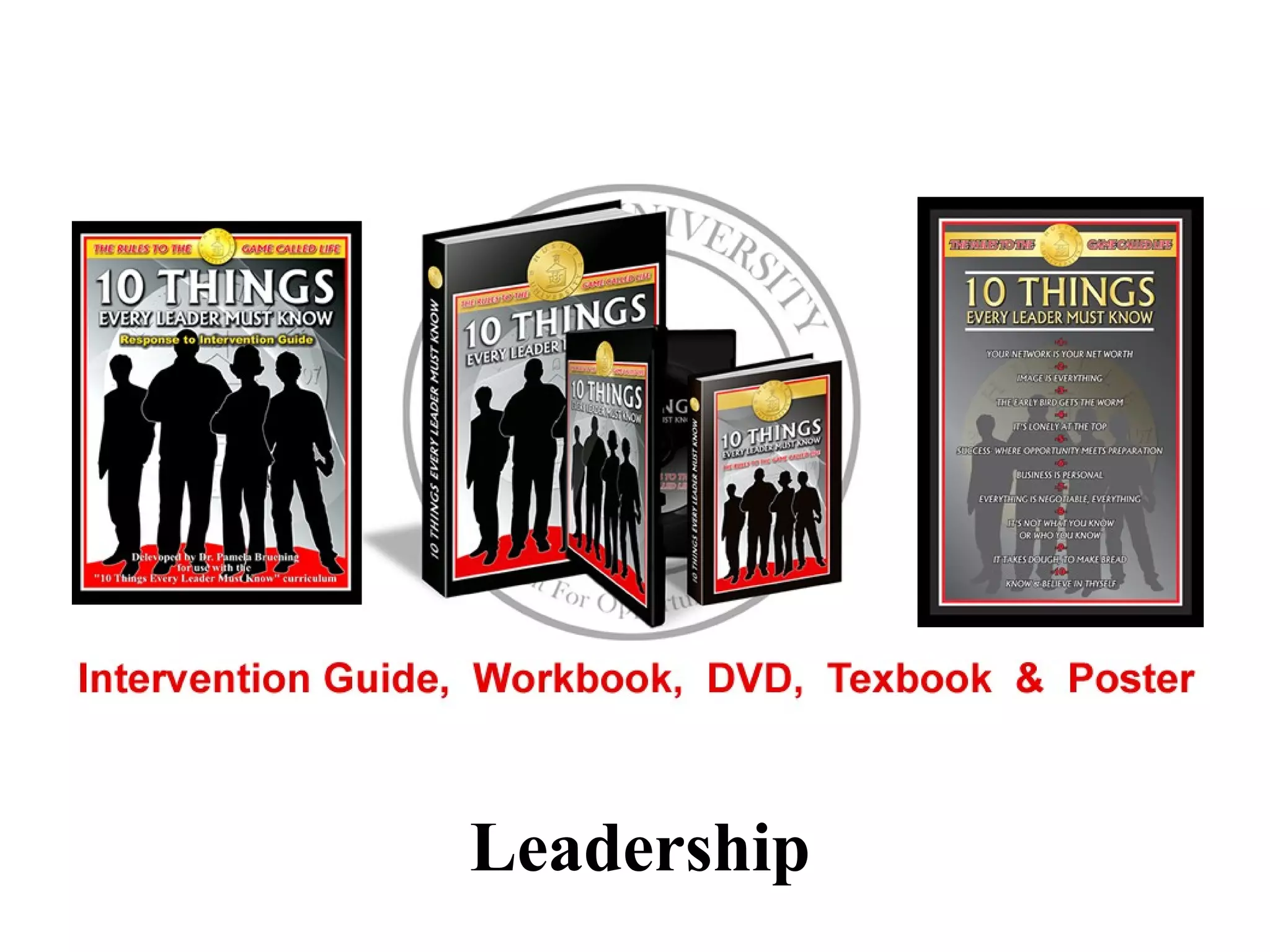
Leadership
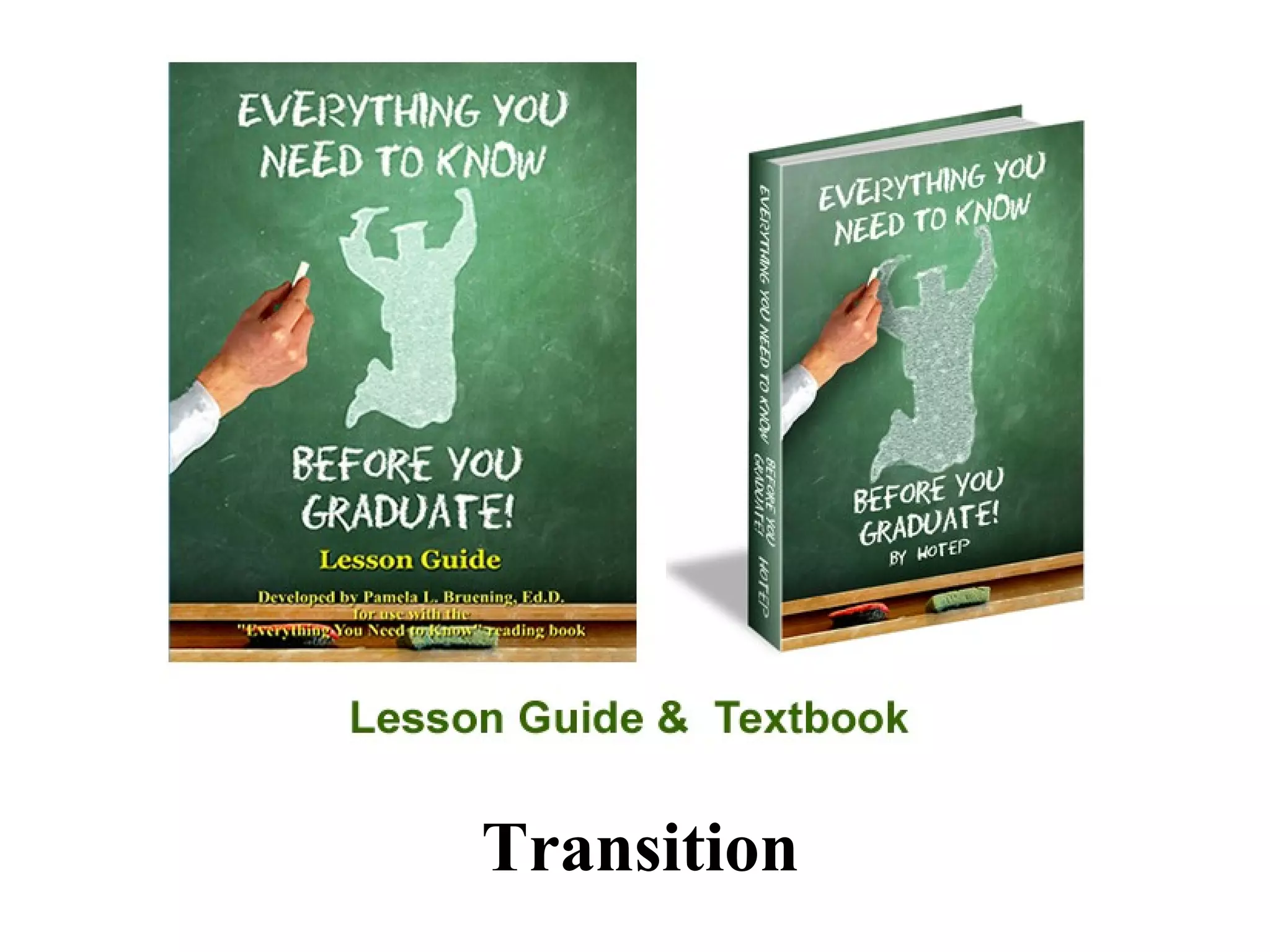
Transition
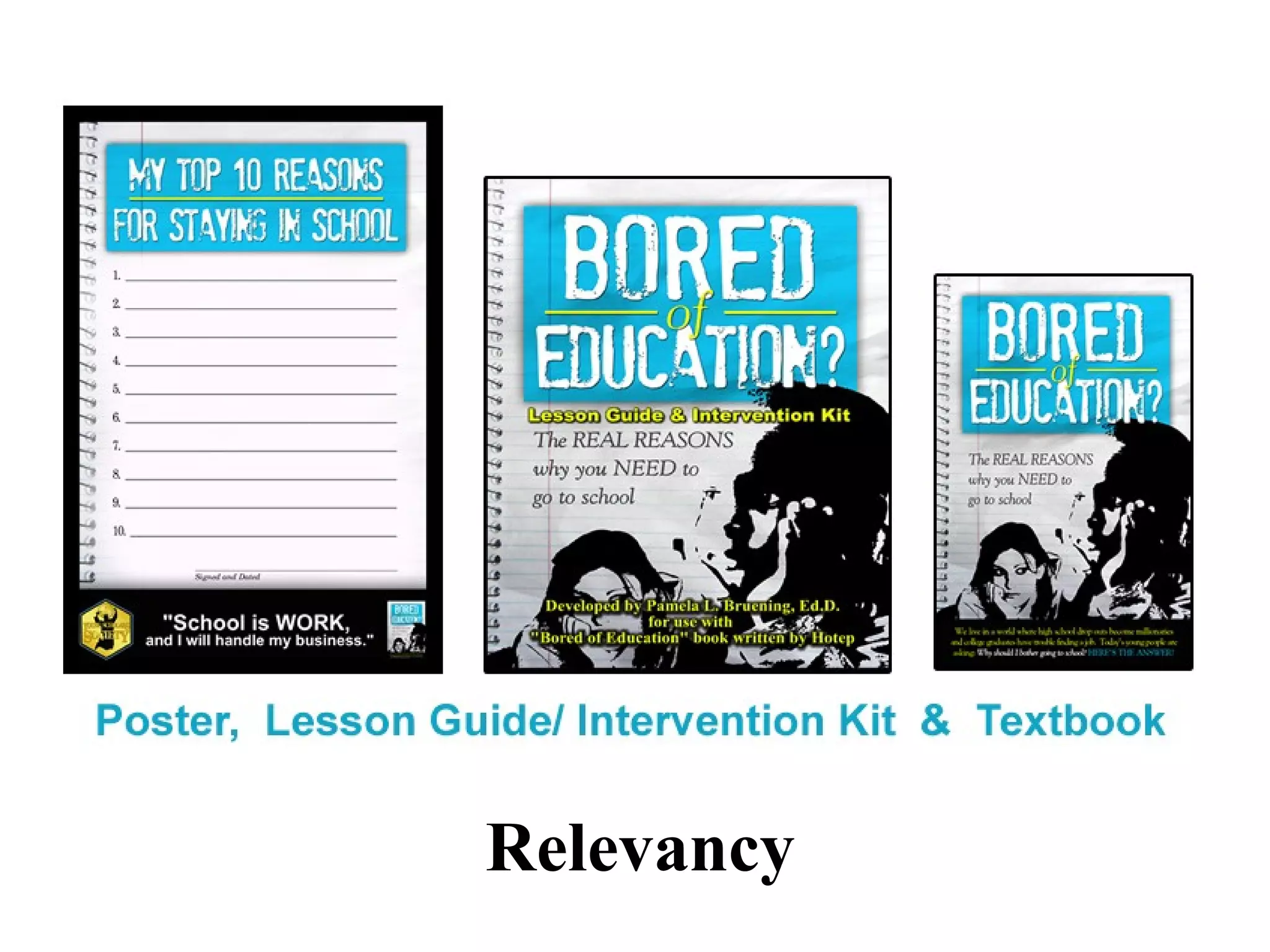
Relevancy
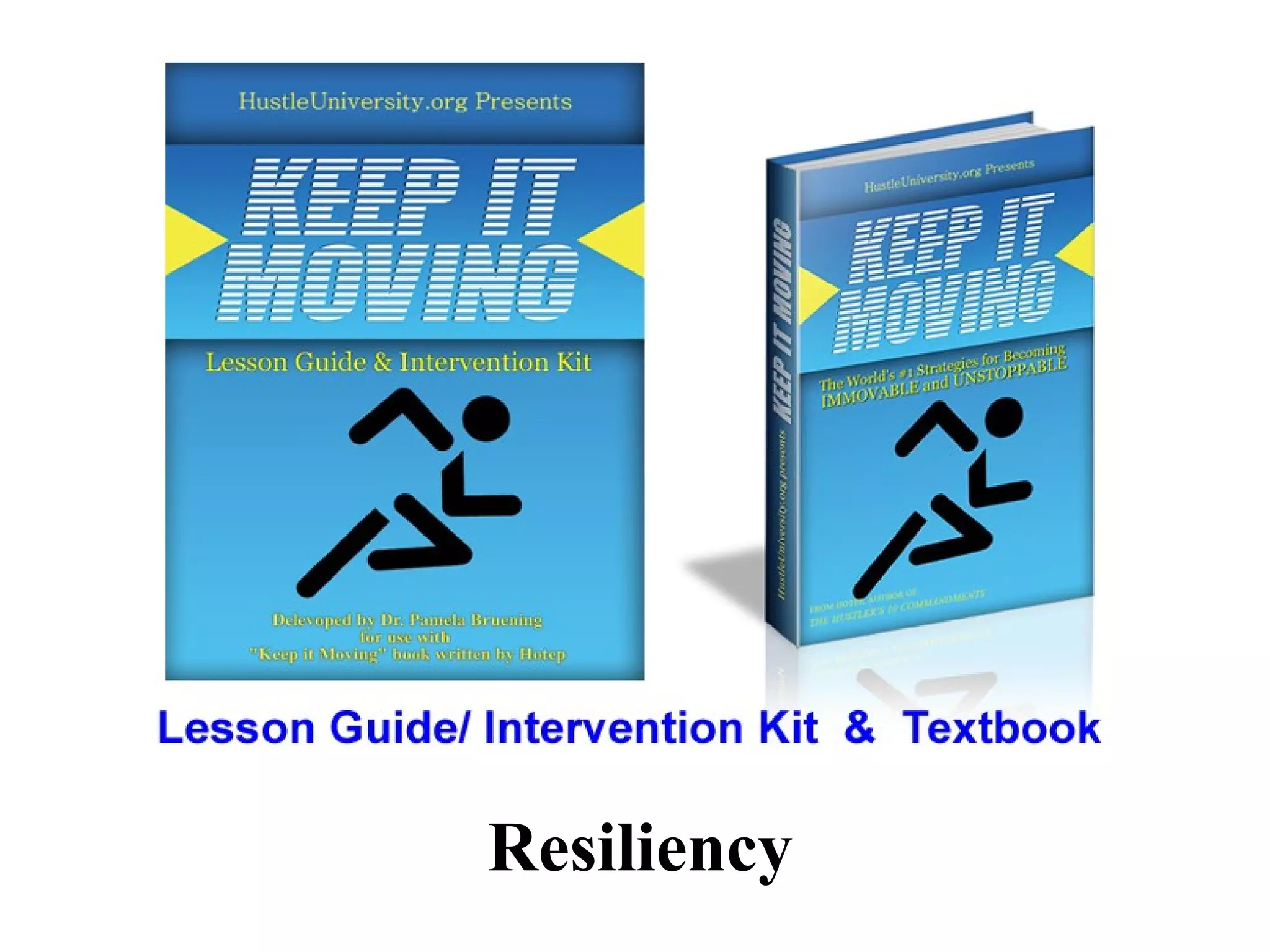
Resiliency
Transition
Leadership
Today, our program and materials are used
in over 1000 schools and we conduct staff
trainings and keynotes throughout the U.S.
Philosophy of the
MAKE A WAY
PROGRAM
Success
is not due to
WHO we are
but
HOW we are.
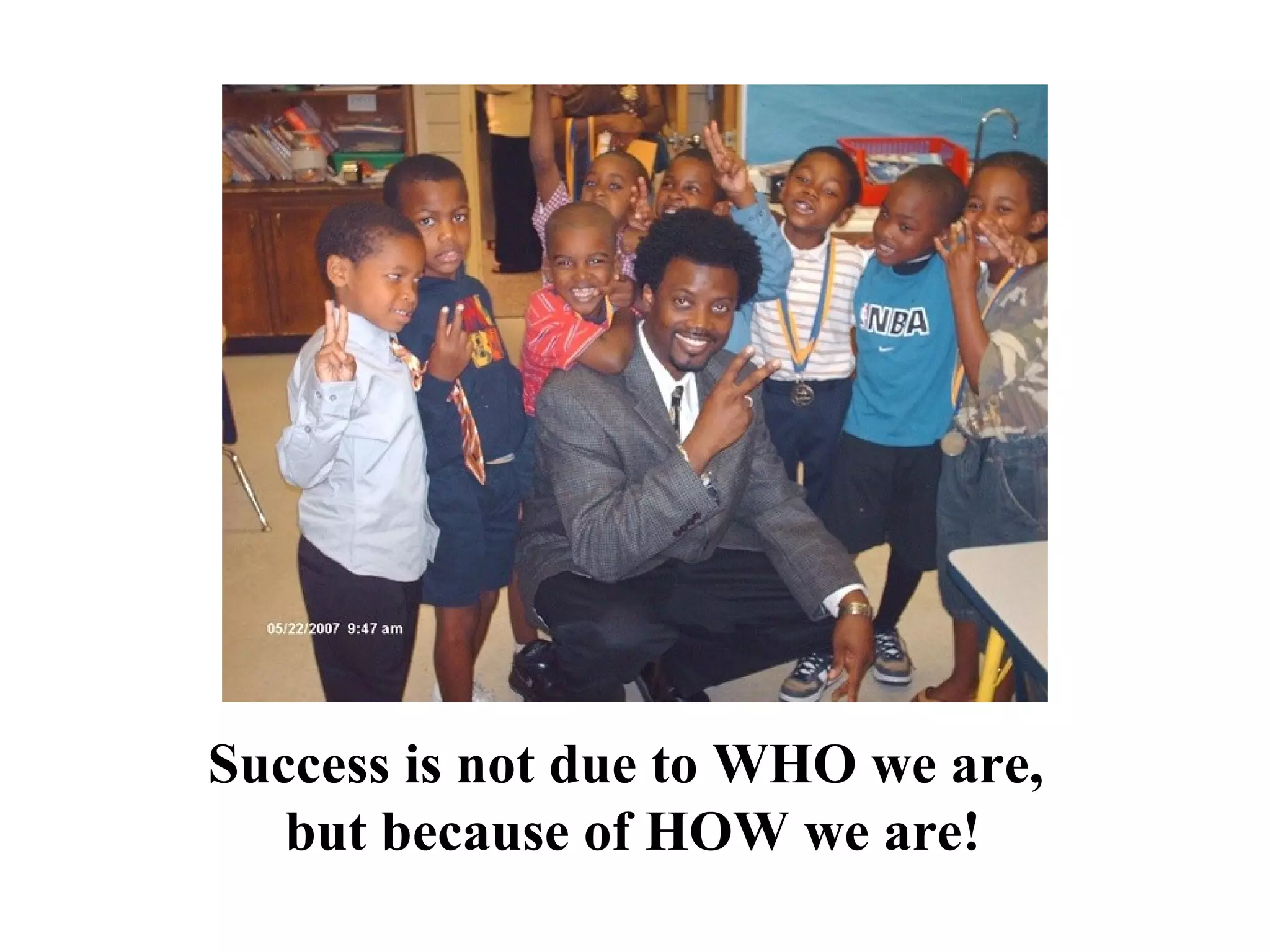
Success is not due to WHO we are,
but because of HOW we are!
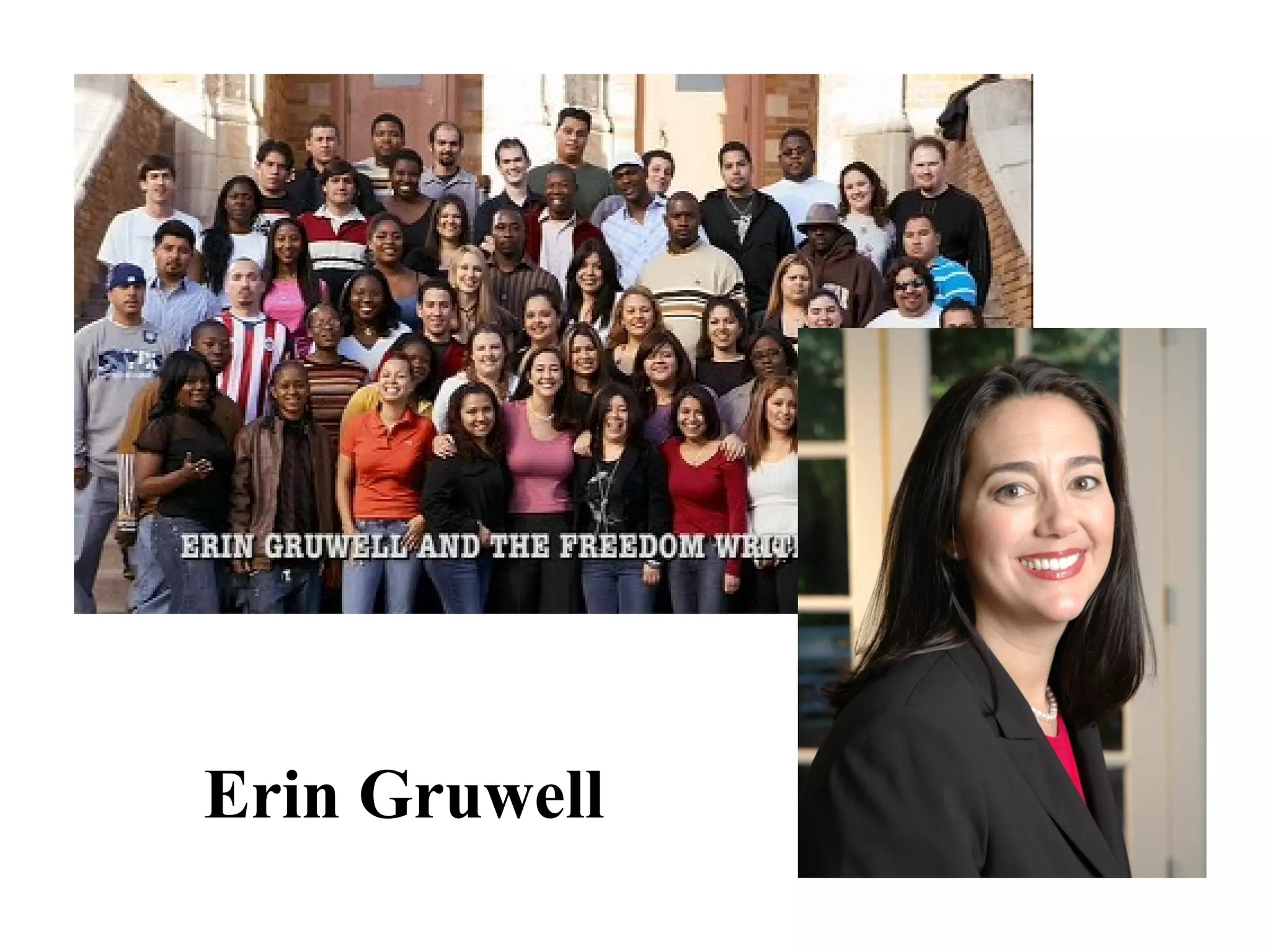
Erin Gruwell
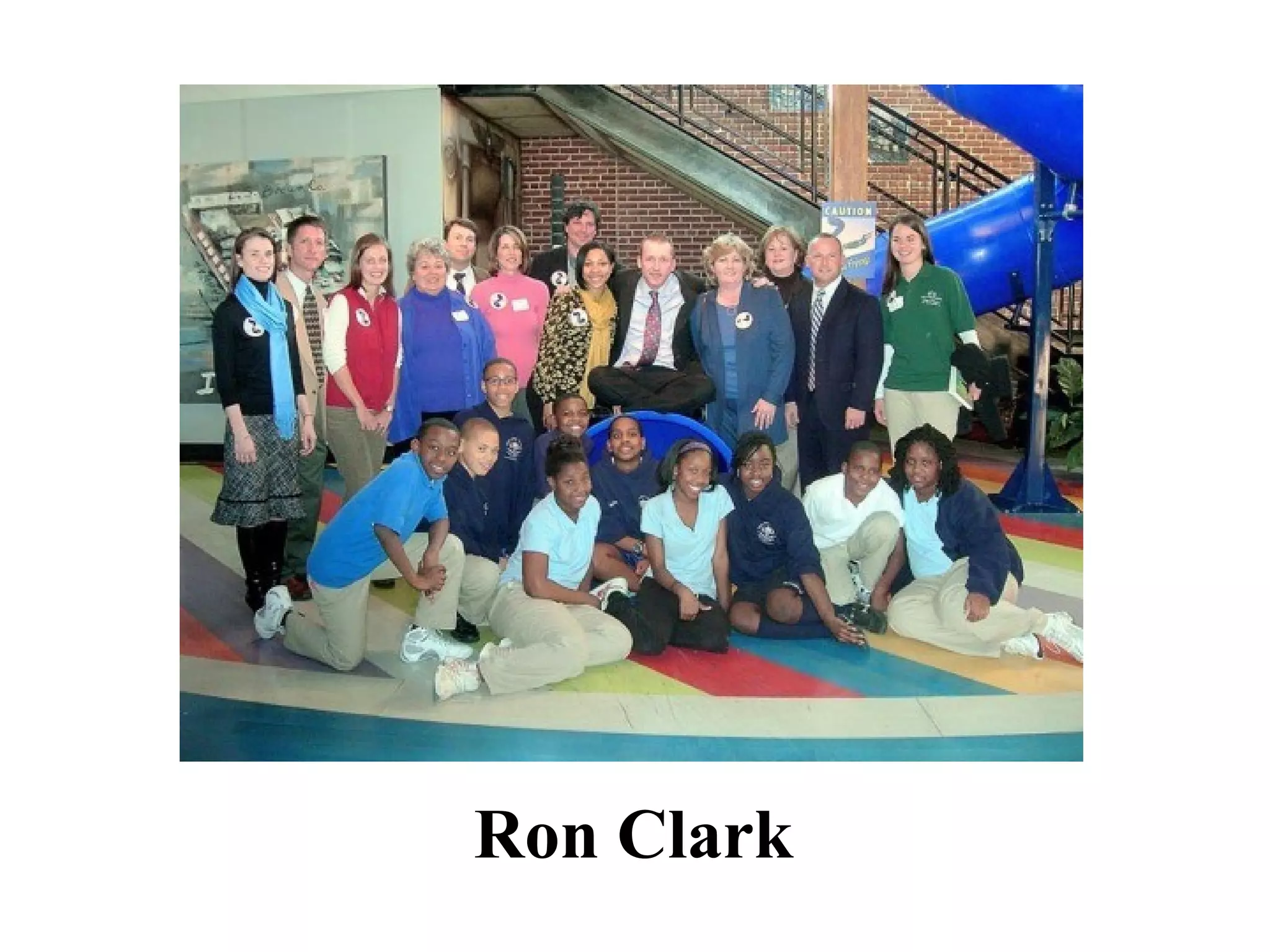
Ron Clark
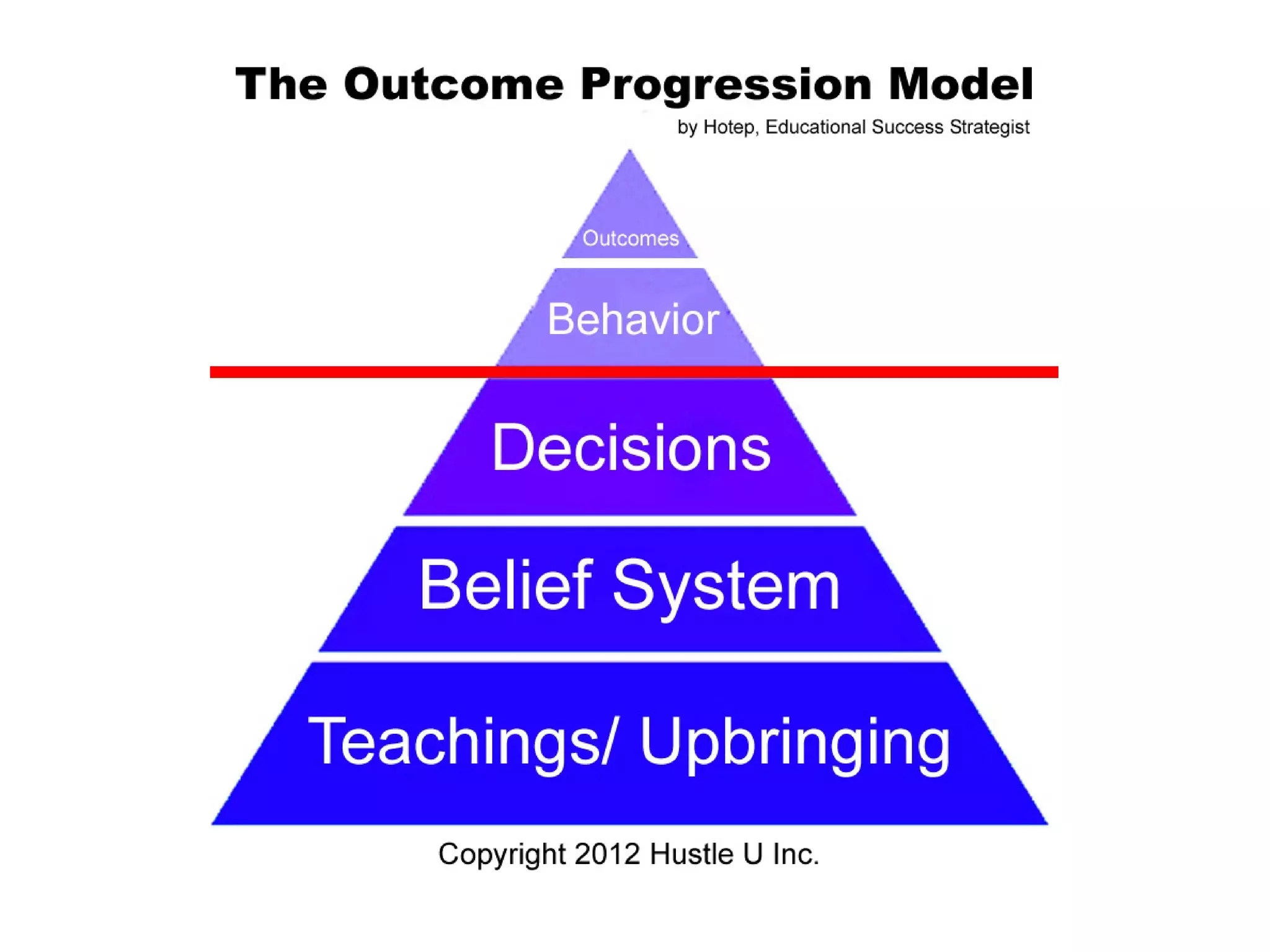
BEHAVIOR
is a
SYMPTOM
not the
PROBLEM.
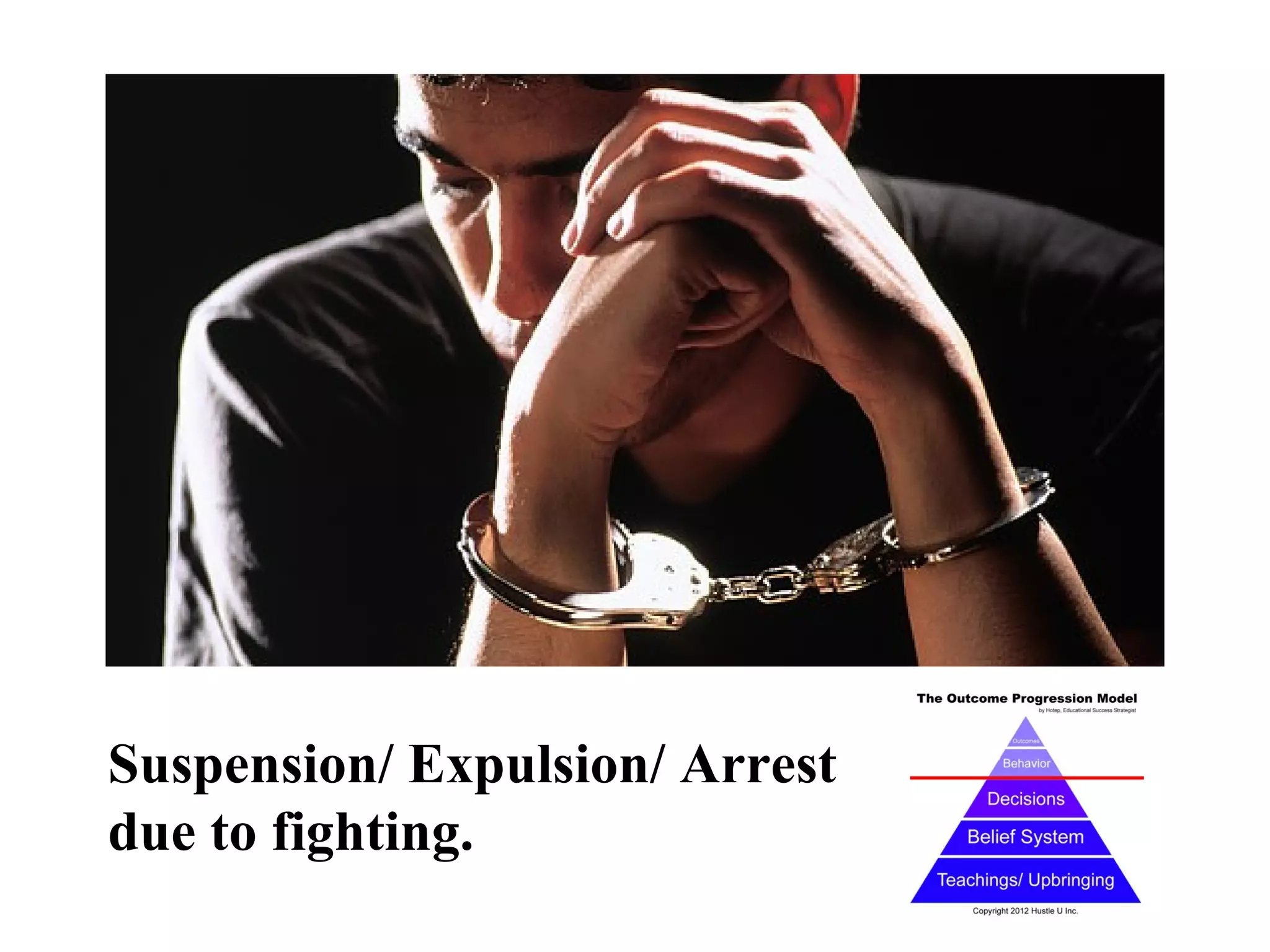
Suspension/ Expulsion/ Arrest
due to fighting.
Change in behavior is impossible
without first changing what people
BELIEVE.
Strategies of the
MAKE A WAY
PROGRAM
PROACTIVE
EDUCATION
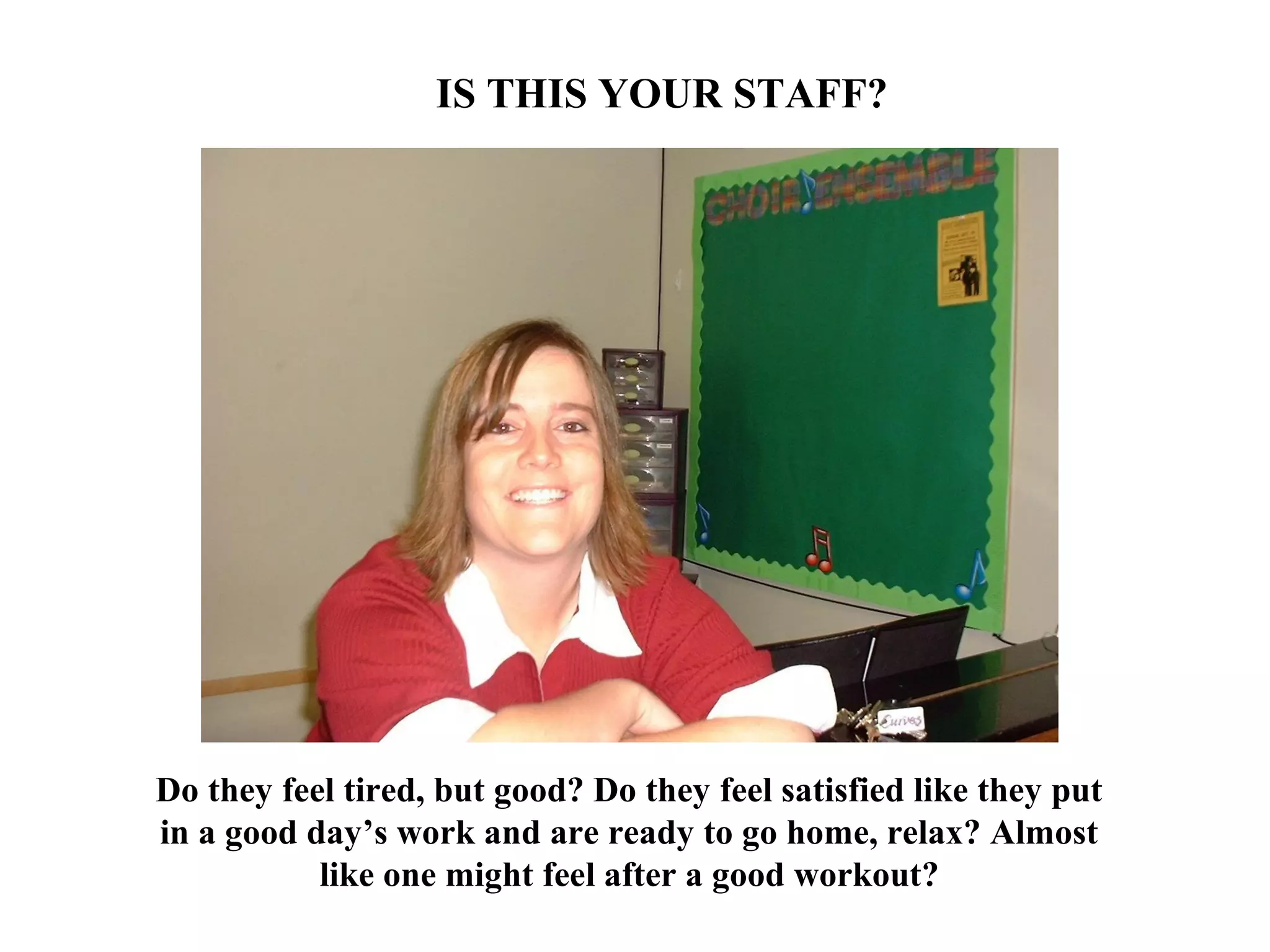
Do they feel tired, but good? Do they feel satisfied like they put
in a good day’s work and are ready to go home, relax? Almost
like one might feel after a good workout?
IS THIS YOUR STAFF?
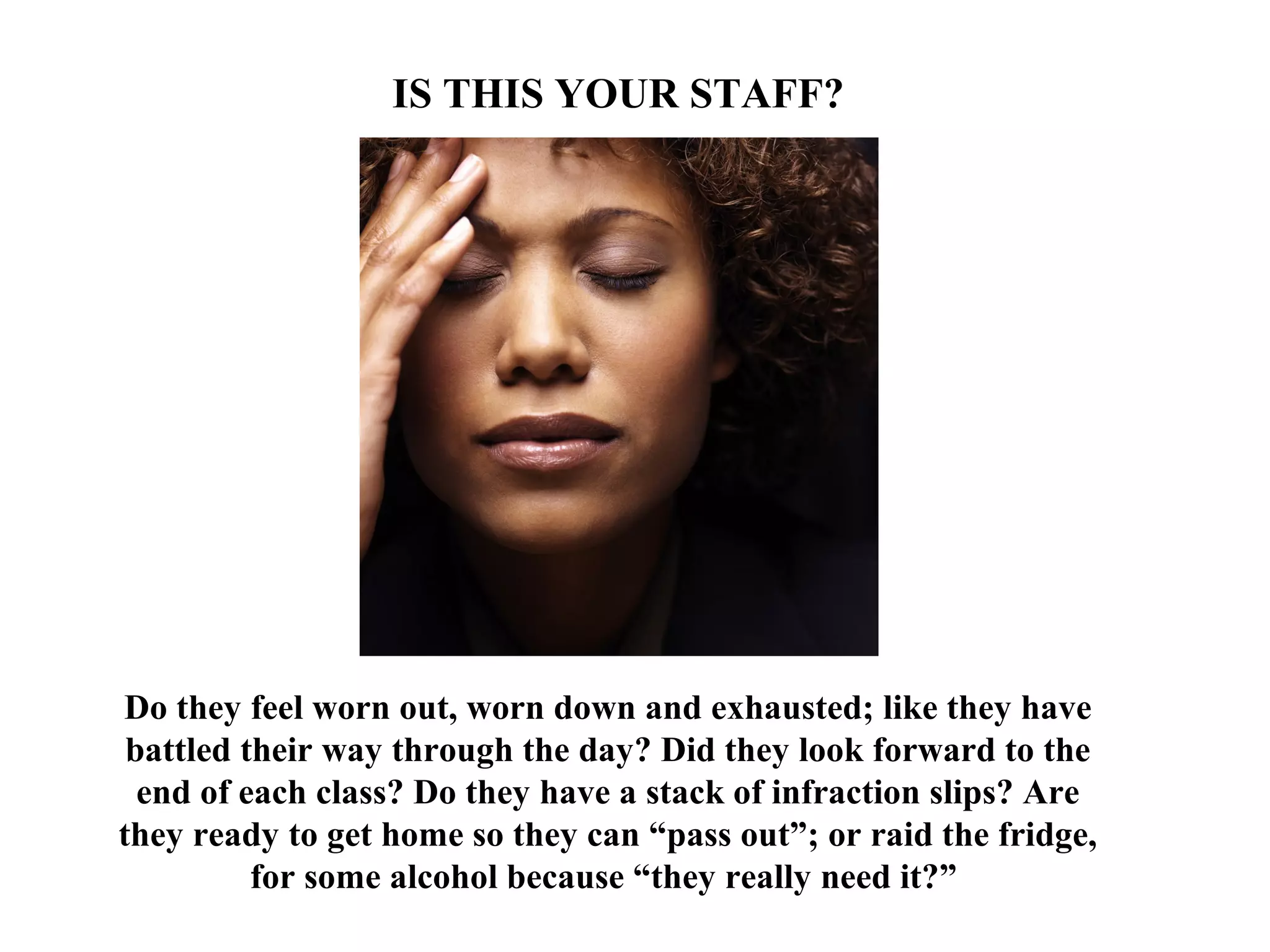
Do they feel worn out, worn down and exhausted; like they have
battled their way through the day? Did they look forward to the
end of each class? Do they have a stack of infraction slips? Are
they ready to get home so they can “pass out”; or raid the fridge,
for some alcohol because “they really need it?”
IS THIS YOUR STAFF?
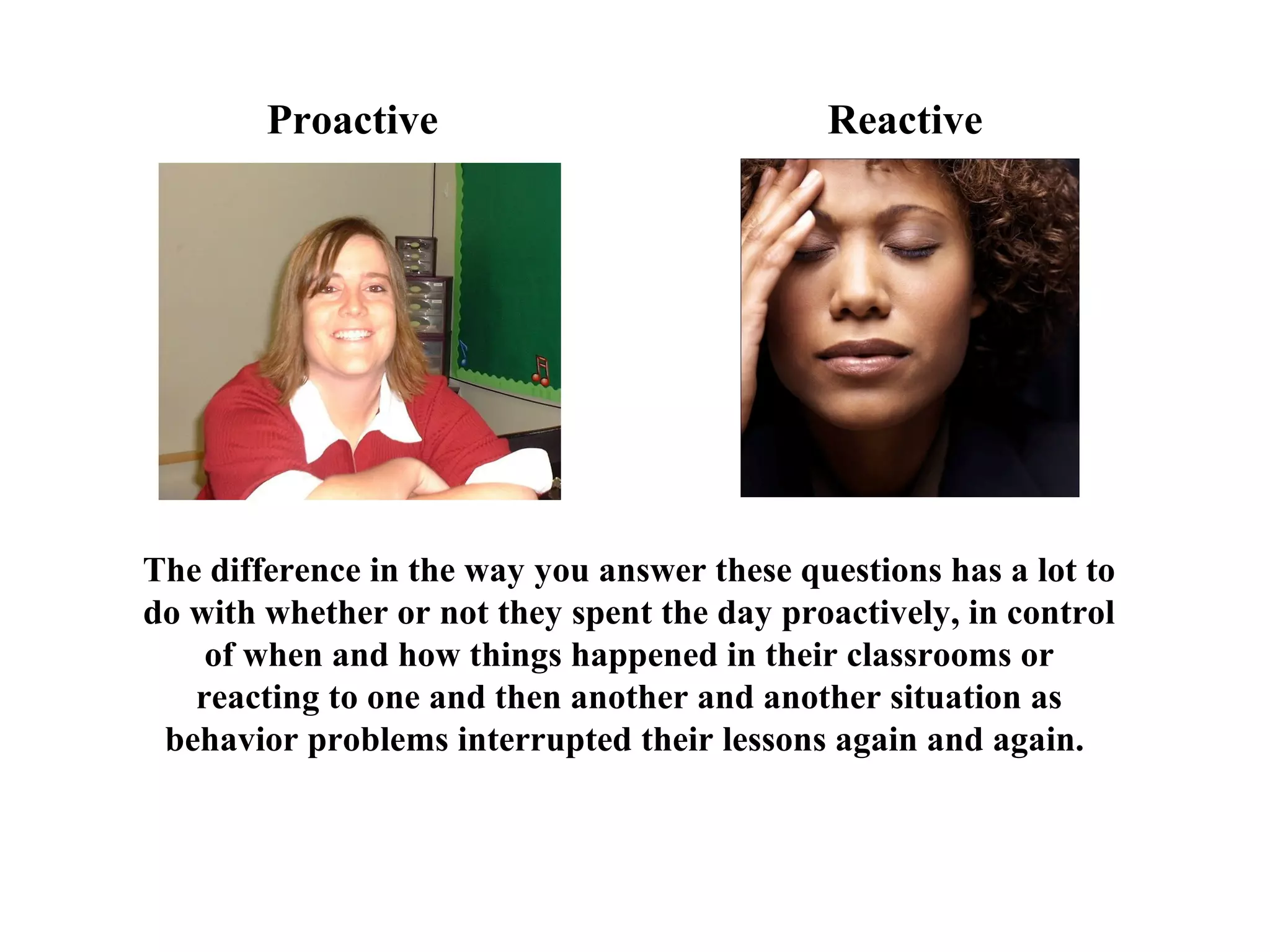
The difference in the way you answer these questions has a lot to
do with whether or not they spent the day proactively, in control
of when and how things happened in their classrooms or
reacting to one and then another and another situation as
behavior problems interrupted their lessons again and again.
Proactive Reactive
TRANSFORMING
CLASSROOM
CLIMATE
Use your differences
to MAKE a difference!
-Hotep
Alternative
Teaching
Models
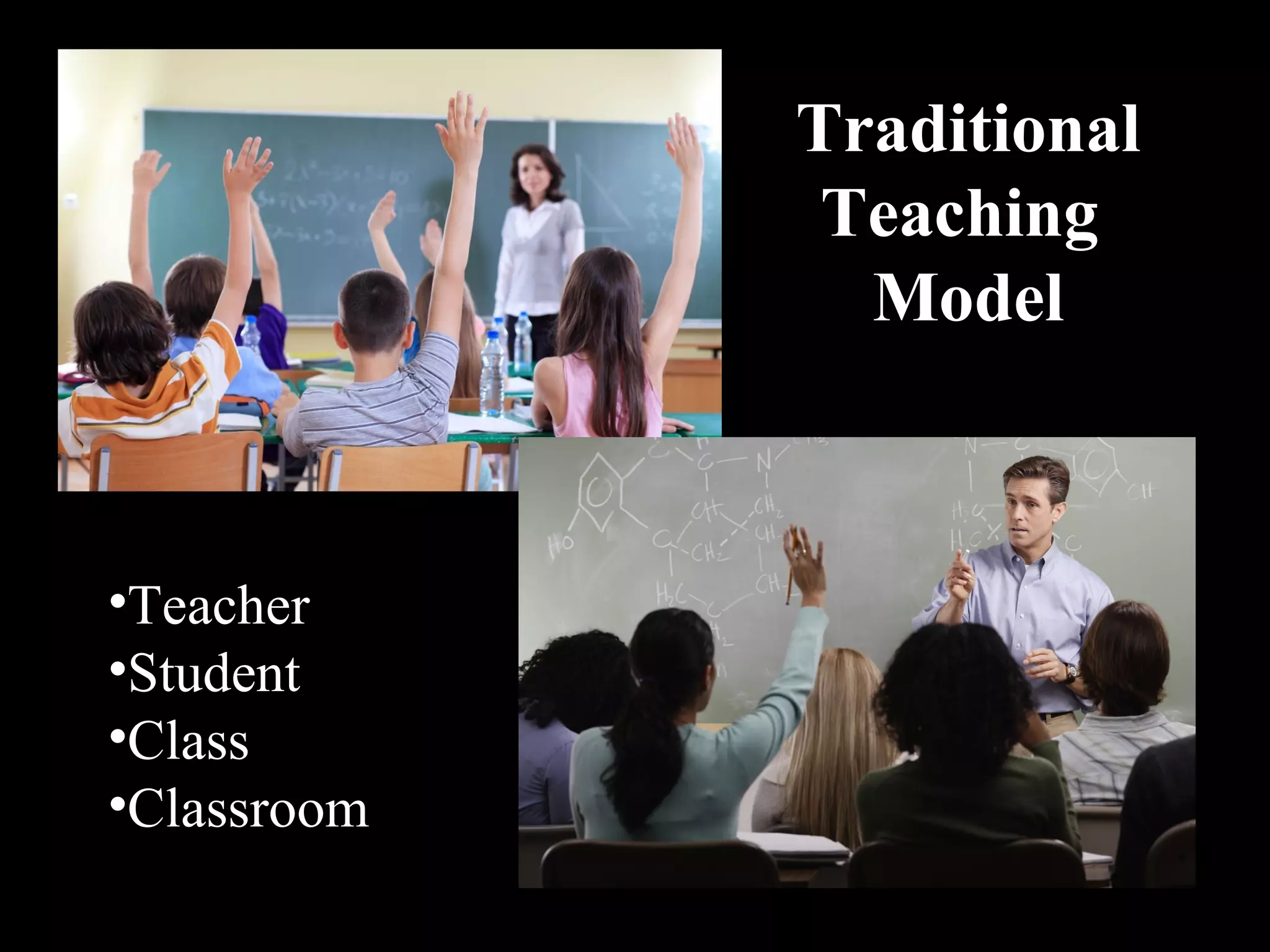
Traditional
Teaching
Model
•Teacher
•Student
•Class
•Classroom
Teacher as a BOSS
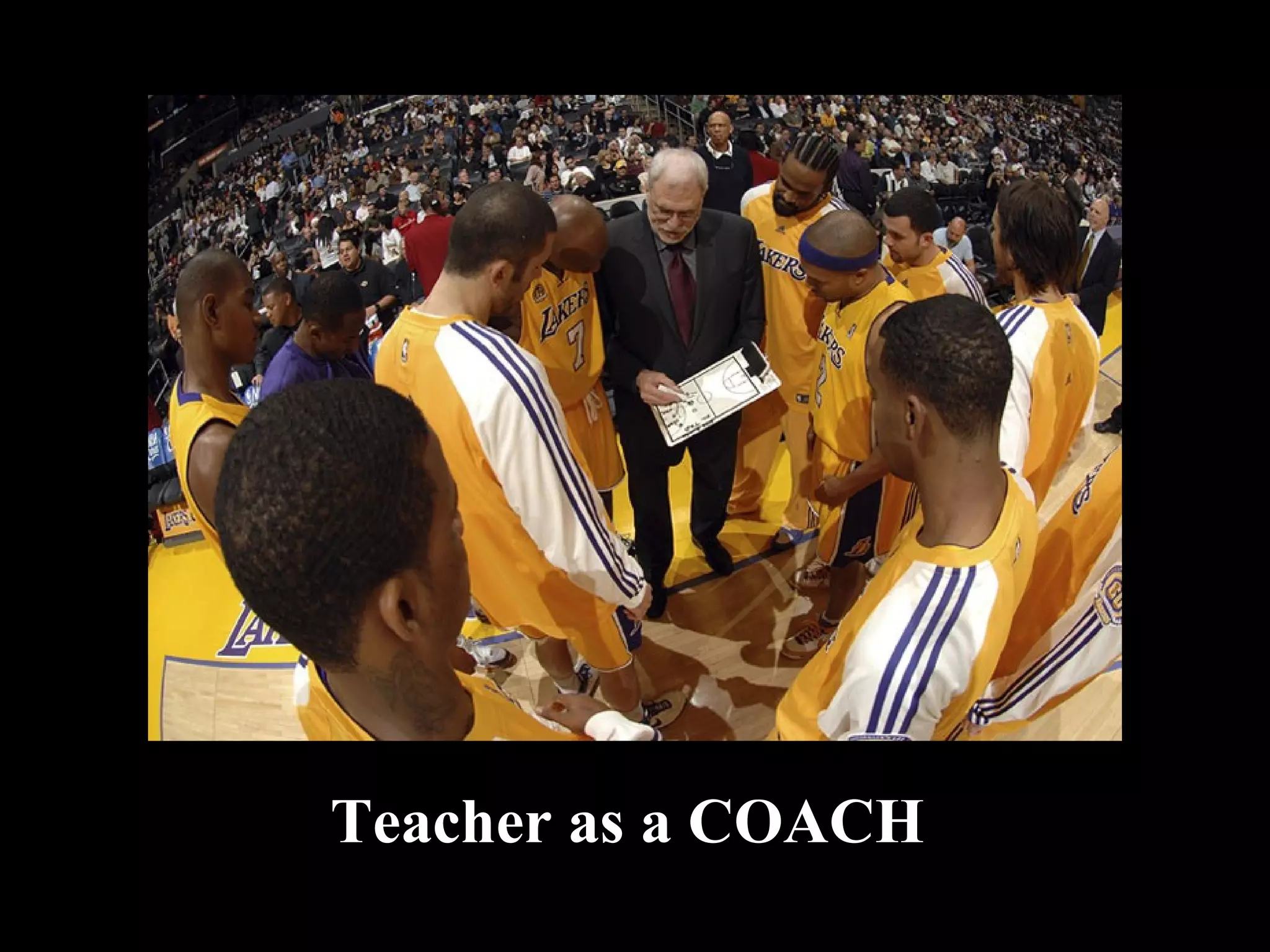
Teacher as a COACH
Other Models:
Teacher as a
TRAINER.
MASTER.
JUDGE.
DOCTOR.
GENERAL.
PARENT.
AUTHENTIC TEACHERS
Help teachers use alternative teaching
models to transform their school
climate, to better engage their
students, and use their differences to
make a difference in their schools.
EXPERIENTIAL
EDUCATION
Experiential education is a philosophy
that informs many methodologies in
which educators purposefully engage
with learners in direct experience and
focused reflection in order to increase
knowledge, develop skills, clarify
values, and develop people's capacity to
contribute to their communities.
Tell me and I will
forget.
Show me and I may
remember.
Involve me and I will
understand.
~Chinese Proverb
Strengths of the
MAKE A WAY
PROGRAM
ACROSS THE BOARD BUY-IN
(RELAVANCY):
Students love to learn it.
Teachers love to teach it.
Parents love to discuss it.
Administrators love the results.
U.S. Vice President’s brother, Frank Biden
FLEXIBILITY:
The MAKE A WAY program can be used for:
Positive Behavior Support
Book Study
Morning Activity
After School Program
In-School Suspension Activities
Class meetings
FLEXIBILITY:
The MAKE A WAY program can be used in a variety of
settings including:
Whole classroom
Small group
1-on-1
Self Directed
In-School Suspension Activities
Class meetings
LESSON GUIDES:
Common Core Aligned
3 Part Lesson
Pacing/ Monitoring Guide
R.T.I. Ready
Parent Inclusion Activities
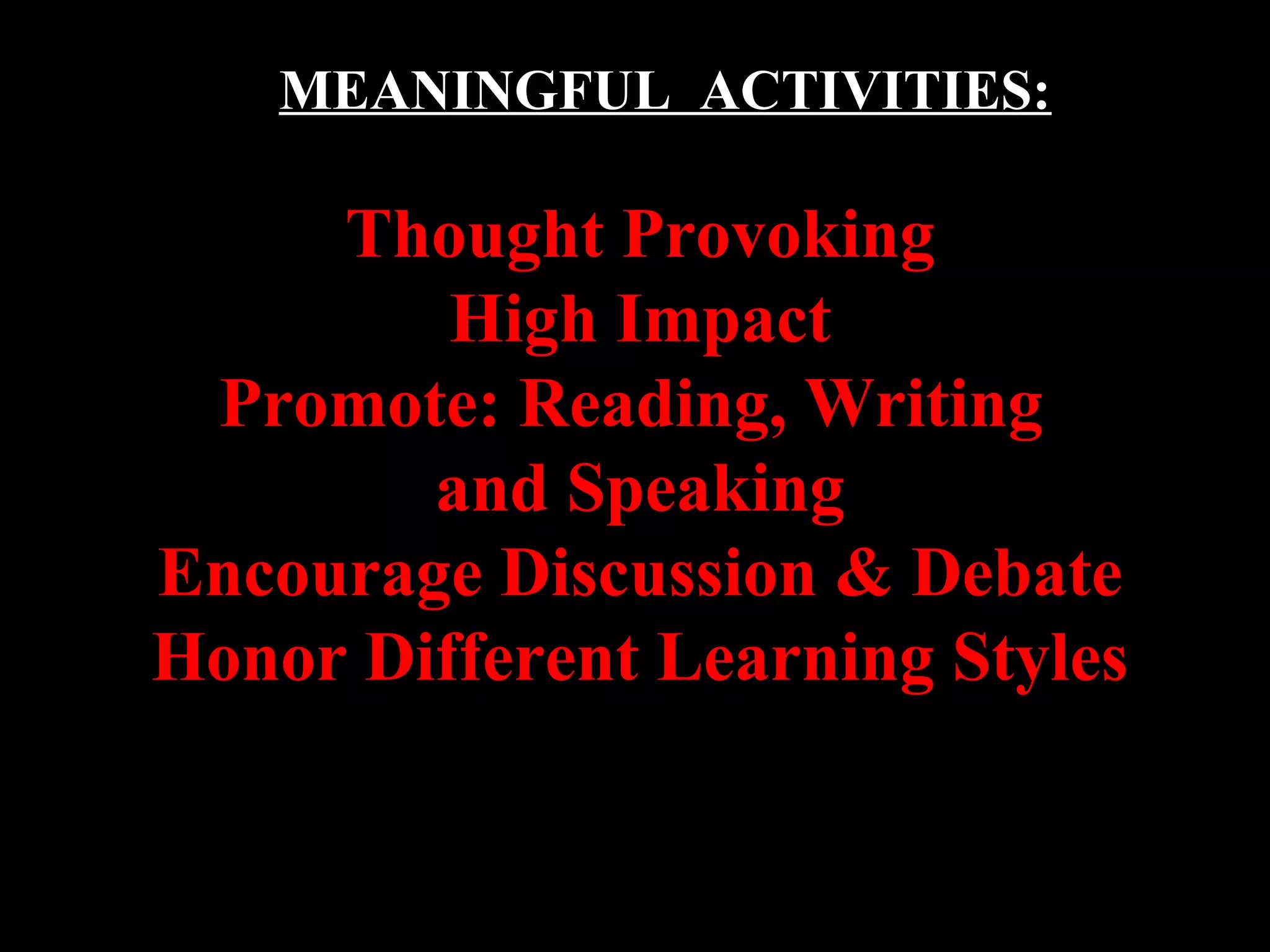
MEANINGFUL ACTIVITIES:
Thought Provoking
High Impact
Promote: Reading, Writing
and Speaking
Encourage Discussion & Debate
Honor Different Learning Styles
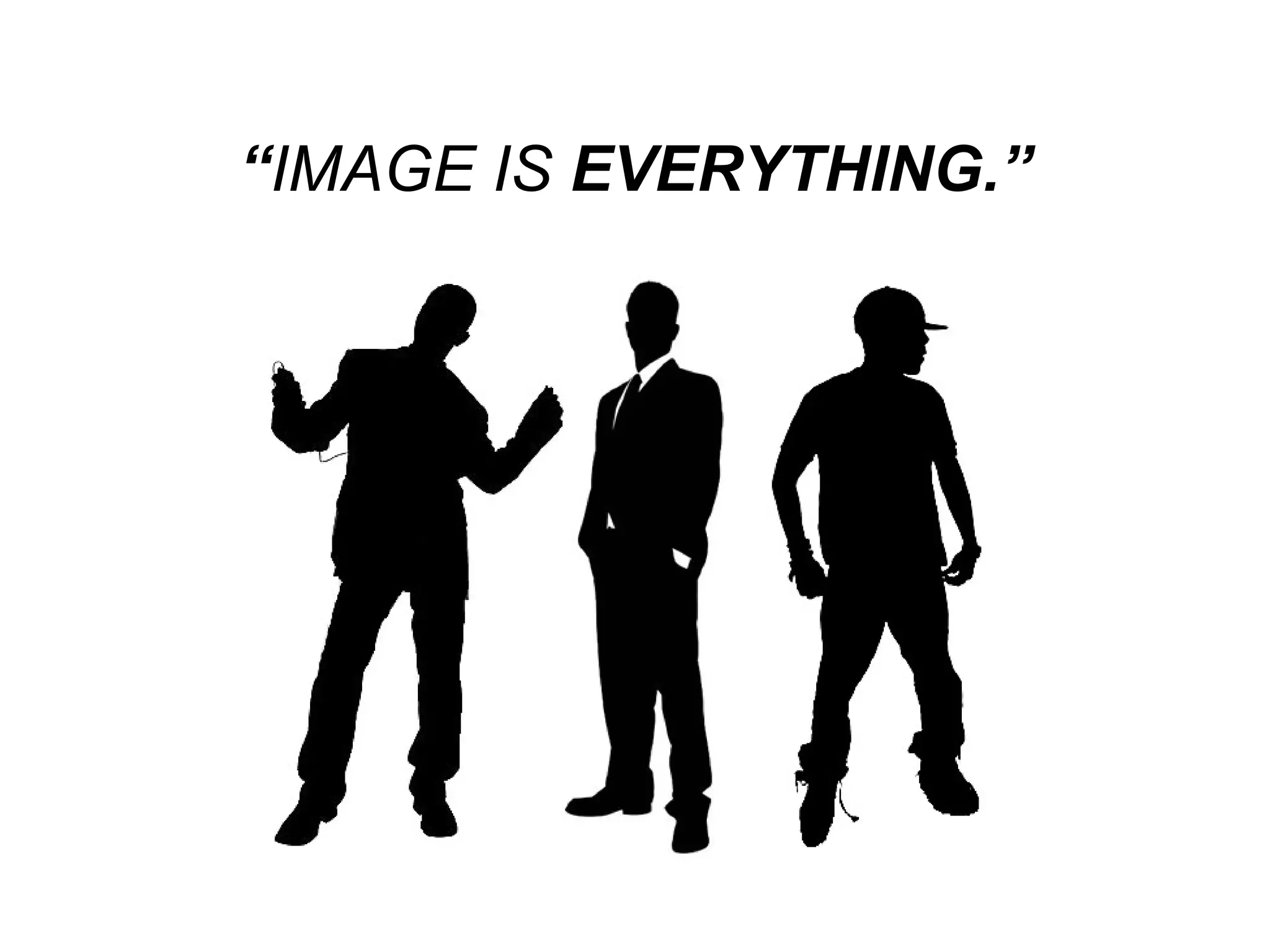
“IMAGE IS EVERYTHING.”
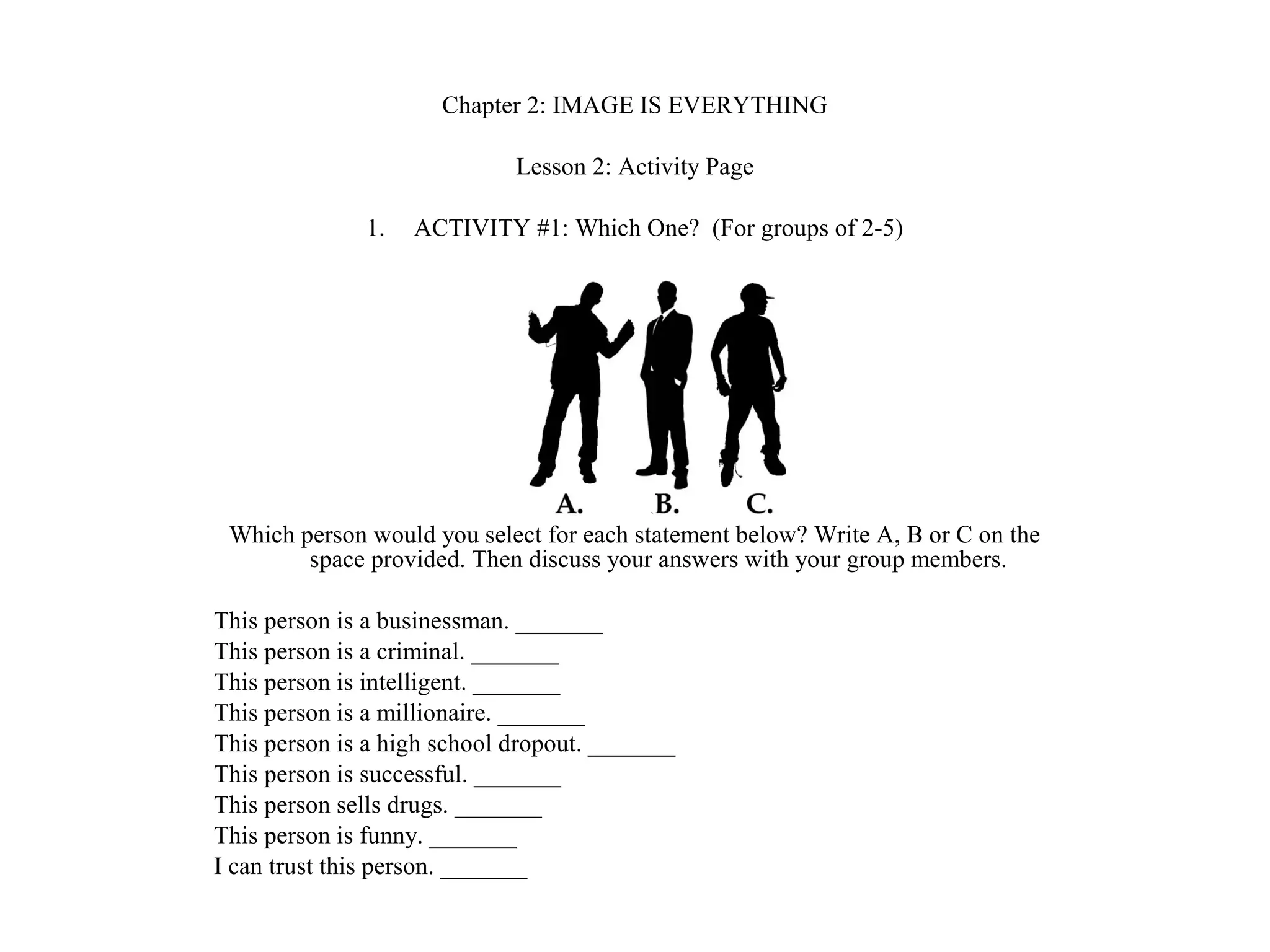
Chapter 2: IMAGE IS EVERYTHING
Lesson 2: Activity Page
1. ACTIVITY #1: Which One? (For groups of 2-5)
Which person would you select for each statement below? Write A, B or C on the
space provided. Then discuss your answers with your group members.
This person is a businessman. _______
This person is a criminal. _______
This person is intelligent. _______
This person is a millionaire. _______
This person is a high school dropout. _______
This person is successful. _______
This person sells drugs. _______
This person is funny. _______
I can trust this person. _______
CURRENT
RESEARCH
DRIVEN
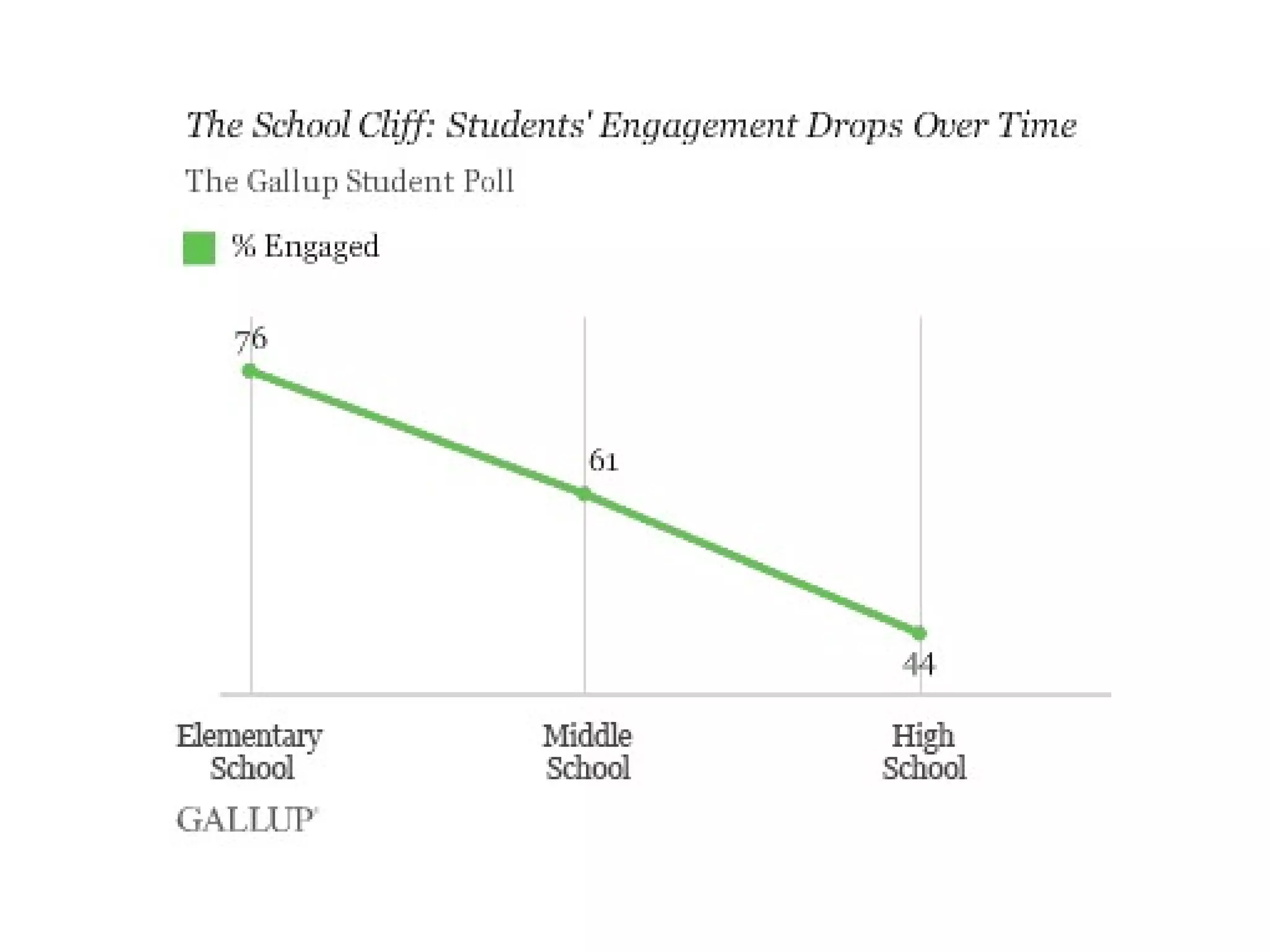
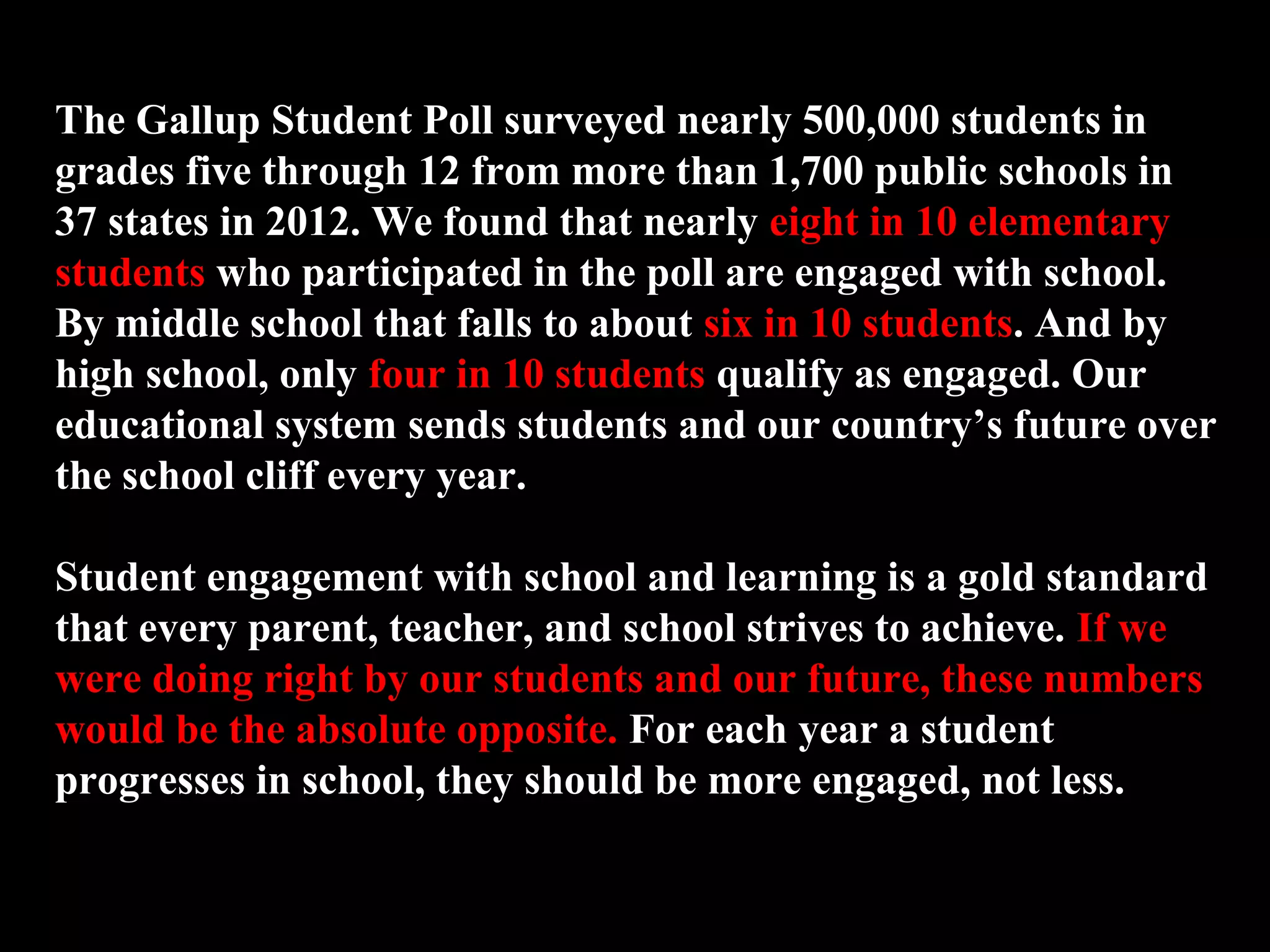
The Gallup Student Poll surveyed nearly 500,000 students in
grades five through 12 from more than 1,700 public schools in
37 states in 2012. We found that nearly eight in 10 elementary
students who participated in the poll are engaged with school.
By middle school that falls to about six in 10 students. And by
high school, only four in 10 students qualify as engaged. Our
educational system sends students and our country’s future over
the school cliff every year.
Student engagement with school and learning is a gold standard
that every parent, teacher, and school strives to achieve. If we
were doing right by our students and our future, these numbers
would be the absolute opposite. For each year a student
progresses in school, they should be more engaged, not less.
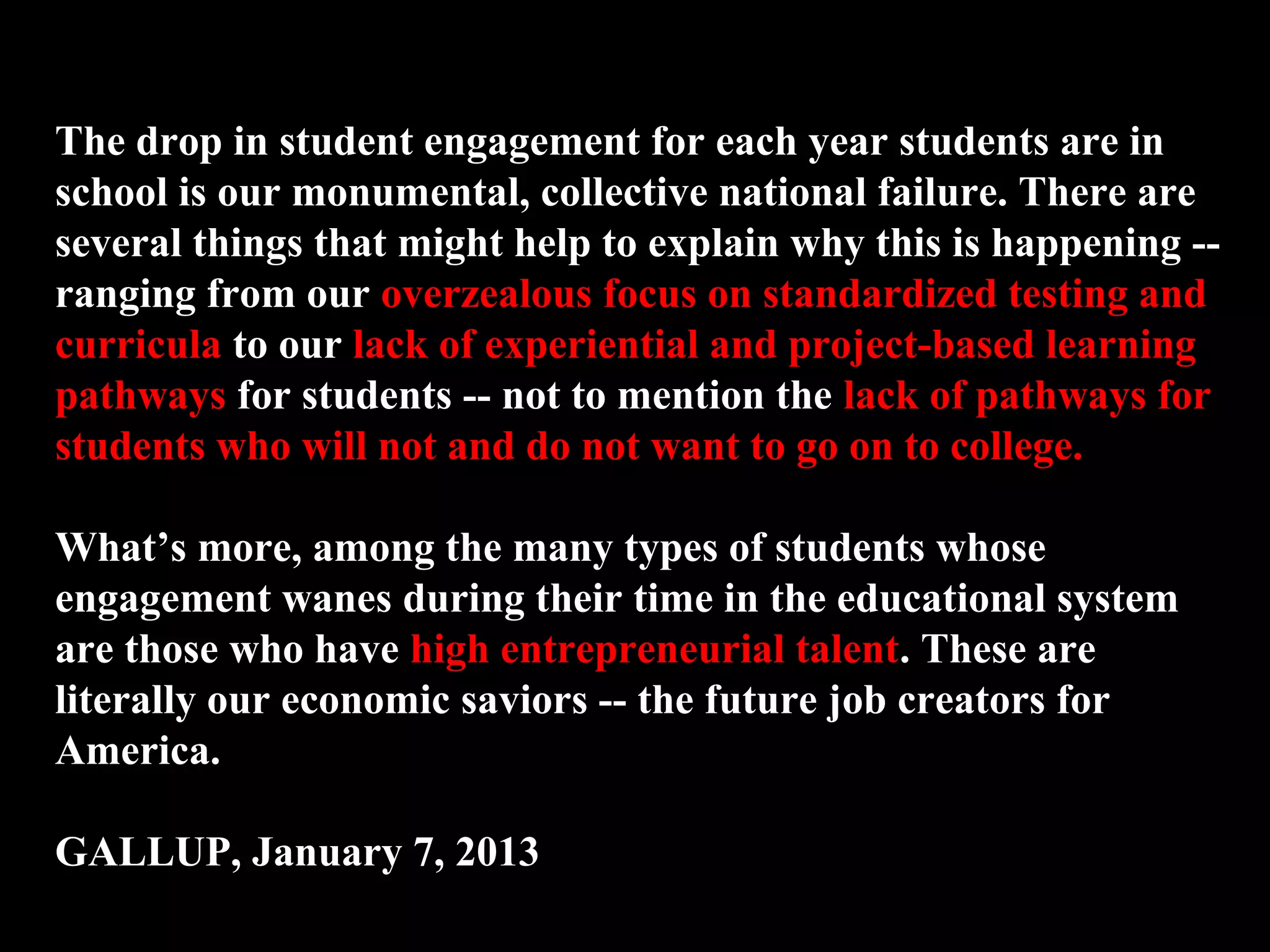
The drop in student engagement for each year students are in
school is our monumental, collective national failure. There are
several things that might help to explain why this is happening --
ranging from our overzealous focus on standardized testing and
curricula to our lack of experiential and project-based learning
pathways for students -- not to mention the lack of pathways for
students who will not and do not want to go on to college.
What’s more, among the many types of students whose
engagement wanes during their time in the educational system
are those who have high entrepreneurial talent. These are
literally our economic saviors -- the future job creators for
America.
GALLUP, January 7, 2013
SPEAKING
ABOUT
JOBS…
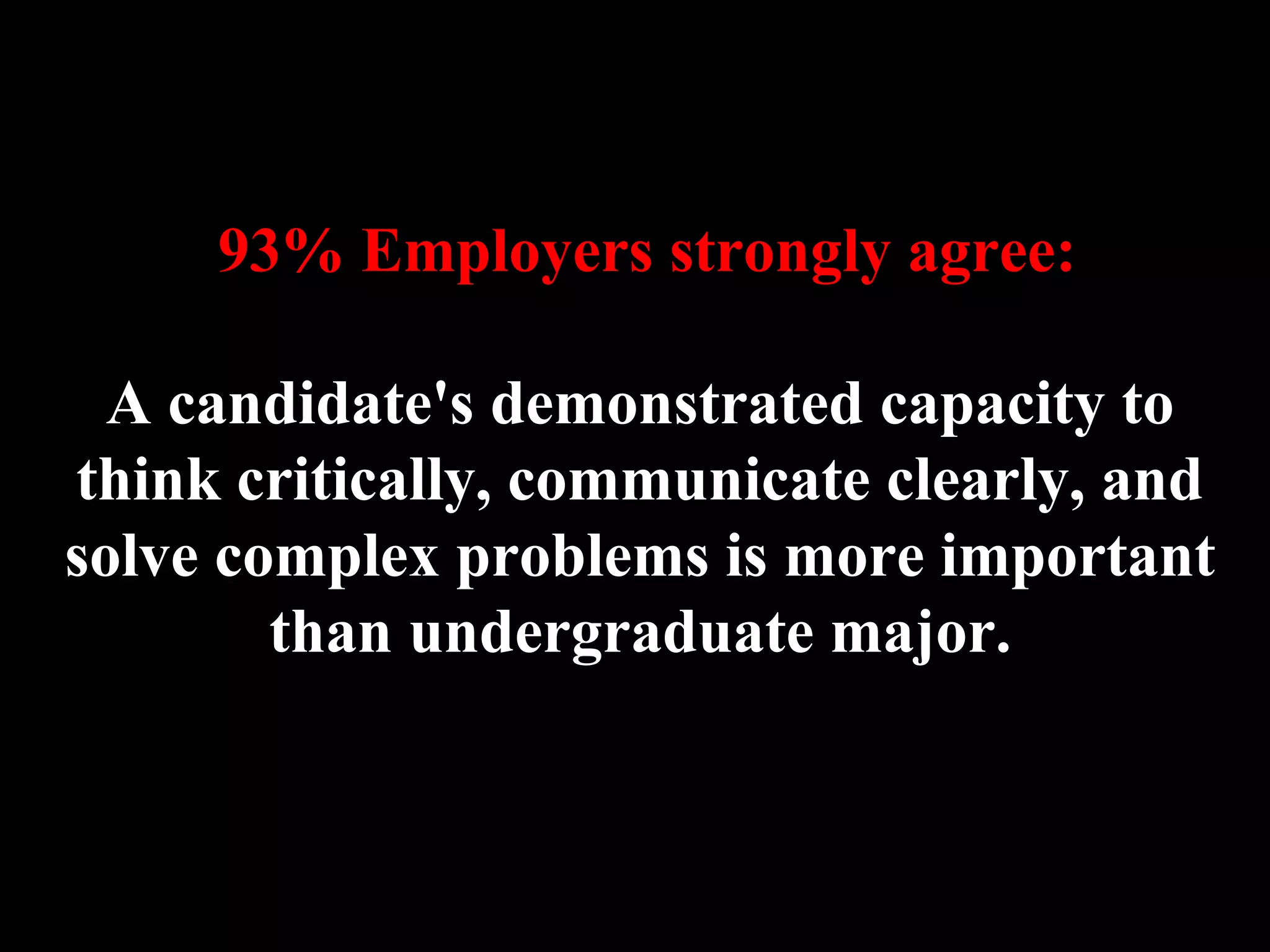
93% Employers strongly agree:
A candidate's demonstrated capacity to
think critically, communicate clearly, and
solve complex problems is more important
than undergraduate major.
They also want to ensure that every college graduate, no matter
what their major is, achieves much higher levels of evidence-
based reasoning, research skills and complex problem-solving
skills [along with] ethical decision-making.”
Another important criterion for employers, is that graduates
demonstrate practical experience applying what they have
learned.
Want employees to demonstrate that they have the knowledge,
and that they have the experience putting the knowledge to use
in real-world settings.
'More Than a Major'
April 10, 2013
By Zack Budryk
Association of American Colleges and Universities
…in other words,
successful programs:
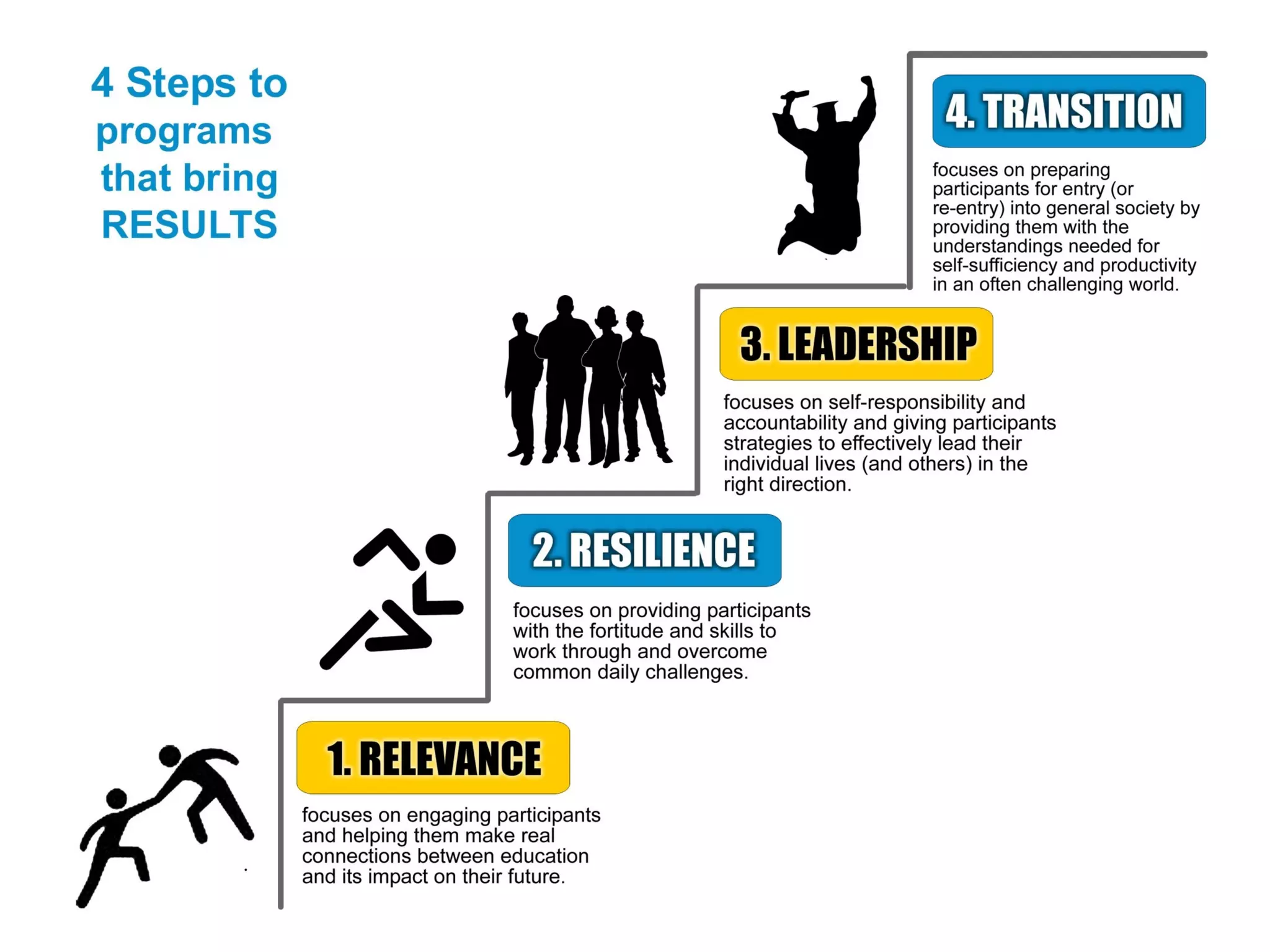
ARE RELEVANT
TEACH
RESILIENCE
AID IN
LEADERSHIP
HELP PEOPLE
TRANSITION
INTO THE REAL
WORLD
Copyright 2013 Hustle U Inc.
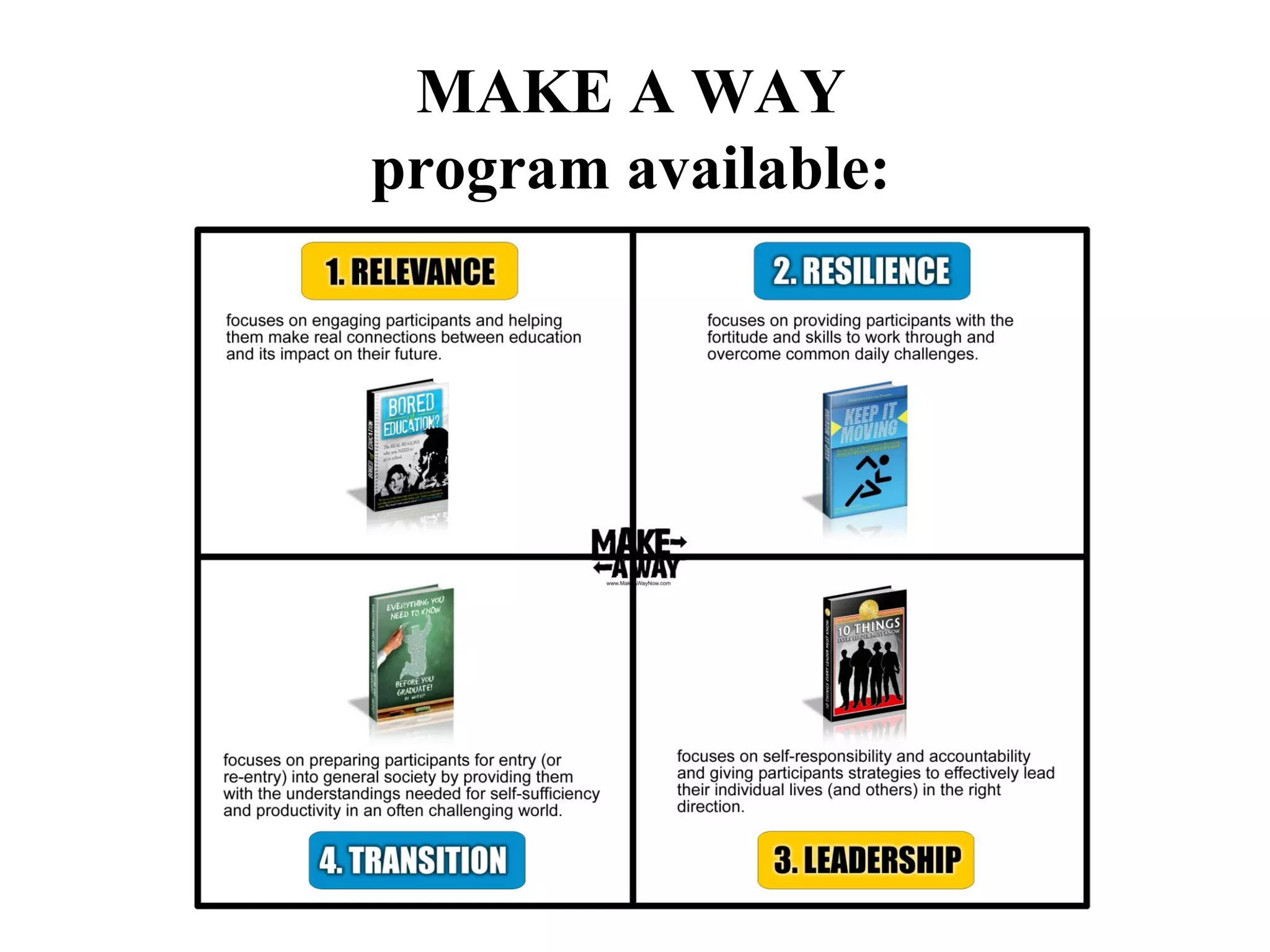
MAKE A WAY
program available:

MAKE A WAY INTRO tutorial

  • 1.
    A High Relevancy EducationProgram that brings RESULTS!
  • 2.
    Created by EducationalSuccess Strategist Hotep, Founder of MAKE A WAY
  • 3.
    MAKE A WAYis a high relevancy educational program that targets at-risk and underserved populations of youth and adults to transform the climate and culture of poverty, excuse making and helplessness into one of empowerment, resiliency and success!
  • 4.
    The MAKE AWAY program and materials are used in over 1,000 schools. We conduct staff trainings and keynotes throughout the U.S.
  • 5.
    How was MAKE AWAY started?
  • 9.
    The Hustler’s 10Commandments has been compared to: Think and Grow Rich The Art of War Rich Dad, Poor Dad 7 Habits of Highly Effective People
  • 13.
  • 20.
    And then theteachers started catching on…
  • 22.
  • 23.
  • 24.
    And that’s whenhe realized why the book was successful… Relevant Resilient Leadership Transition
  • 26.
  • 27.
  • 28.
  • 31.
  • 32.
    Today, our programand materials are used in over 1000 schools and we conduct staff trainings and keynotes throughout the U.S.
  • 33.
  • 34.
    Success is not dueto WHO we are but HOW we are.
  • 35.
    Success is notdue to WHO we are, but because of HOW we are!
  • 36.
  • 37.
  • 39.
  • 41.
  • 42.
    Change in behavioris impossible without first changing what people BELIEVE.
  • 44.
  • 45.
  • 46.
    Do they feeltired, but good? Do they feel satisfied like they put in a good day’s work and are ready to go home, relax? Almost like one might feel after a good workout? IS THIS YOUR STAFF?
  • 47.
    Do they feelworn out, worn down and exhausted; like they have battled their way through the day? Did they look forward to the end of each class? Do they have a stack of infraction slips? Are they ready to get home so they can “pass out”; or raid the fridge, for some alcohol because “they really need it?” IS THIS YOUR STAFF?
  • 48.
    The difference inthe way you answer these questions has a lot to do with whether or not they spent the day proactively, in control of when and how things happened in their classrooms or reacting to one and then another and another situation as behavior problems interrupted their lessons again and again. Proactive Reactive
  • 49.
  • 50.
    Use your differences toMAKE a difference! -Hotep
  • 51.
  • 52.
  • 53.
  • 54.
  • 55.
    Other Models: Teacher asa TRAINER. MASTER. JUDGE. DOCTOR. GENERAL. PARENT.
  • 56.
    AUTHENTIC TEACHERS Help teachersuse alternative teaching models to transform their school climate, to better engage their students, and use their differences to make a difference in their schools.
  • 57.
  • 58.
    Experiential education isa philosophy that informs many methodologies in which educators purposefully engage with learners in direct experience and focused reflection in order to increase knowledge, develop skills, clarify values, and develop people's capacity to contribute to their communities.
  • 59.
    Tell me andI will forget. Show me and I may remember. Involve me and I will understand. ~Chinese Proverb
  • 60.
    Strengths of the MAKEA WAY PROGRAM
  • 61.
    ACROSS THE BOARDBUY-IN (RELAVANCY): Students love to learn it. Teachers love to teach it. Parents love to discuss it. Administrators love the results.
  • 62.
    U.S. Vice President’sbrother, Frank Biden
  • 63.
    FLEXIBILITY: The MAKE AWAY program can be used for: Positive Behavior Support Book Study Morning Activity After School Program In-School Suspension Activities Class meetings
  • 64.
    FLEXIBILITY: The MAKE AWAY program can be used in a variety of settings including: Whole classroom Small group 1-on-1 Self Directed In-School Suspension Activities Class meetings
  • 65.
    LESSON GUIDES: Common CoreAligned 3 Part Lesson Pacing/ Monitoring Guide R.T.I. Ready Parent Inclusion Activities
  • 66.
    MEANINGFUL ACTIVITIES: Thought Provoking HighImpact Promote: Reading, Writing and Speaking Encourage Discussion & Debate Honor Different Learning Styles
  • 68.
  • 69.
    Chapter 2: IMAGEIS EVERYTHING Lesson 2: Activity Page 1. ACTIVITY #1: Which One? (For groups of 2-5) Which person would you select for each statement below? Write A, B or C on the space provided. Then discuss your answers with your group members. This person is a businessman. _______ This person is a criminal. _______ This person is intelligent. _______ This person is a millionaire. _______ This person is a high school dropout. _______ This person is successful. _______ This person sells drugs. _______ This person is funny. _______ I can trust this person. _______
  • 70.
  • 72.
    The Gallup StudentPoll surveyed nearly 500,000 students in grades five through 12 from more than 1,700 public schools in 37 states in 2012. We found that nearly eight in 10 elementary students who participated in the poll are engaged with school. By middle school that falls to about six in 10 students. And by high school, only four in 10 students qualify as engaged. Our educational system sends students and our country’s future over the school cliff every year. Student engagement with school and learning is a gold standard that every parent, teacher, and school strives to achieve. If we were doing right by our students and our future, these numbers would be the absolute opposite. For each year a student progresses in school, they should be more engaged, not less.
  • 73.
    The drop instudent engagement for each year students are in school is our monumental, collective national failure. There are several things that might help to explain why this is happening -- ranging from our overzealous focus on standardized testing and curricula to our lack of experiential and project-based learning pathways for students -- not to mention the lack of pathways for students who will not and do not want to go on to college. What’s more, among the many types of students whose engagement wanes during their time in the educational system are those who have high entrepreneurial talent. These are literally our economic saviors -- the future job creators for America. GALLUP, January 7, 2013
  • 74.
  • 75.
    93% Employers stronglyagree: A candidate's demonstrated capacity to think critically, communicate clearly, and solve complex problems is more important than undergraduate major.
  • 76.
    They also wantto ensure that every college graduate, no matter what their major is, achieves much higher levels of evidence- based reasoning, research skills and complex problem-solving skills [along with] ethical decision-making.” Another important criterion for employers, is that graduates demonstrate practical experience applying what they have learned. Want employees to demonstrate that they have the knowledge, and that they have the experience putting the knowledge to use in real-world settings. 'More Than a Major' April 10, 2013 By Zack Budryk Association of American Colleges and Universities
  • 77.
    …in other words, successfulprograms: ARE RELEVANT
  • 78.
  • 79.
  • 80.
  • 82.
  • 83.