The Counseling ProcessThe Counseling Process
COUNSELLING PROCESS
For example students in a college or
university may be anxious about how to
study in university, lack of clarity on
educational or career direction, have
difficulty living with a room-mate of
another race or religion, have concerns
with self-esteem, feelings with being
“stressed out”, difficulties in relationships
and so forth
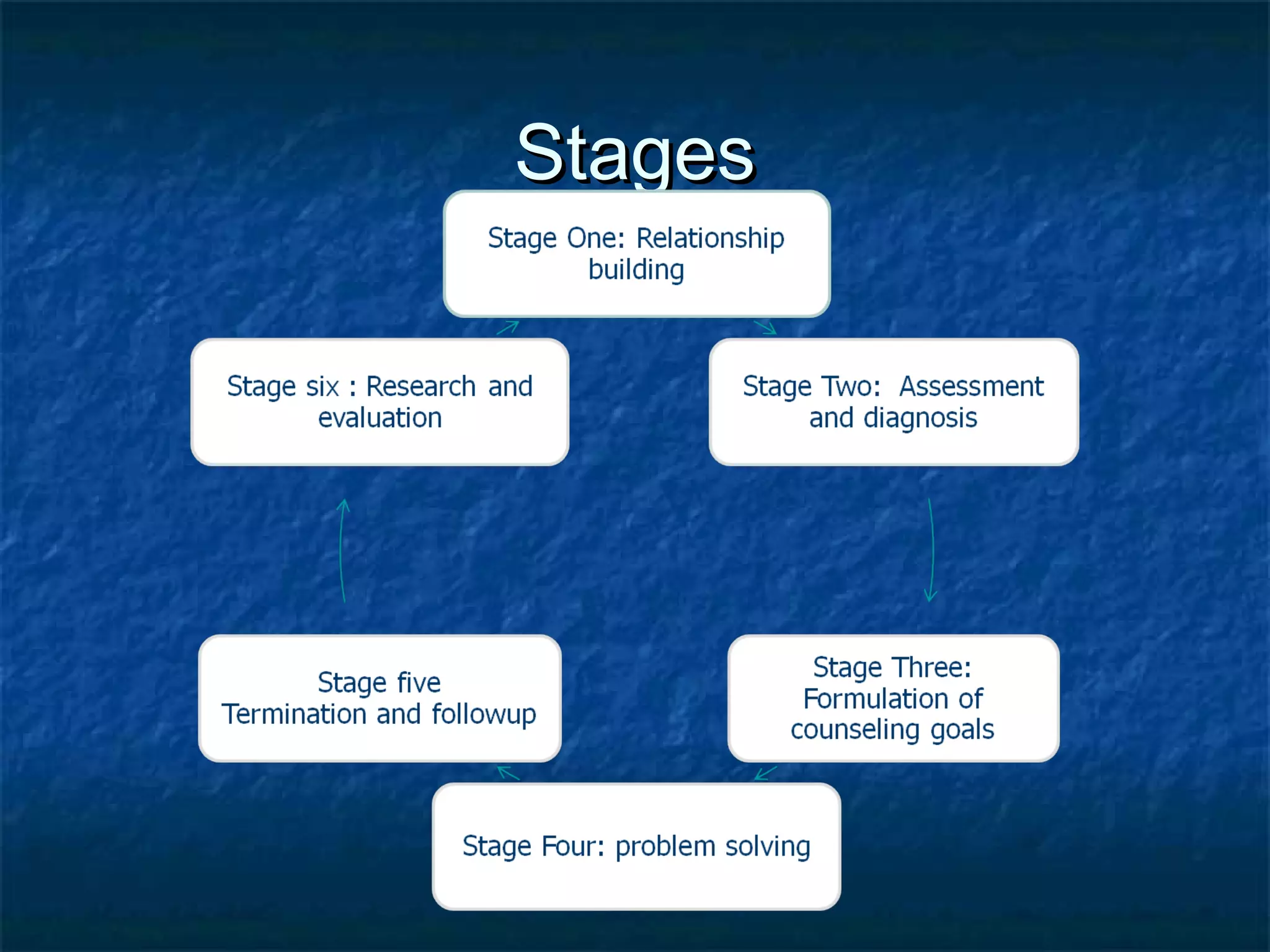
StagesStages
Stage OneStage One
Relationship BuildingRelationship Building
Tasks here include…Tasks here include…
*Laying foundations for trust*Laying foundations for trust
*Establishing the structure and form the*Establishing the structure and form the
relationship will takerelationship will take
*Informed consent process*Informed consent process
Stage TwoStage Two
Assessment and DiagnosisAssessment and Diagnosis
Gathering information to promote understanding ofGathering information to promote understanding of
client’sclient’s
situation and perspective….situation and perspective….
Completion of intake/of psychosocialCompletion of intake/of psychosocial
Standardized (e.g. psychological tests) andStandardized (e.g. psychological tests) and
Non standardized (e.g. clinical interview)Non standardized (e.g. clinical interview)
toolstools
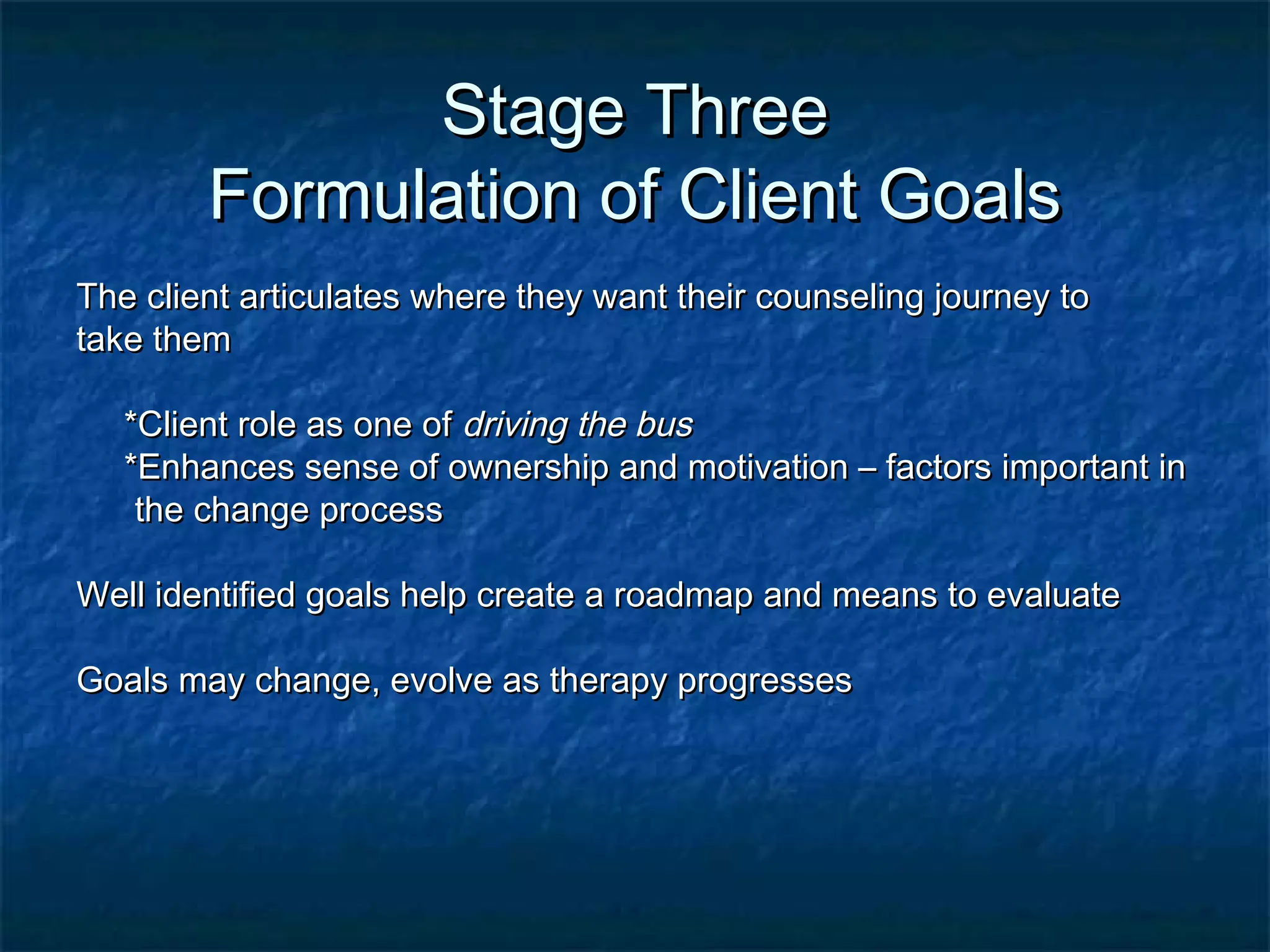
Stage ThreeStage Three
Formulation of Client GoalsFormulation of Client Goals
The client articulates where they want their counseling journey toThe client articulates where they want their counseling journey to
take themtake them
*Client role as one of*Client role as one of driving the busdriving the bus
*Enhances sense of ownership and motivation – factors important in*Enhances sense of ownership and motivation – factors important in
the change processthe change process
Well identified goals help create a roadmap and means to evaluateWell identified goals help create a roadmap and means to evaluate
Goals may change, evolve as therapy progressesGoals may change, evolve as therapy progresses
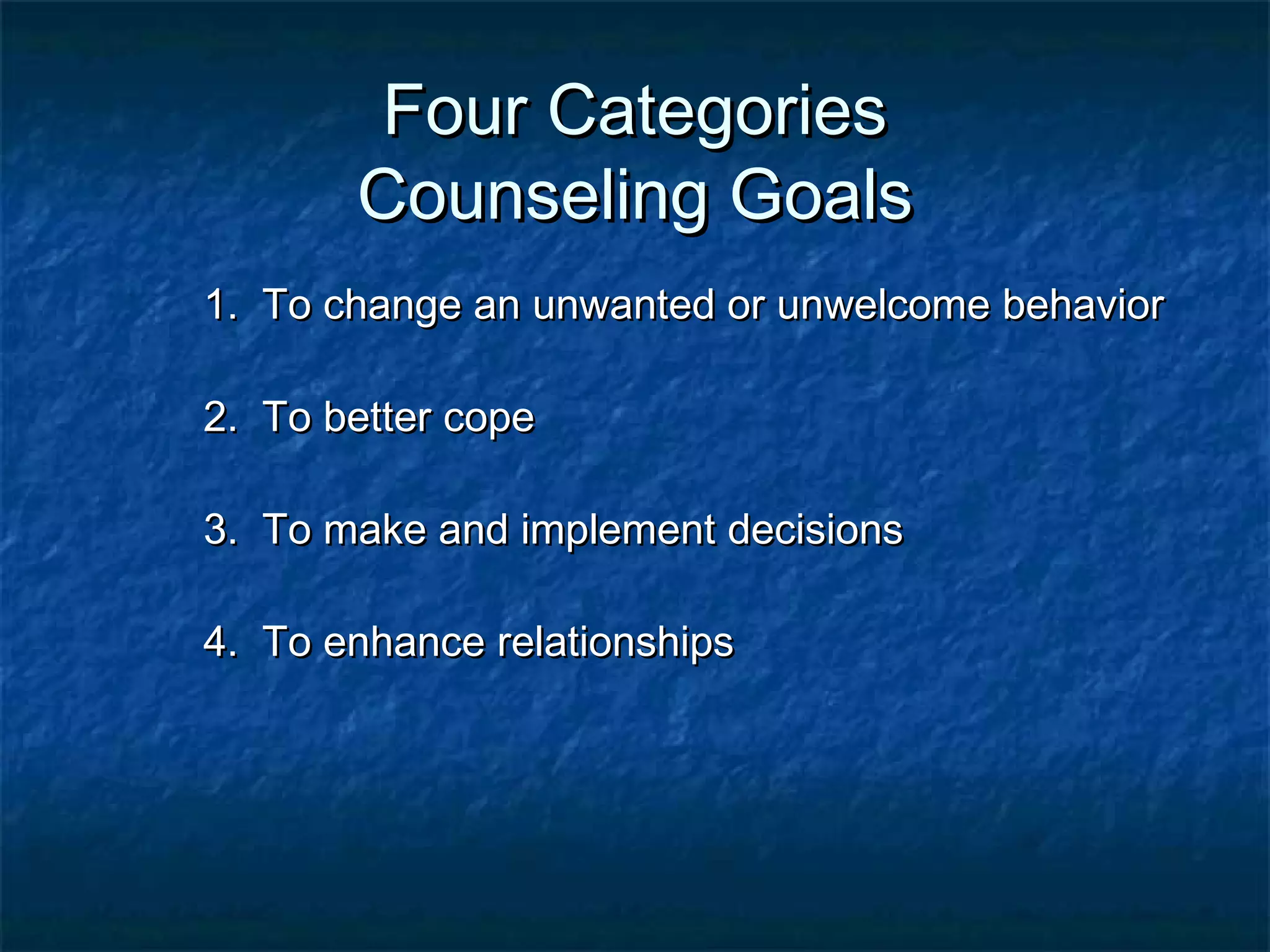
Four CategoriesFour Categories
Counseling GoalsCounseling Goals
1. To change an unwanted or unwelcome behavior1. To change an unwanted or unwelcome behavior
2. To better cope2. To better cope
3. To make and implement decisions3. To make and implement decisions
4. To enhance relationships4. To enhance relationships
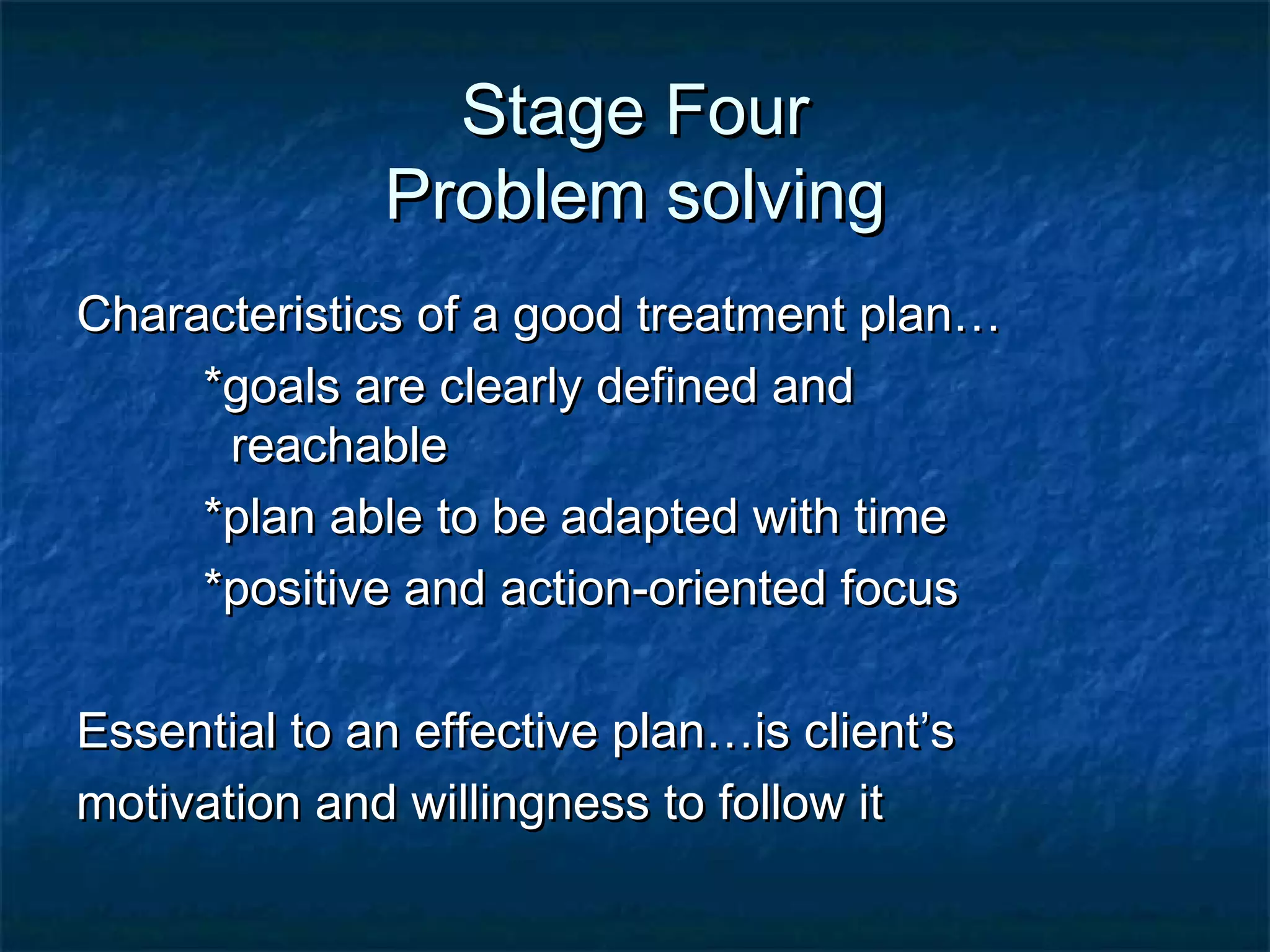
Stage FourStage Four
Problem solvingProblem solving
Characteristics of a good treatment plan…Characteristics of a good treatment plan…
*goals are clearly defined and*goals are clearly defined and
reachablereachable
*plan able to be adapted with time*plan able to be adapted with time
*positive and action-oriented focus*positive and action-oriented focus
Essential to an effective plan…is client’sEssential to an effective plan…is client’s
motivation and willingness to follow itmotivation and willingness to follow it
Types of Counseling
 •Directive Counseling
 •Non – Directive Counseling
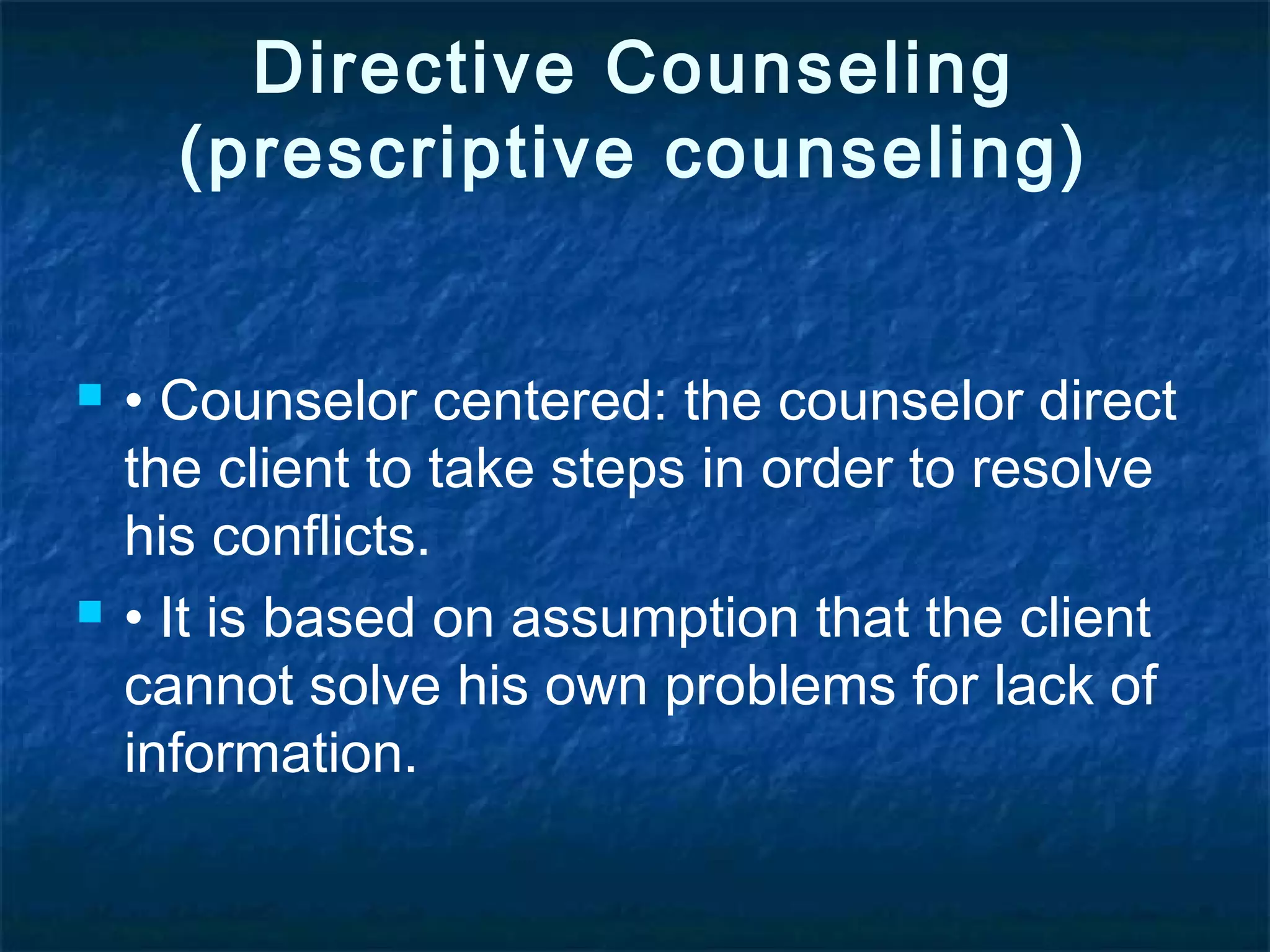
Directive Counseling
(prescriptive counseling)
 • Counselor centered: the counselor direct
the client to take steps in order to resolve
his conflicts.
 • It is based on assumption that the client
cannot solve his own problems for lack of
information.
Cont…Cont…
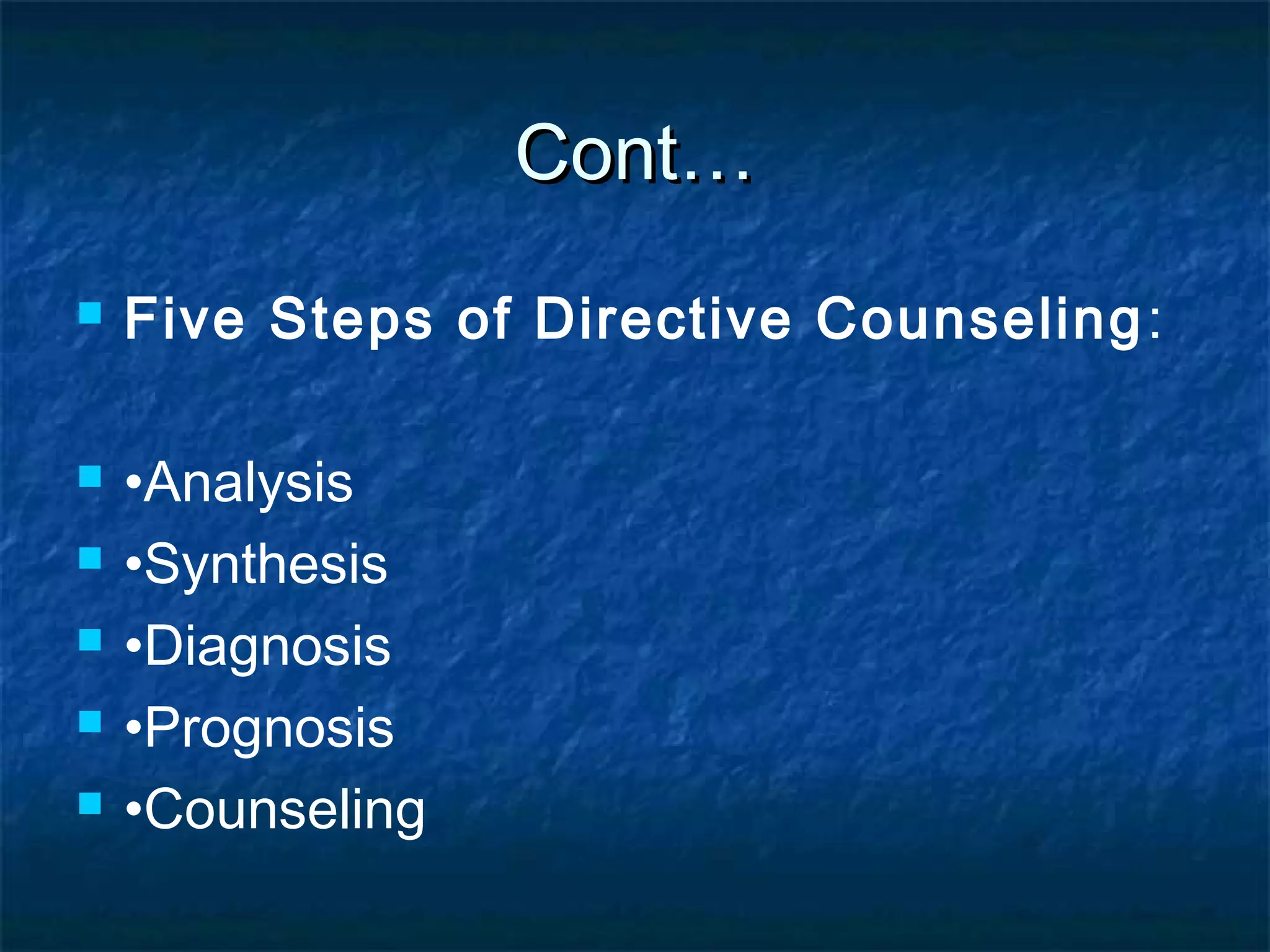
 Five Steps of Directive Counseling:
 •Analysis
 •Synthesis
 •Diagnosis
 •Prognosis
 •Counseling
Cont…Cont…
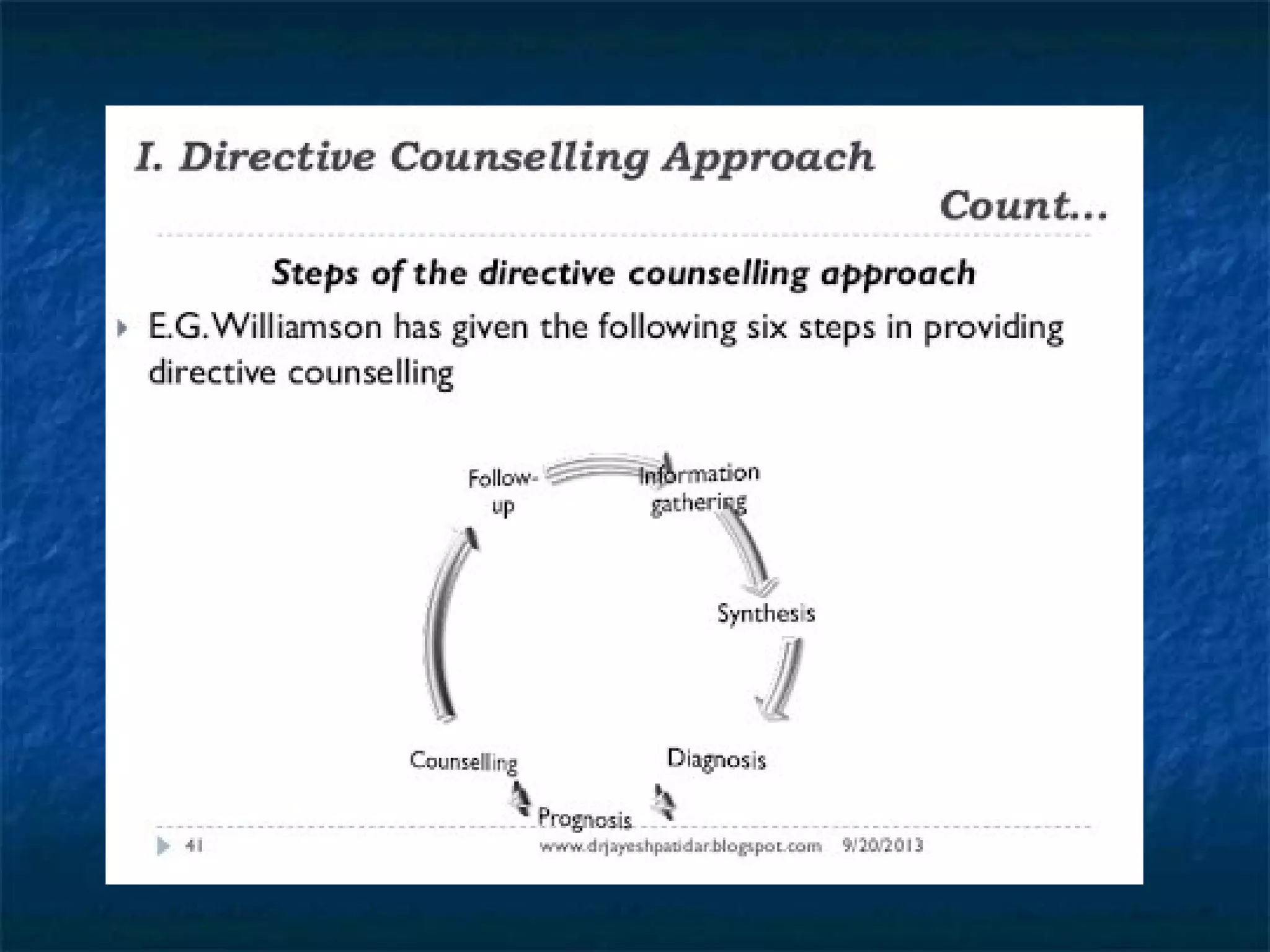
 ‐‐ Analysis – to understand the client‐information collected is analyzed.  Analysis – to understand the client‐information collected is analyzed.  
   
 ‐‐ Synthesis – data collected is summarized and organized to understand Synthesis – data collected is summarized and organized to understand 
 client’s strengths, weaknesses, adjustment, etc. client’s strengths, weaknesses, adjustment, etc. 
   
 ‐‐ Diagnosis  –  drawing  conclusions  about  the  nature  and  causes  of Diagnosis  –  drawing  conclusions  about  the  nature  and  causes  of 
 client’s problem.    client’s problem.    
 ‐‐ Prognosis – predicting the future development of the client’s problem.    Prognosis – predicting the future development of the client’s problem.    
 ‐‐ Counseling – brings about adjustment or readjustment in the client.    Counseling – brings about adjustment or readjustment in the client.    
 ‐‐ Follow‐up  ‐ after counseling is over, the counselor helps the client to Follow‐up  ‐ after counseling is over, the counselor helps the client to 
 readjust the old problem reoccurs.  readjust the old problem reoccurs.  
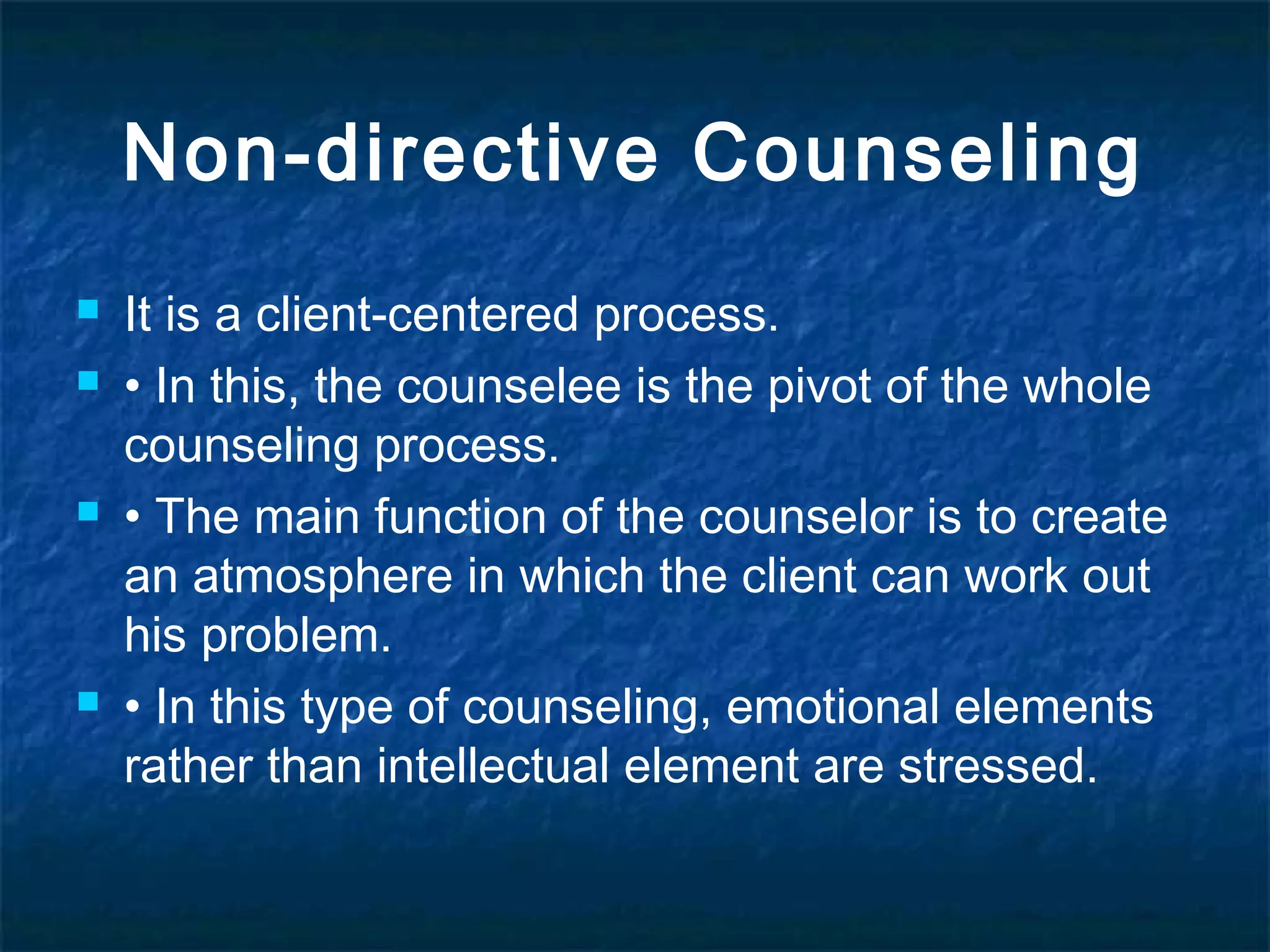
Non-directive Counseling
 It is a client-centered process.
 • In this, the counselee is the pivot of the whole
counseling process.
 • The main function of the counselor is to create
an atmosphere in which the client can work out
his problem.
 • In this type of counseling, emotional elements
rather than intellectual element are stressed.

The counseling process

  • 1.
    The Counseling ProcessTheCounseling Process
  • 2.
    COUNSELLING PROCESS For examplestudents in a college or university may be anxious about how to study in university, lack of clarity on educational or career direction, have difficulty living with a room-mate of another race or religion, have concerns with self-esteem, feelings with being “stressed out”, difficulties in relationships and so forth
  • 3.
  • 4.
    Stage OneStage One RelationshipBuildingRelationship Building Tasks here include…Tasks here include… *Laying foundations for trust*Laying foundations for trust *Establishing the structure and form the*Establishing the structure and form the relationship will takerelationship will take *Informed consent process*Informed consent process
  • 5.
    Stage TwoStage Two Assessmentand DiagnosisAssessment and Diagnosis Gathering information to promote understanding ofGathering information to promote understanding of client’sclient’s situation and perspective….situation and perspective…. Completion of intake/of psychosocialCompletion of intake/of psychosocial Standardized (e.g. psychological tests) andStandardized (e.g. psychological tests) and Non standardized (e.g. clinical interview)Non standardized (e.g. clinical interview) toolstools
  • 6.
    Stage ThreeStage Three Formulationof Client GoalsFormulation of Client Goals The client articulates where they want their counseling journey toThe client articulates where they want their counseling journey to take themtake them *Client role as one of*Client role as one of driving the busdriving the bus *Enhances sense of ownership and motivation – factors important in*Enhances sense of ownership and motivation – factors important in the change processthe change process Well identified goals help create a roadmap and means to evaluateWell identified goals help create a roadmap and means to evaluate Goals may change, evolve as therapy progressesGoals may change, evolve as therapy progresses
  • 7.
    Four CategoriesFour Categories CounselingGoalsCounseling Goals 1. To change an unwanted or unwelcome behavior1. To change an unwanted or unwelcome behavior 2. To better cope2. To better cope 3. To make and implement decisions3. To make and implement decisions 4. To enhance relationships4. To enhance relationships
  • 8.
    Stage FourStage Four ProblemsolvingProblem solving Characteristics of a good treatment plan…Characteristics of a good treatment plan… *goals are clearly defined and*goals are clearly defined and reachablereachable *plan able to be adapted with time*plan able to be adapted with time *positive and action-oriented focus*positive and action-oriented focus Essential to an effective plan…is client’sEssential to an effective plan…is client’s motivation and willingness to follow itmotivation and willingness to follow it
  • 9.
    Types of Counseling •Directive Counseling  •Non – Directive Counseling
  • 11.
    Directive Counseling (prescriptive counseling) • Counselor centered: the counselor direct the client to take steps in order to resolve his conflicts.  • It is based on assumption that the client cannot solve his own problems for lack of information.
  • 12.
    Cont…Cont…  Five Stepsof Directive Counseling:  •Analysis  •Synthesis  •Diagnosis  •Prognosis  •Counseling
  • 14.
    Cont…Cont…  ‐‐ Analysis – to understand the client‐information collected is analyzed.  Analysis – to understand the client‐information collected is analyzed.       ‐‐ Synthesis – data collected is summarized and organized to understand Synthesis – data collected is summarized and organized to understand   client’s strengths, weaknesses, adjustment, etc. client’s strengths, weaknesses, adjustment, etc.       ‐‐ Diagnosis  –  drawing  conclusions  about  the  nature  and  causes  of Diagnosis  –  drawing  conclusions  about  the  nature  and  causes  of   client’s problem.    client’s problem.      ‐‐ Prognosis – predicting the future development of the client’s problem.    Prognosis – predicting the future development of the client’s problem.      ‐‐ Counseling – brings about adjustment or readjustment in the client.    Counseling – brings about adjustment or readjustment in the client.      ‐‐ Follow‐up  ‐ after counseling is over, the counselor helps the client to Follow‐up  ‐ after counseling is over, the counselor helps the client to   readjust the old problem reoccurs.  readjust the old problem reoccurs.  
  • 15.
    Non-directive Counseling  Itis a client-centered process.  • In this, the counselee is the pivot of the whole counseling process.  • The main function of the counselor is to create an atmosphere in which the client can work out his problem.  • In this type of counseling, emotional elements rather than intellectual element are stressed.

Editor's Notes

  • #4 Rick wondering about questions we might ask here…e.g. Stage 1: where are the places where legal and ethical issues would arise Stage 2: What assessment would you consider – from an initial look at case info, does it seem to meet criteria for depression? How specifically? What legal/ethical issues here? Stage 3: Important things to know about the setting of goals. What factors that the client brings are going to have an impact here. What goals would you set with her? Stage Four: Here is the intervention stage – consider your developing treatment plan – sketch out an advance idea of your plan to accomplish your goals, think of early, middle and late stages of counseling Stage Five: What is important to consider as you think about termination? Legal/ethical issues? How would you go about it? Stage Six: Research and Evaluation – here the question is how will you know if your work helped this client – how will your experience with him/her inform your future practice?