INDIVIDUAL
COUNSELLING
MEANING
F.P. Robinson describes counselling as aiding
normal people to achieve higher level
adjustment skills which manifest themselves as
increased maturity, independence, personal
integration and responsibility.
MEANING
In short, counselling is an interpersonal
process through which guidance and
support is provided to persons with
psychological problems.
DEFINITION
G.W. GUSTAD HAS DEFINED COUNSELLING AS A LEARNING-ORIENTED PROCESS, CARRIED
ON IN A SIMPLE ONE TO-ONE SOCIAL ENVIRONMENT, IN WHICH A COUNSELLOR,
PROFESSIONALLY COMPETENT IN RELEVANT PSYCHOLOGICAL SKILLS AND KNOWLEDGE,
SEEKS TO ASSIST THE CLIENT BY METHODS APPROPRIATE TO THE LATTER’S NEEDS AND
WITHIN THE CONTEXT OF THE TOTAL PERSONNEL PROGRAMME,TO LEARN MORE ABOUT
HIMSELF,TO LEARN TO PUT SUCH UNDERSTANDING INTO EFFECT IN RELATION TO MORE
CLEARLY PERCEIVED, REALISTICALLY DEFINED GOALS TO THE END THAT THE CLIENT
MAY BECOME A HAPPIER AND MORE PRODUCTIVE MEMBER OF HIS SOCIETY”
ACCORDING TO G. EGAN, G. (1986) SUCCESSFUL COUNSELLING
CAN BE SEEN AS A THREE-STAGE PROCESS
1. EXPLORATION
2. PLANNING
3. ACTION
PROCESS OF COUNSELLING
 Exploration: The client clarifies his/her understanding of the problems that have
brought him/her to counselling.The client explores and clarifies problems.The
counselor helps the client tell his or her story, focusing and clarifying as well as pointing
out blind spots and helping to generate new perspective.
 Planning: Develops strategies to improve his situation.The client develops a plan
for change.The client imagines a new scenario and develops goals to achieve it.
The counselor encourages a commitment to change.
 Action: Takes concrete steps to achieve measurable change.The client moves toward
the preferred scenario.The counsellor helps the client develop strategies for action and
encourages him or her to implement plans and achieve goals.
IN LITERATURE ABOUT COUNSELLING,THE PROCESS COMPRISE OF
FOUR STAGES:
INITIAL INTERVIEW,
THE ASSESSMENT,
THE MIDDLE PHASE AND
THE TERMINATION.
STEPS IN COUNSELLING PROCESS
PREPARATORY
STAGE
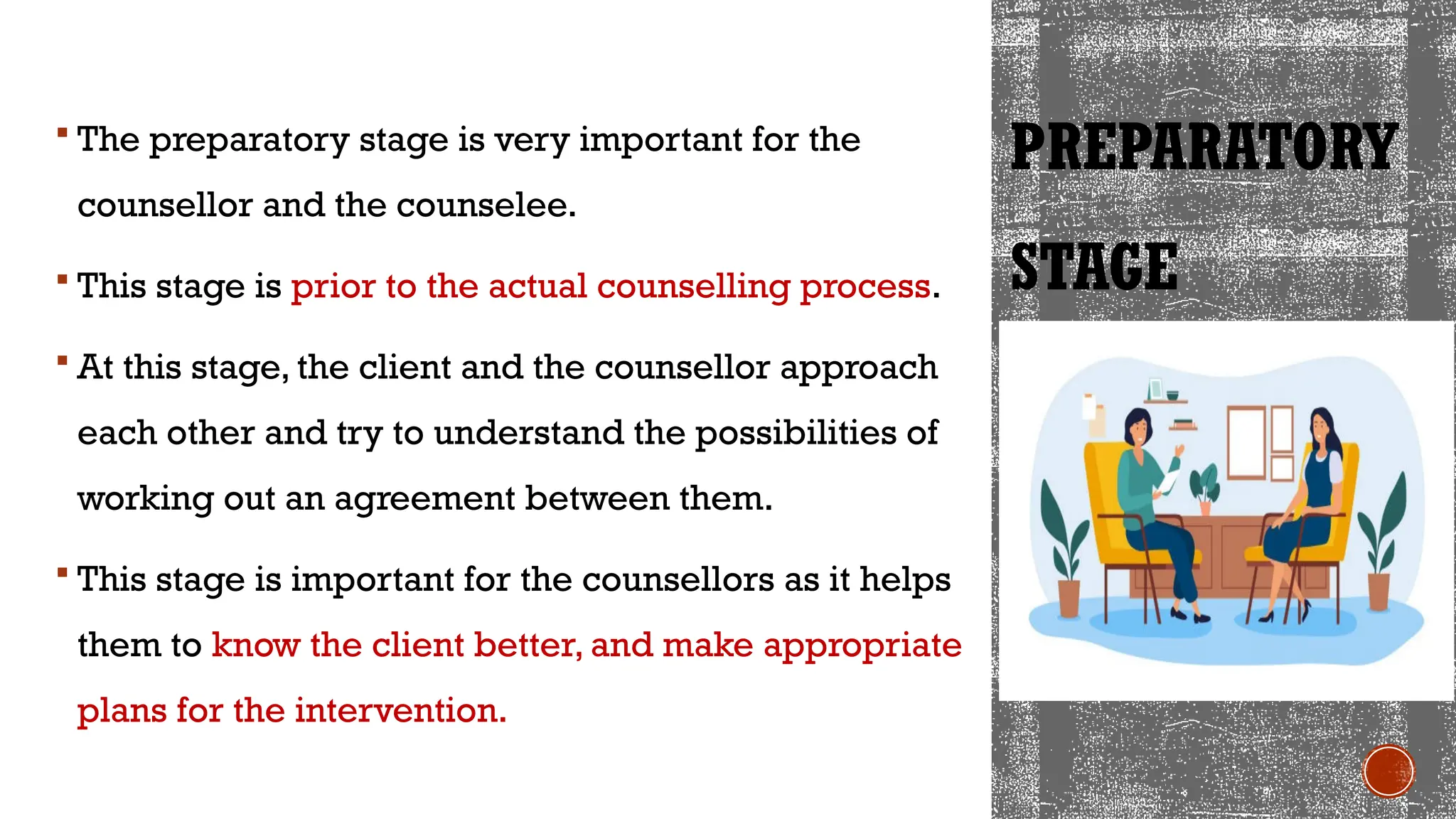
 The preparatory stage is very important for the
counsellor and the counselee.
 This stage is prior to the actual counselling process.
 At this stage, the client and the counsellor approach
each other and try to understand the possibilities of
working out an agreement between them.
 This stage is important for the counsellors as it helps
them to know the client better, and make appropriate
plans for the intervention.
THE BASIC SKILLS REQUIRED AT THIS STAGE ARE
SOCIAL SKILLS,
ATTENDING SKILLS,
OBSERVING AND LISTENING SKILLS
THE ATTITUDES REQUIRED ARE
RESPECT,
GENUINENESS AND
EMPATHY.
EXPLORATORY
STAGE
 In this stage the client and counsellor meet in the
counselling room.The actual counselling begins at this
point of time.
 It is the first session of counselling in which the intake
process or admission of the client into the formalities of
counselling are completed.
 The purpose of this stage is building the counselee's trust
in the counsellor.
 At this stage the information is obtained primarily from the
client, but it may also be sought, with the permission of the
client, from significant other in the client’s life.
THE AREAS OF ENQUIRY FOR GETTING INFORMATION
 1.The problem, and its effects on the
client and his environment;
 2. Probable factors that create and
maintain these problems;
 3. Probable factors that may relieve these
problems;
 4.The clients understanding about the
problem and efforts to tackle the problem.
1.The client’s adjustment at home, at work,
with friends, with persons of the opposite
sex, and with society in general;
2.The client’s strengths and weaknesses,
good and bad habits, likes and dislikes;
and,
3. how the client spends his time or runs his
life.
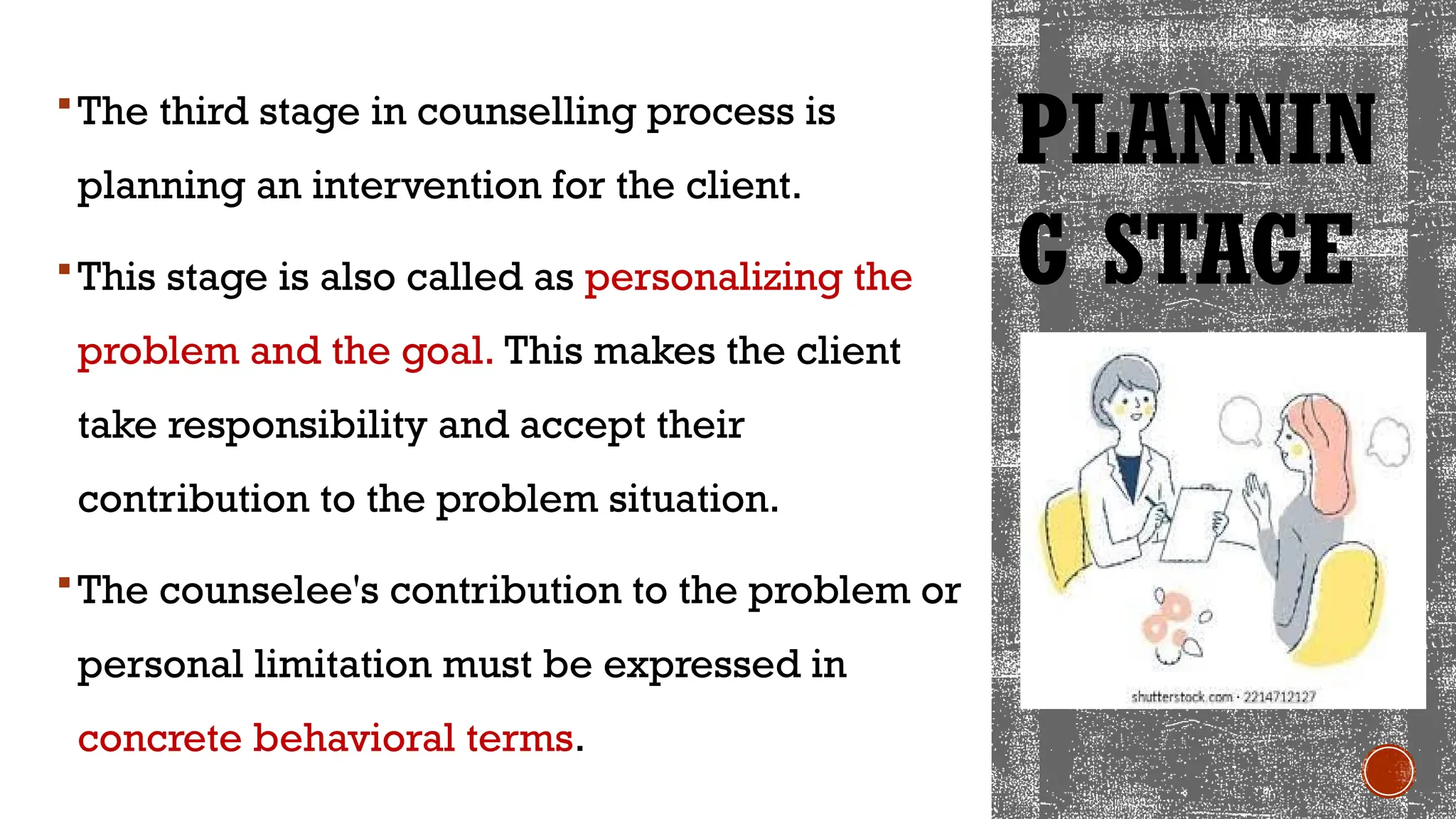
PLANNIN
G STAGE
The third stage in counselling process is
planning an intervention for the client.
This stage is also called as personalizing the
problem and the goal. This makes the client
take responsibility and accept their
contribution to the problem situation.
The counselee's contribution to the problem or
personal limitation must be expressed in
concrete behavioral terms.
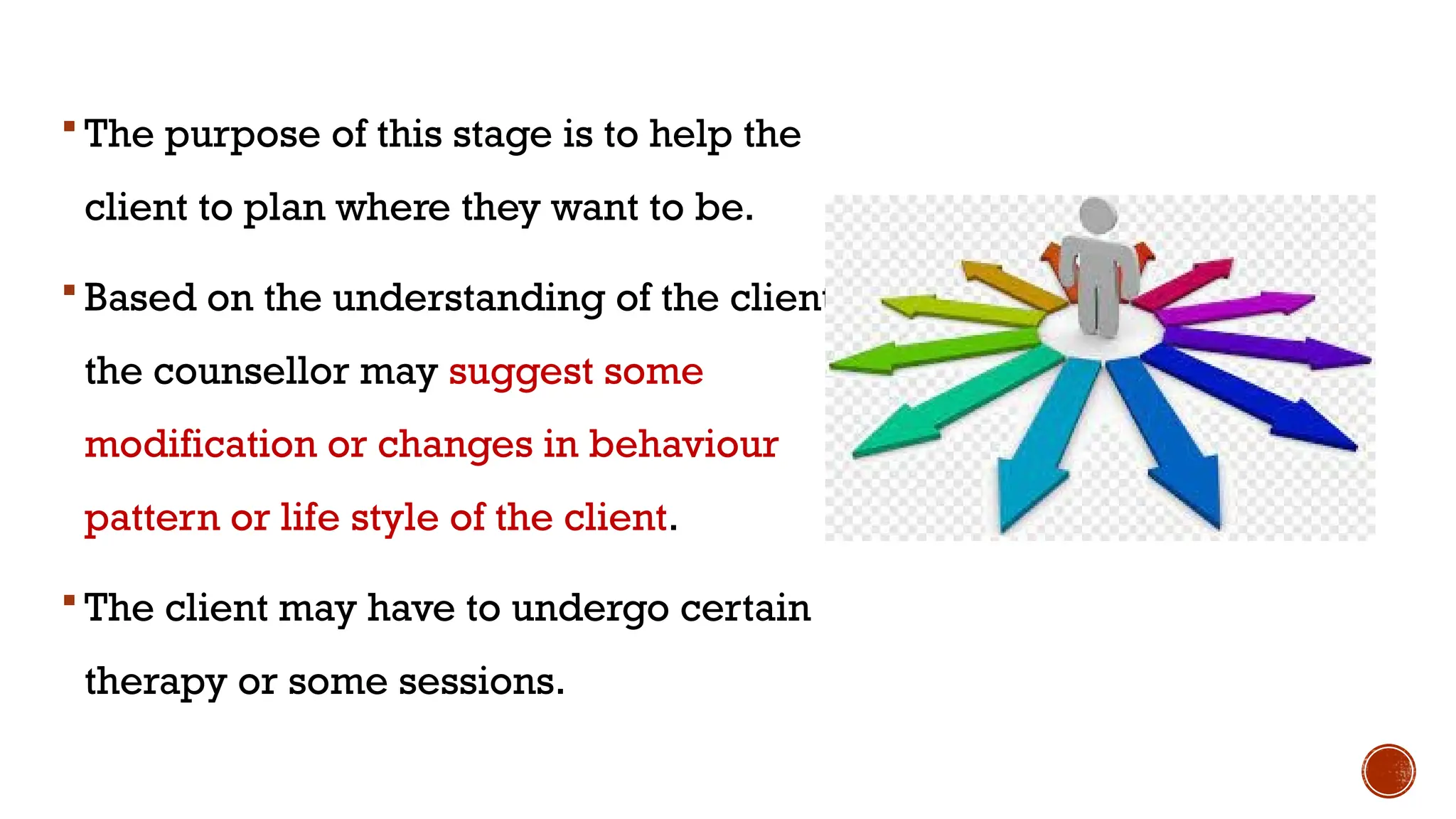
 The purpose of this stage is to help the
client to plan where they want to be.
 Based on the understanding of the client
the counsellor may suggest some
modification or changes in behaviour
pattern or life style of the client.
 The client may have to undergo certain
therapy or some sessions.
ACTION
STAGE
The counsellor helps the client develop
strategies for action and encourages him or
her to implement plans and achieve goals.
The counsellor helps the client by
identifying appropriate and systematic steps
suitable to his/her need and resources.
RESOLUTION OF EMOTIONAL CRISIS;
RESOLUTION OF PROBLEM BEHAVIOURS;
IMPROVED SELF-CONFIDENCE AND SELF-ESTEEM;
IMPROVED SELF-CONTROL AND FRUSTRATION TOLERANCE;
IMPROVED REALITY ORIENTATION AND APPRAISAL OF THREATS;
IMPROVED COMMUNICATION AND PROBLEM-SOLVING SKILLS; AND
IMPROVED OVERALL ADJUSTMENT, JUDGMENT, AND EMOTIONAL STABILITY.
The therapeutic gains during the action stage
include:
EVALUATION
AND
TERMINATION
STAGE
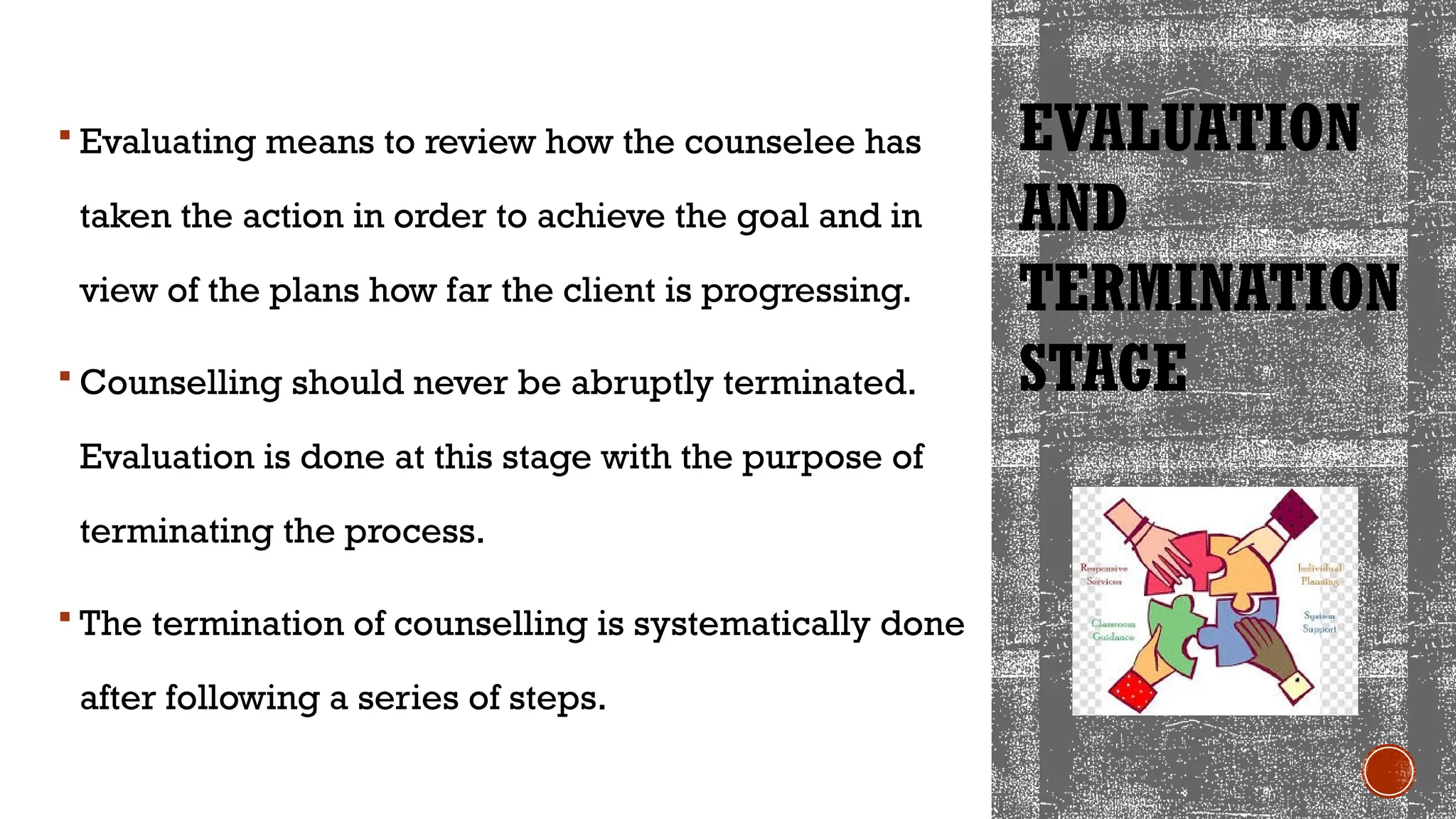
 Evaluating means to review how the counselee has
taken the action in order to achieve the goal and in
view of the plans how far the client is progressing.
 Counselling should never be abruptly terminated.
Evaluation is done at this stage with the purpose of
terminating the process.
 The termination of counselling is systematically done
after following a series of steps.
THE COUNSELLOR DURING THE EVALUATION AND TERMINATION STAGE ENSURES
THE FOLLOWINGS:
 1. Evaluating readiness for termination of counselling process;
 2. Letting the client know in advance about the termination of counselling;
 3. Discuss with client the readiness for termination;
 4. Review the course of action plan;
 5. Emphasis the client’s role in effecting change;
 6.Warning against the danger of ‘flight into health’;
 7. Giving instructions for the maintenance of adaptive functioning;
 8. Discussion of follow up sessions; and
 9. Assuring the availability of counsellor in case of relapse into
dysfunction.
THANK YOU

Individual counselling Process and Stages

  • 1.
  • 2.
    MEANING F.P. Robinson describescounselling as aiding normal people to achieve higher level adjustment skills which manifest themselves as increased maturity, independence, personal integration and responsibility.
  • 3.
    MEANING In short, counsellingis an interpersonal process through which guidance and support is provided to persons with psychological problems.
  • 4.
    DEFINITION G.W. GUSTAD HASDEFINED COUNSELLING AS A LEARNING-ORIENTED PROCESS, CARRIED ON IN A SIMPLE ONE TO-ONE SOCIAL ENVIRONMENT, IN WHICH A COUNSELLOR, PROFESSIONALLY COMPETENT IN RELEVANT PSYCHOLOGICAL SKILLS AND KNOWLEDGE, SEEKS TO ASSIST THE CLIENT BY METHODS APPROPRIATE TO THE LATTER’S NEEDS AND WITHIN THE CONTEXT OF THE TOTAL PERSONNEL PROGRAMME,TO LEARN MORE ABOUT HIMSELF,TO LEARN TO PUT SUCH UNDERSTANDING INTO EFFECT IN RELATION TO MORE CLEARLY PERCEIVED, REALISTICALLY DEFINED GOALS TO THE END THAT THE CLIENT MAY BECOME A HAPPIER AND MORE PRODUCTIVE MEMBER OF HIS SOCIETY”
  • 5.
    ACCORDING TO G.EGAN, G. (1986) SUCCESSFUL COUNSELLING CAN BE SEEN AS A THREE-STAGE PROCESS 1. EXPLORATION 2. PLANNING 3. ACTION PROCESS OF COUNSELLING
  • 6.
     Exploration: Theclient clarifies his/her understanding of the problems that have brought him/her to counselling.The client explores and clarifies problems.The counselor helps the client tell his or her story, focusing and clarifying as well as pointing out blind spots and helping to generate new perspective.  Planning: Develops strategies to improve his situation.The client develops a plan for change.The client imagines a new scenario and develops goals to achieve it. The counselor encourages a commitment to change.  Action: Takes concrete steps to achieve measurable change.The client moves toward the preferred scenario.The counsellor helps the client develop strategies for action and encourages him or her to implement plans and achieve goals.
  • 7.
    IN LITERATURE ABOUTCOUNSELLING,THE PROCESS COMPRISE OF FOUR STAGES: INITIAL INTERVIEW, THE ASSESSMENT, THE MIDDLE PHASE AND THE TERMINATION. STEPS IN COUNSELLING PROCESS
  • 8.
    PREPARATORY STAGE  The preparatorystage is very important for the counsellor and the counselee.  This stage is prior to the actual counselling process.  At this stage, the client and the counsellor approach each other and try to understand the possibilities of working out an agreement between them.  This stage is important for the counsellors as it helps them to know the client better, and make appropriate plans for the intervention.
  • 9.
    THE BASIC SKILLSREQUIRED AT THIS STAGE ARE SOCIAL SKILLS, ATTENDING SKILLS, OBSERVING AND LISTENING SKILLS THE ATTITUDES REQUIRED ARE RESPECT, GENUINENESS AND EMPATHY.
  • 10.
    EXPLORATORY STAGE  In thisstage the client and counsellor meet in the counselling room.The actual counselling begins at this point of time.  It is the first session of counselling in which the intake process or admission of the client into the formalities of counselling are completed.  The purpose of this stage is building the counselee's trust in the counsellor.  At this stage the information is obtained primarily from the client, but it may also be sought, with the permission of the client, from significant other in the client’s life.
  • 11.
    THE AREAS OFENQUIRY FOR GETTING INFORMATION  1.The problem, and its effects on the client and his environment;  2. Probable factors that create and maintain these problems;  3. Probable factors that may relieve these problems;  4.The clients understanding about the problem and efforts to tackle the problem. 1.The client’s adjustment at home, at work, with friends, with persons of the opposite sex, and with society in general; 2.The client’s strengths and weaknesses, good and bad habits, likes and dislikes; and, 3. how the client spends his time or runs his life.
  • 12.
    PLANNIN G STAGE The thirdstage in counselling process is planning an intervention for the client. This stage is also called as personalizing the problem and the goal. This makes the client take responsibility and accept their contribution to the problem situation. The counselee's contribution to the problem or personal limitation must be expressed in concrete behavioral terms.
  • 13.
     The purposeof this stage is to help the client to plan where they want to be.  Based on the understanding of the client the counsellor may suggest some modification or changes in behaviour pattern or life style of the client.  The client may have to undergo certain therapy or some sessions.
  • 14.
    ACTION STAGE The counsellor helpsthe client develop strategies for action and encourages him or her to implement plans and achieve goals. The counsellor helps the client by identifying appropriate and systematic steps suitable to his/her need and resources.
  • 15.
    RESOLUTION OF EMOTIONALCRISIS; RESOLUTION OF PROBLEM BEHAVIOURS; IMPROVED SELF-CONFIDENCE AND SELF-ESTEEM; IMPROVED SELF-CONTROL AND FRUSTRATION TOLERANCE; IMPROVED REALITY ORIENTATION AND APPRAISAL OF THREATS; IMPROVED COMMUNICATION AND PROBLEM-SOLVING SKILLS; AND IMPROVED OVERALL ADJUSTMENT, JUDGMENT, AND EMOTIONAL STABILITY. The therapeutic gains during the action stage include:
  • 16.
    EVALUATION AND TERMINATION STAGE  Evaluating meansto review how the counselee has taken the action in order to achieve the goal and in view of the plans how far the client is progressing.  Counselling should never be abruptly terminated. Evaluation is done at this stage with the purpose of terminating the process.  The termination of counselling is systematically done after following a series of steps.
  • 17.
    THE COUNSELLOR DURINGTHE EVALUATION AND TERMINATION STAGE ENSURES THE FOLLOWINGS:  1. Evaluating readiness for termination of counselling process;  2. Letting the client know in advance about the termination of counselling;  3. Discuss with client the readiness for termination;  4. Review the course of action plan;  5. Emphasis the client’s role in effecting change;  6.Warning against the danger of ‘flight into health’;  7. Giving instructions for the maintenance of adaptive functioning;  8. Discussion of follow up sessions; and  9. Assuring the availability of counsellor in case of relapse into dysfunction.
  • 18.