 Discourse analysis is used to provide a
linguistic description of the interaction which
goes on in EFL classrooms.
 It was used for many reasons:
- Using authentic and naturally-occurring data
as a source
- It establishes in the process new insights
into the sequencing of patterns of interaction.
 What are the predominant patterns of
classroom interaction between teachers and
students in EFL classrooms?
 Are the interactions teacher-dominated or
student –dominated?
 How are such patterns affected by genders?
 The Participants
The classes were single-gender, boys being
taught by male teachers and girls by female
ones.
 Data Collection
The classes were observed and audio-taped
using a MP3 player.
The data collector was present in the
classroom as a non-participant observer.
Each class period involved:
 Covering homework material
 Teaching grammatical points, a reading
passage, vocabulary items or a conversation
 Listening to a text either as a whole-class
activity or as a pair work
 Data Analysis Procedure
- In the teacher talk were such utterances as
‘you’, ‘yes?’
- Some categories were too general to depict
subtle distinctions in the patterns of classroom
interaction between teachers and students
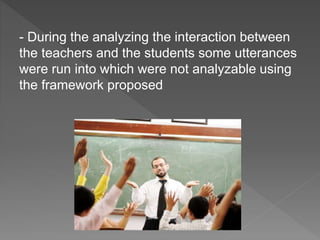
- During the analyzing the interaction between
the teachers and the students some utterances
were run into which were not analyzable using
the framework proposed
 A large number of discourse acts were
present in Teacher-Student Talk.
 Some discourse acts have been added to
Student-Teacher Talk.
 The interaction between the students
reflected the use of variety of discourse acts.
 There was not much difference between
male and female teachers regarding their
patterns of interaction with their students.
 There is difference in ‘Criticism’ because it
was present in female teachers’ talk and
absent in male teachers’ talk.
 Both male and female students made use of
the same discourse acts in their interaction
with their teachers.
 The interaction patterns between the
participants in all three types of talk showed
variation.
 These interactions sharing some
commonalities with the interaction taking
place in natural contexts occurring outside
the classroom
 The teachers sould take up the major
portion of all talk occurring in the classroom
 There is not much difference between male
and female teachers.
 Female teachers were more supportive and
encouraging, providing the students with a
positive evaluation more often than male
teachers.

The classroom interactions

  • 2.
     Discourse analysisis used to provide a linguistic description of the interaction which goes on in EFL classrooms.
  • 3.
     It wasused for many reasons: - Using authentic and naturally-occurring data as a source - It establishes in the process new insights into the sequencing of patterns of interaction.
  • 4.
     What arethe predominant patterns of classroom interaction between teachers and students in EFL classrooms?  Are the interactions teacher-dominated or student –dominated?  How are such patterns affected by genders?
  • 5.
     The Participants Theclasses were single-gender, boys being taught by male teachers and girls by female ones.
  • 6.
     Data Collection Theclasses were observed and audio-taped using a MP3 player. The data collector was present in the classroom as a non-participant observer.
  • 7.
    Each class periodinvolved:  Covering homework material  Teaching grammatical points, a reading passage, vocabulary items or a conversation  Listening to a text either as a whole-class activity or as a pair work
  • 8.
     Data AnalysisProcedure - In the teacher talk were such utterances as ‘you’, ‘yes?’ - Some categories were too general to depict subtle distinctions in the patterns of classroom interaction between teachers and students
  • 9.
    - During theanalyzing the interaction between the teachers and the students some utterances were run into which were not analyzable using the framework proposed
  • 10.
     A largenumber of discourse acts were present in Teacher-Student Talk.  Some discourse acts have been added to Student-Teacher Talk.  The interaction between the students reflected the use of variety of discourse acts.
  • 11.
     There wasnot much difference between male and female teachers regarding their patterns of interaction with their students.
  • 12.
     There isdifference in ‘Criticism’ because it was present in female teachers’ talk and absent in male teachers’ talk.
  • 13.
     Both maleand female students made use of the same discourse acts in their interaction with their teachers.
  • 14.
     The interactionpatterns between the participants in all three types of talk showed variation.  These interactions sharing some commonalities with the interaction taking place in natural contexts occurring outside the classroom
  • 15.
     The teacherssould take up the major portion of all talk occurring in the classroom  There is not much difference between male and female teachers.
  • 16.
     Female teacherswere more supportive and encouraging, providing the students with a positive evaluation more often than male teachers.