 It is based on a characterization of the
unique learning conditions adult L2 learners
face.
 Adults already possess a well-established
conceptual and lexical system.
 Adult L2 vocabulary acquisition is
accompanied by little conceptual or semantic
development.
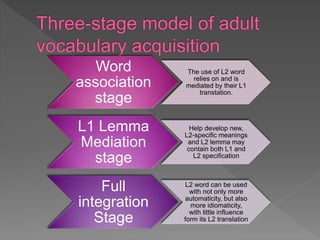
Word
association
stage
The use of L2 word
relies on and is
mediated by their L1
transtation.
L1 Lemma
Mediation
stage
Help develop new,
L2-specific meanings
and L2 lemma may
contain both L1 and
L2 specification
Full
integration
Stage
L2 word can be used
with not only more
automaticity, but also
more idiomaticity,
with little influence
form its L2 translation
 Empirical investigation for at least two
reasons:
- Form-meaning mapping that has remained
the focus of attention in the study of child
vocabulary acquisition.
- The semantic transfer clain represents a
view of form-meaning mappling that is often
in contrast to the assumption held by many
L2 researchers.
 Active relation
A semantic relation between two concepts
 Antonymy
The opposite of a word. Ex: cold vs warm
 Associative relation
A relation which is defined psychologically
 Causal relation
Something is the cause of other something
Example: scurvy is caused by lack of vitamin C
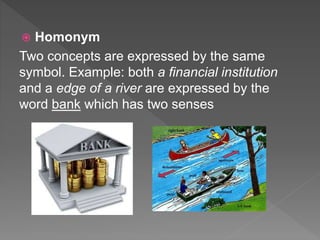
 Homonym
Two concepts are expressed by the same
symbol. Example: both a financial institution
and a edge of a river are expressed by the
word bank which has two senses
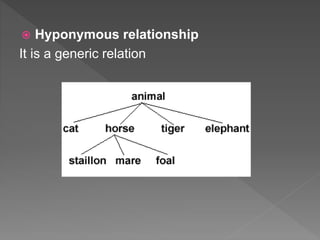
 Hyponymous relationship
It is a generic relation
 Instance-of relation
Designates the semantic relations between a
general concept and individual instances of that
concept
 Locative relation
A semantic relation in which a concept
indicates a location of a thing designated by
another concept.
 Meronymy, partitive relation
A relationship between the whole and it parts
 Passive relation
A semantic relation between two concepts, one
of which is affected by or subjected to an
operation or process expressed by the other.
 Paradigmatic relation
A semantic relation between two concepts, that
is considered to be either fixed by nature, self-
evident, or established by convention.
 Polysemy
A polysemous word is a word that has severañ
sub-senses which are related with one another
 Possessive
A relation between a possessor and what is
possessed
 Related term
A term that is semantically related to another
term.
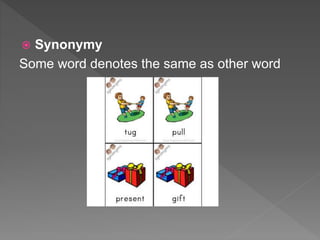
 Synonymy
Some word denotes the same as other word
 Temporal relation
A semantic relation in which a concept
indicates a time or period of an event
designated by another concept
 Troponymy
It is the semantic relation of being a manner of
does something
 Semantics has relation with the teaching
vocabulary because it is the study of
meaning and for understanding vocabulary,
we need to know the meaning of the words.
 Paper attached
 http://www.iva.dk/bh/lifeboat_ko/CONCEPTS
/semantic_relations.htm
 Meaning and discourse

Semantics and teaching vocabulary

  • 2.
     It isbased on a characterization of the unique learning conditions adult L2 learners face.  Adults already possess a well-established conceptual and lexical system.  Adult L2 vocabulary acquisition is accompanied by little conceptual or semantic development.
  • 3.
    Word association stage The use ofL2 word relies on and is mediated by their L1 transtation. L1 Lemma Mediation stage Help develop new, L2-specific meanings and L2 lemma may contain both L1 and L2 specification Full integration Stage L2 word can be used with not only more automaticity, but also more idiomaticity, with little influence form its L2 translation
  • 4.
     Empirical investigationfor at least two reasons: - Form-meaning mapping that has remained the focus of attention in the study of child vocabulary acquisition. - The semantic transfer clain represents a view of form-meaning mappling that is often in contrast to the assumption held by many L2 researchers.
  • 5.
     Active relation Asemantic relation between two concepts  Antonymy The opposite of a word. Ex: cold vs warm
  • 6.
     Associative relation Arelation which is defined psychologically  Causal relation Something is the cause of other something Example: scurvy is caused by lack of vitamin C
  • 7.
     Homonym Two conceptsare expressed by the same symbol. Example: both a financial institution and a edge of a river are expressed by the word bank which has two senses
  • 8.
     Hyponymous relationship Itis a generic relation
  • 9.
     Instance-of relation Designatesthe semantic relations between a general concept and individual instances of that concept  Locative relation A semantic relation in which a concept indicates a location of a thing designated by another concept.
  • 10.
     Meronymy, partitiverelation A relationship between the whole and it parts  Passive relation A semantic relation between two concepts, one of which is affected by or subjected to an operation or process expressed by the other.
  • 11.
     Paradigmatic relation Asemantic relation between two concepts, that is considered to be either fixed by nature, self- evident, or established by convention.  Polysemy A polysemous word is a word that has severañ sub-senses which are related with one another
  • 12.
     Possessive A relationbetween a possessor and what is possessed  Related term A term that is semantically related to another term.
  • 13.
     Synonymy Some worddenotes the same as other word
  • 14.
     Temporal relation Asemantic relation in which a concept indicates a time or period of an event designated by another concept  Troponymy It is the semantic relation of being a manner of does something
  • 15.
     Semantics hasrelation with the teaching vocabulary because it is the study of meaning and for understanding vocabulary, we need to know the meaning of the words.
  • 16.
     Paper attached http://www.iva.dk/bh/lifeboat_ko/CONCEPTS /semantic_relations.htm  Meaning and discourse