


LANGUAGE
TEACHING
METHODOLOGIES
BY CHRISTINE P. LONOY
FACULTY, LIBERAL ARTS AND EDUCATION DEPARTMENT
THECOLLEGEOF MAASIN, MAASIN CITY, SO. LEYTE
Brown (1994: 52) portrays
language teaching as the
“changing winds and
shifting sands of language
teaching”.
Behind any teaching
enterprise there always
exist some theoretical
assumptions, refer to
them as guiding lines or
principles.
• Sometimes not even teachers
can state them as such explicit
foundations. But these principles
do work and influence their
everyday teaching activity.
• As Stern (1983: 24-5) puts it, “A
language teacher can express his
theoretical conviction through
classroom activities as much as
(or indeed, better than) through
the opinions he voices in
discussions at professional
meetings”.
These are the
main ideas:
3. As many factors influence the
FL teaching process, a global
theory is required.
4.Throughout history,
controversial trends on methods
have been used. All may have a
positive contribution.
5. A good theory is most of all
practical.
6. Research and reflection
improve the consistency of a
good teaching method.
1. All teachers follow theoretical
principles though they are not
explicitly stated.
2. Beliefs and convictions on the
most effective teaching
method must be reviewed
and tested.
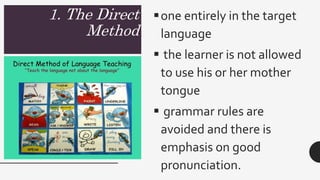
1. The Direct
Method
one entirely in the target
language
 the learner is not allowed
to use his or her mother
tongue
 grammar rules are
avoided and there is
emphasis on good
pronunciation.
2. Grammar-
translation
Learning is largely by
translation to and from the
target language.
 Grammar rules are to be
memorized and long lists
of vocabulary learned by
heart.
 There is little or no
emphasis placed on
developing oral ability.
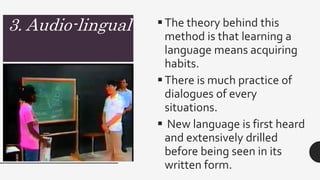
3. Audio-lingual The theory behind this
method is that learning a
language means acquiring
habits.
There is much practice of
dialogues of every
situations.
 New language is first heard
and extensively drilled
before being seen in its
written form.
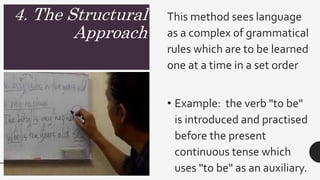
4. The Structural
Approach
This method sees language
as a complex of grammatical
rules which are to be learned
one at a time in a set order
• Example: the verb "to be"
is introduced and practised
before the present
continuous tense which
uses "to be" as an auxiliary.
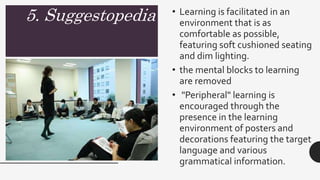
5. Suggestopedia • Learning is facilitated in an
environment that is as
comfortable as possible,
featuring soft cushioned seating
and dim lighting.
• the mental blocks to learning
are removed
• "Peripheral" learning is
encouraged through the
presence in the learning
environment of posters and
decorations featuring the target
language and various
grammatical information.
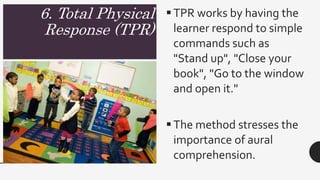
6. Total Physical
Response (TPR)
TPR works by having the
learner respond to simple
commands such as
"Stand up", "Close your
book", "Go to the window
and open it."
The method stresses the
importance of aural
comprehension.
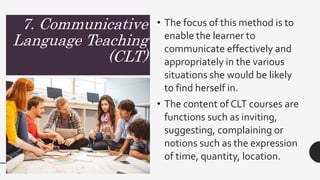
7. Communicative
Language Teaching
(CLT)
• The focus of this method is to
enable the learner to
communicate effectively and
appropriately in the various
situations she would be likely
to find herself in.
• The content of CLT courses are
functions such as inviting,
suggesting, complaining or
notions such as the expression
of time, quantity, location.
Language teaching methodologies

Language teaching methodologies

  • 1.
    LANGUAGE TEACHING METHODOLOGIES BY CHRISTINE P.LONOY FACULTY, LIBERAL ARTS AND EDUCATION DEPARTMENT THECOLLEGEOF MAASIN, MAASIN CITY, SO. LEYTE
  • 2.
    Brown (1994: 52)portrays language teaching as the “changing winds and shifting sands of language teaching”. Behind any teaching enterprise there always exist some theoretical assumptions, refer to them as guiding lines or principles.
  • 3.
    • Sometimes noteven teachers can state them as such explicit foundations. But these principles do work and influence their everyday teaching activity. • As Stern (1983: 24-5) puts it, “A language teacher can express his theoretical conviction through classroom activities as much as (or indeed, better than) through the opinions he voices in discussions at professional meetings”.
  • 4.
    These are the mainideas: 3. As many factors influence the FL teaching process, a global theory is required. 4.Throughout history, controversial trends on methods have been used. All may have a positive contribution. 5. A good theory is most of all practical. 6. Research and reflection improve the consistency of a good teaching method. 1. All teachers follow theoretical principles though they are not explicitly stated. 2. Beliefs and convictions on the most effective teaching method must be reviewed and tested.
  • 5.
    1. The Direct Method oneentirely in the target language  the learner is not allowed to use his or her mother tongue  grammar rules are avoided and there is emphasis on good pronunciation.
  • 6.
    2. Grammar- translation Learning islargely by translation to and from the target language.  Grammar rules are to be memorized and long lists of vocabulary learned by heart.  There is little or no emphasis placed on developing oral ability.
  • 7.
    3. Audio-lingual Thetheory behind this method is that learning a language means acquiring habits. There is much practice of dialogues of every situations.  New language is first heard and extensively drilled before being seen in its written form.
  • 8.
    4. The Structural Approach Thismethod sees language as a complex of grammatical rules which are to be learned one at a time in a set order • Example: the verb "to be" is introduced and practised before the present continuous tense which uses "to be" as an auxiliary.
  • 9.
    5. Suggestopedia •Learning is facilitated in an environment that is as comfortable as possible, featuring soft cushioned seating and dim lighting. • the mental blocks to learning are removed • "Peripheral" learning is encouraged through the presence in the learning environment of posters and decorations featuring the target language and various grammatical information.
  • 10.
    6. Total Physical Response(TPR) TPR works by having the learner respond to simple commands such as "Stand up", "Close your book", "Go to the window and open it." The method stresses the importance of aural comprehension.
  • 11.
    7. Communicative Language Teaching (CLT) •The focus of this method is to enable the learner to communicate effectively and appropriately in the various situations she would be likely to find herself in. • The content of CLT courses are functions such as inviting, suggesting, complaining or notions such as the expression of time, quantity, location.