English Teaching
Practicum
COMMUNICATIVE COMPETENCE
BY JENNY FLORES
Communicative Competence
 Grammatical competence: encompasses knowledge of lexical items and of
rules of morphology, syntax, sentence-grammar semantics, and phonology
 Discourse competence: it is the ability we have to connect sentences in
stretches of discourse and to form a meaningful whole out of a series of
utterances
 Sociolinguistic competence: is the knowledge of the sociocultural rules of
language and of discourse.
 Strategic competence: the verbal and nonverbal communication strategies
that may be called into action to compensate for breakdowns in
communication due to performance variables or due to insufficient
competence
Language Funtions
Instrumental
function
Serves to manipulate the environment, to cause certain
events to happen
Regulatory function Is the control of events
Representational
function
Is the use of language to make statements, convey facts
and knowledge, explain, or report
Interactional
function
Serves to ensure social maintenance.
Personal function
Allows a speaker to express feelings, emotions,
personality, gut-level reactions
Heuristic function
Involves language used to acquire knowledge, to learn
about the environment
Imaginative
function
Serves to créate imaginary systems or ideas
How to develop the Communicative
Competence with the students
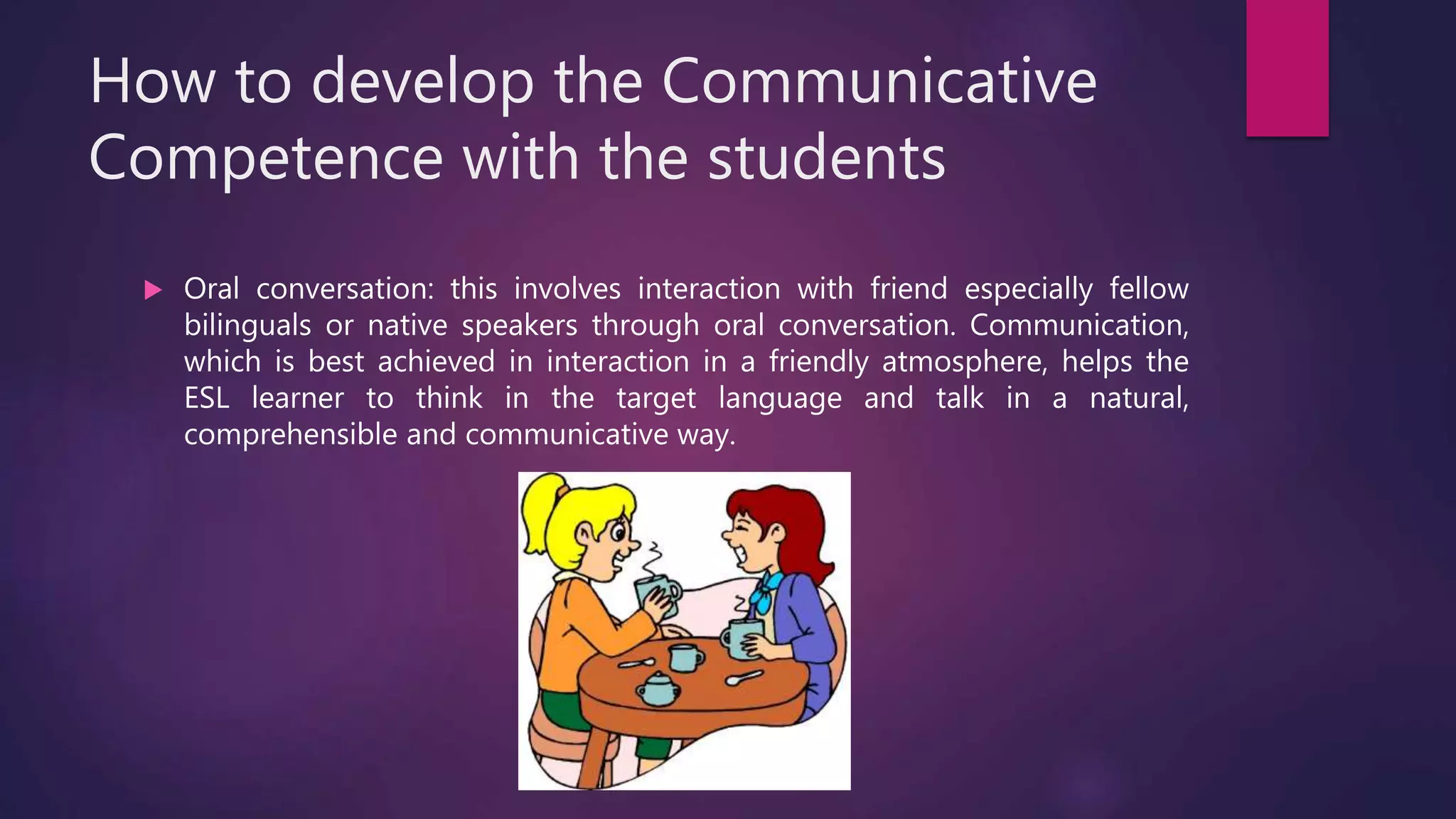
 Oral conversation: this involves interaction with friend especially fellow
bilinguals or native speakers through oral conversation. Communication,
which is best achieved in interaction in a friendly atmosphere, helps the
ESL learner to think in the target language and talk in a natural,
comprehensible and communicative way.
Storytelling
 This is another way of developing communicative competence because it
helps the ESL learner to use language extensively. The speaker shows his
ability to communicate effectively by using appropriate words and phrases
to distinguish characters in the story being narrated
Drama
 Spoken proficiency can be acquired by performing a drama. It helps the
ESL learner to develop his communicative skills; to create and use
language effectively. Where the lines of play are forgotten, he improvises,
thereby, showing his linguistic competence
Composition Writing
 This is another exercise that promotes communicative competence in
English. It combines the skills of Reading for exact information and the skill
of using the information to organize a coherent text.
Role-playing
 Role-play is a game in the target language in which the ESL learners can
act out the parts that have been assigned to them in well defined
situations. Learners are encouraged to use their knowledge and
imagination in process of constructing dialogues
Dialogue
 They are intended to be a representation of actual speech encounters in
the real world ideally they are an effective means of practicing the normal
give and take in conversation
Using Language Acquisition Videos
and other Visual and Audiovisual Aids
 Watching and listening to native speakers during the CNN and BBC news
casting on television and radio, watching life events in English films and
practicing what has been Heard and learn, aids the ESL learner in
developing vocabulary on every activities which eventually improves his
communicative competence in English
Consistent Reading and language
Games
 Communicative competence can also be acquired through the Reading of
books, newspapers and magazines and using language game like the
puzzles
Asking questions for clarification and
cooperation
 The ESL learner asks the speaker to repeat or explain already made
statement for clarification purposes
Repetition
 The act of repeating continuously what the native speaker says or teaches
is another communicative exercise which helps the ESL learner to develop
his communicative competence
Engaging in internal monologue
 This involves the art and talking to oneself which the ESL learner does in
the target language to enhance his communicative competence
References
 http://idosi.org/wjmbs/2(3)14/4.pdf

Communicative competence

  • 1.
  • 2.
    Communicative Competence  Grammaticalcompetence: encompasses knowledge of lexical items and of rules of morphology, syntax, sentence-grammar semantics, and phonology  Discourse competence: it is the ability we have to connect sentences in stretches of discourse and to form a meaningful whole out of a series of utterances  Sociolinguistic competence: is the knowledge of the sociocultural rules of language and of discourse.  Strategic competence: the verbal and nonverbal communication strategies that may be called into action to compensate for breakdowns in communication due to performance variables or due to insufficient competence
  • 3.
    Language Funtions Instrumental function Serves tomanipulate the environment, to cause certain events to happen Regulatory function Is the control of events Representational function Is the use of language to make statements, convey facts and knowledge, explain, or report Interactional function Serves to ensure social maintenance. Personal function Allows a speaker to express feelings, emotions, personality, gut-level reactions Heuristic function Involves language used to acquire knowledge, to learn about the environment Imaginative function Serves to créate imaginary systems or ideas
  • 4.
    How to developthe Communicative Competence with the students  Oral conversation: this involves interaction with friend especially fellow bilinguals or native speakers through oral conversation. Communication, which is best achieved in interaction in a friendly atmosphere, helps the ESL learner to think in the target language and talk in a natural, comprehensible and communicative way.
  • 5.
    Storytelling  This isanother way of developing communicative competence because it helps the ESL learner to use language extensively. The speaker shows his ability to communicate effectively by using appropriate words and phrases to distinguish characters in the story being narrated
  • 6.
    Drama  Spoken proficiencycan be acquired by performing a drama. It helps the ESL learner to develop his communicative skills; to create and use language effectively. Where the lines of play are forgotten, he improvises, thereby, showing his linguistic competence
  • 7.
    Composition Writing  Thisis another exercise that promotes communicative competence in English. It combines the skills of Reading for exact information and the skill of using the information to organize a coherent text.
  • 8.
    Role-playing  Role-play isa game in the target language in which the ESL learners can act out the parts that have been assigned to them in well defined situations. Learners are encouraged to use their knowledge and imagination in process of constructing dialogues
  • 9.
    Dialogue  They areintended to be a representation of actual speech encounters in the real world ideally they are an effective means of practicing the normal give and take in conversation
  • 10.
    Using Language AcquisitionVideos and other Visual and Audiovisual Aids  Watching and listening to native speakers during the CNN and BBC news casting on television and radio, watching life events in English films and practicing what has been Heard and learn, aids the ESL learner in developing vocabulary on every activities which eventually improves his communicative competence in English
  • 11.
    Consistent Reading andlanguage Games  Communicative competence can also be acquired through the Reading of books, newspapers and magazines and using language game like the puzzles
  • 12.
    Asking questions forclarification and cooperation  The ESL learner asks the speaker to repeat or explain already made statement for clarification purposes
  • 13.
    Repetition  The actof repeating continuously what the native speaker says or teaches is another communicative exercise which helps the ESL learner to develop his communicative competence
  • 14.
    Engaging in internalmonologue  This involves the art and talking to oneself which the ESL learner does in the target language to enhance his communicative competence
  • 15.