FACULTY: LINGÜÍSTICA
CAREER: LINGÜÍSTICA APLICADA AL IDIOMA INGLÉS
SUBJECT: ENGLISH TEACHING METHODOLOGY
THEME: ANALYZING PATTERNS OF CLASSROOM INTERACTION IN EFL CLASSROOMS IN IRAN
TEACHER: MSC. NESTOR BONILLA BONILLA
STUDENT: MORA ORTIZ ESPERANZA ALEJANDRINA
LEVEL: FIFTH
PERIOD: APRIL 2016 –AUGUST 2016
THE CLASSROOM INTERACTIONS.
Discourse Analysis (DA) approach in EFL classroom in
Iran.
The goals of the research were
* to identify the interaction patterns
between teachers and students
*to investigate the effect of the gender
*to find out whether the interaction was teacher-
dominated or student -dominated.
*The results of the analysis indicated that the interaction
patterns between the participants vary with the
participants making use
of a variety of discourse acts such as:
 Genre effect
 Boys were found to be more willing to interact
with their teachers than girls.
 an IRF pattern in which the
 Teachers dominated a high portion of classroom talk,
the students did
initiate exchanges with their teachers
Key words: discourse, interaction, patterns, initiation,
response follow up, teacher talk .
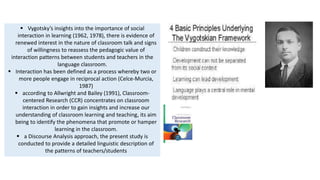
 Vygotsky’s insights into the importance of social
interaction in learning (1962, 1978), there is evidence of
renewed interest in the nature of classroom talk and signs
of willingness to reassess the pedagogic value of
interaction patterns between students and teachers in the
language classroom.
 Interaction has been defined as a process whereby two or
more people engage in reciprocal action (Celce-Murcia,
1987)
 according to Allwright and Bailey (1991), Classroom-
centered Research (CCR) concentrates on classroom
interaction in order to gain insights and increase our
understanding of classroom learning and teaching, its aim
being to identify the phenomena that promote or hamper
learning in the classroom.
 a Discourse Analysis approach, the present study is
conducted to provide a detailed linguistic description of
the patterns of teachers/students
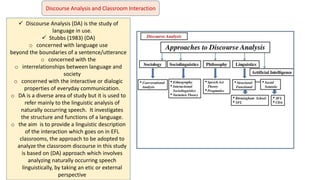
Discourse Analysis and Classroom Interaction
 Discourse Analysis (DA) is the study of
language in use.
 Stubbs (1983) (DA)
o concerned with language use
beyond the boundaries of a sentence/utterance
o concerned with the
o interrelationships between language and
society
o concerned with the interactive or dialogic
properties of everyday communication.
o DA is a diverse area of study but it is used to
refer mainly to the linguistic analysis of
naturally occurring speech. It investigates
the structure and functions of a language.
o the aim is to provide a linguistic description
of the interaction which goes on in EFL
classrooms, the approach to be adopted to
analyze the classroom discourse in this study
is based on (DA) approach which involves
analyzing naturally occurring speech
linguistically, by taking an etic or external
perspective
Theoretical Framework of the Study
In order to make a systematic analysis of the
data, an objective descriptive tool is necessary so
that remarks made on the data
The present study used Tsui's (1994) framework
based on authentic and naturally-occurring data
as a source. Furthermore Tsui takes a three part
exchange as an organizational unit of
conversation. She argues that the basic
organizational unit of conversation is a
potentially three-part exchange including an
initiation, a response and a follow-up
OBJECTIVE AND
RESEARCH QUESTIONS
The present study is conducted to provide a
detailed linguistic description of the patterns
of teachers/students interaction in EFL
classrooms in Iran it is based on the following
questions
1. What are the predominant patterns of
classroom interaction between teachers
and students
2. Are the interactions teacher-dominated or
student-dominated?
3. How are such patterns affected by genders
(that of teachers and students)?
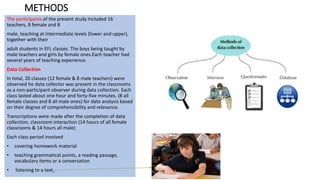
METHODS
The participants of the present study included 16
teachers, 8 female and 8
male, teaching at intermediate levels (lower and upper),
together with their
adult students in EFL classes. The boys being taught by
male teachers and girls by female ones.Each teacher had
several years of teaching experience.
Data Collection
In total, 20 classes (12 female & 8 male teachers) were
observed he data collector was present in the classrooms
as a non-participant observer during data collection. Each
class lasted about one hour and forty-five minutes. (8 all
female classes and 8 all male ones) for data analysis based
on their degree of comprehensibility and relevance.
Transcriptions were made after the completion of data
collection, classroom interaction (14 hours of all female
classrooms & 14 hours all male)
Each class period involved
• covering homework material
• teaching grammatical points, a reading passage,
vocabulary items or a conversation
• listening to a text,
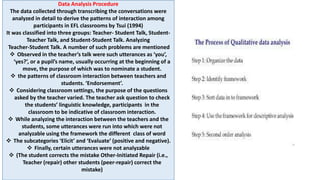
Data Analysis Procedure
The data collected through transcribing the conversations were
analyzed in detail to derive the patterns of interaction among
participants in EFL classrooms by Tsui (1994)
It was classified into three groups: Teacher- Student Talk, Student-
Teacher Talk, and Student-Student Talk. Analyzing
Teacher-Student Talk. A number of such problems are mentioned
 Observed in the teacher’s talk were such utterances as ‘you’,
‘yes?’, or a pupil’s name, usually occurring at the beginning of a
move, the purpose of which was to nominate a student.
 the patterns of classroom interaction between teachers and
students. ‘Endorsement’.
 Considering classroom settings, the purpose of the questions
asked by the teacher varied. The teacher ask question to check
the students’ linguistic knowledge, participants in the
classroom to be indicative of classroom interaction.
 While analyzing the interaction between the teachers and the
students, some utterances were run into which were not
analyzable using the framework the different class of word
 The subcategories ‘Elicit’ and ‘Evaluate’ (positive and negative).
 Finally, certain utterances were not analyzable
 (The student corrects the mistake Other-Initiated Repair (i.e.,
Teacher (repair) other students (peer-repair) correct the
mistake)
RESULTS
Patterns of Classroom Interaction
Between the Participants Teacher-Student Talk, Student-
Teacher Talk, and Student-Student Talk
a large number of discourse acts were present in
Teacher-Student Talk.
the teacher being the authority in the classroom.
The interaction patterns between students and teachers
(i.e., Student- Teacher Talk) in both all male and all
female classrooms are presented The categories ‘Silence’
and ‘self-Repair’, and ‘Peer-Repair’ were added by the
researcher under the head act ‘Responding acts’.
‘Silence’ refers to the times when no answers were
provided by the student[s] to the teachers’ questions or
instructions The teachers either made the students
correct themselves (i.e., ‘self-repair’) or made other
students correct their peers’ mistakes (i.e., ‘Peer-repair).
Finally, ‘Accept Repair’, added to the category ‘Follow-up
acts’, refers to those acts performed by the students
whose function was to acknowledge the teachers’
correction of their errors.
the teacher to provide a piece of information (i.e., ‘elicit:
inform’) and etc. Also, they did follow-up the teachers’
response to their initiations by using an ‘Endorsement’ as
thanking or an‘Acknowledgement’.
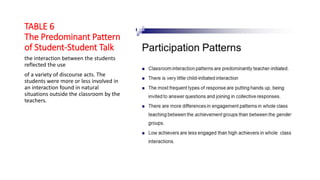
TABLE 6
The Predominant Pattern
of Student-Student Talk
the interaction between the students
reflected the use
of a variety of discourse acts. The
students were more or less involved in
an interaction found in natural
situations outside the classroom by the
teachers.
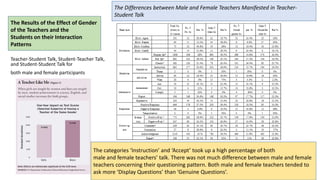
Teacher-Student Talk, Student-Teacher Talk,
and Student-Student Talk for
both male and female participants
The Results of the Effect of Gender
of the Teachers and the
Students on their Interaction
Patterns
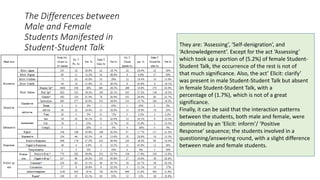
The Differences between Male and Female Teachers Manifested in Teacher-
Student Talk
The categories ‘Instruction’ and ‘Accept’ took up a high percentage of both
male and female teachers’ talk. There was not much difference between male and female
teachers concerning their questioning pattern. Both male and female teachers tended to
ask more ‘Display Questions’ than ‘Genuine Questions’.
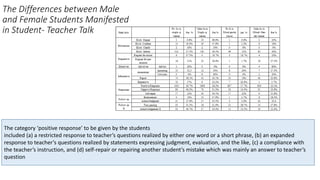
The Differences between Male
and Female Students Manifested
in Student- Teacher Talk
The category ‘positive response’ to be given by the students
included (a) a restricted response to teacher’s questions realized by either one word or a short phrase, (b) an expanded
response to teacher’s questions realized by statements expressing judgment, evaluation, and the like, (c) a compliance with
the teacher’s instruction, and (d) self-repair or repairing another student’s mistake which was mainly an answer to teacher’s
question
The Differences between
Male and Female
Students Manifested in
Student-Student Talk They are: ‘Assessing’, ‘Self-denigration’, and
‘Acknowledgement’. Except for the act ‘Assessing’
which took up a portion of (5.2%) of female Student-
Student Talk, the occurrence of the rest is not of
that much significance. Also, the act’ Elicit: clarify’
was present in male Student-Student Talk but absent
in female Student-Student Talk, with a
percentage of (1.7%), which is not of a great
significance.
Finally, it can be said that the interaction patterns
between the students, both male and female, were
dominated by an ‘Elicit: inform’/ ‘Positive
Response’ sequence; the students involved in a
questioning/answering round, with a slight difference
between male and female students.
DISCUSSION, CONCLUSION, AND IMPLICATION
By applying DA methodology to the analysis of the
interaction taking place between the teachers and the
students in EFL classrooms in Iran, based on:
First, three types of talk showed
variation, sharing some commonalities with the
interaction taking place in natural contexts occurring
outside the classroom with the participants making use
of a variety of discourse acts second, analyzing Teacher-
Student Talk moreover, Student-Teacher Talk on the
other, it is shown that the
teachers/pupils interaction was rather dominated by the
teachers in both male and female classrooms, with the
teachers asking questions Third, with regard to the
effects of the gender of teachers on Teacher-Student
Talk, it was found that there is not much difference
between male and female teachers. Both groups tended
to spend much of class time on directing the students to
do something, asking more ‘Display questions’
the results suggest that female teachers were more
supportive and encouraging, providing the students with
a ‘positive evaluation’ more often than male
Teachers, beside the effect gender had on Student-
Teacher Talk, there emerged a significant difference
between boys and girls.
The studied gender differences in mixed-gender classrooms;
that is to say even in single-gender classrooms in the present
study, boys still were more willing to interact with their
teachers than girls. Concerning Student-Student talk the
results show that girls tended to interact more with their
fellow students than boys tended to do, being caused by the
fact that female teachers tended to provoke more
interaction between their students than male teachers, by
engaging the students in such activities as ‘pair work’, ‘role
play’, and so on
Teachers should incorpórate more real life like activities into
their teaching practice such as ‘problem solving’,
‘information-gap tasks’ and the like.
REFERENCES
Allwright, R. L. (1980). Turns, topics, and tasks: Patterns of
participation in language
learning and teaching. In D. Larsen-Freeman (Ed.), Discourse
analysis in
second language research (pp.165-187). Rowley, MA: Newbury
House.
Allwright, D., & Bailey, D. (1991). Focus on the language
classroom. An introduction to
classroom research for language teachers. Cambridge:
Cambridge University
Press.
Bellack, A. A., Kliebard, H. M., Hymen, R. T., & Smith, F. L. Jr.
(1966). The
language of the classroom. New York: Teachers College Press.
Canada, K., & Pringle, R. (1995). The role of gender in college
classroom interactions
Retrieved July 14, 2008, from http://www.sociology.ohio-
state.edu/emc/ genderincollege classroom.htm.
Celce-Murcia, M. (1987). Teaching pronunciation as
communication. In J. Morley
(Ed.), Current perspectives on pronunciation (pp. 1-12).
Washington, DC: TESOL.
Coulthard, R. M. (1985). An introduction to discourse analysis.
London: Longman.
Doray, M. B. A. (2005). Gender differentiated discourse: A
study of teacher discourse
in the adult ESL classroom. Retrieved October 12, 2007, from
http://espace.library.curtin.edu.au/R?func=search-
simplego&ADJACENT=Y&REQUEST=adtWCU20061011.17015
0/.
Drudy, S., & Chathain, M. (2002). Gender effects in classroom
interaction: data collection, self-analysis and reflection.
Retrieved November 13, 2007 from
http://www.multilingual-
matters.net/erie/016/0034/erie0160034.pdf.
Duffy, J., Warren, K., & Walsh, M. (2002). Classroom
interactions: Gender of teacher,
gender of student, and classroom subject. Retrieved
September 12, 2007, from
http://www.multilingual matters.
net/erie/016/0034/erie0160034.pdf.
Grenoble, L. A. (2000). Discourse analysis. Retrieved July 2,
2007, from www.
indiana.edu/~slavconf/SLING2K/pospapers/grenoble.pdf.
Hatch, E. (1978). Discourse analysis and second language
acquisition. In E. Hatch

English methodology

  • 1.
    FACULTY: LINGÜÍSTICA CAREER: LINGÜÍSTICAAPLICADA AL IDIOMA INGLÉS SUBJECT: ENGLISH TEACHING METHODOLOGY THEME: ANALYZING PATTERNS OF CLASSROOM INTERACTION IN EFL CLASSROOMS IN IRAN TEACHER: MSC. NESTOR BONILLA BONILLA STUDENT: MORA ORTIZ ESPERANZA ALEJANDRINA LEVEL: FIFTH PERIOD: APRIL 2016 –AUGUST 2016
  • 2.
    THE CLASSROOM INTERACTIONS. DiscourseAnalysis (DA) approach in EFL classroom in Iran. The goals of the research were * to identify the interaction patterns between teachers and students *to investigate the effect of the gender *to find out whether the interaction was teacher- dominated or student -dominated. *The results of the analysis indicated that the interaction patterns between the participants vary with the participants making use of a variety of discourse acts such as:  Genre effect  Boys were found to be more willing to interact with their teachers than girls.  an IRF pattern in which the  Teachers dominated a high portion of classroom talk, the students did initiate exchanges with their teachers Key words: discourse, interaction, patterns, initiation, response follow up, teacher talk .
  • 3.
     Vygotsky’s insightsinto the importance of social interaction in learning (1962, 1978), there is evidence of renewed interest in the nature of classroom talk and signs of willingness to reassess the pedagogic value of interaction patterns between students and teachers in the language classroom.  Interaction has been defined as a process whereby two or more people engage in reciprocal action (Celce-Murcia, 1987)  according to Allwright and Bailey (1991), Classroom- centered Research (CCR) concentrates on classroom interaction in order to gain insights and increase our understanding of classroom learning and teaching, its aim being to identify the phenomena that promote or hamper learning in the classroom.  a Discourse Analysis approach, the present study is conducted to provide a detailed linguistic description of the patterns of teachers/students
  • 4.
    Discourse Analysis andClassroom Interaction  Discourse Analysis (DA) is the study of language in use.  Stubbs (1983) (DA) o concerned with language use beyond the boundaries of a sentence/utterance o concerned with the o interrelationships between language and society o concerned with the interactive or dialogic properties of everyday communication. o DA is a diverse area of study but it is used to refer mainly to the linguistic analysis of naturally occurring speech. It investigates the structure and functions of a language. o the aim is to provide a linguistic description of the interaction which goes on in EFL classrooms, the approach to be adopted to analyze the classroom discourse in this study is based on (DA) approach which involves analyzing naturally occurring speech linguistically, by taking an etic or external perspective
  • 5.
    Theoretical Framework ofthe Study In order to make a systematic analysis of the data, an objective descriptive tool is necessary so that remarks made on the data The present study used Tsui's (1994) framework based on authentic and naturally-occurring data as a source. Furthermore Tsui takes a three part exchange as an organizational unit of conversation. She argues that the basic organizational unit of conversation is a potentially three-part exchange including an initiation, a response and a follow-up
  • 6.
    OBJECTIVE AND RESEARCH QUESTIONS Thepresent study is conducted to provide a detailed linguistic description of the patterns of teachers/students interaction in EFL classrooms in Iran it is based on the following questions 1. What are the predominant patterns of classroom interaction between teachers and students 2. Are the interactions teacher-dominated or student-dominated? 3. How are such patterns affected by genders (that of teachers and students)?
  • 7.
    METHODS The participants ofthe present study included 16 teachers, 8 female and 8 male, teaching at intermediate levels (lower and upper), together with their adult students in EFL classes. The boys being taught by male teachers and girls by female ones.Each teacher had several years of teaching experience. Data Collection In total, 20 classes (12 female & 8 male teachers) were observed he data collector was present in the classrooms as a non-participant observer during data collection. Each class lasted about one hour and forty-five minutes. (8 all female classes and 8 all male ones) for data analysis based on their degree of comprehensibility and relevance. Transcriptions were made after the completion of data collection, classroom interaction (14 hours of all female classrooms & 14 hours all male) Each class period involved • covering homework material • teaching grammatical points, a reading passage, vocabulary items or a conversation • listening to a text,
  • 8.
    Data Analysis Procedure Thedata collected through transcribing the conversations were analyzed in detail to derive the patterns of interaction among participants in EFL classrooms by Tsui (1994) It was classified into three groups: Teacher- Student Talk, Student- Teacher Talk, and Student-Student Talk. Analyzing Teacher-Student Talk. A number of such problems are mentioned  Observed in the teacher’s talk were such utterances as ‘you’, ‘yes?’, or a pupil’s name, usually occurring at the beginning of a move, the purpose of which was to nominate a student.  the patterns of classroom interaction between teachers and students. ‘Endorsement’.  Considering classroom settings, the purpose of the questions asked by the teacher varied. The teacher ask question to check the students’ linguistic knowledge, participants in the classroom to be indicative of classroom interaction.  While analyzing the interaction between the teachers and the students, some utterances were run into which were not analyzable using the framework the different class of word  The subcategories ‘Elicit’ and ‘Evaluate’ (positive and negative).  Finally, certain utterances were not analyzable  (The student corrects the mistake Other-Initiated Repair (i.e., Teacher (repair) other students (peer-repair) correct the mistake)
  • 9.
    RESULTS Patterns of ClassroomInteraction Between the Participants Teacher-Student Talk, Student- Teacher Talk, and Student-Student Talk a large number of discourse acts were present in Teacher-Student Talk. the teacher being the authority in the classroom. The interaction patterns between students and teachers (i.e., Student- Teacher Talk) in both all male and all female classrooms are presented The categories ‘Silence’ and ‘self-Repair’, and ‘Peer-Repair’ were added by the researcher under the head act ‘Responding acts’. ‘Silence’ refers to the times when no answers were provided by the student[s] to the teachers’ questions or instructions The teachers either made the students correct themselves (i.e., ‘self-repair’) or made other students correct their peers’ mistakes (i.e., ‘Peer-repair). Finally, ‘Accept Repair’, added to the category ‘Follow-up acts’, refers to those acts performed by the students whose function was to acknowledge the teachers’ correction of their errors. the teacher to provide a piece of information (i.e., ‘elicit: inform’) and etc. Also, they did follow-up the teachers’ response to their initiations by using an ‘Endorsement’ as thanking or an‘Acknowledgement’.
  • 10.
    TABLE 6 The PredominantPattern of Student-Student Talk the interaction between the students reflected the use of a variety of discourse acts. The students were more or less involved in an interaction found in natural situations outside the classroom by the teachers.
  • 11.
    Teacher-Student Talk, Student-TeacherTalk, and Student-Student Talk for both male and female participants The Results of the Effect of Gender of the Teachers and the Students on their Interaction Patterns The Differences between Male and Female Teachers Manifested in Teacher- Student Talk The categories ‘Instruction’ and ‘Accept’ took up a high percentage of both male and female teachers’ talk. There was not much difference between male and female teachers concerning their questioning pattern. Both male and female teachers tended to ask more ‘Display Questions’ than ‘Genuine Questions’.
  • 12.
    The Differences betweenMale and Female Students Manifested in Student- Teacher Talk The category ‘positive response’ to be given by the students included (a) a restricted response to teacher’s questions realized by either one word or a short phrase, (b) an expanded response to teacher’s questions realized by statements expressing judgment, evaluation, and the like, (c) a compliance with the teacher’s instruction, and (d) self-repair or repairing another student’s mistake which was mainly an answer to teacher’s question
  • 13.
    The Differences between Maleand Female Students Manifested in Student-Student Talk They are: ‘Assessing’, ‘Self-denigration’, and ‘Acknowledgement’. Except for the act ‘Assessing’ which took up a portion of (5.2%) of female Student- Student Talk, the occurrence of the rest is not of that much significance. Also, the act’ Elicit: clarify’ was present in male Student-Student Talk but absent in female Student-Student Talk, with a percentage of (1.7%), which is not of a great significance. Finally, it can be said that the interaction patterns between the students, both male and female, were dominated by an ‘Elicit: inform’/ ‘Positive Response’ sequence; the students involved in a questioning/answering round, with a slight difference between male and female students.
  • 14.
    DISCUSSION, CONCLUSION, ANDIMPLICATION By applying DA methodology to the analysis of the interaction taking place between the teachers and the students in EFL classrooms in Iran, based on: First, three types of talk showed variation, sharing some commonalities with the interaction taking place in natural contexts occurring outside the classroom with the participants making use of a variety of discourse acts second, analyzing Teacher- Student Talk moreover, Student-Teacher Talk on the other, it is shown that the teachers/pupils interaction was rather dominated by the teachers in both male and female classrooms, with the teachers asking questions Third, with regard to the effects of the gender of teachers on Teacher-Student Talk, it was found that there is not much difference between male and female teachers. Both groups tended to spend much of class time on directing the students to do something, asking more ‘Display questions’ the results suggest that female teachers were more supportive and encouraging, providing the students with a ‘positive evaluation’ more often than male Teachers, beside the effect gender had on Student- Teacher Talk, there emerged a significant difference between boys and girls. The studied gender differences in mixed-gender classrooms; that is to say even in single-gender classrooms in the present study, boys still were more willing to interact with their teachers than girls. Concerning Student-Student talk the results show that girls tended to interact more with their fellow students than boys tended to do, being caused by the fact that female teachers tended to provoke more interaction between their students than male teachers, by engaging the students in such activities as ‘pair work’, ‘role play’, and so on Teachers should incorpórate more real life like activities into their teaching practice such as ‘problem solving’, ‘information-gap tasks’ and the like.
  • 15.
    REFERENCES Allwright, R. L.(1980). Turns, topics, and tasks: Patterns of participation in language learning and teaching. In D. Larsen-Freeman (Ed.), Discourse analysis in second language research (pp.165-187). Rowley, MA: Newbury House. Allwright, D., & Bailey, D. (1991). Focus on the language classroom. An introduction to classroom research for language teachers. Cambridge: Cambridge University Press. Bellack, A. A., Kliebard, H. M., Hymen, R. T., & Smith, F. L. Jr. (1966). The language of the classroom. New York: Teachers College Press. Canada, K., & Pringle, R. (1995). The role of gender in college classroom interactions Retrieved July 14, 2008, from http://www.sociology.ohio- state.edu/emc/ genderincollege classroom.htm. Celce-Murcia, M. (1987). Teaching pronunciation as communication. In J. Morley (Ed.), Current perspectives on pronunciation (pp. 1-12). Washington, DC: TESOL. Coulthard, R. M. (1985). An introduction to discourse analysis. London: Longman. Doray, M. B. A. (2005). Gender differentiated discourse: A study of teacher discourse in the adult ESL classroom. Retrieved October 12, 2007, from http://espace.library.curtin.edu.au/R?func=search- simplego&ADJACENT=Y&REQUEST=adtWCU20061011.17015 0/. Drudy, S., & Chathain, M. (2002). Gender effects in classroom interaction: data collection, self-analysis and reflection. Retrieved November 13, 2007 from http://www.multilingual- matters.net/erie/016/0034/erie0160034.pdf. Duffy, J., Warren, K., & Walsh, M. (2002). Classroom interactions: Gender of teacher, gender of student, and classroom subject. Retrieved September 12, 2007, from http://www.multilingual matters. net/erie/016/0034/erie0160034.pdf. Grenoble, L. A. (2000). Discourse analysis. Retrieved July 2, 2007, from www. indiana.edu/~slavconf/SLING2K/pospapers/grenoble.pdf. Hatch, E. (1978). Discourse analysis and second language acquisition. In E. Hatch