Your Speakers

Tony Shaw
CEO & Founder
DATAVERSITY
@tonyshaw

John Ladley
President
IMCue Solutions
@jladley

#DATAVERSITY
• A new webinar series on the first Tuesday of each month (mostly)
• Upcoming Topics:
- Data Governance
- Advanced Analytics
- Roles, Function and Hiring of CDOs
- Risk Management
- Data Business Models
- New Technologies you cannot ignore
…and much more!

#DATAVERSITY
• Metrics and Measurement
• John Ladley, President of IMCue
- 30 years experience. Former Meta Group Analyst
- Author of two major books on EIM and Data Governance
- Data Strategy, Information Risk, Organizational Structure, Analytics
- Practical reputation

#DATAVERSITY
Metrics for Information
Management

All content copyright 2013 IMCue Solutions LLC

0
Discussion


Can data or information cost your company
or organization $$$$$?



Is there a broad economic impact of data and
information?



If you answered “yes”, show me how much?
1
Why worry about information metrics?
Accounting reasons:
•

Information is an asset

•

It has a probability of generating future value

•

It is distinct from financial and material
assets

•

Compliance with Financial Accounting
Standards Board Statement No. 142 —
measuring intangible assets

Practical reasons:
•

Information affects the organization in visible
and most likely measurable ways

•

Information assets are rapidly becoming a
significant business element
Objective


Leave with some new views
about measuring tools
to sell and sustain
information asset
management (IAM)

3
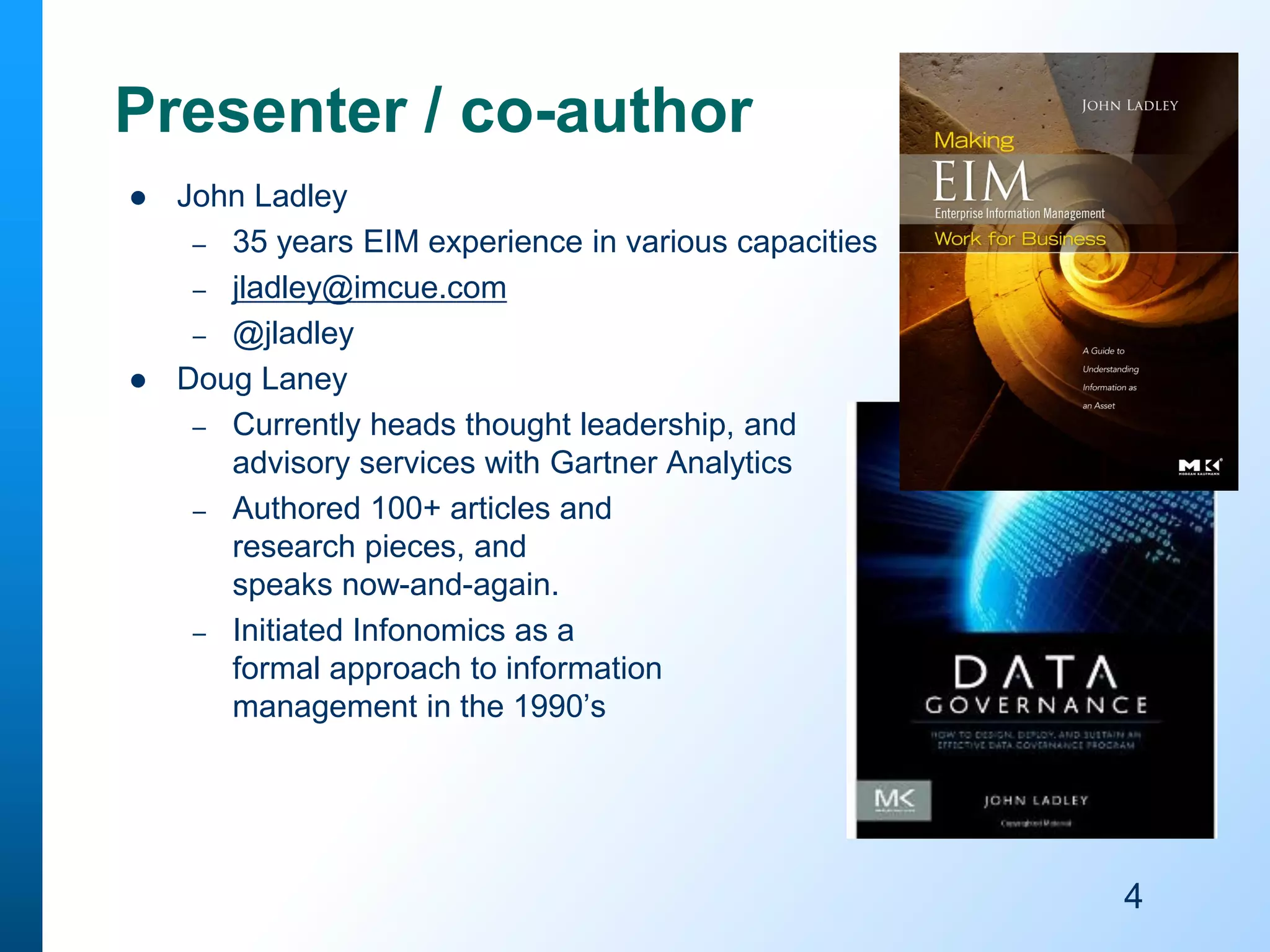
Presenter / co-author




John Ladley
– 35 years EIM experience in various capacities
– jladley@imcue.com
– @jladley
Doug Laney
– Currently heads thought leadership, and
advisory services with Gartner Analytics
– Authored 100+ articles and
research pieces, and
speaks now-and-again.
– Initiated Infonomics as a
formal approach to information
management in the 1990’s

4
Agenda



Terminology
Measuring Information
–
–
–



Information as an asset
What is an asset
What do you need to measure?

Measuring assets
–

Metric taxonomy

–

What types of metrics are there?






There is a lot more to measuring than common ROI
Value, effectiveness, income statement and balance sheet

Samples

5
Terminology


Information – ALL enterprise content that can
be used to further the survival and
achievement of business goals
–



Information Asset Management
–



Data = information = content (for this discussion)

The treatment of data, information and content as
an asset in the true, business sense

Enterprise Information Management (EIM)
–

The program that executes IAM

6
Terminology


Infonomics
–

The economics of information and principles of
information asset management


–

The accounting and measuring aspect of
information asset management




Doug Laney of Gartner Group

John Ladley

Data Governance
–

The oversight of IAM; sets rules of engagement ,
i.e. policy, roles, accountability, responsibilities for
EIM and IAM
7
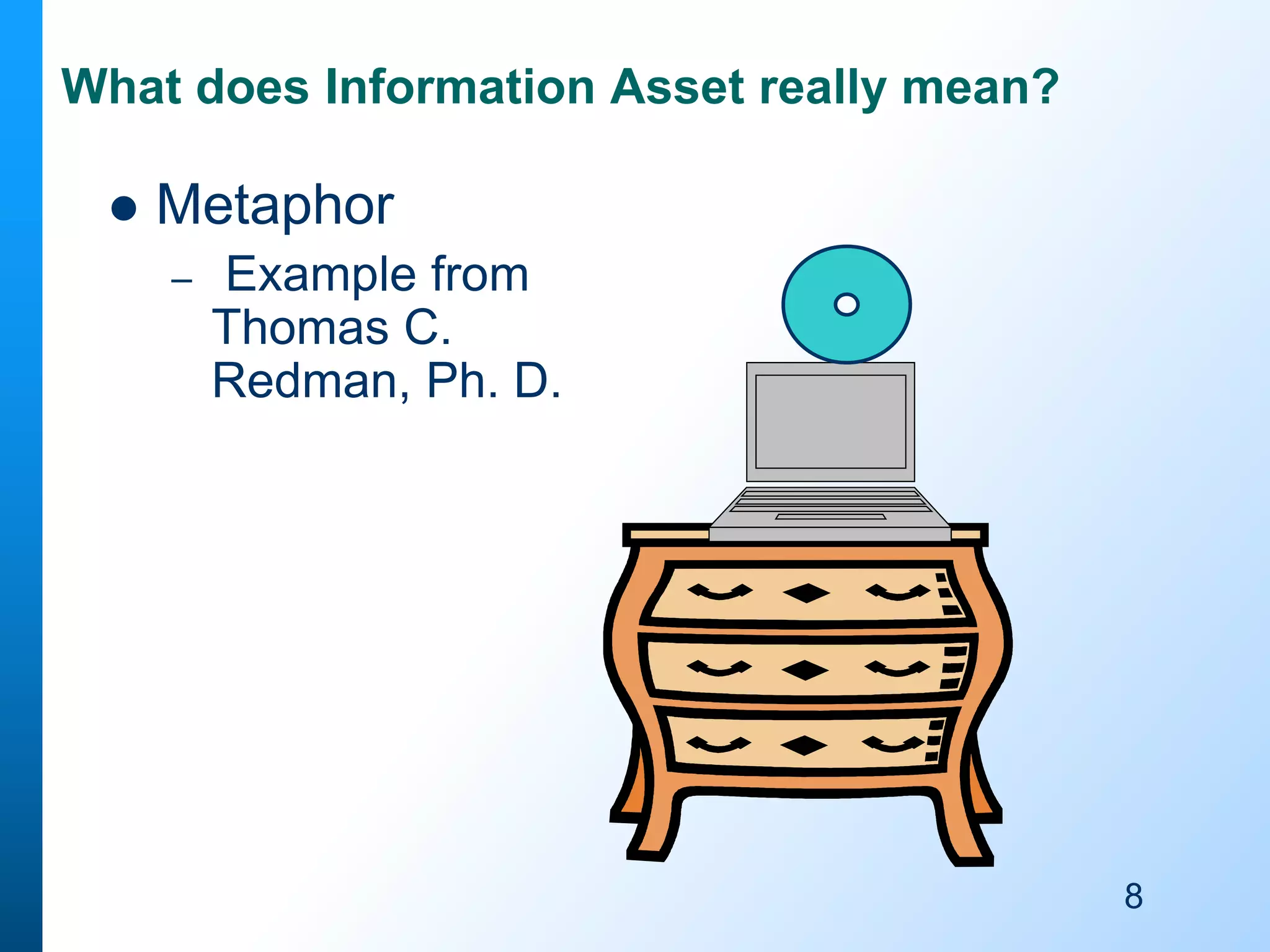
What does Information Asset really mean?


Metaphor
–

Example from
Thomas C.
Redman, Ph. D.

8
Real asset







Goodwill is intangible, appears on the balance sheet,
and can certainly be ‘used up’
Electricity is “used,” but there is always more in
the wire. We buy and
sell kilowatts
Ideas can be copyrighted,
bought and sold
We trade information
every day for something.
Do you have a Twitter™
or Facebook™ account?
You are worth $101.70!

9
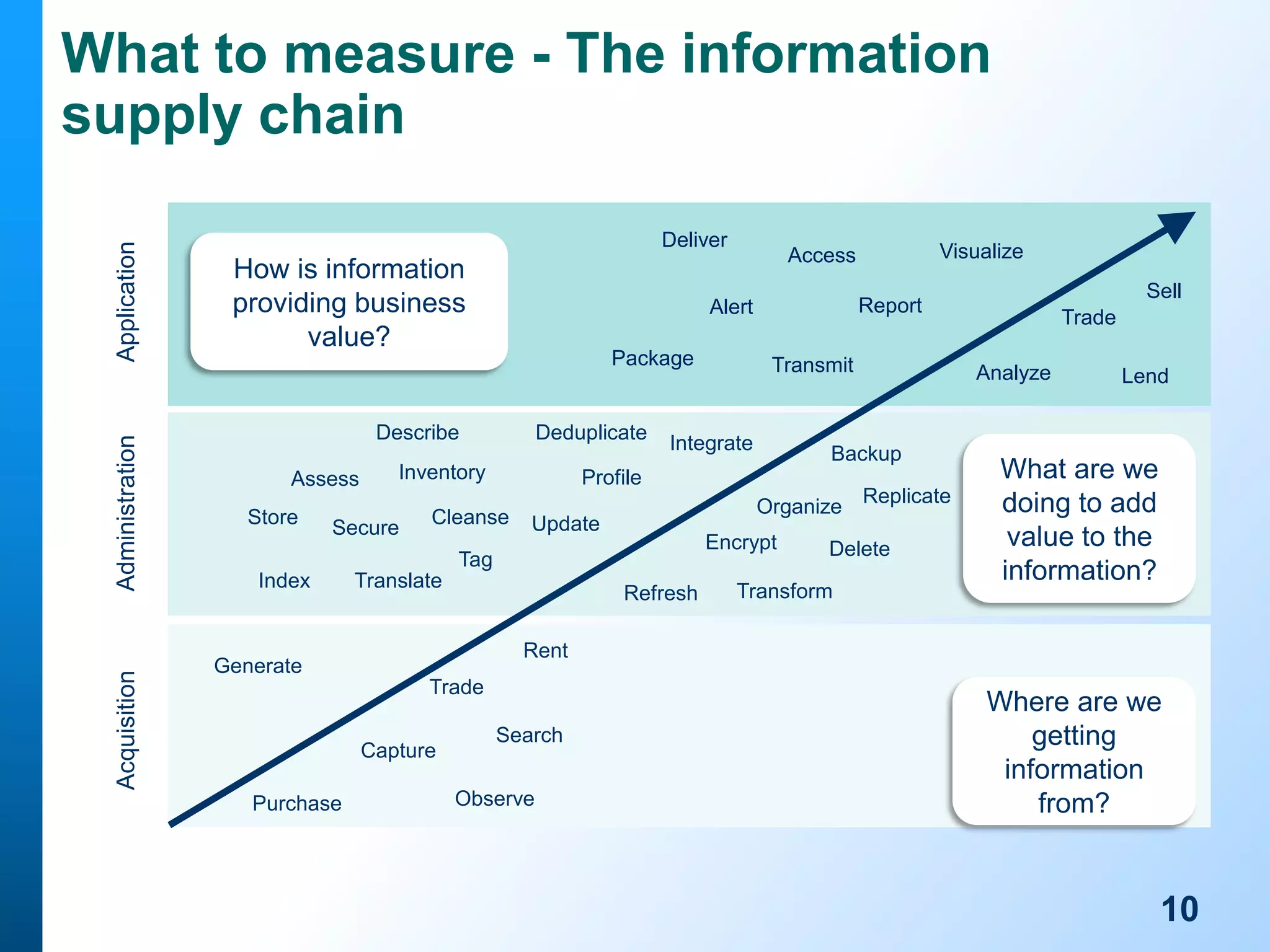
Acquisition

Administration

Application

What to measure - The information
supply chain
Deliver

How is information
providing business
value?

Package

Assess
Store

Deduplicate

Inventory

Secure

Cleanse

Update

Translate

Refresh

Organize Replicate
Delete

Transform

Trade
Analyze

Lend

What are we
doing to add
value to the
information?

Rent

Generate
Trade
Capture
Purchase

Backup

Encrypt

Tag
Index

Transmit

Integrate

Profile

Sell

Report

Alert

Describe

Visualize

Access

Search
Observe

Where are we
getting
information
from?

10
How to measure – core concept










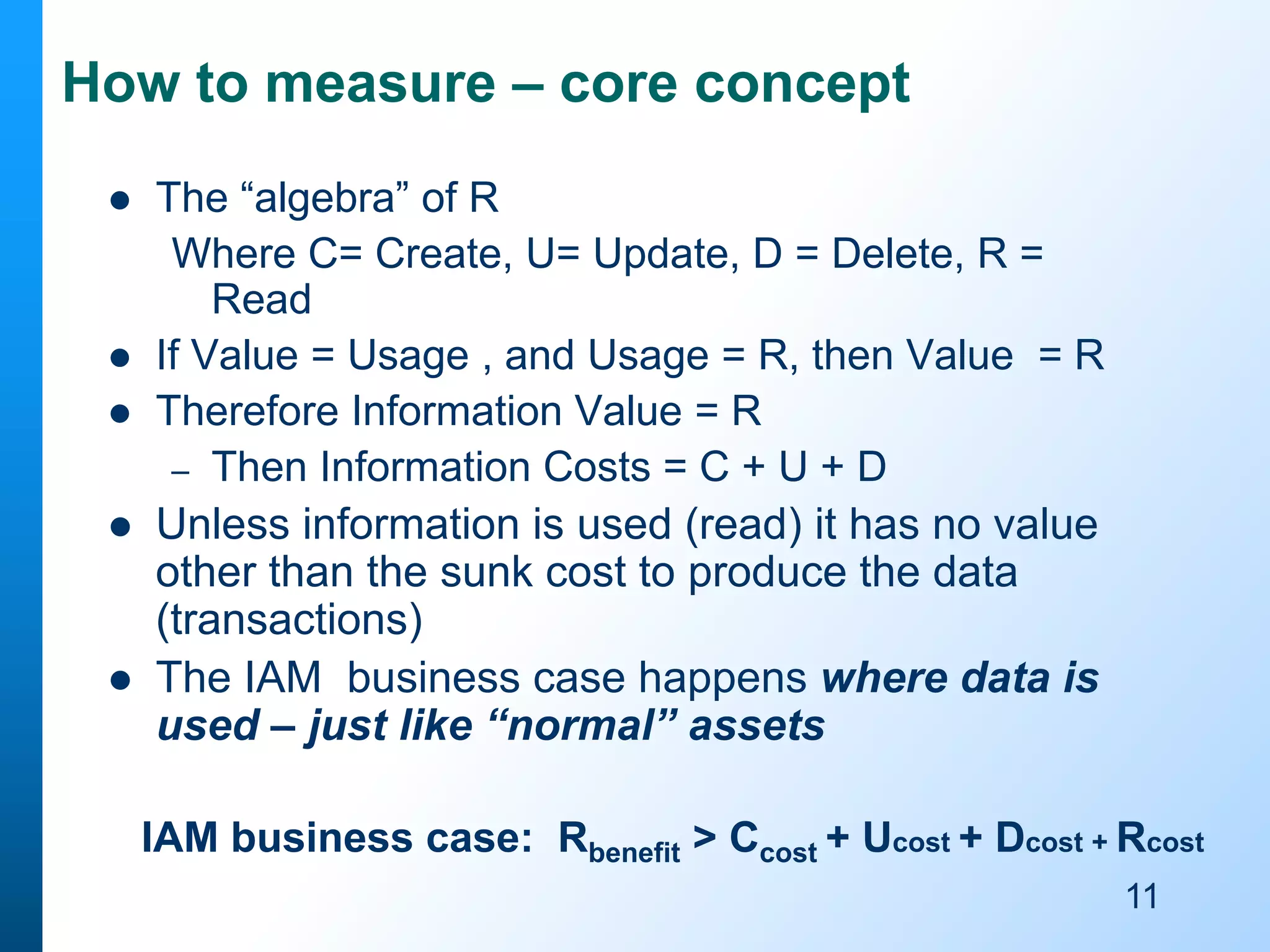
The “algebra” of R
Where C= Create, U= Update, D = Delete, R =
Read
If Value = Usage , and Usage = R, then Value = R
Therefore Information Value = R
– Then Information Costs = C + U + D
Unless information is used (read) it has no value
other than the sunk cost to produce the data
(transactions)
The IAM business case happens where data is
used – just like “normal” assets
IAM business case: Rbenefit > Ccost + Ucost + Dcost + Rcost
11
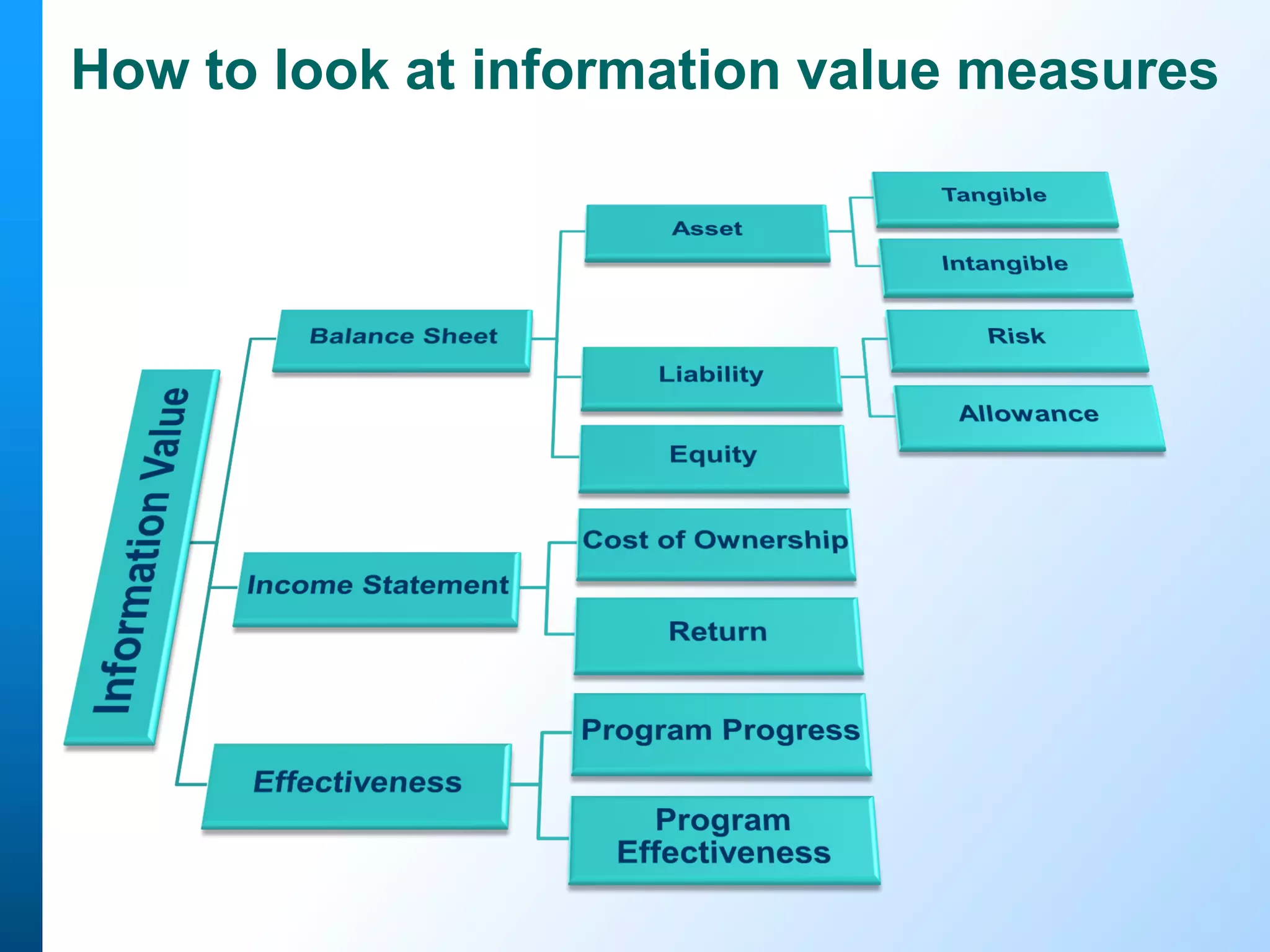
How to look at information value measures
Financial performance


Balance sheet
–

Information asset valuations


–
–



$101.70???

Capitalized information-based revenue streams
Shareholder trust
 Reputation (Social media, regular media)
 Compliance risk assess (identifier quality, contingent fines)
 Protect privacy
 Accuracy
 Complete

Income statement
–
–
–
–
–
–
–

Incident costs
IT costs
Project initiation costs
Error* handling costs
Data risk assessment
Insurance premium
“Line of sight” metrics
Measuring program effectiveness


Efficiency
–



Risk
–



Delta of risk

Improvement
–

14

Measure how well
governance applies its
resources

Amount of improvement /
delta from a “state”

14
Efficiency











Total cost of IT / Party (Customer, Member, etc.)
End User Labor / Number Users
Total BI/DW Budget / Total Users, and / or Support
Number of interfaces, File feeds
Cost per Interface
DG / Compliance cost divided by Total Income
DG / Compliance cost vs. risk reserves / premiums
Budget / TB (GB)
Benchmarks
–
–
–
–

Number IT tools
Maintenance budgets
License costs
Training costs

15
Risk


Threat metrics
–
–



Financial Risk
–
–
–



Liquidity
Operational costs
Equity / market value reduction

Data Governance Compliance
–
–



Cost per downtime event
Loss of customer confidence

“Hits” on web-based tools
Access counts on repositories

Legal Compliance
–
–

Potential penalties per subject area
Litigation fees over time
16
Improvement


Operating Income by Knowledge Worker
–
–



IM Project NPV
–



Operating Income for year divided by number of
Knowledge Workers
Knowledge worker is defined as someone who uses
information to make decisions and take actions that cause
the fulfillment of objectives, reads information

The net present value of the cash flow expected from IM
projects over 5 year planning horizon

IM Portfolio NPV
–

Net present value of the current information assets
expressed as pro-rated portion of free cash flow

17
Summary






Measurements of
information value and
effectiveness are
viable
There are many many
options to present the
value of an
information program
Saying it cannot be
measured is not an
option
18
Building Value Through
Information Asset Management™
jladley@imcue.com
314-422-9076

19

All content copyright 2013 IMCue Solutions LLC

19

The Chief Data Officer Agenda: Metrics for Information and Data Management

  • 1.
    Your Speakers Tony Shaw CEO& Founder DATAVERSITY @tonyshaw John Ladley President IMCue Solutions @jladley #DATAVERSITY
  • 2.
    • A newwebinar series on the first Tuesday of each month (mostly) • Upcoming Topics: - Data Governance - Advanced Analytics - Roles, Function and Hiring of CDOs - Risk Management - Data Business Models - New Technologies you cannot ignore …and much more! #DATAVERSITY
  • 3.
    • Metrics andMeasurement • John Ladley, President of IMCue - 30 years experience. Former Meta Group Analyst - Author of two major books on EIM and Data Governance - Data Strategy, Information Risk, Organizational Structure, Analytics - Practical reputation #DATAVERSITY
  • 4.
    Metrics for Information Management Allcontent copyright 2013 IMCue Solutions LLC 0
  • 5.
    Discussion  Can data orinformation cost your company or organization $$$$$?  Is there a broad economic impact of data and information?  If you answered “yes”, show me how much? 1
  • 6.
    Why worry aboutinformation metrics? Accounting reasons: • Information is an asset • It has a probability of generating future value • It is distinct from financial and material assets • Compliance with Financial Accounting Standards Board Statement No. 142 — measuring intangible assets Practical reasons: • Information affects the organization in visible and most likely measurable ways • Information assets are rapidly becoming a significant business element
  • 7.
    Objective  Leave with somenew views about measuring tools to sell and sustain information asset management (IAM) 3
  • 8.
    Presenter / co-author   JohnLadley – 35 years EIM experience in various capacities – jladley@imcue.com – @jladley Doug Laney – Currently heads thought leadership, and advisory services with Gartner Analytics – Authored 100+ articles and research pieces, and speaks now-and-again. – Initiated Infonomics as a formal approach to information management in the 1990’s 4
  • 9.
    Agenda   Terminology Measuring Information – – –  Information asan asset What is an asset What do you need to measure? Measuring assets – Metric taxonomy – What types of metrics are there?    There is a lot more to measuring than common ROI Value, effectiveness, income statement and balance sheet Samples 5
  • 10.
    Terminology  Information – ALLenterprise content that can be used to further the survival and achievement of business goals –  Information Asset Management –  Data = information = content (for this discussion) The treatment of data, information and content as an asset in the true, business sense Enterprise Information Management (EIM) – The program that executes IAM 6
  • 11.
    Terminology  Infonomics – The economics ofinformation and principles of information asset management  – The accounting and measuring aspect of information asset management   Doug Laney of Gartner Group John Ladley Data Governance – The oversight of IAM; sets rules of engagement , i.e. policy, roles, accountability, responsibilities for EIM and IAM 7
  • 12.
    What does InformationAsset really mean?  Metaphor – Example from Thomas C. Redman, Ph. D. 8
  • 13.
    Real asset     Goodwill isintangible, appears on the balance sheet, and can certainly be ‘used up’ Electricity is “used,” but there is always more in the wire. We buy and sell kilowatts Ideas can be copyrighted, bought and sold We trade information every day for something. Do you have a Twitter™ or Facebook™ account? You are worth $101.70! 9
  • 14.
    Acquisition Administration Application What to measure- The information supply chain Deliver How is information providing business value? Package Assess Store Deduplicate Inventory Secure Cleanse Update Translate Refresh Organize Replicate Delete Transform Trade Analyze Lend What are we doing to add value to the information? Rent Generate Trade Capture Purchase Backup Encrypt Tag Index Transmit Integrate Profile Sell Report Alert Describe Visualize Access Search Observe Where are we getting information from? 10
  • 15.
    How to measure– core concept      The “algebra” of R Where C= Create, U= Update, D = Delete, R = Read If Value = Usage , and Usage = R, then Value = R Therefore Information Value = R – Then Information Costs = C + U + D Unless information is used (read) it has no value other than the sunk cost to produce the data (transactions) The IAM business case happens where data is used – just like “normal” assets IAM business case: Rbenefit > Ccost + Ucost + Dcost + Rcost 11
  • 16.
    How to lookat information value measures
  • 17.
    Financial performance  Balance sheet – Informationasset valuations  – –  $101.70??? Capitalized information-based revenue streams Shareholder trust  Reputation (Social media, regular media)  Compliance risk assess (identifier quality, contingent fines)  Protect privacy  Accuracy  Complete Income statement – – – – – – – Incident costs IT costs Project initiation costs Error* handling costs Data risk assessment Insurance premium “Line of sight” metrics
  • 18.
    Measuring program effectiveness  Efficiency –  Risk –  Deltaof risk Improvement – 14 Measure how well governance applies its resources Amount of improvement / delta from a “state” 14
  • 19.
    Efficiency          Total cost ofIT / Party (Customer, Member, etc.) End User Labor / Number Users Total BI/DW Budget / Total Users, and / or Support Number of interfaces, File feeds Cost per Interface DG / Compliance cost divided by Total Income DG / Compliance cost vs. risk reserves / premiums Budget / TB (GB) Benchmarks – – – – Number IT tools Maintenance budgets License costs Training costs 15
  • 20.
    Risk  Threat metrics – –  Financial Risk – – –  Liquidity Operationalcosts Equity / market value reduction Data Governance Compliance – –  Cost per downtime event Loss of customer confidence “Hits” on web-based tools Access counts on repositories Legal Compliance – – Potential penalties per subject area Litigation fees over time 16
  • 21.
    Improvement  Operating Income byKnowledge Worker – –  IM Project NPV –  Operating Income for year divided by number of Knowledge Workers Knowledge worker is defined as someone who uses information to make decisions and take actions that cause the fulfillment of objectives, reads information The net present value of the cash flow expected from IM projects over 5 year planning horizon IM Portfolio NPV – Net present value of the current information assets expressed as pro-rated portion of free cash flow 17
  • 22.
    Summary    Measurements of information valueand effectiveness are viable There are many many options to present the value of an information program Saying it cannot be measured is not an option 18
  • 23.
    Building Value Through InformationAsset Management™ jladley@imcue.com 314-422-9076 19 All content copyright 2013 IMCue Solutions LLC 19