Data Governance
IASA is

a   non-profit professional association
 run   by architects
 for   all IT architects
 centrally   governed and locally run
 technology     and vendor agnostic


                                           Th
Information Architecture

   Module 0: Course Intro, Architecture              Module 3: Data Integration
    Fundamentals Introduction: Data,                      Lesson 1: Integrating at the Company Level
    Information and Knowledge                             Lesson 2: Data Characteristics
                                                          Lesson 3: Data Integration at the System level
   Module 1: Information for Business
       Lesson 1 – Information as Strategy            Module 4: Data Quality and Governance
                                                          Lesson 1 – Data and Information Quality
       Lesson 2 – Relating Information to Value
                                                          Lesson 2: Data Compliance
       Lesson 3 – Information Scope and                  Lesson 3 – Data and Information Governance
        Governance
                                                      Module 5: Advanced Information Management
   Module 2: Information Usage                           Lesson 1: Data Warehousing
       Lesson 1 – Who Uses Your Information              Lesson 2: Business Intelligence
       Lesson 2 – How, When, Where and Why               Lesson 3: Data Security and Privacy
        is Information Used                               Lesson 4: Metadata and Taxonomy Management
       Lesson 3 – Form Factors                           Lesson 5: Knowledge Management
       Lesson 4 – Usage Design 1
                                                      Module 6: Architecture throughout the Lifecycle
       Lesson 5 – Quality Attributes for
        Information Architecture
       Lesson 6 – Data Tools and Frameworks
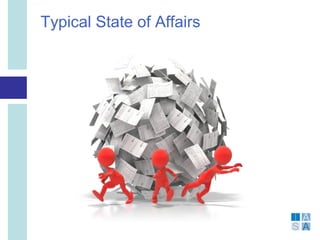
Typical State of Affairs
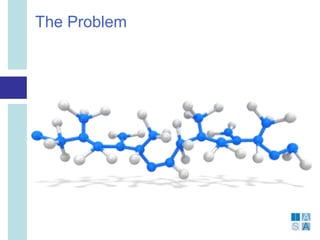
The Problem
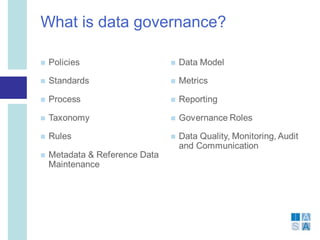
What is data governance?
Governance is Not a Popular Topic
Governance is Overcomplicated
 It   is not about politics
 Itis not about delivering
  verdicts
 Itis not about defining
  solutions
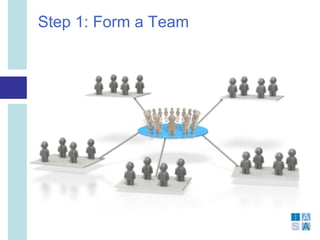
Step 1: Form a Team
Step 2: Establish Lineage
Step 3: Assess Maturity
Step 4: Create Governance Body
Step 5: Define Governance
Step 6: Define Charter


               •Charter
Step 7: Define Scope
Step 8: Create a Plan
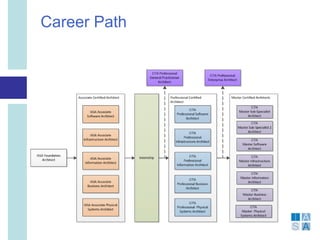
Career Path
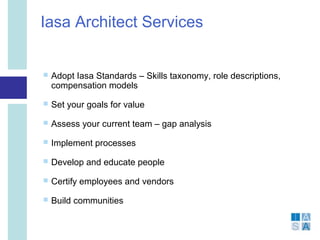
Iasa Architect Services


   Adopt Iasa Standards – Skills taxonomy, role descriptions,
    compensation models
   Set your goals for value
   Assess your current team – gap analysis
   Implement processes
   Develop and educate people
   Certify employees and vendors
   Build communities
•December 6th – 7th, 2012 // Austin, TX
                                                      •Training: Dec. 3rd – 5th, 2012
                                                    •Certification: Dec. 7th – 9th, 2012
                                                                        •


                                                     •www.iasaworldsummit.org

•Leading Innovation in Architecture. Stay ahead of the technology curve and
           shape the future of architecture in your organization.

        •Connect and share insights with the largest global network of
              technology and enterprise architect practitioners.

     •Attend sessions on the most current breakthroughs, case studies and
     key topics in architecture - presented by a mix of practicing architects
              from top performing businesses and organizations.

 •Participate in pre-conference workshops and training. Maximize your time
  at the summit by taking part in one of six intensive training courses designed
        to provide immediate solutions to benefit your everyday practice.


                                      •Featuring Industry Leading Keynote Speakers:


                         •Sheila Jeffrey             •David Del Giudice                 •Paul Preiss
                    Senior Information Architect      Principal Architect            President, Founder
                         Bank of America                 AstraZeneca                    Iasa Global


                       •David Manning                  •Scott Whitmire                     •Cat Susch
                      IT Enterprise Architect         Enterprise Architect           Enterprise Architect
                     Idaho Power Company                  Nordstrom                       Microsoft
End Module
Data Architecture for Data
                      Governance


                                   November 8, 2012


                           Presented by Malcolm Chisholm Ph.D.
                              mchisholm@refdataportal.com
                                 Telephone 732-687-9283
                                  www.refdataportal.com
                                 www.bizrulesengine.com

© AskGet.com Inc., 2012. All rights reserved
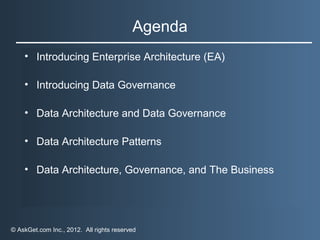
Agenda
    • Introducing Enterprise Architecture (EA)

    • Introducing Data Governance

    • Data Architecture and Data Governance

    • Data Architecture Patterns

    • Data Architecture, Governance, and The Business


© AskGet.com Inc., 2012. All rights reserved
Introducing Enterprise Architecture
                          (EA)


© AskGet.com Inc., 2012. All rights reserved
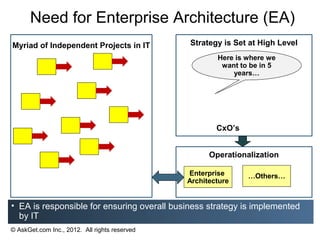
Need for Enterprise Architecture (EA)
Myriad of Independent Projects in IT           Strategy is Set at High Level
                                                       Here is where we
                                                        want to be in 5
                                                           years…


                                                       CxO’s


                                                     Operationalization

                                               Enterprise      …Others…
                                               Architecture


• EA is responsible for ensuring overall business strategy is implemented
  by IT
© AskGet.com Inc., 2012. All rights reserved
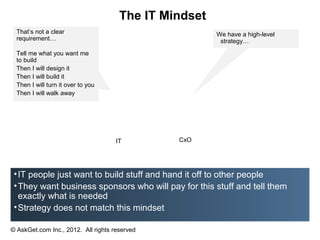
The IT Mindset
  That’s not a clear                                   We have a high-level
  requirement…                                          strategy…
  Tell me what you want me
  to build
  Then I will design it
  Then I will build it
  Then I will turn it over to you
  Then I will walk away


                                     IT        CxO


 • IT people just want to build stuff and hand it off to other people
 • They want business sponsors who will pay for this stuff and tell them
   exactly what is needed
 • Strategy does not match this mindset

© AskGet.com Inc., 2012. All rights reserved
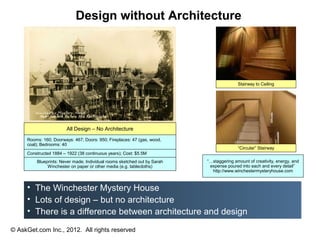
Design without Architecture


                                                                                         Stairway to Ceiling


                        All Design – No Architecture
     Rooms: 160; Doorways: 467; Doors: 950; Fireplaces: 47 (gas, wood,
     coal); Bedrooms: 40
                                                                                         “Circular” Stairway
     Constructed 1884 – 1922 (38 continuous years); Cost: $5.5M
         Blueprints: Never made; Individual rooms sketched out by Sarah   “…staggering amount of creativity, energy, and
              Winchester on paper or other media (e.g. tablecloths)        expense poured into each and every detail”
                                                                            http://www.winchestermysteryhouse.com


     • The Winchester Mystery House
     • Lots of design – but no architecture
     • There is a difference between architecture and design

© AskGet.com Inc., 2012. All rights reserved
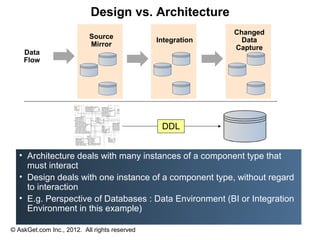
Design vs. Architecture
                                                             Changed
                           Source              Integration     Data
                           Mirror                            Capture
    Data
    Flow


                                                DDL


  • Architecture deals with many instances of a component type that
    must interact
  • Design deals with one instance of a component type, without regard
    to interaction
  • E.g. Perspective of Databases : Data Environment (BI or Integration
    Environment in this example)

© AskGet.com Inc., 2012. All rights reserved
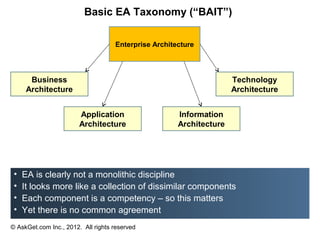
Basic EA Taxonomy (“BAIT”)

                                    Enterprise Architecture


       Business                                                      Technology
      Architecture                                                   Architecture


                        Application                   Information
                        Architecture                  Architecture


 •   EA is clearly not a monolithic discipline
 •   It looks more like a collection of dissimilar components
 •   Each component is a competency – so this matters
 •   Yet there is no common agreement
© AskGet.com Inc., 2012. All rights reserved
Introducing Data Governance


© AskGet.com Inc., 2012. All rights reserved
What is Data Governance? Starter Definitions
                               From the Data Governance Institute


    ”The exercise of decision-making and authority for data-related
    matters.”

    ”A system of decision rights and accountabilities for information-
    related processes, executed according to agreed-upon models which
    describe who can take what actions with what information, and when,
    under what circumstances, using what methods.”


                                     www.datagovernance.com


© AskGet.com Inc., 2010. All rights reserved
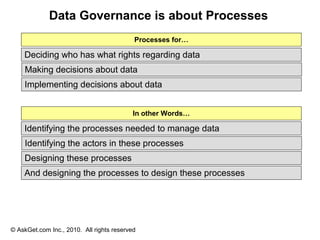
Data Governance is about Processes
                                           Processes for…

    Deciding who has what rights regarding data
    Making decisions about data
    Implementing decisions about data


                                           In other Words…

    Identifying the processes needed to manage data
    Identifying the actors in these processes
    Designing these processes
    And designing the processes to design these processes


© AskGet.com Inc., 2010. All rights reserved
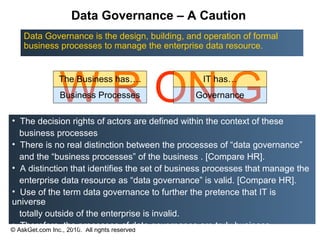
Data Governance – A Caution
   Data Governance is the design, building, and operation of formal
   business processes to manage the enterprise data resource.


            W R ON G
            The Business has….
            Business Processes
                                                 IT has…
                                               Governance

• The decision rights of actors are defined within the context of these
   business processes
• There is no real distinction between the processes of “data governance”
   and the “business processes” of the business . [Compare HR].
• A distinction that identifies the set of business processes that manage the
   enterprise data resource as “data governance” is valid. [Compare HR].
• Use of the term data governance to further the pretence that IT is
universe
   totally outside of the enterprise is invalid.
• Therefore, the processes of data governance are truly business
© AskGet.com Inc., 2010. All rights reserved
processes
Data Architecture and Data
                             Governance


© AskGet.com Inc., 2012. All rights reserved
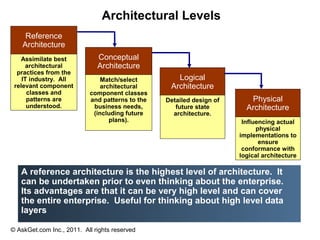
Architectural Levels
     Reference
    Architecture
   Assimilate best            Conceptual
      architectural           Architecture
  practices from the
    IT industry. All           Match/select         Logical
 relevant component            architectural      Architecture
      classes and          component classes
      patterns are         and patterns to the   Detailed design of      Physical
      understood.           business needs,         future state        Architecture
                            (including future      architecture.
                                  plans).                              Influencing actual
                                                                            physical
                                                                      implementations to
                                                                             ensure
                                                                       conformance with
                                                                      logical architecture

   A reference architecture is the highest level of architecture. It
   can be undertaken prior to even thinking about the enterprise.
   Its advantages are that it can be very high level and can cover
   the entire enterprise. Useful for thinking about high level data
   layers

© AskGet.com Inc., 2011. All rights reserved
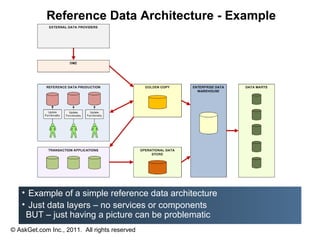
Reference Data Architecture - Example


   • Example of a simple reference data architecture
   • Just data layers – no services or components
    BUT – just having a picture can be problematic
© AskGet.com Inc., 2011. All rights reserved
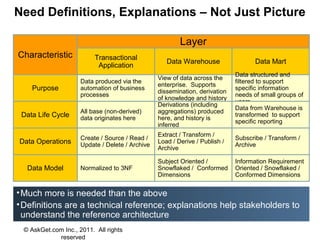
Need Definitions, Explanations – Not Just Picture

                                                         Layer
Characteristic            Transactional
                                                    Data Warehouse                  Data Mart
                           Application
                                                                             Data structured and
                                                 View of data across the
                     Data produced via the                                   filtered to support
                                                 enterprise. Supports
    Purpose          automation of business
                                                 dissemination, derivation
                                                                             specific information
                     processes                                               needs of small groups of
                                                 of knowledge and history
                                                                             users.
                                                 Derivations (including
                                                                             Data from Warehouse is
                     All base (non-derived)      aggregations) produced
 Data Life Cycle     data originates here        here, and history is
                                                                             transformed to support
                                                                             specific reporting
                                                 inferred
                                                 Extract / Transform /
                     Create / Source / Read /                                Subscribe / Transform /
Data Operations      Update / Delete / Archive
                                                 Load / Derive / Publish /
                                                                             Archive
                                                 Archive

                                                 Subject Oriented /          Information Requirement
  Data Model         Normalized to 3NF           Snowflaked / Conformed      Oriented / Snowflaked /
                                                 Dimensions                  Conformed Dimensions


• Much more is needed than the above
• Definitions are a technical reference; explanations help stakeholders to
  understand the reference architecture
 © AskGet.com Inc., 2011. All rights
            reserved
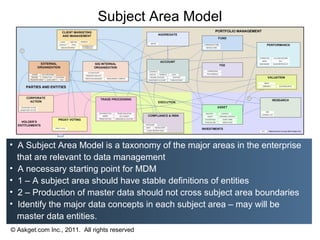
Subject Area Model


• A Subject Area Model is a taxonomy of the major areas in the enterprise
  that are relevant to data management
• A necessary starting point for MDM
• 1 – A subject area should have stable definitions of entities
• 2 – Production of master data should not cross subject area boundaries
• Identify the major data concepts in each subject area – may will be
  master data entities.
© Askget.com Inc., 2011. All rights reserved
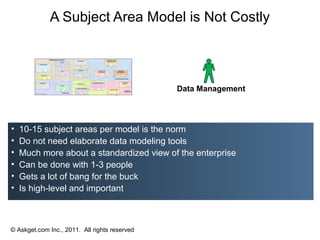
A Subject Area Model is Not Costly


                                               Data Management


•   10-15 subject areas per model is the norm
•   Do not need elaborate data modeling tools
•   Much more about a standardized view of the enterprise
•   Can be done with 1-3 people
•   Gets a lot of bang for the buck
•   Is high-level and important


© Askget.com Inc., 2011. All rights reserved
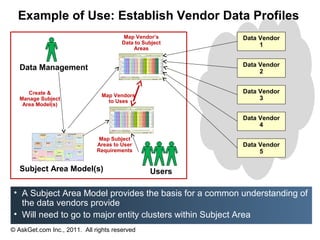
Example of Use: Establish Vendor Data Profiles
                                       Map Vendor’s      Data Vendor
                                       Data to Subject        1
                                           Areas


                                                         Data Vendor
   Data Management                                            2


      Create &                                           Data Vendor
                                Map Vendors
   Manage Subject                 to Uses
                                                              3
    Area Model(s)

                                                         Data Vendor
                                                              4

                               Map Subject
                              Areas to User              Data Vendor
                              Requirements                    5

   Subject Area Model(s)                         Users

 • A Subject Area Model provides the basis for a common understanding of
   the data vendors provide
 • Will need to go to major entity clusters within Subject Area
© AskGet.com Inc., 2011. All rights reserved
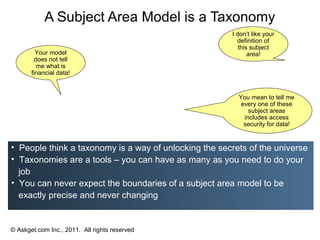
A Subject Area Model is a Taxonomy
                                                       I don’t like your
                                                         definition of
                                                          this subject
         Your model                                           area!
        does not tell
         me what is
       financial data!


                                                         You mean to tell me
                                                          every one of these
                                                             subject areas
                                                           includes access
                                                           security for data!


• People think a taxonomy is a way of unlocking the secrets of the universe
• Taxonomies are a tools – you can have as many as you need to do your
  job
• You can never expect the boundaries of a subject area model to be
  exactly precise and never changing


© Askget.com Inc., 2011. All rights reserved
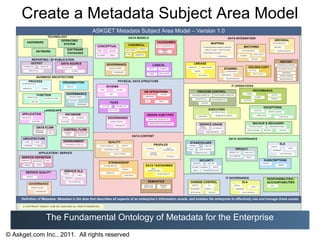
Create a Metadata Subject Area Model


              The Fundamental Ontology of Metadata for the Enterprise
© Askget.com Inc., 2011. All rights reserved
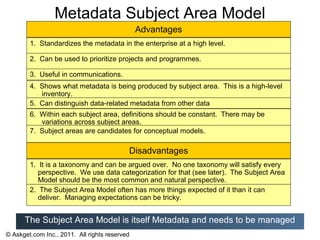
Metadata Subject Area Model
                                               Advantages
        1. Standardizes the metadata in the enterprise at a high level.

        2. Can be used to prioritize projects and programmes.

        3. Useful in communications.
        4. Shows what metadata is being produced by subject area. This is a high-level
           inventory.
        5. Can distinguish data-related metadata from other data
        6. Within each subject area, definitions should be constant. There may be
           variations across subject areas.
        7. Subject areas are candidates for conceptual models.

                                           Disadvantages
        1. It is a taxonomy and can be argued over. No one taxonomy will satisfy every
           perspective. We use data categorization for that (see later). The Subject Area
           Model should be the most common and natural perspective.
        2. The Subject Area Model often has more things expected of it than it can
           deliver. Managing expectations can be tricky.


      The Subject Area Model is itself Metadata and needs to be managed
© Askget.com Inc., 2011. All rights reserved
Data Architecture Patterns


© AskGet.com Inc., 2012. All rights reserved
What is an Architectural Pattern?
  “Pattern in architecture is the idea of       • An architectural style is a central,
  capturing architectural design ideas            organizing concept for a system.
  as archetypal and reusable                    • An architectural pattern describes a
  descriptions”                                   coarse-grained solution at the level of
  - Christopher Alexander, quoted in Business     subsystems or modules and their
  Model Generation by Osterwalder and             relationships.
  Pigneur (2010)
                                                • A system metaphor is more conceptual
                                                  and it relates more to a real-world
  Antipattern: A pattern that is                  concept over a software engineering
  commonly used, but which is                     concept.
  ineffective or damaging. E.g.                 - Quoted from A Practical Guide to Enterprise
  Analysis Paralysis.                             Architecture by McGovern, Ambler et al, at
                                                http://www.infoq.com/news/2009/02/Architectural-
  - Term created by Andrew Koenig, 1995
                                                  Styles-Patterns


   • Patterns occur a lot in architecture
   • There are also styles, metaphors and antipatterns
   • Seem to have emerged from the application architecture
     competency (e.g. rare to hear of dimensional modeling as a pattern
     or style)

© AskGet.com Inc., 2011. All rights reserved
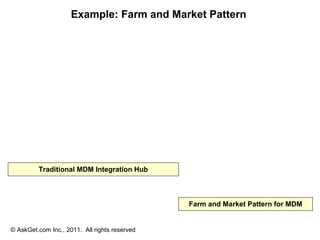
Example: Farm and Market Pattern


         Traditional MDM Integration Hub


                                               Farm and Market Pattern for MDM


© AskGet.com Inc., 2011. All rights reserved
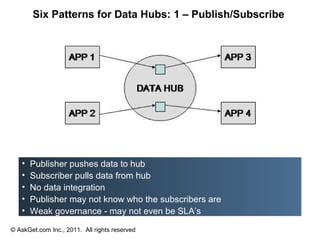
Six Patterns for Data Hubs: 1 – Publish/Subscribe


   •   Publisher pushes data to hub
   •   Subscriber pulls data from hub
   •   No data integration
   •   Publisher may not know who the subscribers are
   •   Weak governance - may not even be SLA’s

© AskGet.com Inc., 2011. All rights reserved
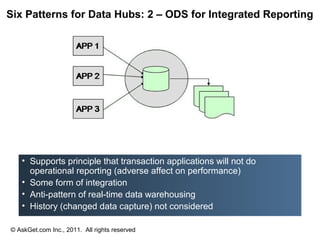
Six Patterns for Data Hubs: 2 – ODS for Integrated Reporting


   • Supports principle that transaction applications will not do
     operational reporting (adverse affect on performance)
   • Some form of integration
   • Anti-pattern of real-time data warehousing
   • History (changed data capture) not considered

© AskGet.com Inc., 2011. All rights reserved
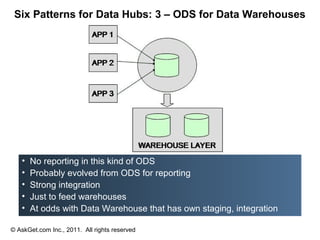
Six Patterns for Data Hubs: 3 – ODS for Data Warehouses


   •   No reporting in this kind of ODS
   •   Probably evolved from ODS for reporting
   •   Strong integration
   •   Just to feed warehouses
   •   At odds with Data Warehouse that has own staging, integration

© AskGet.com Inc., 2011. All rights reserved
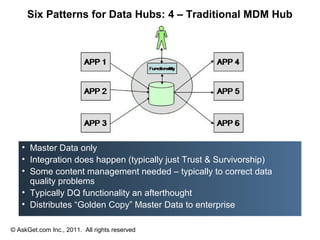
Six Patterns for Data Hubs: 4 – Traditional MDM Hub


   • Master Data only
   • Integration does happen (typically just Trust & Survivorship)
   • Some content management needed – typically to correct data
     quality problems
   • Typically DQ functionality an afterthought
   • Distributes “Golden Copy” Master Data to enterprise

© AskGet.com Inc., 2011. All rights reserved
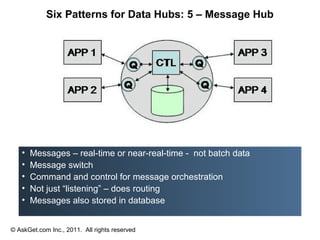
Six Patterns for Data Hubs: 5 – Message Hub


   •   Messages – real-time or near-real-time - not batch data
   •   Message switch
   •   Command and control for message orchestration
   •   Not just “listening” – does routing
   •   Messages also stored in database


© AskGet.com Inc., 2011. All rights reserved
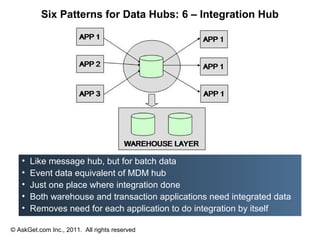
Six Patterns for Data Hubs: 6 – Integration Hub


   •   Like message hub, but for batch data
   •   Event data equivalent of MDM hub
   •   Just one place where integration done
   •   Both warehouse and transaction applications need integrated data
   •   Removes need for each application to do integration by itself

© AskGet.com Inc., 2011. All rights reserved
Data Architecture, Governance, and
                    The Business


© AskGet.com Inc., 2012. All rights reserved
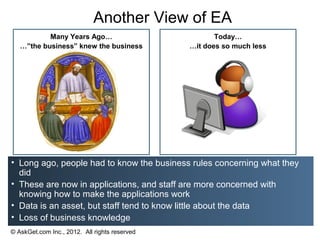
Another View of EA
           Many Years Ago…                            Today…
   …”the business” knew the business           …it does so much less


• Long ago, people had to know the business rules concerning what they
  did
• These are now in applications, and staff are more concerned with
  knowing how to make the applications work
• Data is an asset, but staff tend to know little about the data
• Loss of business knowledge
© AskGet.com Inc., 2012. All rights reserved
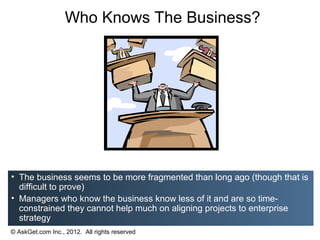
Who Knows The Business?


• The business seems to be more fragmented than long ago (though that is
  difficult to prove)
• Managers who know the business know less of it and are so time-
  constrained they cannot help much on aligning projects to enterprise
  strategy
© AskGet.com Inc., 2012. All rights reserved
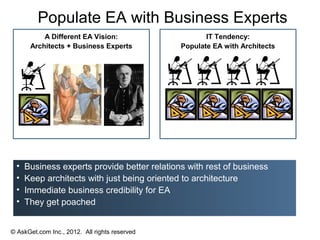
Populate EA with Business Experts
           A Different EA Vision:                     IT Tendency:
       Architects + Business Experts           Populate EA with Architects


  •   Business experts provide better relations with rest of business
  •   Keep architects with just being oriented to architecture
  •   Immediate business credibility for EA
  •   They get poached


© AskGet.com Inc., 2012. All rights reserved
Questions and Answers
                 Data Architecture for Data
                       Governance


                                   November 8, 2012


                            Presented by Malcolm Chisholm Ph.D.
                                 Telephone 732-687-9283
                             mchisholm@MasterDataMgmt.com


© AskGet.com Inc., 2012. All rights reserved