#CDOVision
www.cdovision.com
Moderator: Tony Shaw
CEO, DATAVERSITY
Moderator: John Ladley
President
IMCue Solutions
All content copyright 2015 IMCue Solutions LLC 0
Metrics for Information
Management
Starter
Can data or information cost
your company or organization
$$$$$?
Is there a broad economic
impact of data and
information?
If you answered “yes”, show
me how much?
1
Objective
 Understand the wide
variety of
options available to
CDOs and other TDJ –
types
for measuring the value
of
data and EIM
2
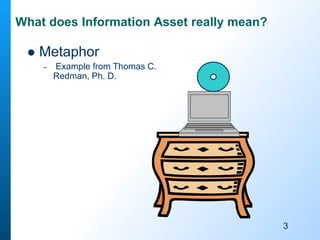
What does Information Asset really mean?
 Metaphor
– Example from Thomas C.
Redman, Ph. D.
3
Accounting
reasons:
If it is an asset, then it has a probability of
generating future value
It is distinct from financial and material assets
Compliance with Financial Accounting Standards
Board Statement No. 142 — measuring
intangible assets
Practical
reasons:
Information affects the organization in visible
and most likely measurable ways
Value is, in its own way, a means to manage
priorities
All types of risks need to be managed
Information management will offset technology
debt
Why worry about information’s value?
4Content property of IMCue and FSFP, Copyright 2013
Reproduction prohibited
Why usage holds the key:
The “algebra” of R
Where C= Create, U= Update,
D = Delete, R = Read
If Value = Usage , and Usage = R,
then Value = R
If Information Value = R,
Information Costs = C + U + D
Unless information is used (read)
it has no value other than the
sunk cost to produce the data, or
the cost to get it back if lost
The EIM / DG business case happens where data is used, or is
misused
5
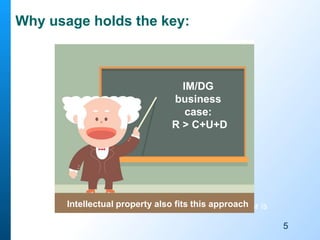
IM/DG
business
case:
R > C+U+D
Intellectual property also fits this approach
6
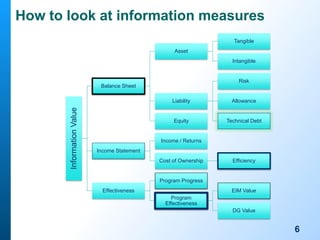
How to look at information measures
InformationValue
Balance Sheet
Asset
Tangible
Intangible
Liability
Risk
Allowance
Technical DebtEquity
Income Statement
Income / Returns
Cost of Ownership Efficiency
Effectiveness
Program Progress
Program
Effectiveness
EIM Value
DG Value
7
INFORMATION VALUATION
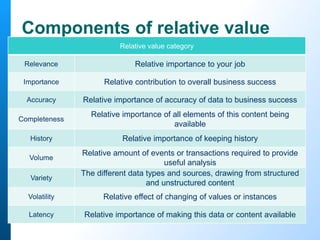
Components of relative value
Relative value category
Relevance Relative importance to your job
Importance Relative contribution to overall business success
Accuracy Relative importance of accuracy of data to business success
Completeness
Relative importance of all elements of this content being
available
History Relative importance of keeping history
Volume
Relative amount of events or transactions required to provide
useful analysis
Variety
The different data types and sources, drawing from structured
and unstructured content
Volatility Relative effect of changing of values or instances
Latency Relative importance of making this data or content available
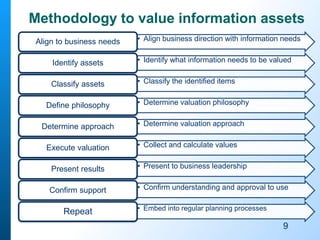
Methodology to value information assets
• Align business direction with information needsAlign to business needs
• Identify what information needs to be valuedIdentify assets
• Classify the identified itemsClassify assets
• Determine valuation philosophyDefine philosophy
• Determine valuation approachDetermine approach
• Collect and calculate valuesExecute valuation
• Present to business leadershipPresent results
• Confirm understanding and approval to useConfirm support
• Embed into regular planning processes
Repeat
9
10
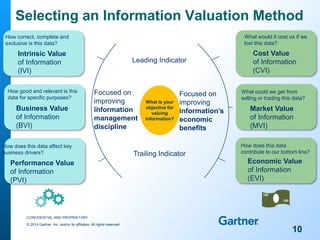
Selecting an Information Valuation Method
What is your
objective for
valuing
information?
Focused on
improving
information
management
discipline
Focused on
improving
information’s
economic
benefits
Intrinsic Value
of Information
(IVI)
How correct, complete and
exclusive is this data?
Business Value
of Information
(BVI)
How good and relevant is this
data for specific purposes?
Performance Value
of Information
(PVI)
How does this data affect key
business drivers?
Cost Value
of Information
(CVI)
What would it cost us if we
lost this data?
Economic Value
of Information
(EVI)
How does this data
contribute to our bottom line?
Market Value
of Information
(MVI)
What could we get from
selling or trading this data?
Leading Indicator
Trailing Indicator
CONFIDENTIAL AND PROPRIETARY
© 2014 Gartner, Inc. and/or its affiliates. All rights reserved.
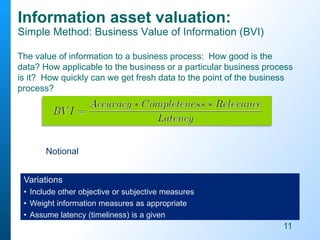
The value of information to a business process: How good is the
data? How applicable to the business or a particular business process
is it? How quickly can we get fresh data to the point of the business
process?
Information asset valuation:
Simple Method: Business Value of Information (BVI)
Variations
• Include other objective or subjective measures
• Weight information measures as appropriate
• Assume latency (timeliness) is a given
Notional
11
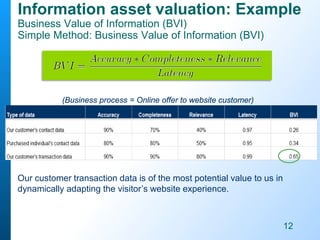
(Business process = Online offer to website customer)
Our customer transaction data is of the most potential value to us in
dynamically adapting the visitor’s website experience.
Information asset valuation: Example
Business Value of Information (BVI)
Simple Method: Business Value of Information (BVI)
12
13
Technical Debt
 Organization
accumulate
technical debt by
doing code poorly
 Poor IM also
generates
technical debt
No time to
design
Business
conditions
require we
proceed
What’s
Layering?
Now we know
how we should
have done it
DeliberateInadvertent
Reckless Prudent
Steve Garnett-Technical Debt Strategies 2013 Ripplerock
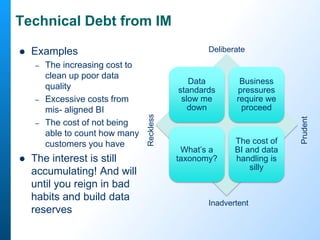
Technical Debt from IM
 Examples
– The increasing cost to
clean up poor data
quality
– Excessive costs from
mis- aligned BI
– The cost of not being
able to count how many
customers you have
 The interest is still
accumulating! And will
until you reign in bad
habits and build data
reserves
Data
standards
slow me
down
Business
pressures
require we
proceed
What’s a
taxonomy?
The cost of
BI and data
handling is
silly
Deliberate
Inadvertent
Reckless
Prudent
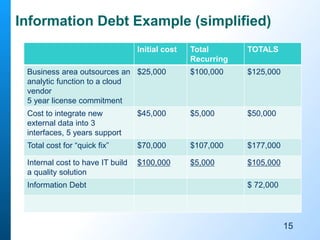
Information Debt Example (simplified)
Initial cost Total
Recurring
TOTALS
Business area outsources an
analytic function to a cloud
vendor
5 year license commitment
$25,000 $100,000 $125,000
Cost to integrate new
external data into 3
interfaces, 5 years support
$45,000 $5,000 $50,000
Total cost for “quick fix” $70,000 $107,000 $177,000
Internal cost to have IT build
a quality solution
$100,000 $5,000 $105,000
Information Debt $ 72,000
15
16
SOME SIMPLE METRICS
17
Efficiency
 Total cost of IT / Party (Customer, Member, etc.)
 End User Labor / Number Users
 Total BI/DW Budget / Total Users, and / or Support
 Number of interfaces, File feeds
 Cost per Interface
 DG / Compliance cost divided by Total Income
 DG / Compliance cost vs. risk reserves / premiums
 Budget / TB (GB)
 Benchmarks
– Number IT tools
– Maintenance budgets
– License costs
– Training costs
18
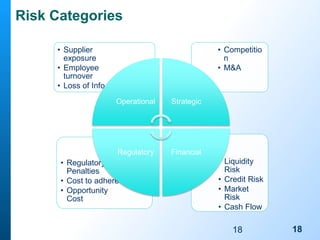
Risk Categories
• Liquidity
Risk
• Credit Risk
• Market
Risk
• Cash Flow
• Regulatory
Penalties
• Cost to adhere
• Opportunity
Cost
• Competitio
n
• M&A
• Supplier
exposure
• Employee
turnover
• Loss of Info
Operational Strategic
FinancialRegulatory
18
19
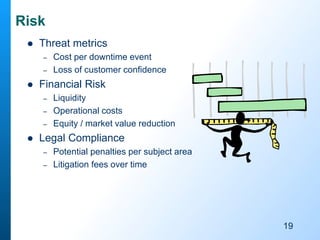
Risk
 Threat metrics
– Cost per downtime event
– Loss of customer confidence
 Financial Risk
– Liquidity
– Operational costs
– Equity / market value reduction
 Legal Compliance
– Potential penalties per subject area
– Litigation fees over time
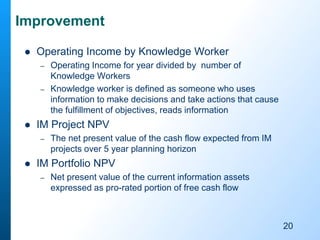
Improvement
 Operating Income by Knowledge Worker
– Operating Income for year divided by number of
Knowledge Workers
– Knowledge worker is defined as someone who uses
information to make decisions and take actions that cause
the fulfillment of objectives, reads information
 IM Project NPV
– The net present value of the cash flow expected from IM
projects over 5 year planning horizon
 IM Portfolio NPV
– Net present value of the current information assets
expressed as pro-rated portion of free cash flow
20
Summary
 Measurements of
information value and
effectiveness are
viable
 There are many many
options to present the
value of an
information program
 Saying it cannot be
measured is not an
option
21
22
THANK YOU!
Questions?
22
All content copyright 2015 IMCue Solutions LLC
23
Building Value Through
Information Asset Management™
jladley@imcue.com
314-422-9076
23

CDO Vision: The Value of Data

  • 1.
    #CDOVision www.cdovision.com Moderator: Tony Shaw CEO,DATAVERSITY Moderator: John Ladley President IMCue Solutions
  • 2.
    All content copyright2015 IMCue Solutions LLC 0 Metrics for Information Management
  • 3.
    Starter Can data orinformation cost your company or organization $$$$$? Is there a broad economic impact of data and information? If you answered “yes”, show me how much? 1
  • 4.
    Objective  Understand thewide variety of options available to CDOs and other TDJ – types for measuring the value of data and EIM 2
  • 5.
    What does InformationAsset really mean?  Metaphor – Example from Thomas C. Redman, Ph. D. 3
  • 6.
    Accounting reasons: If it isan asset, then it has a probability of generating future value It is distinct from financial and material assets Compliance with Financial Accounting Standards Board Statement No. 142 — measuring intangible assets Practical reasons: Information affects the organization in visible and most likely measurable ways Value is, in its own way, a means to manage priorities All types of risks need to be managed Information management will offset technology debt Why worry about information’s value? 4Content property of IMCue and FSFP, Copyright 2013 Reproduction prohibited
  • 7.
    Why usage holdsthe key: The “algebra” of R Where C= Create, U= Update, D = Delete, R = Read If Value = Usage , and Usage = R, then Value = R If Information Value = R, Information Costs = C + U + D Unless information is used (read) it has no value other than the sunk cost to produce the data, or the cost to get it back if lost The EIM / DG business case happens where data is used, or is misused 5 IM/DG business case: R > C+U+D Intellectual property also fits this approach
  • 8.
    6 How to lookat information measures InformationValue Balance Sheet Asset Tangible Intangible Liability Risk Allowance Technical DebtEquity Income Statement Income / Returns Cost of Ownership Efficiency Effectiveness Program Progress Program Effectiveness EIM Value DG Value
  • 9.
  • 10.
    Components of relativevalue Relative value category Relevance Relative importance to your job Importance Relative contribution to overall business success Accuracy Relative importance of accuracy of data to business success Completeness Relative importance of all elements of this content being available History Relative importance of keeping history Volume Relative amount of events or transactions required to provide useful analysis Variety The different data types and sources, drawing from structured and unstructured content Volatility Relative effect of changing of values or instances Latency Relative importance of making this data or content available
  • 11.
    Methodology to valueinformation assets • Align business direction with information needsAlign to business needs • Identify what information needs to be valuedIdentify assets • Classify the identified itemsClassify assets • Determine valuation philosophyDefine philosophy • Determine valuation approachDetermine approach • Collect and calculate valuesExecute valuation • Present to business leadershipPresent results • Confirm understanding and approval to useConfirm support • Embed into regular planning processes Repeat 9
  • 12.
    10 Selecting an InformationValuation Method What is your objective for valuing information? Focused on improving information management discipline Focused on improving information’s economic benefits Intrinsic Value of Information (IVI) How correct, complete and exclusive is this data? Business Value of Information (BVI) How good and relevant is this data for specific purposes? Performance Value of Information (PVI) How does this data affect key business drivers? Cost Value of Information (CVI) What would it cost us if we lost this data? Economic Value of Information (EVI) How does this data contribute to our bottom line? Market Value of Information (MVI) What could we get from selling or trading this data? Leading Indicator Trailing Indicator CONFIDENTIAL AND PROPRIETARY © 2014 Gartner, Inc. and/or its affiliates. All rights reserved.
  • 13.
    The value ofinformation to a business process: How good is the data? How applicable to the business or a particular business process is it? How quickly can we get fresh data to the point of the business process? Information asset valuation: Simple Method: Business Value of Information (BVI) Variations • Include other objective or subjective measures • Weight information measures as appropriate • Assume latency (timeliness) is a given Notional 11
  • 14.
    (Business process =Online offer to website customer) Our customer transaction data is of the most potential value to us in dynamically adapting the visitor’s website experience. Information asset valuation: Example Business Value of Information (BVI) Simple Method: Business Value of Information (BVI) 12
  • 15.
    13 Technical Debt  Organization accumulate technicaldebt by doing code poorly  Poor IM also generates technical debt No time to design Business conditions require we proceed What’s Layering? Now we know how we should have done it DeliberateInadvertent Reckless Prudent Steve Garnett-Technical Debt Strategies 2013 Ripplerock
  • 16.
    Technical Debt fromIM  Examples – The increasing cost to clean up poor data quality – Excessive costs from mis- aligned BI – The cost of not being able to count how many customers you have  The interest is still accumulating! And will until you reign in bad habits and build data reserves Data standards slow me down Business pressures require we proceed What’s a taxonomy? The cost of BI and data handling is silly Deliberate Inadvertent Reckless Prudent
  • 17.
    Information Debt Example(simplified) Initial cost Total Recurring TOTALS Business area outsources an analytic function to a cloud vendor 5 year license commitment $25,000 $100,000 $125,000 Cost to integrate new external data into 3 interfaces, 5 years support $45,000 $5,000 $50,000 Total cost for “quick fix” $70,000 $107,000 $177,000 Internal cost to have IT build a quality solution $100,000 $5,000 $105,000 Information Debt $ 72,000 15
  • 18.
  • 19.
    17 Efficiency  Total costof IT / Party (Customer, Member, etc.)  End User Labor / Number Users  Total BI/DW Budget / Total Users, and / or Support  Number of interfaces, File feeds  Cost per Interface  DG / Compliance cost divided by Total Income  DG / Compliance cost vs. risk reserves / premiums  Budget / TB (GB)  Benchmarks – Number IT tools – Maintenance budgets – License costs – Training costs
  • 20.
    18 Risk Categories • Liquidity Risk •Credit Risk • Market Risk • Cash Flow • Regulatory Penalties • Cost to adhere • Opportunity Cost • Competitio n • M&A • Supplier exposure • Employee turnover • Loss of Info Operational Strategic FinancialRegulatory 18
  • 21.
    19 Risk  Threat metrics –Cost per downtime event – Loss of customer confidence  Financial Risk – Liquidity – Operational costs – Equity / market value reduction  Legal Compliance – Potential penalties per subject area – Litigation fees over time
  • 22.
    Improvement  Operating Incomeby Knowledge Worker – Operating Income for year divided by number of Knowledge Workers – Knowledge worker is defined as someone who uses information to make decisions and take actions that cause the fulfillment of objectives, reads information  IM Project NPV – The net present value of the cash flow expected from IM projects over 5 year planning horizon  IM Portfolio NPV – Net present value of the current information assets expressed as pro-rated portion of free cash flow 20
  • 23.
    Summary  Measurements of informationvalue and effectiveness are viable  There are many many options to present the value of an information program  Saying it cannot be measured is not an option 21
  • 24.
  • 25.
    All content copyright2015 IMCue Solutions LLC 23 Building Value Through Information Asset Management™ jladley@imcue.com 314-422-9076 23