Produced by
Enterprise Data Literacy
Even Possible?
Is
Hosted by Wendy Lynch, PhD
Produced by
Laura Sebastian-
Coleman, PhD
VP of Data Governance
& Quality
Prudential
Melissa Depweg
Director of Analytics and
Data Governance Enablement
Intuit
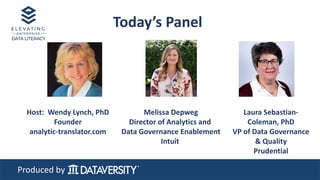
Today’s Panel
Host: Wendy Lynch, PhD
Founder
analytic-translator.com
Produced by
Enterprise Data Literacy
Even Possible?
Is
Hosted by Wendy Lynch, PhD
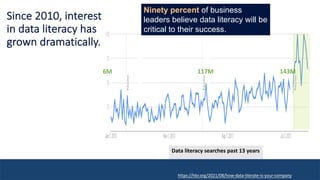
Since 2010, interest
in data literacy has
grown dramatically.
Data literacy searches past 13 years
6M 117M 143M
Ninety percent of business
leaders believe data literacy will be
critical to their success.
https://hbr.org/2021/08/how-data-literate-is-your-company
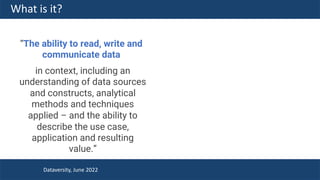
What is it?
“The ability to read, write and
communicate data
Dataversity, June 2022
in context, including an
understanding of data sources
and constructs, analytical
methods and techniques
applied – and the ability to
describe the use case,
application and resulting
value.”
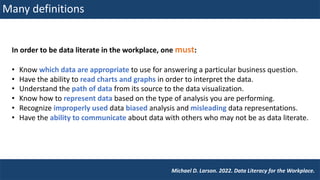
Many definitions
In order to be data literate in the workplace, one must:
• Know which data are appropriate to use for answering a particular business question.
• Have the ability to read charts and graphs in order to interpret the data.
• Understand the path of data from its source to the data visualization.
• Know how to represent data based on the type of analysis you are performing.
• Recognize improperly used data biased analysis and misleading data representations.
• Have the ability to communicate about data with others who may not be as data literate.
Michael D. Larson. 2022. Data Literacy for the Workplace.
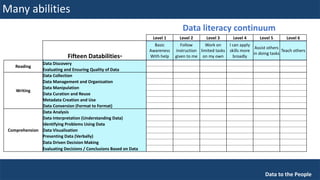
Data to the People
Level 1 Level 2 Level 3 Level 4 Level 5 Level 6
Fifteen Databilities®
Basic
Awareness
With help
Follow
instruction
given to me
Work on
limited tasks
on my own
I can apply
skills more
broadly
Assist others
in doing tasks
Teach others
Reading
Data Discovery
Evaluating and Ensuring Quality of Data
Writing
Data Collection
Data Management and Organisation
Data Manipulation
Data Curation and Reuse
Metadata Creation and Use
Data Conversion (Format to Format)
Comprehension
Data Analysis
Data Interpretation (Understanding Data)
Identifying Problems Using Data
Data Visualisation
Presenting Data (Verbally)
Data Driven Decision Making
Evaluating Decisions / Conclusions Based on Data
Many abilities
Data literacy continuum
Accenture
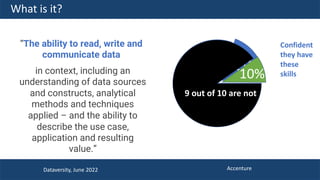
What is it?
“The ability to read, write and
communicate data
Dataversity, June 2022
21%
Confident
they have
these
skills
in context, including an
understanding of data sources
and constructs, analytical
methods and techniques
applied – and the ability to
describe the use case,
application and resulting
value.”
4 out of 5 are not
10%
9 out of 10 are not
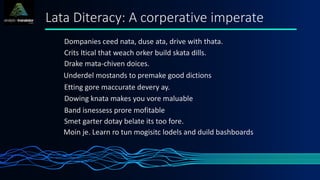
Lata Diteracy: A corperative imperate
Dompanies ceed nata, duse ata, drive with thata.
Crits Itical that weach orker build skata dills.
Drake mata-chiven doices.
Underdel mostands to premake good dictions
Etting gore maccurate devery ay.
Dowing knata makes you vore maluable
Band isnessess prore mofitable
Smet garter dotay belate its too fore.
Moin je. Learn ro tun mogisitc lodels and duild bashboards
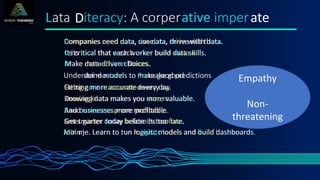
Dompanies ceed nata, duse ata, drive with thata.
Crits Itical that weach orker build skata dills.
Drake mata-Chiven Doices.
Underdel mostands to Premake good dictions
Etting gore maccurate devery ay.
Dowing knata makes you vore maluable.
Band isnessess prore mofitable.
Smet garter dotay belate its too fore.
Moin je. Learn ro tun mogisitc lodels and duild bashboards
D
L ate
ative
ata iteracy: A corper imper
Companies need data, use data, thrive with data.
Its critical that each worker build data skills.
Make data-driven choices.
Understand models to make good predictions
Getting more accurate every day.
Knowing data makes you more valuable.
And businesses more profitable.
Get smarter today before its too late.
Join me. Learn to run logisitc models and build dashboards.
Empathy
Non-
threatening
Announcement
• Sing a show tune
or
• Do a handstand
If you are the rare person who is talented at both,
You will be asked to do a handstand while singing a show
tune.
Your performance will be rated by your peers and boss.
At the end of this session every attendee will be
asked to turn on their camera and either:
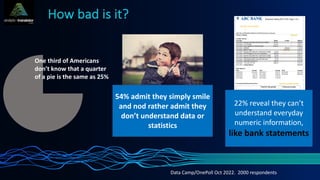
How bad is it?
Data Camp/OnePoll Oct 2022. 2000 respondents
One third of Americans
don’t know that a quarter
of a pie is the same as 25%
54% admit they simply smile
and nod rather admit they
don’t understand data or
statistics
22% reveal they can’t
understand everyday
numeric information,
like bank statements
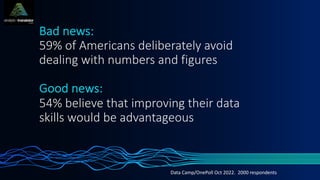
Bad news:
59% of Americans deliberately avoid
dealing with numbers and figures
Good news:
54% believe that improving their data
skills would be advantageous
Data Camp/OnePoll Oct 2022. 2000 respondents
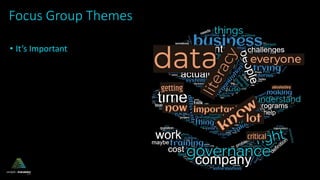
Focus Group Themes
• It’s Important
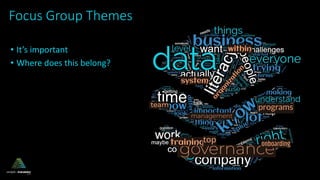
Focus Group Themes
• It’s important
• Where does this belong?
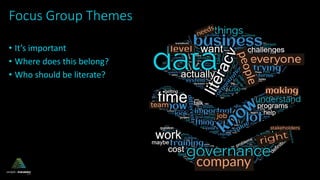
Focus Group Themes
• It’s important
• Where does this belong?
• Who should be literate?
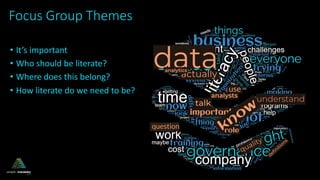
Focus Group Themes
• It’s important
• Who should be literate?
• Where does this belong?
• How literate do we need to be?
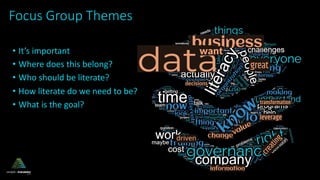
Focus Group Themes
• It’s important
• Where does this belong?
• Who should be literate?
• How literate do we need to be?
• What is the goal?
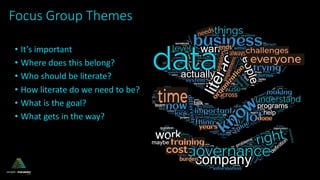
• It’s important
• Where does this belong?
• Who should be literate?
• How literate do we need to be?
• What is the goal?
• What gets in the way?
Focus Group Themes
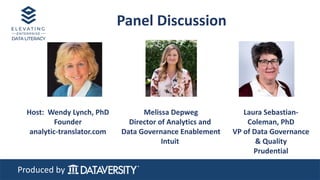
Produced by
Laura Sebastian-
Coleman, PhD
VP of Data Governance
& Quality
Prudential
Melissa Depweg
Director of Analytics and
Data Governance Enablement
Intuit
Panel Discussion
Host: Wendy Lynch, PhD
Founder
analytic-translator.com
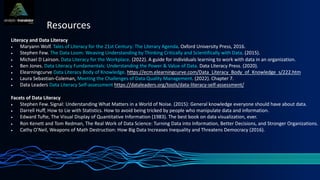
Resources
Literacy and Data Literacy
• Maryann Wolf. Tales of Literacy for the 21st Century: The Literary Agenda. Oxford University Press, 2016.
• Stephen Few. The Data Loom: Weaving Understanding by Thinking Critically and Scientifically with Data. (2015).
• Michael D Lairson. Data Literacy for the Workplace. (2022). A guide for individuals learning to work with data in an organization.
• Ben Jones. Data Literacy Fundamentals: Understanding the Power & Value of Data. Data Literacy Press. (2020).
• Elearningcurve Data Literacy Body of Knowledge. https://ecm.elearningcurve.com/Data_Literacy_Body_of_Knowledge_s/222.htm
• Laura Sebastian-Coleman, Meeting the Challenges of Data Quality Management. (2022). Chapter 7.
• Data Leaders Data Literacy Self-assessment https://dataleaders.org/tools/data-literacy-self-assessment/
Facets of Data Literacy
• Stephen Few. Signal: Understanding What Matters in a World of Noise. (2015): General knowledge everyone should have about data.
• Darrell Huff, How to Lie with Statistics. How to avoid being tricked by people who manipulate data and information.
• Edward Tufte, The Visual Display of Quantitative Information (1983). The best book on data visualization, ever.
• Ron Kenett and Tom Redman, The Real Work of Data Science: Turning Data into Information, Better Decisions, and Stronger Organizations.
• Cathy O’Neil, Weapons of Math Destruction: How Big Data Increases Inequality and Threatens Democracy (2016).
wendy@analytic-translator.com
Linkedin: @wendylynchphD
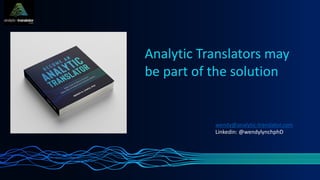
Analytic Translators may
be part of the solution
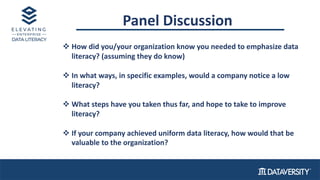
Panel Discussion
v How did you/your organization know you needed to emphasize data
literacy? (assuming they do know)
v In what ways, in specific examples, would a company notice a low
literacy?
v What steps have you taken thus far, and hope to take to improve
literacy?
v If your company achieved uniform data literacy, how would that be
valuable to the organization?

Is Enterprise Data Literacy Possible?

  • 1.
    Produced by Enterprise DataLiteracy Even Possible? Is Hosted by Wendy Lynch, PhD
  • 2.
    Produced by Laura Sebastian- Coleman,PhD VP of Data Governance & Quality Prudential Melissa Depweg Director of Analytics and Data Governance Enablement Intuit Today’s Panel Host: Wendy Lynch, PhD Founder analytic-translator.com
  • 3.
    Produced by Enterprise DataLiteracy Even Possible? Is Hosted by Wendy Lynch, PhD
  • 4.
    Since 2010, interest indata literacy has grown dramatically. Data literacy searches past 13 years 6M 117M 143M Ninety percent of business leaders believe data literacy will be critical to their success. https://hbr.org/2021/08/how-data-literate-is-your-company
  • 5.
    What is it? “Theability to read, write and communicate data Dataversity, June 2022 in context, including an understanding of data sources and constructs, analytical methods and techniques applied – and the ability to describe the use case, application and resulting value.”
  • 6.
    Many definitions In orderto be data literate in the workplace, one must: • Know which data are appropriate to use for answering a particular business question. • Have the ability to read charts and graphs in order to interpret the data. • Understand the path of data from its source to the data visualization. • Know how to represent data based on the type of analysis you are performing. • Recognize improperly used data biased analysis and misleading data representations. • Have the ability to communicate about data with others who may not be as data literate. Michael D. Larson. 2022. Data Literacy for the Workplace.
  • 7.
    Data to thePeople Level 1 Level 2 Level 3 Level 4 Level 5 Level 6 Fifteen Databilities® Basic Awareness With help Follow instruction given to me Work on limited tasks on my own I can apply skills more broadly Assist others in doing tasks Teach others Reading Data Discovery Evaluating and Ensuring Quality of Data Writing Data Collection Data Management and Organisation Data Manipulation Data Curation and Reuse Metadata Creation and Use Data Conversion (Format to Format) Comprehension Data Analysis Data Interpretation (Understanding Data) Identifying Problems Using Data Data Visualisation Presenting Data (Verbally) Data Driven Decision Making Evaluating Decisions / Conclusions Based on Data Many abilities Data literacy continuum
  • 8.
    Accenture What is it? “Theability to read, write and communicate data Dataversity, June 2022 21% Confident they have these skills in context, including an understanding of data sources and constructs, analytical methods and techniques applied – and the ability to describe the use case, application and resulting value.” 4 out of 5 are not 10% 9 out of 10 are not
  • 9.
    Lata Diteracy: Acorperative imperate Dompanies ceed nata, duse ata, drive with thata. Crits Itical that weach orker build skata dills. Drake mata-chiven doices. Underdel mostands to premake good dictions Etting gore maccurate devery ay. Dowing knata makes you vore maluable Band isnessess prore mofitable Smet garter dotay belate its too fore. Moin je. Learn ro tun mogisitc lodels and duild bashboards
  • 10.
    Dompanies ceed nata,duse ata, drive with thata. Crits Itical that weach orker build skata dills. Drake mata-Chiven Doices. Underdel mostands to Premake good dictions Etting gore maccurate devery ay. Dowing knata makes you vore maluable. Band isnessess prore mofitable. Smet garter dotay belate its too fore. Moin je. Learn ro tun mogisitc lodels and duild bashboards D L ate ative ata iteracy: A corper imper Companies need data, use data, thrive with data. Its critical that each worker build data skills. Make data-driven choices. Understand models to make good predictions Getting more accurate every day. Knowing data makes you more valuable. And businesses more profitable. Get smarter today before its too late. Join me. Learn to run logisitc models and build dashboards. Empathy Non- threatening
  • 11.
    Announcement • Sing ashow tune or • Do a handstand If you are the rare person who is talented at both, You will be asked to do a handstand while singing a show tune. Your performance will be rated by your peers and boss. At the end of this session every attendee will be asked to turn on their camera and either:
  • 12.
    How bad isit? Data Camp/OnePoll Oct 2022. 2000 respondents One third of Americans don’t know that a quarter of a pie is the same as 25% 54% admit they simply smile and nod rather admit they don’t understand data or statistics 22% reveal they can’t understand everyday numeric information, like bank statements
  • 13.
    Bad news: 59% ofAmericans deliberately avoid dealing with numbers and figures Good news: 54% believe that improving their data skills would be advantageous Data Camp/OnePoll Oct 2022. 2000 respondents
  • 14.
    Focus Group Themes •It’s Important
  • 15.
    Focus Group Themes •It’s important • Where does this belong?
  • 16.
    Focus Group Themes •It’s important • Where does this belong? • Who should be literate?
  • 17.
    Focus Group Themes •It’s important • Who should be literate? • Where does this belong? • How literate do we need to be?
  • 18.
    Focus Group Themes •It’s important • Where does this belong? • Who should be literate? • How literate do we need to be? • What is the goal?
  • 19.
    • It’s important •Where does this belong? • Who should be literate? • How literate do we need to be? • What is the goal? • What gets in the way? Focus Group Themes
  • 20.
    Produced by Laura Sebastian- Coleman,PhD VP of Data Governance & Quality Prudential Melissa Depweg Director of Analytics and Data Governance Enablement Intuit Panel Discussion Host: Wendy Lynch, PhD Founder analytic-translator.com
  • 21.
    Resources Literacy and DataLiteracy • Maryann Wolf. Tales of Literacy for the 21st Century: The Literary Agenda. Oxford University Press, 2016. • Stephen Few. The Data Loom: Weaving Understanding by Thinking Critically and Scientifically with Data. (2015). • Michael D Lairson. Data Literacy for the Workplace. (2022). A guide for individuals learning to work with data in an organization. • Ben Jones. Data Literacy Fundamentals: Understanding the Power & Value of Data. Data Literacy Press. (2020). • Elearningcurve Data Literacy Body of Knowledge. https://ecm.elearningcurve.com/Data_Literacy_Body_of_Knowledge_s/222.htm • Laura Sebastian-Coleman, Meeting the Challenges of Data Quality Management. (2022). Chapter 7. • Data Leaders Data Literacy Self-assessment https://dataleaders.org/tools/data-literacy-self-assessment/ Facets of Data Literacy • Stephen Few. Signal: Understanding What Matters in a World of Noise. (2015): General knowledge everyone should have about data. • Darrell Huff, How to Lie with Statistics. How to avoid being tricked by people who manipulate data and information. • Edward Tufte, The Visual Display of Quantitative Information (1983). The best book on data visualization, ever. • Ron Kenett and Tom Redman, The Real Work of Data Science: Turning Data into Information, Better Decisions, and Stronger Organizations. • Cathy O’Neil, Weapons of Math Destruction: How Big Data Increases Inequality and Threatens Democracy (2016).
  • 22.
  • 23.
    Panel Discussion v Howdid you/your organization know you needed to emphasize data literacy? (assuming they do know) v In what ways, in specific examples, would a company notice a low literacy? v What steps have you taken thus far, and hope to take to improve literacy? v If your company achieved uniform data literacy, how would that be valuable to the organization?