This document discusses activating data governance using a data catalog. It compares active vs passive data governance, with active embedding governance into people's work through a catalog. The catalog plays a key role by allowing stewards to document definition, production, and usage of data in a centralized place. For governance to be effective, metadata from various sources must be consolidated and maintained in the catalog.
Overview of Non-Invasive Data Governance and the monthly webinar series focusing on Agile Data Governance.
Introduction to enterprise data catalogs, emphasizing the shift to agile data governance and collaborative processes.Key features of agile governance: democratization, business focus, and iterative processes to enhance data access and value.
Guide to establishing an agile data governance framework including cultural change and committee formation.
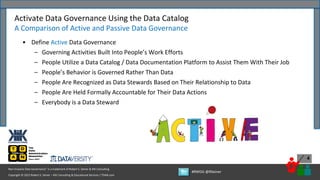
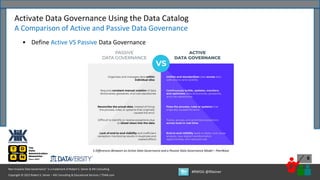
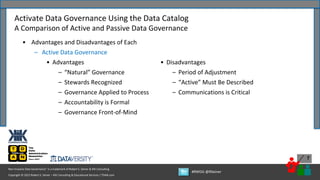
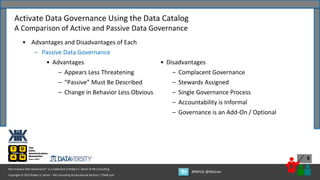
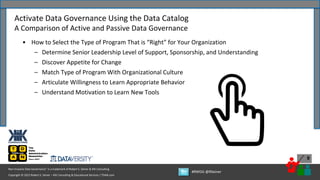
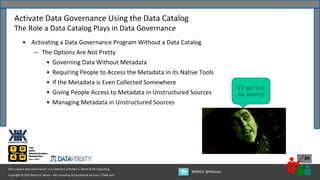
Comparison between active and passive data governance models, focusing on stewardship accountability and organizational behavior.
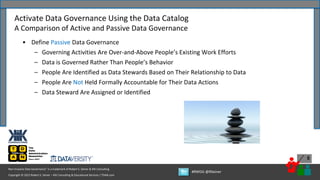
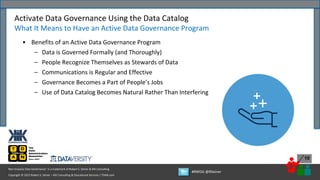
Describes benefits of active governance including accountability and natural governance, versus passive governance's potential drawbacks.
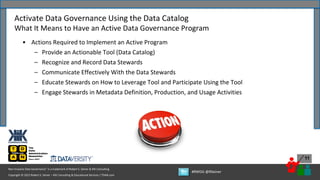
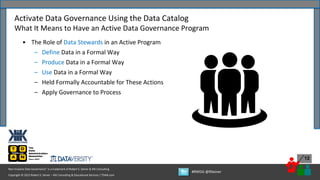
Steps to implement active governance, emphasizing the role and responsibilities of data stewards and the importance of data catalogs.
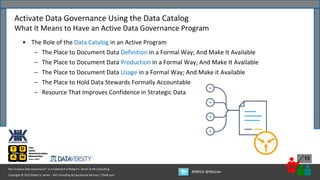
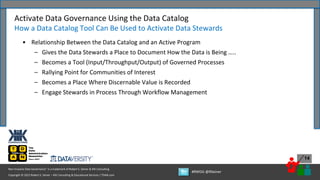
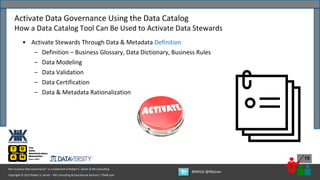
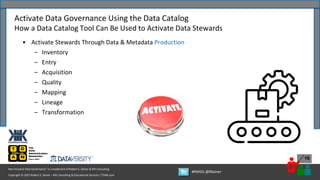
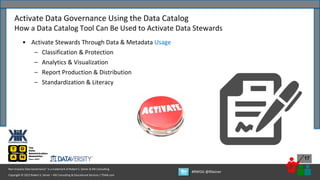
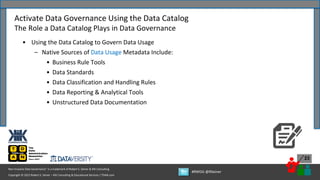
Mechanisms of using data catalogs to support data and metadata definition, production, and usage for effective stewardship.
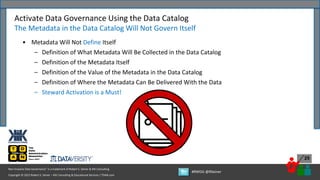
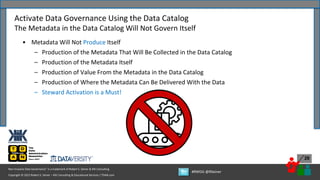
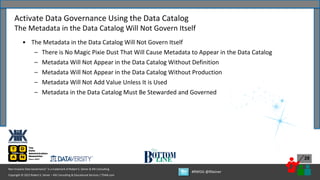
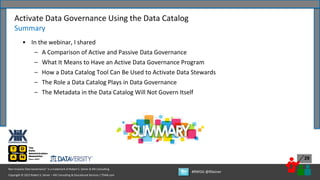
Discussion on managing governance metadata, stressing the importance of cataloging definitions and production details.Summary of the webinar contents reinforcing the importance of a data catalog and stewardship in active data governance.
CONFIDENTIAL
➔ The enterprisedata catalog for the
modern data stack
➔ Fully managed cloud-native SaaS
➔ Leverages the power of knowledge
graph to make data discovery,
governance, and analysis easy
Stewart Coerver
Director, Sales Engineering
datadotworld data.world
4.
CONFIDENTIAL
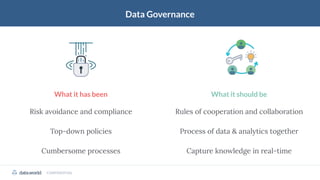
Data Governance
What ithas been
Risk avoidance and compliance
Top-down policies
Cumbersome processes
What it should be
Rules of cooperation and collaboration
Process of data & analytics together
Capture knowledge in real-time
5.
datadotworld data.world
The CloudData Catalog
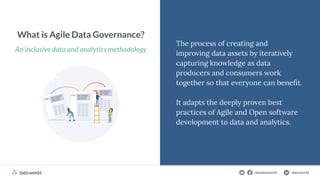
What is Agile Data Governance?
The process of creating and
improving data assets by iteratively
capturing knowledge as data
producers and consumers work
together so that everyone can benefit.
It adapts the deeply proven best
practices of Agile and Open software
development to data and analytics.
datadotworld data.world
The Cloud-Native Data Catalog datadotworld data.world
An inclusive data and analytics methodology
6.
CONFIDENTIAL
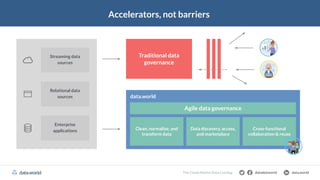
Accelerators, not barriers
Enterprise
applications
Relationaldata
sources
Streaming data
sources
Traditional data
governance
data.world
Agile data governance
Clean, normalize, and
transform data
Data discovery, access,
and marketplace
Cross-functional
collaboration & reuse
datadotworld data.world
The Cloud-Native Data Catalog
7.
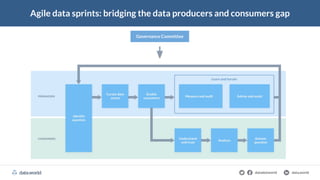
Agile data sprints:bridging the data producers and consumers gap
Governance Committee
datadotworld data.world
8.
datadotworld data.world
The Cloud-NativeData Catalog
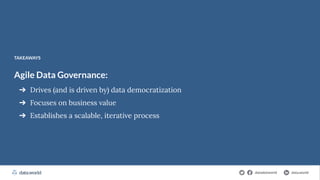
Agile Data Governance:
➔ Drives (and is driven by) data democratization
➔ Focuses on business value
➔ Establishes a scalable, iterative process
TAKEAWAYS
datadotworld data.world
9.
CONFIDENTIAL
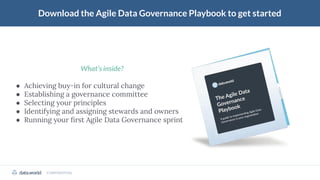
Download the AgileData Governance Playbook to get started
What’s inside?
● Achieving buy-in for cultural change
● Establishing a governance committee
● Selecting your principles
● Identifying and assigning stewards and owners
● Running your first Agile Data Governance sprint