THE PATH TO DATA AND
ANALYTICS MODERNIZATION
W
E
B
I
N
A
R
TONY DAHLAGER
VP, Data Management
Analytics8
KEVIN LOBO
VP, Analytics
Analytics8
The business demands driving modernization, the benefits of modernizing, and how to get started.
Unleash the power of your data
Analytics8 is a data and analytics consultancy.
We help companies make smart, data-driven decisions by
translating their data into meaningful and actionable information.
For us, data is not just data. It's an opportunity to innovate, support, and
transform. We know data is power and with it, we will help you unleash yours.
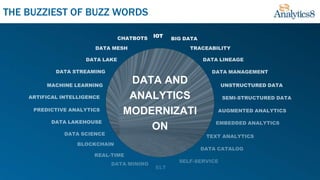
DATA AND
ANALYTICS
MODERNIZATI
ON
THE BUZZIEST OF BUZZ WORDS
IOT
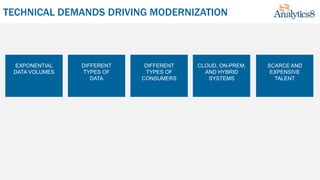
TECHNICAL DEMANDS DRIVING MODERNIZATION
EXPONENTIAL
DATA VOLUMES
DIFFERENT
TYPES OF
DATA
DIFFERENT
TYPES OF
CONSUMERS
CLOUD, ON-PREM,
AND HYBRID
SYSTEMS
SCARCE AND
EXPENSIVE
TALENT
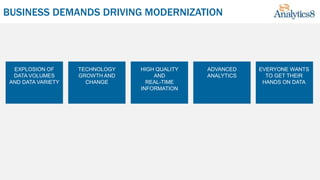
BUSINESS DEMANDS DRIVING MODERNIZATION
EXPLOSION OF
DATA VOLUMES
AND DATA VARIETY
TECHNOLOGY
GROWTH AND
CHANGE
HIGH QUALITY
AND
REAL-TIME
INFORMATION
ADVANCED
ANALYTICS
EVERYONE WANTS
TO GET THEIR
HANDS ON DATA
SO HOW DO YOU SOLVE MODERN DATA PROBLEMS?
You need a modern approach to data and analytics
to solve your modern data problems.
Modern data and analytics solutions are future-ready, scalable, real-time,
high-speed, and agile, enabling broader and better use of data.
WHAT IS DATA AND ANALYTICS MODERNIZATION?
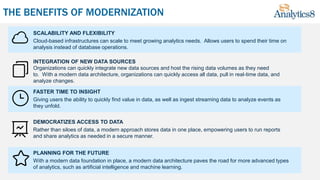
THE BENEFITS OF MODERNIZATION
INTEGRATION OF NEW DATA SOURCES
Organizations can quickly integrate new data sources and host the rising data volumes as they need
to. With a modern data architecture, organizations can quickly access all data, pull in real-time data, and
analyze changes.
FASTER TIME TO INSIGHT
Giving users the ability to quickly find value in data, as well as ingest streaming data to analyze events as
they unfold.
DEMOCRATIZES ACCESS TO DATA
Rather than siloes of data, a modern approach stores data in one place, empowering users to run reports
and share analytics as needed in a secure manner.
PLANNING FOR THE FUTURE
With a modern data foundation in place, a modern data architecture paves the road for more advanced types
of analytics, such as artificial intelligence and machine learning.
SCALABILITY AND FLEXIBILITY
Cloud-based infrastructures can scale to meet growing analytics needs. Allows users to spend their time on
analysis instead of database operations.
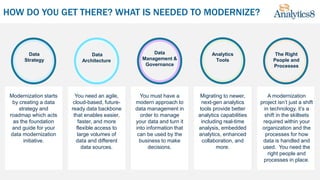
HOW DO YOU GET THERE? WHAT IS NEEDED TO MODERNIZE?
Modernization starts
by creating a data
strategy and
roadmap which acts
as the foundation
and guide for your
data modernization
initiative.
Data
Strategy
You need an agile,
cloud-based, future-
ready data backbone
that enables easier,
faster, and more
flexible access to
large volumes of
data and different
data sources.
You must have a
modern approach to
data management in
order to manage
your data and turn it
into information that
can be used by the
business to make
decisions.
Migrating to newer,
next-gen analytics
tools provide better
analytics capabilities
including real-time
analysis, embedded
analytics, enhanced
collaboration, and
more.
A modernization
project isn’t just a shift
in technology, it’s a
shift in the skillsets
required within your
organization and the
processes for how
data is handled and
used. You need the
right people and
processes in place.
Data
Architecture
Analytics
Tools
Data
Management &
Governance
The Right
People and
Processes
MODERNIZATION STARTS WITH A DATA STRATEGY
Before you begin a modernization initiative,
you need to have a defined data strategy
which acts as the foundation and guide.
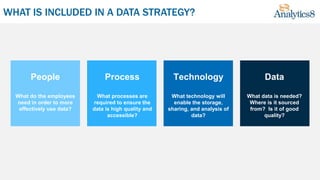
WHAT IS INCLUDED IN A DATA STRATEGY?
People
What do the employees
need in order to more
effectively use data?
Process
What processes are
required to ensure the
data is high quality and
accessible?
Technology
What technology will
enable the storage,
sharing, and analysis of
data?
Data
What data is needed?
Where is it sourced
from? Is it of good
quality?
The best strategies do not start with the data or technology.
Start with what the business wants to achieve and how data can
help you get there.
START WITH THE BUSINESS
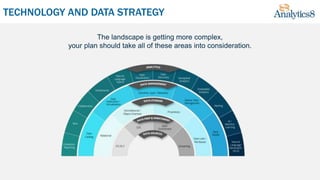
TECHNOLOGY AND DATA STRATEGY
The landscape is getting more complex,
your plan should take all of these areas into consideration.
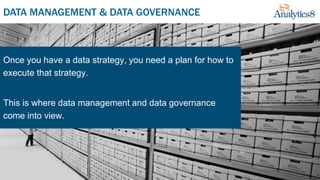
DATA MANAGEMENT & DATA GOVERNANCE
Once you have a data strategy, you need a plan for how to
execute that strategy.
This is where data management and data governance
come into view.
MODERN DATA ARCHITECTURE
IS JUST ONE PART OF
MODERN DATA MANAGEMENT
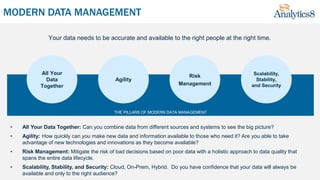
• All Your Data Together: Can you combine data from different sources and systems to see the big picture?
• Agility: How quickly can you make new data and information available to those who need it? Are you able to take
advantage of new technologies and innovations as they become available?
• Risk Management: Mitigate the risk of bad decisions based on poor data with a holistic approach to data quality that
spans the entire data lifecycle.
• Scalability, Stability, and Security: Cloud, On-Prem, Hybrid. Do you have confidence that your data will always be
available and only to the right audience?
Your data needs to be accurate and available to the right people at the right time.
All Your
Data
Together
Agility
Scalability,
Stability,
and Security
THE PILLARS OF MODERN DATA MANAGEMENT
Risk
Management
SOLUTIONS ARE NOT ONE SIZE FITS ALL
Not all organizations require the same data
architecture to be modern.
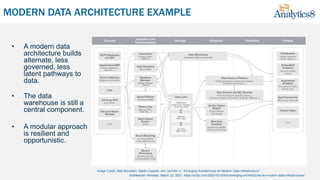
MODERN DATA ARCHITECTURE EXAMPLE
• A modern data
architecture builds
alternate, less
governed, less
latent pathways to
data.
• The data
warehouse is still a
central component.
• A modular approach
is resilient and
opportunistic.
Image Credit: Matt Bornstein, Martin Casado, and Jennifer Li. “Emerging Architectures for Modern Data Infrastructure”.
Andreessen Horowitz. March 22, 2021. https://a16z.com/2020/10/15/the-emerging-architectures-for-modern-data-infrastructure/
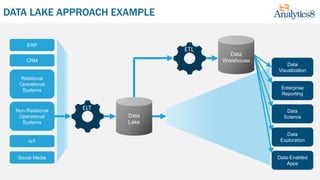
DATA LAKE APPROACH EXAMPLE
Data-Enabled
Apps
Data
Exploration
Data
Science
Enterprise
Reporting
Data
Visualization
Data
Warehouse
ETL
ELT
Social Media
IoT
Non-Relational
Operational
Systems
Relational
Operational
Systems
CRM
Data
Lake
ERP
The goal of data management is to maximize the value
that you create from your data in your organization.
That value is generated by analytics, when you
actually use data.
ANALYTICS TURNS DATA INTO MEANINGFUL INFORMATION
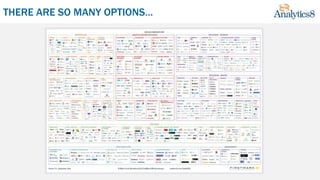
THERE ARE SO MANY OPTIONS…
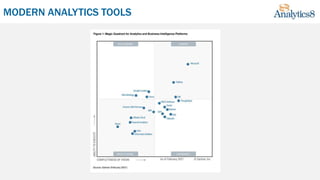
MODERN ANALYTICS TOOLS
THE MIGRATION PROCESS
PICK YOUR TOOL
1. • Consider your entire data architecture
• Do a tool bakeoff
• Take it for a test drive
THE MIGRATION PROCESS
2
1. Pick Your Tool
2. ASSESS SKILL SETS
• Factor your people into your decisions
• Determine the skillsets needed with
new technology
• Plan for training and enablement
1. Pick Your Tool
2. Assess Skill Sets
THE MIGRATION PROCESS
3. FOCUS ON INITIAL BUILD PHASE
• Take opportunity to triage and
revisit requirements
• Select high value reports and
applications for initial migration
1. Pick Your Tool
2. Assess Skill Sets
3. Focus on Short Term
THE MIGRATION PROCESS
4. PUT TOGETHER ROLL-OUT PLAN • Achieve user adoption through
preparation and education
THE RIGHT PEOPLE AND PROCESSES
• Plan for both developer and end-user training
• Determine how your org will receive training
• Determine load balancing method
THE RIGHT PEOPLE AND PROCESSES
Don't just lift and shift.
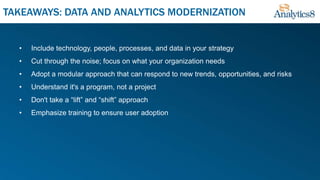
• Include technology, people, processes, and data in your strategy
• Cut through the noise; focus on what your organization needs
• Adopt a modular approach that can respond to new trends, opportunities, and risks
• Understand it's a program, not a project
• Don't take a “lift” and “shift” approach
• Emphasize training to ensure user adoption
TAKEAWAYS: DATA AND ANALYTICS MODERNIZATION
QUESTIONS?
SUBSCRIBE TO THE 8 UPDATE NEWSLETTER • Analytics8.com
TONY DAHLAGER
tdahlager@analytics8.com
Analytics8
KEVIN LOBO
klobo@analytics8.com
Analytics8
MODERNIZATION QUICK START
We know data is power and with it,
we will help you unleash yours.

The Path to Data and Analytics Modernization

  • 1.
    THE PATH TODATA AND ANALYTICS MODERNIZATION W E B I N A R TONY DAHLAGER VP, Data Management Analytics8 KEVIN LOBO VP, Analytics Analytics8 The business demands driving modernization, the benefits of modernizing, and how to get started.
  • 2.
    Unleash the powerof your data Analytics8 is a data and analytics consultancy. We help companies make smart, data-driven decisions by translating their data into meaningful and actionable information. For us, data is not just data. It's an opportunity to innovate, support, and transform. We know data is power and with it, we will help you unleash yours.
  • 3.
  • 4.
    TECHNICAL DEMANDS DRIVINGMODERNIZATION EXPONENTIAL DATA VOLUMES DIFFERENT TYPES OF DATA DIFFERENT TYPES OF CONSUMERS CLOUD, ON-PREM, AND HYBRID SYSTEMS SCARCE AND EXPENSIVE TALENT
  • 5.
    BUSINESS DEMANDS DRIVINGMODERNIZATION EXPLOSION OF DATA VOLUMES AND DATA VARIETY TECHNOLOGY GROWTH AND CHANGE HIGH QUALITY AND REAL-TIME INFORMATION ADVANCED ANALYTICS EVERYONE WANTS TO GET THEIR HANDS ON DATA
  • 6.
    SO HOW DOYOU SOLVE MODERN DATA PROBLEMS? You need a modern approach to data and analytics to solve your modern data problems.
  • 7.
    Modern data andanalytics solutions are future-ready, scalable, real-time, high-speed, and agile, enabling broader and better use of data. WHAT IS DATA AND ANALYTICS MODERNIZATION?
  • 8.
    THE BENEFITS OFMODERNIZATION INTEGRATION OF NEW DATA SOURCES Organizations can quickly integrate new data sources and host the rising data volumes as they need to. With a modern data architecture, organizations can quickly access all data, pull in real-time data, and analyze changes. FASTER TIME TO INSIGHT Giving users the ability to quickly find value in data, as well as ingest streaming data to analyze events as they unfold. DEMOCRATIZES ACCESS TO DATA Rather than siloes of data, a modern approach stores data in one place, empowering users to run reports and share analytics as needed in a secure manner. PLANNING FOR THE FUTURE With a modern data foundation in place, a modern data architecture paves the road for more advanced types of analytics, such as artificial intelligence and machine learning. SCALABILITY AND FLEXIBILITY Cloud-based infrastructures can scale to meet growing analytics needs. Allows users to spend their time on analysis instead of database operations.
  • 9.
    HOW DO YOUGET THERE? WHAT IS NEEDED TO MODERNIZE? Modernization starts by creating a data strategy and roadmap which acts as the foundation and guide for your data modernization initiative. Data Strategy You need an agile, cloud-based, future- ready data backbone that enables easier, faster, and more flexible access to large volumes of data and different data sources. You must have a modern approach to data management in order to manage your data and turn it into information that can be used by the business to make decisions. Migrating to newer, next-gen analytics tools provide better analytics capabilities including real-time analysis, embedded analytics, enhanced collaboration, and more. A modernization project isn’t just a shift in technology, it’s a shift in the skillsets required within your organization and the processes for how data is handled and used. You need the right people and processes in place. Data Architecture Analytics Tools Data Management & Governance The Right People and Processes
  • 10.
    MODERNIZATION STARTS WITHA DATA STRATEGY Before you begin a modernization initiative, you need to have a defined data strategy which acts as the foundation and guide.
  • 11.
    WHAT IS INCLUDEDIN A DATA STRATEGY? People What do the employees need in order to more effectively use data? Process What processes are required to ensure the data is high quality and accessible? Technology What technology will enable the storage, sharing, and analysis of data? Data What data is needed? Where is it sourced from? Is it of good quality?
  • 12.
    The best strategiesdo not start with the data or technology. Start with what the business wants to achieve and how data can help you get there. START WITH THE BUSINESS
  • 13.
    TECHNOLOGY AND DATASTRATEGY The landscape is getting more complex, your plan should take all of these areas into consideration.
  • 14.
    DATA MANAGEMENT &DATA GOVERNANCE Once you have a data strategy, you need a plan for how to execute that strategy. This is where data management and data governance come into view.
  • 15.
    MODERN DATA ARCHITECTURE ISJUST ONE PART OF MODERN DATA MANAGEMENT
  • 16.
    MODERN DATA MANAGEMENT •All Your Data Together: Can you combine data from different sources and systems to see the big picture? • Agility: How quickly can you make new data and information available to those who need it? Are you able to take advantage of new technologies and innovations as they become available? • Risk Management: Mitigate the risk of bad decisions based on poor data with a holistic approach to data quality that spans the entire data lifecycle. • Scalability, Stability, and Security: Cloud, On-Prem, Hybrid. Do you have confidence that your data will always be available and only to the right audience? Your data needs to be accurate and available to the right people at the right time. All Your Data Together Agility Scalability, Stability, and Security THE PILLARS OF MODERN DATA MANAGEMENT Risk Management
  • 17.
    SOLUTIONS ARE NOTONE SIZE FITS ALL Not all organizations require the same data architecture to be modern.
  • 18.
    MODERN DATA ARCHITECTUREEXAMPLE • A modern data architecture builds alternate, less governed, less latent pathways to data. • The data warehouse is still a central component. • A modular approach is resilient and opportunistic. Image Credit: Matt Bornstein, Martin Casado, and Jennifer Li. “Emerging Architectures for Modern Data Infrastructure”. Andreessen Horowitz. March 22, 2021. https://a16z.com/2020/10/15/the-emerging-architectures-for-modern-data-infrastructure/
  • 19.
    DATA LAKE APPROACHEXAMPLE Data-Enabled Apps Data Exploration Data Science Enterprise Reporting Data Visualization Data Warehouse ETL ELT Social Media IoT Non-Relational Operational Systems Relational Operational Systems CRM Data Lake ERP
  • 20.
    The goal ofdata management is to maximize the value that you create from your data in your organization. That value is generated by analytics, when you actually use data. ANALYTICS TURNS DATA INTO MEANINGFUL INFORMATION
  • 21.
    THERE ARE SOMANY OPTIONS…
  • 22.
  • 23.
    THE MIGRATION PROCESS PICKYOUR TOOL 1. • Consider your entire data architecture • Do a tool bakeoff • Take it for a test drive
  • 24.
    THE MIGRATION PROCESS 2 1.Pick Your Tool 2. ASSESS SKILL SETS • Factor your people into your decisions • Determine the skillsets needed with new technology • Plan for training and enablement
  • 25.
    1. Pick YourTool 2. Assess Skill Sets THE MIGRATION PROCESS 3. FOCUS ON INITIAL BUILD PHASE • Take opportunity to triage and revisit requirements • Select high value reports and applications for initial migration
  • 26.
    1. Pick YourTool 2. Assess Skill Sets 3. Focus on Short Term THE MIGRATION PROCESS 4. PUT TOGETHER ROLL-OUT PLAN • Achieve user adoption through preparation and education
  • 27.
    THE RIGHT PEOPLEAND PROCESSES • Plan for both developer and end-user training • Determine how your org will receive training • Determine load balancing method
  • 28.
    THE RIGHT PEOPLEAND PROCESSES Don't just lift and shift.
  • 29.
    • Include technology,people, processes, and data in your strategy • Cut through the noise; focus on what your organization needs • Adopt a modular approach that can respond to new trends, opportunities, and risks • Understand it's a program, not a project • Don't take a “lift” and “shift” approach • Emphasize training to ensure user adoption TAKEAWAYS: DATA AND ANALYTICS MODERNIZATION
  • 30.
    QUESTIONS? SUBSCRIBE TO THE8 UPDATE NEWSLETTER • Analytics8.com TONY DAHLAGER tdahlager@analytics8.com Analytics8 KEVIN LOBO klobo@analytics8.com Analytics8
  • 31.
  • 32.
    We know datais power and with it, we will help you unleash yours.

Editor's Notes

  • #5 Everyone seems to be talking about data modernization these days. It’s no surprise, as the old ways of approaching data and analytics are not keeping up with the sorts of technology demands we’re seeing today. Organizations have: Too much data, too many integrations Organizations can’t keep up with volumes and varieties of data with ingestion, integration or cataloging. There are different types of data vs just relational sources. Older analytics systems have trouble playing nicely with semi- and unstructured sources Reporting, dashboarding, and Excel are no longer sufficient toolsets - streaming, real-time, near-real time, embedded use cases, advanced analytics, and bi-directional use cases are growing. Architectures are getting more complex. Data sources have been on-prem and in the cloud for a while now, but now organizations now have source systems, data warehouses, operational systems, etc split between being hosted on-prem, in the cloud, in multiple clouds, or some combination of these. Scarcity of talent – It’s hard to find people to maintain your old stack, let alone keep up with the rapidly changing demands in the marketplace. Organizations are having trouble finding the right people to bring onboard to help.
  • #6 TONY You may have heard these technical demands through the business perspective instead. They really get at the same problems demanding modernization. To stay competitive in today’s market, companies must be able to use their data to make better decisions and respond to the needs of a dynamic business environment.  Take advantage of the explosion of data: Organizations see the competitive advantages with the ability to access, use, store, transform, and analyze more data- including increasing data volumes, types, and sources. There is a need to move quickly to beat the competition to market or at least in the race of information. The number and variety of data sources is growing constantly. Innovations with social media, different channels, customer engagement, marketing, external data, etc. are forcing businesses to adopt more and more technologies to keep pace. The number and volume of data sources requiring integration are constantly increasing, making it difficult to keep pace. Need high quality data and want real time information: The business demands more and better analytics- which require quick and easy access to all data that is up-to-date. Have the ability to do advanced analytics- now or in the future: Companies at a minimum need the foundation in place to perform advanced analytics like machine learning and AI. More people throughout the company want to get their hands on data: Analysis isn’t just happening in IT anymore- all departments and functions are becoming data literate. People throughout the organization want the ability to slide and dice the data.
  • #7 TONY The old way of doing things isn’t keeping up. It requires modern thinking and modern strategy to adapt to your modern data problems. TONY
  • #8 TONY So what do I mean when I say “data and analytics modernization” First - Modernizing data and analytics is not about a single action or implementing some suite of tools. It is rethinking how you use data and analytics as a company.  Oftentimes people characterize “modernization” as just moving something to the cloud; but the approach you take and the advantages you realize go beyond just cloud adoption. These solutions expose advanced analytical capabilities that help you make smarter decisions. Modernization is leveraging modern data management principles. Yes, it involves moving from legacy databases and architectures to modern, cloud-based platforms and scalable architectures. Modernization is moving from legacy, traditional BI tools to modern, next gen analytics tools to realize returns on your investments in data. You do this by delivering better and faster analytics, including augmented analytics and machine learning. What sorts of returns on investment? What are the benefits?
  • #9 TONY When you adopt a modern approach to data and analytics, you realize all sorts of benefits. All the benefits of moving to the cloud- Speed, scale, flexibility, rapid prototyping, lower TCO, ​etc Provides better management of ALL data- to process the variety of data available Support faster data access and integration of new data sources and types- with a focus on rising data volumes and use of multiple data sources Reduce time to insight, giving users the ability to quickly find value in data, as well as ingest streaming data to analyze events as they unfold. Democratizing access with data stored in one place for every business function, thereby empowering data analysts to run analytics without acquiring new skills. Planning for the future- having the foundation in place for more advanced types of analytics, such as artificial intelligence and machine learning. Provide better analytics and rapid reporting- which enables real-time decision making- ability to quickly access all data, pull in new sources, analyze changes
  • #10 TONY How do you get there? You need a balanced approach. We’ll touch on each of these points today.
  • #11 KEVIN
  • #12 TONY Your data and analytics modernization initiative should be viewed as a high-stakes project driven by a long-term strategy. Address if you do have data strategy already, need to reexamine it. Make sure to connect data strategy to modernization.
  • #14 I’m not convinced we need this slide TONY Technology does play a part in the data strategy though. Choose the tech that’s best for your organization based on your goals and on your requirements Consider your current data needs, and choose an approach to data management and data architecture that can expand with your needs over time
  • #17 Start with principles before moving to architecture
  • #20 Look familiar?
  • #22 1. Power BI 2. Looker 3. Qlik 4. AWS QuickSight
  • #23 1. Power BI 2. Looker 3. Qlik 4. AWS QuickSight
  • #24 KEVIN
  • #25 KEVIVN
  • #26 KEVIN
  • #27 KEVIN
  • #28 1. A training and enablement plan in place to mitigate the learning curve on the new tool 2. How will they receive training: can you develop a strong training program internally ,or do your require outside help to initiative 3. Load balancing. This isn't just a process of learning a new tool. It’s a process of maintaining your legacy tool, and translating those reports to your new tool. How do you divide the workload in your team? Do you need outside vendor help? Who takes what aspect to the process? 4. Don’t just lift and shift- don’t replicate your old analytics solution… Often the analytics selection process takes on such precedence that the question of “who” gets obscured. Your people must be factored into decision-making because they will ultimately be responsible for building and developing reports. A modernization project isn’t just a shift in technology; it’s also a shift in the skillsets required within your organization. If your team of developers must pivot from their legacy platform to a modern analytics solution, they need an enablement plan to mitigate the learning curve. Consider how they’ll receive training too—can you develop a strong training program internally, or do you require outside help initiate? Not just a replication of your old analytics solution--- don’t just take what you know. Use it as an opp to improve the app- how are the dashboards being used? Could they be improved?
  • #29 1. A training and enablement plan in place to mitigate the learning curve on the new tool 2. How will they receive training: can you develop a strong training program internally ,or do your require outside help to initiative 3. Load balancing. This isn't just a process of learning a new tool. It’s a process of maintaining your legacy tool, and translating those reports to your new tool. How do you divide the workload in your team? Do you need outside vendor help? Who takes what aspect to the process? 4. Don’t just lift and shift- don’t replicate your old analytics solution… Often the analytics selection process takes on such precedence that the question of “who” gets obscured. Your people must be factored into decision-making because they will ultimately be responsible for building and developing reports. A modernization project isn’t just a shift in technology; it’s also a shift in the skillsets required within your organization. If your team of developers must pivot from their legacy platform to a modern analytics solution, they need an enablement plan to mitigate the learning curve. Consider how they’ll receive training too—can you develop a strong training program internally, or do you require outside help initiate? Not just a replication of your old analytics solution--- don’t just take what you know. Use it as an opp to improve the app- how are the dashboards being used? Could they be improved?
  • #30 People and processes- critically important- when modernizing technologies, need to ensure people are trained (look at blog post KL) Important to manage data literacy- ensure users are trained/ can do analysis on their own Data democratization Allows companies to make data part of their culture instead of just another task Must have a data strategy- you can’t just implement a modern tool and now you’re modern- you need to have a strategic approach A program not a project- should be ongoing activities Is there a lower barrier to entry for certain technologies- new capabilities that people can take advantage of ( If you want to take advantage of more advanced techniques, you need to have a modern foundation in place You cannot just carry your legacy problems forward. How do you justify the spend? Identifying places where you can identify ROI for modernizing Include summary points for data management section (modularity / agility, not following crowd (fomo))
  • #32 Analytics Tool Assessment (Applicable only if tool has not been selected) Analytics8 will review strengths and weaknesses of modern analytics platforms, and what is the optimal fit within a client's upstream data architecture  Analytics Bake-off (Applicable only if tool has not been selected) Analytics8 will build proof-of-concept applications in the selected Analytics tools. The goal is to utilize a common data set across all analytics tools to contrast feature functionality POC Build (Applicable when a tool has already been selected) Analytics8 will help the client define a Proof-of-Concept project in the selected Analytics tool. Typically this entails taking elements of an existing legacy analytics report, and migrating it over to the specified Analytics tool of choice. The goal of this exercise is to understand feature functionality of the new analytics tool, and how user experience can be constructed to find commonalities back to the legacy analytics platform Roadmap Planning Once POC is complete, Analytics8 will conduct roadmap planning to create a migration path to transition reports to the new analytics tool and retire reports that are no longer necessary Analytics will prioritize and build use cases for advanced analytics, data science and augmented analytics Production Build Analytics8 will focus on building operationalized reporting within the new analytics tool to roll out to end users Adoption and End User Training Customized classroom / virtual training on Analytics platform Boot camp training on production applications to drive user visibility and adoption