©InfoSightPartners,2016,AllRightsReserved
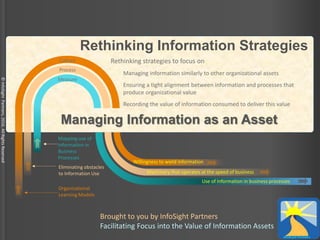
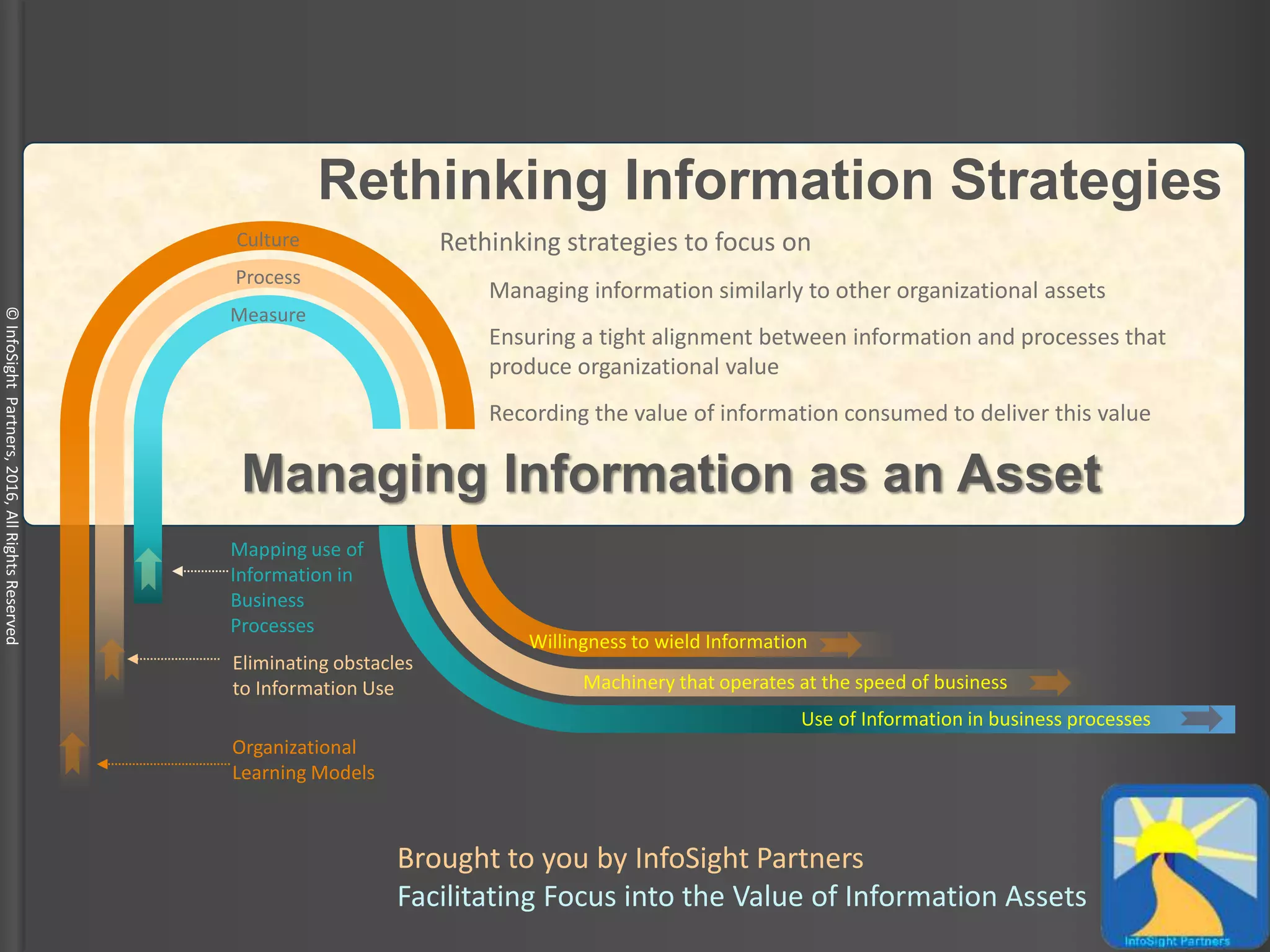
Managing Information as an Asset
Mapping use of
Information in
Business
Processes
Eliminating obstacles
to Information Use
Organizational
Learning Models
Culture
Process
Measure
Willingness to wield Information
Machinery that operates at the speed of business
Use of Information in business processes
Rethinking Information Strategies
Rethinking strategies to focus on
Managing information similarly to other organizational assets
Ensuring a tight alignment between information and processes that
produce organizational value
Recording the value of information consumed to deliver this value
Brought to you by InfoSight Partners
Facilitating Focus into the Value of Information Assets
©InfoSightPartners,2016,AllRightsReserved
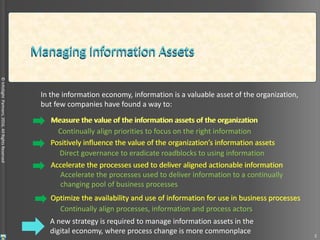
In the information economy, information is a valuable asset of the organization,
but few companies have found a way to:
- Measure the value of the information assets of the organization
- Positively influence the value of the organization’s information assets
- Accelerate the processes used to deliver aligned actionable information
- Optimize the availability and use of information for use in business processes
A new strategy is required to manage information assets in the
digital economy, where process change is more commonplace
Measure the value of the information assets of the organization
Positively influence the value of the organization’s information assets
Accelerate the processes used to deliver aligned actionable information
Optimize the availability and use of information for use in business processes
Continually align priorities to focus on the right information
Direct governance to eradicate roadblocks to using information
Accelerate the processes used to deliver information to a continually
changing pool of business processes
Continually align processes, information and process actors
2
©InfoSightPartners,2016,AllRightsReserved
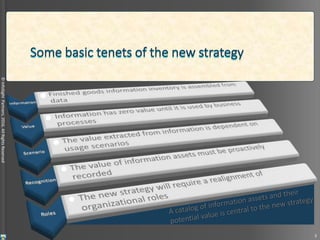
3
©InfoSightPartners,2016,AllRightsReserved
Incoming
Raw Data
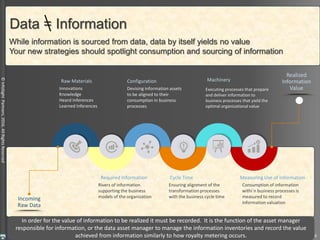
Raw Materials
Innovations
Knowledge
Heard Inferences
Learned Inferences
Required Information
Rivers of information
supporting the business
models of the organization
Configuration
Devising information assets
to be aligned to their
consumption in business
processes
Cycle Time
Ensuring alignment of the
transformation processes
with the business cycle time
Machinery
Executing processes that prepare
and deliver information to
business processes that yield the
optimal organizational value
Measuring Use of Information
Consumption of information
withi`n business processes is
measured to record
information valuation
Realized
Information
Value
Data = Information
While information is sourced from data, data by itself yields no value
Your new strategies should spotlight consumption and sourcing of information
4
The raw materials inventory that is obtained from internal and external sources consists of learned
inferences, heard inferences, the body of enterprise knowledge and innovations
The raw materials inventory of data is not organized to be consumed directly by business processes. Through
a mapping process, the organization, scope and other characteristics of information required for business
processes is defined, which becomes the scope applied through the machinery to create information.
The configuration of information required for consumption in business processes is determined.
The cycle time required for information to be made available is determined as another configuration
instruction for the machinery that prepares information from the raw materials of data.
The machinery is used to construct information. At the exit of the machinery processes, the information has
potential value, meaning that it is ready and waiting for consumption within business processes
The consumption of information must be recorded so that it can be realized similarly to the use of other intangible
assets of the organization. Information does expire but is not depleting, meaning it can be consumed more than once
prior to its expiration. The information half life is a measurement of potential value decay.
In order for the value of information to be realized it must be recorded. It is the function of the asset manager
responsible for information, or the data asset manager to manage the information inventories and record the value
achieved from information similarly to how royalty metering occurs.
©InfoSightPartners,2016,AllRightsReserved
Process
Information
A non-
expiring asset
consumed in
business
processes
Methods
Prepared by
Inventory
Machinery
Strat
Influenced By
Not all use of
information
is equal
Measure
Realized by
Information
not measured
has limited
value
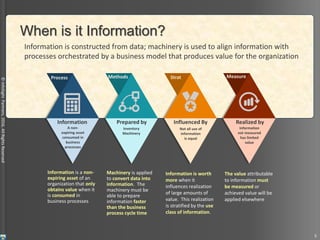
When is it Information?
Information is a non-
expiring asset of an
organization that only
obtains value when it
is consumed in
business processes
Machinery is applied
to convert data into
information. The
machinery must be
able to prepare
information faster
than the business
process cycle time
Information is worth
more when it
influences realization
of large amounts of
value. This realization
is stratified by the use
class of information.
The value attributable
to information must
be measured or
achieved value will be
applied elsewhere
Information is constructed from data; machinery is used to align information with
processes orchestrated by a business model that produces value for the organization
5
©InfoSightPartners,2016,AllRightsReserved
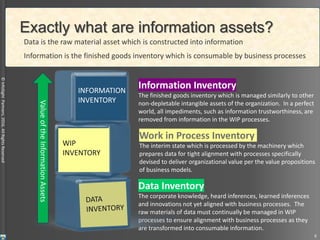
Information Inventory
The finished goods inventory which is managed similarly to other
non-depletable intangible assets of the organization. In a perfect
world, all impediments, such as information trustworthiness, are
removed from information in the WIP processes.
Work in Process Inventory
The interim state which is processed by the machinery which
prepares data for tight alignment with processes specifically
devised to deliver organizational value per the value propositions
of business models.
Data Inventory
The corporate knowledge, heard inferences, learned inferences
and innovations not yet aligned with business processes. The
raw materials of data must continually be managed in WIP
processes to ensure alignment with business processes as they
are transformed into consumable information.
Exactly what are information assets?
Data is the raw material asset which is constructed into information
Information is the finished goods inventory which is consumable by business processes
ValueoftheInformationAssets
6
INFORMATION
INVENTORY
WIP
INVENTORY
©InfoSightPartners,2016,AllRightsReserved
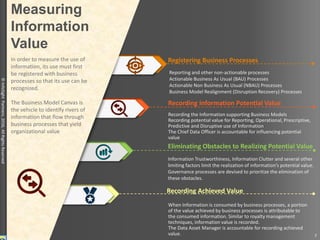
Recording Information Potential Value
Recording the Information supporting Business Models
Recording potential value for Reporting, Operational, Prescriptive,
Predictive and Disruptive use of Information
The Chief Data Officer is accountable for influencing potential
value
Eliminating Obstacles to Realizing Potential Value
Information Trustworthiness, Information Clutter and several other
limiting factors limit the realization of information’s potential value.
Governance processes are devised to prioritize the elimination of
these obstacles.
Recording Achieved Value
When Information is consumed by business processes, a portion
of the value achieved by business processes is attributable to
the consumed information. Similar to royalty management
techniques, information value is recorded.
The Data Asset Manager is accountable for recording achieved
value.
Registering Business Processes
Reporting and other non-actionable processes
Actionable Business As Usual (BAU) Processes
Actionable Non Business As Usual (NBAU) Processes
Business Model Realignment (Disruption Recovery) Processes
Measuring
Information
Value
In order to measure the use of
information, its use must first
be registered with business
processes so that its use can be
recognized.
The Business Model Canvas is
the vehicle to identify rivers of
information that flow through
business processes that yield
organizational value
©InfoSightPartners,2016,AllRightsReserved
7
©InfoSightPartners,2016,AllRightsReserved
Performance
Reporting
Standard
Reporting and
basic analytics
BAU
Business as
Usual
Prescriptive
and Predictive
Models
Non-BAU
Market Force
changes that
limit the value
of historical
based analyses
Disruptive
Disruptions
which
significantly
alter business
assumptions
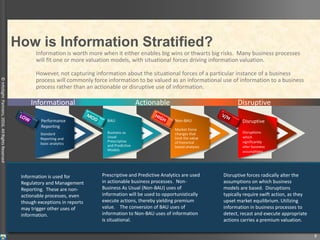
How is Information Stratified?
Information is worth more when it either enables big wins or thwarts big risks. Many business processes
will fit one or more valuation models, with situational forces driving information valuation.
However, not capturing information about the situational forces of a particular instance of a business
process will commonly force information to be valued as an informational use of information to a business
process rather than an actionable or disruptive use of information.
Informational Actionable Disruptive
8
Information is used for
Regulatory and Management
Reporting. These are non-
actionable processes, even
though exceptions in reports
may trigger other uses of
information.
Prescriptive and Predictive Analytics are used
in actionable business processes. Non-
Business As Usual (Non-BAU) uses of
information will be used to opportunistically
execute actions, thereby yielding premium
value. The conversion of BAU uses of
information to Non-BAU uses of information
is situational.
Disruptive forces radically alter the
assumptions on which business
models are based. Disruptions
typically require swift action, as they
upset market equilibrium. Utilizing
information in business processes to
detect, recast and execute appropriate
actions carries a premium valuation.
Performance Reporting reports and basic analytics were once perfectly aligned to the business
processes that they were produced for. However, in highly disruptive times and markets,
particularly those markets with digital products, the alignment between the reports and the
processes supposed to consume the information contained in those reports quickly fades,
thereby rendering their use for in the best cases business as usual conditions and for historical
fact checking. Value achieved from these reports and analysis is commonly low.
Information devised for consumption in processes situationally aligned to business as usual
forces is organized to fit business processes in lockstep with changes in either business
models, assumptions of the business models, or changes in processes used to execute the
value propositions of the business models. In business as usual (BAU) situations, there have
been no or only minor changes to the market forces, and information is used as prescribed
to execute the processes they were aligned to.
Information devised for consumption in processes situationally aligned to non-business as
usual forces is organized to fit business processes in lockstep with changes in either business
models, assumptions of the business models, or changes in processes used to execute the
value propositions of the business models. However, market assumptions used in these
processes have changed and the information has must be consumed in ways slightly or
significantly different from the way proscribed in the business models they were aligned to.
Successful use of this information carries with it higher valuations.
In disruptive situations, the basic assumptions used for a business model and the market
forces are in a state of flux. Usage of the information aligned to business models will be
used in new ways as the models they are aligned with are undergoing changes as well.
Successful use of information carries with it a significant premium. Failure to act or misuse
of information or acting without information (acting on gut) carries with it significant risks in
disruptive situations, as the basic assumptions of market forces are up for grabs in these
situations.
Information is used for
Regulatory and Management
Reporting. These are non-
actionable processes, even
though exceptions in reports
may trigger other uses of
information.
Prescriptive and Predictive Analytics are used
in actionable business processes. Non-
Business As Usual (Non-BAU) uses of
information will be used to opportunistically
execute actions, thereby yielding premium
value. The conversion of BAU uses of
information to Non-BAU uses of information
is situational.
Disruptive forces radically alter the
assumptions on which business
models are based. Disruptions
typically require swift action, as they
upset market equilibrium. Utilizing
information in business processes to
detect, recast and execute appropriate
actions carries a premium valuation.
©InfoSightPartners,2016,AllRightsReserved
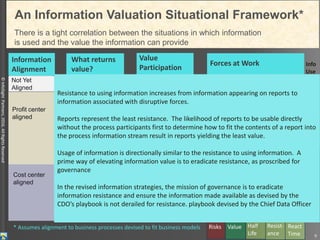
An Information Valuation Situational Framework*
Value influenced
by redirecting
business model
based on NON-
BAU forces
Value influenced
by maintaining
business model
trajectory
Information
used to steer in
an expected
business
trajectory
Profit center
aligned
Activity and other
reports
Cost center
aligned
Capital and
expense used to
produce
information
Information
Alignment
What returns
value?
Value
Participation
DISRUPTIVE
NON-
ACTIONABLEBAUNON-BAU
Not Yet
Aligned
Forces at Work Info
Use
Value influenced by
recasting business
models caused by
disruption
Algorithms
triggered to create
/ respond to
disruptions
Information used
to collaborate
actions based on
NON-BAU forces
Risks Value
J JL
J K J
L J K
L
?
J
K
L
9
There is a tight correlation between the situations in which information
is used and the value the information can provide
* Assumes alignment to business processes devised to fit business models Half
Life
React
Time
Resist-
ance
Minor
Minor
Half
Life
Impact
Half
Life
CauseThe value of information is highly dependent on the situations in which it is consumed
within business processes. For example, information can be included in a report which
was once highly aligned to business processes (but may longer be aligned to intended
business processes).
Information appearing on reports which has to be extracted from reports for use then
interpreted has a lower value than information directly ingestible by business processes if
processes digesting this information have response criteria associated with them.
At certain times, the response criteria is accelerated due to business conditions (non-
business as usual or disruptive conditions), and the ability to wield information has a
premium associated with it by the fact that the business processes wielding this
information have a similar value premium associated with them.
Resistance to using information increases from information appearing on reports to
information associated with disruptive forces.
Reports represent the least resistance. The likelihood of reports to be usable directly
without the process participants first to determine how to fit the contents of a report into
the process information stream result in reports yielding the least value.
Usage of information is directionally similar to the resistance to using information. A
prime way of elevating information value is to eradicate resistance, as proscribed for
governance
In the revised information strategies, the mission of governance is to eradicate
information resistance and ensure the information made available as devised by the
CDO’s playbook is not derailed for resistance. playbook devised by the Chief Data Officer
©InfoSightPartners,2016,AllRightsReserved
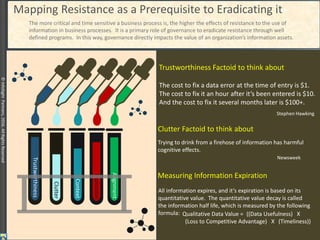
Mapping Resistance as a Prerequisite to Eradicating it
The more critical and time sensitive a business process is, the higher the effects of resistance to the use of
information in business processes. It is a primary role of governance to eradicate resistance through well
defined programs. In this way, governance directly impacts the value of an organization’s information assets.
Trustworthiness Information is de-facto
expected to be validated prior to
consumption by business processes
Clutter More is not better, especially when
clutter obfuscates the important
information that would make a difference
Context Providing meaning to the
information through metadata and
semantics gives the necessary context to use
information
Expiration Information has a half life, and
keeping expired information available to
analyses compromises trustworthiness, adds
to clutter and often leads to inappropriate
actions
Trustworthiness
Clutter
Context
Alignment
Expiration
Alignment The alignment and timing of
information to business processes changes
regularly as market forces change, not
performing the necessary adjustments leads
to misalignment
8
The cost to fix a data error at the time of entry is $1.
The cost to fix it an hour after it’s been entered is $10.
And the cost to fix it several months later is $100+.
Trustworthiness Factoid to think about
Stephen Hawking
Clutter Factoid to think about
Trying to drink from a firehose of information has harmful
cognitive effects.
Newsweek
Measuring Information Expiration
All information expires, and it’s expiration is based on its
quantitative value. The quantitative value decay is called
the information half life, which is measured by the following
formula: Qualitative Data Value = ((Data Usefulness) X
(Loss to Competitive Advantage) X (Timeliness))
©InfoSightPartners,2016,AllRightsReserved
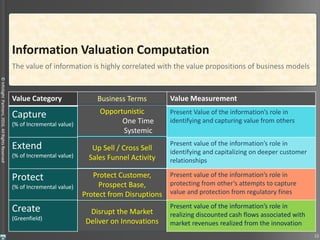
Information Valuation Computation
11
The value of information is highly correlated with the value propositions of business models
Value Category Information’s Role Value Measurement
Capture
(% of Incremental value)
Identify Capture
Opportunities
Present Value of the information’s role in
identifying and capturing value from others
Extend
(% of Incremental value)
Identify Extensions to
customer relationships
Present value of the information’s role in
identifying and capitalizing on deeper customer
relationships
Protect
(% of Incremental value)
Eradicate risks which would
otherwise erode value
Present value of the information’s role in
protecting from other’s attempts to capture
value and protection from regulatory fines
Create
(Greenfield)
Innovate which in best
cases, ripples a disruption
through the marketplace
Present value of the information’s role in
realizing discounted cash flows associated with
market revenues realized from the innovation
Opportunistic
One Time
Systemic
Up Sell / Cross Sell
Sales Funnel Activity
Protect Customer,
Prospect Base,
Protect from Disruptions
Disrupt the Market
Deliver on Innovations
Business Terms
©InfoSightPartners,2016,AllRightsReserved
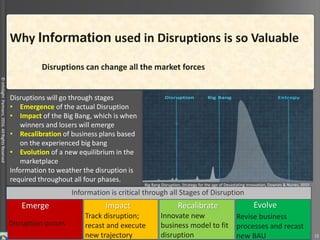
Why Information used in Disruptions is so Valuable
Disruptions can change all the market forces
Clayton Christensen, Disruptive Innovation, 2016
12
Entrants who disrupt the status quo nearly
always win in the marketplace.
The impact of disruptions is highly related
to the pace of technical progress.
The information that is used to formulate
disruptive innovations or react to other
disruptions has elevated valuations, if it can
be managed through all four stages of the
disruption.
Information is critical through all Stages of Disruption
Emerge Impact
Disruption occurs
Track disruption;
recast and execute
new trajectory
Recalibrate
Innovate new
business model to fit
disruption
Evolve
Revise business
processes and recast
new BAU
An emerging disruption can occur
from either a sustaining innovation,
where market forces will be difficult to
change (i.e., new and improved) or a
disruptive innovation, which can and
often does upset the market forces
(i.e., the transistor, the computer chip,
the GPS, etc.)
Once the disruption is detected, it
should be tracked, its magnitude
estimated and, should it be disruptive,
its estimated impact on market forces
defined, which will force a revised
business model.
A revised business model will be cast
for disruptive innovations, which
require remapping of processes and
the information required of the
processes. Because the market forces
are changing rapidly, the detection
and execution of a new business
model in time to matter carries a
value premium.
Once equilibrium is reached, the
revised business model becomes the
new conditions defining business as
usual (BAU)
Big Bang Disruption, Strategy for the age of Devastating Innovation, Downes & Nunes, 2015
Disruptions will go through stages
• Emergence of the actual Disruption
• Impact of the Big Bang, which is when
winners and losers will emerge
• Recalibration of business plans based
on the experienced big bang
• Evolution of a new equilibrium in the
marketplace
Information to weather the disruption is
required throughout all four phases.
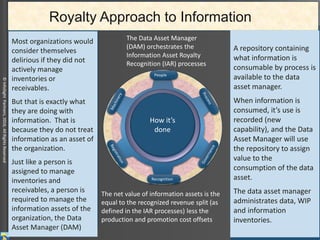
Producer Split
Governance, machinery
costs offset
Incremental Value
recognized revenue split
Promotion Split
CDO, DAM Cost Offset
Production Costs
Provisioning + Machinery
DevOps
Operations Costs
Continuous realignment
of business process with
information, operations
associated with
algorithms
Promotion Costs
Processes to ensure the
availability of the
appropriate fully
contextualized, just-in-
time, trustworthy,
actionable information
The Data Asset Manager
(DAM) orchestrates the
Information Asset Royalty
Recognition (IAR) processes
The net value of information assets is the
equal to the recognized revenue split (as
defined in the IAR processes) less the
production and promotion cost offsets
©InfoSightPartners,2016,AllRightsReserved
Costs Revenues
People
Recognition
Recognition of
value associated
with information
assets
Royalty Approach to Information
11
Production Costs are:
• The costs to obtain
raw materials (data),
• Standardization
instructions
(reference data),
• Developed Code used
to align information
with processes,
• Instructions required
to eradicate
resistance
• And operational
instructions to ensure
that information is
available just in time
for processes
Production Costs
Provisioning + Machinery
DevOps
The promotion costs are
those spent on the
publication of a catalog
which is used to
communicate
• What information is
available
• What has been done
to improve the
context,
trustworthiness and
action-ability of the
information
• What has been done
to ensure the
alignment of process
with information
• Communication of
the information
lineage and proof of
it’s accuracy
Promotion Costs
Processes to ensure the
availability of the
appropriate fully
contextualized, just-in-
time, trustworthy,
actionable information
The operations Costs are
related to the
operational controls put
in place to ensure that
information is available
for manually and
automated processes
(models, algorithms) just
in time for the execution
of the business
processes
Operations Costs
Continuous realignment
of business process with
information, operations
associated with
algorithms
Production
Costs
Promotion
Costs
Operations
Costs
Value
Recognition
Recognizing Revenue
Producer Split
Promotion Split
Most organizations do
not measure the sharing
of value produced by the
consumption of
information in business
processes.
By using a royalty
approach to measuring
this information, a pre-
determined split based
on how information was
consumed (reports, BAU,
non-BAU, disruptive) is
applied to compute a
value for information
used in business
processes.
How it’s
done
Most organizations would
consider themselves
delirious if they did not
actively manage
inventories or
receivables.
But that is exactly what
they are doing with
information. That is
because they do not treat
information as an asset of
the organization.
Just like a person is
assigned to manage
inventories and
receivables, a person is
required to manage the
information assets of the
organization, the Data
Asset Manager (DAM)
A repository containing
what information is
consumable by process is
available to the data
asset manager.
When information is
consumed, it’s use is
recorded (new
capability), and the Data
Asset Manager will use
the repository to assign
value to the
consumption of the data
asset.
The data asset manager
administrates data, WIP
and information
inventories.
©InfoSightPartners,2016,AllRightsReserved
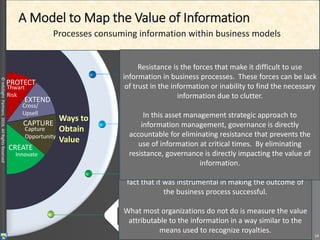
Business Model
The Business Model and business model
components that encompass the strategies
and tactics that create, capture, extend and
protect organizational value.
Process
The processes that are executed as a
means to realize the strategies and
tactics of the business model.
Information
The information consumed in processes
used to capture, enhance, expand and
protect organizational value.
Resistance
The items that discourage usage of information in
processes, such as information clutter, lack of
context, trustworthiness and other factors.
A Model to Map the Value of Information
Processes consuming information within business models
©InfoSightPartners,2016,AllRightsReserved
Ways to
Obtain
Value
CREATE
CAPTURE
EXTEND
PROTECT
Thwart
Risk
Cross/
Upsell
Capture
Opportunity
Innovate
14
Business Models represent the intents of the business.
They are executed by business processes of the
organization, and each of those processes source and/or
produce information (not data)
The value of information is measured as an enabler of
the processes consuming the information. The
information is an intangible asset which has value by the
fact that it was instrumental in making the outcome of
the business process successful.
What most organizations do not do is measure the value
attributable to the information in a way similar to the
means used to recognize royalties.
Resistance is the forces that make it difficult to use
information in business processes. These forces can be lack
of trust in the information or inability to find the necessary
information due to clutter.
In this asset management strategic approach to
information management, governance is directly
accountable for eliminating resistance that prevents the
use of information at critical times. By eliminating
resistance, governance is directly impacting the value of
information.
©InfoSightPartners,2016,AllRightsReserved
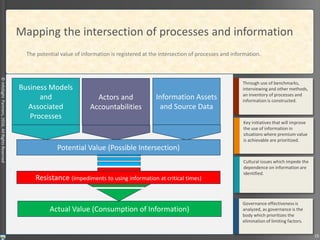
Mapping the intersection of processes and information
Through use of benchmarks,
interviewing and other methods,
an inventory of processes and
information is constructed.
Key initiatives that will improve
the use of information in
situations where premium value
is achievable are prioritized.
Cultural issues which impede the
dependence on information are
identified.
The potential value of information is registered at the intersection of processes and information.
Governance effectiveness is
analyzed, as governance is the
body which prioritizes the
elimination of limiting factors.
Business Models
and
Associated
Processes
Information Assets
and Source Data
Actors and
Accountabilities
Potential Value (Possible Intersection)
Actual Value (Consumption of Information)
Resistance (impediments to using information at critical times)
15
©InfoSightPartners,2016,AllRightsReserved
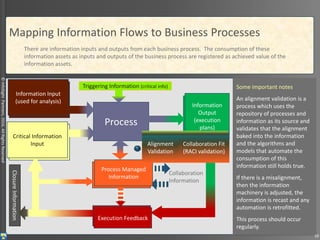
Mapping Information Flows to Business Processes
Each process orchestrated to
complete the expected outcomes
of the business model either
consumes, creates or dispatches
information.
Each of those information flows
are associated with achieving
value to the organization.
A set agreement detailing how
value will be associated with the
consumption of information is
negotiated and the value.
There are information inputs and outputs from each business process. The consumption of these
information assets as inputs and outputs of the business process are registered as achieved value of the
information assets.
The value of information is the
accumulation of information
consumed in business processes,
either as input, output or process
managed information.
Information Input
(used for analysis)
Critical Information
Input
Process
Information
Output
(execution
plan)
Process Managed
Information
Execution Feedback
Collaboration
Information
Triggering Information (critical info)
ClosureInformation
16
Process Managed
Information
Information
Output
(execution
plans)
Information Input
(used for analysis)
Critical Information
Input
Execution Feedback
Some important notes
As information moves
through the value framework,
the likelihood of information
being sourced internally
decreases.
Internal information is usually
respective and can project
departures from the status
quo but can not give insight
into what the departure from
status quo has been.
Disruptive events commonly
don’t fit the models which
align information to the
status quo.
Some important notes
Critical information will be
obtained from a variety of
sources as deemed necessary
to identify what has
happened, derive and test
hypotheses, and derive and
coordinate action plans.
Algorithms and models are
vehicles to pre-wire
information in a specific way
so that it can be consumed
quickly.
Of course algorithms and
models may be of lessened
use during disruptive times.
Some important notes
The ability to collaborate
execution plans quickly so
that the information is used
in a consistent manner is as
much a determinant of
success as is utilizing the right
information.
Algorithms and models force
a level of consistency, as long
as they are aligned to the
process they are integrated
into.
Without this integration, they
are little more than another
reporting source.
Some important notes
An alignment validation is a
process which uses the
repository of processes and
information as its source and
validates that the alignment
baked into the information
and the algorithms and
models that automate the
consumption of this
information still holds true.
If there is a misalignment,
then the information
machinery is adjusted, the
information is recast and any
automation is retrofitted.
This process should occur
regularly.
Alignment
Validation
Collaboration Fit
(RACI validation)
©InfoSightPartners,2016,AllRightsReserved
Valued
Actual
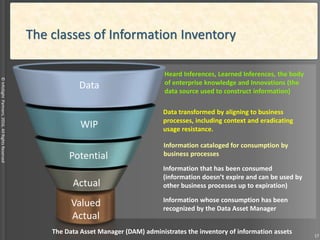
Heard Inferences, Learned Inferences, the body
of enterprise knowledge and Innovations (the
data source used to construct information)
Data transformed by aligning to business
processes, including context and eradicating
usage resistance.
Information cataloged for consumption by
business processes
Information that has been consumed
(information doesn’t expire and can be used by
other business processes up to expiration)
Information whose consumption has been
recognized by the Data Asset Manager
The Data Asset Manager (DAM) administrates the inventory of information assets
Actual
Potential
WIP
Data
The classes of Information Inventory
17
©InfoSightPartners,2016,AllRightsReserved
Information Assets
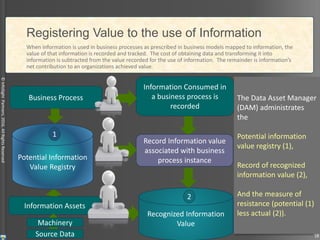
Registering Value to the use of Information
When Information is consumed
by a business process, its use is
recorded and a pre-determined
percentage of value associated
with the business process is
assigned to the information.
A pre-determined premium is
assigned to the use of the
information in Non- BAU and
Disruptive instances of business
process.
A new role, the Data Asset
Manager, is accountable for
recording the recognition of
value associated with
information.
When information is used in business processes as prescribed in business models mapped to information, the
value of that information is recorded and tracked. The cost of obtaining data and transforming it into
information is subtracted from the value recorded for the use of information. The remainder is information’s
net contribution to an organizations achieved value.
The Information Assets of the
organization can be recorded as
a balance sheet item of an
organization.
Potential Information
Value Registry
Information Consumed in
a business process is
recorded
Record Information value
associated with business
process instance
Recognized Information
Value
Business Process
Source Data
Machinery
18
The Data Asset Manager
(DAM) administrates
the
Potential information
value registry (1),
Record of recognized
information value (2),
And the measure of
resistance (potential (1)
less actual (2)).
1
2
Click the roles
(1 – 6) in order
for more
information
CDO CRO
DAM DGC InformationAssets
CIO
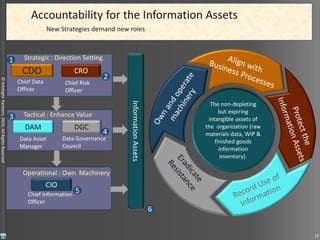
Accountability for the Information Assets
New Strategies demand new roles
Chief Data
Officer
Chief Risk
Officer
Data Asset
Manager
Data Governance
Council
Chief Information
Officer
©InfoSightPartners,2016,AllRightsReserved
Strategic : Direction Setting
Tactical : Enhance Value
Operational : Own Machinery
The CDO is
responsible for
aligning information
with business
processes in ways
that maximize
information value
The Chief Risk
Officer is
responsible for
protecting the
information assets
and use of
information assets
The Data Asset
Manager is the
inventory manager
of Information
Assets
The Data
Governance Council
is responsible for
eradicating
resistance, or
impediments to
using information at
critical times
The CIO is
responsible for the
machinery that
transforms data into
information and
eradicates
information use
resistance
The non-depleting
but expiring
intangible assets of
the organization (raw
materials data, WIP &
finished goods
information
inventory).
19
1
2
3
4
5
6
©InfoSightPartners,2016,AllRightsReserved
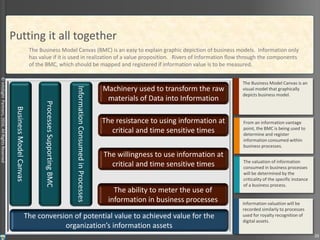
Putting it all together
The Business Model Canvas is an
visual model that graphically
depicts business model.
From an information vantage
point, the BMC is being used to
determine and register
information consumed within
business processes.
The valuation of information
consumed in business processes
will be determined by the
criticality of the specific instance
of a business process.
The Business Model Canvas (BMC) is an easy to explain graphic depiction of business models. Information only
has value if it is used in realization of a value proposition. Rivers of Information flow through the components
of the BMC, which should be mapped and registered if information value is to be measured.
Information valuation will be
recorded similarly to processes
used for royalty recognition of
digital assets.
BusinessModelCanvas
ProcessesSupportingBMC
InformationConsumedinProcesses
Machinery used to transform the raw
materials of Data into Information
The resistance to using information at
critical and time sensitive times
The willingness to use information at
critical and time sensitive times
The ability to meter the use of
information in business processes
The conversion of potential value to achieved value for the
organization’s information assets
20
©InfoSightPartners,2016,AllRightsReserved
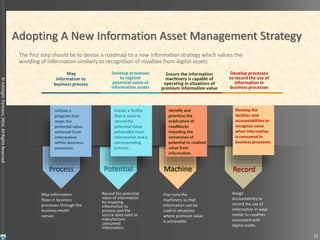
MachineProcess Potential Record
Initiate a
program that
maps the
potential value
achieved from
information
within business
processes.
Create a facility
that is used to
record the
potential value
achievable from
information and a
corresponding
process.
Develop the
facilities and
accountabilities to
recognize value
when information
is consumed in
business processes.
Identify and
prioritize the
eradication of
roadblocks
impeding the
conversion of
potential to realized
value from
information.
Map Information
flows in business
processes through the
business model
canvas.
Record the potential
value of information
by mapping
information to
process and the
source data used to
manufacture
consumed
information.
Assign
accountability to
record the use of
information in ways
similar to royalties
associated with
digital assets.
Fine tune the
machinery so that
information can be
used in situations
where premium value
is achievable.
Adopting A New Information Asset Management Strategy
Map
information to
business process
Develop processes
to register
potential value of
information assets
Ensure the information
machinery is capable of
operating in situations of
premium information value
Develop processes
to record the use of
information in
business processes
The first step should be to devise a roadmap to a new information strategy which values the
wielding of information similarly to recognition of royalties from digital assets
21
©InfoSightPartners,2016,AllRightsReserved
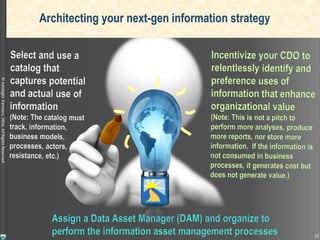
Assign a Data Asset Manager (DAM) and organize to
perform the information asset management processes
Architecting your next-gen information strategy
22
©InfoSightPartners,2016,AllRightsReserved
Who Is InfoSight Partners
Facilitating focus into the value of information assets
InfoSight Partners’ mission is to
facilitate the journey companies
take to gain focus into the value
of their information assets.
Once this journey is started, a
new approach to managing the
organization’s information assets
gains clarity.
23
©InfoSightPartners,2016,AllRightsReserved
Thank You
Q & A

Rethinking Information Strategies

  • 1.
    ©InfoSightPartners,2016,AllRightsReserved Managing Information asan Asset Mapping use of Information in Business Processes Eliminating obstacles to Information Use Organizational Learning Models Culture Process Measure Willingness to wield Information Machinery that operates at the speed of business Use of Information in business processes Rethinking Information Strategies Rethinking strategies to focus on Managing information similarly to other organizational assets Ensuring a tight alignment between information and processes that produce organizational value Recording the value of information consumed to deliver this value Brought to you by InfoSight Partners Facilitating Focus into the Value of Information Assets
  • 2.
    ©InfoSightPartners,2016,AllRightsReserved In the informationeconomy, information is a valuable asset of the organization, but few companies have found a way to: - Measure the value of the information assets of the organization - Positively influence the value of the organization’s information assets - Accelerate the processes used to deliver aligned actionable information - Optimize the availability and use of information for use in business processes A new strategy is required to manage information assets in the digital economy, where process change is more commonplace Measure the value of the information assets of the organization Positively influence the value of the organization’s information assets Accelerate the processes used to deliver aligned actionable information Optimize the availability and use of information for use in business processes Continually align priorities to focus on the right information Direct governance to eradicate roadblocks to using information Accelerate the processes used to deliver information to a continually changing pool of business processes Continually align processes, information and process actors 2
  • 3.
  • 4.
    ©InfoSightPartners,2016,AllRightsReserved Incoming Raw Data Raw Materials Innovations Knowledge HeardInferences Learned Inferences Required Information Rivers of information supporting the business models of the organization Configuration Devising information assets to be aligned to their consumption in business processes Cycle Time Ensuring alignment of the transformation processes with the business cycle time Machinery Executing processes that prepare and deliver information to business processes that yield the optimal organizational value Measuring Use of Information Consumption of information withi`n business processes is measured to record information valuation Realized Information Value Data = Information While information is sourced from data, data by itself yields no value Your new strategies should spotlight consumption and sourcing of information 4 The raw materials inventory that is obtained from internal and external sources consists of learned inferences, heard inferences, the body of enterprise knowledge and innovations The raw materials inventory of data is not organized to be consumed directly by business processes. Through a mapping process, the organization, scope and other characteristics of information required for business processes is defined, which becomes the scope applied through the machinery to create information. The configuration of information required for consumption in business processes is determined. The cycle time required for information to be made available is determined as another configuration instruction for the machinery that prepares information from the raw materials of data. The machinery is used to construct information. At the exit of the machinery processes, the information has potential value, meaning that it is ready and waiting for consumption within business processes The consumption of information must be recorded so that it can be realized similarly to the use of other intangible assets of the organization. Information does expire but is not depleting, meaning it can be consumed more than once prior to its expiration. The information half life is a measurement of potential value decay. In order for the value of information to be realized it must be recorded. It is the function of the asset manager responsible for information, or the data asset manager to manage the information inventories and record the value achieved from information similarly to how royalty metering occurs.
  • 5.
    ©InfoSightPartners,2016,AllRightsReserved Process Information A non- expiring asset consumedin business processes Methods Prepared by Inventory Machinery Strat Influenced By Not all use of information is equal Measure Realized by Information not measured has limited value When is it Information? Information is a non- expiring asset of an organization that only obtains value when it is consumed in business processes Machinery is applied to convert data into information. The machinery must be able to prepare information faster than the business process cycle time Information is worth more when it influences realization of large amounts of value. This realization is stratified by the use class of information. The value attributable to information must be measured or achieved value will be applied elsewhere Information is constructed from data; machinery is used to align information with processes orchestrated by a business model that produces value for the organization 5
  • 6.
    ©InfoSightPartners,2016,AllRightsReserved Information Inventory The finishedgoods inventory which is managed similarly to other non-depletable intangible assets of the organization. In a perfect world, all impediments, such as information trustworthiness, are removed from information in the WIP processes. Work in Process Inventory The interim state which is processed by the machinery which prepares data for tight alignment with processes specifically devised to deliver organizational value per the value propositions of business models. Data Inventory The corporate knowledge, heard inferences, learned inferences and innovations not yet aligned with business processes. The raw materials of data must continually be managed in WIP processes to ensure alignment with business processes as they are transformed into consumable information. Exactly what are information assets? Data is the raw material asset which is constructed into information Information is the finished goods inventory which is consumable by business processes ValueoftheInformationAssets 6 INFORMATION INVENTORY WIP INVENTORY
  • 7.
    ©InfoSightPartners,2016,AllRightsReserved Recording Information PotentialValue Recording the Information supporting Business Models Recording potential value for Reporting, Operational, Prescriptive, Predictive and Disruptive use of Information The Chief Data Officer is accountable for influencing potential value Eliminating Obstacles to Realizing Potential Value Information Trustworthiness, Information Clutter and several other limiting factors limit the realization of information’s potential value. Governance processes are devised to prioritize the elimination of these obstacles. Recording Achieved Value When Information is consumed by business processes, a portion of the value achieved by business processes is attributable to the consumed information. Similar to royalty management techniques, information value is recorded. The Data Asset Manager is accountable for recording achieved value. Registering Business Processes Reporting and other non-actionable processes Actionable Business As Usual (BAU) Processes Actionable Non Business As Usual (NBAU) Processes Business Model Realignment (Disruption Recovery) Processes Measuring Information Value In order to measure the use of information, its use must first be registered with business processes so that its use can be recognized. The Business Model Canvas is the vehicle to identify rivers of information that flow through business processes that yield organizational value ©InfoSightPartners,2016,AllRightsReserved 7
  • 8.
    ©InfoSightPartners,2016,AllRightsReserved Performance Reporting Standard Reporting and basic analytics BAU Businessas Usual Prescriptive and Predictive Models Non-BAU Market Force changes that limit the value of historical based analyses Disruptive Disruptions which significantly alter business assumptions How is Information Stratified? Information is worth more when it either enables big wins or thwarts big risks. Many business processes will fit one or more valuation models, with situational forces driving information valuation. However, not capturing information about the situational forces of a particular instance of a business process will commonly force information to be valued as an informational use of information to a business process rather than an actionable or disruptive use of information. Informational Actionable Disruptive 8 Information is used for Regulatory and Management Reporting. These are non- actionable processes, even though exceptions in reports may trigger other uses of information. Prescriptive and Predictive Analytics are used in actionable business processes. Non- Business As Usual (Non-BAU) uses of information will be used to opportunistically execute actions, thereby yielding premium value. The conversion of BAU uses of information to Non-BAU uses of information is situational. Disruptive forces radically alter the assumptions on which business models are based. Disruptions typically require swift action, as they upset market equilibrium. Utilizing information in business processes to detect, recast and execute appropriate actions carries a premium valuation. Performance Reporting reports and basic analytics were once perfectly aligned to the business processes that they were produced for. However, in highly disruptive times and markets, particularly those markets with digital products, the alignment between the reports and the processes supposed to consume the information contained in those reports quickly fades, thereby rendering their use for in the best cases business as usual conditions and for historical fact checking. Value achieved from these reports and analysis is commonly low. Information devised for consumption in processes situationally aligned to business as usual forces is organized to fit business processes in lockstep with changes in either business models, assumptions of the business models, or changes in processes used to execute the value propositions of the business models. In business as usual (BAU) situations, there have been no or only minor changes to the market forces, and information is used as prescribed to execute the processes they were aligned to. Information devised for consumption in processes situationally aligned to non-business as usual forces is organized to fit business processes in lockstep with changes in either business models, assumptions of the business models, or changes in processes used to execute the value propositions of the business models. However, market assumptions used in these processes have changed and the information has must be consumed in ways slightly or significantly different from the way proscribed in the business models they were aligned to. Successful use of this information carries with it higher valuations. In disruptive situations, the basic assumptions used for a business model and the market forces are in a state of flux. Usage of the information aligned to business models will be used in new ways as the models they are aligned with are undergoing changes as well. Successful use of information carries with it a significant premium. Failure to act or misuse of information or acting without information (acting on gut) carries with it significant risks in disruptive situations, as the basic assumptions of market forces are up for grabs in these situations. Information is used for Regulatory and Management Reporting. These are non- actionable processes, even though exceptions in reports may trigger other uses of information. Prescriptive and Predictive Analytics are used in actionable business processes. Non- Business As Usual (Non-BAU) uses of information will be used to opportunistically execute actions, thereby yielding premium value. The conversion of BAU uses of information to Non-BAU uses of information is situational. Disruptive forces radically alter the assumptions on which business models are based. Disruptions typically require swift action, as they upset market equilibrium. Utilizing information in business processes to detect, recast and execute appropriate actions carries a premium valuation.
  • 9.
    ©InfoSightPartners,2016,AllRightsReserved An Information ValuationSituational Framework* Value influenced by redirecting business model based on NON- BAU forces Value influenced by maintaining business model trajectory Information used to steer in an expected business trajectory Profit center aligned Activity and other reports Cost center aligned Capital and expense used to produce information Information Alignment What returns value? Value Participation DISRUPTIVE NON- ACTIONABLEBAUNON-BAU Not Yet Aligned Forces at Work Info Use Value influenced by recasting business models caused by disruption Algorithms triggered to create / respond to disruptions Information used to collaborate actions based on NON-BAU forces Risks Value J JL J K J L J K L ? J K L 9 There is a tight correlation between the situations in which information is used and the value the information can provide * Assumes alignment to business processes devised to fit business models Half Life React Time Resist- ance Minor Minor Half Life Impact Half Life CauseThe value of information is highly dependent on the situations in which it is consumed within business processes. For example, information can be included in a report which was once highly aligned to business processes (but may longer be aligned to intended business processes). Information appearing on reports which has to be extracted from reports for use then interpreted has a lower value than information directly ingestible by business processes if processes digesting this information have response criteria associated with them. At certain times, the response criteria is accelerated due to business conditions (non- business as usual or disruptive conditions), and the ability to wield information has a premium associated with it by the fact that the business processes wielding this information have a similar value premium associated with them. Resistance to using information increases from information appearing on reports to information associated with disruptive forces. Reports represent the least resistance. The likelihood of reports to be usable directly without the process participants first to determine how to fit the contents of a report into the process information stream result in reports yielding the least value. Usage of information is directionally similar to the resistance to using information. A prime way of elevating information value is to eradicate resistance, as proscribed for governance In the revised information strategies, the mission of governance is to eradicate information resistance and ensure the information made available as devised by the CDO’s playbook is not derailed for resistance. playbook devised by the Chief Data Officer
  • 10.
    ©InfoSightPartners,2016,AllRightsReserved Mapping Resistance asa Prerequisite to Eradicating it The more critical and time sensitive a business process is, the higher the effects of resistance to the use of information in business processes. It is a primary role of governance to eradicate resistance through well defined programs. In this way, governance directly impacts the value of an organization’s information assets. Trustworthiness Information is de-facto expected to be validated prior to consumption by business processes Clutter More is not better, especially when clutter obfuscates the important information that would make a difference Context Providing meaning to the information through metadata and semantics gives the necessary context to use information Expiration Information has a half life, and keeping expired information available to analyses compromises trustworthiness, adds to clutter and often leads to inappropriate actions Trustworthiness Clutter Context Alignment Expiration Alignment The alignment and timing of information to business processes changes regularly as market forces change, not performing the necessary adjustments leads to misalignment 8 The cost to fix a data error at the time of entry is $1. The cost to fix it an hour after it’s been entered is $10. And the cost to fix it several months later is $100+. Trustworthiness Factoid to think about Stephen Hawking Clutter Factoid to think about Trying to drink from a firehose of information has harmful cognitive effects. Newsweek Measuring Information Expiration All information expires, and it’s expiration is based on its quantitative value. The quantitative value decay is called the information half life, which is measured by the following formula: Qualitative Data Value = ((Data Usefulness) X (Loss to Competitive Advantage) X (Timeliness))
  • 11.
    ©InfoSightPartners,2016,AllRightsReserved Information Valuation Computation 11 Thevalue of information is highly correlated with the value propositions of business models Value Category Information’s Role Value Measurement Capture (% of Incremental value) Identify Capture Opportunities Present Value of the information’s role in identifying and capturing value from others Extend (% of Incremental value) Identify Extensions to customer relationships Present value of the information’s role in identifying and capitalizing on deeper customer relationships Protect (% of Incremental value) Eradicate risks which would otherwise erode value Present value of the information’s role in protecting from other’s attempts to capture value and protection from regulatory fines Create (Greenfield) Innovate which in best cases, ripples a disruption through the marketplace Present value of the information’s role in realizing discounted cash flows associated with market revenues realized from the innovation Opportunistic One Time Systemic Up Sell / Cross Sell Sales Funnel Activity Protect Customer, Prospect Base, Protect from Disruptions Disrupt the Market Deliver on Innovations Business Terms
  • 12.
    ©InfoSightPartners,2016,AllRightsReserved Why Information usedin Disruptions is so Valuable Disruptions can change all the market forces Clayton Christensen, Disruptive Innovation, 2016 12 Entrants who disrupt the status quo nearly always win in the marketplace. The impact of disruptions is highly related to the pace of technical progress. The information that is used to formulate disruptive innovations or react to other disruptions has elevated valuations, if it can be managed through all four stages of the disruption. Information is critical through all Stages of Disruption Emerge Impact Disruption occurs Track disruption; recast and execute new trajectory Recalibrate Innovate new business model to fit disruption Evolve Revise business processes and recast new BAU An emerging disruption can occur from either a sustaining innovation, where market forces will be difficult to change (i.e., new and improved) or a disruptive innovation, which can and often does upset the market forces (i.e., the transistor, the computer chip, the GPS, etc.) Once the disruption is detected, it should be tracked, its magnitude estimated and, should it be disruptive, its estimated impact on market forces defined, which will force a revised business model. A revised business model will be cast for disruptive innovations, which require remapping of processes and the information required of the processes. Because the market forces are changing rapidly, the detection and execution of a new business model in time to matter carries a value premium. Once equilibrium is reached, the revised business model becomes the new conditions defining business as usual (BAU) Big Bang Disruption, Strategy for the age of Devastating Innovation, Downes & Nunes, 2015 Disruptions will go through stages • Emergence of the actual Disruption • Impact of the Big Bang, which is when winners and losers will emerge • Recalibration of business plans based on the experienced big bang • Evolution of a new equilibrium in the marketplace Information to weather the disruption is required throughout all four phases.
  • 13.
    Producer Split Governance, machinery costsoffset Incremental Value recognized revenue split Promotion Split CDO, DAM Cost Offset Production Costs Provisioning + Machinery DevOps Operations Costs Continuous realignment of business process with information, operations associated with algorithms Promotion Costs Processes to ensure the availability of the appropriate fully contextualized, just-in- time, trustworthy, actionable information The Data Asset Manager (DAM) orchestrates the Information Asset Royalty Recognition (IAR) processes The net value of information assets is the equal to the recognized revenue split (as defined in the IAR processes) less the production and promotion cost offsets ©InfoSightPartners,2016,AllRightsReserved Costs Revenues People Recognition Recognition of value associated with information assets Royalty Approach to Information 11 Production Costs are: • The costs to obtain raw materials (data), • Standardization instructions (reference data), • Developed Code used to align information with processes, • Instructions required to eradicate resistance • And operational instructions to ensure that information is available just in time for processes Production Costs Provisioning + Machinery DevOps The promotion costs are those spent on the publication of a catalog which is used to communicate • What information is available • What has been done to improve the context, trustworthiness and action-ability of the information • What has been done to ensure the alignment of process with information • Communication of the information lineage and proof of it’s accuracy Promotion Costs Processes to ensure the availability of the appropriate fully contextualized, just-in- time, trustworthy, actionable information The operations Costs are related to the operational controls put in place to ensure that information is available for manually and automated processes (models, algorithms) just in time for the execution of the business processes Operations Costs Continuous realignment of business process with information, operations associated with algorithms Production Costs Promotion Costs Operations Costs Value Recognition Recognizing Revenue Producer Split Promotion Split Most organizations do not measure the sharing of value produced by the consumption of information in business processes. By using a royalty approach to measuring this information, a pre- determined split based on how information was consumed (reports, BAU, non-BAU, disruptive) is applied to compute a value for information used in business processes. How it’s done Most organizations would consider themselves delirious if they did not actively manage inventories or receivables. But that is exactly what they are doing with information. That is because they do not treat information as an asset of the organization. Just like a person is assigned to manage inventories and receivables, a person is required to manage the information assets of the organization, the Data Asset Manager (DAM) A repository containing what information is consumable by process is available to the data asset manager. When information is consumed, it’s use is recorded (new capability), and the Data Asset Manager will use the repository to assign value to the consumption of the data asset. The data asset manager administrates data, WIP and information inventories.
  • 14.
    ©InfoSightPartners,2016,AllRightsReserved Business Model The BusinessModel and business model components that encompass the strategies and tactics that create, capture, extend and protect organizational value. Process The processes that are executed as a means to realize the strategies and tactics of the business model. Information The information consumed in processes used to capture, enhance, expand and protect organizational value. Resistance The items that discourage usage of information in processes, such as information clutter, lack of context, trustworthiness and other factors. A Model to Map the Value of Information Processes consuming information within business models ©InfoSightPartners,2016,AllRightsReserved Ways to Obtain Value CREATE CAPTURE EXTEND PROTECT Thwart Risk Cross/ Upsell Capture Opportunity Innovate 14 Business Models represent the intents of the business. They are executed by business processes of the organization, and each of those processes source and/or produce information (not data) The value of information is measured as an enabler of the processes consuming the information. The information is an intangible asset which has value by the fact that it was instrumental in making the outcome of the business process successful. What most organizations do not do is measure the value attributable to the information in a way similar to the means used to recognize royalties. Resistance is the forces that make it difficult to use information in business processes. These forces can be lack of trust in the information or inability to find the necessary information due to clutter. In this asset management strategic approach to information management, governance is directly accountable for eliminating resistance that prevents the use of information at critical times. By eliminating resistance, governance is directly impacting the value of information.
  • 15.
    ©InfoSightPartners,2016,AllRightsReserved Mapping the intersectionof processes and information Through use of benchmarks, interviewing and other methods, an inventory of processes and information is constructed. Key initiatives that will improve the use of information in situations where premium value is achievable are prioritized. Cultural issues which impede the dependence on information are identified. The potential value of information is registered at the intersection of processes and information. Governance effectiveness is analyzed, as governance is the body which prioritizes the elimination of limiting factors. Business Models and Associated Processes Information Assets and Source Data Actors and Accountabilities Potential Value (Possible Intersection) Actual Value (Consumption of Information) Resistance (impediments to using information at critical times) 15
  • 16.
    ©InfoSightPartners,2016,AllRightsReserved Mapping Information Flowsto Business Processes Each process orchestrated to complete the expected outcomes of the business model either consumes, creates or dispatches information. Each of those information flows are associated with achieving value to the organization. A set agreement detailing how value will be associated with the consumption of information is negotiated and the value. There are information inputs and outputs from each business process. The consumption of these information assets as inputs and outputs of the business process are registered as achieved value of the information assets. The value of information is the accumulation of information consumed in business processes, either as input, output or process managed information. Information Input (used for analysis) Critical Information Input Process Information Output (execution plan) Process Managed Information Execution Feedback Collaboration Information Triggering Information (critical info) ClosureInformation 16 Process Managed Information Information Output (execution plans) Information Input (used for analysis) Critical Information Input Execution Feedback Some important notes As information moves through the value framework, the likelihood of information being sourced internally decreases. Internal information is usually respective and can project departures from the status quo but can not give insight into what the departure from status quo has been. Disruptive events commonly don’t fit the models which align information to the status quo. Some important notes Critical information will be obtained from a variety of sources as deemed necessary to identify what has happened, derive and test hypotheses, and derive and coordinate action plans. Algorithms and models are vehicles to pre-wire information in a specific way so that it can be consumed quickly. Of course algorithms and models may be of lessened use during disruptive times. Some important notes The ability to collaborate execution plans quickly so that the information is used in a consistent manner is as much a determinant of success as is utilizing the right information. Algorithms and models force a level of consistency, as long as they are aligned to the process they are integrated into. Without this integration, they are little more than another reporting source. Some important notes An alignment validation is a process which uses the repository of processes and information as its source and validates that the alignment baked into the information and the algorithms and models that automate the consumption of this information still holds true. If there is a misalignment, then the information machinery is adjusted, the information is recast and any automation is retrofitted. This process should occur regularly. Alignment Validation Collaboration Fit (RACI validation)
  • 17.
    ©InfoSightPartners,2016,AllRightsReserved Valued Actual Heard Inferences, LearnedInferences, the body of enterprise knowledge and Innovations (the data source used to construct information) Data transformed by aligning to business processes, including context and eradicating usage resistance. Information cataloged for consumption by business processes Information that has been consumed (information doesn’t expire and can be used by other business processes up to expiration) Information whose consumption has been recognized by the Data Asset Manager The Data Asset Manager (DAM) administrates the inventory of information assets Actual Potential WIP Data The classes of Information Inventory 17
  • 18.
    ©InfoSightPartners,2016,AllRightsReserved Information Assets Registering Valueto the use of Information When Information is consumed by a business process, its use is recorded and a pre-determined percentage of value associated with the business process is assigned to the information. A pre-determined premium is assigned to the use of the information in Non- BAU and Disruptive instances of business process. A new role, the Data Asset Manager, is accountable for recording the recognition of value associated with information. When information is used in business processes as prescribed in business models mapped to information, the value of that information is recorded and tracked. The cost of obtaining data and transforming it into information is subtracted from the value recorded for the use of information. The remainder is information’s net contribution to an organizations achieved value. The Information Assets of the organization can be recorded as a balance sheet item of an organization. Potential Information Value Registry Information Consumed in a business process is recorded Record Information value associated with business process instance Recognized Information Value Business Process Source Data Machinery 18 The Data Asset Manager (DAM) administrates the Potential information value registry (1), Record of recognized information value (2), And the measure of resistance (potential (1) less actual (2)). 1 2
  • 19.
    Click the roles (1– 6) in order for more information CDO CRO DAM DGC InformationAssets CIO Accountability for the Information Assets New Strategies demand new roles Chief Data Officer Chief Risk Officer Data Asset Manager Data Governance Council Chief Information Officer ©InfoSightPartners,2016,AllRightsReserved Strategic : Direction Setting Tactical : Enhance Value Operational : Own Machinery The CDO is responsible for aligning information with business processes in ways that maximize information value The Chief Risk Officer is responsible for protecting the information assets and use of information assets The Data Asset Manager is the inventory manager of Information Assets The Data Governance Council is responsible for eradicating resistance, or impediments to using information at critical times The CIO is responsible for the machinery that transforms data into information and eradicates information use resistance The non-depleting but expiring intangible assets of the organization (raw materials data, WIP & finished goods information inventory). 19 1 2 3 4 5 6
  • 20.
    ©InfoSightPartners,2016,AllRightsReserved Putting it alltogether The Business Model Canvas is an visual model that graphically depicts business model. From an information vantage point, the BMC is being used to determine and register information consumed within business processes. The valuation of information consumed in business processes will be determined by the criticality of the specific instance of a business process. The Business Model Canvas (BMC) is an easy to explain graphic depiction of business models. Information only has value if it is used in realization of a value proposition. Rivers of Information flow through the components of the BMC, which should be mapped and registered if information value is to be measured. Information valuation will be recorded similarly to processes used for royalty recognition of digital assets. BusinessModelCanvas ProcessesSupportingBMC InformationConsumedinProcesses Machinery used to transform the raw materials of Data into Information The resistance to using information at critical and time sensitive times The willingness to use information at critical and time sensitive times The ability to meter the use of information in business processes The conversion of potential value to achieved value for the organization’s information assets 20
  • 21.
    ©InfoSightPartners,2016,AllRightsReserved MachineProcess Potential Record Initiatea program that maps the potential value achieved from information within business processes. Create a facility that is used to record the potential value achievable from information and a corresponding process. Develop the facilities and accountabilities to recognize value when information is consumed in business processes. Identify and prioritize the eradication of roadblocks impeding the conversion of potential to realized value from information. Map Information flows in business processes through the business model canvas. Record the potential value of information by mapping information to process and the source data used to manufacture consumed information. Assign accountability to record the use of information in ways similar to royalties associated with digital assets. Fine tune the machinery so that information can be used in situations where premium value is achievable. Adopting A New Information Asset Management Strategy Map information to business process Develop processes to register potential value of information assets Ensure the information machinery is capable of operating in situations of premium information value Develop processes to record the use of information in business processes The first step should be to devise a roadmap to a new information strategy which values the wielding of information similarly to recognition of royalties from digital assets 21
  • 22.
    ©InfoSightPartners,2016,AllRightsReserved Assign a DataAsset Manager (DAM) and organize to perform the information asset management processes Architecting your next-gen information strategy 22
  • 23.
    ©InfoSightPartners,2016,AllRightsReserved Who Is InfoSightPartners Facilitating focus into the value of information assets InfoSight Partners’ mission is to facilitate the journey companies take to gain focus into the value of their information assets. Once this journey is started, a new approach to managing the organization’s information assets gains clarity. 23
  • 24.