The Cell Cycle and  Reproduction
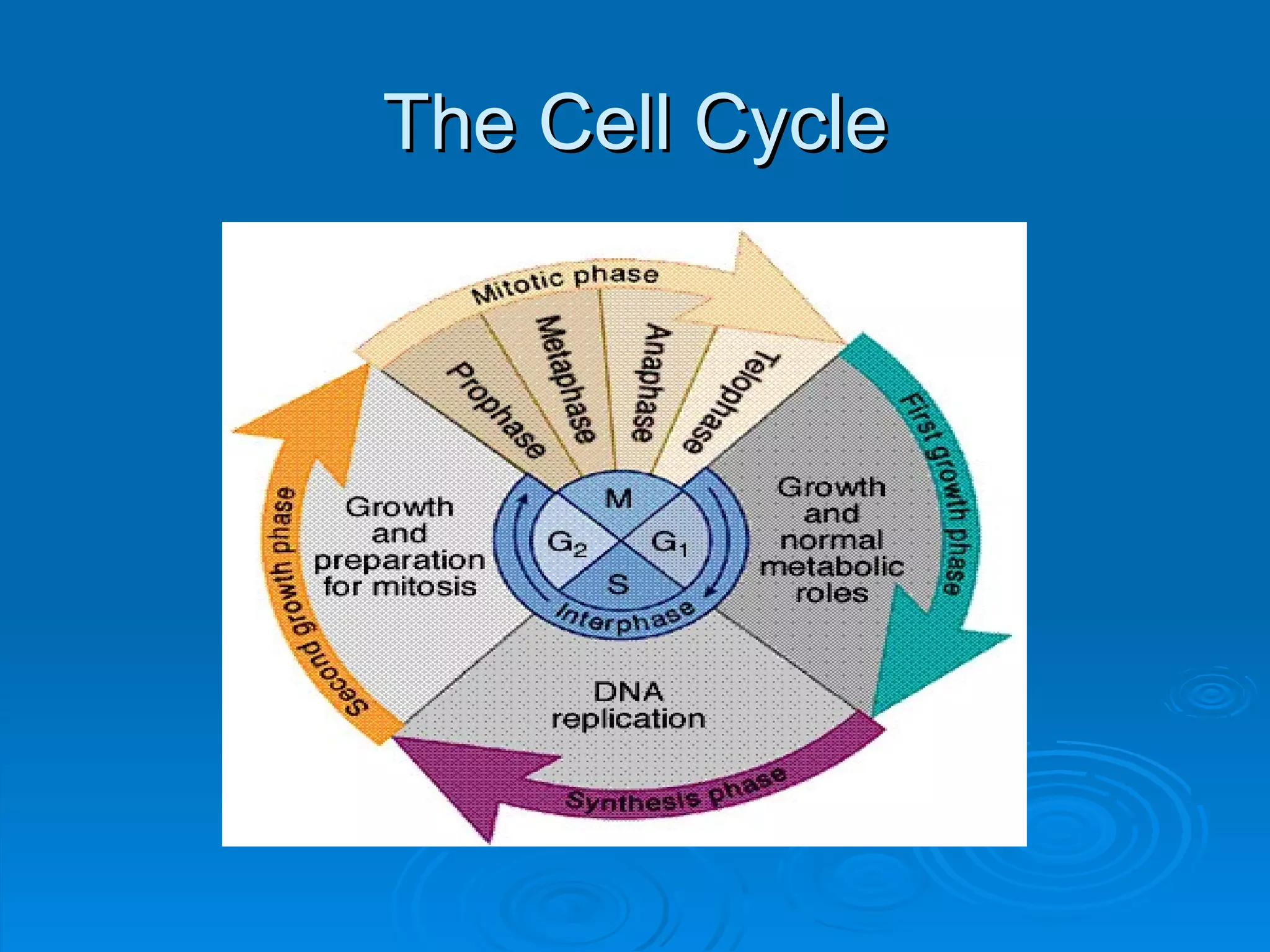
The Cell Cycle Like all living things, cells must be able to grow and reproduce. This happens during the cell cycle.  The cell cycle is divided into two parts: Cell Growth (Interphase) Cell Division (Mitosis)
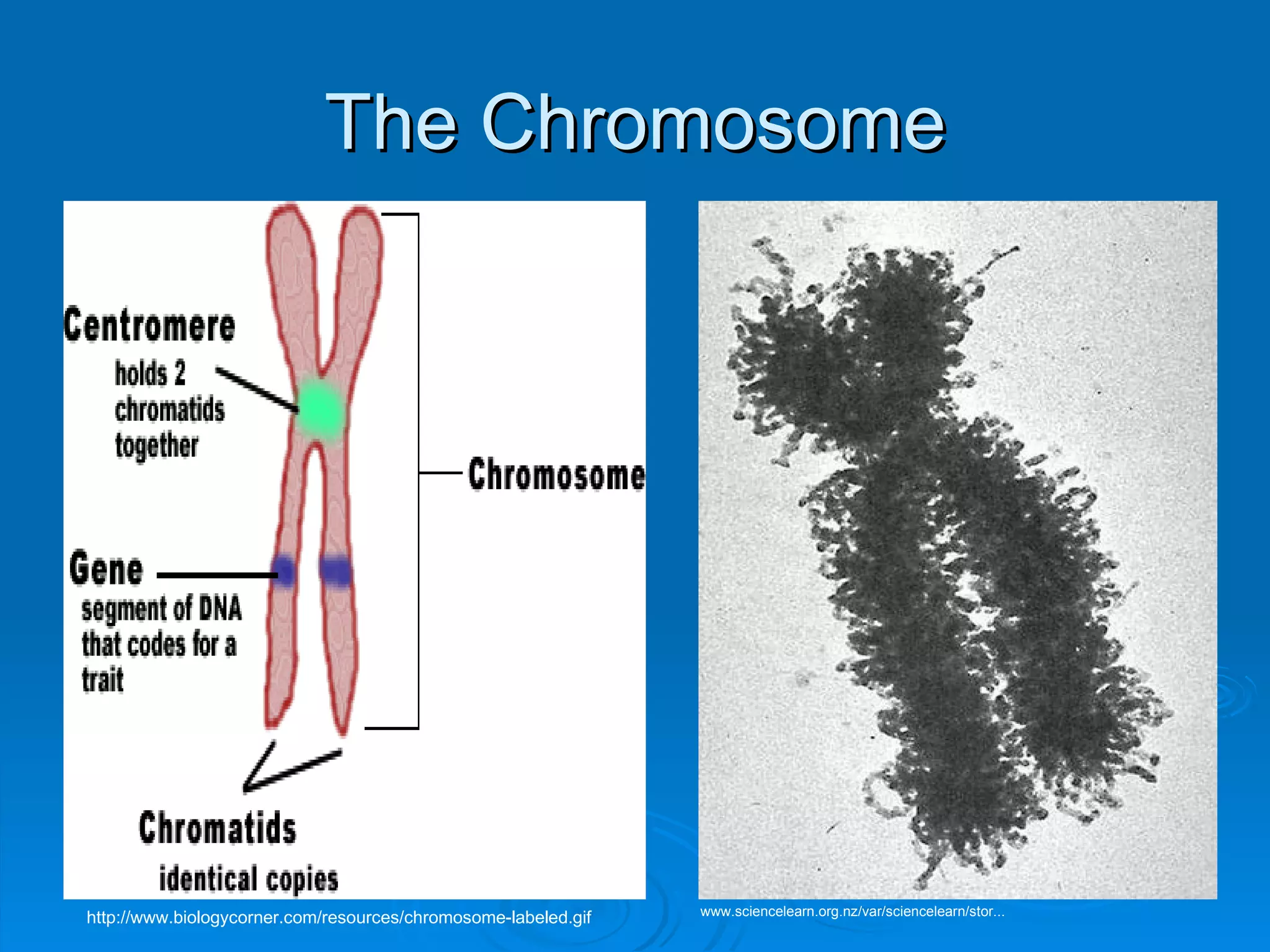
The Chromosome http://www.biologycorner.com/resources/chromosome-labeled.gif www.sciencelearn.org.nz/var/sciencelearn/stor...
The Cell Cycle cont. The longest part of the cell cycle is called interphase. It is divided into 3 main parts: G1 stage - (1 st  Growth stage)- the cell grows and develops; new proteins are made. S stage - (Synthesis stage)- the chromosomes replicate in the nucleus to form a new set of identical chromosomes G2 stage - The cell is getting ready to divide. RNA and proteins are made. Organelles are duplicated.
The Cell Cycle
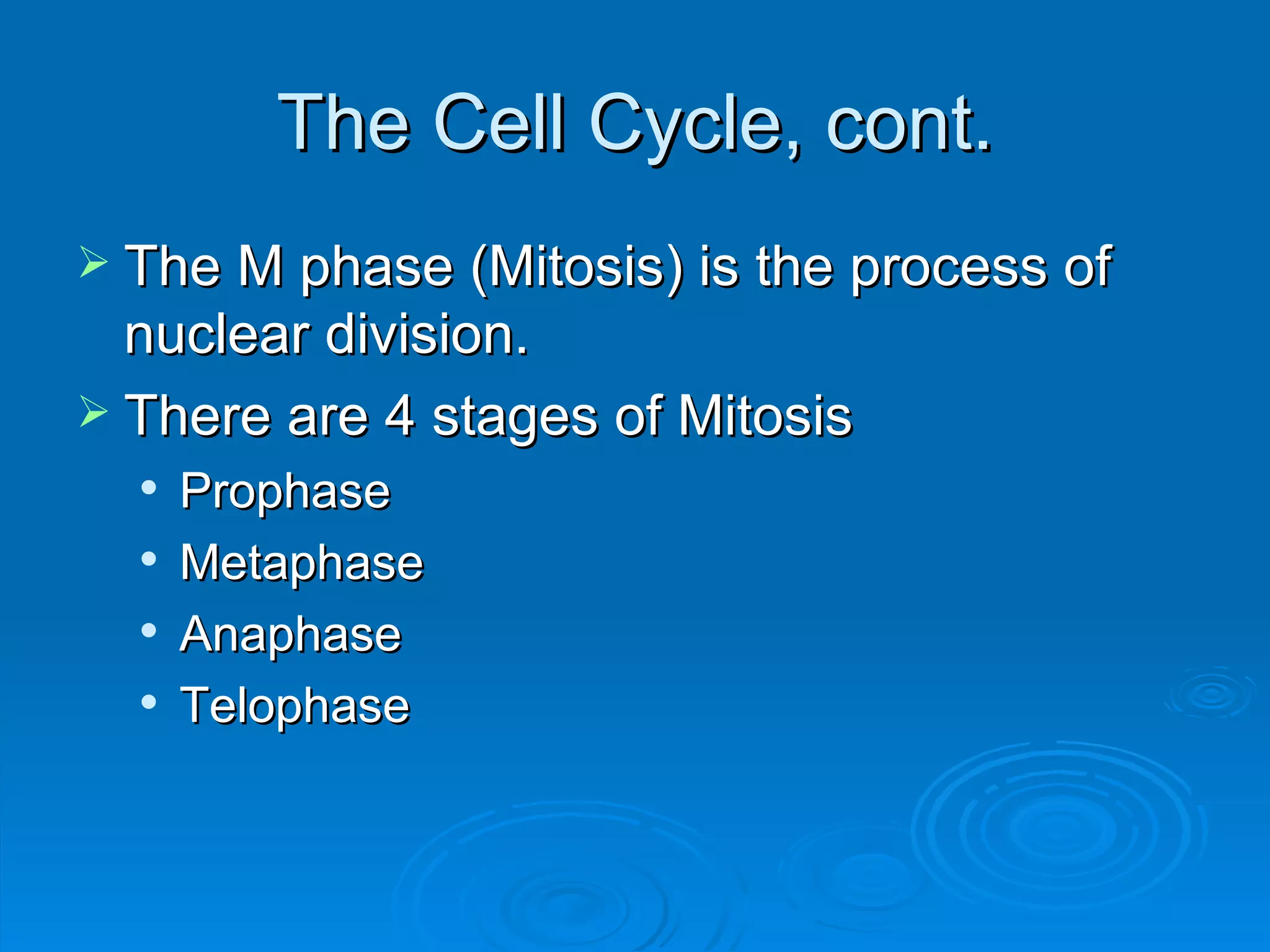
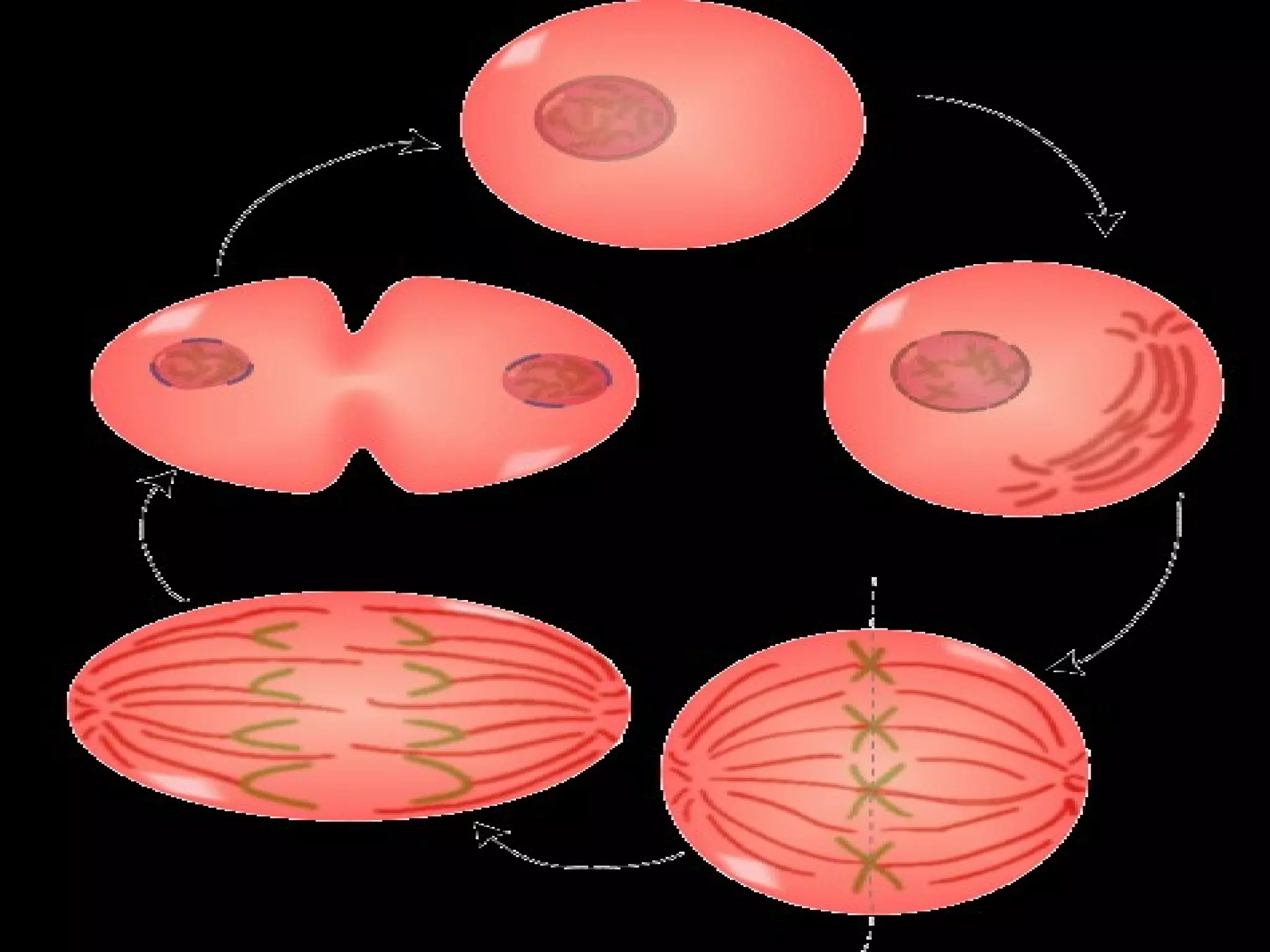
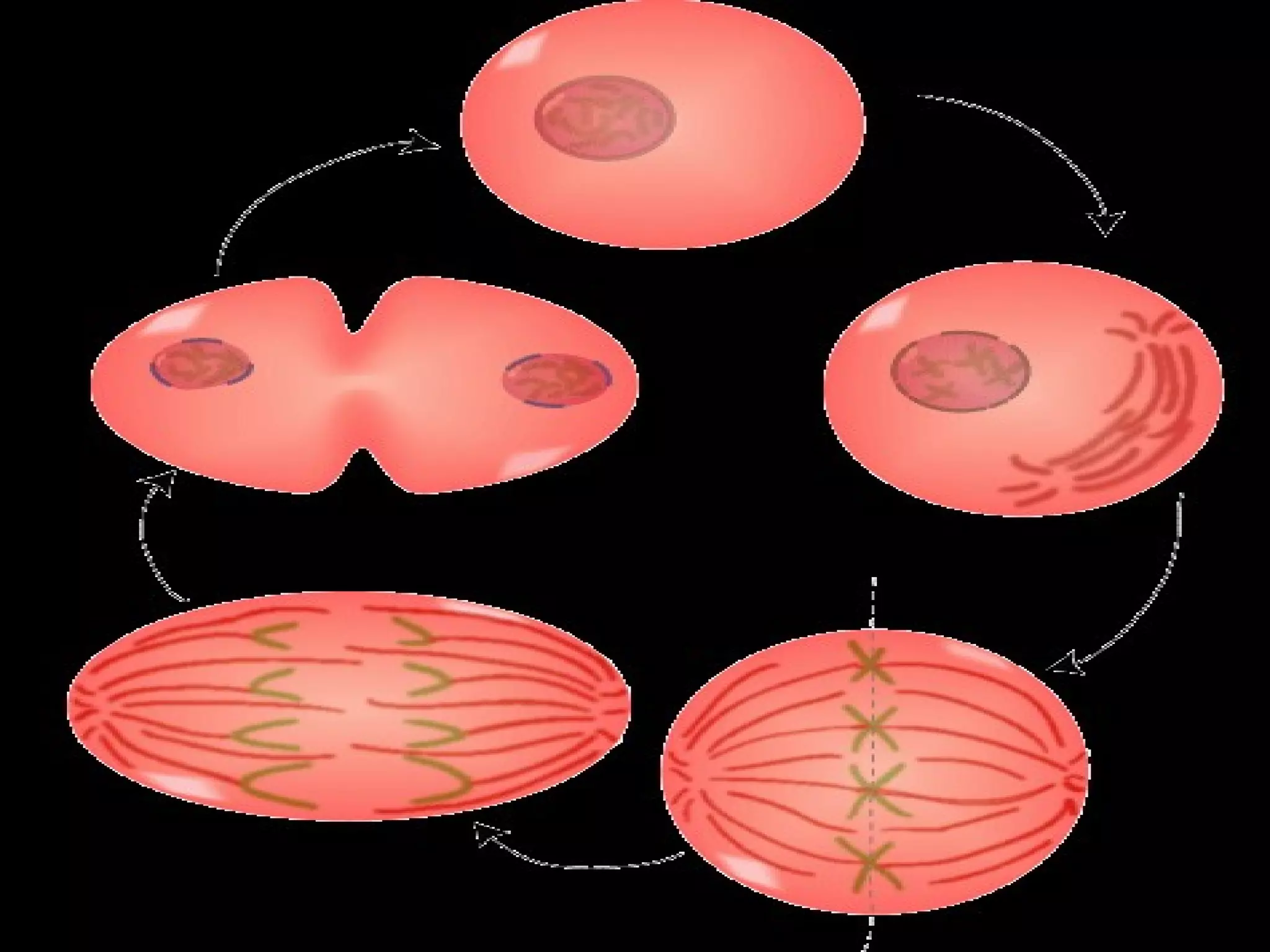
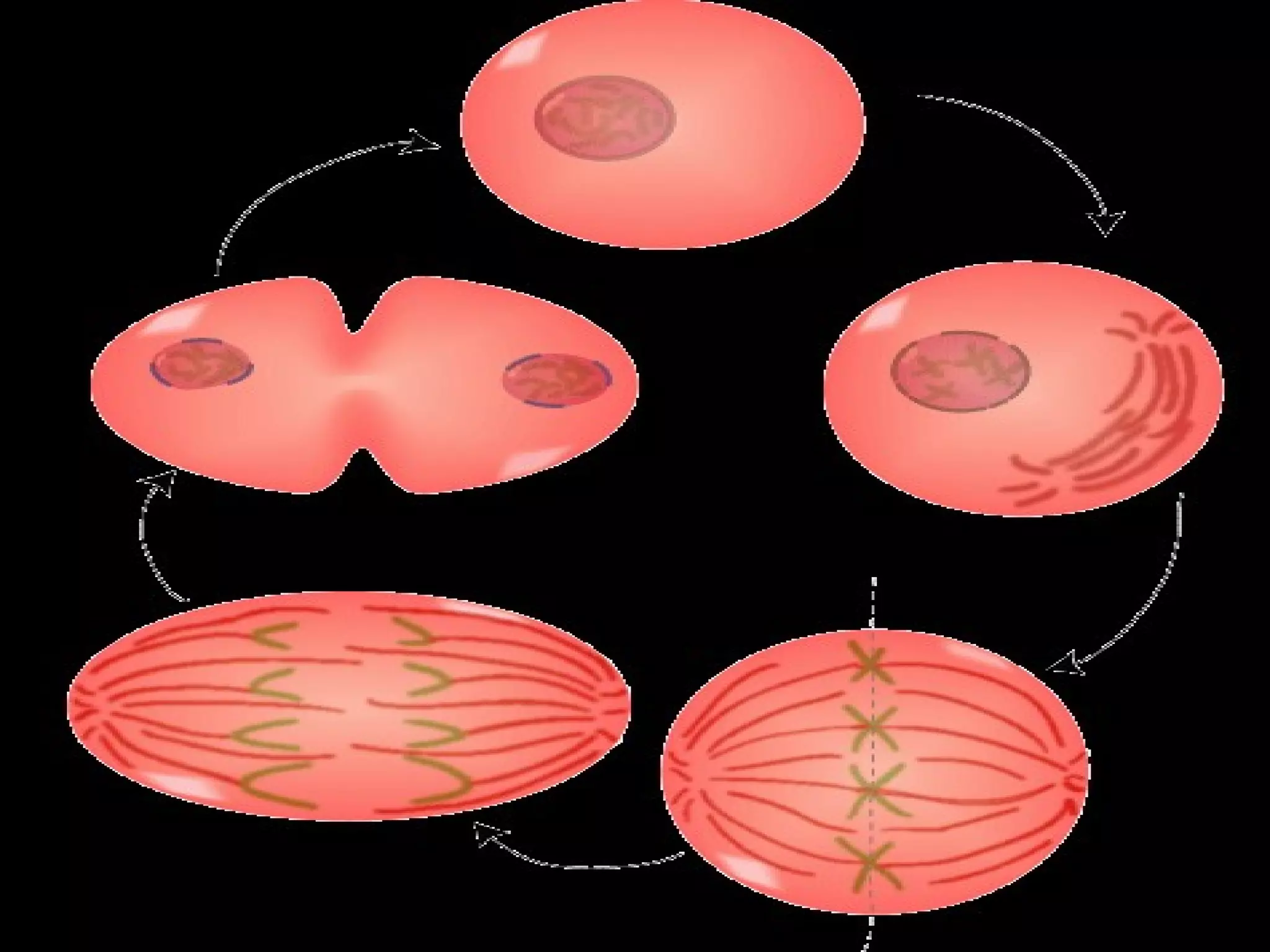
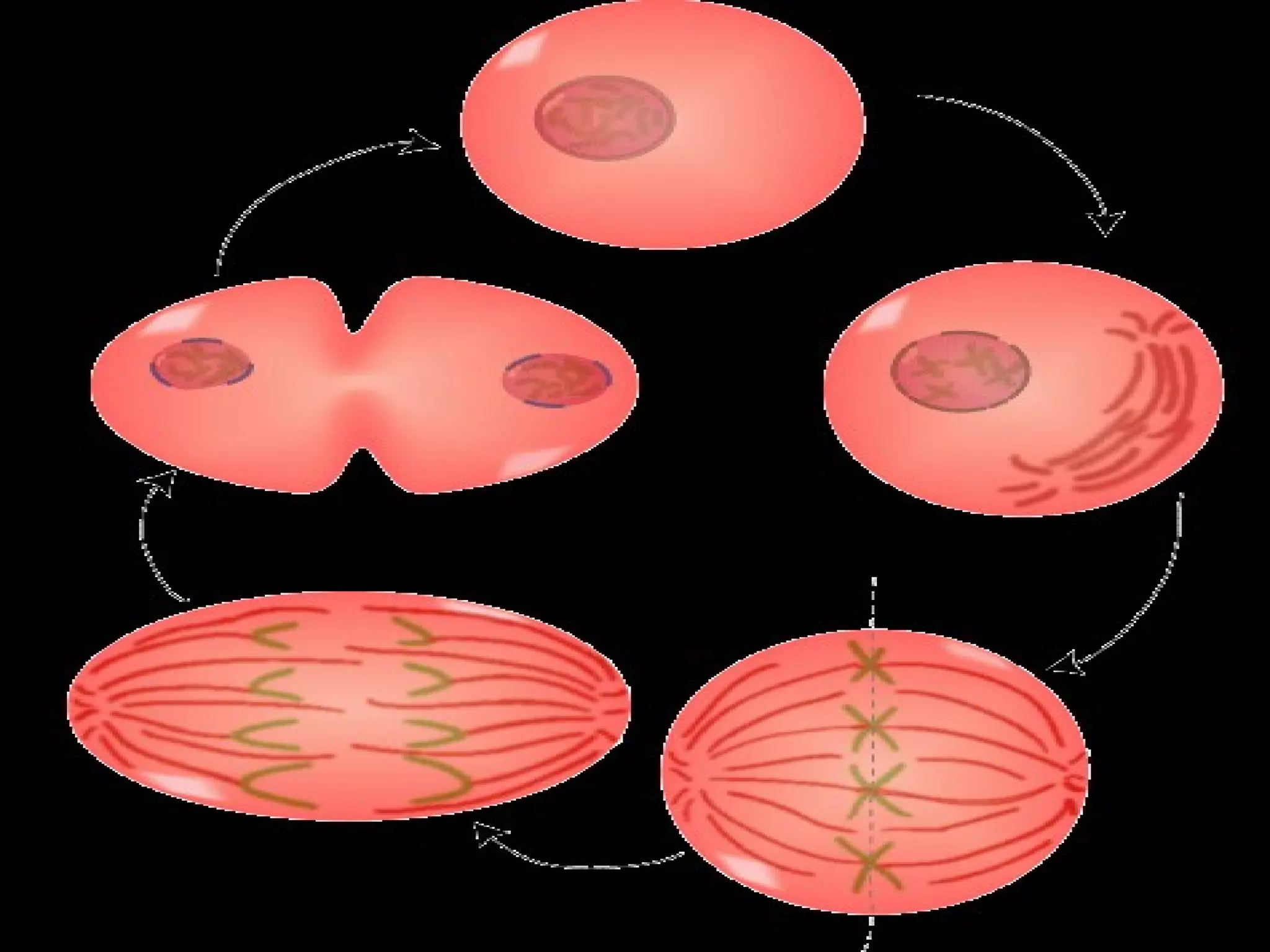
The Cell Cycle, cont. The M phase (Mitosis) is the process of nuclear division. There are 4 stages of Mitosis Prophase Metaphase Anaphase Telophase
The Cell Cycle, cont. Mitosis is the process of nuclear division Mitosis is also important because it allows tissues to repair themselves by producing new cells.
 
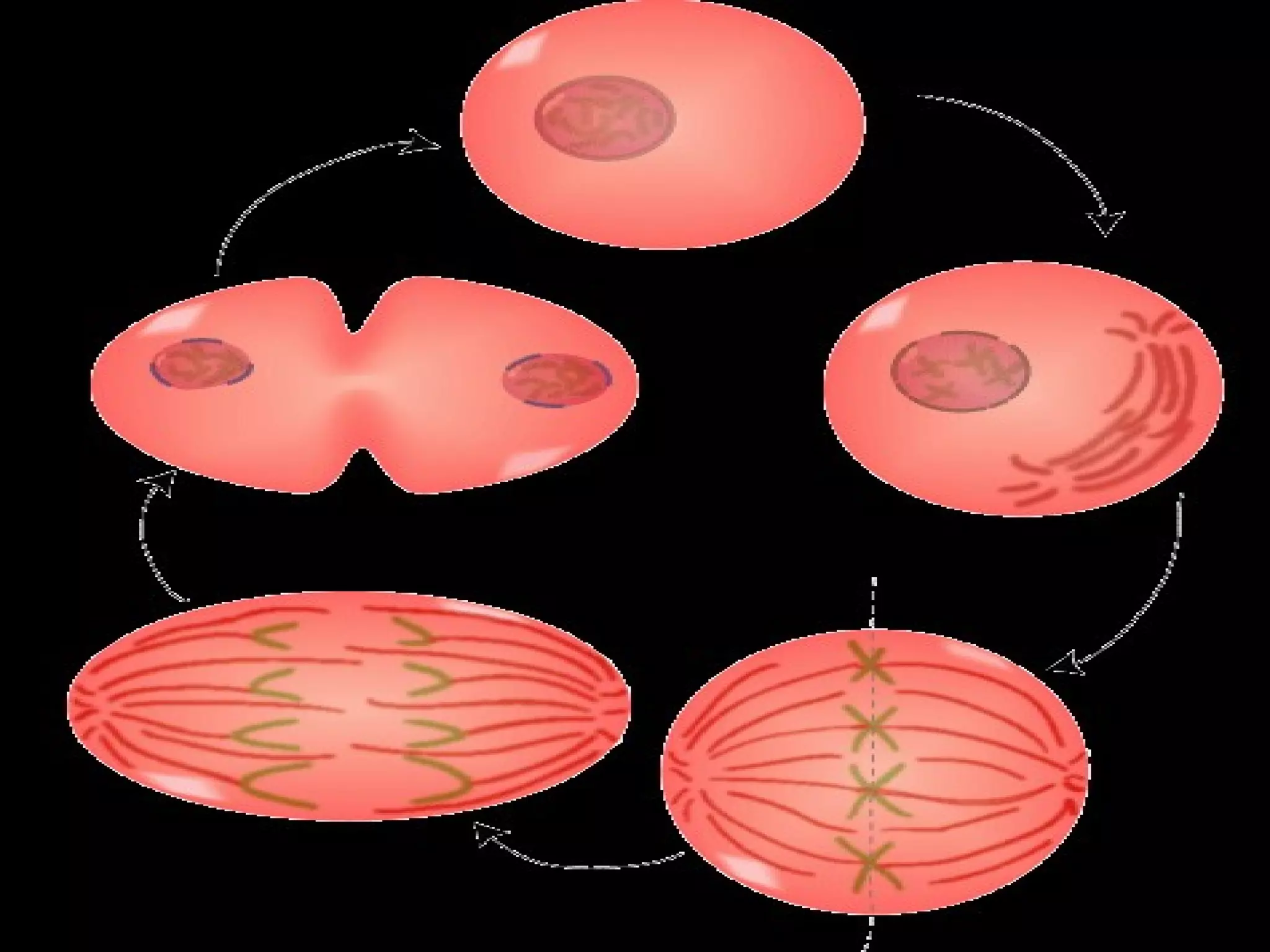
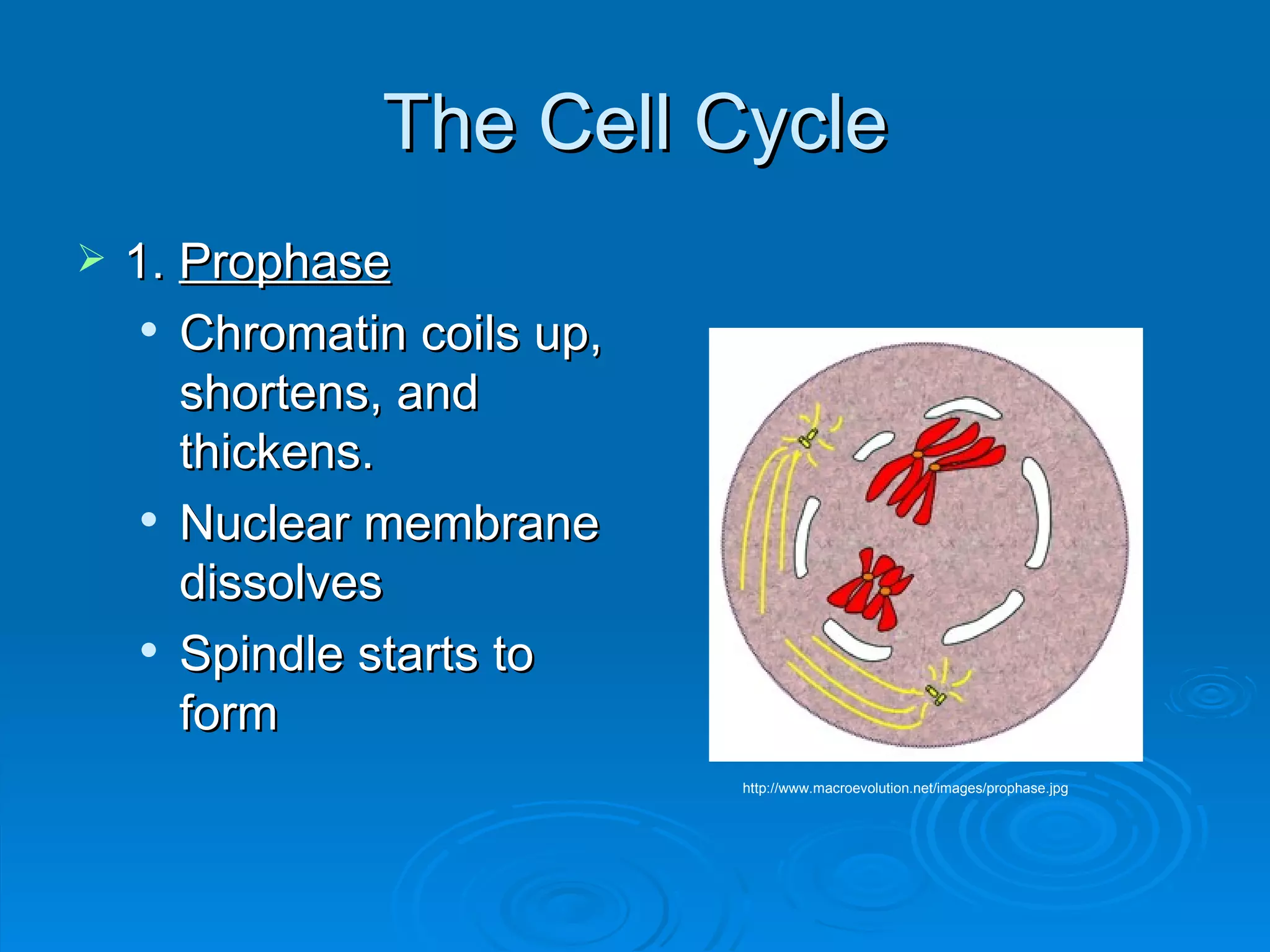
The Cell Cycle 1.  Prophase Chromatin coils up, shortens, and thickens. Nuclear membrane dissolves Spindle starts to form http://www.macroevolution.net/images/prophase.jpg
 
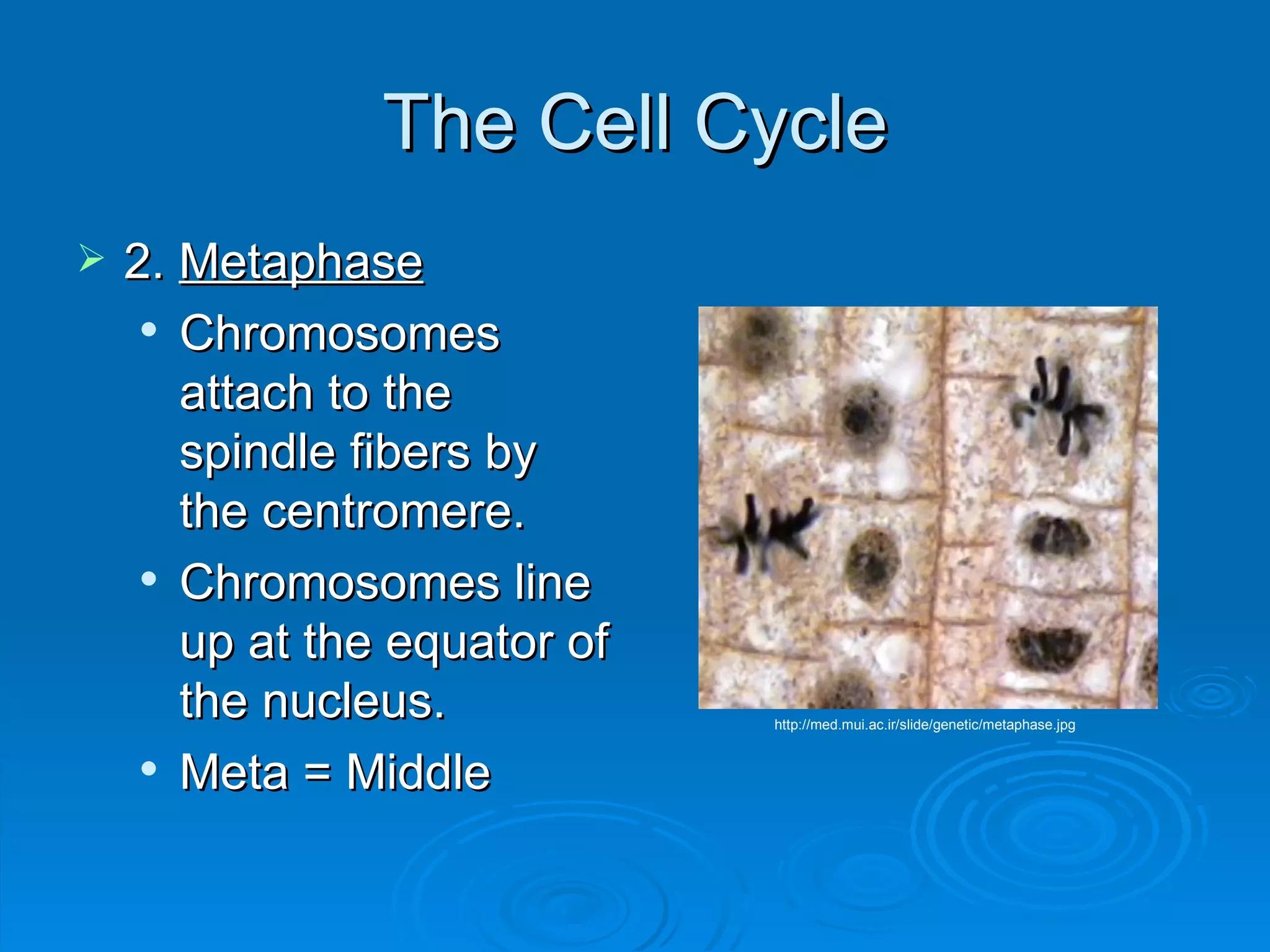
The Cell Cycle 2.  Metaphase Chromosomes attach to the spindle fibers by the centromere.  Chromosomes line up at the equator of the nucleus.  Meta = Middle http://med.mui.ac.ir/slide/genetic/metaphase.jpg
 
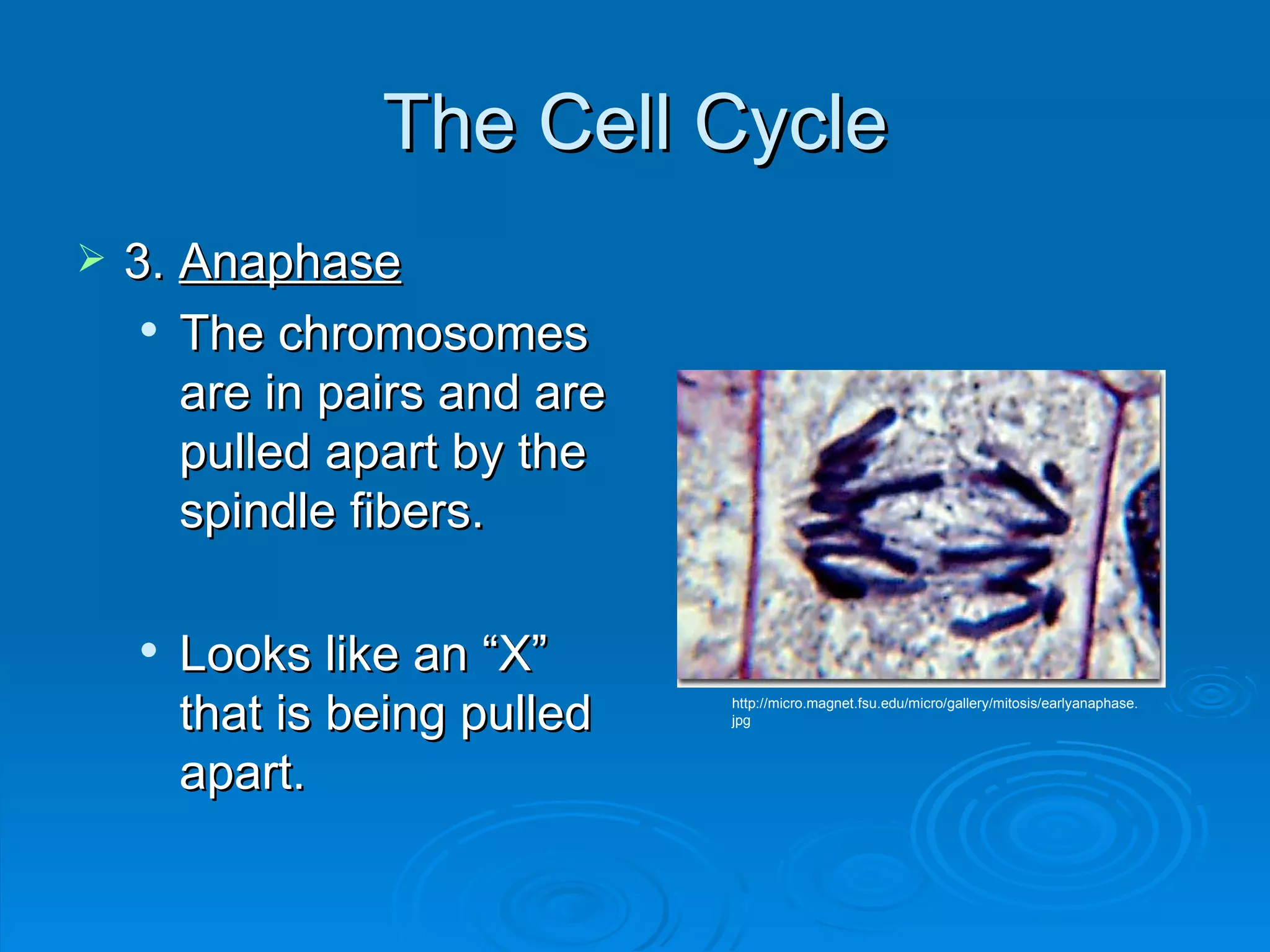
The Cell Cycle 3.  Anaphase The chromosomes are in pairs and are pulled apart by the spindle fibers. Looks like an “X” that is being pulled apart. http://micro.magnet.fsu.edu/micro/gallery/mitosis/earlyanaphase.jpg
 
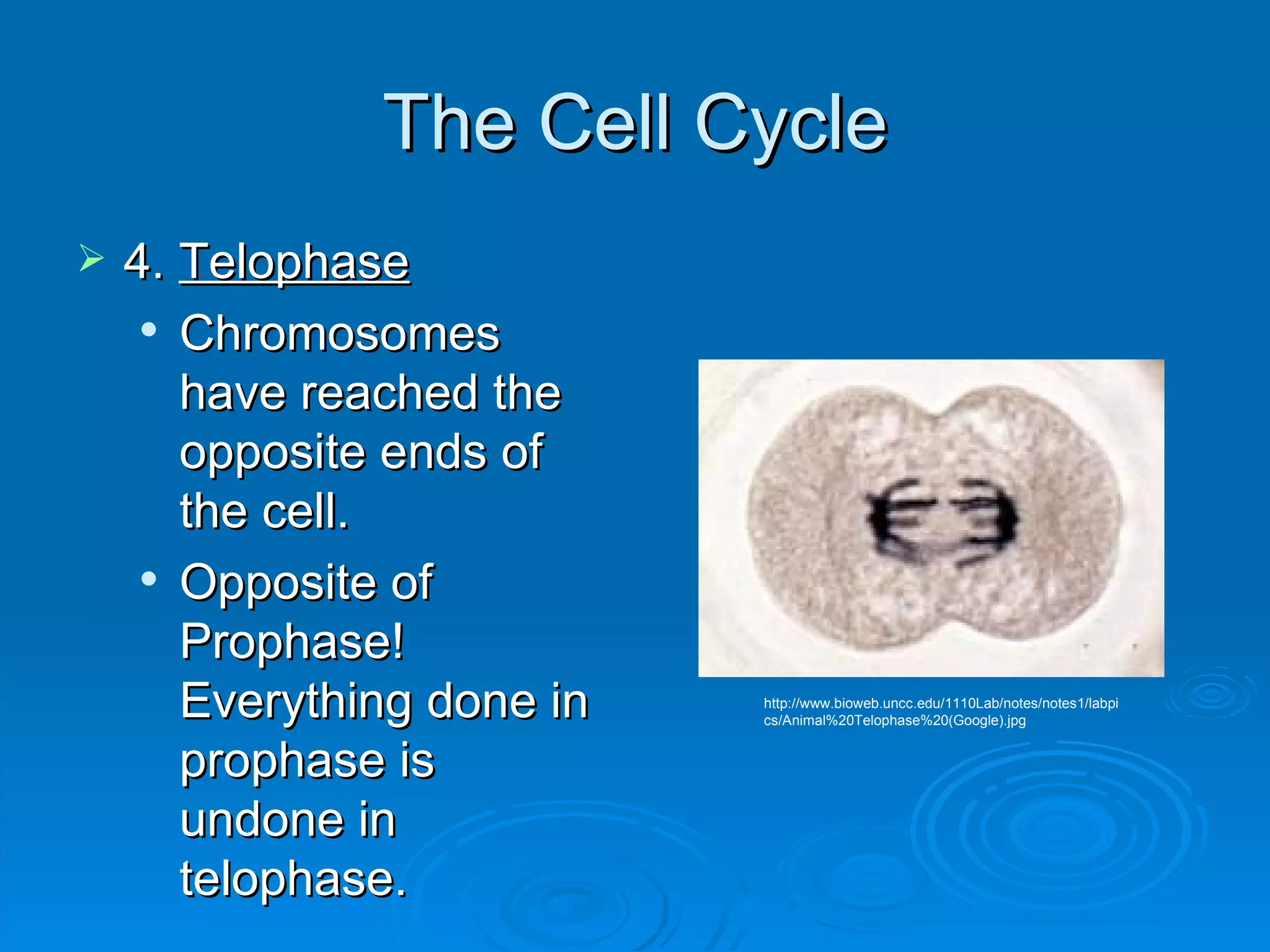
The Cell Cycle 4.  Telophase Chromosomes have reached the opposite ends of the cell. Opposite of Prophase! Everything done in prophase is undone in telophase. http://www.bioweb.uncc.edu/1110Lab/notes/notes1/labpics/Animal%20Telophase%20(Google).jpg
 
The Cell Cycle After telophase is finished, the cytoplasm is divided during the process of cytokinesis. Cyto- means “Cell”  -kinesis means “to cut” Interphase- G1- begins again at the end of cytokinesis
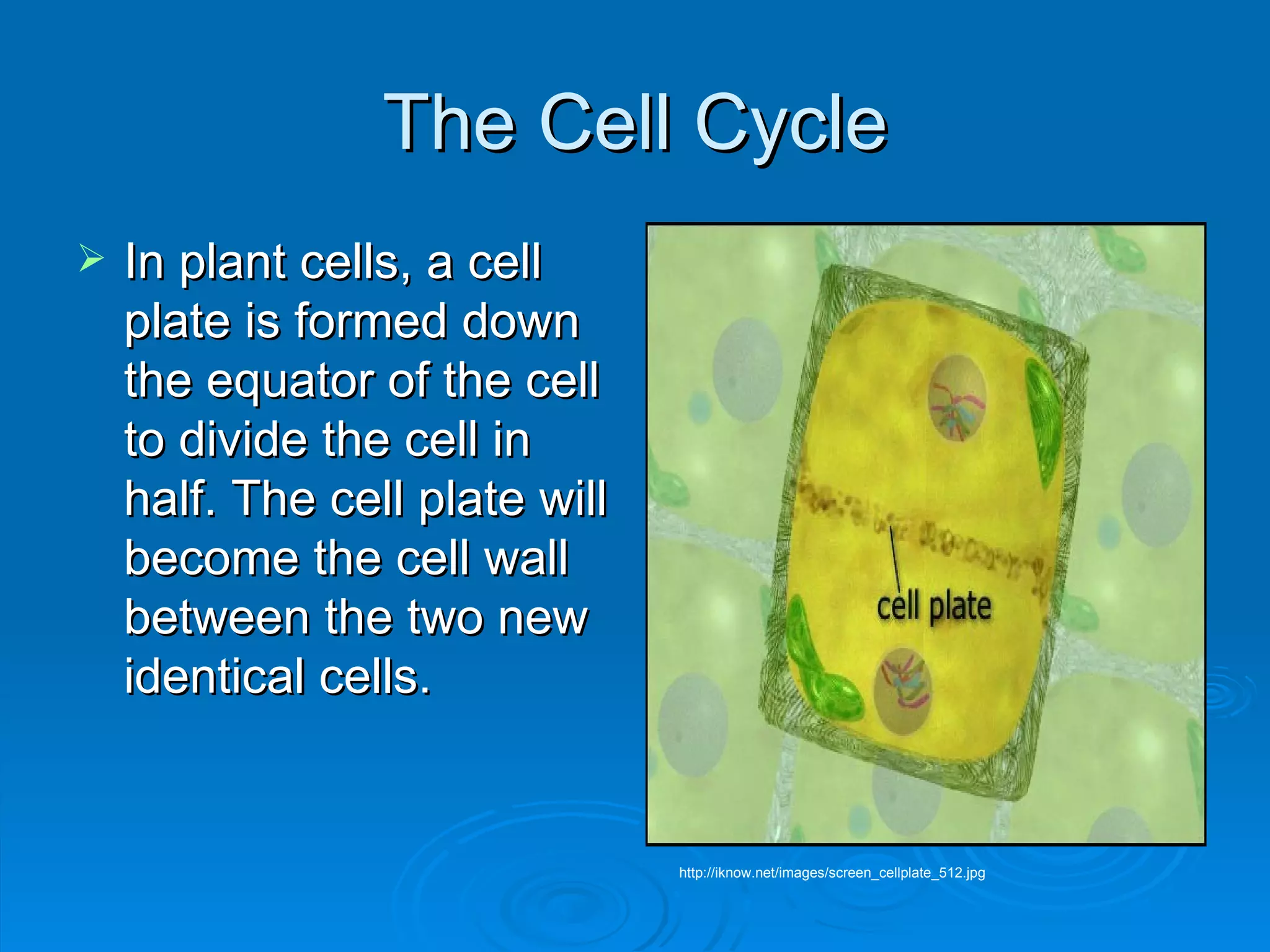
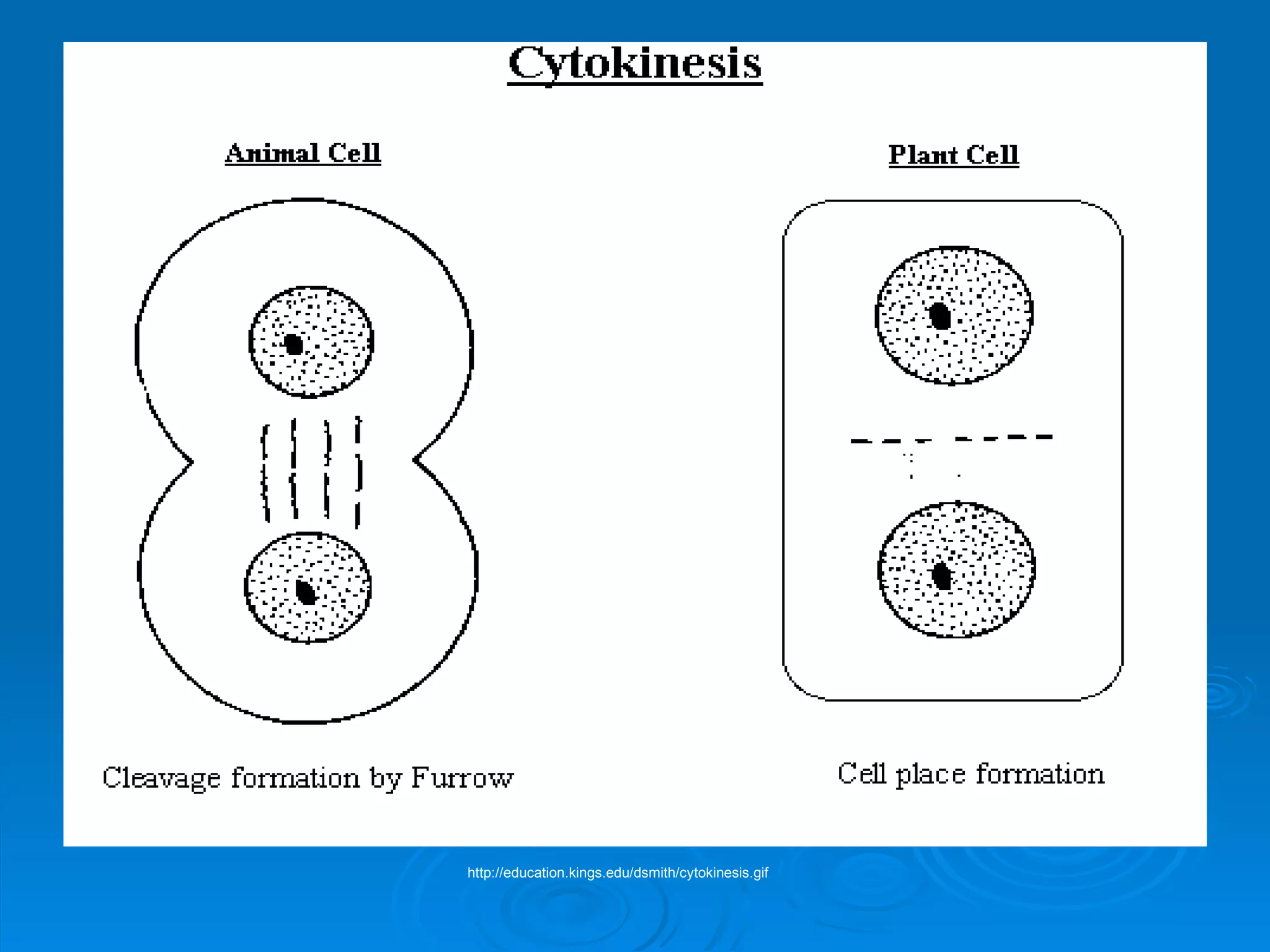
The Cell Cycle In plant cells, a cell plate is formed down the equator of the cell to divide the cell in half. The cell plate will become the cell wall between the two new identical cells. http://iknow.net/images/screen_cellplate_512.jpg
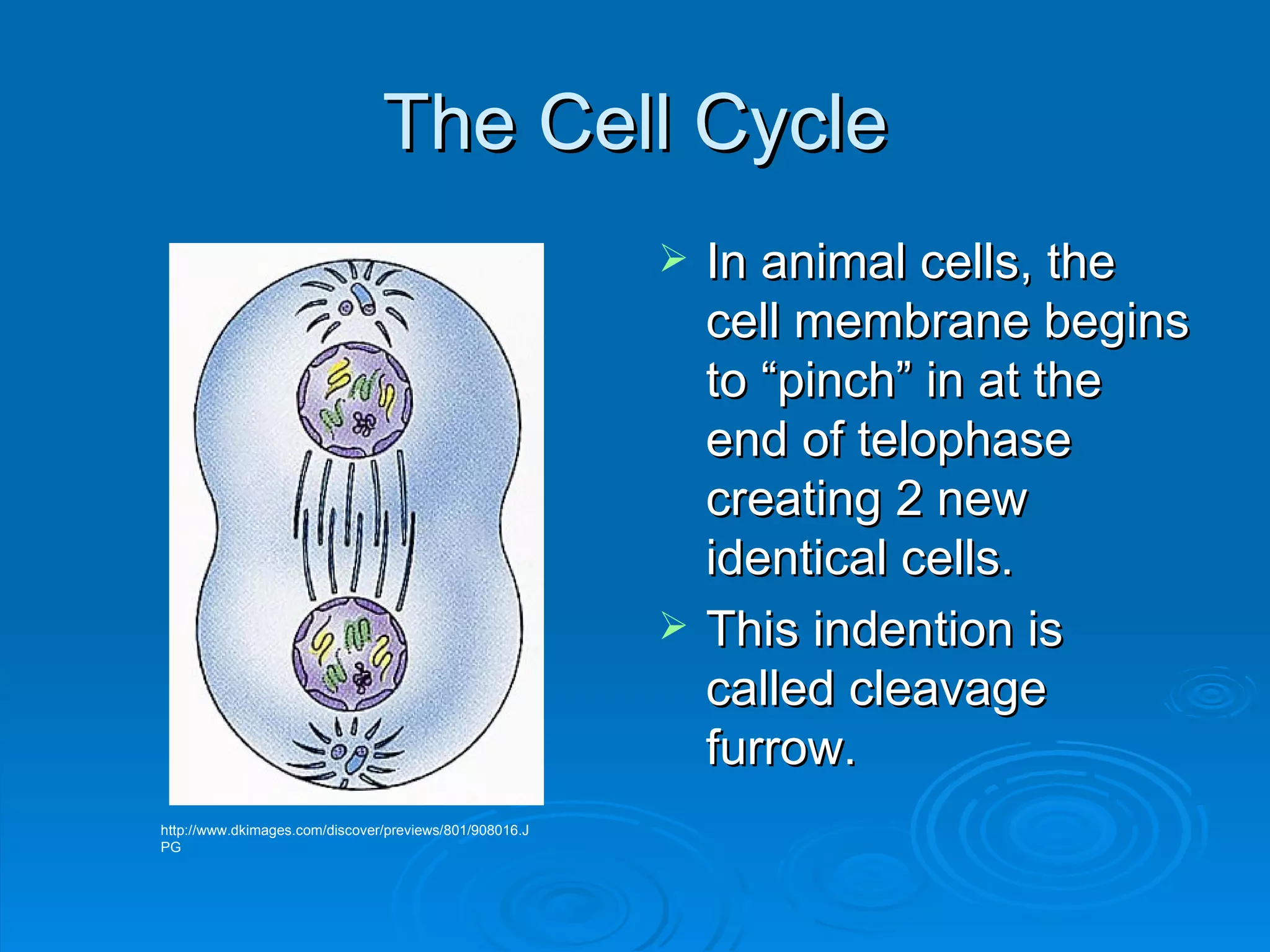
The Cell Cycle In animal cells, the cell membrane begins to “pinch” in at the end of telophase  creating 2 new identical cells. This indention is called cleavage furrow.  http://www.dkimages.com/discover/previews/801/908016.JPG
http://education.kings.edu/dsmith/cytokinesis.gif
Remember PMAT Prophase Metaphase Anaphase Telophase
Sexual Reproduction and Meiosis Organisms using sexual reproduction have 2 types of cells: 1.  Somatic Cells - Body Cells 2.  Gametes - Sex Cells **Sex Cells are reproduced by a process called MEIOSIS**
Sexual Reproduction and Meiosis When you see Meiosis you should think “Sex”.  Male cells (sperm cells) and Female cells (Egg cells) are used in the process of Meiosis.
Sexual Reproduction and Meiosis Male Cells (Sperm Cells) Sperm cells are produced in the testes and are released through the penis. Sperm begin reproduction at puberty and continue until death. It takes 72 hours for a cell to reach maturity. 400-500 million sperm are released each ejaculation.
Sexual Reproduction and Meiosis Male cells….(cont.) Sperm can build up over time and must be released. Some dribble out and are released during urination. Some may be reabsorbed into the body. Sperm require temperatures of about 5 degrees cooler than the body. That’s why the testes hang outside the body. A change in temp. will cause the testes to draw closer to the body for warmth or get really lose when it gets hot.
Sexual Reproduction and Meiosis Female sex cells are called eggs. Eggs are produced in the ovaries. Egg production begins at birth in females but the eggs are not released until the onset of menstruation. Egg production stops at menopause. Ovaries contain thousands of eggs. Only one egg is released each month in humans.
Sexual Reproduction and Meiosis Female sex cells….(cont.) Before ovulation (releasing an egg) the uterus swells with blood and become a nice thick pillow for the prospective baby. When fertilization does not take place, the lining of the uterus, the egg, and all the extra blood must be removed from the body. This takes place during the menstrual cycle.
Sexual Reproduction and Meiosis Chromosome Number The normal number of chromosomes an organism is supposed to have is referred to as diploid (2n). Haploid (n) is half the number of chromosomes. Sex cells are haploid and body cells are always diploid.
Sexual Reproduction and Meiosis Chromosome number (cont.) Chromosomes exist in pairs (homologous chromosomes. Humans have 23 pair of chromosomes which equals 46. The diploid number for humans body cells is 46.  The haploid number for human sex cells is 23. Eggs have 23 chromosomes Sperm cells have 23 chromosomes Skin cells have 46 chromosomes.
Sexual Reproduction and Meiosis Chromosome number…(cont.) Meiosis therefore produces haploid cells. Meiosis adds genetic variation. Chromosomes separate randomly and get “mixed up” therefore it adds variation to the way organisms look. For example, you and your siblings were made by the 2 same parents but are genetically different.
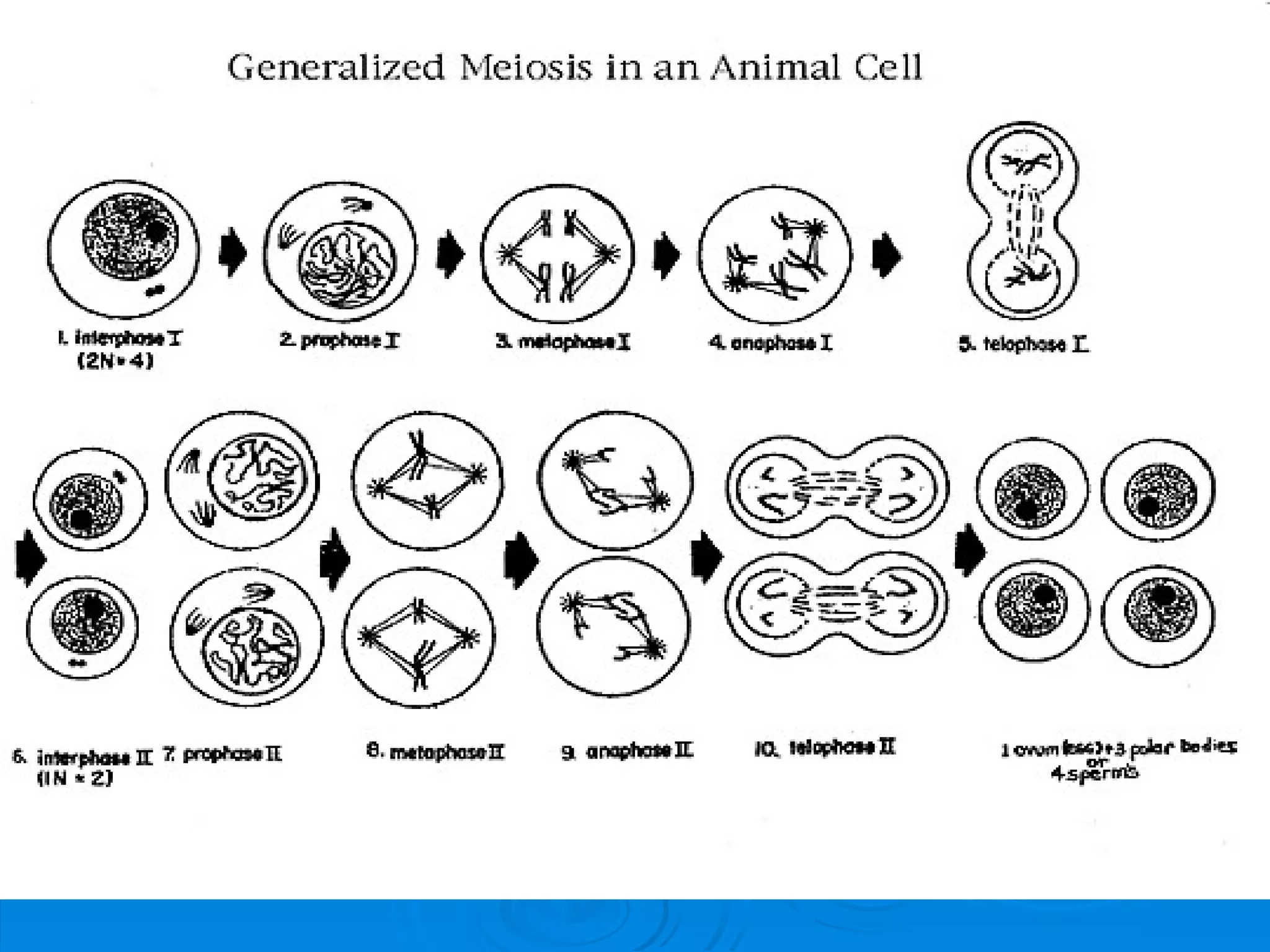
Stages of Meiosis Meiosis I It is very similar to Mitosis Meiosis I results in 2 identical cells The 4 stages of Meiosis I are: Prophase I Metaphase I Anaphase I Telophase I Meiosis II End product is 4 cells with half the number of chromosomes Stages of Meiosis II are: Prophase II Metaphase II Anaphase II Telophase II
 
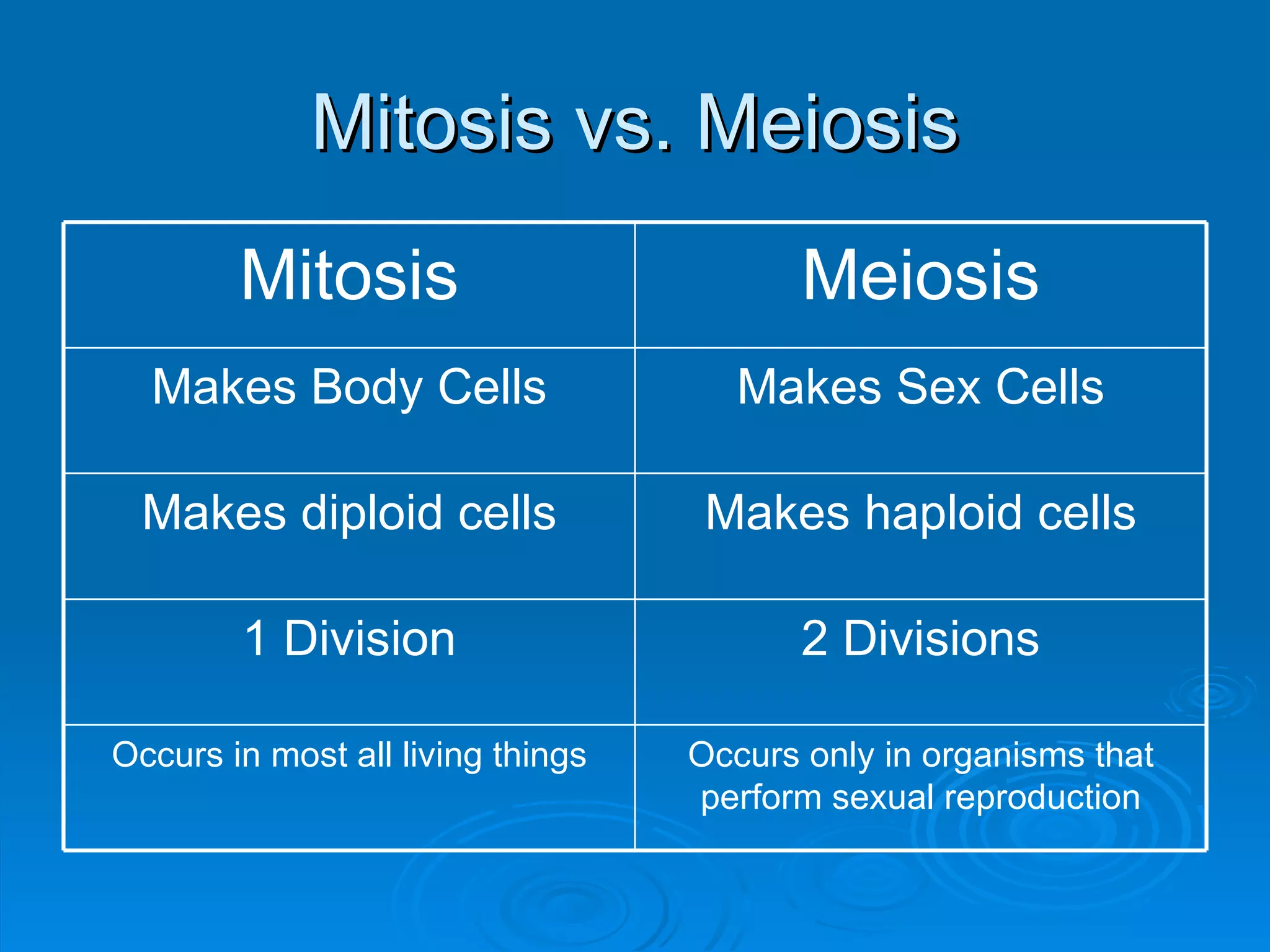
Mitosis vs. Meiosis Occurs only in organisms that perform sexual reproduction Occurs in most all living things 2 Divisions 1 Division Makes haploid cells Makes diploid cells Makes Sex Cells Makes Body Cells Meiosis Mitosis
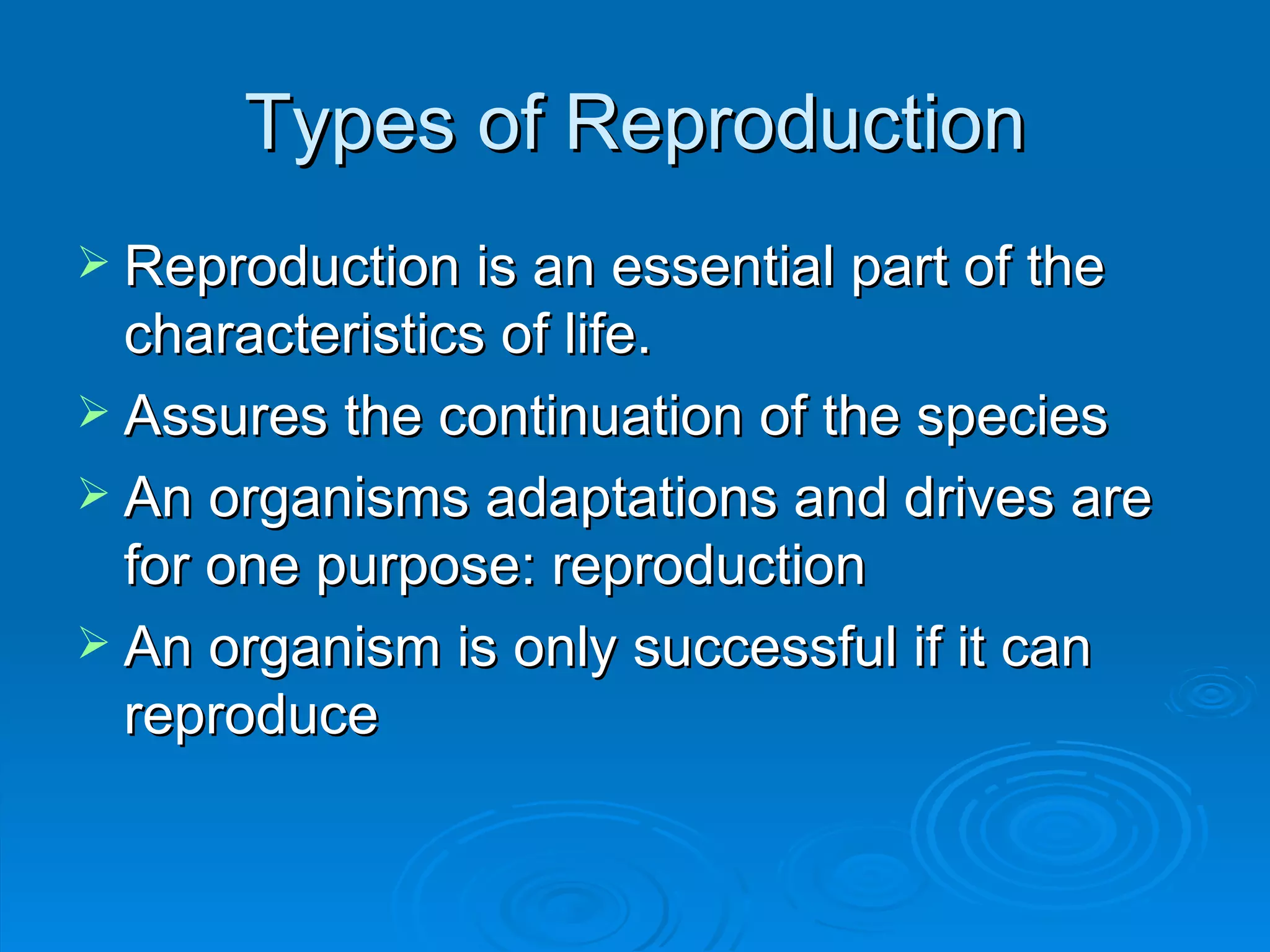
Types of Reproduction Reproduction is an essential part of the characteristics of life. Assures the continuation of the species An organisms adaptations and drives are for one purpose: reproduction An organism is only successful if it can reproduce
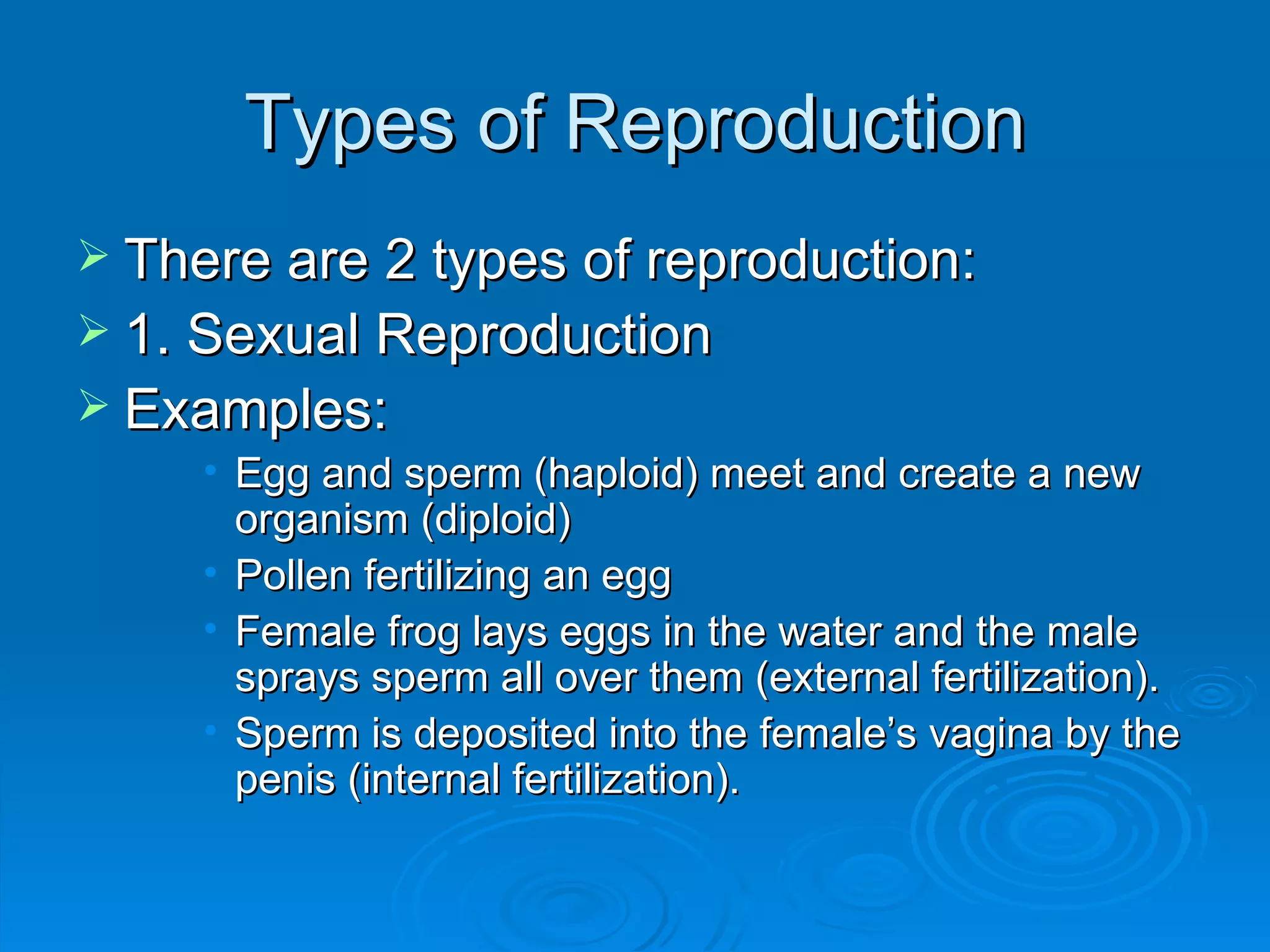
Types of Reproduction There are 2 types of reproduction: 1. Sexual Reproduction Examples: Egg and sperm (haploid) meet and create a new organism (diploid) Pollen fertilizing an egg Female frog lays eggs in the water and the male sprays sperm all over them (external fertilization). Sperm is deposited into the female’s vagina by the penis (internal fertilization).
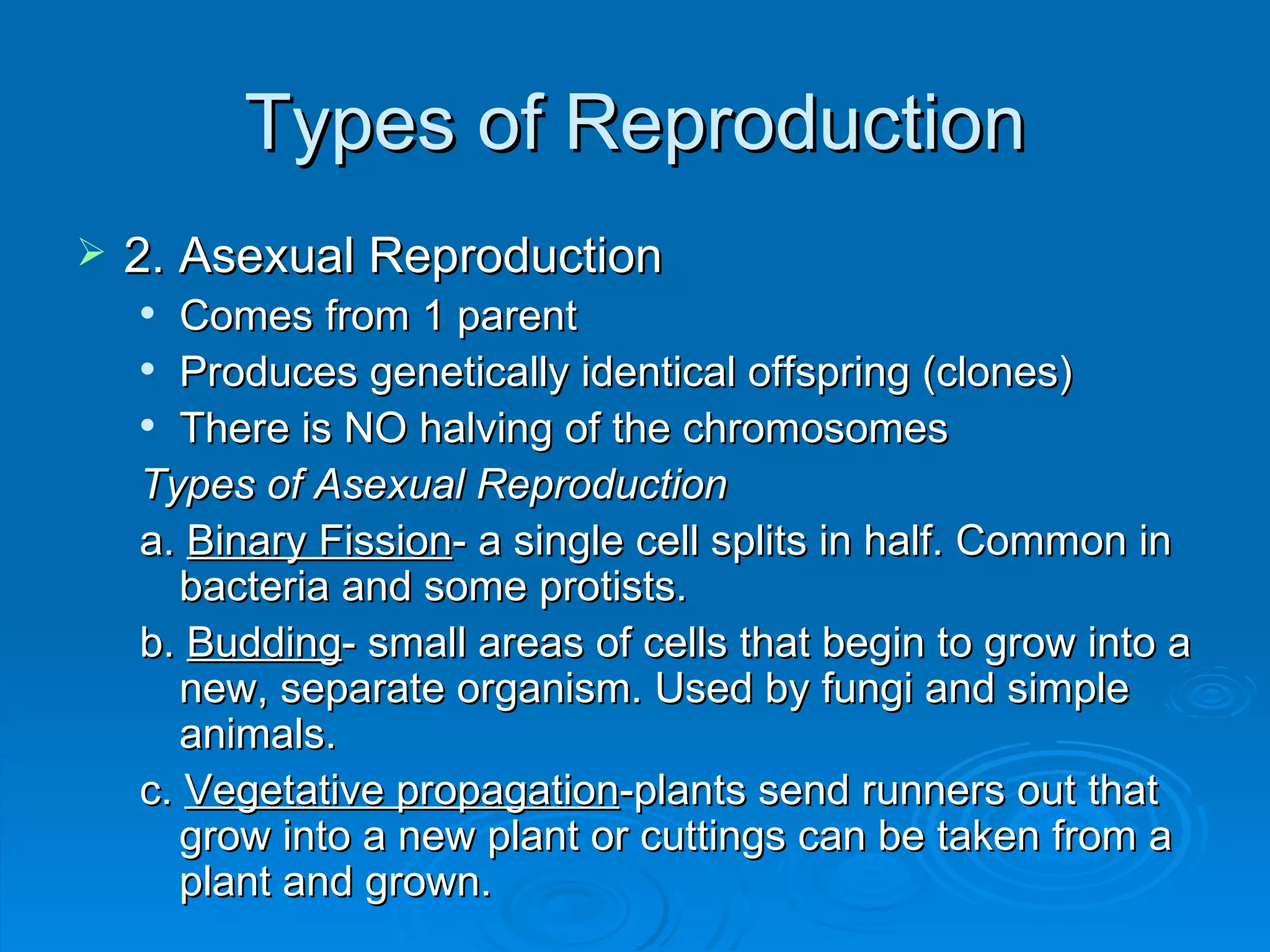
Types of Reproduction 2. Asexual Reproduction Comes from 1 parent Produces genetically identical offspring (clones) There is NO halving of the chromosomes Types of Asexual Reproduction a.  Binary Fission - a single cell splits in half. Common in bacteria and some protists. b.  Budding - small areas of cells that begin to grow into a new, separate organism. Used by fungi and simple animals. c.  Vegetative propagation -plants send runners out that grow into a new plant or cuttings can be taken from a plant and grown.

The Cell Cycle

  • 1.
    The Cell Cycleand Reproduction
  • 2.
    The Cell CycleLike all living things, cells must be able to grow and reproduce. This happens during the cell cycle. The cell cycle is divided into two parts: Cell Growth (Interphase) Cell Division (Mitosis)
  • 3.
  • 4.
    The Cell Cyclecont. The longest part of the cell cycle is called interphase. It is divided into 3 main parts: G1 stage - (1 st Growth stage)- the cell grows and develops; new proteins are made. S stage - (Synthesis stage)- the chromosomes replicate in the nucleus to form a new set of identical chromosomes G2 stage - The cell is getting ready to divide. RNA and proteins are made. Organelles are duplicated.
  • 5.
  • 6.
    The Cell Cycle,cont. The M phase (Mitosis) is the process of nuclear division. There are 4 stages of Mitosis Prophase Metaphase Anaphase Telophase
  • 7.
    The Cell Cycle,cont. Mitosis is the process of nuclear division Mitosis is also important because it allows tissues to repair themselves by producing new cells.
  • 8.
  • 9.
    The Cell Cycle1. Prophase Chromatin coils up, shortens, and thickens. Nuclear membrane dissolves Spindle starts to form http://www.macroevolution.net/images/prophase.jpg
  • 10.
  • 11.
    The Cell Cycle2. Metaphase Chromosomes attach to the spindle fibers by the centromere. Chromosomes line up at the equator of the nucleus. Meta = Middle http://med.mui.ac.ir/slide/genetic/metaphase.jpg
  • 12.
  • 13.
    The Cell Cycle3. Anaphase The chromosomes are in pairs and are pulled apart by the spindle fibers. Looks like an “X” that is being pulled apart. http://micro.magnet.fsu.edu/micro/gallery/mitosis/earlyanaphase.jpg
  • 14.
  • 15.
    The Cell Cycle4. Telophase Chromosomes have reached the opposite ends of the cell. Opposite of Prophase! Everything done in prophase is undone in telophase. http://www.bioweb.uncc.edu/1110Lab/notes/notes1/labpics/Animal%20Telophase%20(Google).jpg
  • 16.
  • 17.
    The Cell CycleAfter telophase is finished, the cytoplasm is divided during the process of cytokinesis. Cyto- means “Cell” -kinesis means “to cut” Interphase- G1- begins again at the end of cytokinesis
  • 18.
    The Cell CycleIn plant cells, a cell plate is formed down the equator of the cell to divide the cell in half. The cell plate will become the cell wall between the two new identical cells. http://iknow.net/images/screen_cellplate_512.jpg
  • 19.
    The Cell CycleIn animal cells, the cell membrane begins to “pinch” in at the end of telophase creating 2 new identical cells. This indention is called cleavage furrow. http://www.dkimages.com/discover/previews/801/908016.JPG
  • 20.
  • 21.
    Remember PMAT ProphaseMetaphase Anaphase Telophase
  • 22.
    Sexual Reproduction andMeiosis Organisms using sexual reproduction have 2 types of cells: 1. Somatic Cells - Body Cells 2. Gametes - Sex Cells **Sex Cells are reproduced by a process called MEIOSIS**
  • 23.
    Sexual Reproduction andMeiosis When you see Meiosis you should think “Sex”. Male cells (sperm cells) and Female cells (Egg cells) are used in the process of Meiosis.
  • 24.
    Sexual Reproduction andMeiosis Male Cells (Sperm Cells) Sperm cells are produced in the testes and are released through the penis. Sperm begin reproduction at puberty and continue until death. It takes 72 hours for a cell to reach maturity. 400-500 million sperm are released each ejaculation.
  • 25.
    Sexual Reproduction andMeiosis Male cells….(cont.) Sperm can build up over time and must be released. Some dribble out and are released during urination. Some may be reabsorbed into the body. Sperm require temperatures of about 5 degrees cooler than the body. That’s why the testes hang outside the body. A change in temp. will cause the testes to draw closer to the body for warmth or get really lose when it gets hot.
  • 26.
    Sexual Reproduction andMeiosis Female sex cells are called eggs. Eggs are produced in the ovaries. Egg production begins at birth in females but the eggs are not released until the onset of menstruation. Egg production stops at menopause. Ovaries contain thousands of eggs. Only one egg is released each month in humans.
  • 27.
    Sexual Reproduction andMeiosis Female sex cells….(cont.) Before ovulation (releasing an egg) the uterus swells with blood and become a nice thick pillow for the prospective baby. When fertilization does not take place, the lining of the uterus, the egg, and all the extra blood must be removed from the body. This takes place during the menstrual cycle.
  • 28.
    Sexual Reproduction andMeiosis Chromosome Number The normal number of chromosomes an organism is supposed to have is referred to as diploid (2n). Haploid (n) is half the number of chromosomes. Sex cells are haploid and body cells are always diploid.
  • 29.
    Sexual Reproduction andMeiosis Chromosome number (cont.) Chromosomes exist in pairs (homologous chromosomes. Humans have 23 pair of chromosomes which equals 46. The diploid number for humans body cells is 46. The haploid number for human sex cells is 23. Eggs have 23 chromosomes Sperm cells have 23 chromosomes Skin cells have 46 chromosomes.
  • 30.
    Sexual Reproduction andMeiosis Chromosome number…(cont.) Meiosis therefore produces haploid cells. Meiosis adds genetic variation. Chromosomes separate randomly and get “mixed up” therefore it adds variation to the way organisms look. For example, you and your siblings were made by the 2 same parents but are genetically different.
  • 31.
    Stages of MeiosisMeiosis I It is very similar to Mitosis Meiosis I results in 2 identical cells The 4 stages of Meiosis I are: Prophase I Metaphase I Anaphase I Telophase I Meiosis II End product is 4 cells with half the number of chromosomes Stages of Meiosis II are: Prophase II Metaphase II Anaphase II Telophase II
  • 32.
  • 33.
    Mitosis vs. MeiosisOccurs only in organisms that perform sexual reproduction Occurs in most all living things 2 Divisions 1 Division Makes haploid cells Makes diploid cells Makes Sex Cells Makes Body Cells Meiosis Mitosis
  • 34.
    Types of ReproductionReproduction is an essential part of the characteristics of life. Assures the continuation of the species An organisms adaptations and drives are for one purpose: reproduction An organism is only successful if it can reproduce
  • 35.
    Types of ReproductionThere are 2 types of reproduction: 1. Sexual Reproduction Examples: Egg and sperm (haploid) meet and create a new organism (diploid) Pollen fertilizing an egg Female frog lays eggs in the water and the male sprays sperm all over them (external fertilization). Sperm is deposited into the female’s vagina by the penis (internal fertilization).
  • 36.
    Types of Reproduction2. Asexual Reproduction Comes from 1 parent Produces genetically identical offspring (clones) There is NO halving of the chromosomes Types of Asexual Reproduction a. Binary Fission - a single cell splits in half. Common in bacteria and some protists. b. Budding - small areas of cells that begin to grow into a new, separate organism. Used by fungi and simple animals. c. Vegetative propagation -plants send runners out that grow into a new plant or cuttings can be taken from a plant and grown.